•
•
Do I Need a Website to Obtain a CySEC Licence?
No single rule requires it. There is no CySEC rule that says "you must have a live website before submitting your CIF application."
But in practice, a website is a structural part of how CySEC, your banking partners, your liquidity provider and your payment processor evaluate your business.
CySEC publishes a List of Approved Domains for every regulated CIF. Your domain becomes part of the public regulatory record. This means domain registration, site architecture and compliance page planning should happen during the licensing process — not after.
The real question is not whether you need a website, but what kind of website you need at each stage. For the full picture of what belongs on the site, see the broker website compliance checklist.
This article is for informational purposes only and does not constitute legal or compliance advice. Requirements may change as CySEC updates its framework. Consult qualified legal professionals for guidance specific to your application. WSA builds websites — we do not provide licence applications or legal counsel.
What CySEC Actually Expects Regarding Your Website
CySEC does not publish a single document titled "website requirements for CIF applicants." Instead, the website obligations are distributed across multiple regulatory layers:
MiFID II requires CIFs to provide clients with clear information about products, costs, risks and the firm itself. Most of this information is expected to be accessible on the firm's website.
ESMA intervention measures mandate firm-specific CFD loss percentage warnings — a standardised risk disclosure that must be prominently displayed on the website.
CySEC's own supervisory practice includes maintaining the Approved Domains register and, as recently as April 2025, issuing Circular C703 — reminding regulated entities that their websites must be "fair, clear, non-misleading" and kept up to date with key investor documentation.
ICF (Investor Compensation Fund) rules require disclosure of client compensation coverage, currently up to €20,000 per retail investor.
None of these obligations are optional. And the only practical place to fulfil most of them is the website. The specific disclosures CySEC expects are listed in CySEC website requirements for forex brokers.
When Should You Build It? A Practical Timeline
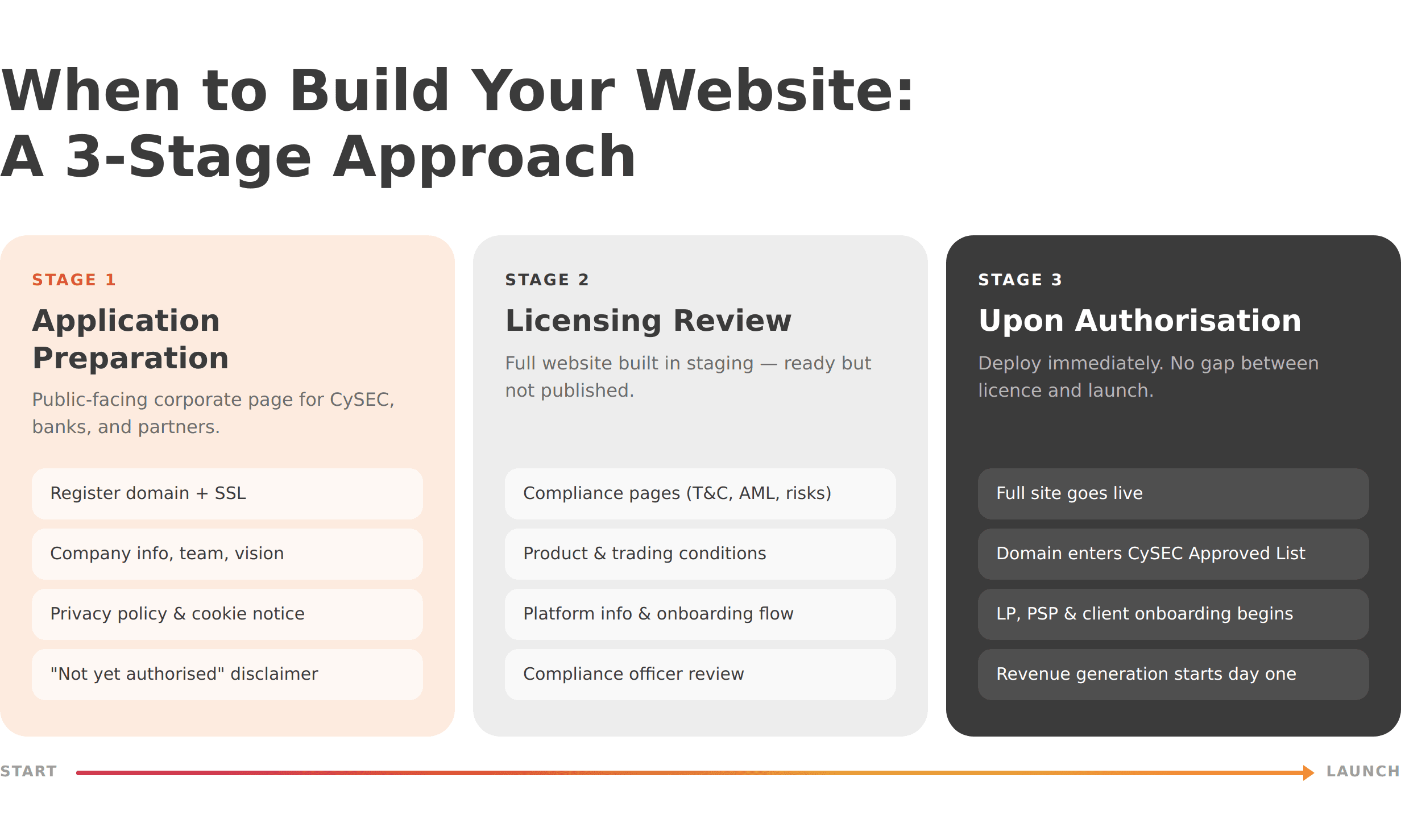
Timing is where most founders get it wrong. They either build too early (publishing trading conditions before approval) or too late (scrambling to create pages after the licence comes through, delaying the actual launch by weeks).
Here is a practical staging approach:
Stage 1: During application preparation
Register your domain. Set up hosting and SSL. Build a corporate-style page: company information, team, vision, contact details. Include a privacy policy and cookie notice. Clearly state that the company is not yet authorised to provide investment services. This is the page your lawyers, banking partners and CySEC case officer will see first.
Stage 2: During the licensing review period
In parallel, prepare the full website in a staging environment: compliance pages (risk disclosure, T&C, AML/KYC, complaints), product pages, trading conditions, platform information, onboarding flow. Everything is ready but not published. Your compliance officer reviews all content before it goes live.
Stage 3: Upon authorisation
Deploy the full website immediately. Your domain enters the CySEC Approved Domains list. Liquidity provider onboarding, payment processor integration and client acquisition can begin without delay. No weeks lost building pages after the fact.
Why this matters commercially: Every week between licence approval and website launch is a week of paying office rent, staff salaries and licence fees in Cyprus — without generating any revenue. A website that is ready to deploy on day one can save a new CIF tens of thousands of euros in wasted runway.
Starting the CySEC licensing process?
We build licensing-ready broker websites in two stages — a compliant corporate presence for the application period, and a full trading website ready to deploy on authorisation day.
What You Can Publish Before Approval — and What You Cannot
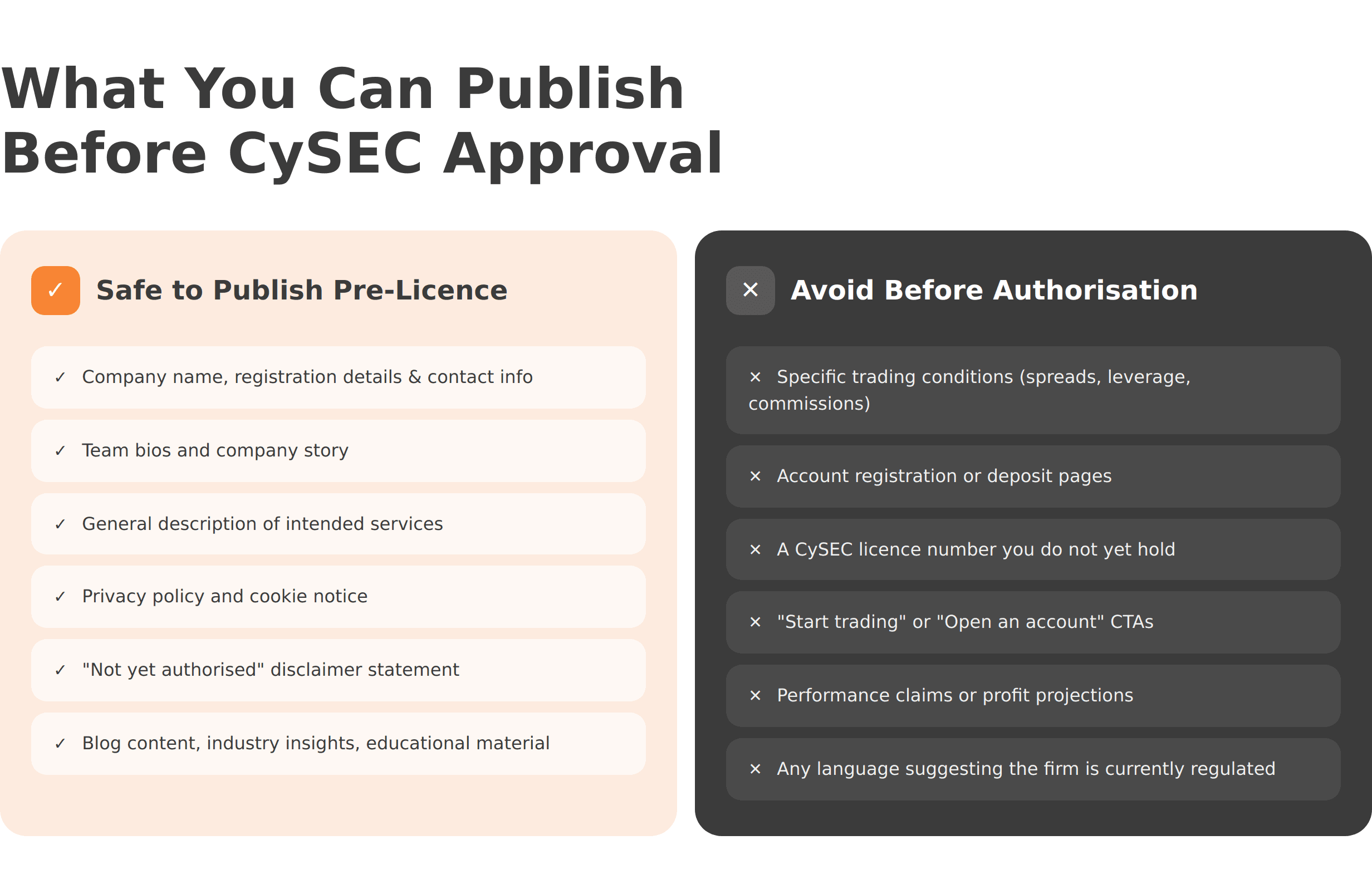
This is the part that makes founders nervous. The line between "corporate presence" and "soliciting clients" is important, and crossing it prematurely creates real risk.
Safe to publish pre-licence
— Company name, registration details and contact information
— Team bios and company story
— General description of intended services
— Privacy policy and cookie notice
— A clear statement: "Not yet authorised to provide investment services"
— Blog content, industry insights, educational material
Avoid pre-licence
— Specific trading conditions (spreads, leverage, commissions)
— Account registration or deposit pages
— A CySEC licence number you do not yet hold
— "Start trading" or "Open an account" calls to action
— Performance claims or profit projections
— Any language suggesting the firm is currently regulated
The principle is straightforward: a pre-licence website should demonstrate that a serious, well-organised company is preparing to enter the market. It should not look or function like a live brokerage.
Landing Page vs Full Website: What Is the Minimum?
Some founders ask whether a single landing page is sufficient during the licensing period. The answer depends on what you mean by "sufficient."
For the CySEC application itself: a corporate landing page with basic company information may not create a regulatory problem, as long as it does not solicit clients or misrepresent the firm's status.
For everything that happens alongside the application: a landing page is not enough. Banking partners evaluating your company want to see a credible web presence. Liquidity providers reviewing your operational readiness expect a structured site. Payment processors check for legal pages, contact information and security indicators.
For your own launch timeline: if all you have at the moment of authorisation is a landing page, your go-to-market is delayed by however long it takes to build everything else. This is the most expensive scenario — because you are paying for a CIF that cannot yet operate.
WSA approach: We build broker websites in two stages. Stage one is a compliant corporate presence for the application period. Stage two — product pages, compliance pages, onboarding flows, platform integration — is built in parallel on a staging server. When the licence comes through, we deploy. No gap between authorisation and launch.
For a detailed comparison of these two approaches, see our article on fintech landing page vs full brokerage website.
What Happens If You Launch Without a Proper Website
Some brokers receive their CIF authorisation and go live with a minimal or hastily assembled website, planning to "fix it later." Here is what typically follows:
LP onboarding stalls. Liquidity providers review your website as part of due diligence. Missing risk disclosures, inconsistent entity information or absent legal pages raise compliance flags. The onboarding process, which normally takes 2–4 weeks, can stretch to months.
Payment processors decline. PSPs have their own compliance thresholds. A website without a visible complaints procedure, clear refund policy or proper SSL certificate may be rejected outright — leaving you with no way to accept client deposits.
Banking partners ask questions. The bank holding your segregated client accounts monitors your public-facing presence. A website that contradicts your CySEC filings or lacks mandatory disclosures triggers reviews that can result in account restrictions.
CySEC notices. The regulator conducts proactive website reviews. If your site does not meet the standards outlined in MiFID II and CySEC circulars, you may receive a supervisory inquiry — a distraction no newly licensed broker wants during its first months of operation.
Clients do not convert. Beyond compliance, a weak website simply does not work commercially. Experienced traders check regulatory credentials, read fee disclosures and compare broker websites before opening accounts. If your site looks incomplete or unprofessional, they move to a competitor.
Frequently Asked Questions
Can I apply for a CySEC CIF licence without a website?
No single rule requires it. CySEC has no published requirement for a live trading website before you submit a CIF application. In practice the site matters earlier than most applicants expect, because CySEC evaluates operational readiness as part of the review and your domain will eventually be listed on the public Approved Domains register. What you publish before authorisation therefore has to match what you filed. A site that solicits clients or implies the firm is already regulated creates a problem rather than an advantage. Beyond the regulator, banking partners, liquidity providers and payment processors all review the public site during their own onboarding, and their standards are usually stricter because they carry the commercial risk rather than the supervisory one.
What is the CySEC Approved Domains list?
It is a public register on the CySEC website that maps every authorised Cyprus Investment Firm to its official website domain or domains. CySEC also publishes a separate list of non-approved domains, which exists to help clients identify firms falsely claiming Cypriot authorisation. The practical consequence for an applicant is that your domain becomes part of the regulatory record, not just a marketing asset. Any domain you intend to operate under, including regional variants and platform subdomains, has to be declared and approved. Changing or adding domains after authorisation is a notification process rather than a free decision, so the architecture is worth settling before you apply rather than after you have started building brand around a name.
When should I register my domain if I am applying for a CIF licence?
Early in the application process, before the website design begins. Your domain architecture, meaning the primary site, any regional variants and any platform subdomains, should be planned before authorisation rather than added afterwards, because each domain you operate under has to be declared to CySEC and appears on the public Approved Domains register. Registering late creates two problems. The first is practical: the name you want may be gone by the time you need it. The second is regulatory: adding a domain after authorisation is a notification process, so an unplanned addition costs time you may not have during a launch. Register the primary domain and any obvious variants at the same time you incorporate the entity.
Can I use a landing page instead of a full website during the application?
Yes, during the application period, provided it is carefully scoped. A corporate landing page is generally acceptable as long as it does not solicit clients and does not imply the firm is already regulated. It can introduce the company, give contact details and describe the intended business, but it should not advertise account types, leverage, spreads or anything that reads as a financial promotion for a regulated product. The limitation comes from elsewhere. Banking partners, liquidity providers and payment processors typically want to see more than a placeholder before they will onboard you, and their reviews often happen in parallel with the licence application. Plan for a fuller site by the time those conversations start.
What pages are mandatory on a CySEC broker website?
At minimum: a risk disclosure carrying the firm-specific CFD loss percentage, terms and conditions, an AML and KYC policy, a privacy policy, a complaints procedure, client categorisation information, and the correct display of the legal entity, licence number and registered address. Cookie consent handling sits alongside these as a page-level obligation under GDPR. Two details matter as much as the list itself. The loss percentage has to be calculated from your own client data and updated at least annually, which means it needs to live in an editable field rather than a hardcoded design element. And the risk warning has to be prominent, so shrinking it to protect the visual hierarchy creates a compliance problem rather than a design improvement.
How long does it take to build a CySEC-compliant broker website?
A properly structured broker website — including compliance pages, product pages, platform integration and onboarding flows — typically takes 6 to 10 weeks to build. Starting during the licensing review period means the site is ready to launch the moment authorisation is granted.
What happens if my website does not meet CySEC standards after authorisation?
CySEC conducts proactive website reviews. Non-compliant content — missing risk warnings, misleading claims, inconsistent entity details — can result in supervisory inquiries, requests for corrective action, or in serious cases, fines. Beyond CySEC, liquidity providers and payment processors may pause or suspend their services if your website falls below compliance thresholds.
Launch Your Licensed Brokerage with Confidence
We support brokers and fintechs through licensing, launch planning, and everything a regulated brand needs to go live.