•
•

Fintech Website Development Company Checklist: 12 Things to Verify
A broker owner signs with an agency whose portfolio looks perfect. Clean typography, confident case studies, a payments client or two. Eight weeks later the site is beautiful and the compliance officer will not approve it. The risk warning sits in 11px grey at the bottom of the page. Nobody wrote the legal pages, because nobody agreed who would. The hosting is under the agency's account.
None of that was a design failure. It was a scoping failure, and it was visible in the first call if anyone had known what to ask.
This fintech website development company checklist is built for that first call. Twelve questions, each one something you can verify rather than take on trust. It assumes you are running vendor selection yourself, possibly mid-licence, and that broker website requirements are new territory for you.
Key Takeaways
Vendor selection in regulated finance fails on compliance scope, ownership terms and timeline fit, almost never on design quality.
In the UK, a public website promoting a financial product is a financial promotion and falls under the regulator's rules. Comparable expectations apply in most other jurisdictions.
The FCA Handbook sets rules that constrain design directly, including a requirement that risk warnings use a font size at least equal to the predominant font size used in the material.
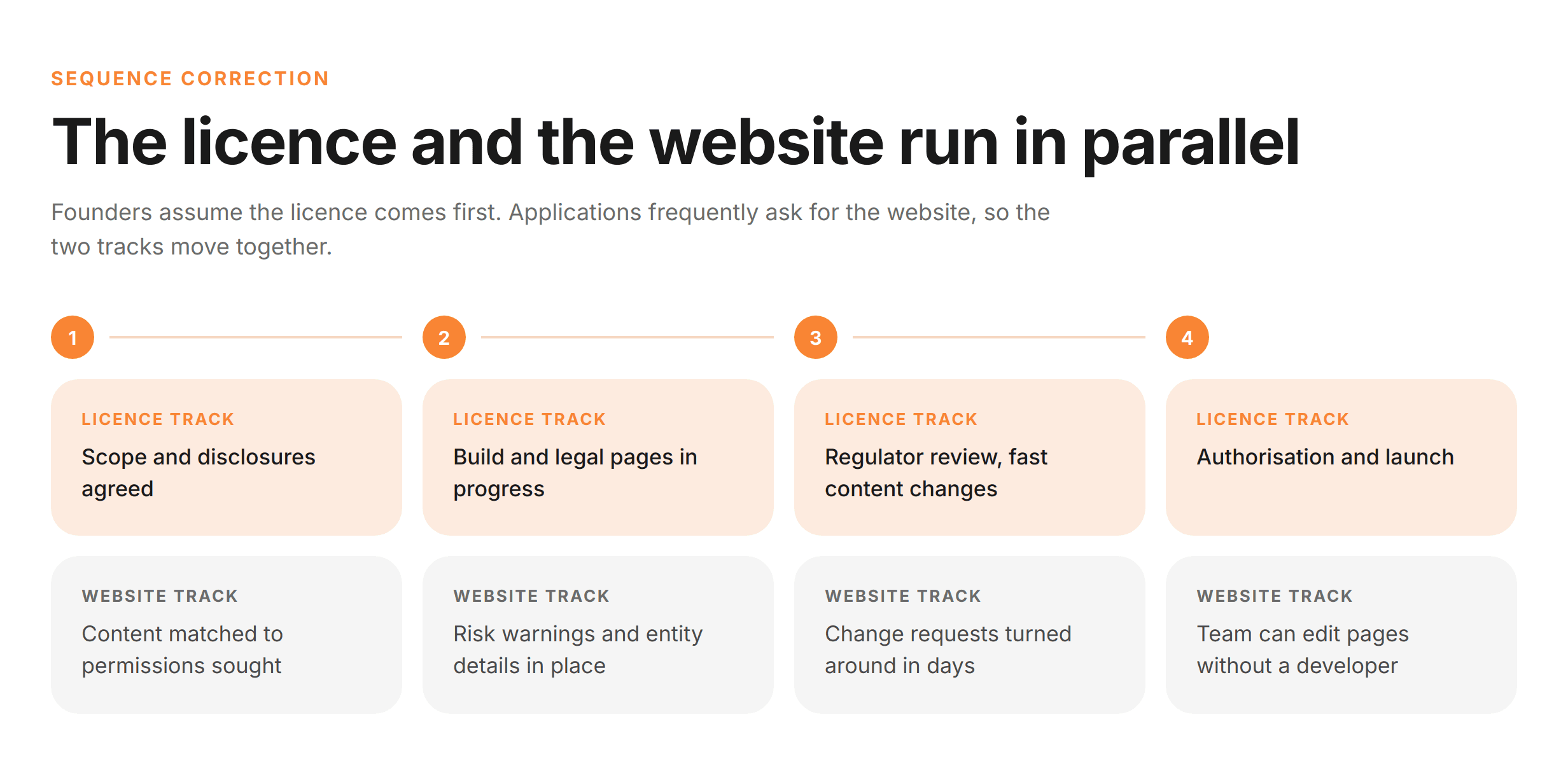
Website readiness and the licence application run in parallel, not in sequence. An agency that cannot work to an application deadline puts the application at risk.
A portfolio of payments-app work does not qualify a vendor for a brokerage build. Different integrations, different disclosures, different supervisor.
If you have no regulated product live yet and need a pre-licence brand page, a generalist agency is a reasonable and cheaper choice. Say so honestly and skip the rest of this list.
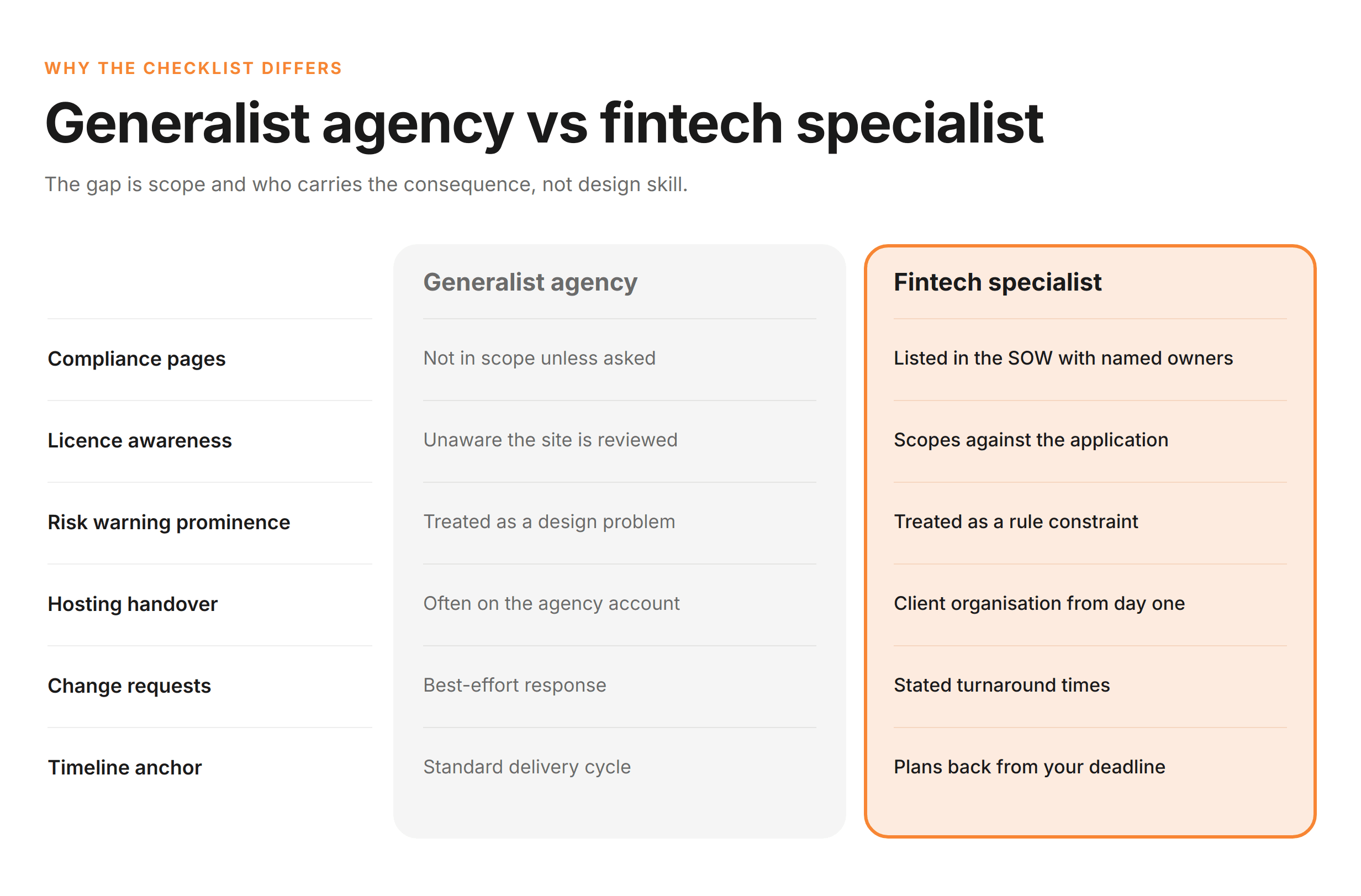
Why a Generalist Web Agency Checklist Does Not Work for Fintech
Unlike a standard corporate site, a regulated financial website carries obligations that outlive the project. It has to disclose specific things, in specific ways, in places a supervisor can find them. It touches KYC and AML flows even when the vendor is not building them, because onboarding entry points sit on the marketing site. Consent and data collection fall under GDPR at the page level, not just inside the product.
The difference between a generalist and a specialist fintech web development agency is not skill. It is scope, and who carries the consequences when scope is wrong.
What Changes When Money and Licences Are Involved
Your website stops being marketing collateral and becomes a document other people read professionally. A supervisor reads it during authorisation. A payment provider reads it during onboarding. A banking partner reads it before opening an account.
Each one is checking whether what the site claims matches what the firm is licensed to do. That is what regulated fintech website compliance actually means at the page level.
Financial services web design also inherits standards the design team may never have met. PCI DSS governs how card data is handled if payment flows touch your infrastructure at all. That is a scoping conversation, not a footnote.
The Cost of Finding Out After the Contract Is Signed
The expensive failure is rework after a compliance review, when the build is finished and the calendar is not flexible. Rewriting copy is cheap. Rebuilding an onboarding flow, adding six legal pages that were never in scope, and re-doing the visual hierarchy so a disclaimer can be legible is not.
In practice, the clients who arrive at WSA mid-rebuild usually did not skip diligence. They ran a normal agency selection process and asked normal agency questions. The gap was that a fintech website development company needs to be assessed on a different axis, and nobody had told them which one.
Building a brokerage site under a live application?
Scope errors found during a compliance review cost weeks you may not have. We scope compliance deliverables before design starts.
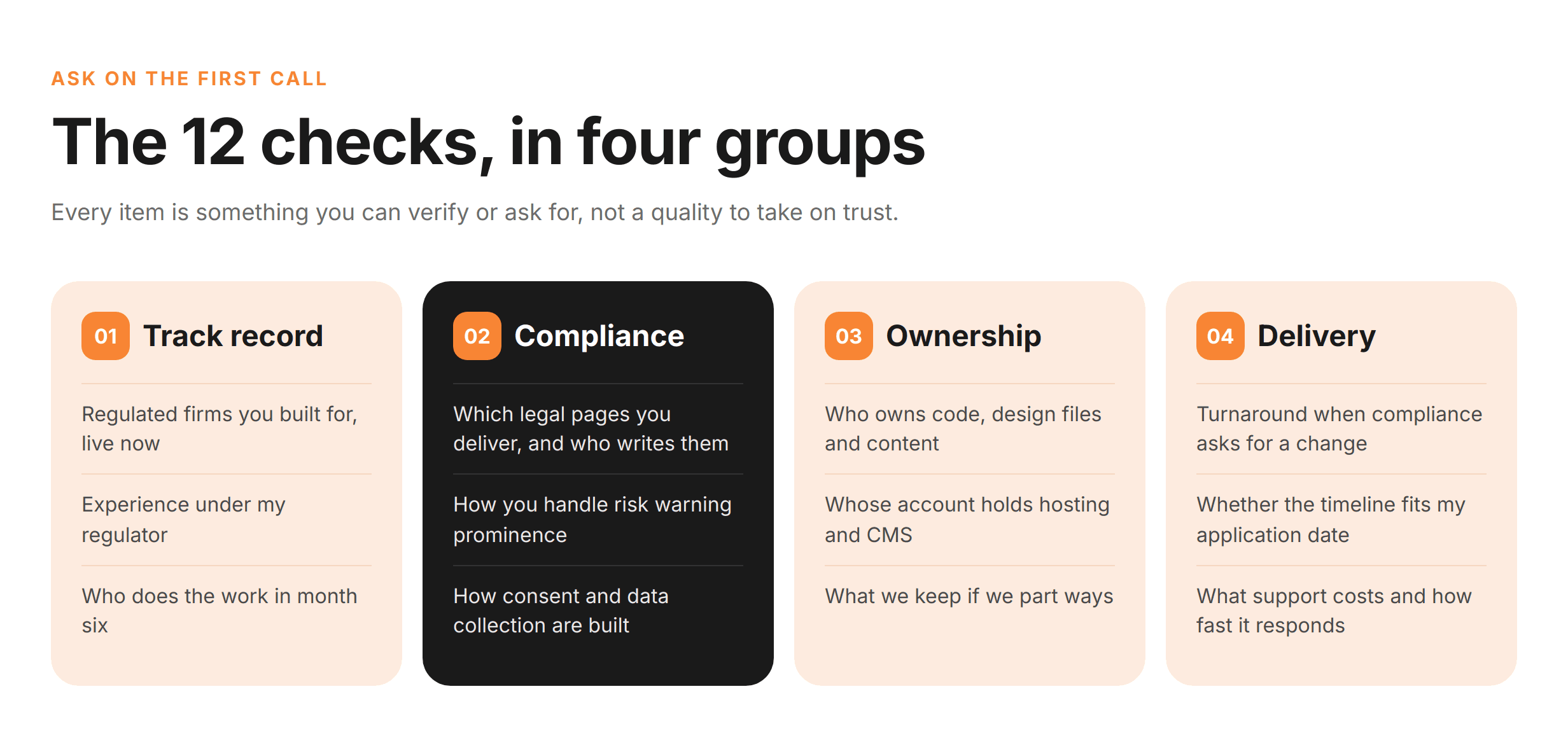
The 12-Point Fintech Website Development Company Checklist
Ask all twelve on the first or second call, before a proposal exists. A good vendor answers most of them without needing to check. This is not a fintech website launch checklist for the build itself; it is a set of questions about the firm you are about to hire.
1. Which regulated financial firms have you built for, and are those sites live now?
You want URLs you can open, not screenshots. A live, licensed firm is verifiable; a case study is not.
2. Have you worked with a firm under my regulator, or in my jurisdiction?
Different authorities expect different disclosures. A vendor with no experience in your jurisdiction is not disqualified, but they should say so plainly rather than imply coverage they lack.
3. Who will actually do this work, and will those people still be on it in month six?
Ask for names and roles. Agencies win work with seniors and staff it with juniors, and in regulated builds the cost of that swap shows up in the details.
4. Which compliance pages do you deliver, and who writes the copy?
Terms, privacy policy, risk disclosure, complaints procedure, AML statement. The common failure is silence: the agency assumes your lawyer writes them, your lawyer assumes the agency does, and launch arrives with placeholders live.
5. How do you handle risk warnings and disclaimer prominence?
This is the single most revealing question on the list. A vendor who has built in regulated finance will talk about prominence, font size and placement as design constraints. A vendor who has not will describe how they would make disclaimers unobtrusive.
6. How do you implement cookie consent and data collection?
Consent handling is website-level work, and it is yours whether or not the product has its own flows. Ask what tool they use, whether consent is logged as GDPR requires, and what happens to analytics before opt-in.
7. What happens when the regulator or the compliance officer asks for a change?
Regulated sites get change requests with deadlines attached. Ask for turnaround times in writing, not a promise of responsiveness.
8. Who owns the code, the design files and the content on delivery?
Get it in writing before development starts. Some agencies build on proprietary components and retain rights to parts of what you paid for.
9. Whose account holds the hosting, the domain and the CMS?
It should be yours, with the agency holding access. The reverse arrangement is common, and it hands the agency bargaining power in any dispute.
10. If we part ways, what do we keep and what stops working?
The honest answer names something. A vendor who says nothing breaks has not thought about it, or is not telling you about a dependency.
11. What is the launch timeline, and can it fit a specific application deadline?
Give them your real date. Watch whether they plan backwards from it or restate their standard cycle.
12. What does post-launch support cover, at what response time, and at what cost?
Maintenance is where regulated sites live or rot. A site that cannot be updated quickly is a compliance liability the day the rules change.
Track Record: Regulated Clients, Not Just Financial-Looking Design
Verify the portfolio by opening it. A forex broker website developer with real experience can point you to licensed firms whose sites are live, and can tell you which parts they built.
Fintech experience is not one thing. A vendor with a strong record integrating Stripe or Plaid has built consumer payments products, and that is genuine work.
It is not the same as a brokerage build with trading widgets, tiered account levels and jurisdictional disclosure logic, where even the MT5 white label website requirements are a category of their own.
Here is where most shortlists go wrong. The standard questions to ask a web development agency cover process and price. In regulated finance, ask about your product category instead of the sector.
Compliance Deliverables: Legal Pages, Disclaimers, Consent
Name every compliance artefact in the statement of work, with an owner against each one. The list typically covers terms of business, privacy policy, cookie policy, risk disclosure, complaints procedure and an AML statement, which we break down in detail in our guide to the legal pages every broker site needs.
Then get specific about prominence. Under COBS 4.5.2R in the FCA Handbook, information given to a retail client must give a fair and prominent indication of relevant risks whenever it references potential benefits.
It must also use a font size for that risk indication at least equal to the predominant font size in the material, and must not disguise, diminish or obscure important warnings.
What this means in practice: a regulator has set a typographic floor. A designer who shrinks a disclaimer to protect the visual hierarchy has created a compliance problem, and a vendor who has worked under these rules will raise it before you do.
Licence Awareness: What Regulators Actually Review on a Website
During authorisation, regulators commonly review the public website for consistency with the application. Across the authorities WSA works with, including CySEC, the FSA in Seychelles, the DFSA, the FSCA and the Mauritius FSC, the elements most often examined are:
Whether described services match the permissions applied for
Whether the legal entity, registration number and registered address appear correctly
Whether risk warnings are present and prominent
Whether client-money and complaints information is reachable
Whether jurisdictional restrictions and target-market statements are stated
Whether marketing claims are balanced rather than performance-led
The UK position is stated plainly by the regulator: the FCA treats a website promoting a financial product or service as a financial promotion, regulated as one regardless of media type. Other authorities word it differently, and CySEC publishes its own requirements for licensed firms, but the practical expectation is similar in most jurisdictions.
This is also why sequence matters. Founders tend to assume the licence comes first and the site follows. Applications frequently ask for the website, which means the build and the application run alongside each other. We covered whether the site must exist before the licence application for one jurisdiction in detail.
Ownership, Hosting and Exit: What Survives the Relationship
Settle three things in writing before development starts:
Code and content ownership. Full ownership of custom work, and named exceptions for any reusable components the agency licenses rather than transfers.
Account control. Domain, hosting, CMS and analytics under your organisation, with agency users invited in.
Exit terms. What is exported, in what format, and how long access continues after the final invoice.
Ask about code and content ownership early. The answer takes ten seconds and it tells you how the last relationship ended.
Not sure which option fits your business?
From startup brokerages to established platforms, WSA delivers websites that convert traders, satisfy regulators, and scale across markets.
Vendor Answers That Should End the Conversation
Some answers are disqualifying on their own. Not because the agency is bad, but because they reveal that regulated work is outside their experience.
"We'll work with your legal team on the compliance side." Deferring the entire question means they have no view on what the site must contain.
"We handle hosting on our account, it's simpler." Simpler for them.
"Our fintech clients? We did a great site for a payments startup." One adjacent client, described in the singular.
"We can make the disclaimers subtle so they don't hurt the design." The rules constrain exactly this.
"Compliance review usually happens near the end." This is the sequence that produces rework.
How to Score a Shortlist Without a Technical Background
Score each vendor on the same criteria with fixed weights, filled in immediately after each call while the answers are fresh. This is the part of how to choose a fintech website development company that founders skip, and it is the part that protects you from a good presentation.
The method matters more than the precision. It stops a polished pitch from outweighing a missing answer.
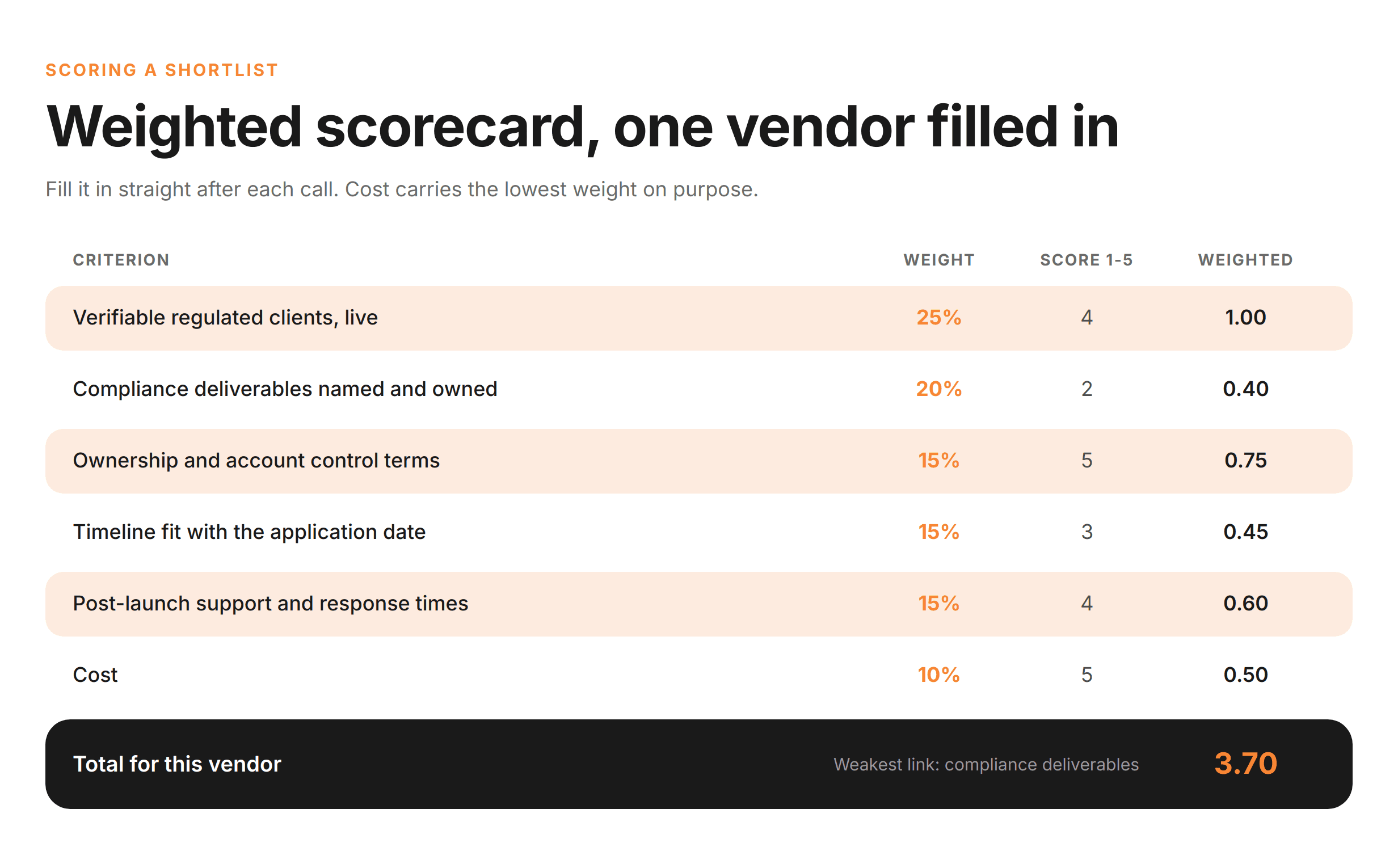
A Simple Weighted Scorecard
Criterion | Weight | Score 1-5 |
|---|---|---|
Verifiable regulated clients, live | 25% | |
Compliance deliverables named and owned | 20% | |
Ownership and account control terms | 15% | |
Timeline fit with the application date | 15% | |
Post-launch support and response times | 15% | |
Cost | 10% |
Cost carries the lowest weight deliberately. The cheapest quote in a regulated build usually excludes the compliance scope, which means the real price appears later, after you have committed.
Set your own baseline for fintech website development cost before the first call, using what a fintech build costs as a reference point, so a low number cannot anchor the comparison.
Reference Calls: The Three Questions That Reveal Everything
Ask past clients three things. What happened when compliance asked for a change late in the build. Who owned the hosting when the project ended. Whether the people pitched were the people who worked on it. A polished portfolio is easy to assemble; a fifteen-minute reference call is not.
Platform Choice: Framer, Webflow or Custom
Choose by who maintains the site after launch. If your team updates content and compliance pages themselves, a Framer or Webflow build gives you speed and control without a developer in the loop, and it is worth comparing CMS options for a fintech build before committing. If the site is genuinely an application, with authenticated dashboards and transaction logic, that belongs in a custom build.
Performance is a commercial argument, not a technical one. The 2020 Google and Deloitte study Milliseconds Make Millions found that on lead-generation sites, a 0.1 second improvement across four mobile speed metrics was associated with 21.6% more users progressing from the first form step to the submission page.
That figure comes from 37 brands and more than 30 million sessions. A broker site is a lead-generation page. Ask any vendor how they will hit the Core Web Vitals thresholds, which Google assesses at the 75th percentile of real visits.
The honest tradeoff: a specialist agency usually costs more up front than a generalist. If you have no regulated product live and you need a brand page before the licence, that premium may not be worth paying yet.
How WSA Approaches Regulated Fintech Builds
WSA works almost entirely with brokers, exchanges and fintech firms, which is why compliance deliverables are scoped before design begins rather than reviewed at the end. Legal pages are listed in the statement of work with named owners. Risk warning prominence is treated as a design constraint from the first layout. Hosting and CMS sit under the client's organisation from day one.
Most of the work runs on Framer, which is what makes an application-driven timeline realistic: content stays editable by the client's own team afterwards, including the pages compliance is most likely to ask about.
FAQ
What should a fintech website development company deliver beyond the design?
A complete deliverable set includes the compliance artefacts, not just the visual build. In practice that means terms of business, privacy and cookie policies, a risk disclosure, complaints procedure and any required AML statement, with a named owner for each piece of copy. It also includes consent handling for cookies and analytics, correct display of the legal entity, registration number and registered address, and a CMS structure that lets your team update those pages without a developer. Ask for hosting, domain and CMS accounts registered to your organisation, along with written confirmation of who owns the code, the design files and the content on delivery. Post-launch, you should have a support arrangement with stated response times, because regulated sites attract change requests with deadlines attached. A vendor who scopes only design, build and launch is quoting on a smaller job than the one you need.
How do I check whether an agency has real regulated-finance experience?
Open their portfolio and verify that the financial clients are licensed firms with live sites. Ask which specific parts of each site they built, since agencies sometimes list projects where they delivered a landing page rather than the platform. Ask whether they have worked under your regulator or in your jurisdiction, and treat an honest no as a better answer than a vague yes. The most reliable test is a question about disclaimer prominence: a vendor with genuine experience will discuss font size, placement and balance as design constraints, because the rules address exactly that. A vendor without it will offer to make disclaimers less visually intrusive. Then take a reference call and ask what happened when a compliance officer requested a change late in the build.
Does my website need to be ready before I apply for a licence?
In many jurisdictions the application itself asks about the website, so the two run in parallel rather than in sequence. Authorities commonly review the public site for consistency with the permissions being sought, which means content describing services you are not yet licensed to offer can create problems during review. Requirements differ by authority, so confirm the specifics for your jurisdiction with your licensing consultant or legal adviser before setting a schedule. The practical consequence for vendor selection is that your agency needs to work to the application timeline and be able to make fast, precise content changes during review, not just deliver a finished site at some point afterwards.
How much should a fintech website cost, and what drives the price?
Price is driven by scope rather than page count, and the largest variables are compliance deliverables, integrations and timeline. A brand and marketing site with a full set of legal pages sits well below a build that includes client-area entry points, trading widgets, multi-jurisdiction content variants or multilingual delivery. Two things reliably push a quote up: a fixed application deadline, and integrations with third-party platforms whose documentation the vendor has not worked with before. Two things quietly push a cheap quote up later: compliance pages that were never in scope, and a maintenance arrangement agreed after launch instead of before. When comparing proposals, normalise them by listing every deliverable each one includes, then look at what only appears in one of them.
Who owns the code and content when the project ends?
You should own the custom code, the design files and all content, with any exceptions named explicitly in the contract before development starts. Some agencies build on proprietary frameworks or reusable component libraries they license rather than transfer, which is workable if you know about it in advance and unworkable if you discover it during a handover. Hosting, domain, CMS and analytics accounts should be registered to your organisation, with the agency added as a user, rather than the other way round. Ask directly what is exported at the end of the relationship, in what format, and how long access continues after the final invoice. A vendor who cannot answer this quickly, in writing, is telling you something about how previous engagements ended.
Conclusion
Vendor selection in regulated finance rewards precision over enthusiasm. The twelve questions in this fintech website development company checklist all point at the same three things: whether the agency has genuinely built for licensed firms, whether compliance is in scope or assumed, and whether you own what you paid for. Broker website requirements will keep shifting as jurisdictions update their rules, which makes the maintenance arrangement as important as the build.
If you are scoping a brokerage or fintech site now, particularly with an application underway, WSA can walk you through what belongs in the statement of work before you sign anything.
Launch Your Licensed Brokerage with Confidence
We support brokers and fintechs through licensing, launch planning, and everything a regulated brand needs to go live.