•
•
How to Create a Website with AI in 2026 (And When It’s a Bad Idea)
The decision framework becomes much clearer when you evaluate your project against five core variables: regulatory exposure, conversion dependency, integration complexity, intended lifespan, and budget.
An AI builder makes sense when your budget is under $3,000, you’re testing an idea or validating demand, operating in a non-regulated industry, and don’t require complex third-party integrations. It’s also a practical choice if the site is short-term — with an expected lifespan of under 12 months. MVP landing pages, campaign microsites, personal portfolios, and internal tools are all strong candidates for this approach.
Key Takeaways
AI website builders automate layout generation and content creation but cannot architect strategic UX or conversion architecture
These tools work well for MVP landing pages, early-stage validation, and low-risk informational sites
They fail in funnel mapping, performance optimization, schema markup implementation, and compliance-sensitive industries
AI powered website platforms optimize for speed—top web development companies optimize for outcomes and long-term scalability
For fintech companies, brokerages, and other regulated industries operating under GDPR, MiFID II, and ESMA compliance requirements, the cost of underperformance can quickly outweigh any initial savings from using an AI website builder.
As a practical decision framework: use AI for lower-budget projects under $3,000 where speed and testing matter most. But for regulated industries and long-term digital assets, hiring specialists is typically the safer and more sustainable choice.
What AI Website Builders Actually Do
AI website builders are prompt-based platforms that assemble pre-configured components, auto-generate content, and apply template-backed styling. What they don’t do is design strategic user experiences or engineer thoughtful conversion flows tailored to a specific business model.
These platforms typically include:
Prompt-based layout generation that interprets text instructions
Auto-generated copy and imagery based on industry keywords
Automated style systems with preset color schemes and typography
Template-backed structure, even when marketed as "fully AI-built"
Pre-configured CMS logic for basic content management
Hosting and CDN bundling for streamlined deployment
Popular tools such as Framer AI, Wix AI, Durable, 10Web, and Webflow AI have come a long way in automating the technical implementation of building a website. They can quickly generate a functional website from a simple description, and it has never been easier to build a website using AI in just minutes, not weeks.
However, these tools operate within clear boundaries. They do not:
Understand your business model or revenue mechanics
Interpret regulatory requirements like GDPR or MiFID II for your industry
Apply A/B testing logic or conversion rate optimization (CRO) testing frameworks
Develop long-term content strategies aligned with programmatic SEO objectives
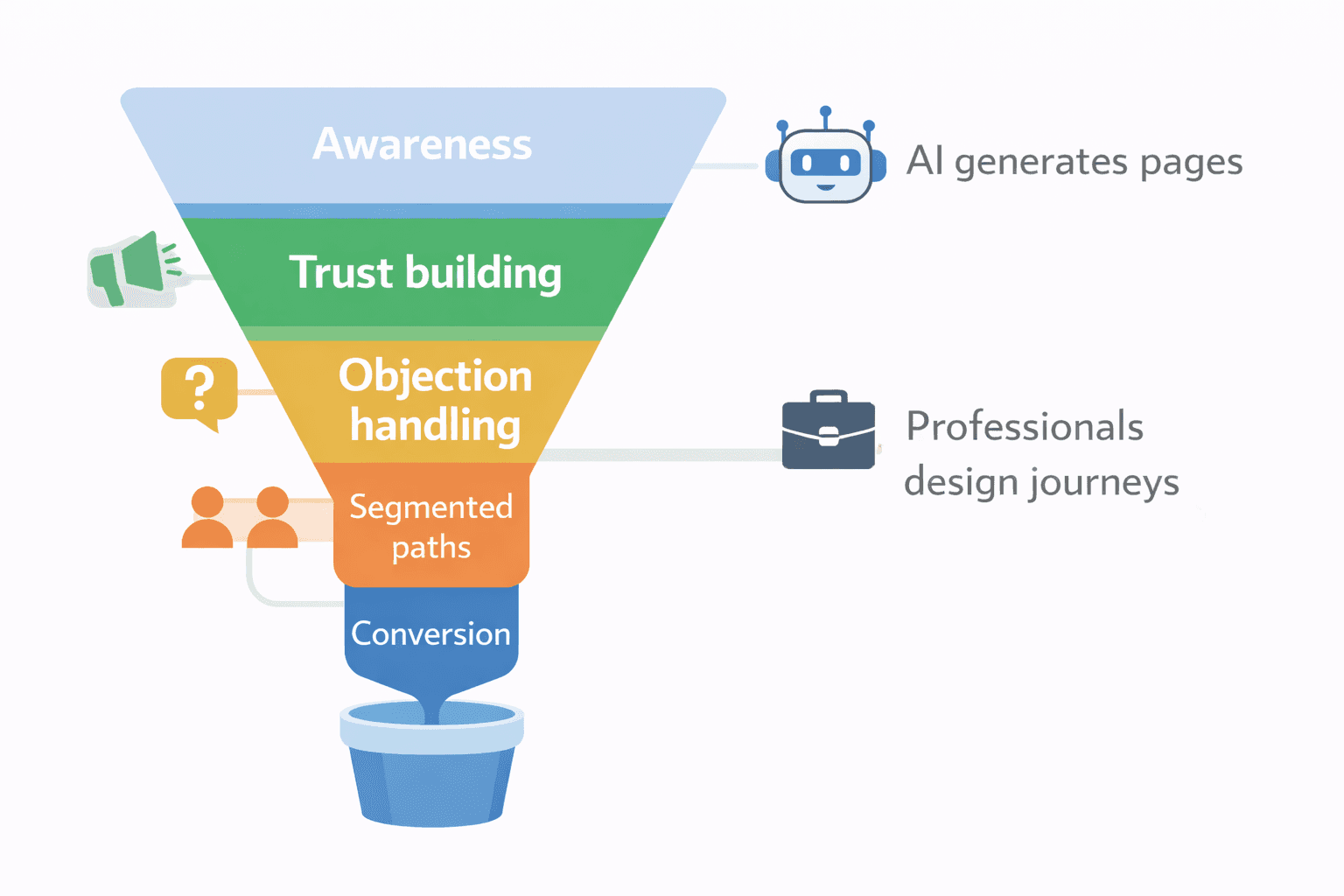
Engineer psychological sequencing in user journeys with proper funnel mapping
AI website builders assemble structured components efficiently. They cannot replace strategic thinking about how your site converts visitors, communicates trust through proper schema markup, or scales with your business—particularly critical for forex website design and broker website development projects.
Where AI Website Builders Work Well
AI tools excel at rapid prototyping and low-complexity projects where speed matters more than strategic architecture.
Effective use cases include:
MVP landing pages for initial market testing
Early-stage validation projects with limited traffic
Personal brands and portfolio sites
Internal tools and documentation hubs
Low-risk informational sites without conversion requirements
Prototype design drafts for stakeholder review
These scenarios share common characteristics:
Limited structural complexity
No heavy compliance requirements
Minimal third-party integrations
Low-volume traffic and SEO demands
Short project lifespans or disposable testing phases
In such scenarios, the use of AI-powered website builders adds real value. These tools condense weeks of work into a matter of hours, allowing entrepreneurs to test their hypotheses rapidly without requiring heavy investment. The tools take care of hosting, SSL certificates, and basic responsive design on their own.
The key here is that AI helps with speed in production but not in strategy. If your website requires the conversion of high-value traffic, regulatory compliance expressed through WCAG guidelines, or a long-term digital asset, then mere speed will not be enough.
Where AI Website Builders Fail
AI-generated sites consistently underperform in conversion architecture, performance optimization, SEO structure, compliance requirements, complex integrations, and brand differentiation.
Conversion Architecture
AI web design tools produce generic call-to-action (CTA) placements with no funnel mapping, behavioral optimization, or psychological sequencing. They cannot:
Engineer trust-building sequences for skeptical audiences
Create segmented user journeys based on traffic source or intent
Structure information hierarchy around decision psychology
Implement A/B testing frameworks for continuous optimization
Design conversion flows that meet forex website design compliance standards
Performance Optimization
AI-generated code frequently includes bloated scripts, redundant libraries, and unoptimized assets that damage Core Web Vitals scores. Common issues:
Poor Largest Contentful Paint (LCP) from oversized hero images
High Cumulative Layout Shift (CLS) from dynamic content loading
Excessive JavaScript execution delaying interactivity
Limited control over code structure and asset delivery
Missing performance optimization that top web development companies implement by default
SEO Architecture
While the best AI website builder platforms handle basic metadata, they lack strategic SEO implementation:
Weak internal linking logic with no topical clustering
No entity mapping for semantic search optimization
Surface-level metadata without keyword research backing
Poor schema markup implementation for rich results
Missing breadcrumb navigation and contextual silos
No programmatic SEO capabilities for scaling content
Compliance-Sensitive Industries
The AI website builder for fintech use case reveals critical limitations. AI tools cannot interpret regulatory requirements for:
Fintech platforms requiring risk disclosures under MiFID II and ESMA guidelines
Brokers needing FCA, CySEC, or ASIC compliance
Crypto exchanges with KYC/AML documentation requirements
Investment platforms mandating legal disclaimers
Healthcare sites requiring HIPAA considerations
Legal services with jurisdiction-specific requirements
These industries face reputational and operational risk when GDPR compliance elements, WCAG accessibility standards, or regulatory disclosures are missing, incorrectly structured, or inadequately disclosed. This represents one of the most significant AI website builder compliance risks that companies face.
Complex Integrations
AI website generators struggle with:
CRM connections requiring custom data mapping
Sophisticated onboarding flows with conditional logic
KYC/AML verification systems
Multi-language functionality beyond simple translation
Customized client dashboards with real-time information
Brand Differentiation
The use of template-based structures ensures that all sites have a similar look and feel, making it rather challenging to differentiate a brand. AI-powered tools value speed over uniqueness, leading to generic designs that are not very effective in communicating unique value propositions, especially in the forex website design industry where trust and credibility are of utmost importance.
AI Website Builders vs Professional Development (Performance & SEO Comparison)
Area | AI Website Builder | Professional Development |
Core Web Vitals | Platform dependent, often suboptimal | Fully optimized for speed and user experience |
SEO Architecture | Surface-level metadata and basic structure | Strategic entity-based optimization with programmatic SEO and schema markup |
Conversion Design | Generic CTAs and standard flows | Funnel-engineered with A/B testing and behavioral psychology |
Compliance | User responsibility, no GDPR/MiFID II interpretation | Structured integration with legal requirements and WCAG standards |
Custom Functionality | Limited to platform capabilities | Fully flexible with tailored solutions |
Scalability | Moderate, constrained by platform | High, with architecture designed for growth |
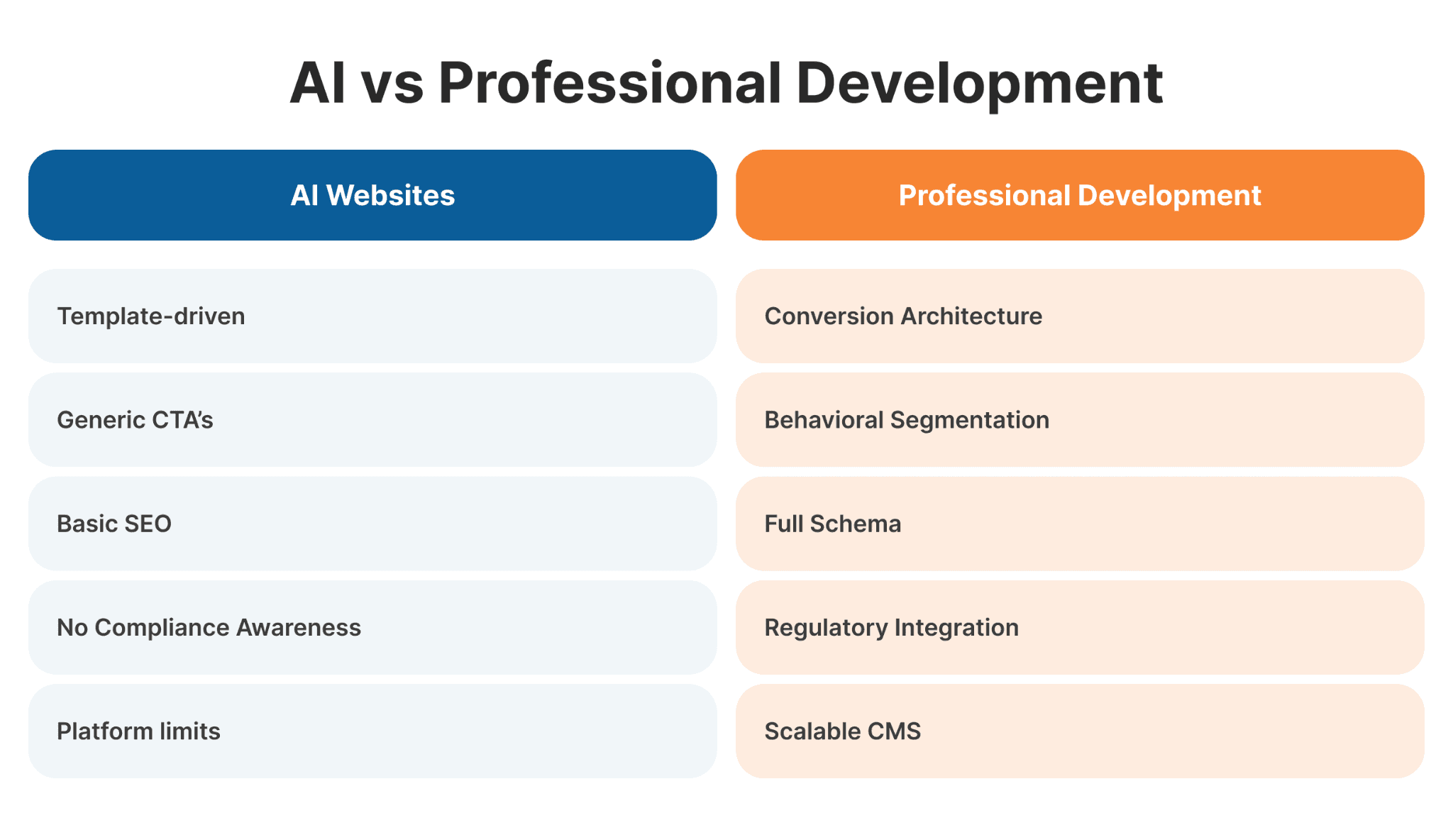
The fundamental difference: AI powered website platforms optimize for speed of deployment. Professional broker website development optimizes for business outcomes—conversion rates, search visibility, regulatory safety, and long-term maintainability.
The Conversion Reality: Why Most AI Sites Underperform
AI-generated sites lack the funnel mapping, psychological sequencing, and trust architecture required to convert high-value traffic effectively.
Effective conversion architecture requires:
Funnel mapping that anticipates user objections at each stage
Psychological sequencing that builds trust before asking for commitment
A/B testing frameworks for continuous improvement
Segmentation logic that adapts messaging to traffic source
CTA hierarchy that guides users through decision paths
Strategic trust signals positioned where skepticism peaks
For sectors such as brokerage sites, trading tools, crypto initiatives, and high-end B2B solutions, generic strategies do not work. The audience is complex, risk-savvy, and demands precisely crafted experiences that cater to their particular needs.
A fintech solution cannot have a generic "Sign Up" button when the audience must comprehend regulatory safeguards within ESMA guidelines, security features, costs, and geographical implications.
High-value traffic demands engineered experiences. The difference between 2% and 8% conversion rates on paid traffic can mean hundreds of thousands in revenue—far exceeding any broker website development cost savings from using AI tools.
Compliance Risks in Regulated Industries
AI solutions do not interpret regulatory requirements, which poses a legal and reputational risk to fintech, brokerages, crypto, and other regulated sectors.
Critical compliance gaps include:
Omitted risk disclosures mandated by MiFID II and ESMA regulations for financial services
Incorrect legal structuring of terms, privacy policies, and disclaimers
Unclear data processing disclosures violating GDPR or similar frameworks
Weak privacy controls for handling sensitive customer information
Accessibility compliance (WCAG 2.1 Level AA standards)
Regional regulatory differences across FCA, CySEC, ASIC, SEC jurisdictions
For example:
Brokerage sites require specific risk warnings about leverage and capital loss under ESMA guidelines
Crypto platforms need clear KYC/AML procedures and jurisdictional disclaimers
Investment platforms must structure communications to avoid misleading claims per MiFID II
The payment processor must have clear statements of GDPR compliance with data handling and PCI compliance
Knowledge of AI website builder compliance risks is essential, as these tools put the full burden of regulatory compliance on the user without any interpretation, templates, or guidance.
This is why forex website design and broker website development require specialized expertise—professionals who understand both technical implementation and regulatory frameworks.
When You Should Use AI — And When You Shouldn't
Clear decision framework based on project complexity, industry requirements, and business objectives.
Use AI Website Builders If:
Budget is under $3,000
Testing an unvalidated idea or market hypothesis
Operating in non-regulated industries
No complex third-party integrations required
Project has short lifespan or is disposable
Target audience has low trust barriers
GDPR and WCAG compliance are not critical factors
Hire Website Specialists If:
Operating in fintech, brokerage, crypto, or regulated finance requiring MiFID II and ESMA compliance
Managing investor trust or institutional credibility through professional forex website design
Requiring multilingual programmatic SEO with localized content strategies
Running paid traffic at scale where conversion architecture and A/B testing impact profitability
Building a long-term digital asset with proper schema markup meant to scale
Need advanced integrations with CRM, KYC, or custom dashboards
Brand differentiation is strategically important
Performance optimization through Core Web Vitals directly impacts revenue
WCAG accessibility compliance is legally required
The cost-benefit analysis shifts dramatically based on traffic value. A site generating 1,000 monthly visitors can tolerate suboptimal conversion. A site driving $50,000 in monthly ad spend cannot. This is where comparing AI vs professional web development becomes critical.
When to Hire Website Specialists
Professional development delivers strategic UX architecture, conversion engineering, compliance-aware design, and scalable infrastructure.
Specialists among top web development companies provide:
UX architecture planning grounded in user research and behavioral data
Conversion engineering with psychological sequencing, funnel mapping, and trust optimization
SEO-optimized architecture leveraging entity mapping, topical authority, schema markup, and technical optimization
Compliance-friendly design incorporating GDPR, MiFID II, ESMA, and WCAG guidelines from inception
Performance optimization for Core Web Vitals, page speed, and user experience
Scalable CMS architecture that supports content strategies and programmatic SEO over years
Long-term maintainability with clean code and documentation
For fintech and financial services firms, specialized agencies are aware of the technical needs and the regulatory environment. They design sites that can withstand the test of scrutiny from users, regulators, and search engines.
This expertise becomes particularly valuable when:
Your site is the primary customer acquisition channel
Conversion architecture and A/B testing directly impact unit economics
GDPR, MiFID II, and ESMA compliance is non-negotiable
Brand perception influences customer lifetime value
Technical performance affects search rankings and paid traffic ROI
As a landing page development agency with deep fintech expertise, WSA approaches broker and exchange development with examples across brokerages, exchanges, and institutional platforms that require sophisticated forex website design.
Build It Right from the Start
Not every project should rely on AI alone. Let’s discuss your specific requirements, regulatory considerations, and long-term growth strategy.
For strategic guidance on whether your project requires specialized development, book a discovery call to discuss your specific requirements, compliance needs, and growth objectives.
Final Verdict: AI Is a Tool — Not a Strategy
AI accelerates execution. Professionals architect outcomes.
The development of platforms that enable you to build a website using AI is a real step forward in the democratization of website building. Founders are now able to validate their ideas, test messaging, and build MVPs quicker than ever before.
However, the cost of underperformance in high-trust industries consistently exceeds initial savings. A broker losing regulatory approval due to missing ESMA compliance elements or inadequate GDPR implementation faces consequences far beyond a $10,000 development budget. A crypto platform converting at 2% instead of 6% on paid traffic loses multiples of what custom broker website development costs.
For fintech, brokerages, and regulated financial services requiring MiFID II compliance and proper conversion architecture, strategy matters more than speed. AI powered website platforms provide templates and automation. They cannot, and should not, replace strategic thinking on the subject of funnel mapping, A/B testing, regulatory compliance, performance optimization via Core Web Vitals, or long-term scalability via programmatic SEO.
In the debate of AI vs professional web development, the question is no longer whether to employ AI, but rather when to do so—and when to leverage the expertise of the best web development companies to transform a website into a revenue-producing, compliant, and scalable digital asset.
Frequently Asked Questions
Can AI website builders create SEO-optimized sites?
AI website builders are capable of handling simple SEO aspects such as meta title, description, and mobile-friendliness, but they are not capable of performing optimization. They do not use entity mapping, topic authority, schema markup, and programmatic SEO.
Are AI-generated websites compliant for fintech companies?
No. AI website builders do not understand the regulations applicable to fintech, brokerages, and crypto platforms. They cannot create GDPR-compliant privacy policies, WCAG guidelines for accessibility, or jurisdiction-specific regulations from the FCA, CySEC, ASIC, ESMA, or SEC. They cannot create MiFID II-compliant risk disclosure statements either.
How much does professional website development cost compared to AI builders?
The top AI website builders usually range from $10 to $50 per month for hosting and occasional template buys. The cost of professional broker website development for fintech or brokerage platforms can vary from $15,000 to $100,000+ depending on complexity, custom development, conversion architecture, and regulatory requirements such as GDPR, MiFID II, and WCAG. However, the ROI analysis swings wildly when conversion rates, regulatory risks, and scalability are considered. A 3% conversion rate boost via correct funnel optimization and A/B testing on $50,000 monthly ad spend pays for development costs in months.
Can I begin with an AI website builder and then move to professional development?
Yes, but it’s usually a rebuild scenario rather than an upgrade path. AI website builders rely on closed systems with poor code export capabilities. Upgrading AI website platforms to custom-built solutions often involves rebuilding architecture, redoing schema markup, re-engineering integrations, and restructuring for optimal Core Web Vitals performance from scratch. For projects with known scalability requirements for programmatic SEO or regulatory compliance, professional development from the best web development companies can sidestep unnecessary expenses.
What is the most significant risk of using AI-powered website builders for brokerages or exchanges?
The most significant risk is non-compliance. Online brokerage services, cryptocurrency exchanges, and investment solutions are subject to rigorous regulatory standards such as MiFID II, ESMA regulations, and GDPR, which demand particularized disclosure, legal organization, and consumer safeguards. AI-powered website builders lack the capability to understand these norms, thus posing a risk of regulatory punishment, business closure, and loss of reputation. Apart from non-compliance, inefficient conversion architecture and suboptimal performance optimization result in lost revenue that is orders of magnitude higher than what would have been paid for professional forex website design and broker website development.
Launch Your Licensed Brokerage with Confidence
We support brokers and fintechs through licensing, launch planning, and everything a regulated brand needs to go live.