•
•
Fintech Landing Page: When Performance Matters More Than Design
Fintech traffic is expensive. Whether it comes from paid search, paid social, affiliate partnerships, or a PR spike, every visit has a cost — and most fintech teams can’t afford to send that spend to a page that bounces users before they’ve even read the headline.
Here’s the problem: many fintech landing pages are built to impress, not convert. They launch with polished hero sections, scroll animations, and layered visual treatments — then quietly underperform because they’re slow, hard to trust at a glance, and difficult to measure accurately.
This guide covers what actually drives results on a fintech landing page: speed, stability, clarity, trust, and reliable measurement. Not aesthetics. Not trends. Performance.
Key Takeaways
Performance means more than looks. On a fintech landing page, performance covers speed, responsiveness, layout stability, tracking accuracy, and conversion clarity — all of it.
Core Web Vitals targets to aim for: LCP ≤ 2.5s, INP < 200ms, CLS < 0.1. These are Google’s recommended thresholds for a “good” user experience.
INP replaced FID as a Core Web Vital — any “FID-first” optimization advice is now outdated. INP measures responsiveness across all interactions, not just the first one.
Script sprawl is a silent killer. Chat widgets, analytics libraries, A/B testing tools, and affiliate pixels stack up fast — and each can hurt both page speed and attribution accuracy.
Trust signals belong above the fold, not in the footer. In fintech, users ask “is this safe?” before they ask anything else.
The best fintech landing pages are the ones you can measure and iterate. If you can’t track what’s happening clearly, you can’t improve it — and in a regulated space, iteration has to happen without adding compliance risk.
Mobile performance is non-negotiable. A page that passes desktop tests but fails on throttled mobile is failing the majority of your paid traffic.
What “Performance” Means on a Fintech Landing Page
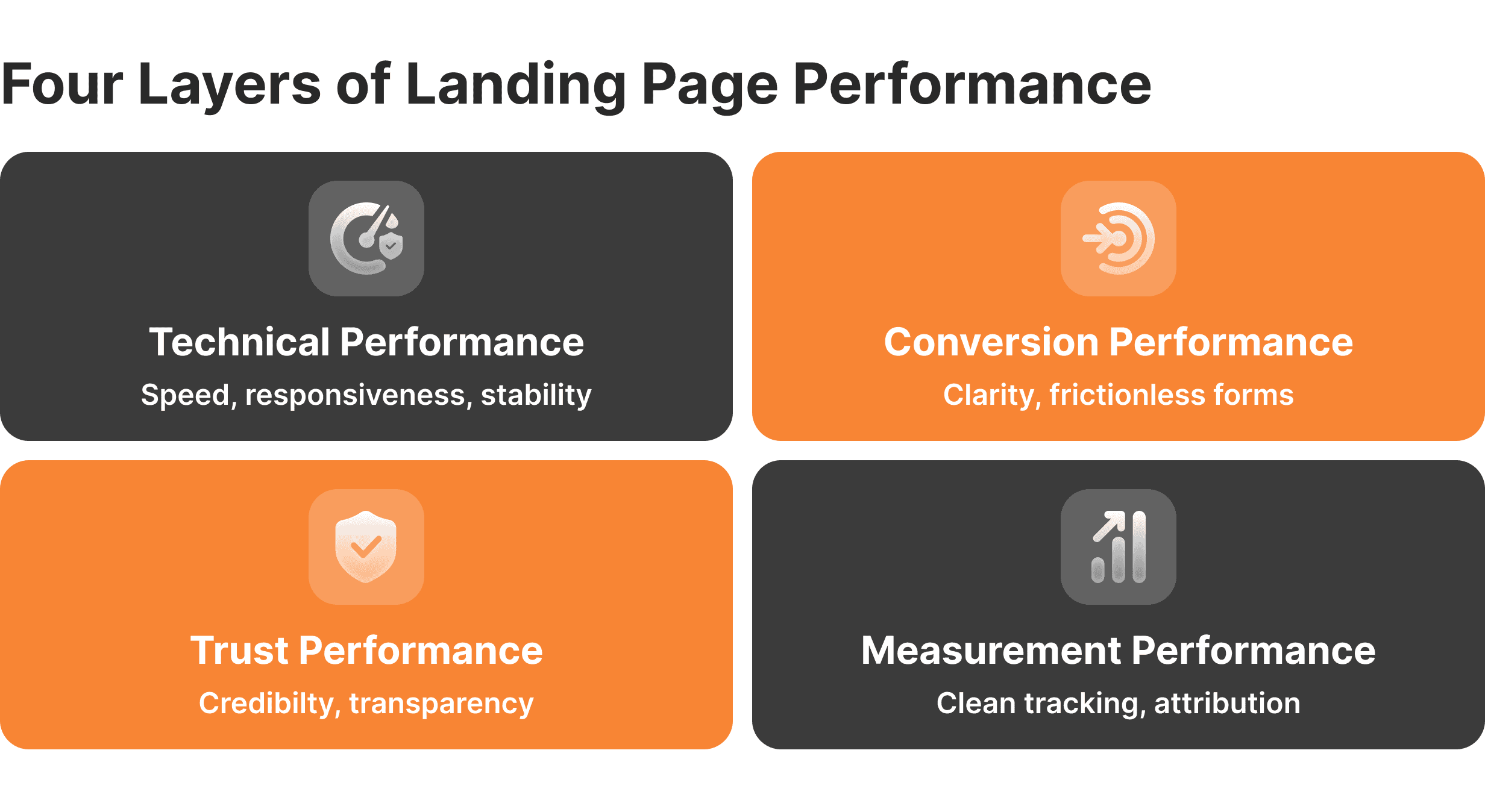
Performance is a landing page’s ability to convert intent into a measurable action — quickly and reliably, on real devices and real networks.
It’s not a single metric. It’s a layered concept, and teams that only optimize one layer tend to miss the others entirely.
Four layers of landing page performance:
1. Technical performance — Does the page load fast, respond to interactions without delay, and stay visually stable as it loads? This is where Core Web Vitals live.
2. Conversion performance — Is the value proposition clear? Is there one obvious action to take? Does the form complete without friction?
3. Trust performance — Does the user feel safe within the first few seconds? Are credibility signals visible early, and do they match the product’s actual regulatory and security posture?
4. Measurement performance — Are events firing correctly? Is attribution tracking reliable? If the page converts, do you actually know why?
Most fintech landing page audits reveal the same pattern: strong on layer one (at least on desktop), weak on layers two through four. The result is a page that looks like it should work — and quietly doesn’t.
Why Fintech Can’t Afford “Design-First” Landing Pages
Every second you lose in load time is conversion you leave behind — and in fintech, where users are already cautious about trusting a new money product, there’s no margin to waste.
The business case for speed is well documented. Think with Google’s “Milliseconds Make Millions” report found that a 0.1-second improvement in mobile load times can meaningfully move retail conversion outcomes. Cloudflare’s breakdown of performance and conversion rates makes the same point: slow pages hurt business, regardless of how polished they look.
In fintech specifically, there’s an additional dynamic: the user’s first question isn’t “does this look professional?” It’s “is this legitimate — and is my money safe here?” That question has to be answered in the first scroll, not halfway down a beautifully animated page that takes four seconds to settle.
Design-first pages also tend to accumulate technical debt quickly. They ship with oversized assets, stacked animations, and a collection of third-party scripts that weren’t performance-audited before launch. By the time the team realizes the page is slow or misattributing conversions, it may have already burned weeks of budget.
The Performance-First Fintech Landing Page Structure
A high-converting fintech landing page doesn’t need to be clever — it needs to be clear, fast, and sequenced so trust is established before you ask for anything.
Here’s a recommended block order that prioritizes both conversion and performance:
Block | Purpose |
|---|---|
One-line value prop | Immediate answer to “what is this?” — plain language, no jargon |
Credibility line | Regulated, secure, trusted by, volume processed — whichever applies and is provable |
Primary CTA | One action. Not two. Not three. |
3–5 benefit bullets | Outcome-focused, not feature-focused |
“How it works” | 3 steps maximum — reduce perceived complexity |
Trust stack | Logos, metrics, security/compliance cues — real, not decorative |
FAQs | Objection handling — and a strong source of structured, AI-extractable answers |
Secondary CTA | Repeat the primary action for users who scroll to the bottom |
If your hero section needs a paragraph to explain what the product does, performance is already lost. Clarity is a performance metric.
Core Web Vitals Targets for Landing Pages
Core Web Vitals are Google’s standardized, field-measured performance targets — and hitting them is the baseline for any page running paid traffic or competing for organic visibility.
The three metrics and their recommended targets are:
LCP (Largest Contentful Paint): Aim for the main content to load within 2.5 seconds. This is usually your hero image, headline, or above-the-fold section. (source)
INP (Interaction to Next Paint): Aim for responsiveness under 200ms. This replaced FID (First Input Delay) as the responsiveness metric in March 2024. (source)
CLS (Cumulative Layout Shift): Keep layout shifts minimal as the page loads — under 0.1. A high CLS score means elements jump around on screen, which destroys trust immediately.
A note on INP vs. FID: If you’re still auditing pages against FID targets, you’re working from outdated criteria. INP measures responsiveness across interactions throughout the user’s visit — not just the first tap or click. A page that passed FID can still fail INP. Update your benchmarks.
Lab vs. field data — and why both matter:
Lab data (tools like Lighthouse) tests performance in a controlled environment. It’s great for debugging and development.
Field data comes from real users and is aggregated in the Chrome UX Report (CrUX) and surfaced in Google Search Console. This is what reflects real-world experience at scale.
PageSpeed Insights can show both: Lighthouse lab results and field data when it’s available. (PageSpeed Insights)
If your lab scores look fine but your Search Console Core Web Vitals report shows “Poor” or “Needs Improvement,” trust the field data — it’s what your users are experiencing.
The Hidden Performance Killer in Fintech: Scripts and Tags
The most common reason fintech landing pages are slow isn’t the design — it’s the tag stack that accumulates before and after launch.
A typical fintech landing page might carry:
A live chat or chatbot widget
A cookie consent / CMP tool
Google Analytics 4
Google Tag Manager (often with unpruned legacy tags)
An A/B testing library
One or more affiliate/partner pixels
A heatmap or session recording tool
Each of these adds network requests and main-thread work — and can create conflicts that silently break attribution. A page that started fast can become slow within two sprints if no one owns tag governance.
Practical steps to keep scripts under control:
Assign one GTM owner. Enforce naming conventions, an approval workflow, and a quarterly audit cadence.
Define first-party events before adding more tools. Lock your core GA4 event plan (CTA click, form start, form submit, scroll depth) and QA it before layering on extras.
Align consent mode correctly. If you operate in GDPR-applicable regions, ensure consent mode is configured properly in GTM. This impacts both compliance and data quality.
Run a script performance audit. Use waterfall analysis (Chrome DevTools or WebPageTest) to identify the biggest offenders. Some can be deferred; some need to be removed.
The goal is a clean, auditable measurement stack — not more tools. Better signal from fewer sources is almost always the right trade-off.
Forms That Convert Without Killing Trust
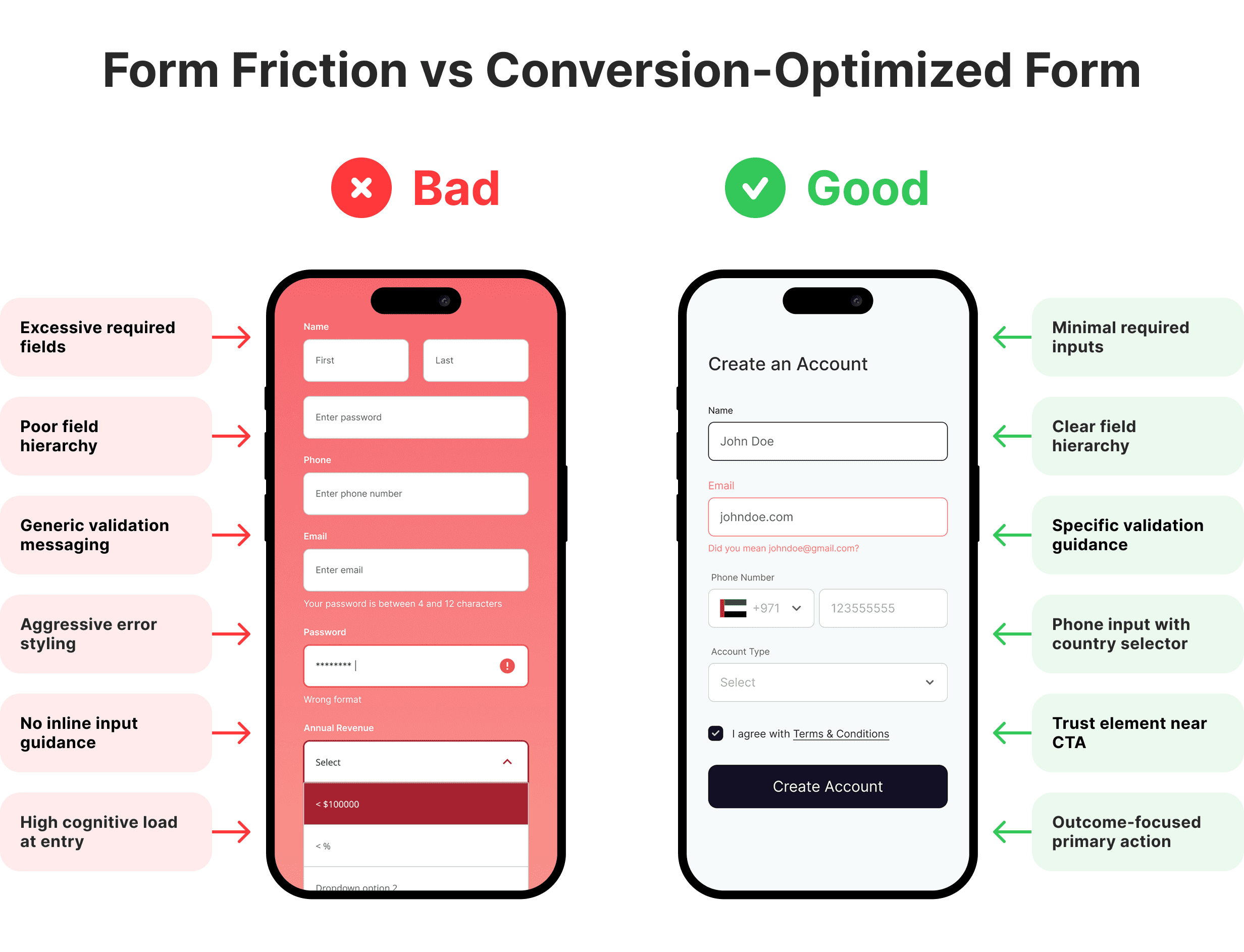
A fintech form is where conversion actually happens — and most forms are over-engineered, under-tested, and optimized for desktop rather than where most traffic lives: mobile.
Common form failures:
Asking for too much information too early
No explanation of why specific data is needed
Broken autofill on mobile (wrong input types, missing
autocompleteattributes)Vague error messages that don’t explain how to fix the problem
No confirmation of what happens after submission
Form optimization checklist:
Minimize fields to what’s truly required at this stage
Use correct HTML input types (
email,tel,number) so mobile keyboards matchEnable browser autofill via
autocompleteattributesWrite error states in plain language (“Please enter a valid email address,” not “Invalid input”)
Set clear expectations post-submit (“We’ll send you a confirmation” / “Expect a call within 24 hours”)
Avoid mandatory account creation unless creating an account is the conversion
Add a short, human privacy note near the CTA — not a legal disclaimer, just a line: “We don’t share your details. Unsubscribe anytime.”
Test the full flow on a real mobile device, not just a browser resize
Trust Signals That Improve Conversion Performance
In fintech, trust signals aren’t decorative — they’re conversion infrastructure. Users evaluating a money product make a risk assessment before they take any action. If the page doesn’t answer “is this safe?” early enough, they leave.
Trust signal hierarchy:
Near the primary CTA: One or two strong credibility cues — a regulation note (if applicable), a security posture statement, or a proof metric (“trusted by 10,000 businesses”).
In the trust block (mid-page): Customer logos, press mentions, testimonials, relevant certifications.
In the footer: Links to Terms, Privacy Policy, and any required regulatory disclosures.
Rules for trust signals:
Only include what’s true and verifiable. Unsubstantiated claims (“the most secure platform”) destroy credibility.
Regulatory status, licensing, and security certifications (SOC 2, PCI DSS) should only be referenced if they apply and can be documented.
Stripe’s security documentation is a good example of how a fintech product can communicate security posture clearly — factual, structured, and easy to reference without overreaching.
A trust signal that can’t be substantiated is a liability, not an asset. In a regulated space, this matters beyond conversion.
Design Rules When Performance Is the Priority
Design still matters — but on a fintech landing page, design should serve speed, clarity, and trust, not the other way around.
Practical do/don’t guidance for fintech landing page design:
Don’t:
Autoplay hero video (unless it’s an optimized, short background clip with a static fallback)
Stack multiple animation libraries (Lottie, GSAP, and a parallax plugin on the same page is a performance disaster)
Use oversized images without responsive sizing and modern formats (WebP/AVIF)
Prioritize “mood” over message in the hero — users need to understand the product in under five seconds
Do:
Use a restrained component system — fewer variants, smaller CSS payloads, faster renders
Prioritize accessible typography and contrast (WCAG 2.1 AA as a baseline)
Keep the first screen lightweight and message-forward — hero image/illustration, headline, subhead, CTA
Design for mobile first, then layer up for desktop
The best-performing fintech pages tend to look clean and professional, not flashy. That’s not a coincidence — restraint in design usually correlates with restraint in asset weight.
Not sure what’s holding your landing page back?
We design and build fintech landing pages with speed, clarity, and measurement in mind — so you can launch with a clean structure and a reliable tracking foundation.
Platform Choices That Make Performance Easier
The platform you build on shapes how hard you have to fight for performance from day one.
Webflow / Framer: Strong choices for fintech marketing pages and landing pages. Fast iteration, solid performance baselines, and good CMS capabilities. The main risk is accumulated scripting and integrations — both platforms can become heavy if you’re not deliberate about what you add.
Next.js / custom build: Better suited when you need deep product integration, personalization at scale, or complex routing logic. Requires more engineering overhead, but gives you full control of the performance stack.
Regardless of platform: enforce a performance budget before launch. Define your LCP, INP, and CLS targets as requirements — not post-launch goals — and test against them before any traffic runs.
A/B Testing for Fintech Without Breaking Compliance
A/B testing is essential for fintech CRO — but it needs a structured approach that doesn’t introduce claims you can’t substantiate or variants you haven’t documented.
A safe, effective testing roadmap:
Start with headline and value prop clarity — what you say matters more than how it looks
Then test CTA wording — “Start your application” vs. “See if you qualify” can move conversion meaningfully
Then test trust block placement — above vs. below the primary CTA
Then test form length and step flow — multi-step vs. single-step, required vs. optional fields
Fintech-specific testing rules:
Never introduce a claim in a test variant that hasn’t been reviewed and approved. Even if it performs well, publishing it without review creates compliance exposure.
Document all variants — including the losers.
If your product is regulated, keep approval gates tight. A fast test cycle that skips compliance review is a liability in the making.
For a deeper look at managing this alongside your full web presence, WSA’s compliance checklist for broker websites is a useful reference point.
Common “Beautiful but Slow” Mistakes
These are the patterns that show up most consistently in fintech landing page audits:
Design-led rebuild that ships 10+ new third-party scripts — no performance audit before launch
Massive Lottie or SVG animation above the fold — adds significant JavaScript weight and parse time
Stock photography that reads as “generic fintech template” — undermines credibility before the user reads a word
Vague CTA with no implicit promise — “Get started” tells the user nothing about what happens next
No event tracking plan before launch — the page ships, traffic runs, and no one knows what’s working
Desktop-only performance testing — desktop PageSpeed can look fine; throttled mobile is where pages fail
Missing or broken UTM persistence — traffic converts, but source data is lost because UTMs don’t pass through to form submission
Ready to build a fintech landing page that performs?
We create fintech landing pages designed for fast load, mobile usability, and clean attribution — with a simple, focused conversion flow.
Pre-Launch Checklist for a Performance-First Fintech Landing Page
Before any paid traffic or public announcement, run through this QA:
Technical performance
Core Web Vitals baseline checked — mobile and desktop (PageSpeed Insights + Search Console)
Page speed tested on throttled mobile (Fast 3G or Slow 4G simulation in Chrome DevTools)
Images compressed and served in WebP/AVIF with correct responsive sizing
No unnecessary render-blocking resources; use
defer/asyncwhere appropriate
Analytics and tracking
GA4 and GTM events tested: CTA click, form start, form submit, key scroll-depth milestones
UTM parameter persistence validated through to conversion
Consent/cookie behavior tested in relevant regions (GDPR, as applicable)
No duplicate events or misfiring tags
Conversion and UX
Form QA’d across devices (iOS Safari, Android Chrome at minimum)
All CTAs tested — links resolve, forms submit, confirmation messages appear
Error states verified on form fields
Compliance and trust
All claims reviewed and substantiated
Required disclaimers and disclosures present and visible
Privacy policy and terms links resolve correctly
Launch readiness
Broken link check run
Redirects validated
Basic error monitoring enabled (even a simple uptime alert)
Rollback plan confirmed — if something breaks post-launch, who does what, and how fast?
FAQ
What is a good load time for a fintech landing page?
Anchor your targets to Google’s Core Web Vitals thresholds: LCP under 2.5 seconds, INP under 200ms, and CLS under 0.1. These are field-data benchmarks — measured from real users — which makes them a more honest standard than lab-only testing. On a mid-range mobile device with a throttled connection, they’re meaningfully harder to hit, which is exactly why mobile testing should be part of your pre-launch process.
What are the most important metrics to track on a fintech landing page?
At a minimum: CTA click-through rate, form start rate, form completion rate, overall conversion rate, and cost per lead (if running paid traffic). Beyond those, track qualified lead rate (are signups turning into real customers?) and drop-off by step if you’re using a multi-step form. Without step-level data, you can’t diagnose where the form is losing people.
Does Core Web Vitals matter for landing pages if I’m running paid ads?
Yes — for two reasons. First, page performance directly affects bounce rates and conversion efficiency regardless of how traffic arrives. A slow page wastes ad spend. Second, CWV is a standardized benchmark that gives you a consistent way to assess whether your page is meeting a reasonable baseline. Cloudflare’s overview explains the performance-to-conversion relationship well if you need a non-technical summary for stakeholders.
Why did INP replace FID, and should I care?
Yes. FID only measured the delay before the browser responded to the first interaction on a page. INP measures responsiveness across all interactions throughout a user’s session. A page could pass FID with a fast first tap, then lag badly on every subsequent click or input. INP became an official Core Web Vital in March 2024, making it the current standard. If you’re still benchmarking responsiveness against FID alone, your assessment is incomplete.
How do I add trust signals without cluttering the design?
Use a simple hierarchy: one or two strong credibility points near your primary CTA (regulation status, security posture, a proof metric), a more complete trust block mid-page for careful evaluators, and policy/terms links in the footer. Avoid stacking every trust signal into the hero — it can read as defensive and compete with your value proposition for attention.
Can I start with a landing page and expand later?
Absolutely — and for most early-stage fintechs, a focused landing page is the right starting point. The key is building it in a way that scales: a sensible URL structure, a component system that can grow, and a platform choice that supports a full site later without a rebuild. WSA’s guide to landing page vs. full brokerage website covers how to think through that decision.
Next Steps — When to Bring in a Performance-First Fintech Partner
If this reads like a list of problems your current landing page has, you’re not alone. The patterns described here — slow pages, broken tracking, overdesigned above-the-fold sections, missing trust signals — are the norm in fintech marketing, not the exception.
WSA builds fintech landing pages and marketing sites designed to load fast, track cleanly, and convert reliably from day one. Work is scoped clearly, delivered without unnecessary iteration cycles, and built with performance, SEO, and compliance considerations from the first wireframe — not as an afterthought in a post-launch audit.
If you’re launching a new product, rebuilding a page that isn’t converting, or recovering performance after a design-heavy rebuild, the right starting point is a straightforward conversation about what you’re working with — and what you actually need.
Launch Your Licensed Brokerage with Confidence
We support brokers and fintechs through licensing, launch planning, and everything a regulated brand needs to go live.