•
•
FSCA Broker Website: Where to Store and Present Your Compliance Documents After Getting Licensed
Six categories of document belong on an FSCA-licensed broker's website: the FSP licence number, FAIS disclosure, AML/KYC policy, POPIA privacy policy, fee disclosure and a complaints procedure. South African clients verify the FSP number on fsca.co.za, then check your site.
This article is for informational purposes only and does not constitute legal advice. Brokers should consult qualified legal and compliance professionals for jurisdiction-specific guidance.
You just received your FSCA licence. The FSP number is confirmed, the Key Individual is approved, and your compliance manual is filed. Now comes the part most brokers underestimate: building a broker website that actually proves all of this to clients, regulators, and banking partners. The authorisation route behind that licence is the ODP licence application.
Your FSCA broker compliance documents need a home. That home is your website. Not a PDF buried in a shared drive. Not a footnote in an email signature. A structured, accessible, professional website where every required document is findable in seconds.
South African clients are trained to verify. They check your FSP number on fsca.co.za, then they check your site. If your compliance documents are missing, buried, or incomplete, they leave. And they don't come back.
Key Takeaways
Your FSCA broker website is where clients, regulators, and banking partners verify your compliance status before engaging with you
Six categories of documents must be accessible: FSP licence number, FAIS disclosure, AML/KYC policy, POPIA privacy policy, fee disclosure, and a complaints procedure linked to the FAIS Ombud
The FSCA suspended 1,061 FSP licences and withdrew 75 in 2023/24 alone, making client verification behaviour stronger than ever
Document placement matters: FSP number in the footer, legal documents in a dedicated compliance hub, and trust signals above the fold
Template broker websites consistently miss compliance elements that the FSCA, banking partners, and South African clients expect to see
A professionally built website with compliance architecture reduces regulatory risk and increases client conversion
Your Website Is Where FSCA Compliance Documents Live
Your FSCA broker website is the first place clients, regulators, and banking partners look to verify your licence and review your compliance documents. This is not optional. It is the primary verification channel for everyone who evaluates your brokerage before doing business with you.
The Financial Sector Conduct Authority (FSCA) has increased enforcement significantly in recent years. In the 2023/24 reporting period, the FSCA imposed over R943 million in penalties, suspended 1,061 FSP licences, withdrew 75, and debarred 156 individuals. South Africa's placement on the FATF grey list further intensified public scrutiny of financial services providers. The result: South African clients now verify brokers more carefully than almost any other market.
Why South African Clients Check Your Site Before They Deposit
South African traders are among the most verification-trained in the world. The process is straightforward and widely known: find the broker's FSP number, search it on the FSCA register at fsca.co.za, and compare the details.
Here's where your website becomes critical. Clients look for your FSP number on your site first. If they can't find it in the footer, on the About page, or in a dedicated legal section, many won't bother searching the register at all. They'll move to a competitor whose website displays it clearly.
Your website either passes this 10-second trust test or it doesn't. There is no second chance.
What the FSCA and Banking Partners Review on Your Website
The FSCA reviews broker websites during supervisory inspections and licence renewals. They check that your website meets South Africa broker website requirements under the FAIS Act, including items covered in our broker website compliance checklist:
FSP licence number displayed clearly and accurately
FAIS disclosure documents accessible to clients
Risk warnings visible on relevant pages
Privacy policy compliant with POPIA
Complaints procedure directing clients to the FAIS Ombud
Banking partners and liquidity providers also review your website during due diligence. A broker that applies for a corporate bank account or a liquidity arrangement without a properly structured website often faces delays or outright rejection. Your website is part of your compliance infrastructure, not a separate marketing project.
Your FSCA Licence Is Approved. Now You Need a Website That Proves It.
WSA builds broker websites where compliance architecture and conversion design work together. Every required document, properly placed, from day one.
The Compliance Documents Every FSCA Broker Website Needs
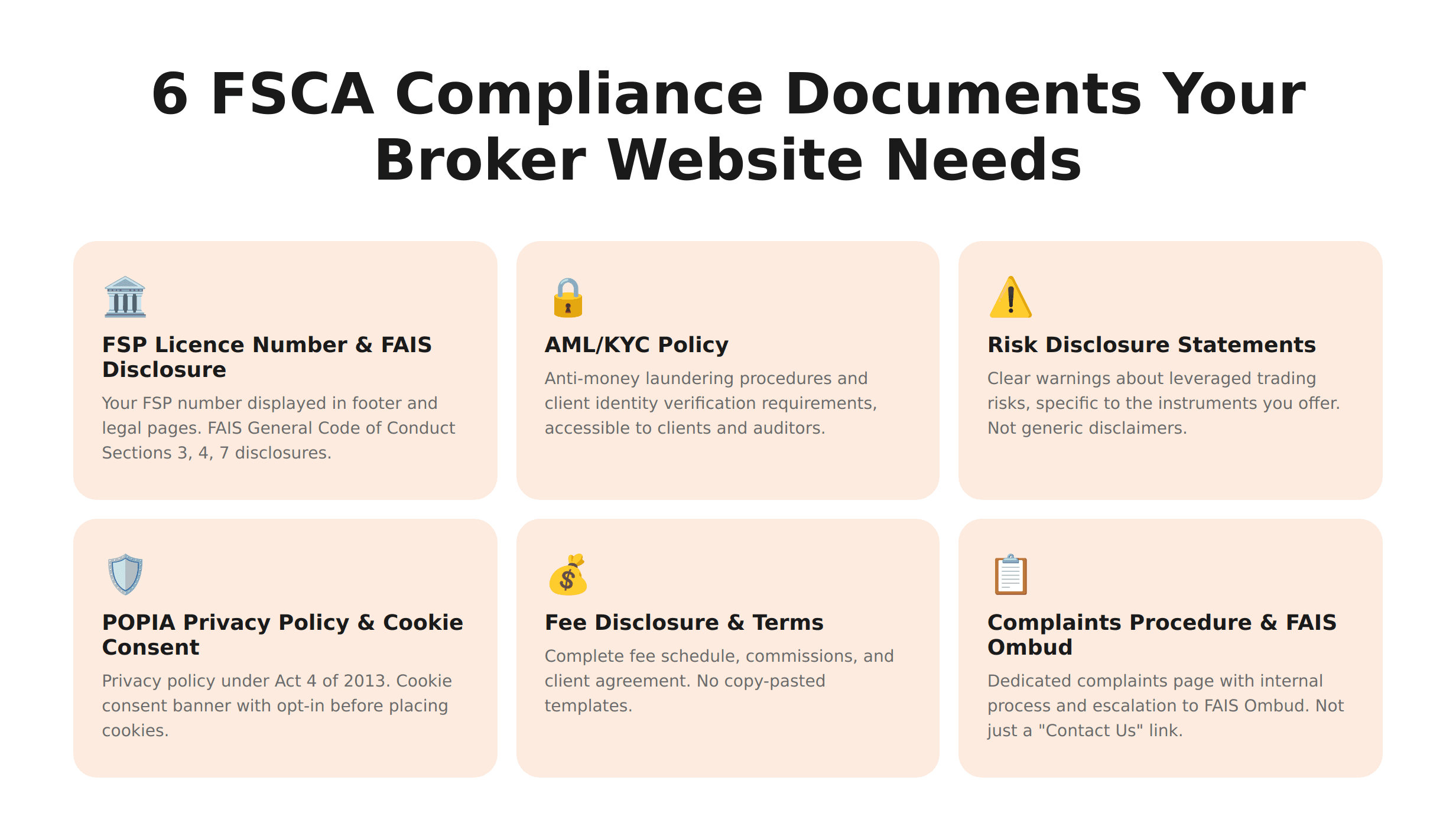
Six categories of compliance documents must be accessible on every FSCA-licensed broker website. These are not optional additions. They are regulatory requirements under the FAIS Act and supporting legislation.
FSP licence number and FAIS disclosure
AML/KYC policy and risk disclosure statements
POPIA privacy policy and cookie consent
Fee disclosure and client agreement
Complaints procedure linked to the FAIS Ombud
Risk warnings for derivatives and leveraged products
FSP Licence Number and FAIS Disclosure
Your Financial Services Provider (FSP) number is the single most important trust signal on your FSCA broker website. It must appear exactly as registered with the FSCA, including the correct legal entity name.
The FAIS General Code of Conduct (Sections 3, 4, and 7) requires that you disclose your legal and contractual status, your relationships with product suppliers, and any material financial interest in those suppliers. These disclosures must be available to clients at the earliest reasonable opportunity.
In practice, your website is the earliest opportunity. A client visiting your site for the first time should immediately see your FSP number in the footer and be able to access your full FAIS disclosure from a dedicated legal page.
AML/KYC Policy and Risk Disclosure Statements
Your Anti-Money Laundering (AML) and Know Your Customer (KYC) policies describe the verification process clients undergo when opening an account. Publishing them on your broker website serves two purposes: it sets client expectations and it demonstrates to regulators that your compliance framework is documented and accessible.
Risk disclosure statements are particularly important for brokers offering derivatives and CFDs. These must clearly explain the risks of leveraged trading, including the possibility of losing more than the initial deposit. Generic risk warnings are not sufficient. The disclosure should reflect the specific instruments you offer.
POPIA Privacy Policy and Cookie Consent
The Protection of Personal Information Act (POPIA), Act 4 of 2013, requires every South African website that collects personal data to publish a privacy policy. For a broker website, this means disclosing what personal information you collect during registration, KYC verification, and trading activity.
Your POPIA-compliant privacy policy must include: what data you collect, where it comes from, how it is processed and stored, who it may be shared with, and how clients can exercise their data rights.
Cookie consent is a separate requirement. Your website must display a consent banner that lets visitors opt in before cookies are placed on their browser. This is not decorative. It is a legal obligation under POPIA.
Fee Disclosure and Client Agreement (Terms and Conditions)
The FAIS Act requires that fee structures, commissions, and charges are disclosed to clients before they commit to a financial service. Your website should publish a clear fee schedule alongside your Terms and Conditions.
Your client agreement governs the relationship between your brokerage and its clients. It should be complete, not copied from a generic template. Regulators and compliance auditors review this document closely, and clients increasingly read it before opening an account.
Complaints Procedure and the FAIS Ombud Link
Every FSCA-regulated broker must provide a clear, accessible complaints procedure that directs clients to the FAIS Ombud as the external dispute resolution body. This is not a suggestion. It is a statutory requirement.
A "Contact Us" page is not a complaints procedure. Your website needs a dedicated complaints page (or a clearly marked section within your legal hub) that explains: how to submit a complaint, the internal resolution timeline, and the escalation path to the FAIS Ombud if the complaint is not resolved. Include the Ombud's contact details directly.
Where to Place Each Document on Your Broker Website
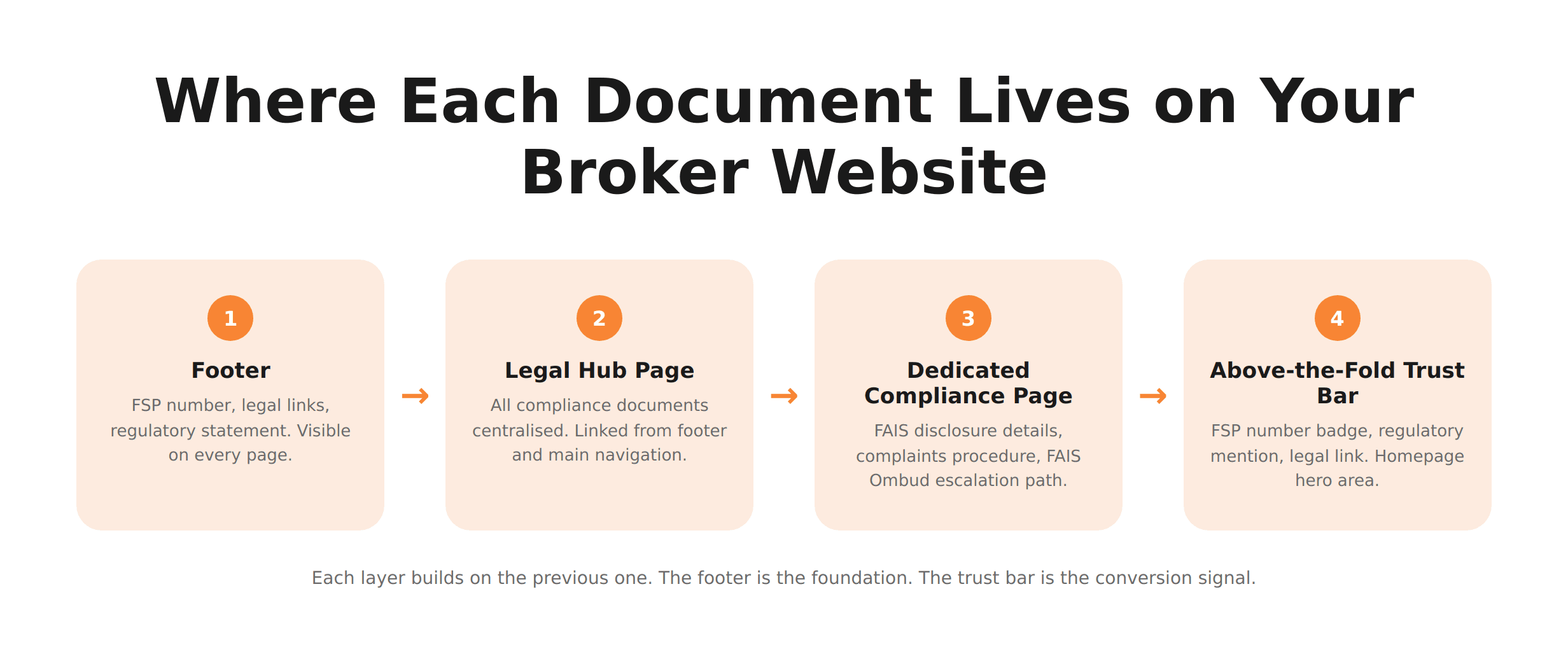
Where you place compliance documents matters as much as which documents you include. A client who can see your FSP number in the footer, find your legal documents in one click, and verify your regulatory status from the homepage is a client who stays on your site.
Footer: FSP Number, Legal Links, and Regulatory Badge
The footer of your FSCA broker website should include your FSP number as a permanent, visible element on every page. Best practice is to display it alongside links to your key legal documents: Terms and Conditions, Privacy Policy, Risk Disclosure, and Complaints Procedure.
Many FSCA-regulated brokers also include a regulatory badge or statement in the footer, such as: "Authorised Financial Services Provider, FSP No. [XXXXX]." This provides immediate reassurance to visitors scanning the page.
Dedicated Legal or Compliance Hub Page
A dedicated compliance page (or legal hub) is where all documents live in one place. This page should be linked from the footer and from the main navigation. It serves as the central access point for clients, regulators, and banking partners reviewing your FSCA compliance.
Structure it cleanly: document name, brief description, and a link to the full document (PDF or dedicated page). Avoid burying legal documents behind multiple clicks or inside obscure menu items.
Above-the-Fold Trust Signals That Build Credibility
The first 5-7 seconds on your homepage determine whether a visitor stays or leaves. For an FSCA broker website, this means placing visible trust signals above the fold: your FSP number, a regulatory mention, and a link to your legal documents.
This is not about cluttering the hero section. It is about making compliance visible without disrupting the design. A well-designed broker website integrates these signals naturally, reinforcing credibility without looking like a legal disclaimer.
Need a Website That Passes the FSCA Compliance Test?
WSA designs broker websites with a dedicated legal hub, structured footer compliance, and above-the-fold trust signals built into the architecture.
Why a Professionally Built Website Makes Compliance Easier
A template broker website rarely meets FSCA compliance requirements without significant modification. The issue is not that templates look unprofessional. It is that they are built for general purposes, not for the specific compliance architecture a regulated broker needs.
What Goes Wrong When Brokers Use Templates for Compliance
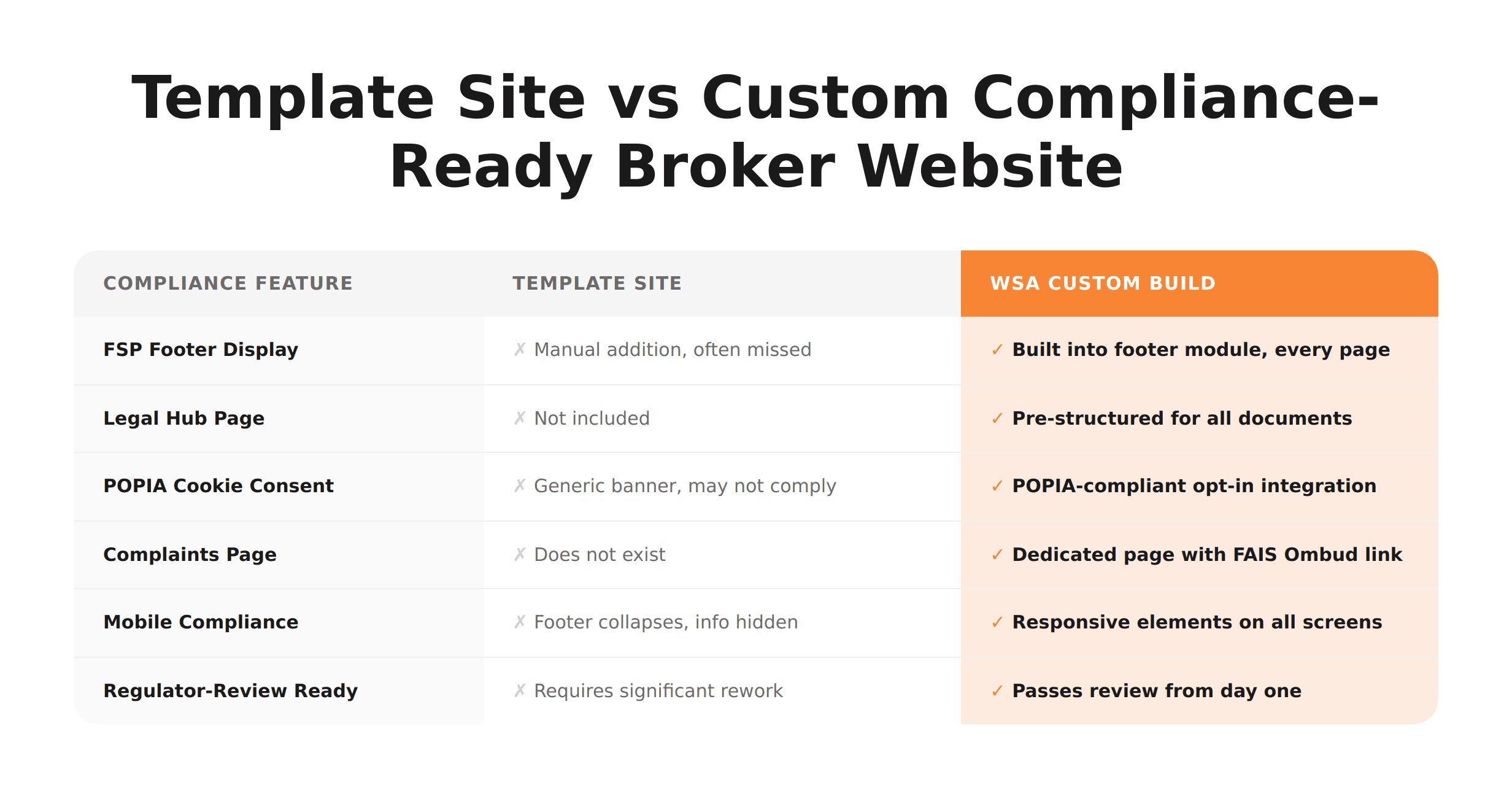
Template broker websites typically lack:
A structured footer with FSP number and legal links. Most templates have a basic footer with social media icons and a copyright notice.
A dedicated legal hub page. Templates rarely include a page designed to house multiple legal documents with clear navigation.
POPIA-compliant cookie consent. Generic cookie banners may not meet South African requirements. POPIA requires opt-in consent, not a dismissible notification.
A complaints page linking to the FAIS Ombud. This page simply does not exist in any standard template.
Mobile compliance visibility. On mobile devices, footer compliance information often collapses into unreadable menus.
The result: brokers spend weeks patching a template to meet FSCA requirements, often at a higher cost than building correctly from the start.
How WSA Designs Compliance Into the Website Architecture
WSA builds FSCA broker websites on Framer with compliance architecture included from the design phase. This means every required document has a designated home in the site structure before a single page is designed.
WSA's approach includes a compliance footer module (FSP number, legal links, regulatory statement on every page), a legal hub page template (structured for multiple documents with clear navigation), POPIA-compliant cookie consent integration, a dedicated complaints page with FAIS Ombud escalation path, and mobile-responsive compliance elements that remain visible on all screen sizes.
The result: your website passes regulatory review, banking due diligence, and the client trust test on day one. No patching. No compliance gaps discovered after launch.
FAQ
What documents must an FSCA-licensed broker display on their website?
An FSCA-licensed broker must make six categories of documents accessible on their website: FSP licence number and FAIS disclosure, AML/KYC policy, risk disclosure statements, a POPIA-compliant privacy policy with cookie consent, fee disclosure and client agreement (Terms and Conditions), and a complaints procedure that directs clients to the FAIS Ombud.
Where should I put my FSP licence number on my broker website?
Your FSP number should appear in the footer of every page on your website, exactly as registered with the FSCA. This is the first place clients and regulators look. Additionally, include it on your About page, in your FAIS disclosure document, and ideally as a trust signal in the homepage hero area.
Does my FSCA broker website need a POPIA privacy policy?
Yes. If your website collects any personal information from South African residents (including during registration, KYC verification, or through cookies and analytics), you are required to publish a POPIA-compliant privacy policy.
Can I use a website template for an FSCA-regulated brokerage?
You can, but templates rarely meet FSCA compliance requirements without substantial modification. Most templates lack a structured compliance footer, a legal hub page, POPIA-compliant cookie consent, and a dedicated complaints page with FAIS Ombud escalation.
How do South African clients verify if a broker is FSCA-regulated?
South African clients typically follow a two-step process. First, they look for the FSP number on the broker's website. Second, they search that number on the official FSCA register at fsca.co.za to confirm the licence is active and the details match.
Ready to Build a Compliance-Ready FSCA Broker Website?
WSA designs and develops broker websites with every required document in place, every trust signal visible, and every compliance page structured for FSCA review.
Conclusion
Your FSCA licence is the starting point. Your website is where that licence becomes visible, verifiable, and meaningful to the people who matter: your clients, your banking partners, and the regulator.
Every compliance document has a place on your broker website. The FSP number belongs in the footer. FAIS disclosures, AML/KYC policies, risk warnings, and your POPIA privacy policy belong in a dedicated legal hub. The complaints procedure must lead to the FAIS Ombud.
Getting this right from day one means fewer compliance gaps, faster banking approvals, and higher client trust.
WSA builds FSCA broker websites with this compliance architecture included from the first wireframe. As a fintech web design agency specialising in regulated broker sites, WSA has seen what happens when compliance is treated as an afterthought. If your licence is ready and your website is not, that is the gap to close now.
Launch Your Licensed Brokerage with Confidence
We support brokers and fintechs through licensing, launch planning, and everything a regulated brand needs to go live.