•
•

GEO for Fintech Websites: How to Show Up in AI Search
A prospect searches for "best payment infrastructure for B2B SaaS" on Perplexity. ChatGPT gets asked which forex broker platforms are regulated in the EU. Google's AI Overview surfaces a curated answer about crypto custody services. In each case, AI engines select two to seven sources to cite — and hundreds of fintech websites that rank in Google get no mention at all.
This is the shift that GEO for fintech websites addresses. Generative engine optimization — the practice of structuring your site so AI search engines cite it when generating answers — is now as important as traditional SEO for financial brands. AI Overviews now appear in 25.8% of all Google queries in the Financials industry — the second-highest rate across all sectors — meaning one in four financial searches already surfaces an AI-generated answer before any organic result (Conductor, 2026). LLM-sourced visitors typically convert at 4–6× the rate of standard organic traffic.If your fintech website isn't built for AI citability, it won't show up where your next client is already looking.
Key Takeaways
GEO (generative engine optimization) is the practice of optimising your website to be cited by AI engines like Google AI Overviews, Perplexity, and ChatGPT — not just ranked in search results.
Finance content falls into the YMYL (Your Money or Your Life) category, which means AI engines apply the highest level of scrutiny before citing it.
Structured data (schema markup), semantic HTML, and trust signal design are the technical foundations of GEO — and they must be built into your site, not added as an afterthought.
Compliance documentation — certifications, licensing badges, regulatory disclosures — is a GEO asset when designed correctly into page structure.
GEO results in finance typically take 4–8 months to become significant; the earlier you start, the larger your advantage.
What Is GEO — and Why Fintech Websites Can't Ignore It
GEO — generative engine optimization — is the practice of structuring your website so AI search engines cite it when generating answers. Unlike traditional SEO, which targets ranking positions in a list of links, GEO targets citations in a single synthesised response. When ChatGPT answers a question about payment solutions, it doesn't show ten links — it references two to seven sources it treats as authoritative. GEO is about being one of them.
For fintech brands, the stakes are clear. According to G2's 2026 AI Search Insight Report (n=1,076 B2B buyers), 71% of B2B software buyers now rely on AI chatbots for vendor research — and 51% begin their search with an AI chatbot rather than Google, up from 29% just seven months prior.The generative AI in financial services market was valued at $2.21 billion in 2024 and is projected to reach $25.71 billion by 2033 (Grand View Research). AI search isn't a future trend — it's the channel where your buyers already are.
How GEO Differs from Traditional SEO
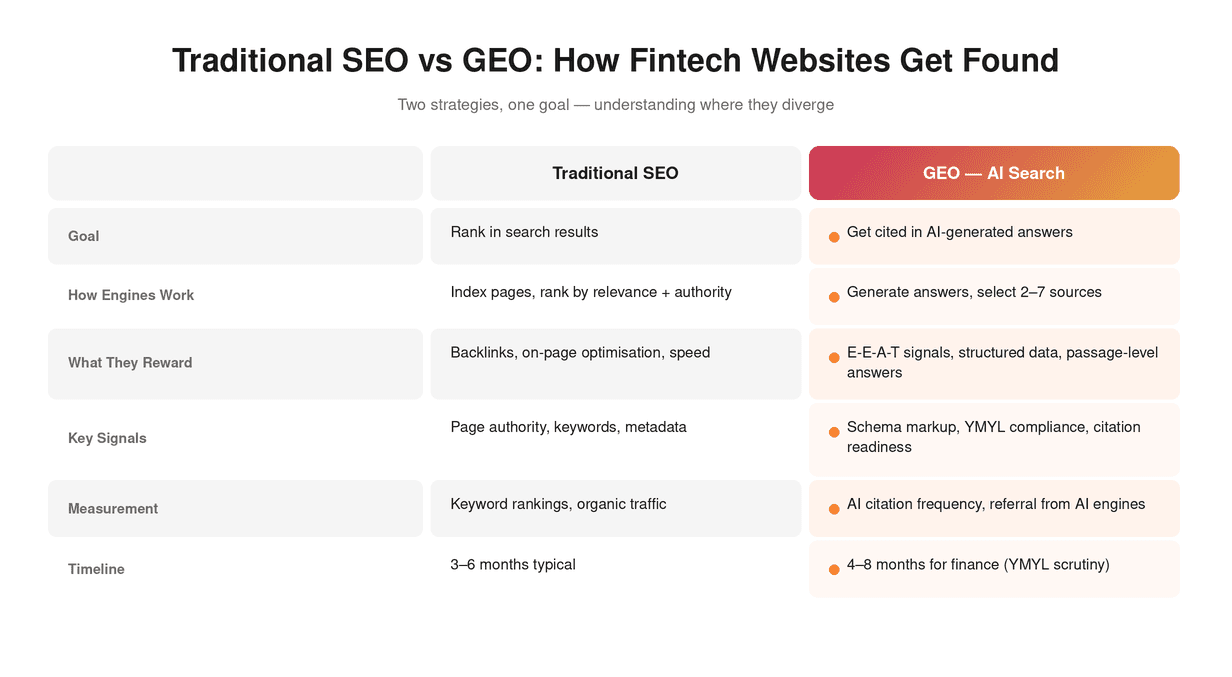
SEO is about indexing and ranking. GEO is about being cited and trusted. The table below captures the core differences:
Dimension | Traditional SEO | GEO |
|---|---|---|
Goal | Rank in search results | Get cited in AI-generated answers |
How engines work | Index pages, rank by relevance + authority | Generate synthesised answers, select sources |
What they reward | Backlinks, on-page optimisation, speed | E-E-A-T signals, structured data, passage-level answers |
Key signals | Page authority, keywords, metadata | Schema markup, YMYL compliance, citation readiness |
Measurement | Keyword rankings, organic traffic | AI citation frequency, referral traffic from AI engines |
Timeline | 3–6 months typical | 4–8 months for finance (higher scrutiny) |
Both strategies share the same foundation: a well-built, authoritative website. But the tactics diverge at the content structure level — which is where your fintech GEO strategy begins.
Want Your Fintech Site to Show Up in AI Search?
WSA audits fintech websites for GEO readiness — from schema markup to trust signal design.
Why AI Search Engines Favour Fintech Content Differently
Finance content falls into the YMYL (Your Money or Your Life) category — the highest-scrutiny tier for AI engines. Google defines YMYL as content that could directly affect a person's financial stability, health, or safety. AI engines apply additional verification layers before citing it.
This has two practical consequences. First, Google AI Overviews appear for 91% of educational financial queries ("What is...") but only 7% of real-time data queries. Educational, well-structured content is far more likely to earn a citation. Second, AI platforms cite only 2–7 domains per response — in fintech, only sources demonstrating clear authority make the cut. YMYL is not a constraint for prepared fintech companies; it's a filter that eliminates under-prepared competitors.
How AI Search Engines Evaluate Fintech Websites
AI engines don't evaluate websites by traffic or backlinks alone. For fintech, three signals determine citability: structured data, E-E-A-T, and compliance transparency. Getting any one of these wrong means being passed over for a competitor who got all three right.
E-E-A-T Signals That Drive AI Citability
E-E-A-T — Experience, Expertise, Authoritativeness, Trustworthiness — is Google's framework for evaluating source credibility. For AI engines, it functions as a citation filter. The finance vertical carries the highest E-E-A-T requirements of any content category.
In practice, E-E-A-T for fintech web design means:
Experience: Author bios with verifiable credentials, institutional affiliations, and publication dates on every article. AI engines look for evidence that real practitioners wrote the content.
Expertise: Precise use of regulatory and technical terminology. Vague claims are skipped; specific, verifiable ones get cited.
Authoritativeness: Cross-references to credible fintech sources via inline links. Internal links to related resources demonstrate consistent editorial depth.
Trustworthiness: Compliance disclosures, regulatory licensing details, and honest acknowledgment of limitations. Hedged language ("typically", "in most cases") signals intellectual honesty to AI engines — not weakness.
In WSA's experience building fintech websites, clients who structure author attribution correctly and display licensing information in dedicated, schema-marked sections see measurably faster AI citation uptake.
Structured Data and Schema Markup for Financial Brands
Structured data gives AI engines a machine-readable layer of meaning. Without it, even well-written content may be passed over in favour of a competitor whose information is explicitly labelled.
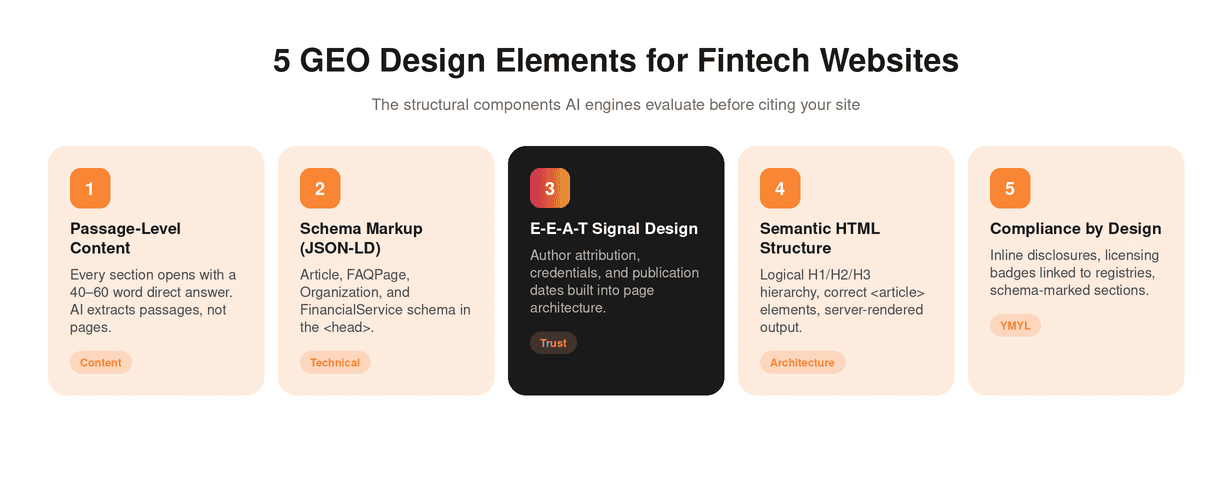
For financial brands, the essential schema types are:
Article — marks content as an authoritative written resource (always required)
FAQPage — flags question-and-answer sections for direct extraction (use on every article with a FAQ)
Organization — defines your brand entity, name, URL, and logo
FinancialProduct / FinancialService — classifies your specific offerings with machine-readable properties including jurisdiction, license number, and fee structures
All schema markup should be implemented in JSON-LD format, placed in the <head>, and validated with Google's Rich Results Test. JSON-LD is Google's recommended format because it separates markup from display logic, reduces developer error, and makes updates easier when product details change.
GEO Optimisation Techniques for Fintech Websites
Optimising a fintech website for GEO is a structural challenge as much as a content one. The techniques that increase AI citability work at the level of page architecture, content formatting, and trust signal design. This is where AI search fintech SEO diverges from conventional content marketing — and where fintech-specialist web design becomes the deciding factor.
Writing Content AI Engines Can Extract and Cite
AI engines extract passages, not pages. Content structured as direct answers — question heading, immediate definition, supporting detail — is cited at significantly higher rates than content written in essay form.
When thinking about how to optimize fintech content for AI search, the core principle is this: every section should be answerable on its own. Apply it at every heading:
Direct answer first: The first 40–60 words after any heading must answer the implicit question of that heading — no filler, no preamble.
Q&A structure in FAQs: AI engines scan for content structured as a question followed by an immediate, self-contained answer. FAQ sections are among the most-cited content formats for this reason.
Avoid context collapse: Each factual claim should carry enough context to be accurate when extracted without the surrounding paragraph. State rates, entities, and qualifications within the same sentence, not across sentences.
LLM optimization fintech content means writing for extraction as much as for reading. These two goals are compatible — clear, passage-level writing is also better for your human readers.
Page Architecture and Semantic HTML Structure
Semantic HTML tells AI engines what each block of content represents — not just how it looks. A heading marked as <h2> signals a major section. An <article> element wraps a complete piece of content. A <header> scopes the author and publication metadata.
For fintech websites, semantic structure means:
Logical heading hierarchy: H1 for the page title, H2 for major sections, H3 for sub-topics — no skipped levels, no decorative headings used for styling
Correct element use:
<article>for editorial content,<section>for grouped topics,<aside>for supplementary information,<footer>for disclaimersClean URL structure:
/news/geo-for-fintech-websitessignals topical relevance directly to crawlers and AI parsersServer-rendered HTML: AI crawlers don't execute complex JavaScript reliably; structured data in the
<head>and server-rendered content ensure schema is parsed correctly
This is the structured data fintech website consideration that most content guides miss — because it's a web development question, not a content one.
Building Trust Signals Into Your Web Design
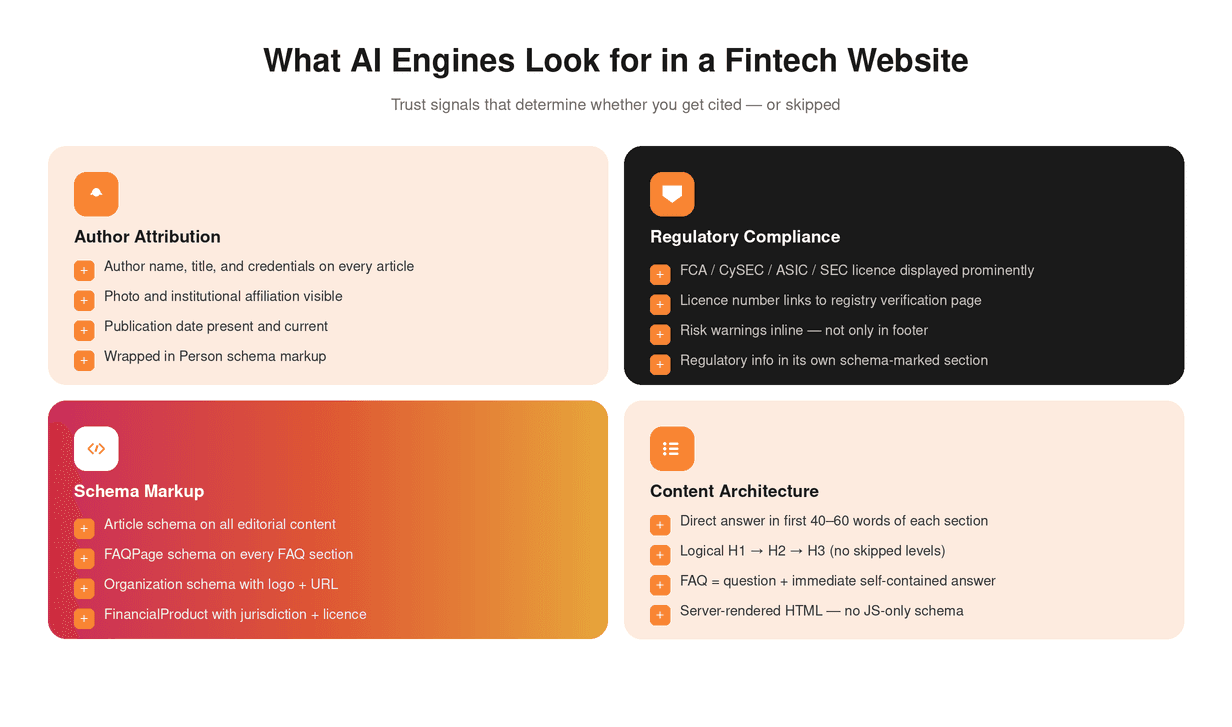
Trust signals embedded in page design — author bios, certification badges, disclosure statements, institutional logos — are machine-readable credibility markers, not just visual elements. When designed with the correct HTML semantics and linked schema, they become direct inputs to AI engine trust scoring for AI search visibility fintech.
Key design patterns:
Author attribution blocks: A dedicated author section with name, title, credentials, and photo — wrapped in
Personschema — is treated as an expertise signalRegulatory badge placement: FCA, CySEC, ASIC, or SEC licensing displayed prominently, linked to the registry entry, is a trustworthiness signal AI engines can verify
Disclosure sections: Platform risk warnings and terms presented inline (not only in the footer) score higher for YMYL compliance
Testimonial structure: Client testimonials with company name, role, and date in structured markup contribute to authority signals
The Compliance Advantage: How Regulatory Rigour Improves GEO
Regulated fintech companies have a structural GEO advantage that most content agencies overlook: compliance documentation is exactly what AI engines look for as trust evidence. The certifications, licensing information, and regulatory disclosures your legal team requires are, when designed into the page structure correctly, strong E-E-A-T signals that unregulated competitors simply can't replicate.
Here's what most fintech teams miss: compliance documentation isn't separate from GEO — it's one of your strongest citation signals.
Compliance-by-design fintech means treating regulatory requirements as content architecture decisions, not just legal ones. The outcome is a website that satisfies regulators and earns AI citations — two goals that reinforce each other when approached together as part of your fintech GEO strategy.
Designing Disclosures and Certifications for AI Visibility
Most fintech websites handle compliance by placing disclosures in footers or on separate terms pages. From a GEO perspective, this is a missed opportunity. Disclosures placed inline — near the claims they qualify — are more likely to be extracted accurately by AI engines.
Practical design decisions for compliance-by-design fintech web design:
Display your regulatory license number and jurisdiction on the homepage and all product pages, marked with Organization or FinancialService schema
Use inline risk warnings near specific rate or performance claims — not only in fine print
Link certification badge images to registry verification pages so AI engines can follow the reference
Separate regulatory body information into its own schema-marked
<section>rather than embedding it in general footer text
Dynamic Content and Real-Time Data Considerations
Fintech sites often display live data — exchange rates, interest rates, asset prices. These present a specific GEO challenge: AI engines index cached snapshots, not live feeds. Rates that differ between your page and an AI's last crawl create citation errors that damage trust.
The architectural solution: use static structured data blocks for product descriptions, certifications, and institutional claims — the content AI should cite — while keeping dynamic data components clearly scoped and outside schema-marked regions.
Building a Fintech Website That Earns AI Citations
WSA designs GEO-ready fintech websites — schema implementation, trust signal design, and compliance architecture included from day one.
How WSA Designs Fintech Websites for GEO and AI Visibility
Most web agencies focus on how a website looks and loads. WSA's approach to fintech websites builds GEO requirements into the structure from the first wireframe. GEO for financial brands isn't a separate workstream — it's part of how WSA scopes every fintech build.
In practice, that means:
Schema implementation from the build: Article, FAQPage, Organization, and FinancialService schema are part of the technical brief for every project — not a post-launch checklist item
Framer and Webflow semantic output: Both platforms produce clean, parse-ready HTML when configured correctly. WSA's builds follow strict heading hierarchy and element semantics that AI crawlers can read reliably
Trust signal design patterns: Author attribution sections, compliance badge placements, and disclosure blocks are designed components in WSA's fintech design system — tested for user comprehension and AI extraction
AI search fintech SEO as a design brief requirement: Before any page goes to development, content structure is reviewed against GEO criteria — passage-level answers, direct definitions, schema readiness
The result is a fintech website that ranks on Google and gets cited in ChatGPT, Perplexity, and Google AI Overviews — because the structural foundations support both.
Conclusion
AI search has changed where fintech buyers form their first impressions. Google AI Overviews, Perplexity, and ChatGPT are now channels where your next client may encounter your brand for the first time — or not at all. GEO for fintech websites is the discipline that determines which outcome you get.
The foundation remains the same: a well-built, authoritative website. What's different is the structural layer above it — schema markup, semantic page architecture, E-E-A-T signal design, and compliance documentation treated as a visibility asset. These aren't purely content decisions. They're design and development decisions.
FAQ
What is GEO and how is it different from SEO for fintech?
GEO (generative engine optimization) is the practice of optimising your website to be cited in AI-generated answers, rather than ranked in a list of search results. Traditional SEO focuses on keyword rankings and backlinks so your page appears in Google search results. GEO focuses on E-E-A-T signals, structured data, and passage-level content so AI engines like ChatGPT, Perplexity, and Google AI Overviews select your site as a source when generating answers. For fintech companies, both matter — SEO builds the authority foundation, while GEO captures citations in the AI channels where 68% of B2B decision-makers now begin their research.
How do I get my fintech website cited in AI search results?
Getting AI citations requires three elements working together. First, structure your content with direct answers at the start of every section — AI engines extract passages, not pages. Second, implement schema markup: Article, FAQPage, Organization, and FinancialService schema tell AI engines what your content is and who published it. Third, build E-E-A-T signals into the page design — author attribution with credentials, regulatory licensing linked to registry entries, and inline compliance disclosures. Finance content sits in the YMYL category, so AI engines require the highest level of verification. Websites that provide it clearly are cited; those that don't, aren't.
Does web design affect GEO performance?
Yes — significantly. Page architecture, semantic HTML structure, and trust signal design all directly affect how AI engines process and cite your content. A site with logical heading hierarchy, properly scoped article and section elements, and schema markup in the head gives AI engines a clear, machine-readable signal map. A site with inconsistent headings, missing schema, and disclaimers only in the footer gives AI engines nothing reliable to cite. This is why working with a fintech web design specialist — rather than a content-only agency — makes a measurable difference to GEO performance.
What structured data does a fintech website need for AI search?
At minimum, fintech websites should implement four schema types: (1) Article — for all editorial and blog content; (2) FAQPage — for FAQ sections on articles and product pages; (3) Organization — to define your brand entity, name, logo, and URL; and (4) FinancialProduct or FinancialService — to classify your specific offerings with machine-readable properties including jurisdiction, license number, and fee structures. All schema should be in JSON-LD format, placed in the head of each page, and validated using Google's Rich Results Test. For companies with multiple products, each product page should carry its own FAQPage and FinancialProduct schema.
How long does it take to see GEO results for a fintech site?
Finance GEO typically takes 4–8 months to show significant results — longer than most other industries. The reason is the YMYL classification: AI engines apply higher scrutiny before citing financial content, which means you need a consistent track record of accurate, well-structured content before AI citation frequency increases. Some structural changes — schema markup, heading corrections, FAQ implementation — can produce first citations within 30–45 days for lower-competition queries. Meaningful traffic impact typically appears at the 90-day mark. The key is starting early: fintech companies that invest in GEO now will have a compounding advantage as AI search continues to grow.
Launch Your Licensed Brokerage with Confidence
We support brokers and fintechs through licensing, launch planning, and everything a regulated brand needs to go live.