•
•

NFT Marketplace Website Development: What You Need to Know
You have a collection, a brand, or a community ready to trade digital assets. So you brief an agency to "build the NFT marketplace," and the quotes come back ten times apart, because half the teams are pricing a website and the other half are pricing on-chain engineering. That gap is the single most expensive misunderstanding in NFT marketplace development.
Here is the part most guides skip: an NFT marketplace is two products stacked together. There is the front-end: the brand, the gallery, the listing pages, the minting screen people actually touch. And there is the on-chain layer: smart contracts, custody, indexing, the part that records who owns what. Knowing which layer you are buying, and from whom, is what keeps a marketplace website project on budget.
This guide covers what the site genuinely needs, the marketplace types and the design decisions behind each, the realistic tech stacks, and an honest account of what a Webflow agency like WSA can and can't build.
Key Takeaways
An NFT marketplace website is two layers: a front-end (brand, gallery, minting UI) and an on-chain layer (smart contracts, custody, indexing). Price and staff them separately.
Five things separate a marketplace site from a standard one: wallet connection, on-chain reads, a minting interface, gas-fee display, and a collection gallery.
Marketplace type (curated, open, brand-specific, or game-integrated) decides your whole information architecture. Choose it before design starts.
The minting flow and wallet UX are where marketplaces lose users. Step-by-step approval clarity beats visual polish.
Three front-end stacks dominate: Webflow + custom JS for marketing and showcase, Next.js + ThirdWeb or React + Moralis for a fully interactive marketplace.
Webflow is excellent for the marketing, brand, and showcase layer with light wallet reads, but a full transactional minting and trading dApp needs a framework build.
What an NFT Marketplace Website Needs That a Standard Site Doesn't
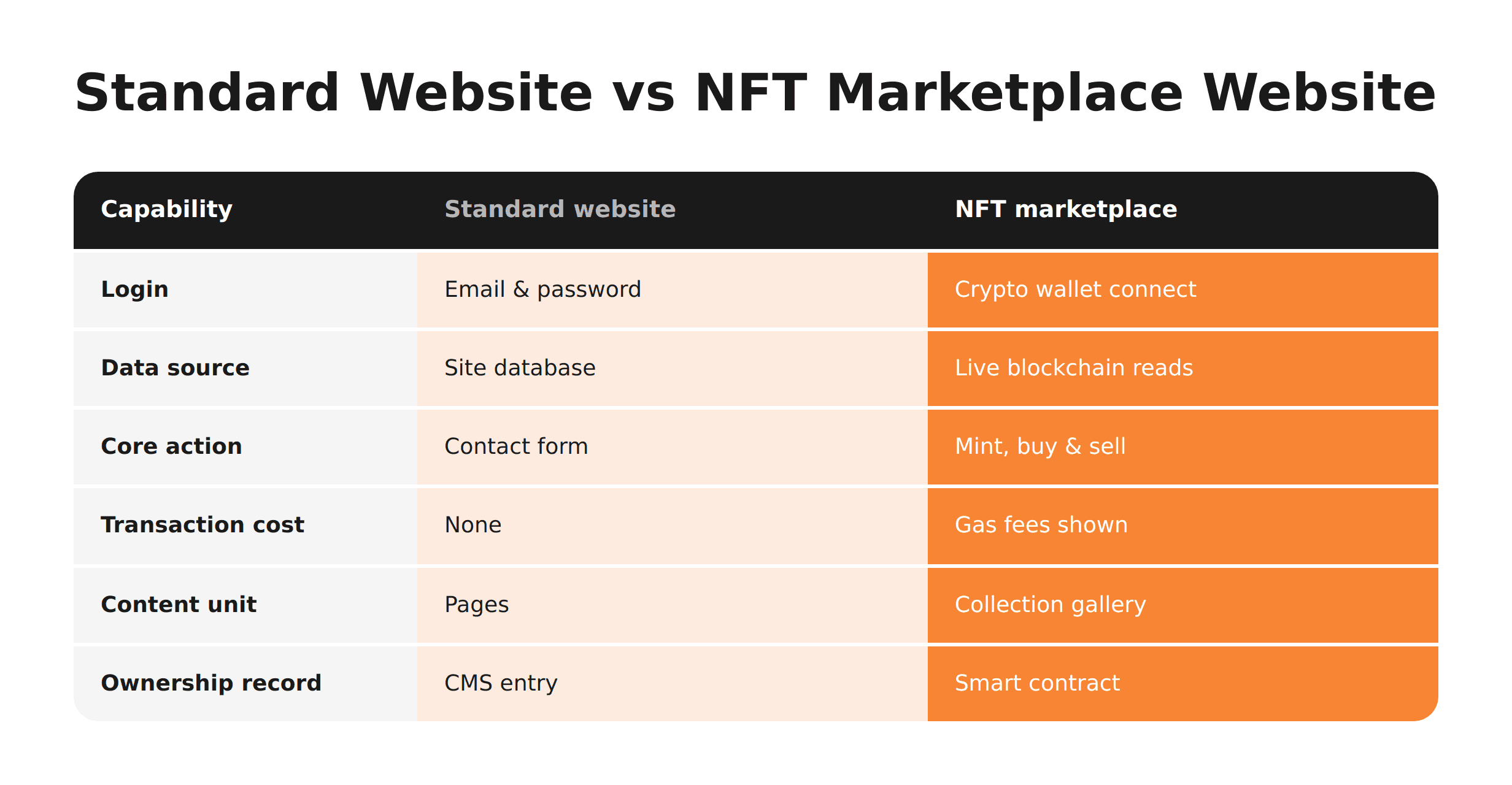
An NFT marketplace website needs five things a standard marketing site never asks for: wallet connection, live on-chain data reads, a minting interface, honest gas-fee display, and a collection gallery built for thousands of items. Miss any one and the site stops being a marketplace.
A normal website collects a form and emails you. A marketplace has to talk to a blockchain: read ownership, trigger transactions, and reflect state that changes every block. That single requirement reshapes the whole build.
Wallet connection and on-chain interaction
Wallet integration is the front door. Instead of an email-and-password login, users connect a crypto wallet like MetaMask or any WalletConnect-compatible app, and that wallet becomes both their identity and their payment method.
Behind the connect button, the site has to read on-chain data: which tokens a wallet holds, what's listed, what sold. That data doesn't sit in your database. It lives on the blockchain and is pulled through an indexing service or Web3 API.
What this means: the moment you need wallet login and live ownership data, you've left standard website territory. This is the line where a marketing site becomes a Web3 application, the same line we cover in our guide to build a crypto exchange website.
Minting UI, gas fee display, and the collection gallery
Minting is the act of turning a digital file into an NFT recorded on-chain. The minting UI has to walk a user through upload, metadata, a royalty setting, and a wallet signature, clearly enough that a first-timer doesn't abandon at the signature prompt.
Gas fees are the network's transaction cost, and they move constantly. An honest marketplace shows the likely fee before the user signs, rather than surprising them mid-transaction. The collection gallery, the grid where assets live, has to stay fast and readable whether it holds 50 items or 50,000.
Not Sure Which Layer You Actually Need?
Most NFT teams overpay because front-end and on-chain work get quoted as one thing. A scoping call separates them.
NFT Marketplace Types (and What Each One Demands From Design)
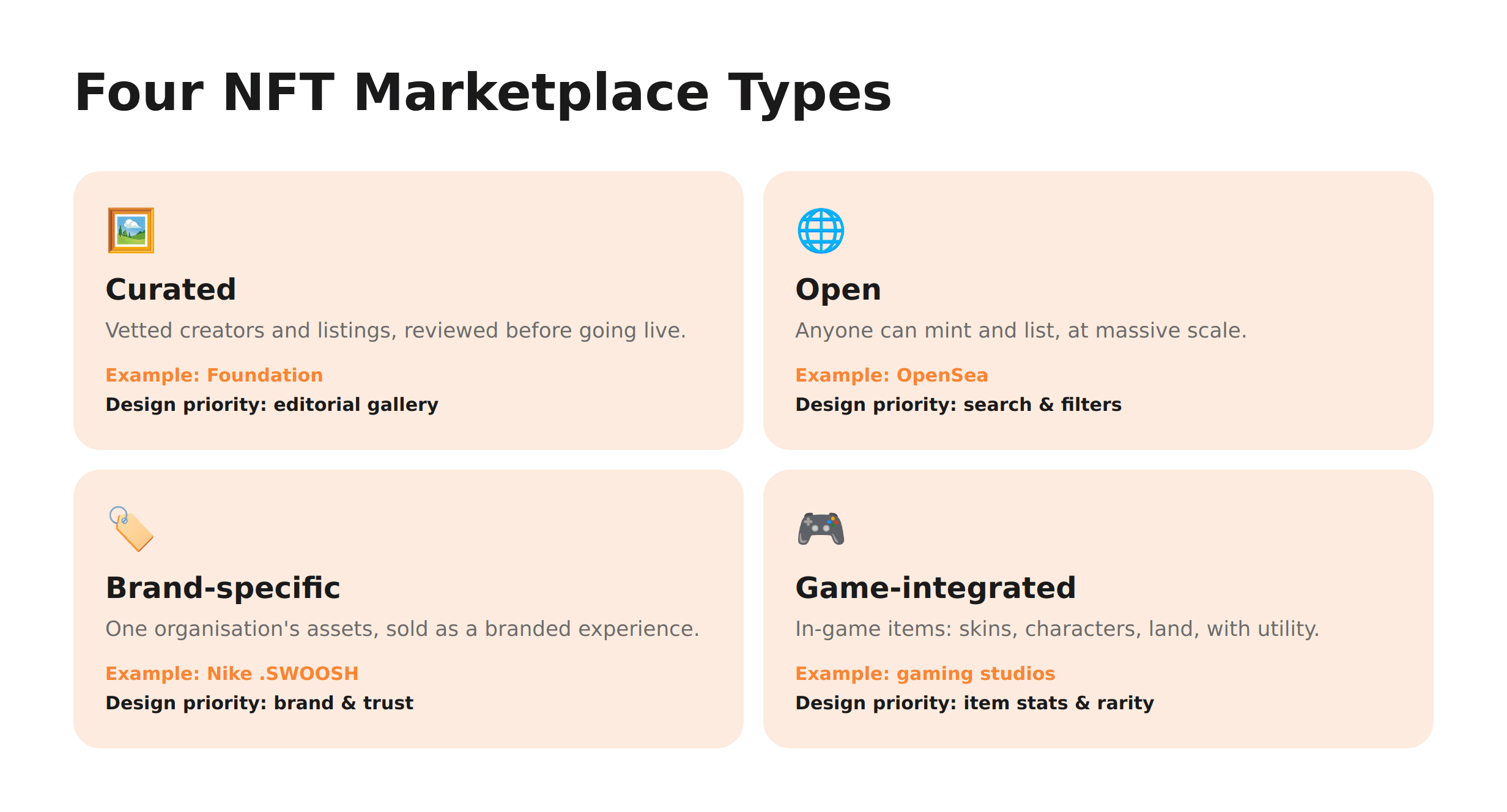
NFT marketplaces fall into four main types, and each one demands a different information architecture. Pick your type before any design work begins. It changes navigation, page templates, and how much of the build is brand versus utility.
Curated, open, brand-specific, and game-integrated
Curated marketplaces review every creator and listing before it goes live, like Foundation. Design leans editorial: fewer items, bigger imagery, strong creator storytelling, a gallery that feels like a showroom rather than a catalogue.
Open marketplaces let anyone mint and list, like OpenSea. Here the design problem flips to scale: search, filters, sorting, and category navigation have to handle millions of items without overwhelming the buyer.
Brand-specific marketplaces sell one organisation's assets, like Nike's .SWOOSH. The site is a brand experience first and a marketplace second, so visual identity and trust signals carry more weight than open discovery.
Game-integrated marketplaces trade in-game items such as skins, characters, or land. Design has to match the game's world and surface item stats, rarity, and utility, not just a price.
Key Design Decisions That Make or Break a Marketplace
The design decisions that make or break a marketplace are mostly about clarity under pressure: helping a user understand what they own, what they're buying, and what it costs, at the exact moment money moves. NFT website design lives or dies on these moments.
Listing grid and collection hierarchy
The listing grid is the workhorse screen. It has to load fast, stay scannable, and show the few facts that matter (image, name, price, collection) without clutter. Collection hierarchy is how you group items so a buyer can move from a collection down to a single asset and back without getting lost.
Get hierarchy wrong and discovery collapses. Buyers bounce when they can't tell where one collection ends and another begins.
Creator profiles, minting flow UX, and royalty display
Creator profiles carry trust. A clear profile, with verified status, past work, and links, is often what separates a confident purchase from a closed tab.
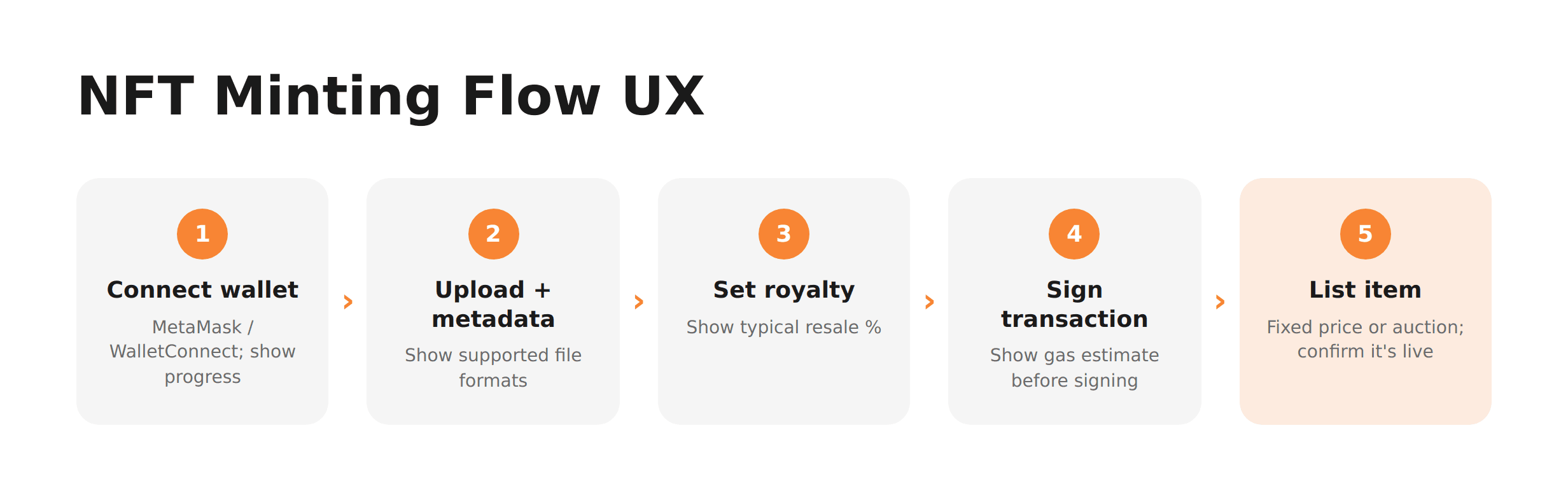
The minting flow is where most marketplaces quietly lose people. Each step (connect wallet, upload file and metadata, set a royalty, sign the transaction, list the item) needs a plain-language label and a visible sense of progress. Royalty display matters too: creators set a resale percentage (commonly between 2% and 10%, often around 6% under the ERC-2981 royalty standard), and the interface should show it honestly. Enforcement varies between marketplaces, so the design shouldn't promise a guarantee the chain can't keep.
Your Minting Flow Is Your Conversion Funnel
A confusing wallet approval loses the sale. We design Web3 front-ends where the flow is the feature.
Tech Stack Options for NFT Marketplace Front-Ends
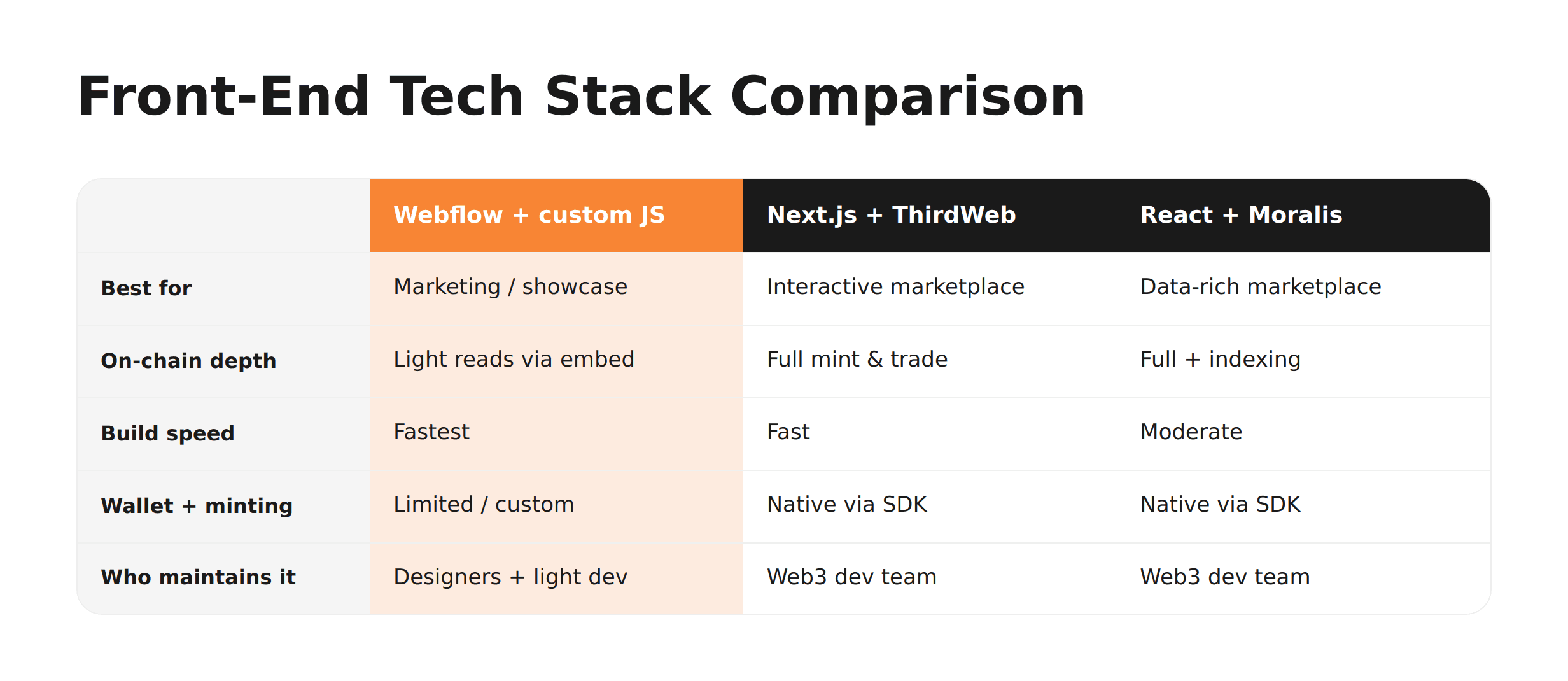
Three common front-end stacks power NFT marketplaces, and the right one depends entirely on how much live, on-chain interaction your site actually needs. The choice isn't about taste; it's about whether you're building a showcase or a trading application.
Webflow + custom JavaScript suits a marketing and showcase front-end with light on-chain reads. You get fast, designer-controlled pages and a clean CMS, then add custom embeds to display collection data pulled from an API. It's the fastest route to a polished brand site, but it isn't built to run a full minting and trading engine.
Next.js + ThirdWeb is a strong choice for a genuinely interactive marketplace. ThirdWeb's SDK bundles wallet connection, NFT rendering, and prebuilt marketplace contracts, which compresses weeks of integration into days, as shown in its official Next.js marketplace guide. Its v5 SDK is modular, so you import only what you need.
React + Moralis is the pick when user accounts and real-time data matter most. Moralis emphasises authentication and indexed Web3 data, making it well-suited to marketplaces that need rich profiles and live transaction feeds. Whichever stack you choose, the contracts behind it follow the same ERC-721 token standard for unique assets.
Across all three, large media files don't live on-chain. They sit on decentralised storage like IPFS, with the blockchain holding the pointer.
What WSA Can (and Can't) Build in Webflow for NFT Projects
Here's the honest version most agencies won't put in writing: Webflow is the right tool for the brand and showcase layer of an NFT project, and the wrong tool for a full transactional dApp. We'd rather tell you that up front than discover it mid-build.
What WSA can build well in Webflow for NFT projects:
A high-craft marketing site, drop landing pages, and brand storytelling
A collection showcase and creator pages, with on-chain data displayed through custom JavaScript embeds pulling an indexer or Web3 API
A wallet-connect button and read-only views (e.g. "items in this collection," floor data) via custom code
Fast CMS-driven content (blog, FAQ, roadmap) that scales without a developer
What Webflow can't do, and where you need a framework build (Next.js or React) instead:
Native wallet connection and on-chain transaction signing without custom embeds
Minting, buying, or trading directly, since there is no native smart-contract interaction
Real-time gas-fee estimation as a built-in feature
A full trading engine with auctions, bids, and live order state
In practice, the strongest NFT marketplace development setups split the work: WSA delivers the front-end and brand layer in Webflow, and a blockchain engineering team owns the contracts and custody. When a project needs the whole interactive marketplace in one codebase, that's a framework build, and we'll say so rather than stretch Webflow past where it belongs.
What an NFT Marketplace Front-End Looks Like in Practice
Picture a brand launching a 5,000-piece collection. The realistic scope splits cleanly. (This is an illustrative example, not a specific client engagement.)
The front-end, built fast in Webflow, carries the launch: a brand-led homepage, a drop page with a countdown, a collection gallery pulling live mint counts through a custom embed, creator and FAQ pages, and a wallet-connect button for read-only ownership checks. That's the layer where design and conversion live, and it ships in weeks.
The on-chain layer (smart contracts for the collection in ERC-721 or ERC-1155, the minting logic, and royalty rules) is handled by a blockchain team and connected to the front-end. The website's job is to make that machinery feel simple: clear minting steps, honest gas display, and a gallery that loads.
The takeaway: a great NFT marketplace website isn't one heroic build. It's a clean division of labour where the front-end earns trust and conversions, and the chain does what only the chain can.
FAQ
What is NFT marketplace development?
NFT marketplace development is the process of building a platform where users can mint, list, buy, sell, and trade NFTs. It spans two layers: the front-end website (brand, gallery, listing pages, minting interface) and the on-chain layer (smart contracts, wallet interaction, royalty logic, and decentralised storage). The front-end is where a design agency adds the most value; the on-chain layer needs blockchain engineering. Treating them as one undifferentiated project is the most common reason quotes and timelines blow out.
How much does it cost to build an NFT marketplace website?
It depends almost entirely on which layer you're building. A polished marketing and showcase front-end with read-only on-chain data is a relatively contained website project. A fully interactive marketplace with native minting, trading, auctions, and custody is a software build with ongoing smart-contract and security costs, and lands in a much higher range. Because numbers vary widely by scope, the most useful first step is a scoping call that separates the front-end from the on-chain work so each is priced honestly rather than bundled into one vague figure.
Can you build an NFT marketplace in Webflow?
You can build the marketing, brand, and showcase layer of an NFT marketplace in Webflow, with wallet-connect and read-only on-chain data added through custom JavaScript embeds. What you can't do in Webflow is run native minting, trading, or transaction signing, because there's no built-in smart-contract interaction or real-time gas estimation. For a full transactional marketplace, the build moves to a framework like Next.js or React. Many successful projects use Webflow for the front-end and a separate engineering team for the on-chain layer.
What's the difference between an open and a curated NFT marketplace?
An open marketplace lets anyone mint and list assets without approval, like OpenSea, so its design centres on search, filtering, and discovery at massive scale. A curated marketplace vets creators and listings before they appear, like Foundation, so its design leans editorial: fewer items, larger imagery, and stronger creator storytelling. The choice shapes everything downstream: open marketplaces optimise for volume and findability, while curated ones optimise for prestige and quality signals.
How do I build an NFT marketplace website without losing users at checkout?
The biggest drop-off point is the minting and wallet-approval flow, so design it as a clear, labelled sequence: connect wallet, upload file and metadata, set royalty, sign, and list. Show a visible sense of progress, display the likely gas fee before the user signs, and confirm clearly when an item is live. Honest gas display and plain-language steps do more for conversion than visual polish. If your project needs native minting, plan for a framework build rather than forcing it into a tool that wasn't made for on-chain transactions.
Planning an NFT Marketplace? Book a Scoping Call With WSA.
We'll separate the front-end from the on-chain work and tell you honestly what we can build.
Conclusion
NFT marketplace development only gets expensive and slow when the front-end and the on-chain layer get treated as one job. Separate them, and the path clears: choose your marketplace type, design the minting flow for clarity, pick a stack that matches how interactive the site really needs to be, and be honest about where a tool like Webflow stops.
That honesty is the point. WSA builds the brand, design, and showcase layer of an NFT marketplace website to a high standard, and tells you plainly when a full transactional dApp needs a framework build instead. A credible NFT marketplace website is a clean division of labour, not an overpromise.
Launch Your Licensed Brokerage with Confidence
We support brokers and fintechs through licensing, launch planning, and everything a regulated brand needs to go live.