•
•

How to Build a Crypto Exchange Website That Builds Trust and Converts
A crypto exchange website gets judged fast. Visitors do not arrive with much patience, and they do not give crypto brands much benefit of the doubt. They look for a few things almost immediately: does the company seem legitimate, does the product make sense, and does the whole operation feel safe enough to trust. That early reaction affects users first, but it also matters for partners, payment providers, and regulators.
Most teams do not need design inspiration alone. They need a site that can explain the offer clearly, answer obvious doubts, support trust, and move the right visitors toward onboarding. This guide is for founders, product leads, and marketing teams who want to create a crypto exchange website that does exactly that. It covers strategy, page structure, compliance content, UX, platform choice, integrations, and launch readiness — all focused on the public-facing website rather than the exchange backend.
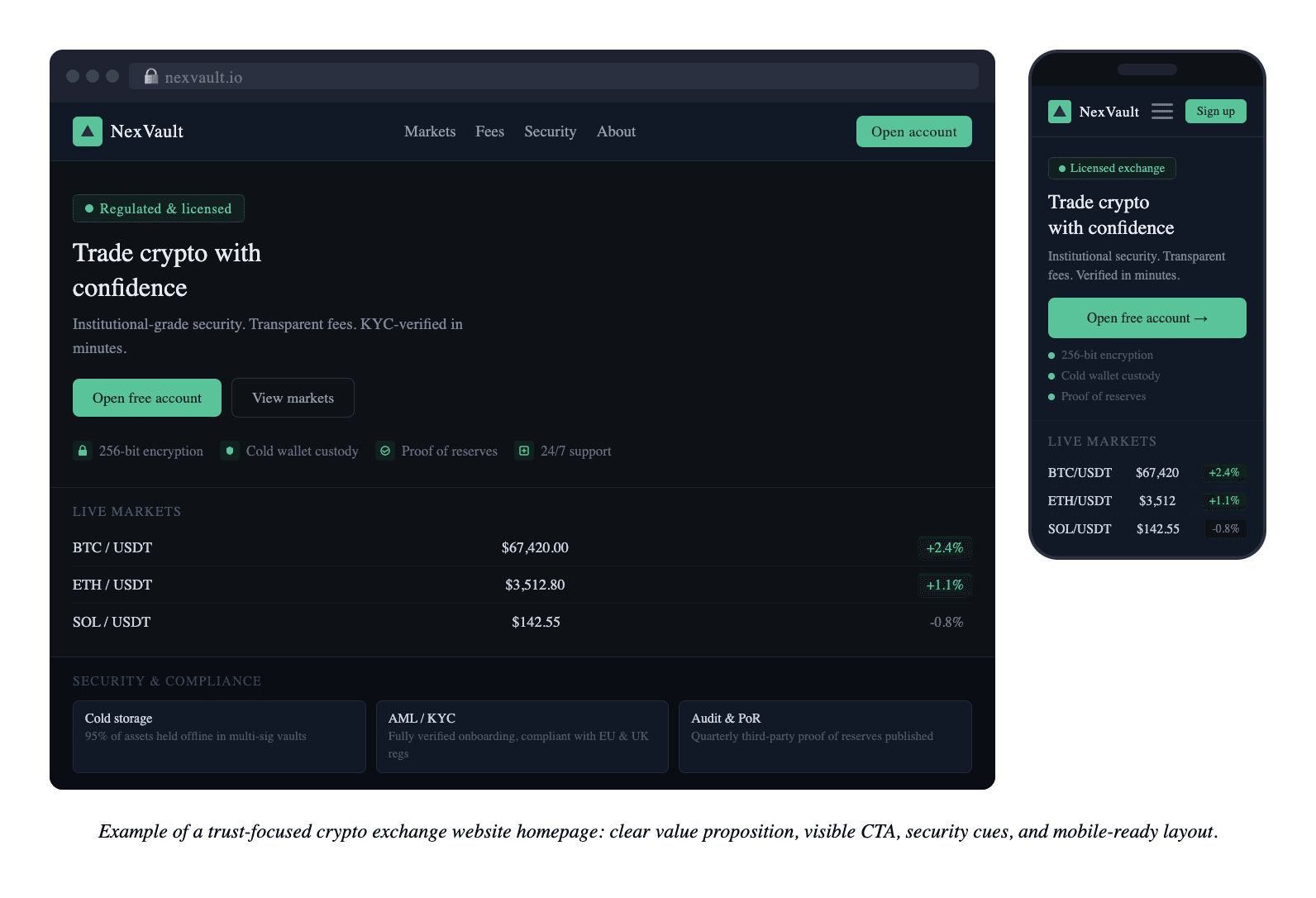
Step 1. Define What Your Crypto Exchange Website Needs to Achieve
Most teams start with design ideas too early. A better starting point is the job the site needs to do. That sounds basic, but this is where many exchange website projects begin to drift.
A crypto exchange website usually has to handle several goals at once. It may need to attract new users, explain the platform in plain language, move visitors toward KYC registration, support listing or partnership enquiries, and reassure banks or compliance stakeholders that the business is properly set up. Each of those goals changes what information the site needs to show and how users should move through it.
That is why this stage matters more than it may seem. If sign-ups are the top priority, the structure and messaging need to guide people toward that outcome. If institutional leads, listings, or partnerships matter too, those paths need to be visible without cluttering the main flow. A high-converting crypto exchange website should actively support acquisition and onboarding. It should not exist just to make the brand look established.
Step 2. Plan the Right Crypto Exchange Website Structure
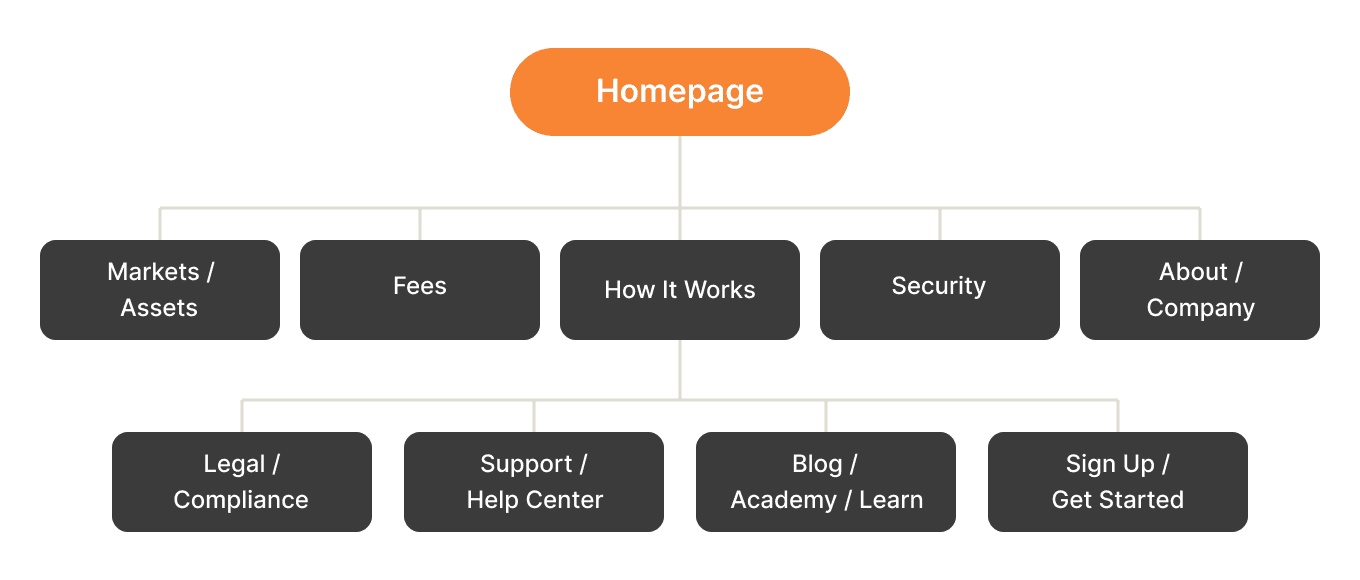
Site structure matters because visitors are trying to orient themselves quickly. They want to understand the offer, check whether the platform seems safe, and figure out what action makes sense next. Structure also affects SEO, so this is not only a UX decision.
One practical way to think about crypto exchange website structure is to imagine a cautious first-time visitor landing on the homepage. What are they trying to confirm? Usually the same questions come up: what can I trade, how much will it cost, how secure is it, who runs this company, and how do I get started?
Core pages every crypto exchange website should include:
Homepage — positioning, value proposition, primary CTA, and trust signals
Markets / Assets — what coins, pairs, or products are available
Fees — trading fees, withdrawal fees, and cost transparency
How It Works — plain-language explanation of deposits, trading, custody, or wallet connection
Security — storage model, 2FA, proof points, and custody approach
About / Company — leadership, registration details, and company credibility
Legal / Compliance — terms, privacy policy, AML/KYC, risk disclosures, and jurisdictional restrictions
Support / Help Center — FAQs, guides, and contact options
Blog / Academy / Learn — SEO content, education, and glossary
Sign Up / Get Started — a clear, frictionless entry into registration
Some businesses will also need institutional pages, API pages, referral sections, listing enquiry pages, or regional landing pages. A crypto exchange website should make decision-making easier, not harder. When users cannot quickly find fees, company details, or security information, trust tends to fall away fast.
Step 3. Build Legal, Risk, and Compliance Pages From Day One
Legal and compliance pages are not background material on an exchange website. They are part of how the business gets judged. Users look at them, but so do vendors, banks, and regulators.
Most crypto exchange compliance pages include Terms & Conditions, Privacy Policy, AML/KYC Policy, Risk Disclosure, a Restricted Jurisdictions notice, a Cookie Policy, and company or licensing information where relevant. These pages should be visible, current, and consistent with how the exchange actually operates in practice.
The exact disclosures depend on the business model and the jurisdictions involved. A centralized exchange, broker, OTC desk, and fiat on-ramp will not all need the same language. This is one of the places where generic templates often fail: they blur important distinctions around custody, eligibility, onboarding, and risk. In the EU, that may involve MiCA-related disclosures; in the UK, FCA registration under the Money Laundering Regulations is a legal requirement for in-scope services and should not be framed as a product endorsement; in Dubai or Singapore, VARA or MAS requirements may influence disclosure and onboarding language. A specialist agency can help present that information clearly without making the site feel heavy or inaccessible.
Step 4. Design for Trust: UX That Makes Users Feel Safe Enough to Sign Up
When someone lands on a crypto site, design is only part of what they are reacting to. They are also trying to work out whether the platform feels credible, understandable, and safe enough to try. That usually happens very quickly, often before they have read much at all.
That is why crypto exchange web design has to carry more weight than pure visual presentation. It needs to reduce friction, answer obvious questions early, and make the next step feel understandable.
The UX principles that matter most in crypto exchange website UX include:
Clarity first — people should understand the offer quickly, not after reading several sections
Professional execution — consistent layouts, spacing, and hierarchy help the business look more reliable
Security communication — cold wallet custody, proof of reserves, and 2FA should be described in language users can actually follow
Simple onboarding paths — getting started should feel straightforward rather than overwhelming
Mobile-first design — a large share of crypto traffic comes from mobile devices, so weak mobile UX hurts conversion immediately
Fast loading performance — slow pages create doubt and increase drop-off; in fintech, poor Core Web Vitals can meaningfully affect both user trust and conversion rates
Transparent fees and processes — unclear pricing or unexplained steps make users hesitate
Trust signal placement — custody, payment, KYC, audit, or infrastructure partner logos where relevant and actually integrated, alongside security certifications, media mentions, and uptime or status page links
A good crypto exchange website does not win trust through aesthetics alone. It does it by making the platform easier to understand and less risky to engage with.
Step 5. Choose the Right Platform for Crypto Exchange Website Development
Choosing a platform is not just a build question. It affects launch speed, content updates, and how much day-to-day work ends up depending on developers.
For most public-facing crypto exchange website development, Webflow and Framer are practical options. They support relatively fast delivery, strong design execution, better performance than many traditional CMS builds, and easier content editing for internal teams. They also give marketing teams useful flexibility around SEO settings and landing pages. If you are still weighing the options, this CMS comparison for fintech websites is worth reviewing.
Custom frontend development in React makes more sense when the website needs to work closely with product architecture — for example, proprietary dashboard states, custom authentication logic, or tightly connected KYC flows. In some cases that is justified, but for many launch-stage marketing sites it introduces more complexity than the first version really needs.
WordPress still has its place, but it should not be the default assumption for a modern exchange website. For many teams, Framer and Webflow provide a better balance of design flexibility, speed, and ease of iteration.
Step 6. Plan Integrations Before Launch, Not After
A website can look polished and still perform badly if it is disconnected from the rest of the stack. That is why crypto exchange website integrations should be planned up front rather than treated as follow-up work.
At a minimum, the site should connect properly to the tools handling acquisition, onboarding, support, and reporting. Otherwise, traffic may arrive, but attribution, follow-up, and operational visibility break down.
Key crypto exchange website integrations to plan before the build begins:
CRM and lead capture — route inquiries into your pipeline (e.g., HubSpot)
GA4 and GTM — full analytics and event tracking configured before go-live
Email marketing and lifecycle flows — onboarding sequences and reactivation
Live chat and support tools — reduce drop-off at key decision points
KYC verification providers — clean handoffs into Sumsub or Onfido
Fiat on-ramp and payment providers — connection to MoonPay or equivalent
Wallet connection — WalletConnect if the product supports self-custody
Market data widgets — TradingView for charts and price displays
Status and uptime tools — a public status page builds operational transparency
Referral and affiliate tracking — growth mechanics that must be live from launch
From the user’s point of view, the site should feel connected to the product and onboarding flow from the first visit. It should not feel like a polished front layer sitting apart from the real operation.
Step 7. Build SEO and Growth Infrastructure Into the Website From Day One
Some websites are built to look good at launch and then stall. Others keep becoming more useful over time because the growth layer was planned from the start.
That is why SEO needs to be part of the original scope. A strong setup includes crawlable URLs, solid metadata, structured data markup, a blog or academy section organized around topical authority, and landing pages for campaigns or regional targeting where needed. Core Web Vitals are used by Google's ranking systems as part of the page experience signal — not as a guarantee of rankings, but as one factor among several that can affect both visibility and user behaviour when neglected. They should be checked before launch, not treated as a later clean-up task.
If the exchange plans to operate across multiple markets, a multilingual crypto exchange website setup should also be scoped early. Localization is usually much easier when the site structure is designed for it from the beginning.
Analytics belongs in this same foundation. Event tracking, attribution, and conversion measurement should all be configured and tested before the site goes live. Too many crypto brands invest heavily in paid traffic while underbuilding the organic side of the website. A well-structured content hub — trading guides, asset explainers, and regulatory FAQs — can support SEO, trust, and user activation at the same time.
DIY Templates vs. Professional Crypto Exchange Web Design
Templates are not always the wrong choice. For a narrow first-phase launch or simple validation project, they can be enough. The problem usually starts later, when the site has to do more than look presentable.
That is where professional crypto exchange web design becomes much more valuable. If the brand needs to earn trust quickly, differentiate itself, and support more than a basic onboarding journey, templates tend to show their limits. That matters even more when multiple user types are involved, landing pages need to be tailored, or compliance-sensitive messaging has to be handled properly from the start.
The hidden cost of templates is often easiest to see later. Once teams start adapting a crypto website template for a financial brand — adding legal pages, trust signals, clearer UX, and stronger conversion paths — the effort can get close to the cost of a professional build while still producing a weaker result. For teams building a serious crypto exchange website to support growth, that tradeoff usually becomes visible fairly quickly.
Common Mistakes When Building a Crypto Exchange Website
Most exchange website mistakes start before launch. Usually the problem is not the code itself, but unclear priorities, weak structure, or copy that leaves too much unanswered.
Prioritizing futuristic visuals over messaging clarity and trust
Hiding fees, risks, or key product details
Creating confusing or high-friction onboarding paths
Using generic crypto imagery that makes the brand look disposable
Treating compliance pages as an afterthought
Launching without analytics, CRM tracking, or event measurement
Designing desktop-first while neglecting mobile behavior
Failing to explain security and custody in plain language
Building the site as a one-time project rather than a living growth asset
A website can look impressive and still fail commercially if users do not understand it or do not trust it.
Pre-Launch Checklist: What to Verify Before Going Live
Use this exchange website checklist before launch:
Messaging clearly explains the product and who it is for
Design reviewed across all core pages and breakpoints
Legal and compliance pages reviewed, approved, and current
All forms, CTAs, and registration links tested end-to-end
Mobile experience tested on real devices
Page speed and Core Web Vitals checked and optimized
SSL and basic security headers verified
GA4 and GTM configured with events firing correctly
CRM and email flows connected and tested
SEO basics confirmed: titles, descriptions, sitemap, structured data
Regional or language variants reviewed if applicable
Support and contact flows tested from a new user perspective
Backup, monitoring, and maintenance responsibilities defined
This kind of review is boring compared with design work, but it is where a lot of avoidable problems get caught.
Next Steps: Why Specialized Fintech and Crypto Website Partners Deliver Better Results
At some point, most crypto teams realize the website is not a standalone design task. It sits in the middle of trust, onboarding, and growth, which is why generic web processes often fall short here.
Generalist agencies often miss the details that matter. Compliance stays loosely scoped, UX patterns get borrowed from SaaS without matching crypto user behaviour, integrations are pushed too late in the process, and platforms are selected because they are familiar rather than because they fit the job.
WSA specializes in websites for crypto exchanges and fintech companies. Their approach focuses on trust-first UX, fast delivery in Framer and Webflow, clear integration planning, and launch readiness that helps reduce costly rework. You can review their work at wsa.design/projects.
Before choosing a direction, it helps to get specific: review competitors in your category, identify the trust objections your users are likely to have, decide what the website needs to convert visitors into, and be realistic about whether phase one needs speed or deeper customization.
WSA offers complimentary website consultations for crypto exchanges and fintech brands. Book a discovery call here.
FAQ
How to build a crypto exchange website?
Start with the user journey. To build a crypto exchange website well, you need to define the trust requirements, conversion goals, and onboarding flow before choosing a platform or visual direction. Then build the core site structure, legal pages, trust-focused UX, integrations, and a clear pre-launch review process. The public-facing website should help move users from discovery into onboarding.
What pages should a crypto exchange website include?
At minimum, a crypto exchange website should include a homepage, markets or assets page, fees page, security page, about page, legal and compliance pages, support or help center, blog or academy, and a sign-up flow. Depending on the business model, institutional, API, listing, referral, or regional pages may also be needed.
How long does it take to build a crypto exchange website?
The timeline for building a crypto exchange website depends on scope, content readiness, page count, and integrations. A professional build in Webflow or Framer often takes around 4–8 weeks. Projects with deeper onboarding logic, custom development, or longer compliance review cycles can take more time.
How much does a crypto exchange website cost?
The cost of a crypto exchange website depends mainly on scope. Professional crypto exchange website development typically ranges from roughly $5,000 to $25,000+, depending on page count, design depth, CMS requirements, and integrations. Simple landing pages sit at the lower end, while full-scale websites with content systems and custom flows sit at the higher end.
What integrations does a crypto exchange website need?
Most exchange websites need analytics, CRM-connected forms, live chat, email capture, and onboarding handoff integrations at launch. Depending on the business model, additional integrations for a crypto exchange website may include KYC providers (Sumsub, Onfido), wallet connection (WalletConnect), fiat on-ramp (MoonPay), market data (TradingView), and referral tracking.
Launch Your Licensed Brokerage with Confidence
We support brokers and fintechs through licensing, launch planning, and everything a regulated brand needs to go live.