•
•
Custom Fintech Website vs Template Solution: What Financial Brands Really Need
You can launch a fintech website in a weekend with a template. That’s true. But when your brand is asking people to trust you with their money, their financial data, or their business, speed to launch is rarely the constraint that matters most.
The real question isn’t “template or custom?” It’s: what does your website need to do, and what does it need to prove? For financial brands, the answer almost always includes trust, compliance readiness, accessibility, and measurable conversion performance. This article is a decision framework—not a generic “templates are bad” opinion piece—to help you choose the right approach for your stage, risk profile, and growth goals.
Key Takeaways
A finance website is a trust product—design, performance, and information clarity drive conversions. They’re not cosmetic.
“Template vs custom” is rarely binary. Many high-performing fintech teams land on a hybrid approach: custom design built on a modern platform (Webflow, Framer) with targeted custom code where needed.
Regulated marketing requirements, risk disclosures, and marketing rule constraints shape UX and layout—they aren’t bolt-on content you add at the end.
Accessibility is increasingly a legal obligation, not a nice-to-have—especially for EU-facing services under the EU Accessibility Act, effective 28 June 2025.
Choose based on risk, scale, and differentiation requirements, not just launch speed or upfront cost.
What Counts as a Template Site vs a Custom Fintech Website?
A template site is a prebuilt layout you adapt. A custom site is designed around your brand, content model, and user journeys. It may still be built on Webflow, Framer, or WordPress—but it isn’t constrained by a marketplace theme.
This distinction matters because “custom” is often misunderstood. It’s not about the tech stack—it’s about fit: whether the site is designed around your requirements, or whether your requirements are being squeezed into a generic structure.
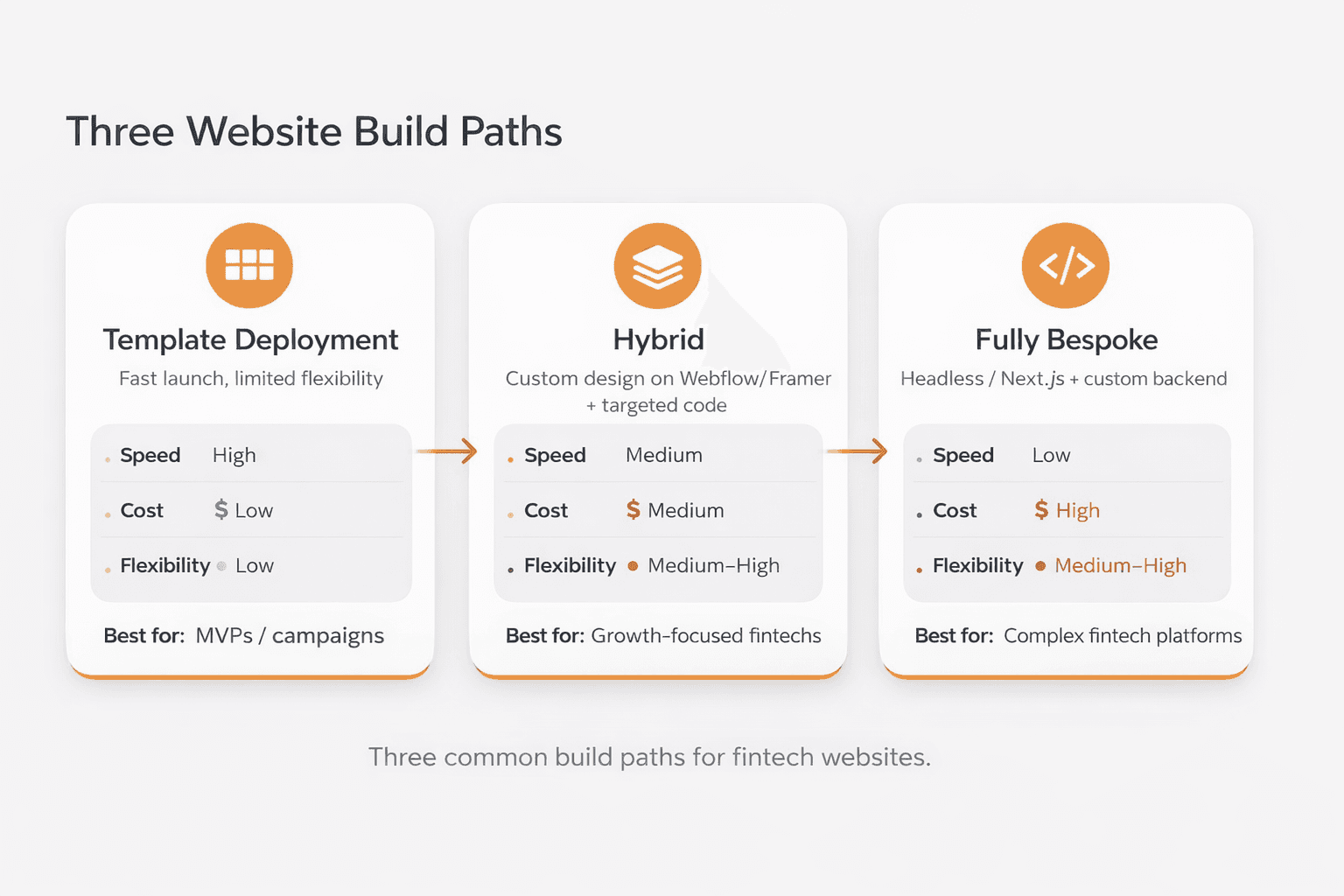
There are three common build paths:
Template deployment — You buy or clone a theme, swap in your content and brand colours, and launch. Fast and low-cost. Constrained by the template’s structure.
Custom build on a modern platform — Custom components and a structured content system built inside Webflow, Framer, or a similar visual development platform. High flexibility without heavy engineering overhead.
Fully bespoke engineering — Next.js/headless architecture, custom backend logic, complex application layers. Best for product-heavy builds with deep integration requirements.
Understanding which path matches your situation is the foundation of this decision.
Why “Template vs Custom” Is Different in Financial Services
Financial brands operate under higher trust and compliance expectations than most industries. That’s why generic templates often fall short on governance, disclosures, accessibility, and differentiation.
Here’s what makes financial services website design fundamentally different:
Trust sensitivity is amplified
People instantly notice when a fintech website looks like three others they’ve already seen. In a category where credibility is everything, a “template look” raises the wrong questions before a single word is read.
Compliance constraints shape UX
What your site can claim, how it must disclose risk, and how it presents performance data or testimonials varies by jurisdiction and product type. In the UK, the FCA’s financial promotions rules require communications to be “fair, clear, and not misleading.” In the US, the SEC marketing rule governs how investment advisers can present testimonials and performance online. These requirements don’t neatly fit into a generic template footer.
Accessibility is becoming a legal obligation
For EU-facing services, the EU Accessibility Act takes effect on 28 June 2025 and introduces accessibility requirements that many teams implement by aligning to WCAG standards (often WCAG 2.2 AA, or equivalent). UK organisations may also be subject to equality and accessibility regulations, depending on context. Accessibility isn’t a design preference—it’s increasingly a baseline requirement.
Third-party vendor risk is under scrutiny
For EU financial entities, the Digital Operational Resilience Act (DORA) increases expectations around ICT risk management and oversight of digital vendors. Your website platform and agency selection can become part of that risk conversation.
Note: Nothing in this article constitutes legal or compliance advice. Financial brands should confirm obligations with qualified compliance counsel.
When a Template Solution Is the Right Choice for a Fintech
Templates can work when you’re validating a market, running a focused campaign, or launching a simple marketing presence with low content complexity.
Templates are a reasonable starting point if:
You need a single fintech landing page template for a campaign or waitlist launch.
Your product and audience are simple and content is minimal (roughly 4–6 pages or fewer).
You have in-house brand/design capacity to meaningfully differentiate the template.
You’re early pre-revenue and brand differentiation isn’t yet a conversion driver.
You can accept scaling constraints and you’re comfortable rebuilding later.
Template De-Risk Checklist
Before you launch on a template, validate the following:
Mobile performance: Load time is acceptable on mobile (aim for under 3 seconds; research consistently links speed to conversion).
Accessibility basics: Contrast ratios, keyboard navigation, focus states, and alt text handling.
Disclaimer flexibility: You can add required disclosures without breaking layout or the CMS model.
Content ownership: No vendor lock-in, brittle plugins, or unexportable content dependencies.
Analytics readiness: GA4 and GTM can be implemented cleanly, with consent mode if you’re EU-facing.
Compliance review: A qualified reviewer has signed off on what the template allows you to say—and how it presents that information.
Where Templates Break Down for Financial Brands
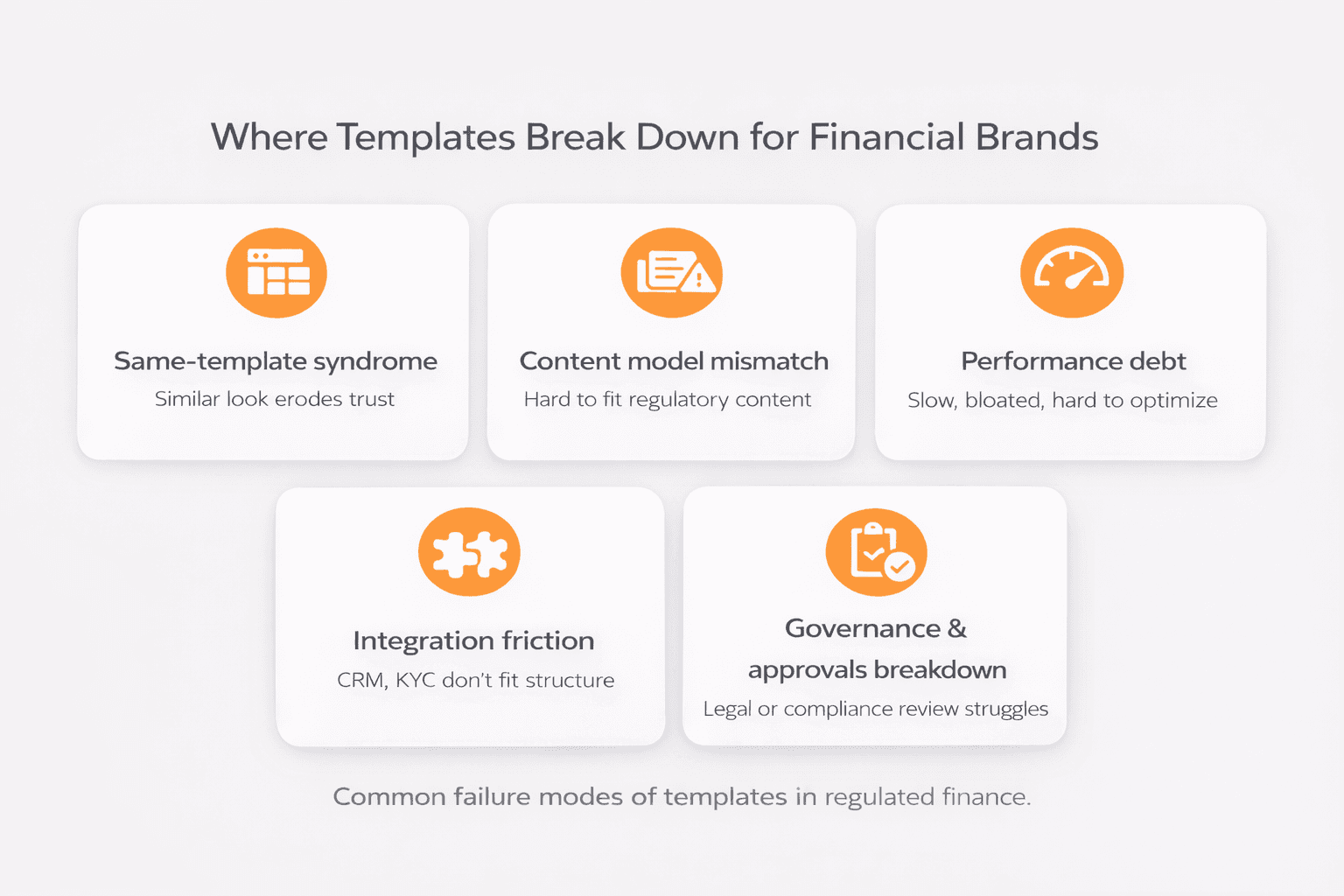
Templates typically fail when you need differentiation, structured governance, multi-region compliance support, or multiple conversion journeys.
The failure modes are predictable:
Same-template syndrome
Popular fintech themes are sold to hundreds of buyers. When your payments platform looks identical to a competitor, you’ve made trust harder to earn before a user reads a single line.
Content model mismatch
A template built for a generic SaaS product won’t naturally accommodate risk disclosures, regulated product pages, performance footnotes, or structured educational content. You end up hacking the CMS model or duplicating layouts.
Performance debt
Many marketplace templates ship with heavy animations, unoptimised assets, and third-party scripts that hurt Core Web Vitals—damaging both user trust and organic search performance.
Integration friction
CRM attribution (HubSpot, Salesforce), onboarding flows, consent management, KYC embeds, and support tools like Intercom are often planned late—and templates rarely make those integrations feel native.
Governance and approvals breakdown
Legal and compliance review works best with structured, reusable components. When every page is a one-off template instance, version control and approval trails become fragile.
Ready to build a fintech website that works as hard as your product does?
Custom design. Compliance-aware layouts. Fast delivery on modern platforms.
What Financial Brands Actually Need from a Custom Website
A custom fintech website should be a controlled, measurable growth asset—built with a design system, clear information architecture, compliant content patterns, and scalable CMS and integrations.
This isn’t about aesthetics. A strong custom website for financial services should deliver:
Discovery-led IA: audience segmentation and conversion-journey architecture (consumer acquisition, partner/B2B, enterprise sales).
Information architecture: product pages, transparent fees/pricing, security and trust pages, resource hubs, regulatory disclosures.
Design system: brand tokens, reusable components, clear typography hierarchy—so every new page looks intentional and on-brand.
Compliance-friendly patterns: reusable risk disclosure modules, performance/testimonial disclaimer patterns, jurisdiction-aware footers.
Performance and accessibility built in, not retrofitted.
Content governance: defined publishing, review, and approval workflows with rollback capability.
The Hybrid Approach: The Most Common Answer in Fintech
The hybrid approach combines a custom design build on Webflow or Framer with targeted custom code for specific fintech requirements—delivering platform speed with bespoke differentiation.
This is where many growing fintech teams land, and for good reason. Examples of hybrid features that integrate well into a Webflow or Framer build:
Calculators: APR, savings projections, fee estimators (custom JS embedded into CMS pages).
Dynamic pricing and plan comparisons with logic for different customer segments.
Resource hubs: tagged content models, filters, gated content flows.
Localised content variants for multi-region or multi-jurisdiction products.
Secure onboarding embeds: KYC/application flows integrated into the marketing-site UX (with appropriate security review).
A Webflow fintech website built this way gives marketing teams direct CMS control, shortens iteration cycles, and maintains design quality—without requiring an engineering sprint for every update.
Cost, Timeline, and Total Cost of Ownership
Templates are cheaper upfront, but a custom or hybrid build often wins on total cost when brand impact, conversion rate, and iteration speed are factored in.
Rough ranges:
Build type | Typical timeline | Upfront cost range |
|---|---|---|
Template deployment | Days to 2 weeks | Low |
Custom on modern platform (Webflow/Framer) | 4–8 weeks (multi-page marketing site) | Mid |
Fully bespoke (Next.js/headless) | 10–20+ weeks | High |
Timelines are illustrative. Scope complexity and approvals cycles are usually the biggest variables.
TCO drivers to account for
Iteration velocity: Can marketing update pages without a developer ticket?
Rework cost: Templates customised beyond their intended scope can cost as much as custom—with worse outcomes.
Migration cost: SEO authority, URL structure, analytics events, and CMS content all carry migration cost when you outgrow a template.
Plugin/dependency risk: Maintenance, security patches, and compatibility issues accumulate over time.
The Regulated Fintech Website Readiness Checklist
Before committing to template or custom, confirm you can meet performance, accessibility, and regulated marketing requirements in your target markets.
Performance
Mobile load time target under 3 seconds; Core Web Vitals in the “Good” range.
Minimise render-blocking scripts; optimise images and fonts.
Conversion Measurement
GA4 events mapped to key conversion actions.
GTM container configured with CRM attribution (HubSpot/Salesforce).
Consent mode active for EU/UK traffic.
Disclosures and Regulated Marketing
Risk disclosures present and correctly positioned on relevant pages.
Performance claims reviewed for jurisdiction-specific requirements (FCA, SEC marketing rule, or other applicable rules).
Testimonials or case studies comply with applicable marketing rules.
Financial promotions copy reviewed by qualified compliance counsel.
Accessibility
WCAG-aligned accessibility validated (or in progress).
EU Accessibility Act requirements assessed for EU-facing services.
UK equality/accessibility obligations reviewed (as applicable).
Security and Trust
Privacy policy and cookie banner implemented with correct consent logic.
Security page covering data handling, encryption, and incident contact.
SSL, secure headers, and anti-phishing guidance where relevant.
Governance
Publishing and approval workflow documented.
Rollback and versioning capability confirmed.
Third-party vendor risk assessed (DORA context for EU financial entities).
Decision Framework: How to Choose
Choose templates when requirements are simple and risk is low. Choose a custom or hybrid build when differentiation, governance, compliance complexity, and scale are real requirements.
Use this as a practical signal check:
Dimension | Template is viable when… | Custom/Hybrid is the safer bet when… |
|---|---|---|
Brand differentiation | Generic is acceptable | Differentiation affects conversion and trust |
Compliance complexity | Low-risk, single-market | Regulated, multi-jurisdiction, higher scrutiny |
Content complexity | 1–5 mostly static pages | Multi-page, CMS-driven, education/resources |
Integration needs | Minimal | CRM, analytics, KYC, consent, support tooling |
Internal capability | You can confidently customise and maintain | You need structured governance and specialist execution |
Primary priority | Launch speed is the priority | Long-term scalability and iteration speed are priorities |
Recommended pattern:
Early-stage, low regulatory exposure → Start with a de-risked template; plan the migration.
Regulated or scaling fintech → Hybrid: custom design on Webflow/Framer with custom code where needed.
Complex product, app-like features, deep integrations → Bespoke or hybrid with headless.
Common Mistakes Financial Teams Make
Customising a template to death until the total cost exceeds custom—with worse results and an unmaintainable build.
Forgetting analytics and attribution until after launch, then scrambling to retrofit GA4 events and CRM tracking.
Treating compliance and accessibility as final polish instead of designing components around them from day one.
Over-engineering with bespoke development when a custom Webflow or Framer build would deliver faster—and give marketing more autonomy.
Building without a component system, leading to inconsistent pages, slow updates, and design debt.
Skipping governance for regulated teams—no defined approval path means legal sign-off becomes a bottleneck on every update.
Next Steps: Build the Right Foundation for Your Fintech Brand
WSA works exclusively with financial brands—payments, lending, crypto, wealth, embedded finance—to design and build websites that are conversion-ready, compliance-aware, and built to scale.
The process starts with discovery: your audience, your conversion journeys, your content model, and your regulatory context. The output is a site that performs, looks credible, and gives your team the autonomy to publish without an engineering ticket.
Explore recent fintech projects or book a discovery call to talk through your specific situation.
FAQs
Is a fintech website template safe to use in regulated markets?
It can be—but “safe” depends on your compliance validation, not the template itself. Templates aren’t preconfigured for regulated marketing environments. Before launching, confirm required risk disclosures can be implemented cleanly, that testimonials and performance claims comply with applicable rules (FCA financial promotions, SEC marketing rule, or others), and that accessibility expectations are met. A compliance counsel review is essential for any regulated product. Templates aren’t inherently unsafe—unreviewed templates in regulated contexts are.
Can I start with a template and later move to a custom fintech website?
Yes—if you plan for migration upfront. Start with a structured CMS model, clean URL patterns, and GA4/GTM from day one. Avoid hard-coding key content into template-specific fields you can’t export. Template-first becomes expensive when the template is heavily modified, the CMS model doesn’t map to your real content, or you’ve built SEO authority on URLs that won’t survive a redesign.
How long does a custom fintech website take to build?
A custom-designed, multi-page marketing site built on Webflow or Framer typically takes 4–8 weeks from approved brief to launch, depending on scope and approval speed. Fully bespoke builds (Next.js/headless, custom backend) usually take longer—often 10 to 20+ weeks. The most consistent timeline variable isn’t design or development; it’s internal reviews and approvals. Regulated brands should bake compliance and legal sign-off into the schedule from day one.
What should a financial services website include to build trust?
Trust signals go beyond visual polish. Prioritise: a clear security/trust page explaining data handling; transparent product and fee information; proof points that comply with marketing rules; fast mobile performance; consistent mobile UX; and accessibility that signals professionalism. Research consistently links site speed to conversion outcomes—and a slow site undermines trust before a user reads your headline.
Do financial websites need to meet accessibility standards?
Increasingly, yes. The EU Accessibility Act (effective 28 June 2025) introduces accessibility requirements for many businesses offering services in EU markets, often implemented via WCAG-aligned practices. In the UK, equality and accessibility obligations may also apply depending on your context. Beyond legal requirements, accessibility is a trust signal: if a site fails basic keyboard navigation or contrast checks, it reflects poorly on the brand. For fintech, accessibility should be a baseline requirement, not an afterthought. An audit during design is far cheaper than a retrofit.
Should we build on Webflow/Framer or go fully custom-coded?
It depends on what the site needs to do. For marketing sites—product pages, resource hubs, landing pages, pricing—Webflow or Framer typically delivers faster launches, strong performance, and CMS autonomy for marketing teams. For product-heavy builds with complex application logic, deep API integrations, or authenticated experiences, a headless or bespoke approach may be necessary. The most common mistake is over-engineering: choosing Next.js/headless because it sounds more serious when a custom Webflow fintech website would launch faster, cost less, and give marketing more control. Match the platform to the use case—not a technical preference.
Launch Your Licensed Brokerage with Confidence
We support brokers and fintechs through licensing, launch planning, and everything a regulated brand needs to go live.