•
•
Where Should Your DFSA Regulatory Documents Live? A Website Guide for DIFC-Licensed Brokers
DFSA GEN Rule 6.4 requires every authorised firm to display "Regulated by the DFSA" on all client-facing materials, including the website. The core documents to publish are risk disclosures, client agreements, AML/KYC policy and DIFC data protection notices.
This article is for informational purposes only and does not constitute legal advice. Brokers should consult qualified legal and compliance professionals for jurisdiction-specific guidance.
You spent months on the DFSA licensing process. The application, the compliance framework, the capital requirements — all handled. Your firm is now authorised to operate from the Dubai International Financial Centre (DIFC). But when a potential client from Abu Dhabi or Riyadh visits your website, what do they see? If the answer is a basic landing page with no regulatory documents, no risk disclosures, and no visible compliance structure — your DFSA broker website compliance documents are missing where they matter most. The licence exists. The website doesn't show it. The stages behind that process are set out in the DFSA authorisation checklist.
This guide covers what DFSA-licensed brokers should publish on their website, where each document belongs, and why a dedicated compliance section turns a regulatory requirement into a competitive advantage.
Key Takeaways
DFSA GEN Rule 6.4 requires every authorised firm to display "Regulated by the DFSA" on all client-facing materials, including their website.
The core compliance documents for a DIFC broker website include risk disclosures, client agreements, AML/KYC policy, and DIFC data protection notices.
Most DIFC brokers store regulatory documents in email attachments or rely solely on the DFSA Public Register — both approaches create friction for clients conducting due diligence.
GCC institutional clients and banking partners typically check a broker's website before the DFSA Public Register — your site is the first trust checkpoint.
A professionally structured compliance section converts regulatory obligations into visible trust signals that accelerate client onboarding.
What DFSA Requires Brokers to Disclose — and Where
Every DFSA-licensed broker must include the phrase "Regulated by the Dubai Financial Services Authority" on all client-facing materials, including their website. This is not optional guidance. It comes directly from GEN Rule 6.4 of the DFSA Rulebook.
The GEN 6.4 Rule: "Regulated by the DFSA" Across All Client-Facing Materials
GEN Rule 6.4 applies to websites, promotional materials, client agreements, email signatures, and text messages. The phrase can use the acronym ("Regulated by the DFSA") or the full name. Every page a client interacts with should carry this disclosure. In practice, most DFSA-regulated broker websites place it in the footer — but the requirement extends to any page that promotes or describes a financial service.
Documents Clients, LPs, and Banking Partners Expect to Find
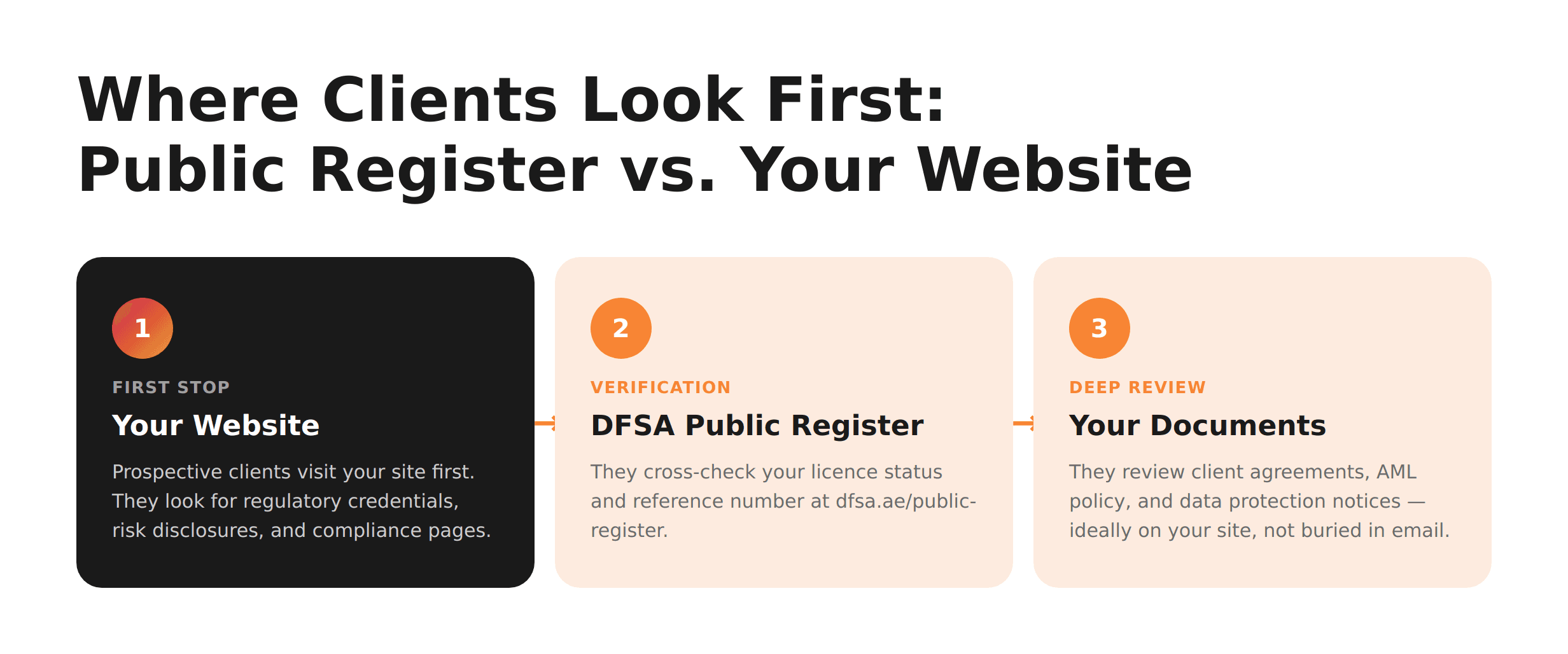
Beyond the mandatory disclosure phrase, clients and institutional partners expect to find specific documents on your site. A DFSA licence signals a high regulatory standard — GCC-based investors, family offices, and banking partners treat the website as a due diligence checkpoint. If the documents aren't there — especially if you're planning a broker website redesign — the next step is usually to move on to a competitor whose site provides them.
The Core Compliance Documents for a DFSA Broker Website
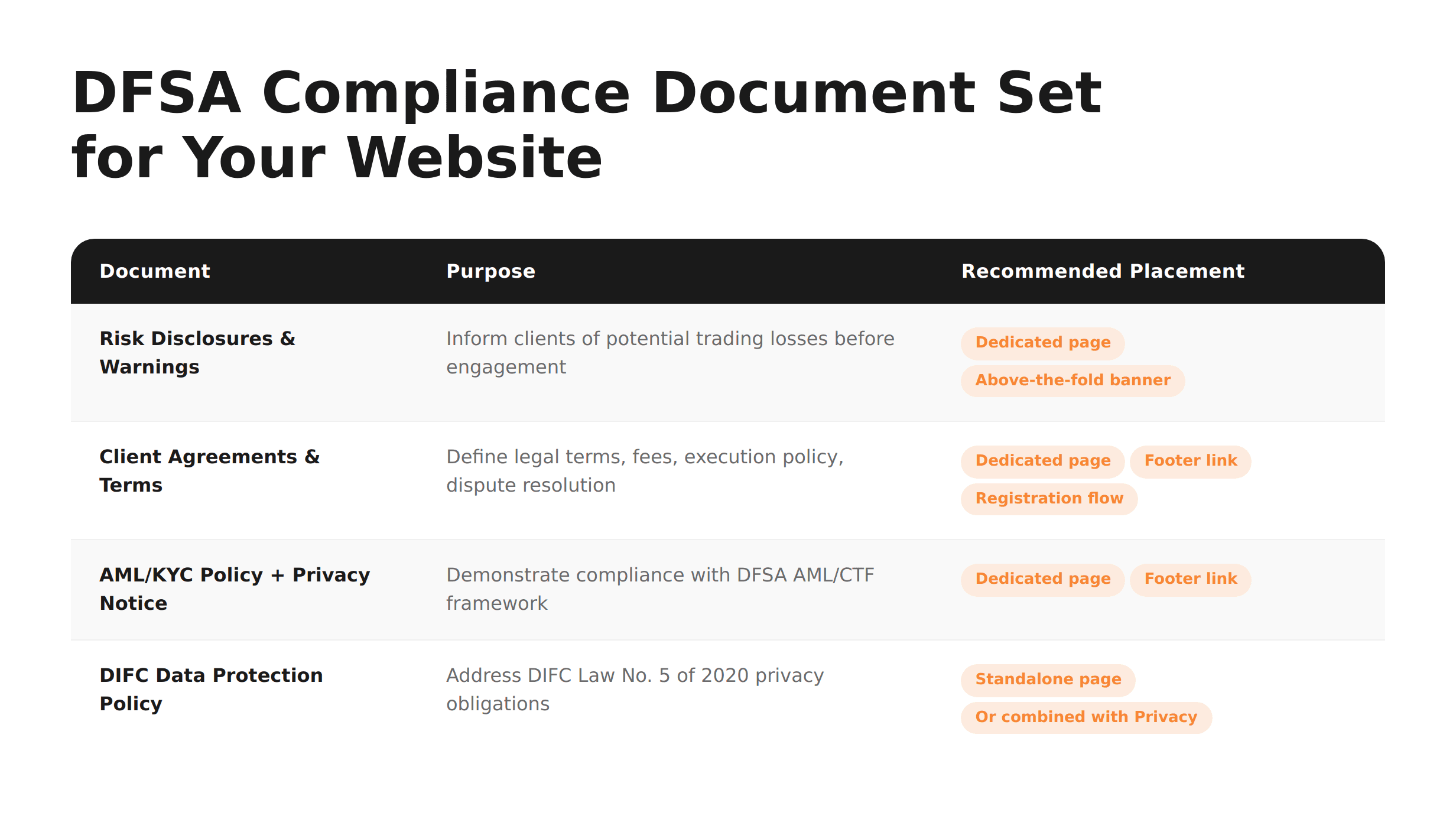
The standard set of DFSA compliance documents for a broker website includes four categories. Each serves a distinct audience and purpose.
Risk Disclosures and Warnings
Risk disclosures inform clients about the potential for loss when trading leveraged products. DFSA requires brokers to provide comprehensive risk information before clients begin trading. On a website, this typically appears as a dedicated Risk Disclosure page and as an above-the-fold warning banner on product and account registration pages.
Need a Compliance-Ready Broker Website?
WSA designs and builds websites for forex and CFD brokers in DIFC. Structured for regulatory documents, built for client trust.
Client Agreements and Terms of Business
Client agreements outline the legal relationship between the broker and the client. They cover account terms, fee structures, order execution policies, and dispute resolution. Publishing these on your website allows prospective clients to review terms before onboarding.
AML/KYC Policy and Privacy Notice
Anti-money laundering and know-your-customer policies demonstrate compliance with DFSA's AML/CTF framework. A privacy notice explains how client data is collected, stored, and used. Both documents are expected by institutional clients conducting due diligence.
Cybersecurity and DIFC Data Protection Policy
DIFC operates under its own data protection framework — the DIFC Data Protection Law (Law No. 5 of 2020), which is modelled on GDPR standards. Brokers operating in DIFC should publish a data protection notice that addresses DIFC-specific requirements, including data subject rights and cross-border transfer safeguards.
Where Most DIFC Brokers Keep These Documents Today — and Why It Falls Short
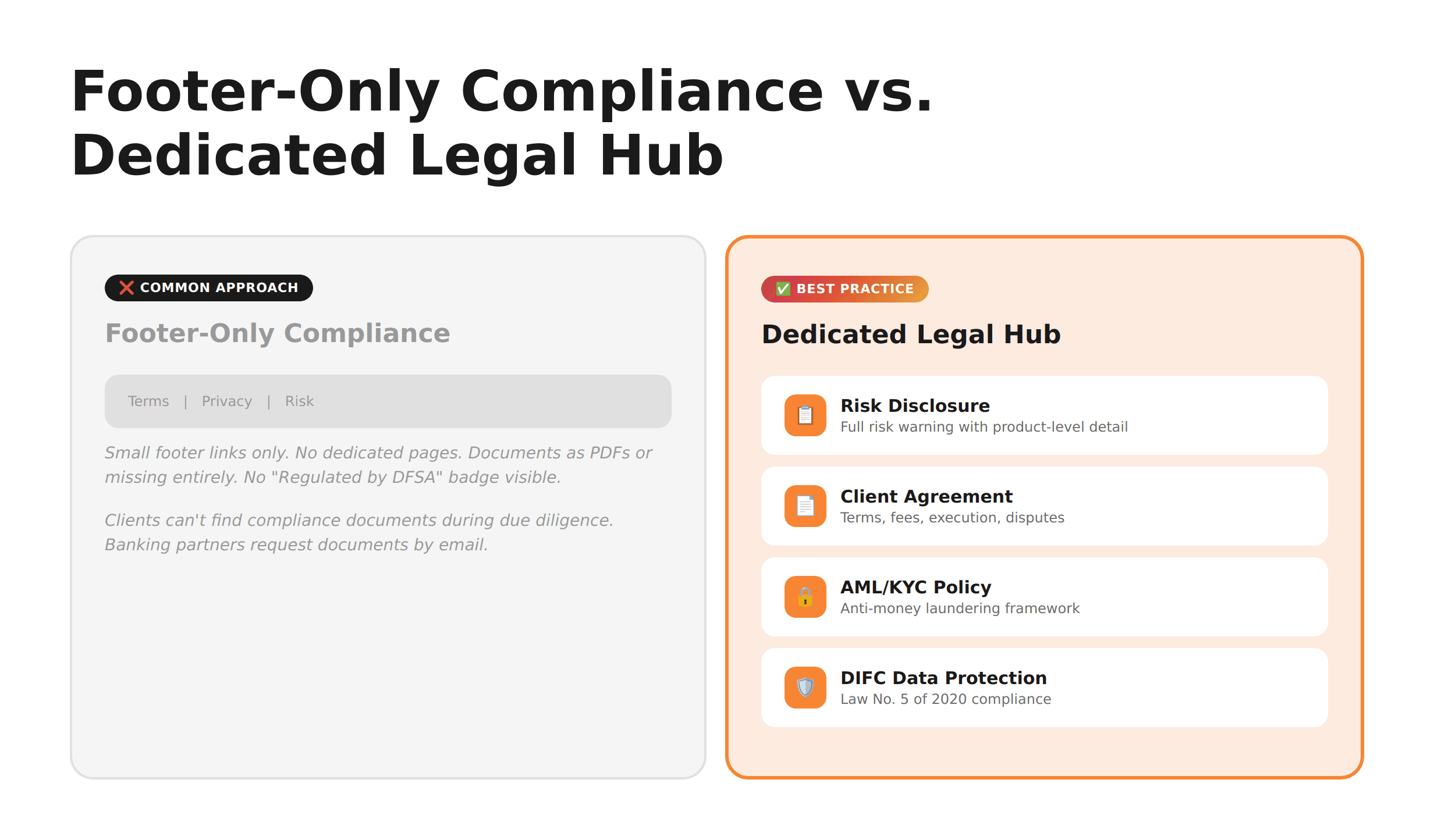
Most DIFC brokers distribute compliance documents through email attachments, locked PDFs, or rely on the DFSA Public Register as their primary disclosure mechanism. This creates problems.
The PDF-in-Email Problem
Sending compliance documents as email attachments means they exist only for the client who requested them. A prospective institutional client visiting your website for the first time can't access them. A banking partner reviewing your firm's credibility can't find them. The documents exist — they're just invisible to anyone who hasn't already started a conversation with you.
DFSA Public Register vs. Your Own Website
The DFSA Public Register at dfsa.ae lists every authorised firm with their licence status, reference number, and contact details. It confirms that a firm is regulated. But it doesn't host your risk disclosures, client agreements, or data protection policies. Clients who verify your status on the Register still need somewhere to review your actual documents. In WSA's experience, institutional clients from the GCC check the broker's website first — and the Public Register second, to confirm what they've already seen.
Why a Dedicated Compliance Section on Your Website Changes Everything
A dedicated compliance section on a DIFC broker website turns regulatory obligations into visible trust signals. Instead of scattering documents across emails and PDFs, you give every stakeholder a single, structured place to verify your firm's credibility.
Trust Signals for GCC Institutional Clients
GCC-based investors and family offices expect a level of web presence that matches the cost of a DFSA licence. A visible compliance section — with clearly labelled risk disclosures, published client agreements, and accessible privacy policies — signals that your firm operates at an institutional standard. This matters in a market where trust is built before the first meeting, not during it.
Due Diligence Made Easy for Banking Partners
Banking partners reviewing a DFSA-licensed broker often start with the website. A structured legal hub with downloadable compliance documents accelerates their review process and reduces back-and-forth email requests. This is especially relevant for brokers seeking banking relationships in the UAE.
Your Website as the First Impression — Before the Public Register
The DFSA Public Register confirms your licence. Your website establishes your credibility. In practice, the website comes first. A broker with a strong compliance page and clear regulatory documentation creates a very different impression than one with a single-page site. For more on building a forex broker website that converts, trust architecture is the foundation.
How to Structure a Compliance-Ready Broker Website
A compliance-ready DIFC broker website organises regulatory documents across three levels: a dedicated legal hub, persistent footer links, and inline disclosures.
Legal Hub, Footer Links, and Inline Disclosures
Legal hub: A dedicated /legal or /compliance section that houses all regulatory documents — risk disclosures, client agreements, AML/KYC policy, privacy notice, and DIFC data protection policy. Each document gets its own page or clearly labelled section.
Footer links: Every page on the site should include footer links to the key compliance documents and the "Regulated by the DFSA" statement. This satisfies GEN 6.4 and gives visitors persistent access.
Inline disclosures: Product pages and account registration pages should include relevant risk warnings at the point of decision — not hidden behind a link. This is where compliance and conversion design intersect.
Matching the Quality of Your Website to the Cost of Your Licence
A DFSA licence represents one of the highest regulatory thresholds in the Middle East. The application process alone can take 6–12 months and cost over a million dollars when you factor in capital requirements, legal fees, and operational setup. A website that doesn't reflect this investment creates a mismatch that clients and partners notice immediately.
WSA Design builds broker websites for DIFC-licensed firms using Framer — designed to present compliance documents, regulatory credentials, and trust signals at the standard GCC clients expect. For a broader look at what a broker website should cover, see this broker website compliance checklist.
Conclusion
DFSA broker website compliance documents don't need to be complicated. The document set is clear: risk disclosures, client agreements, AML/KYC policy, and DIFC data protection notices. The placement logic is straightforward: a dedicated legal hub, persistent footer links, and inline disclosures where clients make decisions.
What matters is that these documents are visible, accessible, and structured — not buried in email attachments or absent from your site entirely. Your DIFC broker website is the first place clients and banking partners look. The DFSA Public Register comes second.
With the new DFSA Conduct Principles framework taking effect on 1 July 2026 — and the disclosure obligation becoming a standalone requirement — there's no better time to ensure your website reflects the full weight of your DFSA licence.
A DFSA licence costs over a million to get. The website should show it. WSA Design builds compliance-ready broker websites for DIFC-licensed firms — from legal hub architecture to the trust signals GCC clients expect. Get in touch.
Launch Your Licensed Brokerage with Confidence
We support brokers and fintechs through licensing, launch planning, and everything a regulated brand needs to go live.