•
•

Trading Platform Requirements for a Forex Broker Licence in 2026
Your licence file is with the regulator. The entity is incorporated, capital is deposited, directors have passed the fit and proper test, the AML manual runs to forty pages. Then the case officer replies with one question: which trading platform will you use, and can you send the agreement with the provider?
The project stops there. You have not signed with a platform provider yet, because someone told you the platform comes after approval.
That gap is one of the most common reasons forex broker platform requirements hold up an application. In 2026, regulators in Mauritius, Vanuatu, Abu Dhabi and South Africa ask about the trading system on the application form itself, not in a letter after the licence is granted. They want a platform name, a provider profile, a contract and a set of controls around it.
This article is for informational purposes only and does not constitute legal advice. Brokers should consult qualified legal and compliance professionals for jurisdiction-specific guidance.
This guide sets out what trading platform evidence belongs in a licence file, at which stage each piece is needed, and what the regulator can also examine on the public side of your business: the website and the route a client takes from your homepage to a funded account.
Key Takeaways
The FSC Mauritius Investment Dealer criteria ask applicants to name the platform, confirm whether the provider is regulated, attach a draft copy of the platform agreement and submit the provider's corporate profile.
Vanuatu's VFSC guidance asks for the platform or software system to be identified with evidence, plus a copy of the service agreement where the platform is supplied by a third party.
Regulators treat the trading platform as an outsourcing and resilience question. ASIC states in RG 1 that outsourcing does not move your licensee obligations to the vendor.
Six documents typically make up the platform section of a licence file: platform name and type, provider corporate profile, signed or draft agreement, IT infrastructure details, business continuity and disaster recovery plan, and cyber and access controls.
A white label is accepted in most jurisdictions, but the chain still has to be evidenced: your entity, the provider's rights to the platform, and the contract between you.
Your website sits inside the regulated perimeter. FCA rules fix the retail CFD risk warning at the top of the screen, and ASIC counts website design as choice architecture that the issuer must justify.
The platform decision determines the size of your document set, so choosing late stalls the entire file.
What Forex Broker Platform Requirements Mean in a Licence Application
Forex broker platform requirements are the evidence a regulator asks for about the trading system you will actually use: the platform's name and type, the agreement with its provider, the infrastructure it runs on, and the controls that keep it available and secure. It is a documentation question before it is a technology question.
That distinction matters, because it changes who owns the work. A CTO can pick a platform in a week. Producing a provider corporate profile, a signed agreement, an IT infrastructure description and a continuity plan that survives a regulator's reading takes longer.
Most of this evidence attaches to your programme of operations, the document that describes how the business will actually run day to day: who executes orders, on which system, hosted where, with what backup.
The Six Requirement Buckets: Why Technology Is No Longer Last
Trading platform requirements for a forex broker licence sit in bucket six on paper. Most published lists of forex broker licence requirements for 2026 group them the same way:
Legal entity, registered office and local substance
Minimum paid-up capital
Fit and proper directors, shareholders and key function holders
AML/CFT and KYC programme
Business plan or programme of operations, with financial projections
Technical setup: trading platform, hosting, security and continuity
Technology is listed sixth almost everywhere. Application forms do not read that way. ASIC's current licensing guide asks applicants to address "IT system security, the currency of your hardware and software, and your disaster recovery systems and business resumption capacity" as part of demonstrating adequate technological resources.
What this means: bucket six is not a purchase order. It is a set of policies, contracts and architecture statements that other buckets depend on.
Named Platform vs "Platform To Be Confirmed": How Regulators Read Each
A blank platform section reads as an unfinished business model, not a pending purchase. An application that names MetaTrader 5, cTrader, DXtrade or Match-Trader and attaches the provider agreement gives the case officer something to assess. An application that says "platform to be selected post-licensing" gives them a reason to write back.
The FCA puts the expectation in plain words on its authorisation pages: applicants should demonstrate that the technology or systems they will use are ready to carry out the regulated activities applied for, and firms are expected to be "ready, willing and organised" to comply. Complete applications are determined within six months; incomplete ones can take up to twelve.
Here is the practical consequence. Six months of regulator time is the baseline. Every clarification round you trigger sits on top of it.
What Trading System Evidence Regulators Require at Each Licence Application Stage
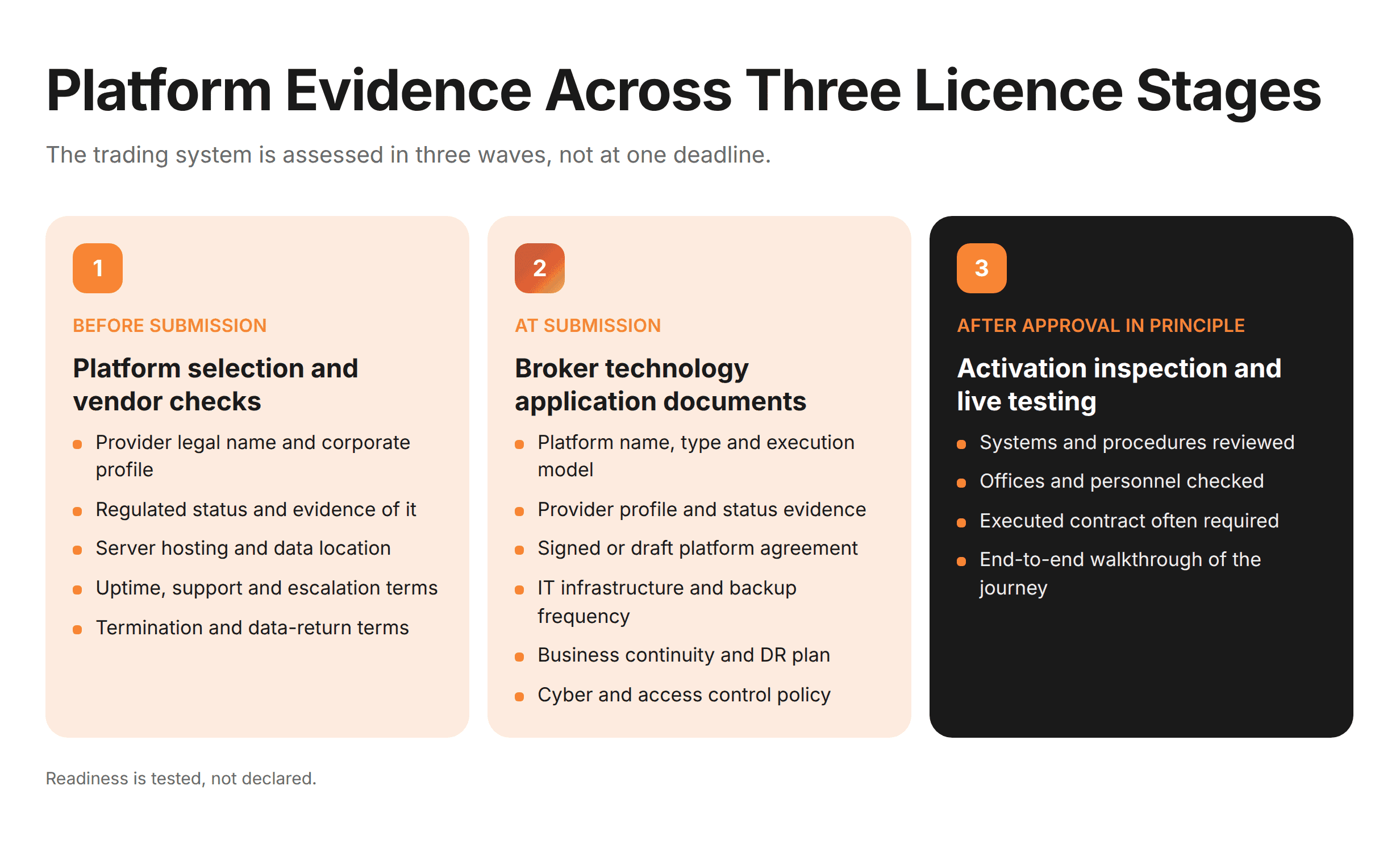
Trading system evidence arrives in three waves: vendor selection before submission, documents at submission, and readiness testing after approval in principle. Treating it as one deadline is what causes the scramble.
Before Submission: Platform Selection and Vendor Checks
Vendor selection is the first regulated decision you make, even though no regulator is watching yet. Before you sign anything, collect the material you will later be asked to file:
The provider's legal name, incorporation details and corporate profile
Whether the provider is regulated, and evidence of that status if so
Where the servers are hosted, and in which country the data sits
Uptime commitments, support hours and escalation contacts in the contract
Termination and data-return terms, so you can exit without losing records
Brokers who do this in the wrong order pay twice: once for the platform, and again in lost weeks when the contract turns out to be missing the terms the regulator expects to see.
At Submission: Broker Technology Application Documents
The platform section of a licence file usually contains six documents:
Platform name, type and execution model
Provider corporate profile and regulated status evidence
Signed or draft platform agreement
IT infrastructure and hosting details, including backup frequency
Business continuity and disaster recovery plan
Cyber, access control and data protection policy
Mauritius is the clearest example of this in published form, and the full Mauritius Investment Dealer checklist sets out where each item sits. The FSC's Investment Dealer licensing criteria ask for details on the platform to be used, an indication of whether it is regulated or linked to a regulated exchange, a draft copy of the agreement to be entered into with the platform provider, and the provider's corporate profile. Separate items in the same list require a disaster recovery and business continuity plan and IT infrastructure details including backup frequency. Vanuatu's VFSC guidance notes take a similar line, asking for the type of platform or software system with supporting evidence plus a copy of the service agreement where a third party supplies it.
After Approval in Principle: Activation Inspection and Live Testing
Approval in principle is not the end of the platform conversation. In Cyprus, practitioners describe an activation stage after in-principle approval, when the regulator reviews offices, personnel, systems and procedures before the licence is issued. Abu Dhabi's FSRA application form goes further at the paperwork stage, asking firms to list their IT products by name and to confirm that the regulator has rights to inspect the service provider's systems.
The takeaway: readiness is tested, not declared. A demo environment that nobody has walked end to end is a risk at exactly the moment you cannot afford one.
Get your broker site licence-ready in days.
The public-facing side of your application usually starts last and finishes late. WSA builds brokerage websites that hold up to regulator, bank and liquidity provider review.
Platform Ownership, Licence or White-Label Agreement for a Forex Broker Application
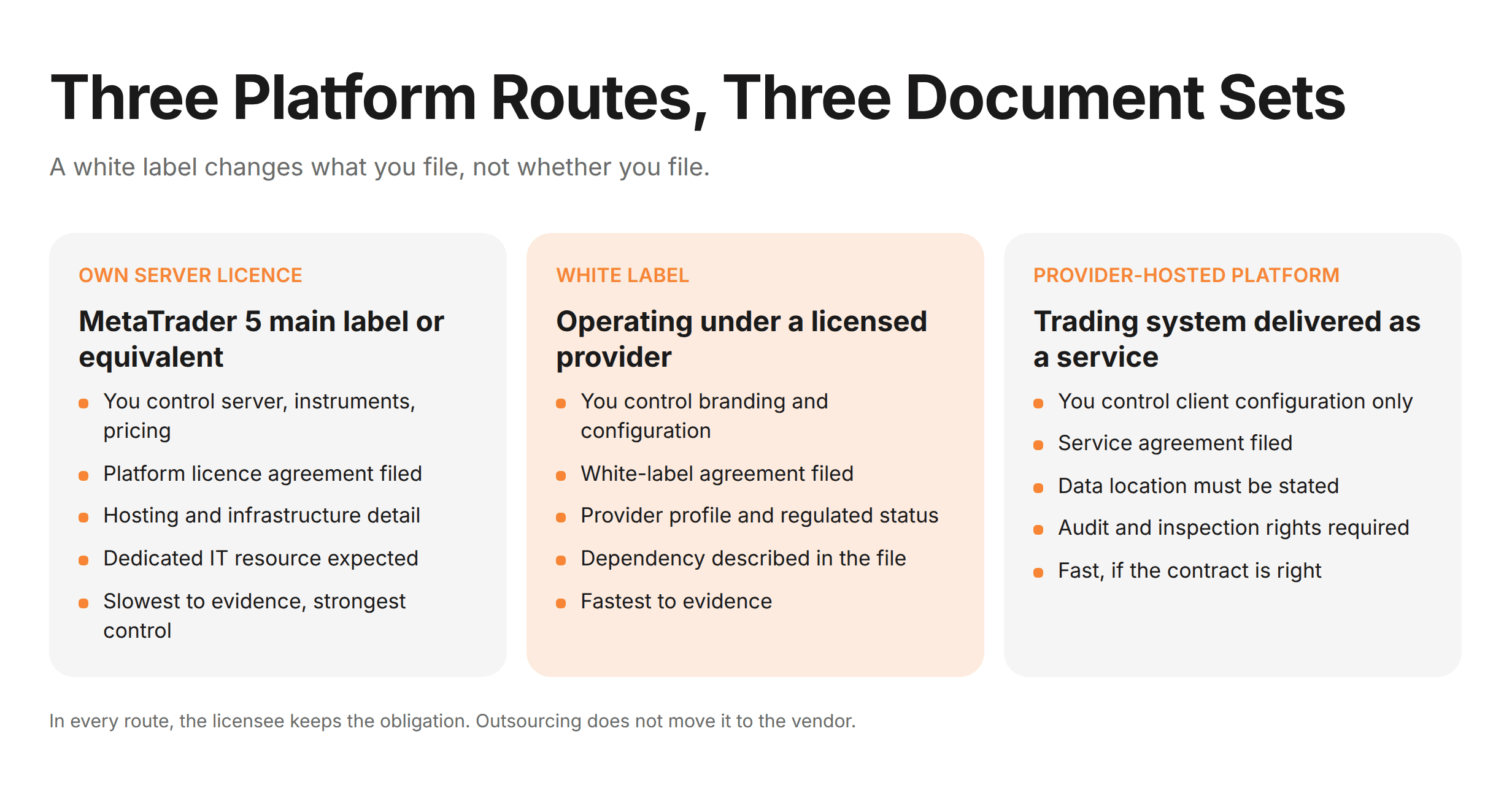
Three routes exist, and each one produces a different document set for the regulator. Choosing a white label or a full server licence changes the paperwork, not the obligation behind it.
Route | What you control | What the regulator asks for | Typical readiness |
|---|---|---|---|
Own server licence (e.g. MetaTrader 5 main label) | Server, instruments, pricing, branding | Platform licence agreement, hosting and infrastructure detail, dedicated IT resource, continuity plan | Slowest to evidence, strongest control |
White label under a licensed provider | Branding, client-facing configuration | White-label agreement, provider's corporate profile and regulated status, description of the dependency | Fastest to evidence, dependency disclosed |
Provider-hosted platform (SaaS trading system) | Client configuration only | Service agreement, provider profile, data location, inspection and audit rights | Fast, but audit rights must be in the contract |
A white label is not a shortcut around the evidence. It changes what you file, not whether you file. You still show the chain: your licensed entity, the provider's rights to the platform, and the contract that binds them.
MT5 Licence Application: What MetaQuotes Expects Before the Regulator Does
An MT5 licence application runs on MetaQuotes' own timetable, not the regulator's, and the MT5 white label requirements differ from those for a main label. MetaTrader 5 is now the volume leader among the two MetaTrader platforms, accounting for 54.2% of combined MT4 and MT5 trading volume in the first quarter of 2025 according to Finance Magnates reporting. The same outlet reported MetaTrader licensing fees rising by 20% to 25% from January 2025, with enterprise packages quoted in the tens of thousands of dollars per month.
Before you get to the regulator's questions, a full server licence typically requires:
A legal entity with documented ownership
Evidence of financial standing to cover monthly fees
Enterprise hosting arrangements and dedicated IT support
An AML/KYC policy and a business plan
Providers publish different acceptance criteria and change them without notice, so treat published prices and prerequisites as indicative and confirm them directly.
Trading System Due Diligence on Your Platform Provider
Trading system due diligence is your evidence that you chose the vendor deliberately. ASIC's guidance is direct on why it matters: when you outsource, you remain responsible for complying with all of your licensee obligations. For EU and Cyprus entities, DORA has applied since January 2025 and adds a register of information covering ICT third-party contractual arrangements.
Ask for four things in writing before signing: the provider's incident notification timeline, its subcontractor list, its security certifications, and your audit and inspection rights. Every one of those reappears later in the outsourcing arrangement section of the application.
Platform Evidence by Jurisdiction: Mauritius, Vanuatu, FSCA, ADGM and CySEC
Five regulators, five different platform questions on the form. Forex broker platform requirements are jurisdiction-specific, but the pattern holds: even the regulators with the shortest published criteria still ask for the platform by name.
Regulator | What the form asks about the platform | Supporting document |
|---|---|---|
FSC Mauritius (Investment Dealer) | Platform details, whether it is regulated or linked to a regulated exchange | Draft platform agreement, provider corporate profile, DR and BCP, IT infrastructure with backup frequency |
VFSC Vanuatu (Financial Dealer) | Type of platform or software system, with evidence or a printout | Copy of the service agreement, ICT policy recommended at licensing stage |
FSCA South Africa (ODP) | Details on the trading method or facility used to trade | Approved IT framework, IT risk framework, BCP, list of all third-party and outsourcing arrangements |
ADGM FSRA | Proprietary and non-proprietary IT systems, and the names of the products used for execution and record keeping | Outsourcing detail plus confirmation of regulator inspection rights over the provider |
CySEC (CIF) | Systems and procedures assessed at the activation stage after in-principle approval | Programme of operations, ICT risk framework consistent with DORA |
Website-to-Platform Customer Journey Requirements for a Regulated Broker
The regulator's interest does not stop at the platform login. The route a client takes from your homepage to a funded account is regulated territory, because the disclosures, warnings and account flows that rules attach to are delivered on your website.
No regulator publishes a general rule that your live website must be reviewed before authorisation. What exists is narrower and more testable: rules about what appears on the page, where it appears, and how the sales process is designed.
Risk Warnings, Disclosures and Where They Must Sit
UK rules for retail CFDs are specific to the level of pixel placement. The FCA Handbook requires the standardised risk warning disclosing the percentage of retail investor accounts that lose money with the provider, recalculated every three months, and requires that on a website it is "statically fixed at the top of the screen". Margin close-out at 50% and negative balance protection sit in the same chapter.
Fast fact: the rule does not say "prominent". It says statically fixed at the top of the screen, which is a layout instruction, not a copy instruction.
Australia frames it as design rather than disclosure. ASIC's product design and distribution guidance names product bundling, default settings, sales process and website design as choice architecture that an issuer has to consider, and treats specific product content on the entity's website as a distribution condition to be justified.
What this means in practice: a landing page built by a marketing team without the rule text open is a compliance defect with a design fix.
Demo, Live Account and KYC Handoff Points
The handoff points are where journeys break. A trader clicks "Open account" and lands in a provider-branded portal with different fonts, a different logo and no risk warning. Trust drops, and so does completion.
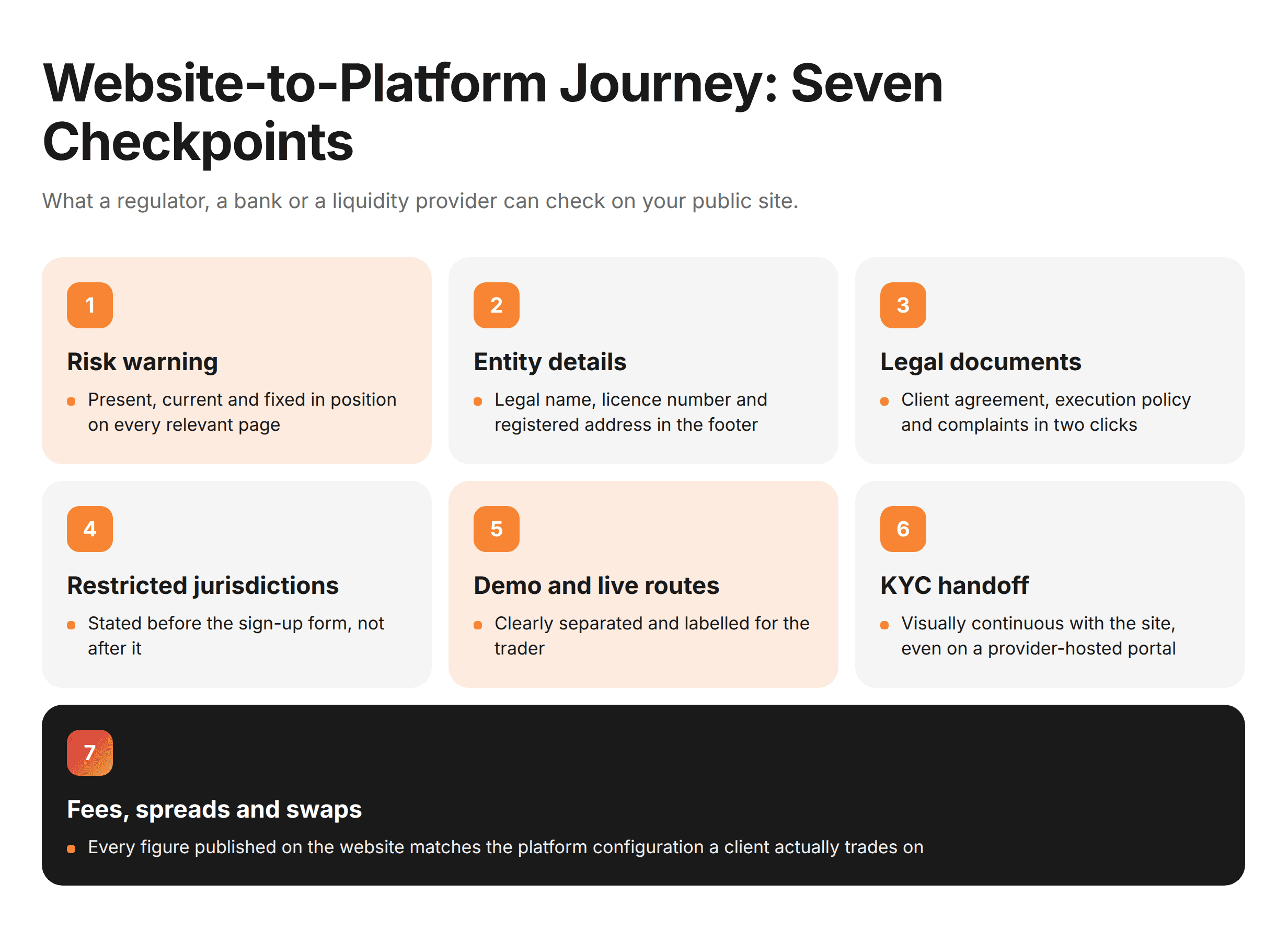
Seven points a reviewer, a bank or a liquidity provider can check on your public site, and a fuller website compliance checklist covers the rest:
Risk warning present, current and fixed in position on every relevant page
Legal entity name, licence number and registered address in the footer
Client agreement, order execution policy and complaints procedure reachable in two clicks
Restricted jurisdictions stated before the sign-up form, not after
Demo and live routes clearly separated and labelled
KYC steps visually continuous with the site, even when the portal is provider-hosted
Fee, spread and swap information consistent with the platform configuration
How to Build Platform and Website Evidence in Parallel
Platform readiness and website readiness are the same project on two tracks, and both are usually started last. The licence file goes to the regulator, the platform contract gets signed, and then someone asks who is building the site that all of this points at.
Meeting forex broker platform requirements on time is a scheduling problem before it is a technical one, which is why brokers who prepare both in parallel launch sooner. The sequencing is not complicated:
Weeks 1 to 2: platform shortlist and provider due diligence; site architecture and disclosure map drafted from the same document set
Weeks 3 to 5: platform agreement signed; site build with legal pages, risk warnings and entity details in place
Weeks 6 to 8: integration of the client portal and KYC flow; end-to-end walkthrough of the journey a reviewer would take
In WSA's work with brokerage clients, the public site is almost always the last workstream to start and the one with the least slack. WSA works almost exclusively with brokers, fintech and crypto companies, which means the disclosure map, the legal page set and the portal handoff are decisions already made rather than discovered mid-build. Brokerage sites typically launch in weeks rather than quarters on Framer, which matters when the licence date moves.
One honest caveat: requirements differ by jurisdiction and by licence class, and your licensing counsel confirms the final document list. Use this article to prepare the platform and website evidence early, not to replace that advice.
Conclusion
Forex broker platform requirements are not a post-licence purchase decision. They are a documentation exercise that starts with vendor selection, runs through the platform agreement and infrastructure detail you file, and ends with a readiness check that some regulators carry out before the licence is issued.
The brokers who move fastest treat trading platform requirements for a forex broker licence and website readiness as one project. Same document set, same disclosure map, same launch date.
If your licence file is in progress and the public-facing side has not started, that is the gap worth closing this month. WSA builds brokerage websites for regulated financial brands, and can have the client-facing layer ready before your licence is.
FAQ
Does a forex broker need to select a trading platform before applying for a licence?
In most jurisdictions, yes. Mauritius FSC licensing criteria for an Investment Dealer ask for details of the platform to be used and for a draft copy of the agreement with the platform provider, and Vanuatu's VFSC guidance asks for the type of platform or software system with supporting evidence. Regulators that do not name the platform on the form still ask about execution arrangements, hosting and continuity, which cannot be answered without knowing which system you will run. The FCA's authorisation guidance expects applicants to demonstrate that the technology they will use is ready for the activities applied for. A practical rule: shortlist before you draft the business plan, and sign before you submit. Naming the platform is also the cheapest way to make your application look complete, which affects how quickly it is processed.
Must the platform contract be signed before licence submission?
Not always signed, but usually drafted. Mauritius accepts a draft copy of the agreement with the platform provider at application stage, while Vanuatu asks for a copy of the service agreement where the platform is supplied by a third party. Where a draft is accepted, it should be a real negotiated draft with parties, term, fees, service levels and termination in place, not a template with blanks. Some regulators will grant approval in principle and expect the executed contract before activation, which is common where an inspection or activation step follows in-principle approval. Ask your case officer or licensing counsel which of the two applies, then plan the vendor negotiation to finish before whichever date is binding. Signing late is a scheduling problem, not a legal one, until it delays the licence.
Does a white label satisfy the licence application?
A white label is accepted in most jurisdictions, provided the arrangement is documented as an outsourcing relationship rather than presented as your own infrastructure. You file the white-label agreement, the provider's corporate profile and evidence of its regulated status or platform rights, and you describe the dependency in your programme of operations. What a white label does not do is transfer responsibility. ASIC states in its licensing guidance that outsourcing does not remove the licensee's obligation to comply, and other regulators take the same position. That means your continuity plan still has to answer what happens if the provider fails, and your contract still needs audit and inspection rights, incident notification and data return on termination. For many applicants a white label is the better route, because the document set is smaller and faster to assemble than a full server licence.
Will the regulator test the client journey?
Sometimes directly, and often indirectly through the rules that apply to what your website shows. FCA rules for retail CFDs specify the standardised loss-percentage risk warning and require it to be statically fixed at the top of the screen on a website, which is a testable page-level requirement. ASIC's design and distribution guidance treats sales process and website design as choice architecture the issuer must consider, and product content on the website as a distribution condition. In Cyprus, practitioners describe an activation review of systems and procedures after in-principle approval. Even where no formal review of the live site happens, banks, payment providers and liquidity providers examine the public journey during onboarding, and they apply similar standards. Walk the route yourself before anyone else does: homepage, product page, sign-up, KYC, funding, platform login.
How long does website and platform readiness take alongside a licence application?
Plan six to eight weeks for both tracks if they run in parallel, against a regulator timeline that is typically several months. A platform shortlist and vendor due diligence takes one to two weeks, contract negotiation two to four, and a brokerage website with legal pages, disclosures and portal integration builds in roughly four to six weeks with a specialist team. Sequential execution is what makes it slow: waiting for the platform contract before starting the site, then discovering the disclosures and portal handoff need decisions nobody has made. The regulator's clock is the constraint you cannot compress. The FCA determines complete applications within six months and incomplete ones in up to twelve, so the goal is to have platform and website evidence ready at submission rather than in a clarification round.
Launch Your Licensed Brokerage with Confidence
We support brokers and fintechs through licensing, launch planning, and everything a regulated brand needs to go live.