•
•

MT5 White Label vs Full Licence: Cost, Control and Compliance
This article is for informational purposes only and does not constitute legal advice. Brokers should consult qualified legal and compliance professionals for jurisdiction-specific guidance.
Your regulator application is moving. Liquidity quotes are on the table. Two payment providers have come back with terms. Then your CTO asks the question that decides your next three years: whose MT5 server will your clients actually trade on?
Most founders treat MT5 white label vs full licence as a budget line. It isn't. It is a question about who holds the server licence, who can change your trading conditions at short notice, and who your regulator calls when something goes wrong. The monthly invoice is a symptom of that, not the decision itself.
The stakes are real. Global FX turnover hit $9.6 trillion a day in April 2025, up 28% from $7.5 trillion three years earlier, according to the BIS Triennial Central Bank Survey. The infrastructure you pick now decides how much of that flow you can service.
Key Takeaways
The real difference is ownership, not price: with a white label the provider holds the MT5 server licence and the MetaQuotes contract; with a full licence you hold both.
MetaQuotes stopped issuing new MT5 white label licences in late 2022, so a white label in 2026 is a sub-licence from an existing main label holder, not an arrangement you make with MetaQuotes directly.
Expect roughly $5,000–$25,000 in setup and $1,500–$11,000 a month for a white label. Full licence fees are commonly quoted from $5,000 to $20,000 a month, with first-year all-in costs for a main label often landing between $60,000 and $150,000.
A white label agreement transfers technology, not regulatory liability. KYC, AML, client money segregation and data protection stay with you in both models.
"Full licence" is three products, not one. MetaQuotes sells Entry, Standard and Enterprise tiers at 1,000, 25,000 and 200,000 real accounts respectively.
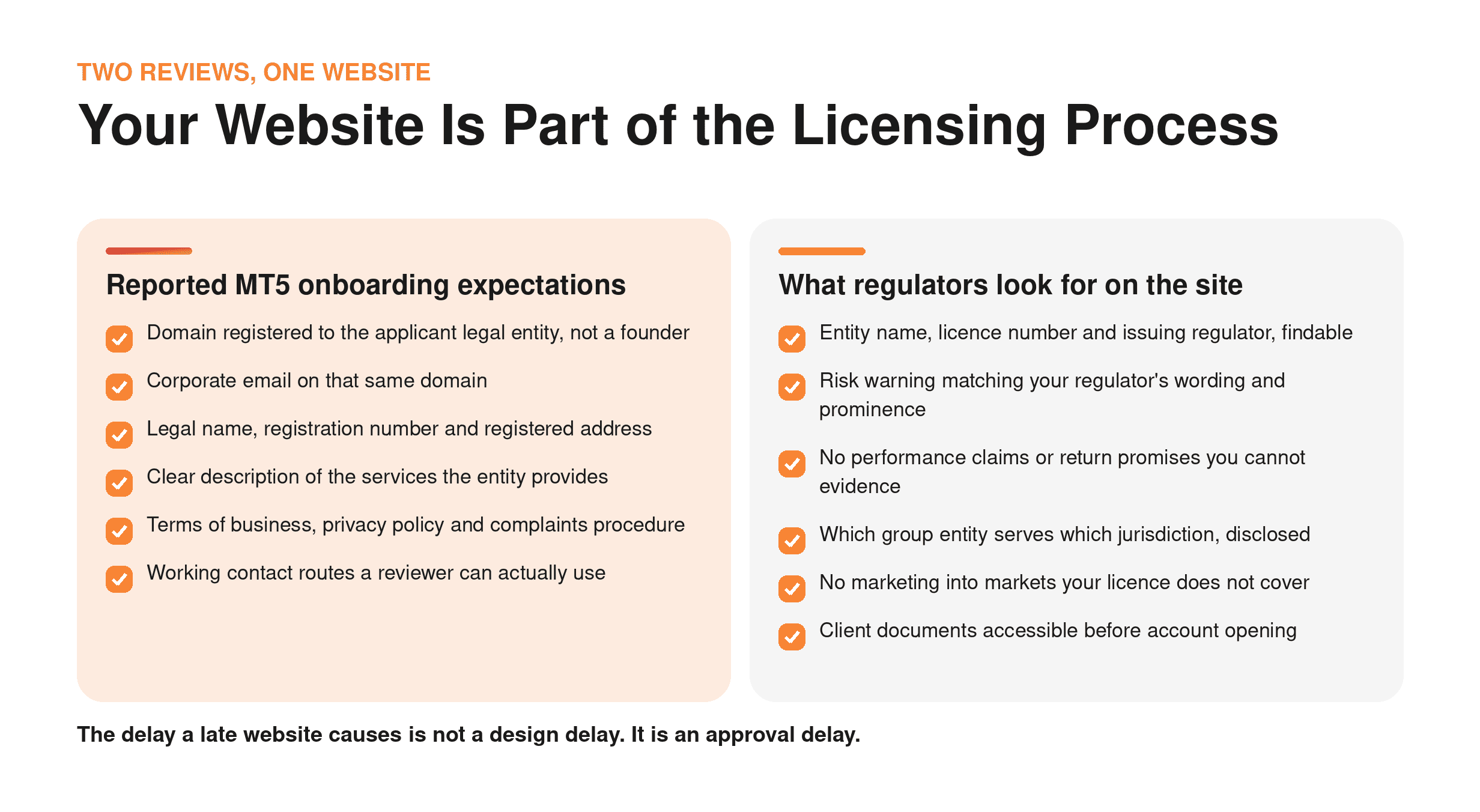
Neither model includes your website, your domain, your onboarding funnel or your compliance pages. That layer is yours to own either way, and it is where most brokers lose traders before a single trade is placed.
MT5 White Label vs Full Licence: What Actually Differs
The difference between an MT5 white label and a full licence is who holds the server licence. Under a white label, an existing main label holder owns and operates the MetaTrader 5 server, and you run a branded environment on it. Under a full licence, you license MT5 directly from MetaQuotes and run your own server.
One detail reshaped this market. MetaQuotes stopped issuing new MT5 white label licences in late 2022, so any white label signed in 2026 is a sub-licence from a provider who already holds a main label. Your platform relationship runs through a commercial intermediary, not the software vendor.
There is a third arrangement worth naming once: an MT5 grey label, where you offer MT5 to clients under a parent broker's identity with minimal branding and almost no configuration control. It is cheaper and faster than a white label, and it is not a comparable option for anyone building a brand.
What an MT5 White Label Gives You
An MT5 white label gives you a fully branded trading environment on infrastructure someone else owns. You get the client-facing product without the operational weight of running a trade server.
Your brand on the desktop, web and mobile terminals
A dedicated server group with your own symbols, spreads, leverage and swap settings
Your own liquidity routing, in most agreements, including A-book and B-book configuration
Manager-level access to accounts, groups and reporting
Launch in roughly 2–8 weeks rather than months
What you do not get is the server itself. Hosting, patching, version upgrades, disaster recovery and the MetaQuotes relationship all sit with the provider.
What a Full MT5 Licence (Main Label) Gives You
A full MT5 licence, also called a main label, gives you your own server and a direct contract with MetaQuotes. Administrator access is complete, and nothing about your trading environment depends on another broker's commercial priorities.
Your own MT5 server licence and admin credentials
Freedom to install any plugin, including PAMM/MAM, copy trading and custom risk tools
Authority to issue your own white labels to introducing partners
Direct vendor support and upgrade control
Capacity sized to a licence tier rather than to a provider's server group allocation
That last point is where most comparisons get sloppy. MetaQuotes sells its MT5 broker licence in Entry, Standard and Enterprise tiers, rated for 1,000, 25,000 and 200,000 real accounts. Asking what a full licence costs without naming a tier is like pricing a building without naming the floor count.
Unlike a white label, a main label makes you the operator of record for the technology as well as the business. MetaQuotes states it has no access to your servers, accounts or clients' trading history, which is also why nobody else can fix your server at 2am.
Dimension | MT5 White Label | Full MT5 Licence (Main Label) |
|---|---|---|
Who owns the server | Main label provider | You |
MetaQuotes contract | Held by the provider | Held by you |
Typical setup cost | $5,000–$25,000 | Negotiated by licence tier |
Typical monthly cost | $1,500–$11,000 | Commonly $5,000–$20,000 |
Admin access | Manager level, scoped by provider | Full administrator |
Plugin freedom | Limited to the provider's approved set | Unrestricted |
Where client data sits | Provider's server, your records | Your server, your records |
Time to launch | 2–8 weeks | Typically 2–4 months |
What this means: a white label buys speed and a smaller fixed cost base. A main label buys control and unit economics that improve as you grow. Neither is inherently more professional.
Cost: What Each Model Really Costs to Run
A white label typically runs $5,000–$25,000 to set up and $1,500–$11,000 a month, based on provider pricing published by B2BROKER in 2026. A full licence is more commonly quoted as a flat monthly fee between $5,000 and $20,000, with realistic first-year totals for a main label often between $60,000 and $150,000 once infrastructure and staffing are counted.
Treat every figure as a market range as of 2026. Pricing varies by provider, jurisdiction, licence tier and volume, and most providers quote nothing until they see your projected account count.
MT5 White Label Cost Breakdown
The platform fee is rarely the largest line in the first year. The stack around it is what surprises people.
Platform fee: setup plus monthly, covering server group creation, branding, symbol configuration and routing
Liquidity bridge: roughly $500–$2,000 a month for aggregation and A/B-book routing, from providers such as PrimeXM, oneZero or T4B
Forex CRM and back office: roughly $500–$2,000 a month, and the item most often underbudgeted
KYC and AML tooling: roughly $200–$1,000 a month depending on volume and jurisdiction
Payment processing: per-transaction fees plus rolling reserves
Your website and client portal: a one-off build plus ongoing maintenance
Ask one more question before signing: what are the MetaTrader white label requirements on the provider's side? Most want proof of regulatory standing or a clear jurisdiction plan, a minimum monthly commitment, and evidence you can fund the bridge and CRM too.
MT5 Full Licence Cost Breakdown
The MT5 full licence cost is a monthly fee to MetaQuotes plus everything you now do yourself. That second half is the part brokers underestimate.
Licence fee: monthly, scaled to your capacity tier
Hosting and colocation: latency-sensitive, and priced accordingly
DevOps and platform administration: at least one dedicated hire, realistically two for 24/5 coverage
Monitoring, backup and disaster recovery: your obligation now, not a provider's
The same bridge, CRM, KYC and payments stack as a white label
Here's where the maths turns: a broker with a few hundred funded accounts paying main-label fees plus salaries for platform staff is usually worse off than the same broker on a white label. The full licence stops being expensive somewhere in the low thousands of active traders, not before.
Control: Server Access, Branding and Client Data
Control splits along three lines: server administration, brand presentation and client data. A white label gives you most of the second, a meaningful slice of the third, and very little of the first.
In practice, the constraint founders feel first is not access, it is latency of change. Adding an instrument, adjusting a group's leverage or installing a plugin becomes a ticket to your provider rather than a task on your own admin terminal. When a competitor lists a new symbol on Monday, a two-day turnaround costs you flow.
Here is what a white label broker usually cannot change: the MT5 build version, the server's physical location, the plugin set, and the terminal's core interface behaviour beyond skinning and naming.
Who Owns Client Data Under an MT5 White Label
You keep your client relationships and your client records; the provider holds the server those records sit on. Your CRM, KYC files and commercial relationship with each trader remain yours, and reputable agreements grant full access to account and trading data.
The gap is custody, not ownership. Because the provider processes personal data on infrastructure it controls, the arrangement sits in GDPR Article 28 processor territory for any EU-facing broker: you need a written contract covering processing instructions, security measures and the return or deletion of data when the contract ends.
The question almost nobody negotiates: what happens to account histories, open positions and client credentials if you migrate away? Brokers argue hard over setup fees and sign exit terms without reading them. Fix that clause before you fix the price.
Can an MT5 White Label Use Its Own Website and Domain?
Yes. An MT5 white label runs on your own domain, your own website and your own brand, and traders have no visibility into who owns the server behind it.
The limits are narrow but real. Terminal branding is skinning rather than redesign, and mobile app distribution under your own developer account depends on your provider's arrangement with MetaQuotes, so some white labels route clients to a web terminal instead of a branded store listing.
Everything else, the marketing site, the client portal shell, the onboarding flow and every compliance page, is entirely yours to design. Which is exactly why the structure of your broker website does more for conversion than the platform badge in your footer.
Budget your front end before you sign the platform contract.
Most brokers cost the bridge, the CRM and the licence, then discover the website was never in the model.
Compliance: Licensing, KYC and Who Carries the Risk
A white label agreement transfers technology, not regulatory liability. Whichever model you choose, your licence, your compliance function and your regulatory record are yours alone, and no provider contract changes that.
The principle is written into regulation rather than left to interpretation. Under SYSC 8.1 of the FCA Handbook, a firm that outsources critical or important operational functions remains fully responsible for discharging all of its regulatory obligations. Most major regulators apply the same logic.
Obligations you cannot outsource to a platform provider:
Client identification and ongoing KYC
AML monitoring, reporting and record keeping
Client money segregation and safeguarding
Suitability, leverage caps and risk warnings for your target markets
Data protection compliance for every jurisdiction you accept clients from
Complaints handling and dispute resolution
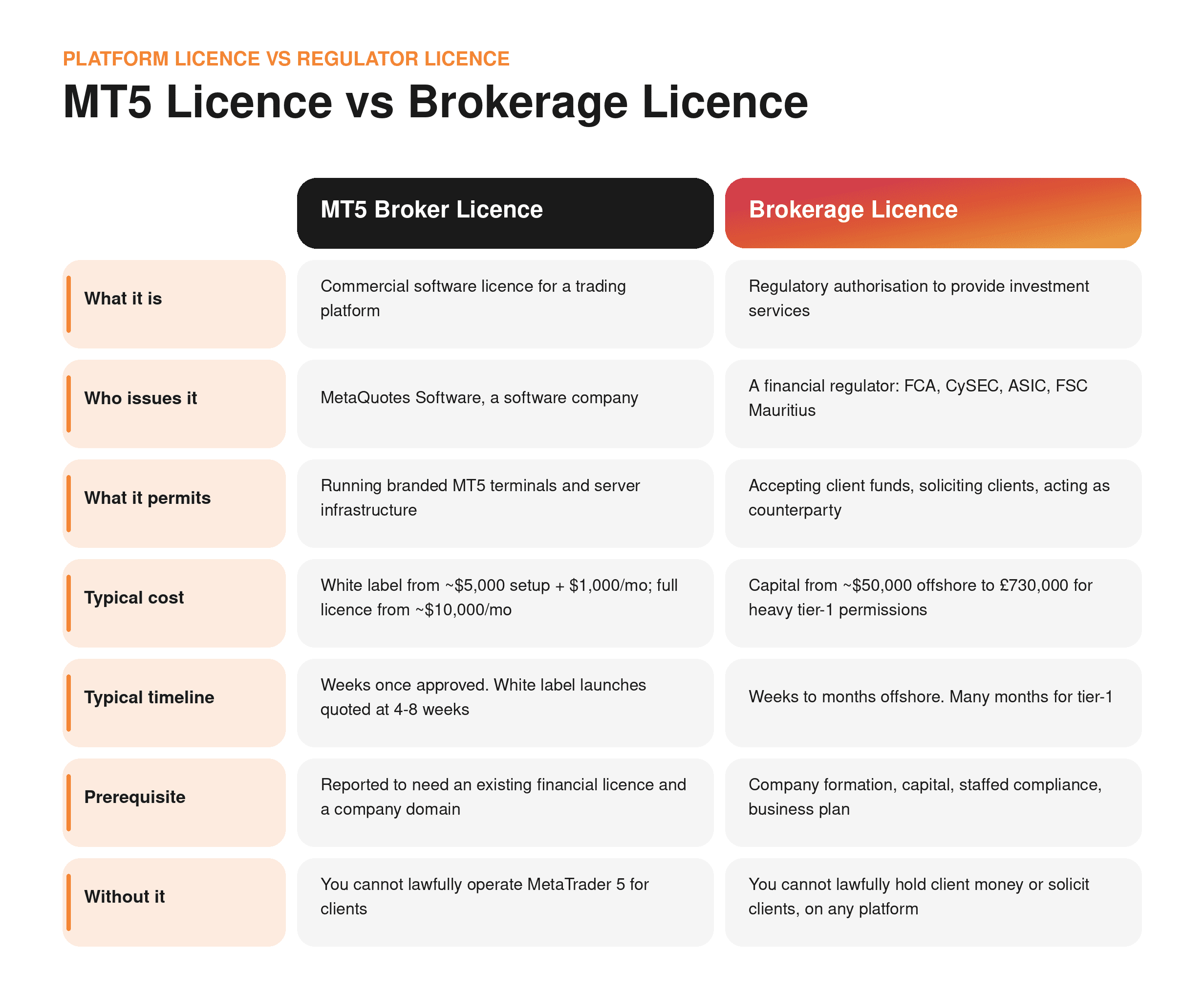
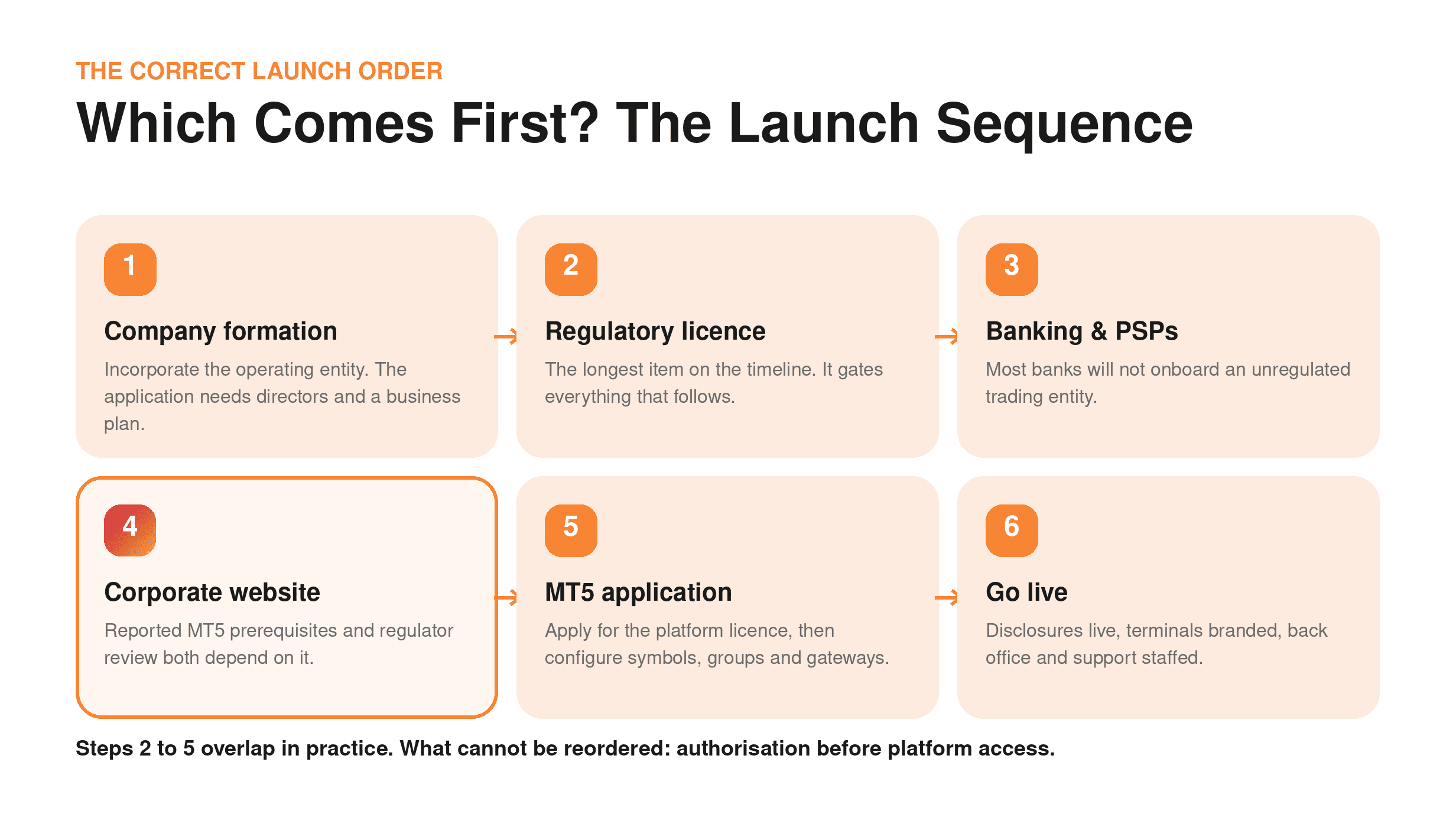
Does an MT5 white label require a broker licence? That depends on your business model, not your platform. A regulated broker under CySEC, the FCA, ASIC or a comparable authority needs full authorisation regardless of who owns the server. An offshore entity in Seychelles, Belize or St Vincent faces lighter requirements and a narrower reach, because banks, payment processors and liquidity providers all read your regulatory status first.
One dimension providers rarely raise: operational resilience. The FCA's guidance on outsourcing and operational resilience expects firms to run due diligence, monitor provider performance and hold a workable exit plan. If your trading platform is a third party, your regulator will eventually ask what happens when that third party fails.
This article is informational and not legal or regulatory advice. Confirm your obligations with counsel licensed in your jurisdiction before committing to either model.
When to Move From White Label to a Full MT5 Licence
The move is usually triggered by three things: volume, plugin restrictions and margin. Ambition is not one of them, and neither is the desire to look established.
Signals You Have Outgrown a White Label
Your monthly white label invoice is approaching what a licence tier plus platform staffing would cost
You need PAMM/MAM, copy trading or a custom risk plugin your provider will not install
You want to issue your own white labels to introducing brokers and partners
Server-side latency or maintenance windows are costing you client complaints
Your regulator is asking questions about platform control you cannot fully answer
You are planning a second entity in a new jurisdiction and want one platform behind both
A common industry rule of thumb puts the crossover near 5,000 active traders. Treat it as a prompt to run your own numbers, not a threshold: a broker with 2,000 high-volume clients may cross it well before one with 8,000 small accounts.
What Migration Actually Involves
Model the true cost. Licence tier, hosting, two platform hires, monitoring, and the bridge and CRM contracts you will need to re-point.
Apply to MetaQuotes for the tier that matches your projected real account count, not your current one.
Read your exit clause. Confirm what account history, balances and client data your provider will hand over, in what format, and on what notice.
Stand up the new server in parallel and run both environments while you test routing, groups, symbols and reporting.
Migrate accounts and history in a scheduled window, usually over a weekend, with a tested rollback path.
Re-point every client-facing surface: portal URLs, download links, mobile terminals, API integrations and tracking.
Communicate early and specifically. Traders forgive a planned migration; they do not forgive a login that silently stops working.
The practical implication: migration is a project with a timeline and an owner, not a switch. Budget 8–12 weeks and expect the client communication workstream to take as long as the technical one.
MetaTrader 5 White Label vs Full Licence by Launch Stage and Budget
The rule is simple: rent infrastructure until your volume makes ownership cheaper than dependency. Where you sit on that curve, not where you want to be, is what should decide it.
Stage | Recommended model | Realistic platform budget | Trigger to review |
|---|---|---|---|
Pre-launch, no clients | White label | $1,500–$5,000/month | First 500 funded accounts |
Up to 500 clients | White label | $2,000–$6,000/month | Plugin or routing request refused |
500–2,000 clients | White label, model the licence | $4,000–$11,000/month | Invoice approaches licence plus staffing |
2,000–5,000+ clients | Full licence | $10,000–$25,000/month all-in | Second entity or partner white labels |
Still validating demand? Weigh MT5 white label cost and server control for a regulated brokerage in that order: accept less control, protect your runway, prove the funnel converts. Past product-market fit and constrained by what your provider will approve? The MT5 full licence cost stops being the expensive option.
The Part Neither Model Covers: Your Front End
Neither model includes your website. Not the marketing site, not the onboarding funnel, not the compliance pages your regulator and your banking partners will read, and not the design work that makes a client portal feel like part of your brand.
This is the layer you own completely in both models, and it is the layer that decides whether a trader who found you actually funds an account. A white label broker with an excellent site converts better than a main label broker with a template one, every time.
The seam to watch is the handoff. Brokers on a white label often inherit a provider-supplied portal that looks nothing like their marketing site, and traders notice the moment the fonts change. That visible discontinuity reads as a scale problem, and it shows up in the UX patterns that cost broker sites conversions long before anyone blames the platform.
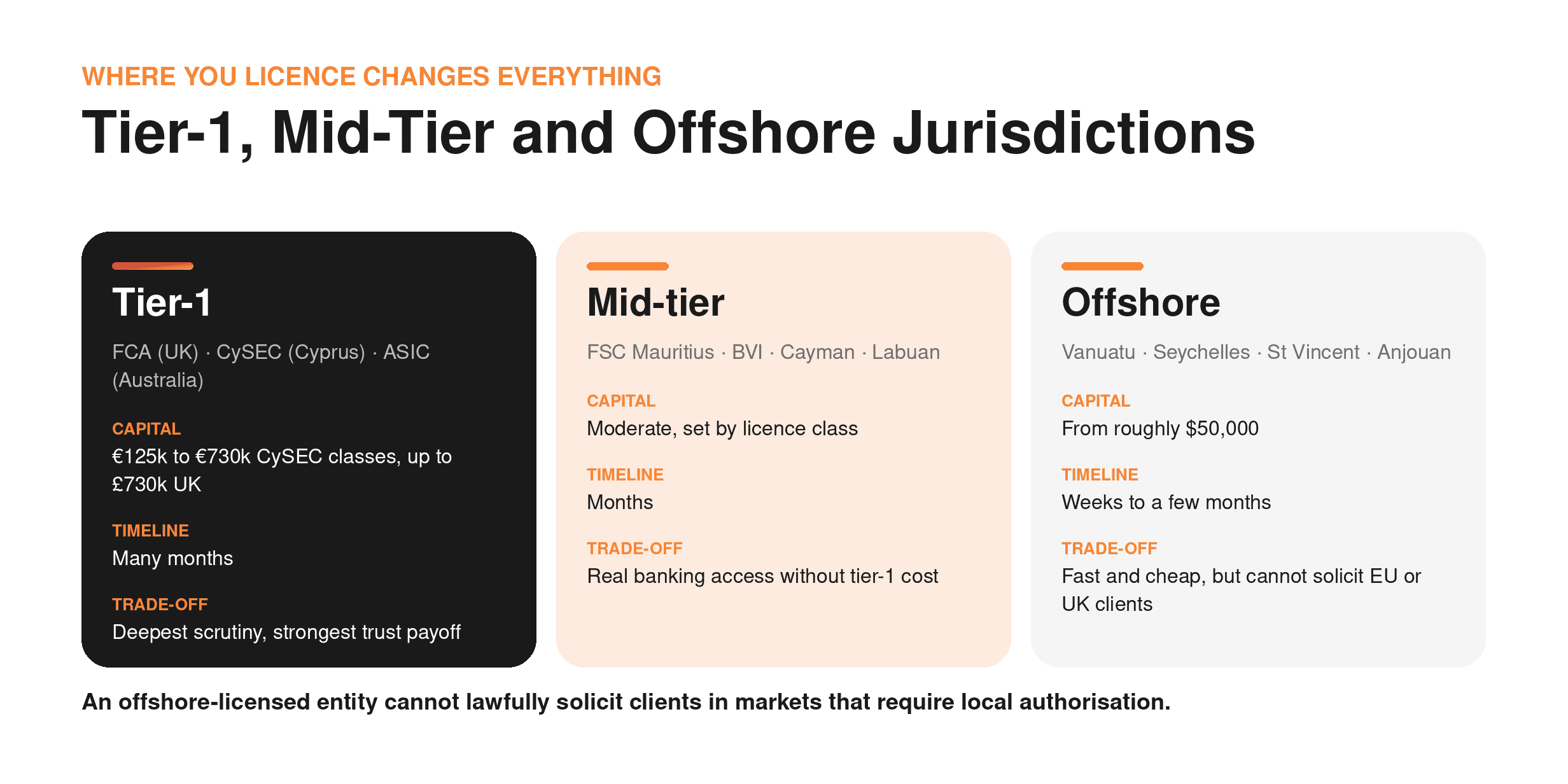
Regulated brokers carry a second front-end obligation. Where your risk warnings, legal entity details, complaints procedure and fee disclosures live is a supervised question in most jurisdictions, and CySEC's website requirements are specific enough that retrofitting them costs more than building them in. If your application is still open, check what regulators expect to see before your licence application is filed.
WSA builds websites for brokers, exchanges and fintech companies on Framer and Webflow, which means we see both models up close. The pattern is consistent: brokers who treat the front end as the last line item ship a site that undersells whatever platform decision they just spent four months making.
Not sure which option fits your business?
From startup brokerages to established platforms, WSA delivers websites that convert traders, satisfy regulators, and scale across markets.
Conclusion
MT5 white label vs full licence is a question about ownership and timing, not prestige. Rent the server while you are proving demand, and take the licence when your volume, plugin needs and margin all point the same way. Signing a main label too early buys control you cannot yet use and a cost base you have not yet earned.
Whichever way you go, two things stay with you: the regulatory obligations, and the front end your clients actually see. The platform decision changes what you can offer. Your website decides whether anyone signs up for it.
If you are planning a launch or a migration, WSA designs and builds broker websites around exactly these constraints. Tell us your model, jurisdiction and launch date and we will map the site architecture to fit it.
FAQ
What is the difference between an MT5 white label and a full licence?
The difference is who holds the MetaTrader 5 server licence. With a white label, an existing main label holder owns and operates the server, and you run a fully branded trading environment on it with manager-level access to your own accounts, groups and trading conditions. With a full licence, also called a main label, you license MT5 directly from MetaQuotes, run your own server and hold complete administrator rights. That single distinction drives everything else. A white label typically costs $5,000–$25,000 to set up and $1,500–$11,000 a month, and launches in 2–8 weeks. A full licence is commonly quoted between $5,000 and $20,000 a month, takes two to four months to stand up, and requires you to hire platform administration and cover hosting, monitoring and disaster recovery yourself.
Does an MT5 white label require a broker licence?
Your platform model does not determine your licensing requirement, your business model does. If you hold client funds and provide brokerage services, you need appropriate authorisation in your chosen jurisdiction whether the server belongs to you or to a provider. A regulated broker under CySEC, the FCA, ASIC or a comparable authority needs full authorisation, capital adequacy, KYC and AML procedures and client money segregation regardless of platform ownership. An entity registered offshore in Seychelles, Belize or St Vincent operates under lighter requirements, but that choice narrows which clients, banks, payment processors and liquidity providers will work with you. What a white label never does is transfer regulatory liability.
Who owns client data under an MT5 white label?
You own the client relationship and the client records; the provider holds the server those records sit on. Your CRM data, KYC files and commercial relationship with each trader are yours, and a reasonable white label agreement gives you full access to account and trading data at all times. The distinction that matters is custody. Because the provider processes personal data on infrastructure it controls, an EU-facing broker is in a controller-to-processor relationship under GDPR Article 28, which requires a written contract covering processing instructions, security measures and the return or deletion of data when the agreement ends. The clause to negotiate before you sign is the exit clause.
When should a broker move from white label to a full MT5 licence?
Move when your white label invoice plus your growth constraints exceed what a licence tier and platform staffing would cost. Three signals usually arrive together: volume that makes per-account provider fees expensive, a plugin or routing change your provider will not approve, and margin pressure that makes the fixed-cost model attractive. A common industry rule of thumb places the crossover near 5,000 active traders, though it depends far more on trading volume than headcount. Two other triggers justify the move earlier: wanting to issue your own white labels to introducing brokers, and planning a second regulated entity you would rather run on one platform. Plan 8–12 weeks for migration.
Can an MT5 white label use its own website and domain?
Yes. A white label runs entirely under your own domain, brand and website, and your traders have no visibility into who owns the server behind the platform. Terminal branding is closer to skinning than redesign: your logo, name and colour treatment appear, while the core interface behaviour stays MetaTrader 5. Mobile distribution is the one area to confirm in advance, since publishing a branded app under your own developer account depends on your provider's arrangement with MetaQuotes. Everything outside the terminal is fully yours: the marketing site, the client portal shell, the onboarding and KYC flow, the funding pages and every compliance page.
Launch Your Licensed Brokerage with Confidence
We support brokers and fintechs through licensing, launch planning, and everything a regulated brand needs to go live.