•
•

Licence First or Website First? How Fintech Founders Should Prepare Both in Parallel
Neither comes first: they run in parallel. Most fintech licences take 6 to 18 months, a professional website takes 4 to 10 weeks, so building sequentially adds one to three months of dead time after approval. Corporate content can go live before approval; regulated service claims and client onboarding cannot. Here's what that means in practice.
This article is for informational purposes only and does not constitute legal advice. Brokers should consult qualified legal and compliance professionals for jurisdiction-specific guidance.
Your licence application has been with the regulator for five months. Legal fees are paid, capital is locked, and the compliance officer is hired. Then approval lands, and the launch stalls anyway, because the website is still a parked domain with a coming-soon page.
That is the trap of treating fintech licence and website preparation as two sequential projects. Founders assume the licence must come first and the site can wait. In practice, the two run on very different clocks. A fintech licence application takes months and sits largely outside your control. A website takes weeks and sits fully inside it.
This guide shows you how to run both tracks together, what regulators and banks actually check on your site, and which pages can safely go live before approval. The answer depends partly on which compliance pages each regulator expects to see published at application stage.
Key Takeaways
Most fintech licences take 6–18 months to secure, while a professional fintech website takes 4–10 weeks. Building sequentially adds one to three months of dead time after approval.
Regulators, banks, and payment providers review your public web presence during due diligence, even in jurisdictions where a website is not formally required.
Corporate content (company story, team, contact, educational articles) can typically go live before approval. Regulated service claims and client onboarding must wait.
A parallel roadmap ties each website stage to an application stage, so the site switches on the day the licence is granted.
Compliance mistakes are expensive: 60% of fintechs paid at least $250,000 in compliance fines in a single year, according to Alloy's 2023 benchmark report.
Why the Licence vs Website Question Matters for Fintech Founders
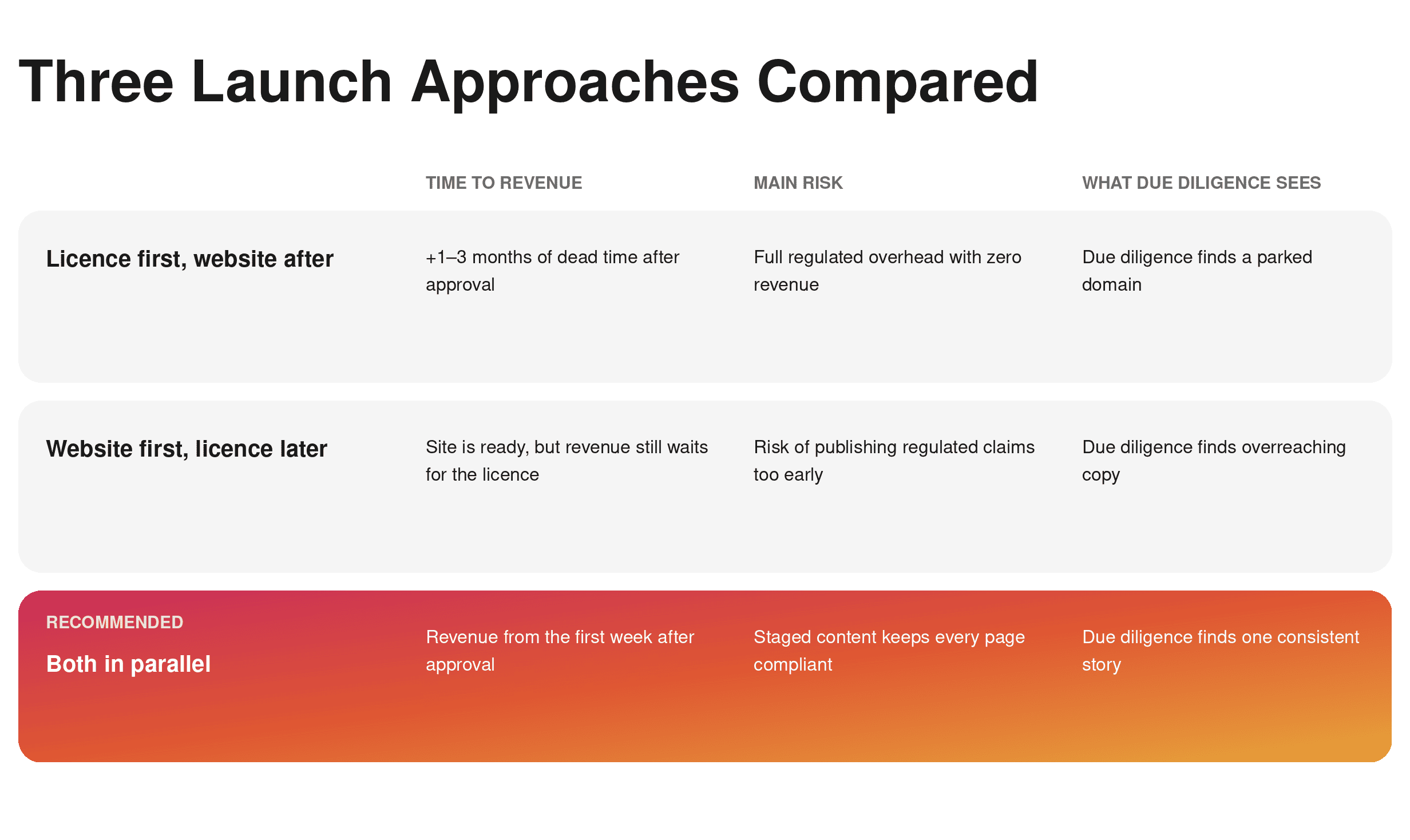
"Licence first or website first" is a false choice: the licence sets your critical path, and the website should be built during the application window, not after it. A licence application moves at the regulator's pace. A website moves at yours. Queuing them turns the slowest process into a blocker for the fastest one.
The decision matters because time to market is the one variable you can still influence once the application is submitted. Unlike the licence, the website timeline is fully under your control.
The Real Cost of Sequential Planning
Here's where most founders lose months. A typical sequence looks like this: incorporate, apply, wait, get approved, and only then brief an agency. The build takes 4–10 weeks. Content and legal review add more. Meanwhile, the licence is already generating costs.
Approved firms pay for regulatory capital, compliance staff, office requirements, and audits from day one. Every week between approval and a working website is a week of full regulated-business overhead with zero revenue.
Put numbers on it. A regulated payments startup carrying a compliance officer, capital requirements, and audit costs can easily burn $50,000–$150,000 per quarter before revenue. If the site starts only after approval, that quarter is spent watching an agency work through a backlog you could have cleared in month three.
What this means: a licence that took 12 months to win can sit idle for a quarter simply because nobody started the web build early.
What Regulators Actually Review Before Approval
Regulators assess your business plan, capital, governance, key personnel, and systems. The UK's FCA, for example, must determine a complete application within 6 months, and reported an average processing time of around 110 days for new firm authorisations in late 2024.
Your public presence gets attention too. Case teams routinely check whether an applicant is already promoting regulated services without authorisation, and whether public claims match the application file. A website that contradicts your business plan raises questions. A credible, consistent one quietly supports your file.
Requirements vary by jurisdiction, so treat this as a planning baseline rather than legal advice.
How Licensing and Website Timelines Compare
Most fintech licences take 6 to 18 months to secure, while a professional fintech website takes 4 to 10 weeks to design and build. That gap is the entire argument for parallel preparation.
Typical Licensing Timelines by Licence Type
Timelines depend on jurisdiction, application quality, and regulator workload, but typical ranges look like this:
Licence type | Typical timeline | Notes |
|---|---|---|
EMI licence (EU/UK) | 6–12 months | Plus 2–3 months of preparation |
PI / PSP licence | 6–12 months | Faster in Lithuania or Estonia (3–9 months) |
Forex / CFD broker licence (offshore) | 3–9 months | Varies widely by regulator |
Full banking licence | 12–24 months | Highest capital and governance burden |
Crypto asset registration | 6–15 months | Regime still maturing in many markets |
The clock only runs while your application is complete and in progress. Regulator questions pause it, which is why real timelines often exceed statutory ones. Authorisation specialists publish similar ranges for EMI and PI applications across the EU and UK.
One nuance worth knowing: not every fintech needs its own licence on day one. Many launch through a Banking-as-a-Service partner or an umbrella arrangement, which compresses the regulatory step to weeks. The due-diligence logic stays the same, though. The partner bank or PSP will still review your public presence before onboarding you, so the website track keeps its deadline either way.
How Long a Fintech Website Really Takes
A corporate fintech site typically takes 4–10 weeks from kickoff to launch: discovery and structure, design, build, content, and a compliance pass on every public claim. Client portals, onboarding flows, and integrations add scope on top.
This is why the timeline matters: even a 10-week build fits inside the shortest realistic licensing window several times over. You could design, review, and rebuild the entire site twice before most regulators issue a decision. Waiting for approval to start does not make the site better. It only moves those same 10 weeks to the most expensive part of your calendar.
WSA's experience with fintech and broker launches shows the build itself is rarely the bottleneck. The slow parts are content approval and legal review, and both can run while the regulator reviews your application.
Planning a fintech launch in the next 12 months?
We guide founders through the full journey: jurisdiction, documentation, banking onboarding, and the website regulators expect to see.
Why Your Website Is Part of the Licence Application
Regulators, banks, and payment providers all review an applicant's public web presence as part of due diligence. Even where no rule says "you must have a website", everyone evaluating your business will look for one.
Banking onboarding is the clearest example. When you open a corporate account or apply to a PSP, their compliance team searches for you. An empty domain, a generic template, or claims that overreach your permissions all create friction, and sometimes rejections. Research from the Stanford Web Credibility Project found that people judge a company's credibility largely from its website's visual design, and bank due-diligence officers are no exception.
This is why a website for a fintech licence application is best treated as a due-diligence asset, not a marketing afterthought.
Website Elements Regulators and Banks Expect to See
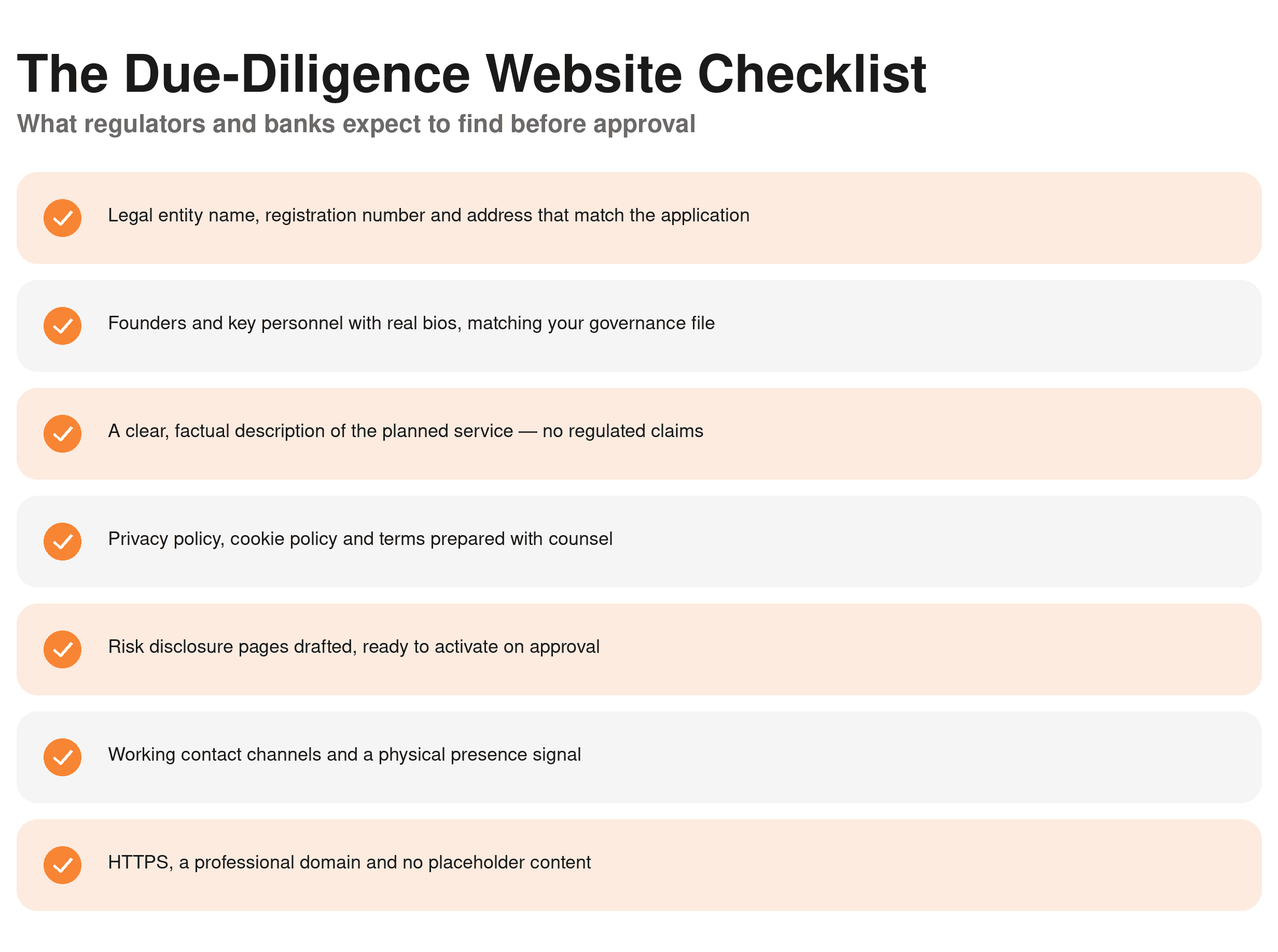
A pre-approval fintech site should already include:
Legal entity name, registration number, and registered address that match the application
Founders and key personnel with real bios, matching the governance section of your file
A clear, factual description of the planned service, without regulated claims
Privacy policy, cookie policy, and terms prepared with counsel
Risk disclosure pages drafted and ready to activate on approval
Working contact channels and a physical presence signal
HTTPS, a professional domain, and no placeholder content
What Can Go Live Before Approval (and What Can't)
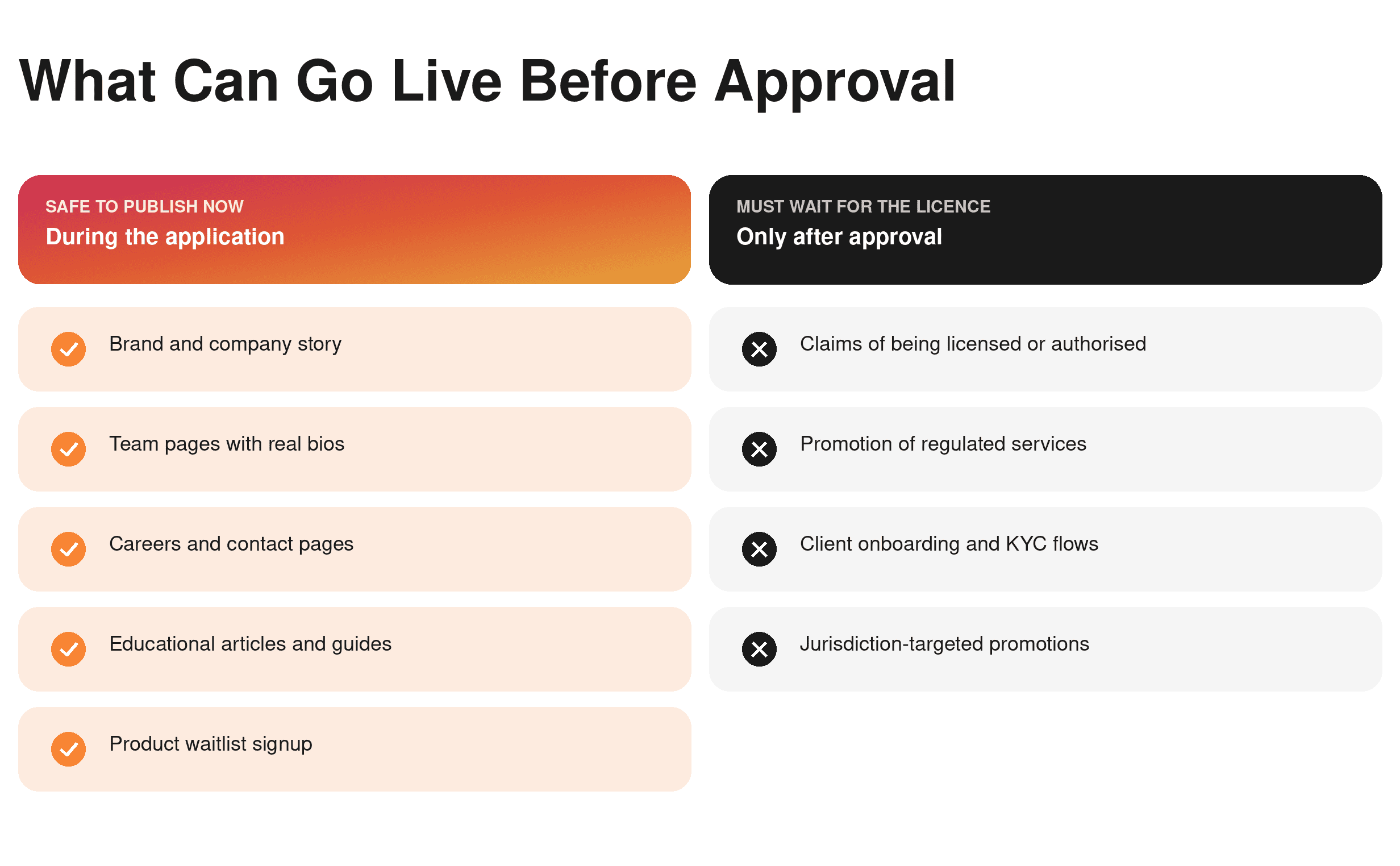
You do not need to hide until approval. You need to stage what is visible.
Typically safe before approval: brand and company story, team pages, careers, contact, educational content, and a product waitlist. Typically not safe: stating or implying you are licensed, promoting regulated services, running client onboarding or KYC, and jurisdiction-targeted promotions. Financial promotion rules, such as the FCA's, apply to websites just as they do to ads.
[Visual: Go Live vs Wait — two-column cards showing what can publish pre-approval and what must wait for the licence]
How to Run Licence and Website Preparation in Parallel
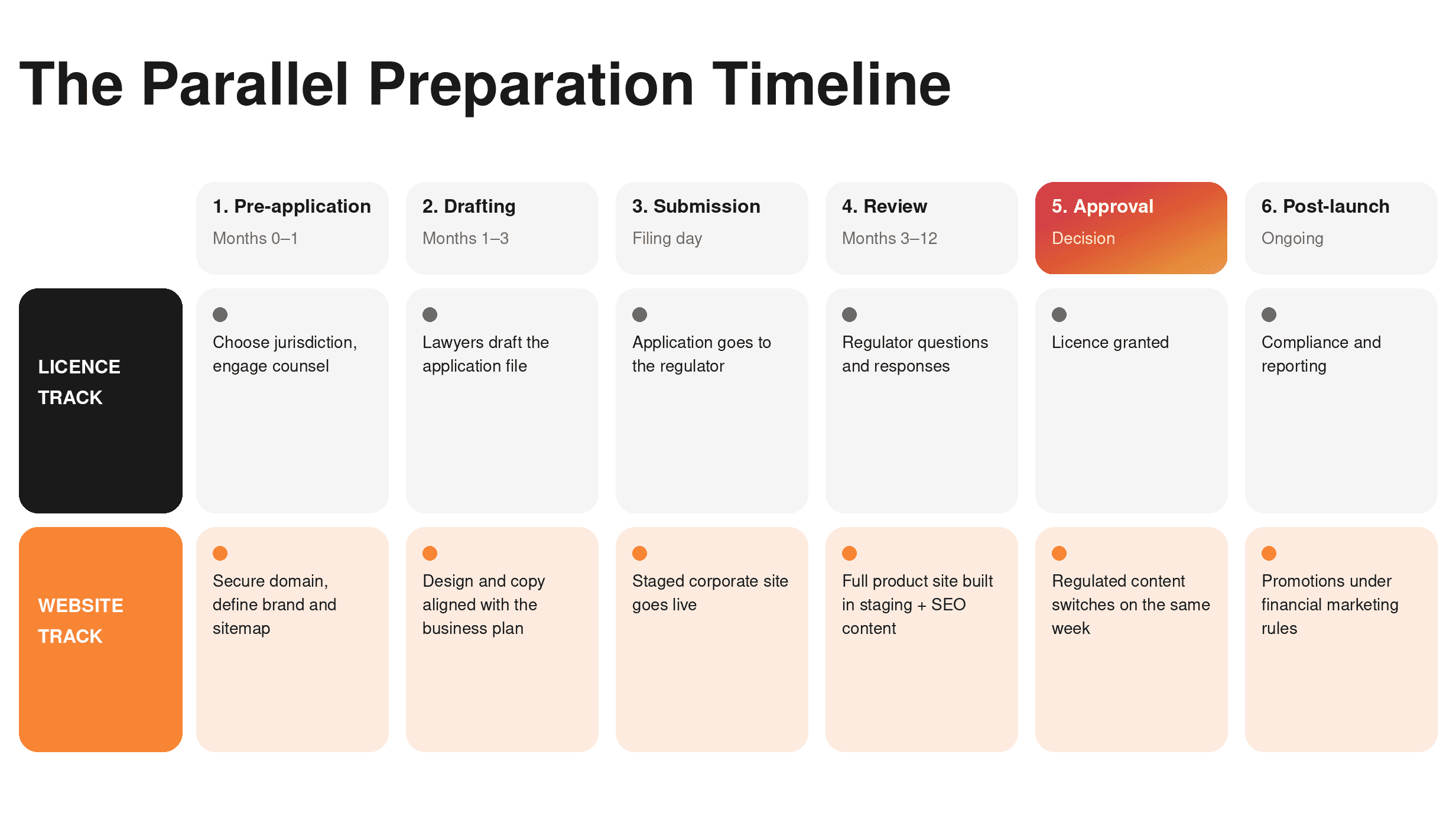
To prepare a fintech licence and website in parallel, align each build stage with an application stage. The licence sets the calendar; the site fills it.
A Stage-by-Stage Parallel Roadmap
Pre-application (months 0–1). Choose jurisdiction and counsel. In parallel: secure the domain, define brand and sitemap, and brief your web team.
Application drafting (months 1–3). While lawyers draft the file, design and copy take shape. Align website wording with the business plan so due diligence finds one consistent story.
Submission. Publish a staged corporate site: company, team, contact, educational content. No regulated claims yet.
Regulator review (months 3–12). Build the full product site, portals, and integrations in staging. Publish educational articles to build search visibility while you wait.
Approval. Switch on regulated content: licence number, risk disclosures, service pages, onboarding. This is a content release, not a rebuild.
Post-launch. Start promotions under local financial marketing rules, with analytics tracking from day one.
Common Mistakes That Delay Both Tracks
The same failure patterns show up in most delayed launches:
Website copy that contradicts the application file, triggering extra regulator questions
Publishing regulated claims before authorisation and drawing a warning
Hiring a generalist agency, then rebuilding legal pages and disclosures a second time
Leaving content and legal review until after approval
Nobody owning the compliance pass on the site, so launch waits on internal sign-off
These errors carry real cost. In Alloy's 2023 compliance benchmark, 60% of fintechs reported paying at least $250,000 in compliance fines in a single year.
Each of these mistakes has the same root cause: the website is treated as marketing, so nobody applies application-level discipline to it. The fix is procedural, not creative. Version the site copy alongside the application file, and require the same sign-off for both.
A fintech launch checklist that covers both tracks, with one owner per track, removes most of these risks. For the broader sequence, see our guide on how to launch a fintech company.
Not sure your application file would survive due diligence?
Get a full readiness review — licence documents, compliance pages, and public web presence, checked as one package.
How WSA Helps Founders Get Licensed and Launch
For most founders, the licence is the goal, and the website is one of the assets that gets them there. WSA covers the full journey: an A-to-Z service that runs from company setup for forex, crypto, and fintech businesses, through licence obtaining, to platform integration and connectivity, including liquidity, payments, and trading infrastructure, delivered through a partner network.
Within that service, the web design and development agency work covers the part of the application regulators and banks see first. Risk disclosures, regulatory footers, jurisdiction gating, and legal pages are part of the plan from week one, so the site supports the licence file instead of contradicting it. And because WSA builds on Framer, a staged corporate site can be live in weeks and expanded as the application progresses.
In practice, that means one team keeps both tracks on the same calendar: a broker or payments founder can incorporate and submit in month two, publish a credible public presence in month three, and release the regulated version of the site the week approval arrives. WSA's licence document checklist work for jurisdictions like the Bahamas shows how tightly the tracks are linked, since a website is often assumed to exist by the time the file is reviewed.
Conclusion
The licence-first-or-website-first debate resolves itself once you see the two timelines side by side. The licence takes months you cannot compress. The website takes weeks you fully control. Running fintech licence and website preparation in parallel converts regulatory waiting time into build time, satisfies the due-diligence checks that happen along the way, and lets you earn revenue the week approval lands instead of a quarter later.
If you plan to launch a fintech company in the next year, start both tracks now. Share your launch timeline with the WSA team and get a build plan that is ready before your licence is.
FAQ
Do I need a website before applying for a fintech licence?
Most regulators do not formally require a website to submit an application, but in practice you need one earlier than the rule suggests. Banks, payment service providers and liquidity providers all review the public site during their own onboarding, and several regulators ask about your intended web presence in the business plan even when a live site is not a filing requirement. The answer is therefore neither yes nor no but a matter of what goes live when. Corporate content, factual entity details and legal pages can and should exist during the application. Regulated service claims and client onboarding wait for approval. What you publish before authorisation has to match what you filed.
Can I launch a fintech website before getting regulatory approval?
Yes, provided the site does not claim or imply that you are licensed and does not promote regulated services. Corporate pages, team information, a factual description of what the company intends to do, and contact details are all safe. What is not safe is advertising account types, leverage, spreads or returns, inviting registration or deposits, or displaying a regulator's name in a way that suggests authorisation already exists. A factual statement that an application is in progress is generally acceptable, but keep it away from any call to action, and get it reviewed by counsel. The test to apply before publishing: could a reviewer read this page as soliciting clients for a regulated product?
How long does it take to get a fintech licence?
Between six and eighteen months for most fintech licences. EMI and PSP authorisations in Europe typically take six to twelve months; offshore securities dealer licences can move faster, while retail-facing models in major jurisdictions take longer. What extends a timeline is rarely the regulator's processing speed. It is incomplete submissions, ownership structures that need explaining, capital that is not yet in place, and appointed officers who have to be reassessed. Against that, a professional website takes four to ten weeks. Building sequentially therefore leaves one to three months of dead time after approval, at exactly the point when you need to start acquiring clients. Running both tracks together removes that gap without adding risk.
What should a fintech website include for regulators?
Consistency with the application, above everything else. That means legal entity details that match what was filed, real founder and team information, a factual description of the intended business, and no claim of authorisation you do not yet hold. Where legal pages exist, they should be the same documents submitted in the file rather than edited marketing versions. The failure mode is a discrepancy rather than an omission. An assessor who opens your site expects to find the services described in your business plan, described the same way. A site promising instruments or account types outside the permissions you applied for creates a question that has to be answered in writing, and questions cost weeks.
How long does it take to build a fintech website?
Four to ten weeks for a professional corporate fintech site, covering structure, design, build, content and a compliance review pass. The variable that decides the date is content and decision speed rather than development. Legal pages in particular need a named owner and a review cycle, and those are the pages most likely to hold up a launch. Because a licence application typically runs six to eighteen months, the build fits comfortably inside it, which is the whole argument for running the two tracks in parallel. Give the agency your application deadline at the first conversation and watch whether they plan backwards from it. A standard delivery cycle quoted in response means the deadline is not really in scope.
Launch Your Licensed Brokerage with Confidence
We support brokers and fintechs through licensing, launch planning, and everything a regulated brand needs to go live.