•
•
How to Make Your FSC Compliance Documents Accessible to Clients, LPs and Banks
An FSC-licensed Mauritius broker needs at least seven compliance documents accessible on its website: licence certificate, AML/CFT policy, MLRO appointment, risk disclosure, terms and conditions, privacy policy and a complaints procedure. Banks and liquidity providers check the site before onboarding. Here's what that means in practice.
This article is for informational purposes only and does not constitute legal advice. Brokers should consult qualified legal and compliance professionals for jurisdiction-specific guidance.
A liquidity provider opens your website. They see a single-page site with a Mauritius address in the footer and one PDF link to a risk disclosure. The tab closes. Due diligence stalls before it starts.
You spent months and upwards of $50,000 securing an FSC Investment Dealer licence — an IOSCO-grade credential that puts you in the same regulatory family as the FCA, ASIC, and SEC. But your website tells a different story. It looks like a shell company with a PO Box. The application requirements behind that licence are set out in the investment dealer licence checklist.
The problem is not your licence. The problem is how your Mauritius FSC broker compliance documents are presented online. Banks, LPs, and prospective clients all check your website before they check the FSC register. And what they see in the first 30 seconds determines whether they proceed or move on.
This guide explains which documents belong on your FSC investment dealer website, where each one should live, and how to structure your site so it proves substance — not just compliance.
Key Takeaways
An FSC Mauritius Investment Dealer licence carries IOSCO-grade credibility, but your website must reflect the substance behind it — 2 resident directors, a local office, and real operations.
Banks and liquidity providers check your website before onboarding. Template disclaimers, missing documents, and generic pages are red flags that stall the process.
Your site needs at least 7 compliance documents accessible: licence certificate, AML/CFT policy, MLRO appointment, risk disclosure, terms and conditions, privacy policy, and audited financials confirmation.
A dedicated legal hub page with clear navigation is more effective than scattering PDFs across footer links.
Website architecture is a substance signal. A well-structured site with named officers, a verifiable Mauritius address, and accessible compliance documents tells counterparties your operation is real.
Why Mauritius FSC Demands More Than a Licence Badge
IOSCO Membership and What It Signals to Counterparties
The FSC Mauritius is an ordinary member of IOSCO — the International Organization of Securities Commissions. That places it alongside regulators like the FCA (UK), ASIC (Australia), and the SEC (US) in terms of international cooperation standards.
For a broker, this matters beyond prestige. IOSCO membership means your regulator participates in cross-border information sharing through the Multilateral Memorandum of Understanding (MMoU). LPs and banks recognise this. When they see an FSC licence, they expect a higher standard of disclosure than they would from a lighter-touch offshore jurisdiction.
That expectation extends to your website. If your site does not reflect the regulatory standard your licence implies, the credibility gap works against you.
Substance Requirements: Directors, Office, Operations
Mauritius Global Business Corporations (GBCs) operating under the Securities Act 2005 must satisfy substance requirements that go well beyond a registered address.
The core requirements typically include:
At least 2 directors resident in Mauritius who participate in management decisions
A physical office in Mauritius (not a virtual mailbox)
Local banking and local auditors conducting annual reviews
Board meetings held in or from Mauritius, with documented minutes
Management and control exercised from Mauritius — not remotely from another jurisdiction
The FSC and the Mauritius Revenue Authority (MRA) actively scrutinise these requirements to ensure a GBC is not a "brass plate" operation. Your website is often the first place counterparties look to verify whether you meet them.
The Documents Every FSC-Licensed Investment Dealer Needs on Its Website
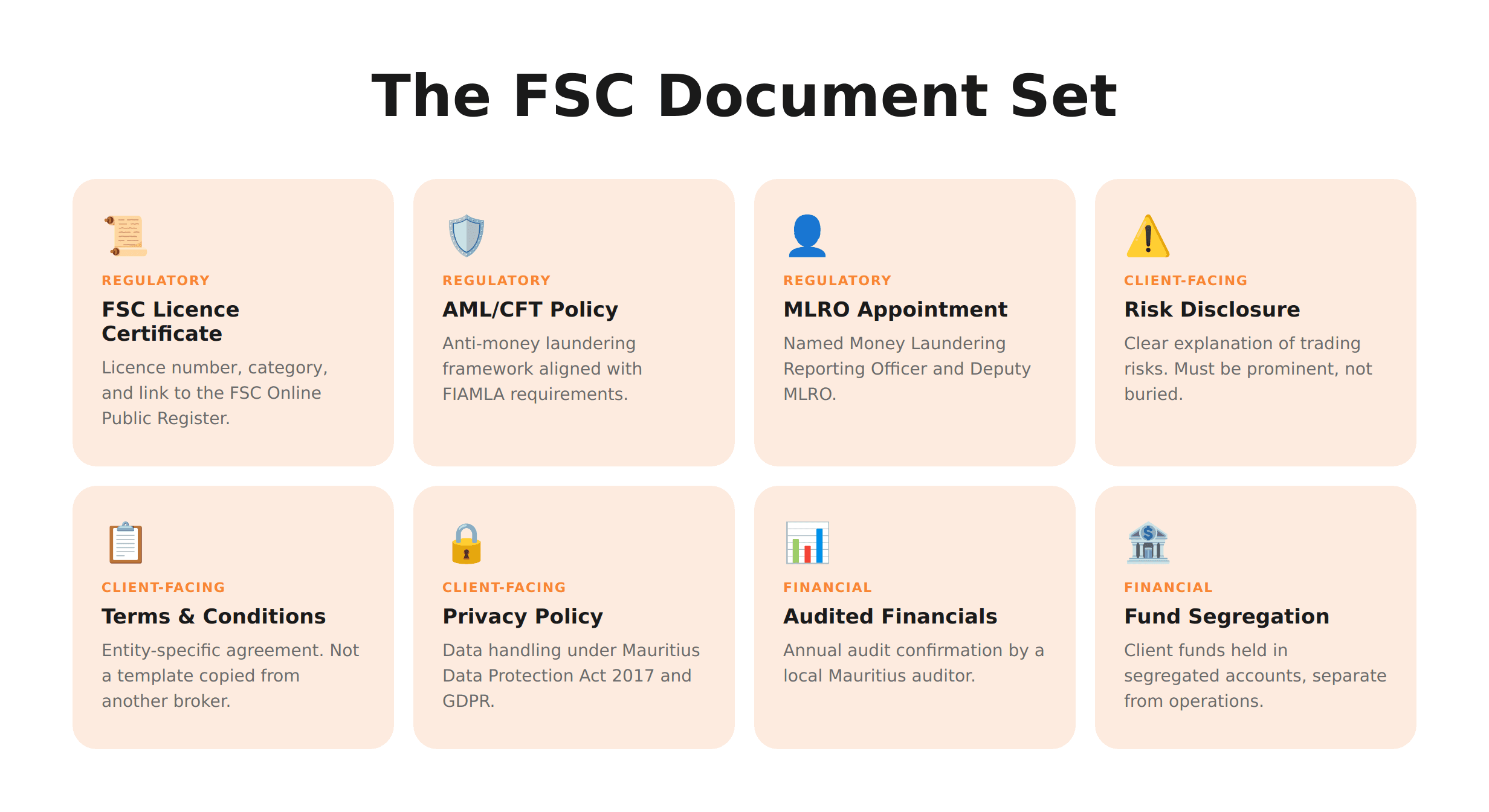
An FSC-licensed investment dealer should make several categories of Mauritius broker licence documents accessible through its website. Here is the core set, grouped by purpose.
Core Regulatory Documents
FSC Licence Certificate — your Investment Dealer licence number, category (Broker, Full Service, Discount), and the issuing date. Link to the FSC Online Public Register so visitors can verify it independently.
AML/CFT Policy — your anti-money laundering and counter-terrorist financing framework, developed in line with the Financial Intelligence and Anti-Money Laundering Act (FIAMLA). This is not optional for FSC licensees.
MLRO Appointment — confirmation that a Money Laundering Reporting Officer and Deputy MLRO are appointed, as required by the FSC's AML/CFT Handbook.
Client-Facing Documents
Risk Disclosure Statement — a clear explanation of the risks associated with the financial products you offer (forex, CFDs, securities). FSC expects this to be prominent, not buried.
Terms and Conditions — the complete agreement governing the client-broker relationship. Must be specific to your entity, not a generic template.
Privacy and Data Protection Policy — how you collect, store, and process client data. Mauritius has its own Data Protection Act 2017, which applies alongside any GDPR obligations for EU-facing operations.
Need a Website That Passes Due Diligence?
WSA designs broker websites with compliance architecture built in — legal hub, footer disclosures, and substance signals from day one.
Financial and Operational Documents
Audited Financial Statements — confirmation that your entity undergoes annual audit by a local Mauritius auditor. You do not need to publish full financials, but a reference to the audit cycle and auditor name builds credibility.
Client Fund Segregation Confirmation — a statement confirming that client funds are held in segregated accounts, separate from the company's operational funds. This is a requirement under FSC licensing conditions.
Note: This article covers website presentation guidance. For jurisdiction-specific legal requirements, consult your compliance officer or management company. For a multi-regulator overview, see the WSA broker website compliance checklist.
Where Each Document Lives on Your Broker Website
Document placement determines whether counterparties can verify your compliance status quickly. A well-structured FSC investment dealer website organises compliance information in layers — from always-visible elements to detailed document pages.
The Legal Hub: Dedicated Compliance Page Architecture
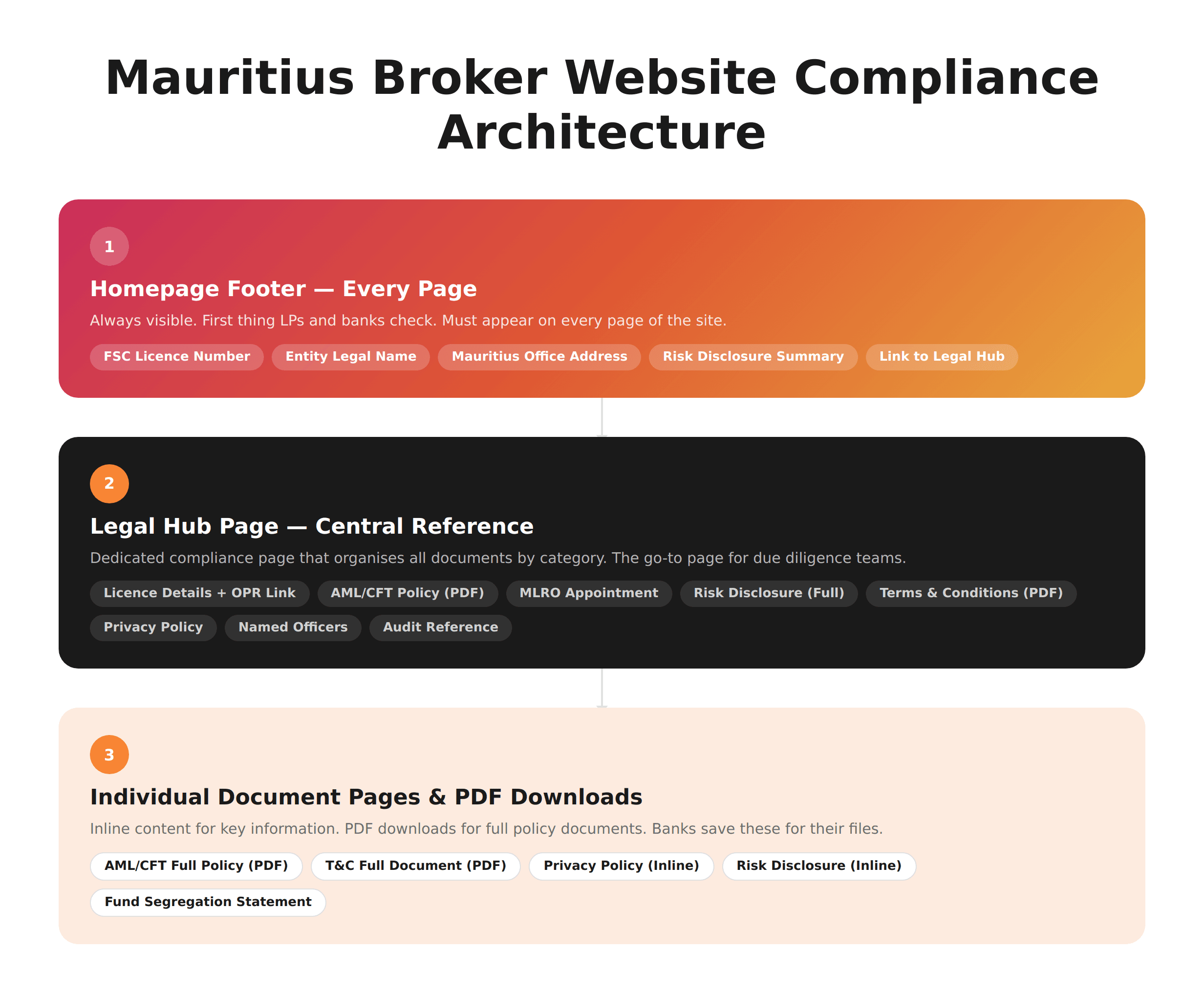
The most effective approach is a single "Legal" or "Regulation" hub page that links to every compliance document. This page serves as the central reference point for LPs, banks, and clients conducting due diligence.
A strong legal hub includes:
A summary header with your FSC licence number, category, and a direct link to the FSC Online Public Register
Individual sections or cards for each document category (regulatory, client-facing, financial)
PDF download links where appropriate (especially for AML/CFT policy and T&C)
Named officers — at minimum, the Compliance Officer and MLRO — with professional context
Footer Structure: What Must Be Visible on Every Page
Your website footer should display on every page:
FSC licence number and entity legal name
Mauritius registered address (physical, not PO Box)
Risk disclosure summary (1-2 sentences, with link to full statement)
Link to the Legal / Regulation hub page
PDF Downloads vs Inline Content: What Banks and LPs Prefer
For detailed policies (AML/CFT, full T&C), PDF downloads are standard and expected. Banks and compliance teams often save these for their files.
For key information like licence status, risk disclosure summaries, and fund segregation confirmations, inline content on the website is more effective.
The ideal approach combines both: inline summaries on the legal hub page, with PDF downloads available for the full document versions.
What Banks and LPs Actually Check on Your Website Before Onboarding
Banks and liquidity providers follow a predictable pattern when reviewing a Mauritius broker's website during due diligence. Understanding that pattern helps you design for it.
The 30-Second Due Diligence Scan
A compliance analyst at a bank or LP typically checks these items first:
Licence number visible — is it in the footer or on a dedicated page?
Entity legal name matches — does the name on the site match the FSC register?
Mauritius physical address — is it a real office address or a PO Box?
Named compliance officers — is there an MLRO listed, or is the team page empty?
Risk disclosure accessible — can they find it in under 10 seconds?
FSC register link — can they click through to verify the licence independently?
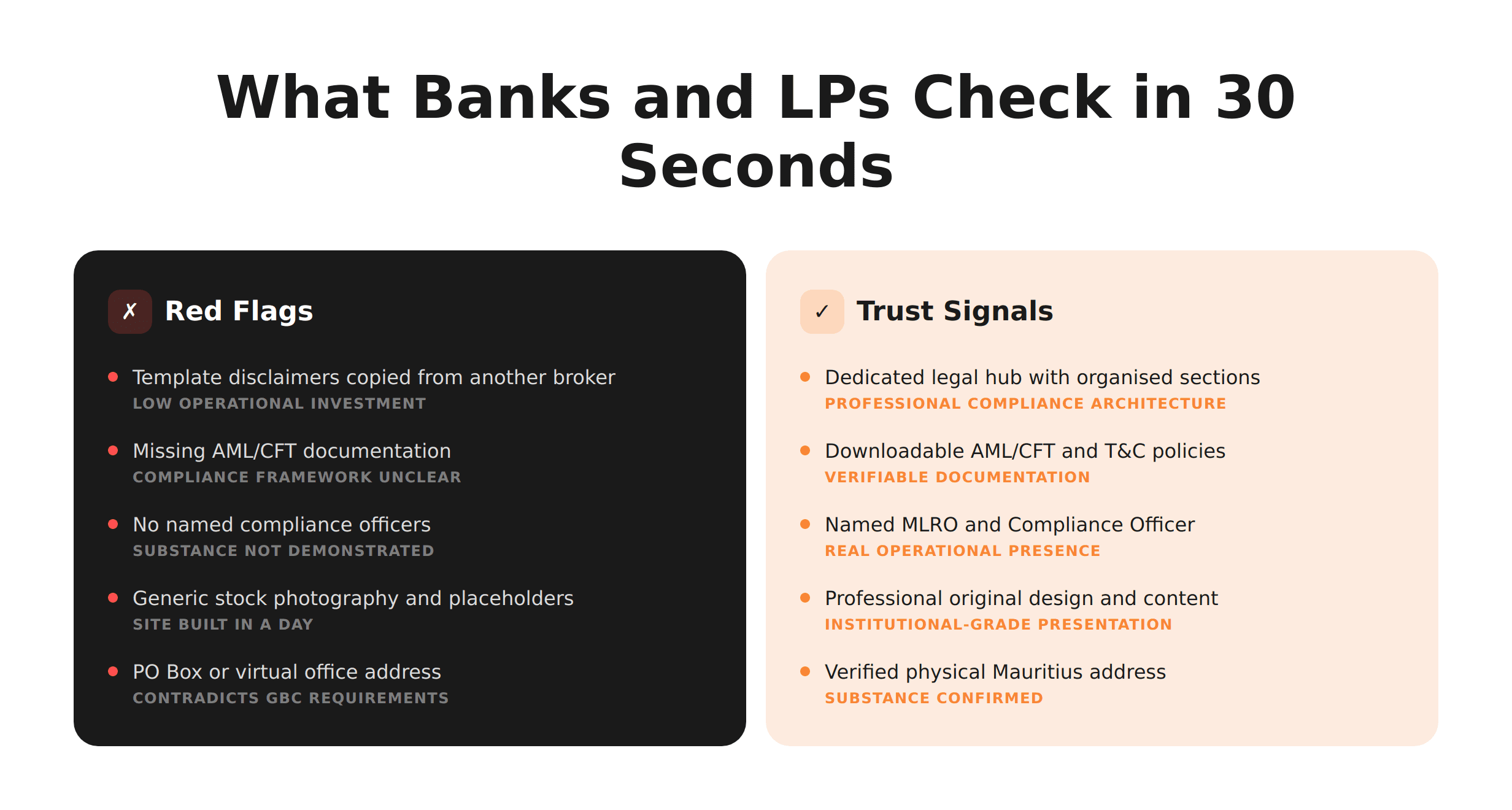
Red Flags That Stall Onboarding
Template disclaimers copied from another jurisdiction or broker
Missing AML/CFT documentation
No named officers
Generic stock photography and placeholder content
PO Box or virtual office address
The opposite of each red flag is a trust signal. A dedicated compliance page with named officers, verifiable documents, and a real Mauritius address tells a very different story.
How Your Website Architecture Proves Substance
Substance is the single most important concept for any Mauritius GBC — and your website is where counterparties verify it before they pick up the phone.
The Shell Company Problem and How Design Solves It
Many Mauritius-licensed brokers still operate with websites that look identical to unlicensed operations: a one-page template, a generic logo, and a contact form. For a business that invested in 2 resident directors, a physical office, local auditors, and FSC-compliant policies, this creates a costly disconnect.
UX Patterns That Signal an Institutional-Grade Operation
A structured About or Company page with the Mauritius office address and team
A legal hub with organised document sections, not just a list of PDF links
An Our Regulation or Licensing section on the homepage — above the fold, not in the footer
Professional, original design — not a template that five other brokers also use
Multi-page architecture — a site with distinct pages for services, compliance, about, and contact
Building an FSC-Compliant Mauritius Broker Website
A Mauritius forex broker website needs to balance regulatory presentation with commercial effectiveness. A good broker website agency will handle the compliance side as part of the design process, not as an add-on. When evaluating options, look for a team that offers:
Compliance-first page architecture — legal hub, footer strip, inline disclosures designed from the start
Substance-communicating design — professional visuals, real team presentation, Mauritius office context
Framer-based builds — fast, SEO-optimised, easy for your team to update
Multi-jurisdictional experience — familiarity with FCA, CySEC, ASIC, FSC Mauritius, FSA Seychelles and other regulatory frameworks
WSA Design works with Mauritius-licensed brokers on exactly this kind of project — here is a guide on how to create a broker website if you want to explore further.
Conclusion
Your FSC Investment Dealer licence is one of the strongest credentials an offshore broker can hold. It signals IOSCO-grade oversight, genuine substance requirements, and a regulatory framework that banks and LPs recognise.
But the licence alone does not close deals or open bank accounts. Your website is where counterparties verify that the substance behind the licence is real. A dedicated legal hub, clear document placement, named compliance officers, and professional design are what separate a credible Mauritius operation from a PO Box with a PDF.
If your site could use an upgrade, agencies like WSA Design specialise in building compliance-ready broker websites — it might be worth a conversation.
Launch Your Licensed Brokerage with Confidence
We support brokers and fintechs through licensing, launch planning, and everything a regulated brand needs to go live.