•
•
Wealthtech Website Design: Making Complex Products Simple for Users
There is a quiet problem at the heart of most wealthtech websites. The product is genuinely strong — the technology is sophisticated, the investment logic is sound, the team is credible — yet visitors land on the site, read a few paragraphs, and leave without taking action. Not because the product failed them, but because the website did.
Wealthtech website design is not simply about making finance look modern. Its real job is to reduce cognitive load: to help visitors quickly understand what you offer, decide whether it is right for them, and move confidently to the next step. That is a harder challenge than it sounds when your product involves portfolio construction, algorithmic rebalancing, multi-asset strategies, or advisor-led workflows that took years to build but can cost you a prospect in minutes.
This article is a practical guide for founders, CMOs, product marketers, and redesign teams working on robo-advisors, digital investment platforms, advisor-facing tools, and hybrid wealth brands. It focuses specifically on the public website — the layer that sits in front of your platform and handles explanation, trust-building, and conversion before a user ever logs in. It is not about the product interface itself. That distinction matters, and we will return to it throughout.
If you are trying to figure out how to design a wealthtech website that actually converts high-intent visitors, this is the framework to follow.
Key Takeaways
Wealthtech website design should reduce cognitive load, not showcase complexity for its own sake.
The clearest sites separate audience journeys for retail users, HNW prospects, advisors, and institutions.
Product explanation should rely on plain-language copy, strong information hierarchy, and visual storytelling.
Trust, compliance, fee visibility, and performance are core UX features — not legal or technical afterthoughts.
The right CMS and website architecture make it easier to scale content, localization, and conversion optimization over time.
What Makes Wealthtech Website Design Different From Generic Fintech Web Design?
Wealthtech websites face a harder communication challenge than most fintech sites because the products are more abstract, the trust threshold is higher, and the decision cycle is longer.
A payments app can show you a transaction in two seconds. A lending product can deliver an approval decision almost instantly. A wealthtech product asks users to think about their financial future, accept some level of risk, and hand over capital — often without an immediate, tangible result to point to. That is a fundamentally different persuasion problem.
Investment platform website design has to do several things at once that most fintech categories do not. It must explain products that are conceptual and multi-layered. It must serve audiences with very different levels of financial sophistication. It must carry the weight of compliance and regulatory disclosure without reading like a legal document. And it must establish trust before a single login occurs.
There is also a persistent confusion that undermines many wealthtech builds: teams conflate the marketing website with the product itself. The authenticated dashboard, the portfolio view, and the trade execution interface are product problems. The public-facing website is a different layer entirely, and it has one job: to take a complex investment offering and make it feel clear, credible, and worth acting on.
That is what distinguishes strong wealthtech website design from generic fintech website design. The stakes are higher, the information is denser, and the margin for confusion is much smaller.
Why Do Complex Wealthtech Products Confuse Users Online?
Visitors get lost on wealthtech websites not because the products are inherently confusing, but because the websites are structured as if everyone arrives already informed.
The most common failure modes are predictable once you know where to look.
Jargon-heavy messaging often front-loads terminology — alpha, drawdown, rebalancing threshold, AUM-tiered pricing — before users understand the basic value proposition. Homepages try to explain every product feature at once, creating density where there should be direction. And many sites offer no clear signal of who the product is actually for, so a retail investor and an institutional allocator can land on the same page and both feel underserved.
Fee structures are hidden in footnotes or delayed until later in the funnel, which creates distrust rather than protecting the brand from awkward questions. Process explanations are weak or missing: how does onboarding actually work? How long until a portfolio goes live? What happens if markets move significantly? Vague answers to these questions generate anxiety, not trust.
And then there is the missing next step. A polished hero section with a “Learn more” button that scrolls to more marketing copy is not a conversion path. It is a loop.
These are wealthtech UX problems as much as they are copywriting problems. They reflect structural decisions about what information appears in what order, how much prior knowledge the user is expected to have, and whether the site is organized around the user’s questions or the brand’s preferences. Strong investment platform website design puts the user’s mental model first and builds outward from there.
What Pages Should Every Wealthtech Website Include?
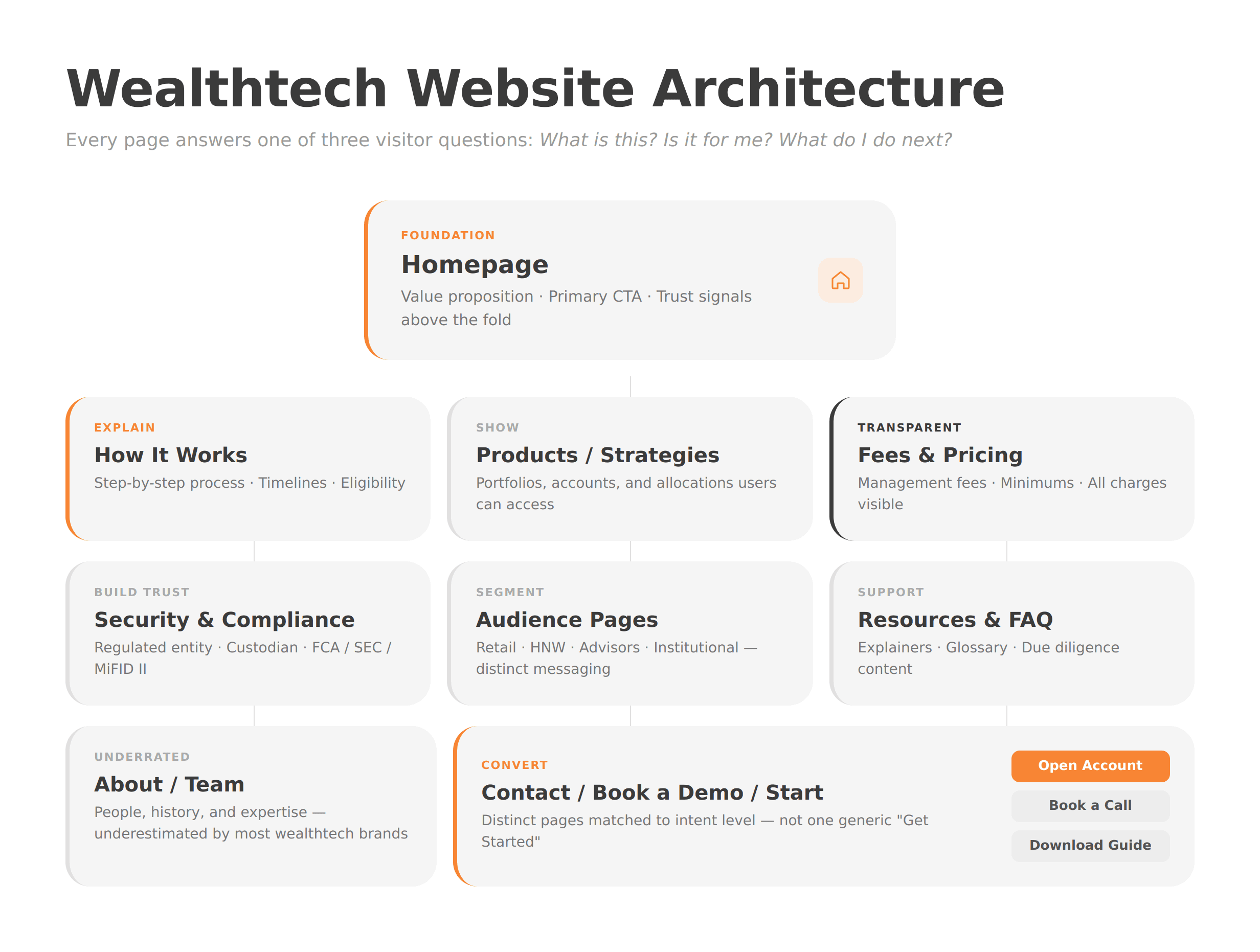
Strong wealthtech website structure begins by making sure visitors can answer three questions quickly: What is this? Is it for me? What do I do next?
Every page on the site should help answer at least one of those questions. Here is the core architecture that makes that possible:
Homepage — a clear value proposition, an immediate signal of who the product is for, a primary CTA, and at least one top-tier trust signal above the fold.
How It Works — a step-by-step explanation of the product process, including typical timelines, eligibility criteria, and what users should expect.
Products / Portfolios / Strategies — what users can actually access, invest in, or allocate to. Concrete, not abstract.
Fees & Pricing — management fees, platform costs, minimums, and any advisory charges, presented clearly. Users who cannot find this information will find a competitor who shows it.
Security / Custody / Compliance — regulated entity details, custodian information, relevant regulatory frameworks (SEC, FINRA, FCA, MiFID II, where applicable), and links to full legal disclosures.
Who It’s For / Audience Pages — separate pages or clearly segmented sections for retail investors, HNW clients, advisors, employer plans, or institutional partners, depending on your model.
Resources / Education / FAQ — explainers, glossary pages, comparison guides, and help content that support due diligence without requiring a sales conversation.
About / Team / Credibility — the people, history, and expertise behind the product. This page is underestimated by almost every wealthtech brand.
Contact / Book a Demo / Start Investing — distinct conversion pages matched to different levels of intent, not a single generic “Get Started” button.
Navigation should be lean. Every label in the menu is a micro-commitment the user has to make. If they need to read five nav items just to decide whether the site is relevant to them, the site has already failed.
How Do You Explain Complex Investment Products Without Overwhelming Users?
The answer is staged disclosure: show the simplest version of the truth first, then give users the tools to go deeper when they are ready.
There is a set of design devices that consistently works well for simplifying complex investment products on a public website. None of them requires sacrificing accuracy. They simply reorder information so that the most important point is also the first one.
Progressive disclosure is the foundation. Lead with the value. Follow with the mechanism. Offer the detail to those who want it — through expandable sections, tooltips, or dedicated deep-dive pages. The homepage is not the place for your full white paper. It is the place to make someone want to read it.
Comparison cards work well for products with multiple tiers, account types, or audience-specific variants. A side-by-side table removes the need for users to hold multiple options in working memory at once.
Short process diagrams and “How it works” sequences are among the highest-ROI design investments a wealthtech site can make. A three- or four-step flow such as “Connect your account → Set your goals → We build your portfolio → You track performance” does more cognitive work than four paragraphs of copy.
Labeled screenshots and dashboard visuals are especially valuable. Showing a realistic portfolio summary view, with labels explaining each element, gives users a concrete mental model of what they are signing up for. Abstract stock photography of people smiling at laptops does the opposite.
Glossary tooltips handle unavoidable terminology without derailing the reading experience. If you need to use a term like “volatility” or “rebalancing,” a hover tooltip is far better than either avoiding the term completely or assuming users already understand it.
Fee and plan tables turn an anxiety-inducing topic into a scannable, comparable format. Clear pricing on an investment website is not a weakness. It is a trust signal.
Here is a quick diagnostic to test whether your simplification is working:
What a user should understand in the first 10 seconds:
✓ What the product does in one sentence
✓ Who it is designed for
✓ Roughly what it costs
✓ One reason to trust the brand
✓ What to do next
If your current homepage fails any of those five tests, you have a structural problem that copy edits alone will not fix.
How Should You Segment Journeys for Retail Users, HNW Clients, Advisors, and Institutions?
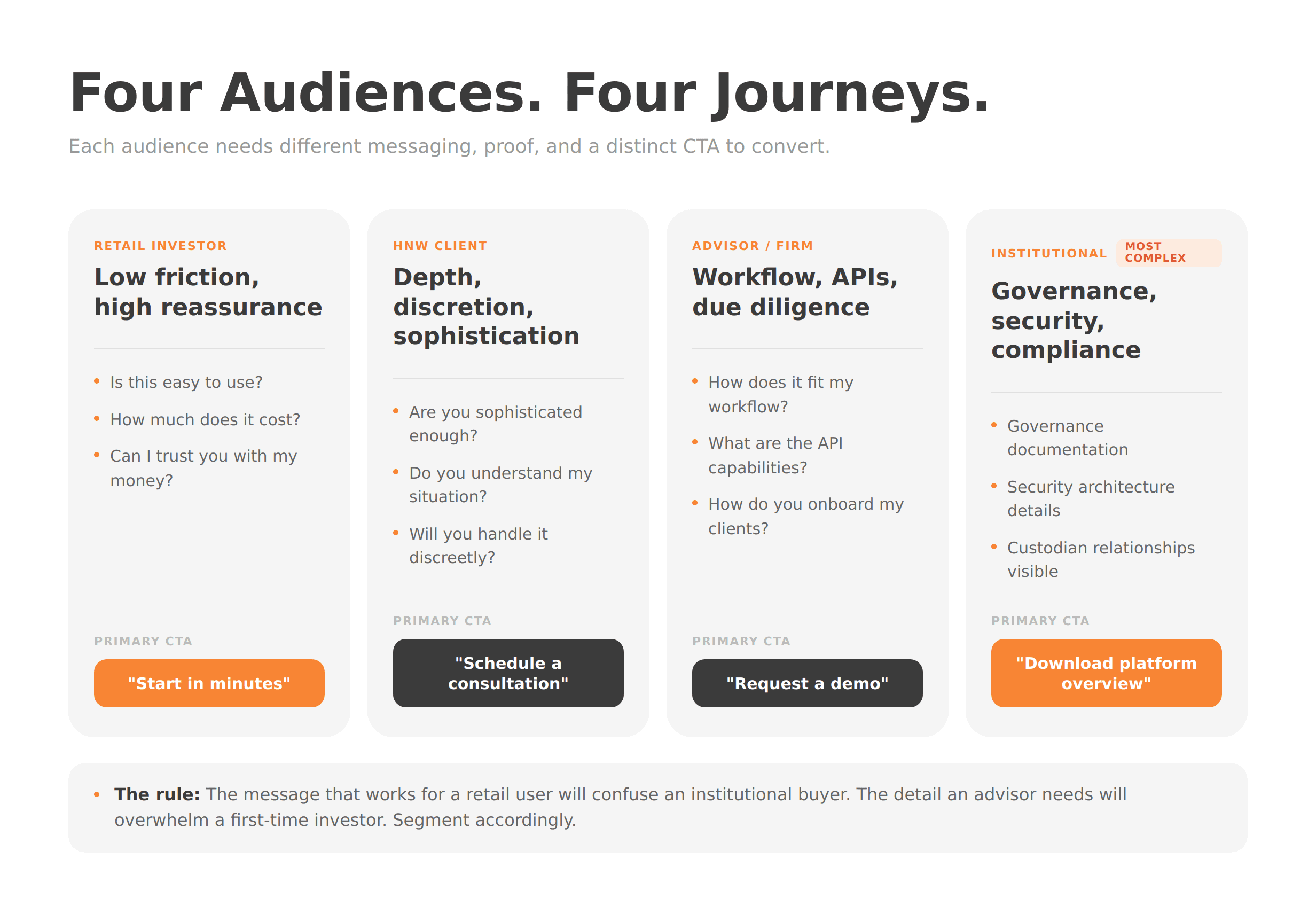
One of the most common and costly mistakes in wealthtech website design is building a single generic journey for every audience at once.
A retail investor researching an ISA or Roth IRA account wants to know: is this easy to use, how much does it cost, and can I trust you with my money? Their tolerance for complexity is low. Their need for reassurance is high. The CTA should be low-friction: “Start in minutes” or “Open an account.”
An HNW prospect evaluating a discretionary managed service wants to know: are you sophisticated enough to manage significant wealth, do you understand my situation, and will you handle it discreetly? They want depth, not oversimplification. The CTA is usually softer: “Speak to an advisor” or “Schedule a consultation.”
An advisor or firm evaluating a platform integration wants to know: what does the product actually do, how does it fit into my workflow, what are the API capabilities, and how do you support onboarding my client base? They are due-diligence buyers, not first-impression buyers. The CTA should be “Request a demo” or “Download the platform overview.”
An institutional or enterprise buyer wants governance documentation, security architecture details, regulatory standing, and evidence of operational resilience before a conversation even begins. They will read your compliance page. They will look for your custodian relationships. They will notice if that information is difficult to find.
These four audiences do not need four separate websites. For a robo-advisor website design, retail-focused navigation can serve as the primary path, with a clear link for institutional or advisor inquiries. For a multi-segment digital wealth platform website, dedicated audience pages with distinct messaging, proof, and CTA structures can mean the difference between a site that speaks to everyone and a site that converts no one.
A simple rule applies here: the message that works for a retail user will likely confuse an institutional buyer. The detail an advisor needs will overwhelm a first-time investor. Segment accordingly.
Where Should Trust, Compliance, and Fee Transparency Appear on a Wealthtech Website?
Trust signals for fintech websites should not be isolated on legal pages or buried in the footer. They should be distributed throughout the experience, where users are actually making judgments.
Most wealthtech brands treat compliance and disclosure as a footer problem: a small “Regulated by the FCA” badge in gray text beneath the copyright notice, a PDF link to the fee schedule, a legal page no one reads voluntarily. This approach misunderstands how trust works in digital wealth management website design.
Users form trust impressions quickly, continuously, and often unconsciously. They are not evaluating your legal pages in isolation. They are reading the signals your design sends at every moment: the language you use, the information you volunteer, the credentials you display without being asked, and the things you make easy to find that competitors often make hard.
Here is where trust signals actually belong:
On the homepage, in the hero or directly below it: regulatory standing, custodian or custody partner details, and any relevant third-party validation, such as awards, auditors, or coverage from credible financial media.
On product and portfolio pages: clear fee disclosure, including minimums, management fees, and any performance or advisory charges. Investment website design that hides pricing does not protect the brand — it signals that pricing is something to be embarrassed about.
On the How It Works page: security and data-protection messaging, KYC and AML process explanation, and realistic language about risk and returns. Overpromising investment performance is not just a compliance risk; it is a trust-destroying signal for the most sophisticated users in your funnel.
On any page where a CTA appears: proximity to trust signals matters. A “Start investing” button positioned next to a short sentence about FDIC protection, SIPC membership, or regulated custodian details converts better than an isolated button floating in clean white space.
Visually polished but opaque websites — brands that look sophisticated but make users hunt for basic answers about fees, regulation, or risk — are a growing problem in investment platform UX. Users notice when something they expect to find easily is missing. That absence becomes a question mark they may never return to resolve.
How Do You Reduce Friction Between Research and Onboarding?
The handoff from marketing website to onboarding flow is where wealthtech conversion breaks down most often — and it is almost always a solvable design problem.
Friction at this stage is rarely accidental. It usually reflects a disconnect between the team that built the marketing site and the team that built the product, with no shared ownership of the moment between them.
The first principle is expectation-setting. Before users click “Get started,” they should already know approximately how many steps onboarding involves, what information or documents they will need to provide — proof of identity, bank account details, investment questionnaire — and roughly how long it will take. That information is almost never present. It should be.
The second principle is CTA hierarchy. Not every visitor is ready to open an account. A wealthtech onboarding flow that offers only one conversion action — “Start investing now” — loses everyone who is still in research mode. Softer conversion options like “Book a call,” “Request a demo,” “Download our guide,” or “See example portfolios” capture prospects earlier and give you a way to nurture them toward the primary action. This is especially important for products with higher minimum investments or longer consideration cycles.
The third principle is integration from day one. A website that routes qualified leads into a disconnected inbox, with no CRM tracking, no UTM attribution, and no GA4 event structure, is generating demand it cannot measure. Connecting the website to your CRM, scheduling tool, and analytics stack is not a phase-two project. It is a launch requirement if conversion optimization matters to you.
Do not underestimate the psychological impact of moving from a polished marketing page to a clunky onboarding interface. If the brand quality drops sharply at the point of commitment, users notice. The onboarding flow does not need to match the marketing site pixel for pixel, but the transition should feel considered rather than jarring.
What Platform and CMS Are Best for a Wealthtech Website?
For most wealthtech public marketing websites, Webflow or Framer is the right place to start. The real question is not which tool is technically capable — it is which tool your team can operate effectively.
The best CMS for a wealthtech website is almost never the same stack the core product is built on. Tying your marketing site to your engineering sprint cycle creates a bottleneck that slows every content update, SEO change, and landing-page test. Marketing and content teams need to be able to move independently.
Webflow is a leading choice for wealthtech public sites that require a strong marketing layer with CMS content, multiple landing pages, localization support for a multilingual investment website, and integrations with tools like HubSpot, Segment, or GA4. It handles compliance-friendly page structures, custom components, and high-performance delivery without requiring developers for routine updates.
Framer is compelling for teams that prioritize design fidelity and rapid iteration, particularly for smaller teams or highly design-led brands.
Hybrid approaches make sense when the marketing site needs to connect directly to a calculator, proprietary onboarding module, authenticated dashboard preview, or custom data integration. In these cases, the marketing layer can still be built in Webflow or a similar platform, with specific components handed off to engineering for custom development.
Full custom development for the public marketing site is rarely the right choice unless there is genuinely product-level logic in the website itself, complex governance around content publishing, or multi-region deployment with distinct regulatory content requirements.
The investment platform website design decision should follow the team’s operational reality: how often content needs to change, who owns publishing, what compliance review process exists, and which integrations are non-negotiable on day one. For a more comprehensive comparison of platform options across regulated industries, our complete CMS guide for fintech websites covers the full decision framework in detail.
Common Mistakes in Wealthtech Website Design
Even well-resourced teams make the same mistakes. Here are the ones most worth watching for:
Explaining every feature at once instead of using hierarchy to guide users from simple to detailed.
Leading with jargon before establishing plain-language value, and losing users before they understand what you actually offer.
Hiding pricing, minimums, or fee structures in the footer, in a downloadable PDF, or by omitting them entirely.
Treating all audience types as if they want the same message — a retail investor and an institutional allocator are not the same user.
Confusing the marketing website with the product or app by adding authenticated functionality or excessive product depth to the public site instead of keeping the two layers clearly separated.
Using generic fintech visuals — abstract data graphics, stock-photo handshakes, and gradient mesh backgrounds that explain nothing about the product.
Burying trust and compliance signals in the footer or on pages users will only find if they already know to look for them.
Sending users into onboarding without expectation-setting — no step count, no document list, no timeline, no preparation.
Launching without analytics infrastructure — no GA4 event tracking, no funnel visibility, no way to know what is working.
Designing for aesthetics first and clarity second — a beautiful site that confuses visitors is still a conversion problem.
Next Steps: Why Fintech-Specialized Website Partners Make Wealthtech Products Easier to Understand
The websites that do this well share one characteristic: someone on the team understood that making a complex investment product feel simple online is a strategy problem, not just a design problem.
Generic templates cannot solve that problem. A freelance designer unfamiliar with regulated financial products cannot solve it. And an internal team stretched across product, compliance, and marketing without a clear brief cannot solve it consistently either.
Working with a fintech website design partner who understands the category changes the starting point. The difference between an agency that has worked on investment platforms and one that has not is visible in the brief, the information architecture, the compliance-aware copy structure, and the conversion logic — before a single visual has been produced.
The right partner helps you translate complex products into clear, public-facing UX. They structure the site for multiple audience types without creating four separate brands. They build trust and disclosure into the design as features, not footnotes. They choose the right CMS and integration approach for your team’s reality. They help you launch quickly without relying on generic templates that make sophisticated brands look interchangeable. And they support the investment website SEO, GEO, and post-launch optimization work that makes the site more valuable over time.
Before you commit to a build or redesign, it is worth working through a short readiness checklist:
Define which audience matters most at launch — and which ones come next.
Separate website scope from product scope before the brief is written.
Identify the trust signals users need before they are ready to convert.
Decide whether the primary next step should be self-serve or consultation-led.
Choose a CMS that supports where the team needs to be in 12–24 months, not just where it is today.
If you are ready to have that conversation, book a free discovery call with WSA to discuss your wealthtech website goals. We work with digital investment platforms, robo-advisors, advisor-tech brands, and hybrid wealth businesses that need more than a polished template — and we are built to translate product complexity into websites that actually convert.
FAQ
What is wealthtech website design?
Wealthtech website design is the practice of designing the public website layer for digital wealth products — the part that explains what the platform does, establishes credibility, and guides users to the right next step before they ever enter the product itself. It is distinct from the design of the investment platform, dashboard, or authenticated app. The public website’s job is to communicate value, build trust, and convert high-intent visitors. Done well, it makes even highly complex investment offerings feel clear and accessible.
How do you explain a complex investment product on a website?
Start with a plain-language value proposition that requires no prior financial knowledge. Layer information progressively — simple overview first, mechanism second, full detail available for those who want it. Use visual explanation tools such as process diagrams, labeled product visuals, comparison tables, and concise FAQ formats. Segment the journey so different audiences receive messaging matched to their level of sophistication. And be transparent about fees and risk from the start, because attempting to simplify complex investment products by omitting uncomfortable information does not simplify anything — it creates mistrust.
What pages should a wealthtech website include?
The core pages are: a homepage for the value proposition and primary CTA, a How It Works page for process explanation, products or portfolios pages for what users can access, fees and pricing pages for transparent costs, trust and compliance pages for regulatory standing, custody, and security, audience-specific pages for retail, HNW, advisors, and institutions, resources and FAQ pages for educational content and due diligence support, an About page for credibility and expertise, and conversion pages for account opening, demo booking, or consultation requests. A clear wealthtech website structure makes it easy for every visitor to answer three questions quickly: what is this, is it for me, and what should I do next?
Should a wealthtech website be separate from the investing platform itself?
Yes, in almost every case. The public marketing website and the authenticated investment platform serve fundamentally different purposes and should be built and maintained as separate layers. The public site handles explanation, trust, SEO, and conversion. The platform handles account management, portfolio functionality, KYC, and authenticated workflows. Mixing the two — either technically or conceptually — creates maintenance burdens, slows the marketing team’s ability to iterate, and often produces a worse experience on both sides of the login.
What platform is best for a wealthtech website?
For the public marketing layer, Webflow and Framer are strong choices for most wealthtech brands. They support CMS content management, fast iteration, custom design, and integration with CRM, analytics, and marketing tools without requiring engineering resources for routine updates. Hybrid approaches make sense when the marketing site needs to connect to custom calculators, onboarding modules, or proprietary data. Full custom development is rarely necessary for the public-facing website unless there is genuinely product-level logic or complex multi-region governance involved.
How long does it take to build a wealthtech website?
A professional marketing website for a wealthtech brand typically launches in four to eight weeks, depending on scope, the availability of finalized copy and brand assets, compliance review cycles, and the complexity of integrations. Multi-region builds, custom calculators, or deeply segmented audience architectures take longer. The most common delays are not design or development — they are content readiness and compliance sign-off. Teams that arrive with clear messaging and pre-approved copy move significantly faster.
Can a template work for a wealthtech website?
A template can serve a specific, limited purpose — early validation, a simple landing-page test, or a placeholder site while the full build is in progress. But templates consistently fail once a wealthtech website needs to support real trust architecture, multiple audience journeys, clear explanations of product complexity, and the disclosure expectations of a regulated financial brand. The problem with templates is not aesthetics. It is that the structural assumptions baked into them were never made for financial products, and working around those assumptions often becomes more expensive than building it correctly from the start.
WSA is a website studio specializing in regulated industries, including fintech, investment platforms, and wealth management brands. You can explore our work at wsa.design/projects or book a discovery call to discuss your next build.
Launch Your Licensed Brokerage with Confidence
We support brokers and fintechs through licensing, launch planning, and everything a regulated brand needs to go live.