•
•

Fintech SEO: Strategy for Highly Regulated Industries
Organic search is one of the most cost-effective acquisition channels available to fintech companies — but it comes with a catch. Finance is a YMYL (Your Money or Your Life) category, which means Google and other search engines hold financial content to a significantly higher standard. Add compliance obligations from regulators like the FCA, the SEC, or ESMA, and you’re operating in an environment where a poorly worded landing page isn’t just a ranking problem — it can be a legal one.
The companies that win in fintech SEO aren’t the ones publishing the most content. They’re the ones that build a systematic, compliance-aware approach to search — where keyword strategy, content production, site architecture, and approval workflows work together as a single operating model.
This guide outlines that model step by step, with practical frameworks designed for regulated financial businesses.
Key Takeaways
Fintech SEO operates in YMYL territory, where trust signals are gating factors — not optional enhancements.
A compliance-first content strategy reduces review bottlenecks and lowers the risk of publishing misleading claims.
E-E-A-T (Experience, Expertise, Authoritativeness, Trustworthiness) is implemented through concrete site elements: author bios, editorial policies, citations, and transparency pages.
Technical SEO in fintech includes security, privacy infrastructure, and careful indexation controls — not just page speed.
Authority building in regulated categories depends on original research, credible PR, and partnership-driven mentions — not link volume.
Meaningful KPIs go beyond organic sessions: qualified leads, compliance incident rates, and content cycle time all matter.
Why Is Fintech SEO Judged Differently Than Most Industries?
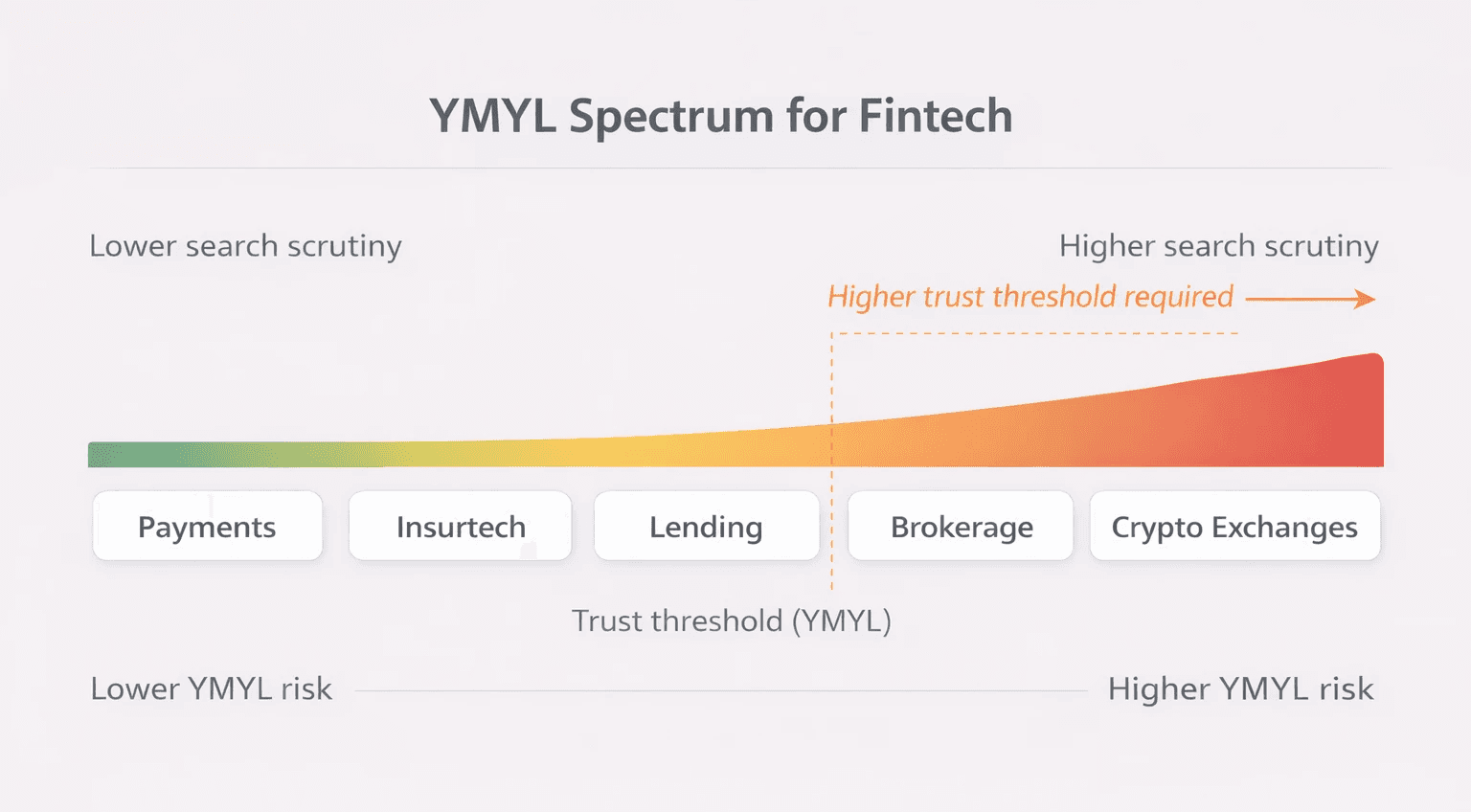
Fintech content is classified as YMYL (“Your Money or Your Life”), meaning poor or misleading information can cause real financial harm — so Google applies greater scrutiny to trust and quality signals.
According to Google’s Search Quality Rater Guidelines, YMYL pages are assessed against stricter expectations for expertise, accuracy, and trustworthiness. For financial services, that means a technically well-optimised page can still underperform if it lacks verifiable authorship, credible citations, or clear editorial standards.
For fintech businesses, the challenge is doubled:
YMYL scrutiny — quality evaluators assess whether content could harm users financially if it’s wrong or misleading.
Regulatory constraints — what a fintech company can legally publish is shaped by its licences, jurisdictional rules, and applicable financial promotion regulations.
This isn’t a reason to avoid SEO. It’s a reason to build it correctly from day one.
What Is a Compliance-First Fintech SEO Strategy?
A compliance-first SEO strategy treats regulatory and legal requirements as inputs to content planning — not blockers at the end of the process.
Most fintech marketing teams experience SEO and compliance as opposing forces: SEO wants to publish quickly and broadly; legal/compliance wants to review everything (and often slows publishing to a crawl). The result is a backlog that grows faster than it clears.
The fix is to redesign the workflow so compliance constraints are built in upstream. That means:
Keyword selection informed by what you can claim — before you write, not after.
Staged review processes with defined roles (for example: SEO lead → subject-matter expert → legal/compliance).
Versioning and audit trails so updates to published content don’t introduce undisclosed risk.
When the process is designed this way, SEO and compliance aren’t in conflict. Compliance becomes a quality filter that can strengthen performance — because Google’s guidance emphasises accuracy, transparency, and trustworthiness.
Step 1. Map Your Regulatory Footprint Before You Do Keyword Research
Before building a keyword list, map the boundaries: which jurisdictions you operate in, which licences you hold, which products are restricted, and what you can and can’t claim.
This step is frequently skipped — and it’s one of the most expensive mistakes in fintech SEO. Publishing content that implies a feature is available in a market where it isn’t, or suggesting outcomes that breach FCA financial promotion standards, can trigger regulatory action — not just a ranking drop.
Your regulatory footprint audit should cover:
Jurisdictions served and where your entity is licensed or registered
Products available by market — and where availability differs
Claims permitted (e.g., factual product descriptions, audited performance data) versus claims to avoid (e.g., guaranteed returns, “risk-free” language, unverified comparisons)
Required disclosures — risk warnings, terms, cooling-off periods, and jurisdiction-specific notices
For UK-regulated firms, the FCA is explicit: financial promotions — including websites — must be “clear, fair and not misleading.” Similar principles apply under MiFID II for European firms and under relevant CFTC/SEC rules in the US.
Note: This section provides a planning framework. Always involve qualified legal counsel when assessing specific regulatory obligations.
Step 2. Build a Keyword Strategy That Survives Compliance Review
Use a Green / Yellow / Red keyword classification model to prioritise topics based on the level of substantiation and review they require.
This model speeds up planning because it aligns SEO opportunity with compliance risk before a single word is written:
Tier | Examples | Requirements |
|---|---|---|
Green | “What is AML?”, “How does a prime broker work?”, “What is a liquidity pool?” | Educational; low compliance burden; faster to publish |
Yellow | “Best crypto exchange for institutional traders”, “Low-spread FX broker comparison” | Evidence-based claims required; disclaimers needed; legal review recommended |
Red | “Guaranteed trading returns”, “Risk-free investment accounts” | Avoid — typically misleading and likely to breach financial promotion rules |
A large share of high-value fintech SEO traffic sits in the Green tier: regulatory explainers, product education, glossary terms, and “how it works” content. This is also where review cycles tend to be shortest, which improves publishing velocity.
Compliance nuance: The FCA warns that generic, boilerplate risk statements — the kind pasted identically on every page — can be ineffective and even counterproductive. Contextual risk statements tailored to the specific product and audience are better compliance practice and better SEO practice (they strengthen relevance and trust signals at the same time).
Step 3. Create E-E-A-T Signals That Search Engines and Users Can Verify
E-E-A-T — Experience, Expertise, Authoritativeness, Trustworthiness — isn’t a marketing checklist. It’s a set of verifiable signals used to judge whether a financial website is credible.
For fintech, implementing E-E-A-T means building specific site infrastructure:
Author bylines and bios: Attribute substantive content to named authors with verifiable credentials (trading experience, regulatory background, professional qualifications). Generic “Editorial Team” bylines often underperform in YMYL contexts.
Editorial and fact-checking policy: Publish a clear policy that explains how content is reviewed for accuracy — especially for data-heavy or market-related pages.
Citations to primary sources: Link to regulators, central banks, exchange documentation, and official standards — not just third-party blogs.
Transparency pages: About, Contact, Privacy Policy, Security Policy, and Regulatory/Licensing information should be consistently accessible from any page.
Off-site reputation signals: Mentions in credible financial media, industry association memberships, and registrations that can be verified externally.
Step 4. How to Structure a Fintech Website for SEO and Compliance
A compliant, rankable fintech site organises content into three functional tiers: money pages (product and conversion), trust pages (legal and transparency), and authority pages (education and thought leadership).
Money Pages
Your highest-value conversion pages: product descriptions, pricing, platform features, integrations, and security summaries. They need clear, substantiated copy with contextual disclaimers — not buried boilerplate.
Trust Pages
Licensing and regulatory status, risk disclosures, terms of service, privacy policy, cookie policy, and AML/KYC information. These pages influence perceived legitimacy. Don’t bury them in footer-only navigation or make them difficult to find.
Authority Pages
Educational content, regulatory guides, glossaries, research reports, and market commentary. These pages capture informational intent and build topical authority.
Regional and Jurisdiction Pages
If product availability or regulatory status differs by market (common in brokerage, payments, and crypto), create dedicated regional pages with accurate, jurisdiction-specific disclosures. Make careful indexation decisions: pages targeting markets where you aren’t licensed shouldn’t drive conversion-focused traffic.
Not sure which option fits your business?
From startup brokerages to established platforms, WSA delivers websites that convert traders, satisfy regulators, and scale across markets.
Step 5. What Content Actually Ranks in Fintech Without Making Risky Claims?
The highest-performing fintech content categories are educational, regulatory, and tool-based — not purely promotional.
Content that consistently ranks well and typically clears review includes:
Educational explainers: “What is a prime-of-prime broker?”, “How does margin lending work?”, “What is T+1 settlement?”
Regulatory breakdowns: “What does MiFID II require from brokers?” — kept factual and sourced to official documentation
Evidence-based comparisons: Publish the methodology alongside the comparison; avoid subjective superlatives
Calculators and tools: Margin calculators, fee comparison tools, currency converters — paired with methodology and appropriate disclaimers
Case studies and use cases: Framed around process, integration, or operational outcomes — not performance promises
A Note on AI-Generated Content in Fintech
AI tools can help with research, structure, and first drafts — but in regulated YMYL categories, one rule is non-negotiable: every AI-assisted piece must go through qualified human expert review before publication. Google’s helpful content guidance focuses on whether content demonstrates genuine expertise and serves users accurately. Unreviewed AI output fails that standard by default.
Step 6. Technical SEO Fundamentals for Regulated Fintech Websites
Fintech technical SEO extends beyond Core Web Vitals — it includes security architecture, privacy infrastructure, and indexation hygiene as credibility signals.
Key technical priorities:
HTTPS and security posture: Table stakes. Beyond SSL, your privacy and data handling pages should clearly explain how user data is stored, processed, and protected — especially for platforms handling financial or identity data.
Core Web Vitals: Page experience affects both rankings and conversion. Slow or unstable UX is particularly damaging on high-intent product pages.
Indexation hygiene: Use canonicals and noindex tags to keep staging environments, thin pages, jurisdiction-irrelevant pages, and duplicate variations from diluting crawl budget — and from creating compliance exposure on pages not cleared for publication.
Structured data: Implement Organization, Person, Article, and FAQPage schema as a baseline. Use FinancialService schema only where it accurately describes the business — and only where the business is licensed to provide those services in the relevant jurisdiction.
International SEO: For multi-market operators, hreflang ensures the right regional content — including jurisdiction-specific disclosures — reaches the right audience.
Visual reference 3: Technical SEO audit checklist table with columns for: Element, Priority, Fintech-specific consideration, Pass/Fail.
Step 7. Link Building and Authority in Regulated Industries
In YMYL categories, the credibility and relevance of who cites you matters far more than raw backlink volume.
Low-quality tactics — paid placements, irrelevant guest posts, directory spam — aren’t just ineffective in fintech; they can damage credibility and create compliance exposure if links appear in misleading contexts. Stronger approaches include:
Original research and reports: Data studies, market surveys, regulatory analysis others can cite
Digital PR: Coverage in credible financial media via newsworthy data, commentary, or announcements
Partnership and integration mentions: Earned links through co-marketing with regulated partners and technology providers
Speaking and webinars: Panels, talks, and educational sessions that generate citations and strengthen entity authority
The principle: in regulated industries, authority is built by being cited in credible contexts — not by accumulating volume.
Step 8. How to Measure Fintech SEO Success Without Vanity Metrics
Organic sessions are a leading indicator, not a success metric. Fintech SEO reporting should connect to pipeline, compliance performance, and operational efficiency.
KPI | What It Measures |
|---|---|
Qualified organic leads | Intent and conversion quality from search |
Conversion rate by organic landing page | Which pages drive pipeline, not just traffic |
Branded search volume growth | Proxy for awareness and trust |
Share of voice for priority topics | Competitive position in target clusters |
Content cycle time (draft to publish) | Efficiency of the governance workflow |
Post-publish compliance incidents | Whether review and approvals are working |
Track compliance incident rate explicitly: a strong workflow should drive it towards zero. If content is regularly flagged or pulled after publication, the upstream process needs fixing.
Common Fintech SEO Mistakes That Kill Growth — and Create Risk
Publishing outcome-based claims without substantiation (“the fastest,” “the lowest fees”) — compliance risk and ranking liability
Thin, generic content with no expert authorship — weak E-E-A-T in YMYL contexts
Hiding disclosures in footer-only placements or using identical boilerplate regardless of page context
Treating SEO as blog-only while product, pricing, and trust pages stay weak or unconvincing
Operating without a governance workflow — creating permanent bottlenecks, not one-off delays
Fintech SEO Checklist
Use this as a pre-launch and ongoing audit reference:
Regulatory footprint documented (jurisdictions, licences, claim restrictions)
Keyword risk matrix built (Green/Yellow/Red classification)
Trust pages present and consistently accessible (About, Legal, Licensing, Privacy, Security)
Author bios with verifiable credentials live on substantive content
Editorial and fact-checking policy published
Core technical SEO implemented (Core Web Vitals, sitemap, canonicals, robots.txt)
Structured data deployed (Organization, Person, Article, FAQPage minimum)
hreflang implemented for multi-market operations
Content calendar aligned to the product funnel (not just blog topics)
Authority plan active (PR pipeline, research calendar, partnership mentions)
Reporting dashboard tracking qualified leads + compliance incident rate
When to Work With a Fintech-Specialised Web and SEO Partner
Generalist SEO agencies can move fast — but speed without regulatory literacy creates risk in fintech. Common failure modes include claim-heavy keyword strategies, technical builds that overlook compliance architecture, and weak understanding of how financial promotions rules shape copy decisions.
A fintech-specialised partner brings both disciplines together: how compliance constraints shape content, how site architecture supports jurisdiction-specific pages, and how a governance workflow can accelerate — rather than block — organic growth.
FAQ
How long does fintech SEO take to see results?
In YMYL categories, expect 3–6 months for early traction (informational rankings, growing branded search) and 6–12 months for meaningful pipeline contribution. A well-designed governance workflow accelerates this by reducing the gap between content production and publication.
Can fintech companies use AI to write SEO content?
Yes — AI is effective for research, outlining, and first drafts. However, in YMYL contexts, all AI-assisted content must be reviewed by a qualified subject-matter expert and cleared through compliance before publication. AI doesn’t replace editorial accountability.
What is YMYL and why does it matter for fintech SEO?
YMYL (“Your Money or Your Life”) is a classification used in Google’s Search Quality Rater Guidelines for topics where inaccurate or misleading information could cause harm. Financial services content is a core YMYL category, which means it faces heightened scrutiny. Trust and accuracy affect performance — not just brand perception.
What does E-E-A-T mean in practice for financial services websites?
Experience, Expertise, Authoritativeness, and Trustworthiness — implemented via named authors with verifiable credentials, editorial policies, citations to primary sources, transparent company/licensing pages, and an externally verifiable reputation (media coverage, industry memberships, registrations).
How do you handle risk warnings and disclosures without hurting conversions?
Use contextual disclosures — risk statements that reflect the specific product and page intent, placed where users actually make decisions. Boilerplate warnings repeated everywhere are flagged by the FCA as potentially ineffective and are often ignored. Contextual disclosures improve compliance, UX, and trust signals.
What is the biggest fintech SEO mistake?
Treating SEO and compliance as separate, sequential processes. When review only happens at the end, bottlenecks become permanent. Build a governance workflow where compliance informs keyword selection and planning upfront — turning review into a quality and speed advantage.
Fintech SEO is a long-term operating system, not a campaign. Firms that build compliant infrastructure, verifiable trust signals, and governed content workflows compound organic visibility in ways paid acquisition can’t replicate. Firms that skip the foundations spend years cleaning up the consequences.
Launch Your Licensed Brokerage with Confidence
We support brokers and fintechs through licensing, launch planning, and everything a regulated brand needs to go live.