•
•
Best CMS for Fintech Website in 2026: Comparison Guide
Your fintech website is not just a marketing asset. It’s a trust surface—reviewed by prospective customers, enterprise partners, procurement teams, and compliance auditors. Choosing the wrong CMS creates compounding issues: publishing bottlenecks, security gaps, SEO stagnation, and expensive migrations 18 months later—when you can’t ignore any of it.
This guide cuts through the noise. Instead of ranking CMS platforms by market share or design awards, it gives you a decision framework based on how fintech teams actually operate: who publishes content, who approves it, what compliance expectations you face, and how much engineering resource you can realistically sustain. Whether you’re launching your first marketing site at Seed stage or rebuilding a multi-region platform at Series B and beyond, the goal is the same: pick a CMS you won’t regret.
Key Takeaways
There is no single best CMS for fintech—the right choice depends on your content operations model, team structure, and regulatory context.
Marketing-led fintech sites (small team, fast shipping, high design bar) typically win with Webflow or Framer.
Product-led or platform fintechs with complex content, approval workflows, or multi-region requirements are better served by headless CMS platforms (Contentful, Storyblok, Sanity, Hygraph).
Security posture is not just features—it’s evidence. Ask for SOC 2 reports, ISO certificates, subprocessor lists, and audit log capabilities before you shortlist.
Governance matters more than you expect at Series A+. Compliance teams need review workflows, versioning, and locked templates for regulated pages (fees, risk disclosures, T&Cs).
WordPress can work, but only with deliberate hardening, managed hosting, and strict plugin governance. The default setup isn’t fintech-grade.
Regulatory frameworks like DORA and NIS2 are increasing scrutiny on ICT vendors and third-party dependencies—your CMS is part of that vendor risk picture.
What Does a Fintech Website CMS Need in 2026?
A fintech CMS must do more than manage content. It must support your security posture, your compliance workflow, and your growth—simultaneously.
Requirements typically fall into three categories:
Security & Vendor Due Diligence
SSO support (SAML/OIDC), enforced MFA, and role-based access controls (RBAC)
Full audit logs: who published what, when, and from where
Staging environments with clear separation from production
Documented subprocessors and data-residency options
Accessible security documentation—SOC 2 reports, ISO 27001 certificates, or equivalent trust-centre evidence
Governance & Publishing Workflow
Approval workflows: marketing drafts, compliance reviews, legal sign-off before publishing
Content versioning and rollback capability
Scheduled publishing with access-level restrictions
Locked or templated pages for high-risk content: pricing/fees, risk disclosures, T&Cs, KYC flows, investor relations
Growth & Performance
Clean SEO controls: meta data, canonicals, structured data/schema, sitemaps
Fast page load (Core Web Vitals alignment)
Localisation and multi-site readiness
Integrations with CRM, analytics, cookie consent, and experimentation tooling
Callout: If your compliance or legal team must approve content before it goes live, audit logs and granular role permissions are non-negotiable—not nice-to-haves.
2026 Reality Check: Why Regulations Influence CMS Vendor Scrutiny
In 2026, choosing a CMS is increasingly part of your vendor risk management picture—not just a product decision.
Two regulatory developments are directly relevant:
DORA (Digital Operational Resilience Act) has applied to EU financial entities since 17 January 2025. It increases formal scrutiny around ICT risk and third-party dependencies—including digital infrastructure vendors. Your CMS sits in that vendor chain.
NIS2 raised baseline cybersecurity expectations across sectors in the EU, with a member-state transposition deadline of 17 October 2024. While coverage varies by country and entity type, the broader effect is that governance, incident response, and third-party risk documentation carry more weight in enterprise vendor reviews.
This article is not legal advice, and no CMS makes you DORA- or NIS2-compliant by default. What these frameworks do is increase the likelihood that your procurement and security teams—or your enterprise customers’ procurement teams—will ask harder questions about your CMS vendor. Choosing a platform with a clear trust centre, documented controls, and accessible security evidence puts you in a stronger position to answer them.
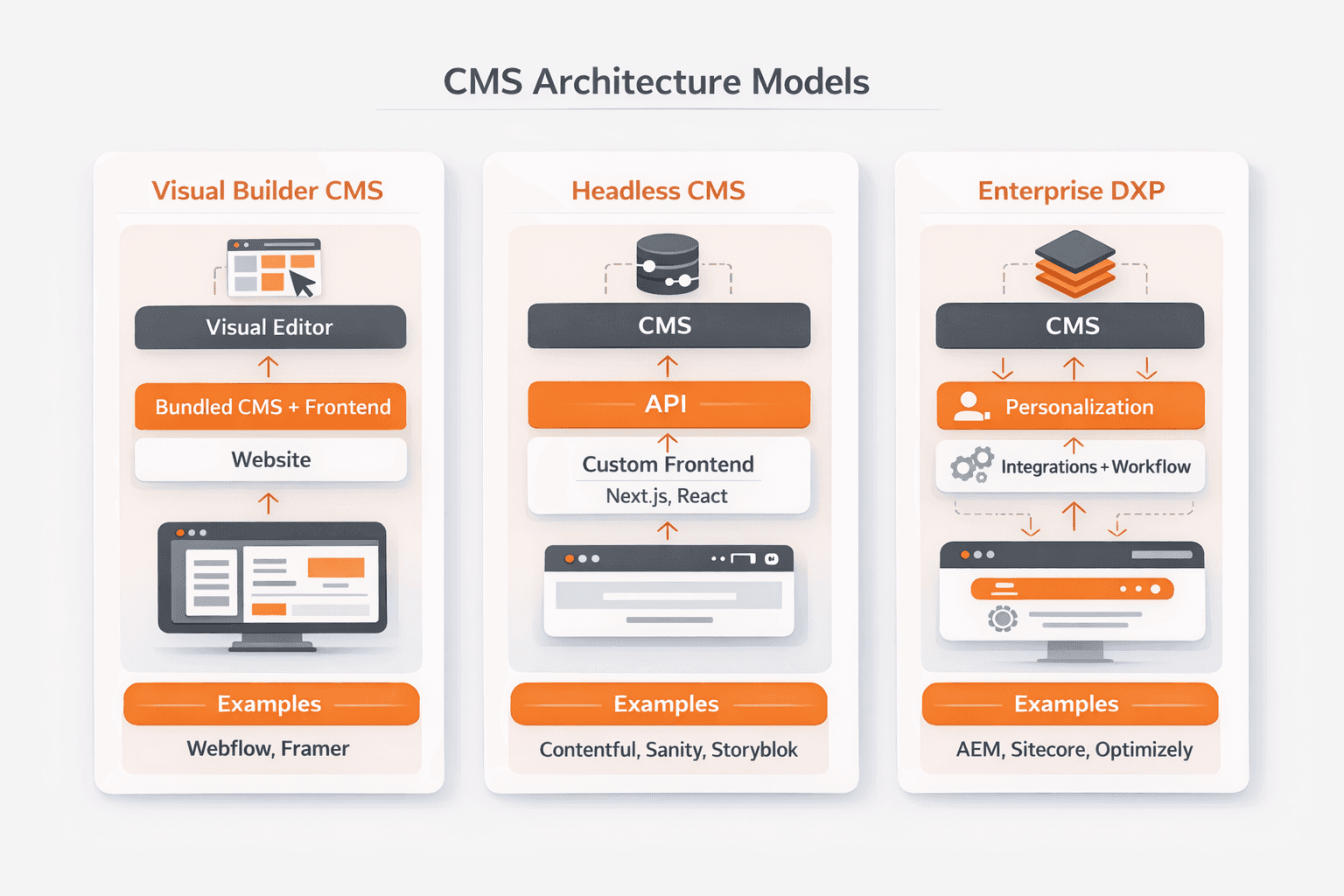
CMS Types for Fintech Websites
Type | Examples | Best For |
|---|---|---|
Visual Builder CMS | Webflow, Framer | Marketing-led teams, fast iteration, design-forward sites |
Headless CMS (SaaS) | Contentful, Sanity, Storyblok, Hygraph, Prismic | Product-led fintechs, multi-channel content, complex governance |
Open-Source Headless | Strapi | Teams that want control, self-hosting paths, or enterprise licences |
Traditional CMS | WordPress, Drupal | Teams with existing investment or strong internal support capability |
Enterprise DXP | Adobe Experience Manager, Sitecore, Optimizely | Large orgs with multi-brand governance, deep personalisation, internal support |
How We Are Comparing Platforms
Each platform is evaluated against six criteria weighted for fintech relevance:
Criteria | Weight |
|---|---|
Security & compliance evidence | 25% |
Governance & publishing workflows | 20% |
SEO + performance control | 15% |
Content modelling & scalability | 15% |
Integrations & extensibility | 15% |
TCO & team fit | 10% |
Quick Comparison Table
Platform | Best For | Team Fit | Key Strength | Key Risk | Notes |
|---|---|---|---|---|---|
Webflow | Marketing-led fintech | Marketing + some dev | Design speed, SOC 2 Type II | Governance limits at scale | Trust centre exists; request access |
Framer | Lean teams, fast launch | Solo / small marketing | Fastest to ship | Limited CMS depth | ISO 27001 documentation available |
Contentful | Enterprise headless | Dev + content ops | Scale, governance, security | Higher cost, steeper setup | SOC 2 + ISO 27001 attestations |
Sanity | Dev-first, complex content | Engineering-led | Structured content, real-time | Governance requires configuration | Flexible, but needs investment |
Storyblok | Headless + visual editor | Marketing + dev | Editor UX, ISO 27001 | Less suited to very large enterprise rollouts | Strong for Series A–B |
Hygraph | GraphQL-first, composable stacks | Dev teams | API flexibility, SOC 2 Type II | Lower brand recognition | Solid for composable stacks |
Strapi | Self-hosted control | Dev-heavy teams | Ownership, open source | Security ops burden | Enterprise tier adds support |
WordPress | Budget-conscious rebuild | Any (with discipline) | Ecosystem, flexibility | Plugin sprawl, maintenance | Requires hardening + managed hosting |
Drupal | Open-source governance | Internal dev team | Governance, open source | High complexity | Best where the team can support it |
AEM / Sitecore / Optimizely | Enterprise, multi-brand | Enterprise IT + dev | Full governance suite | Very high cost + complexity | Worth it only when required |
Not sure which option fits your business?
From startup brokerages to established platforms, WSA delivers websites that convert traders, satisfy regulators, and scale across markets.
The Best CMS Options for Fintech Websites in 2026
Webflow — Best for Marketing-Led Fintech Sites
Best for: Seed to Series B fintechs with a strong marketing team and a high design bar, where engineering bandwidth is limited.
Webflow gives marketing teams genuine publishing independence without needing developer involvement for every update. Its visual editor produces clean, semantic HTML and offers granular SEO controls out of the box—meta fields, canonical tags, structured data (schema) support, and fast load times on Webflow’s CDN.
From a security standpoint, Webflow holds SOC 2 Type II certification, and security documentation is available through its trust centre process—which should be one of your first requests during vendor due diligence.
Tradeoffs: Webflow’s CMS is purpose-built for marketing content. Complex governance workflows—multi-step approvals, locked templates, granular content roles—often require workarounds or third-party tooling. At Series B+, where compliance review becomes more formal, you may hit those limits.
Implementation note: Use Webflow’s role permissions carefully, keep a disciplined page structure from day one, and document your templating approach for regulated pages (fees, disclosures, T&Cs) to protect consistency.
Framer — Best for Lean Teams Shipping Fast
Best for: Early-stage fintechs (pre-seed to Seed) that need a credible, fast-loading site with minimal ops overhead.
Framer’s design-to-publish speed is unmatched for small teams. It isn’t a deep CMS platform, but for a 10–20 page marketing site that needs to look trustworthy and load quickly, it’s excellent. Framer references ISO 27001 compliance in its enterprise documentation—worth requesting directly as part of any vendor review.
Tradeoffs: Content modelling, approval workflows, and CMS depth are limited. Framer is a strong starting point, not a long-term platform for content-heavy fintechs.
Contentful — Enterprise Headless for Scale and Governance
Best for: Series B+ fintechs, enterprise financial services, or any team managing multiple content types, regions, or product lines.
Contentful is the most mature headless CMS on this list for enterprise use. Its content modelling is highly structured, its governance features (roles, approval workflows, environments, versioning) are production-grade, and its security posture is among the most documented—with ISO 27001 and SOC 2 attestations available via its security page.
Tradeoffs: Contentful’s cost and setup complexity are real. Expect meaningful engineering investment at the start, and budget for ongoing content ops management.
Implementation note: Pair Contentful with a Next.js front end for maximum performance and SEO control. The investment pays off when you have multiple contributors, a compliance review step, or regional publishing requirements.
Sanity — Developer-First Content OS for Product Ecosystems
Best for: Engineering-led fintechs building composable platforms where content is a structured data layer, not just a marketing function.
Sanity treats content as structured data you query and compose—powerful for fintechs that need content to feed multiple surfaces (website, app, onboarding flows, status pages). Its real-time collaboration and highly customisable Studio give product teams significant control.
Tradeoffs: Governance and approval workflows require deliberate configuration. Sanity doesn’t ship a compliance workflow out of the box—your engineering team builds it. Verify security documentation directly via Sanity’s official sources before including it in a vendor review.
Storyblok — Headless with Strong Enterprise Positioning
Best for: Series A–B fintechs that want headless architecture but still need marketing teams to publish independently.
Storyblok’s visual editor is among the most accessible of the headless options, which reduces friction for non-technical content teams. It holds ISO 27001 certification, with evidence available via third-party certificate listings. Its component-based content modelling is well-suited to fintech marketing sites with recurring structures (product pages, comparison pages, legal pages).
Tradeoffs: At large enterprise scale, Storyblok’s ceiling is typically lower than Contentful’s. For most Series A–B use cases, it’s more than sufficient.
Hygraph — Headless, GraphQL-First with Security Positioning
Best for: Dev teams building composable stacks that need a content mesh layer with clean API architecture.
Hygraph (formerly GraphCMS) is a strong choice when your stack is already GraphQL-native and you want a CMS that integrates cleanly with multiple data sources. It references SOC 2 Type II and GDPR compliance on its security and features pages—review directly for due diligence.
Tradeoffs: Hygraph has less brand recognition than Contentful or Storyblok, which can require more explanation during vendor review.
Strapi — Open-Source Headless for Teams That Want Control
Best for: Fintechs that want headless CMS architecture with more ownership over infrastructure, or teams evaluating self-hosting paths.
Strapi’s open-source model means you control your hosting environment, your data residency, and your upgrade cycle. Its enterprise tier adds managed support and, notably, references SOC 2 compliance as part of its financial services positioning. It’s a reasonable choice where data sovereignty or third-party hosting restrictions are genuine constraints.
Tradeoffs: The security and infrastructure operations burden falls on your team. Open-source flexibility is only valuable if you have the engineering resource to run it responsibly.
WordPress — Only If You Can Operationalise Security and Performance
Best for: Teams with existing WordPress investment and the operational discipline to manage it properly.
WordPress can work for fintech. Its ecosystem is broad, its flexibility is real, and for content-heavy sites with strong internal support, it remains viable. But the default WordPress setup isn’t fintech-grade. Plugin sprawl, inconsistent update cycles, and unmanaged hosting create real exposure—both from a security standpoint and in terms of site performance.
Tradeoffs: If you choose WordPress, commit to managed hosting, a strict plugin policy, a formal update schedule, enforced MFA, and ideally a WAF at the infrastructure layer. The risk isn’t WordPress itself—it’s the operational drift that tends to follow.
Drupal — Compliance-Heavy Orgs That Want Open-Source Governance
Best for: Established financial services organisations with internal developer teams who want open-source governance and control.
Drupal’s access controls, content workflow modules, and active security team make it a defensible choice for organisations that can support it internally. It’s genuinely strong on governance—but that strength only materialises when you have the team to implement and maintain it properly.
Adobe Experience Manager, Sitecore, Optimizely — Enterprise DXP Tier
Best for: Large regulated financial services organisations with multi-brand portfolios, deep personalisation requirements, and enterprise IT infrastructure.
These platforms offer comprehensive governance, personalisation, and multi-site management. They’re expensive, complex, and typically require dedicated implementation partners and internal support teams. If your procurement and security requirements explicitly demand an enterprise DXP tier—or your organisation already operates within one—they’re worth evaluating. Otherwise, a mature headless CMS like Contentful will serve most Series C+ fintechs better, with a lower total cost of ownership.
Ready to Make the Right CMS Call?
You don’t need to evaluate 10 platforms in parallel. WSA helps fintech teams cut through the options and ship a CMS setup that holds up under compliance review, marketing pressure, and growth.
“Pick Your CMS”: Recommendations by Fintech Stage
Stage | Recommended CMS | Rationale |
|---|---|---|
Pre-launch / Seed | Webflow or Framer | Fast, clean, low ops load, credible design |
Series A–B (marketing + product content) | Storyblok, Sanity, or Contentful + Next.js | Headless flexibility with governance foundations |
Enterprise / multi-brand / regulated | Contentful or enterprise DXP | Formal governance, multi-region, compliance workflows |
Self-hosting / data sovereignty constraint | Strapi (enterprise) or Drupal | Ownership and control over infrastructure |
CMS Vendor Due Diligence Checklist for Fintech Teams
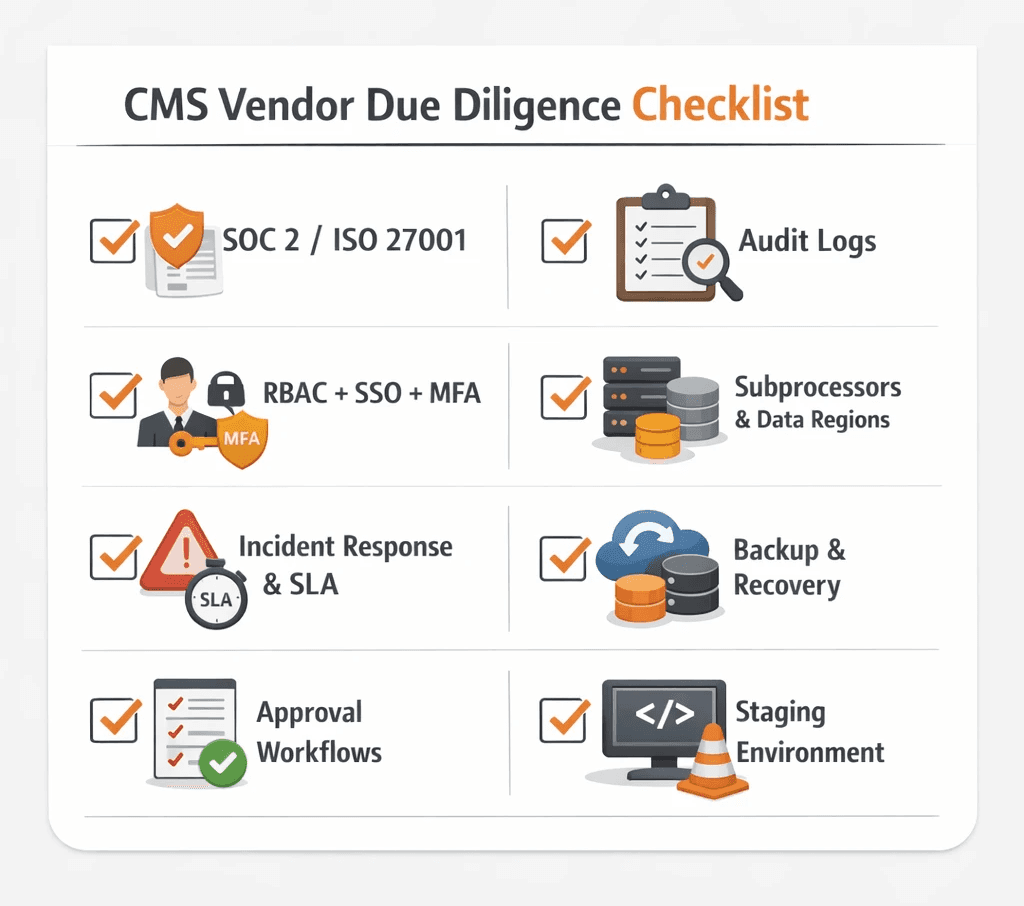
When evaluating any CMS vendor, request or confirm the following—because procurement and security teams will ask anyway:
Security reports: SOC 2 Type II report access (where applicable); ISO 27001 certificate
Audit logs: Can you export a full log of who changed what, when?
RBAC + SSO: Role-based access controls, SAML/OIDC SSO enforcement, MFA requirements
Subprocessors: Full subprocessor list and data hosting regions
Incident response: Documented process, notification timelines, uptime SLA, and track record
Backup and recovery: Backup frequency, restore process, disaster recovery basics
Editorial workflow: Approval stages, staging environments, and scheduled publishing with access controls
Common Mistakes Fintech Teams Make When Choosing a CMS
Choosing by popularity, not operating model—the most-used CMS is rarely the most appropriate for your team structure.
Underestimating governance until Series A+—approval workflows and audit trails feel optional early and become critical fast.
Ignoring localisation until “later”—retrofitting multilingual CMS architecture is expensive; plan for it in the content model.
Overbuilding headless when a builder CMS would do—headless isn’t inherently better; it’s better when your team can support it.
Underbuilding and landing in plugin chaos—especially common on WordPress; technical debt accumulates invisibly.
No migration or redirect plan—CMS migrations without a proper redirect strategy routinely cost significant organic traffic.
CMS Migration and Launch Checklist
Content inventory — catalogue all existing pages, URLs, and asset types
URL mapping — map old URLs to the new structure; flag required redirects
Content model + templates — define content types, locked templates, and field structures before migration
Staging workflow — confirm the approval chain works in staging before going live
SEO migration — implement 301 redirects, review canonicals, submit updated sitemaps
Performance checks — baseline Core Web Vitals in staging; fix before launch
Analytics + consent tooling — verify tracking continuity and cookie consent integration
Security review + access controls — confirm roles, remove legacy accounts, document access policy
Launch + monitor — run a crawl on launch day; monitor indexation and Core Web Vitals for the first 30 days
Next Steps: How WSA Helps Fintech Teams Ship the Right CMS Setup
Choosing the right CMS is only part of the problem. The other part is building a site that reads as credible to customers, passes vendor security review, and gives your team the publishing freedom to keep it current.
WSA works exclusively with fintech and financial services teams on exactly this. The work spans CMS selection and architecture recommendation, fintech UX and trust design, compliance-friendly content structure, and full build, migration, and SEO foundations.
If you’re at the point of making a CMS decision—or realising the current one isn’t working—a short discovery conversation is the fastest way to get clarity.
FAQ
What is the best CMS for a fintech startup website in 2026?
For most fintech startups at Seed to early Series A, Webflow is the most practical choice—fast to build, clean for SEO, and credible enough for early enterprise prospects. As team complexity grows and compliance workflow needs emerge, a headless CMS like Storyblok or Contentful paired with Next.js becomes a stronger long-term architecture.
Is Webflow safe enough for fintech?
Webflow holds SOC 2 Type II certification, supports role-based access, and provides security documentation through its trust centre process. For most marketing sites at early-to-mid stage fintechs, it clears the bar. The more important question is whether your content governance model—approvals, versioning, access controls—can be operationalised within Webflow’s feature set. For high-volume content operations or multi-region publishing, it has limits.
When should a fintech choose headless CMS over Webflow or Framer?
Consider headless when you need:
multiple contributors with different permission levels
a documented approval step before publishing (compliance/legal)
multilingual or multi-site publishing from a single content layer
content to feed more than a website (app, onboarding, status pages)
Headless adds engineering overhead—so it’s the right call only when your team can absorb it.
Can WordPress work for fintech websites?
Yes, but only with deliberate investment in security and operations. That means managed WordPress hosting, a strict (minimal) plugin policy, a formal patch schedule, enforced MFA, and ideally a WAF at the infrastructure layer. The risk isn’t WordPress itself—it’s the operational drift that tends to accumulate. If you’re not prepared to maintain it to that standard, a managed alternative is the safer choice.
What CMS is best for multilingual fintech websites?
Contentful and Storyblok both have mature localisation support, including locale-specific content fields, translation workflows, and multi-region publishing controls. Contentful is typically stronger for large-scale multilingual operations with formal governance requirements. Storyblok offers a more accessible path for Series A–B fintechs managing two to five markets.
How long does a CMS migration take?
A straightforward migration (10–30 pages, single language, no complex content modelling) typically runs four to eight weeks, including content migration, redirects, SEO validation, and staging review. More complex migrations—multi-region, large content libraries, legacy integrations, compliance workflow setup—typically run three to six months. The SEO migration work (redirects, canonical review, sitemap resubmission) is the phase most often underestimated—and most expensive to fix after the fact.
Launch Your Licensed Brokerage with Confidence
We support brokers and fintechs through licensing, launch planning, and everything a regulated brand needs to go live.