•
•

Brokerage License + Website Package: How to Bundle Compliance and Launch in One Timeline
Your licensing consultant confirms the application pack is ready to file. Then the regulator's questionnaire asks for your website address, and you do not have one. Or you have a holding page with a stock chart and a form that goes nowhere.
That single gap costs founders weeks. Sometimes months.
A brokerage license + website package exists to close it. Buy the two together and you stop treating the site as post-approval marketing and start treating it as part of the filing itself. The catch is that most vendors selling a broker launch package will not tell you what is actually in the box, what each half costs, or when each deliverable lands.
This article is that scope document. You get the deliverables list split by workstream, the pages regulators read at filing, price ranges for both halves, and a week-by-week plan from kickoff to a licensed, live brokerage.
This article is for informational purposes only and does not constitute legal advice. Brokers should consult qualified legal and compliance professionals for jurisdiction-specific guidance.
Key Takeaways
A brokerage license + website package is two workstreams on one clock: a licensing mandate measured in months, and a website build measured in weeks.
Regulators do not publish a website specification. They check whether your public site matches your filed application, and inconsistency is the delay that catches founders out.
The brokerage license and website package cost splits into one variable line and one fixed line. Licensing typically consumes 80–95% of the launch budget.
Approval runs 1–3 months in Vanuatu, 6–12 months in Cyprus and 9–18 months in the UK. The website is ready inside 10 weeks either way.
A realistic broker go-live timeline is 4–6 months offshore and 9–18 months in a tier-1 jurisdiction, with the site staged and waiting behind a gate.
One vendor almost never holds both a licensing mandate and a design studio. Plan for two partners on a shared milestone plan.
What a Brokerage License + Website Package Actually Includes
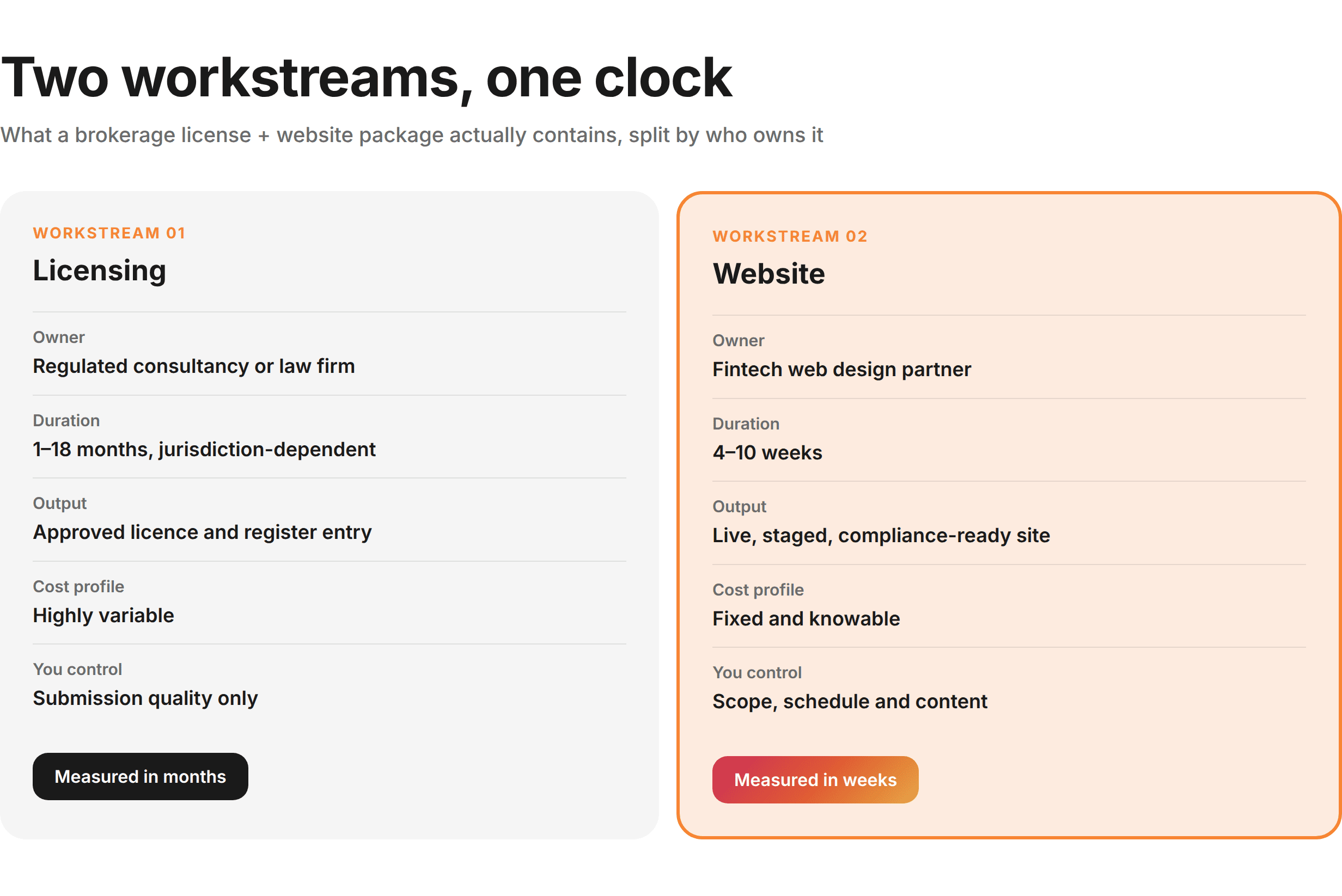
A brokerage license + website package is a single engagement plan covering two separate workstreams on one clock: a regulated licensing mandate that takes months, and a website build that takes weeks. The value is not the discount. It is the handoff points, where your filing documents and your public site copy have to say the same thing.
Compare that to a turnkey brokerage solution, which bundles trading technology: platform licence, liquidity, CRM, payment rails. Those are operational systems. A licence and website bundle covers the two things a regulator and a bank actually assess before you trade at all.
Here is what sits on each side.
Dimension | Licensing workstream | Website workstream |
|---|---|---|
Owner | Regulated consultancy or law firm | Fintech web design partner |
Duration | 1–18 months, jurisdiction-dependent | 4–10 weeks |
Output | Approved licence and register entry | Live, staged, compliance-ready site |
Cost profile | Highly variable | Fixed and knowable |
You control | Submission quality only | Scope, schedule and content |
What this means: you cannot compress the licence. You can compress everything else, and that is where a bundled engagement earns its money.
The Licensing Workstream
The licensing workstream produces the filing pack. Across major jurisdictions the required set is consistent, according to B2BROKER's 2026 licensing guide:
Company registration and corporate structure documents
A business plan naming products and target markets
Audited or projected financials, with stated assumptions
AML and KYC policies
A risk management framework
Governance and organisational structure
CVs and fit-and-proper assessments for key personnel
That same guide makes a point worth pinning to the wall: incomplete documentation causes more application delays than anything else. Submission quality is the one lever you hold over approval speed.
The Website Workstream
The website workstream produces the public asset the regulator, your banking partner and your first traders all read. In a properly scoped bundle it delivers:
Information architecture mapped to your filed product list, not to a template
Corporate, governance and contact pages carrying your exact legal entity details
A legal document section: terms, privacy, risk disclosure, complaints procedure, AML statement
Product and pricing pages built but gated, ready to publish the day the licence number exists
A staging environment with controlled publishing, so nothing regulated goes live early
Performance, analytics and CRM integration for the traffic that follows approval
Framer and Webflow both support staged environments and permissioned publishing, which is what makes gating a configuration rather than a rebuild. If you want the mechanics of the build itself, WSA's step-by-step broker website build guide covers it in sequence.
See How Compliance-Ready Broker Sites Are Built
Fixed scope, fixed timeline, designed for regulated filing from day one.
Which Website Deliverables Regulators Expect at Filing
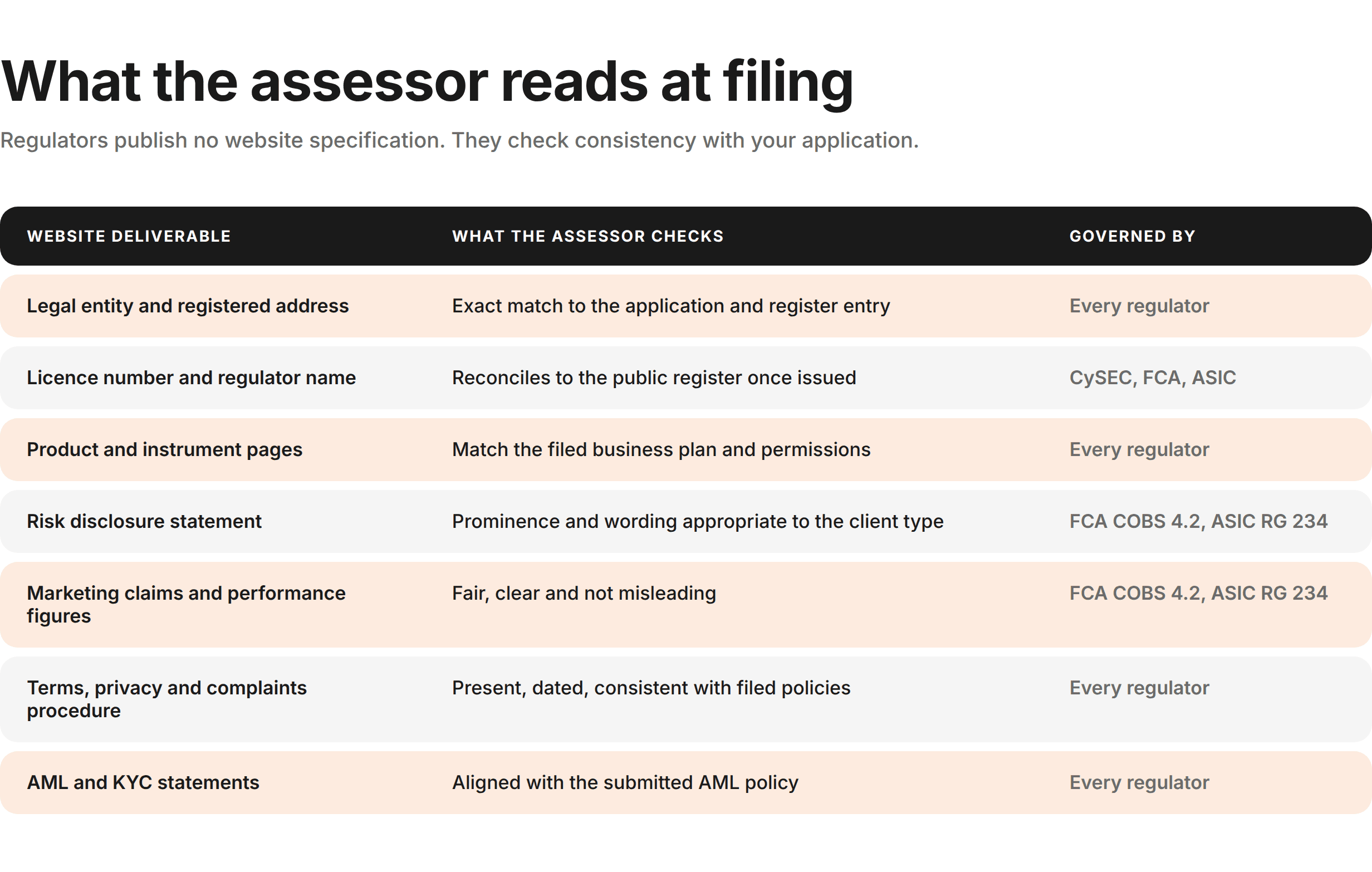
Regulators do not publish a website specification. What they check is consistency: whether the entity named on your site is the entity in the application, whether the products you advertise are the products you applied for, and whether your risk language matches the regime you are entering.
Here is where most teams lose weeks. The business plan says "professional clients, spot FX only." The homepage says "trade 200+ instruments with 1:500 leverage." Now the assessor has a question, and questions add review cycles.
The non-obvious part: your banking partner reads the same site. WSA's experience with broker launches shows a corporate account can stall on exactly the inconsistency the regulator already flagged, which means the delay lands twice on one launch budget.
Website deliverable | What the assessor checks | Governed by |
|---|---|---|
Legal entity and registered address | Exact match to the application and register entry | Every regulator |
Licence number and regulator name | Reconciles to the public register once issued | CySEC, FCA, ASIC |
Product and instrument pages | Match the filed business plan and permissions | Every regulator |
Risk disclosure statement | Prominence and wording appropriate to the client type | FCA COBS 4.2, ASIC RG 234 |
Marketing claims and performance figures | Fair, clear and not misleading | FCA COBS 4.2, ASIC RG 234 |
Terms, privacy and complaints procedure | Present, dated, and consistent with filed policies | Every regulator |
AML and KYC statements | Aligned with the submitted AML policy | Every regulator |
Corporate and Governance Pages
Corporate pages must reconcile to the application, line for line. The legal entity name, registered address, company number and, once issued, the licence number all have to match what a reviewer can pull from the regulator's public register, such as CySEC's register of Cypriot Investment Firms.
Small mismatches read badly. A trading name in the footer where the licensed entity should be, or an address from a prior incorporation, invites a question you do not need.
Legal, Risk and Disclosure Documents
Every regulated claim on the site is a financial promotion. In the UK, COBS 4.2.1R in the FCA Handbook requires that a communication or financial promotion is fair, clear and not misleading, with proportionality applied to the client type. In Australia, ASIC's Regulatory Guide 234, updated in June 2026, sets out how the prohibitions on false or misleading statements apply to advertising financial products and services.
The practical implication: your risk warning is not a footer afterthought. Its placement, prominence and wording are part of what the assessor evaluates, and they differ by regime. WSA's broker website compliance checklist maps the CySEC, FCA and ASIC requirements page by page.
What a Licence and Website Bundle Costs End to End
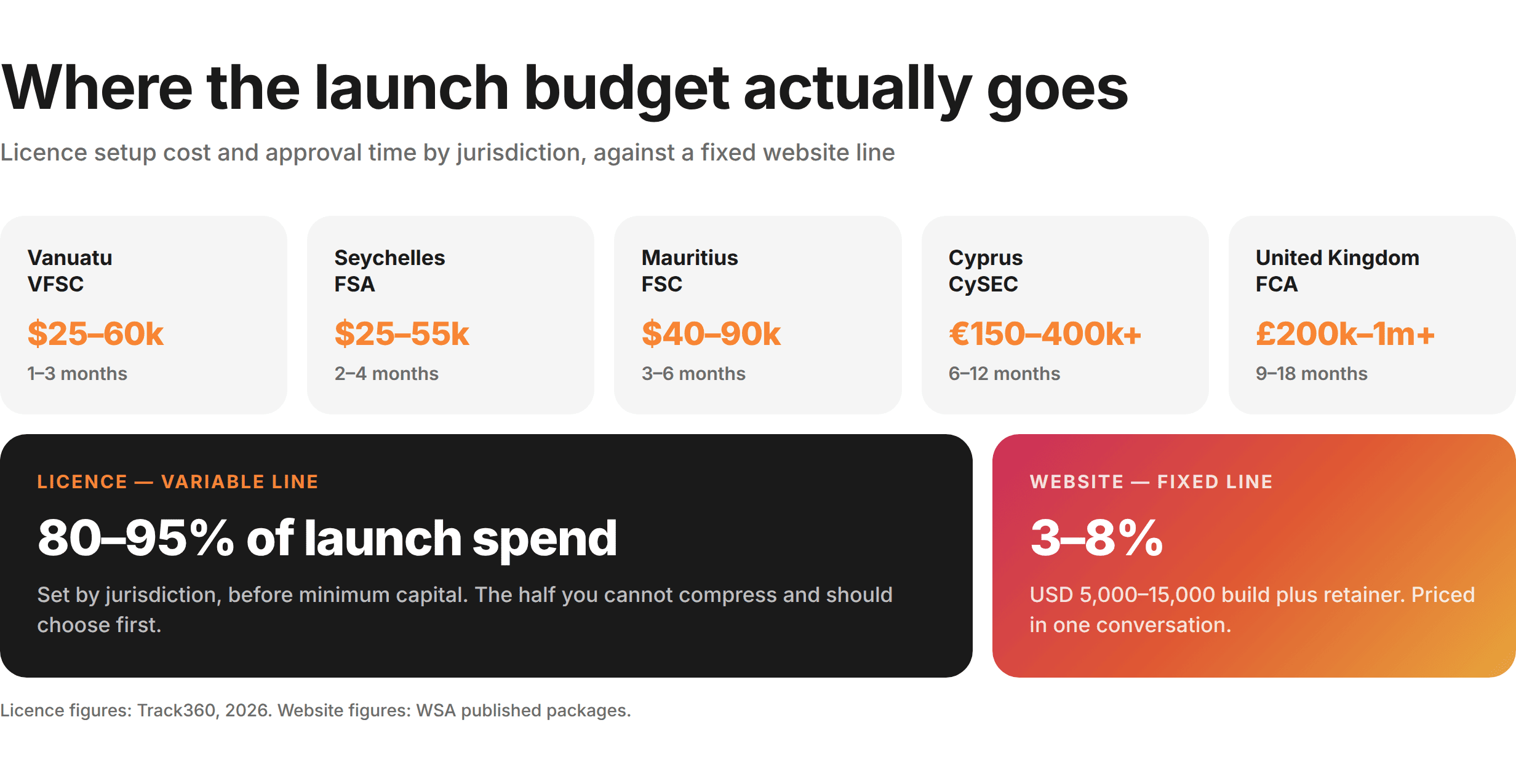
A licence and website bundle splits into one wildly variable cost and one fixed cost. The licence dominates: in most launches it accounts for 80–95% of the total, and the range between jurisdictions is more than twentyfold. The website is a line item you can price in a single conversation.
Founders routinely get this backwards. They spend three weeks negotiating a design fee and three days choosing a jurisdiction.
Licensing Costs by Jurisdiction
Setup cost, minimum capital and approval time move together. Track360's 2026 jurisdiction guide puts the spread as follows:
Jurisdiction | Setup cost | Minimum capital | Approval time |
|---|---|---|---|
Vanuatu (VFSC) | USD 25–60k | ~USD 50k | 1–3 months |
Seychelles (FSA) | USD 25–55k | ~USD 50k | 2–4 months |
Mauritius (FSC) | USD 40–90k | USD 25–100k | 3–6 months |
Cyprus (CySEC) | EUR 150–400k+ | EUR 125–730k | 6–12 months |
UK (FCA) | GBP 200k–1m+ | GBP 125k+ | 9–18 months |
Cyprus and the UK cost more because you are buying market access and credibility, not just permission. A CySEC licence carries the MiFID II passport across the EU. In the EU, firms dealing on own account in OTC derivatives face a EUR 750,000 own-funds floor under IFR/IFD, per B2BROKER's 2026 guide.
The takeaway: pick the jurisdiction your target clients and payment providers will accept, then build the budget around it. Reversing that order is the most expensive mistake in the sequence.
Website and Design Costs
A compliant broker website is a fixed line. WSA's published packages run at USD 4,999 upfront plus USD 499 per month for a landing page with a legal documents section, USD 9,999 plus USD 999 for a site with a managed blog and SEO, and USD 14,999 plus USD 1,499 for a multi-page build with CRM-linked forms and GA4 event tracking. Every tier is listed on WSA's pricing page, and the full brokerage website cost breakdown explains what moves the number.
Against a Cyprus licence at EUR 150,000 and up, the website is roughly 3–8% of launch spend. It is also the only part a prospective client will ever see.
Price Your Broker Site Before You Pick a Jurisdiction
Know the fixed half of your launch budget in one call, not three revisions.
The Combined Timeline: From Kickoff to Licensed, Live Brokerage
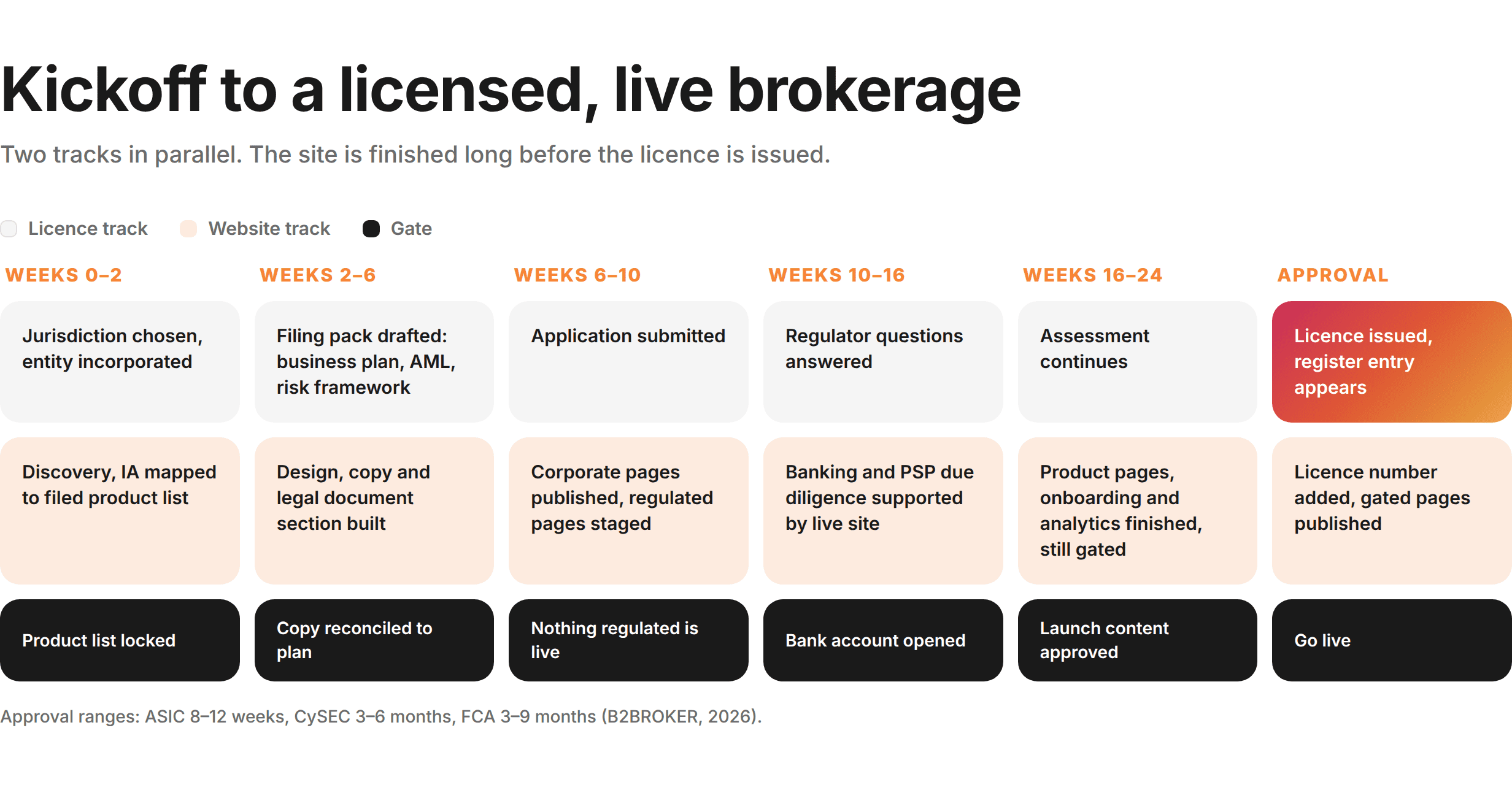
Kickoff to a licensed, live brokerage typically runs 4–6 months in an offshore jurisdiction and 9–18 months in a tier-1 regime. The website is ready inside the first 10 weeks in both cases, which means the broker go-live timeline is set almost entirely by the licence. B2BROKER's 2026 figures put ASIC at 8–12 weeks for straightforward applications, CySEC at 3–6 months for complete submissions, and the FCA at 3–9 months depending on permissions sought.
Run the two tracks in parallel and the sequence looks like this. Anyone weighing the order of operations should read WSA's guide on how to sequence the two workstreams.
Weeks | Licence track | Website track | Gate |
|---|---|---|---|
0–2 | Jurisdiction chosen, entity incorporated | Discovery, IA mapped to filed product list | Product list locked |
2–6 | Filing pack drafted: business plan, AML, risk framework | Design, copy, legal document section built | Site copy reconciled to business plan |
6–10 | Application submitted | Corporate and governance pages published; regulated pages staged | Nothing regulated is live |
10–16 | Regulator questions answered | Banking and PSP due diligence supported by live corporate site | Bank account opened |
16–24 | Assessment continues | Product pages, onboarding flow and analytics finished, still gated | Launch content approved |
Approval | Licence issued, register entry appears | Licence number added, gated pages published, campaigns switched on | Go live |
Here is why the timeline matters: the site is finished long before the licence. That is the point. Every week the application sits in assessment is a week you are not also waiting on a design agency, and the 1–3 months of dead time founders usually burn after approval simply does not happen.
Can One Vendor Deliver Both the Licence and the Website?
Rarely, and that is not a defect in the market. Licensing work requires a regulated consultancy, a law firm, or a provider with a standing mandate in the jurisdiction. Website work requires a design and development studio that understands regulated content. Very few businesses hold both credibly, and the ones claiming to usually subcontract one half without saying so.
The workable model for a broker launch package is two partners on one shared milestone plan, with the founder owning a single document that both read. What makes it function is unglamorous:
One product and permissions list, referenced by both teams
The licensing partner reviews site copy before anything regulated publishes
The web partner holds a change log so late licence conditions can be reflected in hours, not sprints
Agreed publishing gates tied to application stages, not calendar dates
Ask any vendor selling a turnkey brokerage solution which half they actually perform in-house. The answer tells you where accountability sits when a date slips.
How WSA Delivers the Website Side of a Broker Launch Package
WSA runs the website workstream of a broker launch package and works alongside your licensing partner. To be direct about scope: WSA does not issue licences and does not give legal advice. What WSA delivers is the compliant broker website that your application, your bank and your first clients all read.
In practice that means:
Framer builds shipped in weeks, with staged environments and gated publishing for regulated pages
Legal document sections structured for CySEC, FCA and ASIC expectations, built to your counsel's wording
Copy written against your filed business plan, so the site and the application agree
Fixed-scope packages with a defined timeline, from a landing page to a multi-page brokerage site
Ongoing retainer support for the changes that arrive with licence conditions
WSA works only with financial brands: brokers, forex, crypto exchanges and fintech. That specialisation is the reason the compliance questions get asked in week one rather than week nine.
One honest caveat: if you already hold a licence, you do not need a bundle. Buy the website workstream alone and skip the coordination overhead.
Conclusion
A brokerage license + website package works when you stop thinking of it as one product and start managing it as two tracks with shared gates. The licence sets your broker go-live timeline and consumes most of your budget. The website is fast, fixed in price, and the only part of the launch a client will ever see, which makes it worth building while the application sits in assessment rather than after.
Get the deliverables list, the price split and the gates agreed in week one and the rest is execution.
WSA builds the website side of broker launches for regulated financial brands, working alongside your licensing partner. If your application is drafted or already filed, the site can be ready before the decision arrives.
Tell WSA where your application stands and the website workstream can start this week.
Start the Website Workstream While Your Application Runs
Ten weeks of build inside months of assessment, gated until your licence number exists.
FAQs
What does a brokerage license and website package cost end to end?
Between roughly USD 30,000 and USD 1,000,000 or more, driven almost entirely by jurisdiction. On the licence side, Track360's 2026 guide puts setup at USD 25–60k in Vanuatu, USD 40–90k in Mauritius, EUR 150–400k or more in Cyprus and GBP 200k to over GBP 1m in the UK, before minimum capital. On the website side, expect a fixed USD 5,000–15,000 build plus a monthly retainer; WSA's packages start at USD 4,999 upfront plus USD 499 per month.
The website is typically 3–8% of the total. If a single vendor quotes one blended number for both, ask for the split before signing, and ask which half they perform in-house rather than subcontract.
Which website deliverables does the regulator want at filing?
The ones that prove your public presence matches your application. In practice that means your legal entity name and registered address exactly as filed, a legal document section covering terms, privacy, risk disclosure and complaints procedure, product pages limited to the instruments and client types you applied for, and marketing claims that meet the promotion rules of your regime.
No regulator publishes a page-by-page website specification. They assess consistency and the fairness of your claims. Under FCA COBS 4.2, communications and financial promotions must be fair, clear and not misleading; ASIC's RG 234 covers the same ground for Australian advertising. Regulated claims and any licence number should stay unpublished until the licence is actually issued.
How many weeks does it take from kickoff to a licensed, live brokerage?
Roughly 18–26 weeks offshore and 40–78 weeks in a tier-1 jurisdiction. The licence sets the pace: B2BROKER's 2026 figures give ASIC 8–12 weeks for straightforward applications, CySEC 3–6 months for complete submissions and the FCA 3–9 months depending on permissions, while Track360 puts Vanuatu at 1–3 months and the UK at 9–18 months end to end.
The website takes 4–10 weeks and finishes long before approval. Building it in parallel is what removes the 1–3 months of dead time that sequential planning creates after the licence lands.
Who owns the design files and hosting after handover?
You should, and this belongs in the contract before work starts. Ask for three things in writing: ownership of the design files and source project, ownership of the hosting and domain accounts in your company's name, and a defined handover process if the relationship ends.
On Framer or Webflow, the project should sit in your organisation's workspace with the agency invited as a collaborator, not the reverse. That single arrangement prevents the most common post-launch problem in regulated web work, where an urgent compliance edit waits on a former vendor's login.
What happens to the website if the licence is refused?
The corporate site stays live and the regulated pages never publish, which is exactly why gating matters. If the application is refused or withdrawn, you keep a working brand presence, a legal document framework and an information architecture you can re-point at a different jurisdiction, usually in a few weeks rather than a full rebuild.
What you must not do is publish product pages, licence claims or a regulator's name in anticipation of approval. Advertising a permission you do not hold is a compliance problem in its own right, separate from the refusal, and it makes a second application harder.
Launch Your Licensed Brokerage with Confidence
We support brokers and fintechs through licensing, launch planning, and everything a regulated brand needs to go live.