•
•

BVI Forex License: BVI FSC Requirements and Setup
You have shortlisted three offshore jurisdictions and the British Virgin Islands keeps coming up. Then you start reading, and the numbers stop agreeing with each other. One consultant page says the capital requirement is $250,000. Another says $100,000 to $500,000. A third says budget a million. None of them tells you which license category a forex broker actually needs.
That confusion is the real cost of researching a BVI forex license. Founders lose weeks to it, and some submit applications built on the wrong category entirely.
This guide fixes that. It sets out which BVI Financial Services Commission category a BVI forex broker license actually falls into, what the BVI FSC assesses, what the fees are under the current fee regulations, and how long approval realistically takes. It also covers the part almost nobody writes about: what your website has to show once you are licensed.
This article is for informational purposes only and does not constitute legal advice. Brokers should consult qualified legal and compliance professionals for jurisdiction-specific guidance.
Key Takeaways
Forex and CFD dealing in the BVI falls under Category 1, Dealing in Investments of the investment business licence regime. Sub-Category A covers dealing as agent, Sub-Category B covers dealing as principal. Category 3 is investment management and does not cover broker dealing.
The BVI publishes no single fixed minimum capital figure for all applicants. The BVI FSC assesses capital resources against your business plan and risk profile, which is why credible advisers quote anything from roughly $100,000 to $1,000,000 and above.
Current official fees for Category 1A and 1B are $2,200 on application and $3,300 annually, set by the Financial Services (Fees) (Amendment) Regulations, 2023. Pages still quoting $1,000 and $1,500 are using pre-2023 figures.
Timelines split sharply. A complete, conventional application can clear in 2 to 4 weeks after submission. Complex or novel ones run 10 weeks to 12 months. Application quality drives the difference, not the regulator.
Expect at least two experienced directors, an approved auditor, a compliance and AML officer, professional indemnity insurance, and an authorised representative unless you maintain real management presence in the BVI.
Once licensed, your website becomes part of the regulatory record. Entity name, licence category and number, registered office, risk warnings and restricted-jurisdiction notices all have to be findable and consistent with the BVI FSC public register.
What Is a BVI Forex License?
A BVI forex license is an investment business licence issued by the British Virgin Islands Financial Services Commission (BVI FSC) under the Securities and Investment Business Act, 2010. It authorises a BVI company to deal in investments, which is the statutory activity that covers forex and CFD brokerage.
There is no instrument in BVI law literally called a "forex licence". What brokers refer to by that name is a specific category of investment business licence, and getting the category right is the first real decision in the process.
Who Regulates Forex Brokers in the British Virgin Islands
Forex brokers in the British Virgin Islands are regulated by the BVI FSC, the territory's single financial services regulator. A British Virgin Islands forex broker licence is granted, varied and revoked by that one body. It licenses the entity, approves its directors and senior officers individually, and supervises it for as long as the licence is live.
The BVI FSC's remit over a licensed broker covers three things:
Authorisation: whether the applicant, its owners and its officers are fit and proper, and whether the business plan is credible
Prudential supervision: whether the firm holds capital resources appropriate to its risks, under the Regulatory Code
Conduct and reporting: audited accounts, compliance reporting, notification of material changes, and public disclosure
What this means in practice: approval is not a one-time filing. You are entering a supervisory relationship, and the BVI FSC will keep asking for evidence that the firm still looks like the one it licensed.
A BVI FSC Licence vs a Plain BVI Company
Unlike an unregulated BVI business company, a BVI FSC licensee may lawfully accept client funds and deal in investments. A plain BVI company cannot. Incorporating in the BVI gives you a legal entity, nothing more.
This distinction catches founders out more often than any other point in the process. Carrying on investment business in or from within the BVI without a licence is an offence, and Mourant's guide to BVI investment business regulation is blunt about the consequences.
Here is where it gets expensive. Some brokers incorporate, launch a website describing regulated services, and only then start the application. The site is already making claims the entity cannot support. That is the sort of mismatch a regulator notices and a bank refuses to onboard.
Which BVI Investment Business Licence Category Covers Forex Dealing
Forex and CFD dealing falls under Category 1, Dealing in Investments. Sub-Category A covers dealing as agent. Sub-Category B covers dealing as principal, which includes market making. Category 3 is investment management and does not cover broker dealing, despite being widely misquoted online.
Here is where most applications go wrong. Your business model decides the sub-category, and the choice is not cosmetic. It sets your risk profile, and therefore what the BVI FSC expects you to hold in capital.
Sub-Category A: Dealing as Agent | Sub-Category B: Dealing as Principal | |
|---|---|---|
What you do | Transmit and execute client orders through a third party | Take the other side of client trades on your own book |
Typical model | A-book, STP, matched-principal flow | B-book, market making, hybrid execution |
Market risk | Passed to the liquidity provider | Retained by the firm |
Capital expectation | Lower | Higher, and scrutinised harder |
Who it suits | Brokers routing to a prime or LP from day one | Brokers running internal or hybrid execution |
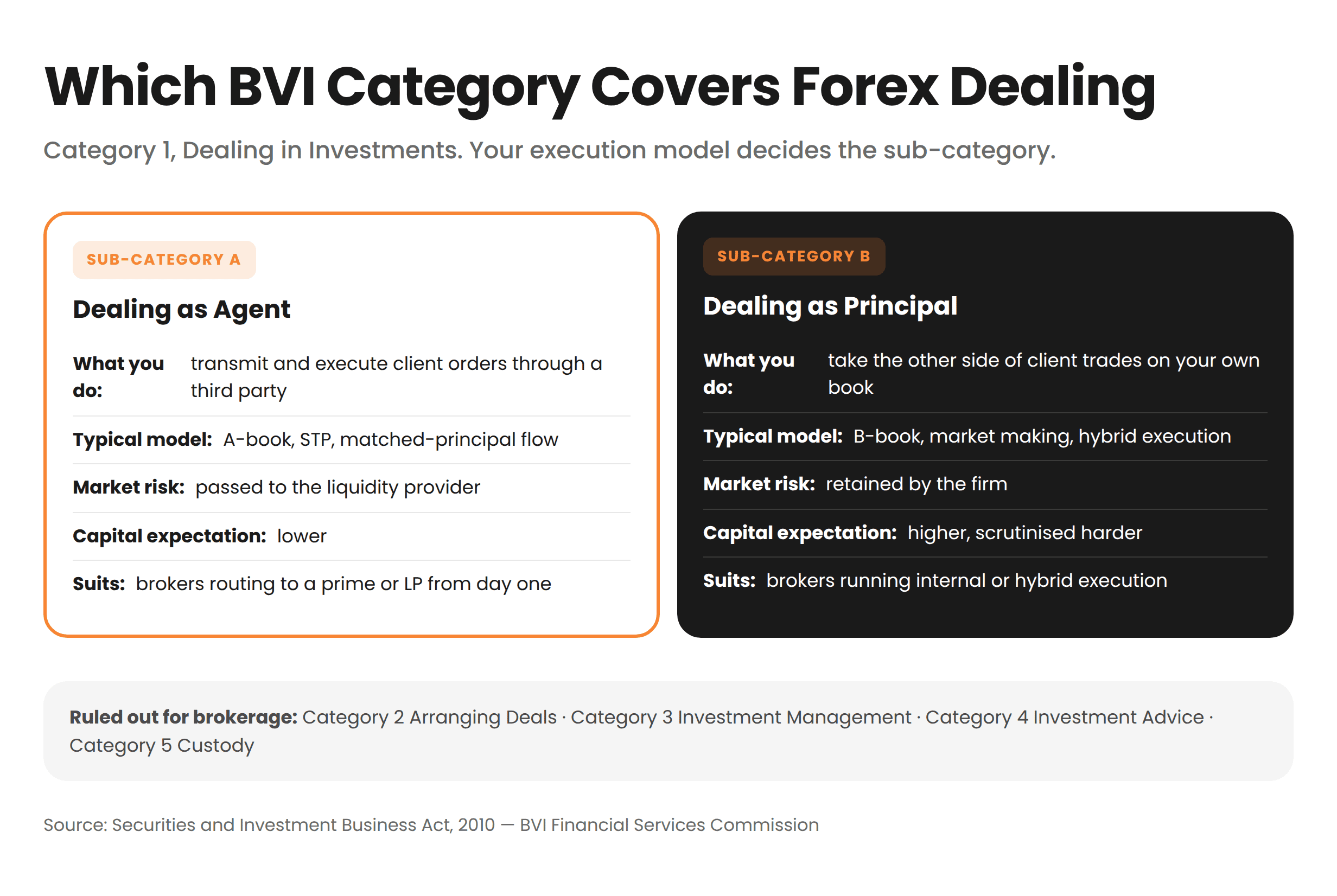
Most start-up brokers apply for both sub-categories so they can run a hybrid book without reapplying later. That is a reasonable position, but say so in the business plan and be ready to justify the capital that goes with principal dealing.
The other categories exist and are worth naming so you can rule them out:
Category 2, Arranging Deals: introducing and arranging, without executing
Category 3, Investment Management: managing portfolios, funds, pension schemes
Category 4, Investment Advice: advice only, no dealing
Category 5, Custody: holding client assets as custodian
If your pitch deck says "we execute client trades", you are in Category 1. Everything else is a different business.
Get Your Website Application-Ready Before You File
Regulators and banks read your site while your file is open, and an entity mismatch turns into weeks of questions.
BVI FSC Requirements: Capital, People and Local Presence
The BVI forex licence requirements fall into four groups: capital resources, fit-and-proper people, local presence, and ongoing reporting. Weakness in any one of them is what turns a four-week approval into a nine-month one.
Capital Requirements for a BVI Investment Business Licence
The BVI does not publish a single fixed minimum capital figure that applies to every investment business licensee. Under the Regulatory Code, the BVI FSC assesses whether your capital resources are adequate for the business you have described, so the number comes out of your own business plan.
This is why the numbers you found do not match. Licensing consultants quote $250,000. Others quote a $100,000 to $500,000 band. Law firm Harneys advises practitioners to budget around $1,000,000 or more for a substantial dealing operation. All of those can be true at once, because they describe different businesses.
What this means: stop hunting for the official number. Build the business plan first, then size capital to the execution model, client volumes and target jurisdictions in it. A principal-dealing broker serving retail clients across several regions will be held to a different standard than an agency broker routing everything to one prime.
Budget beyond the capital itself. Incorporation, registered agent, legal drafting, compliance manuals, audit engagement, professional indemnity cover and local representation are all real line items, and consultants who run BVI files put the all-in first-year cost well above the capital figure alone.
Directors, Compliance Officer, Auditor and Authorised Representative
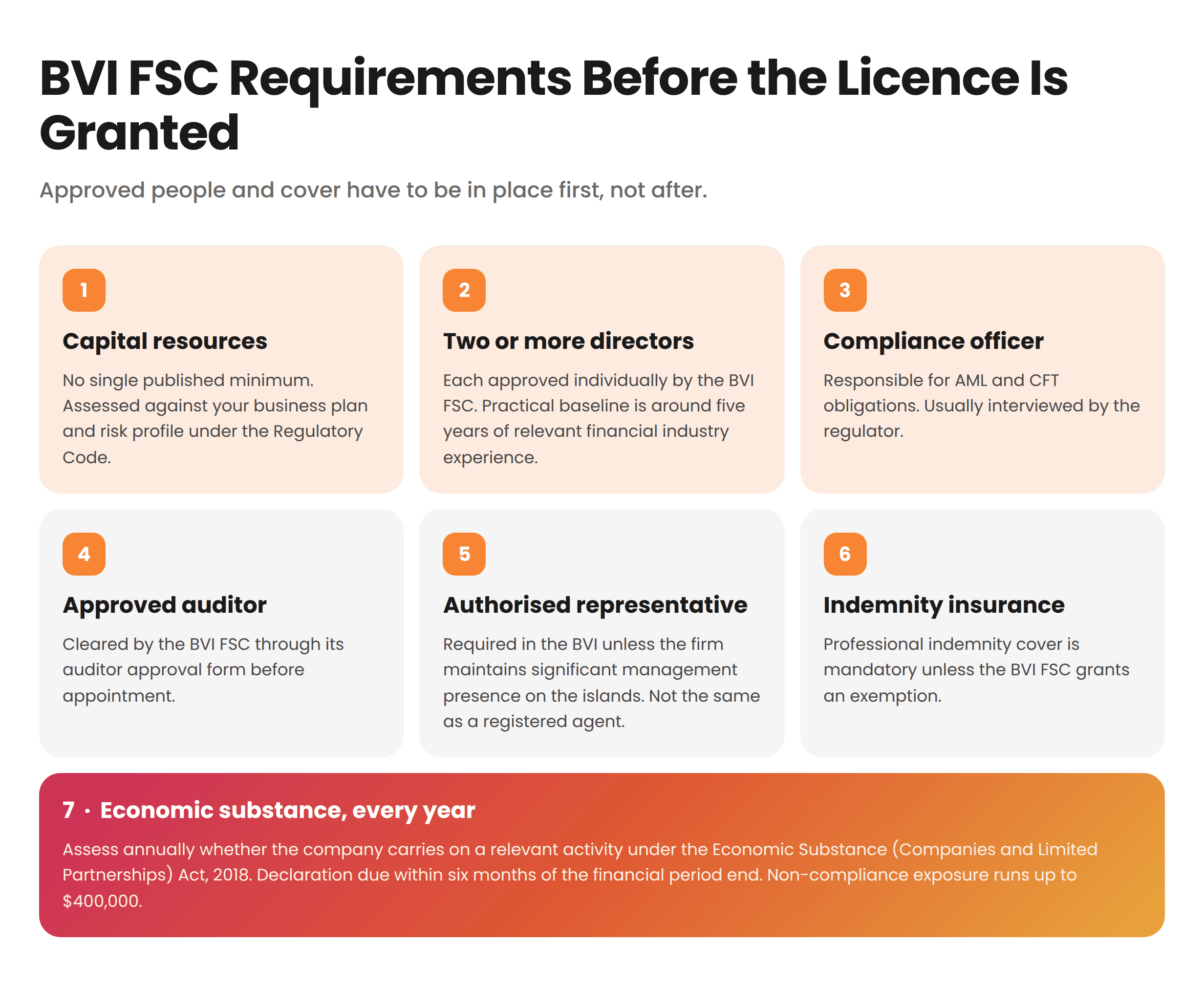
A BVI FSC applicant needs approved people in place before the licence is granted, not after. Harneys sets the practical baseline at two directors, each with around five years of relevant financial industry experience, approved individually by the regulator.
The full roster to plan for:
Two or more directors, each approved by the BVI FSC through the director and senior officer approval process
A compliance officer responsible for AML and CFT obligations, usually interviewed by the regulator
An approved auditor, cleared by the BVI FSC through its auditor approval form before appointment
An authorised representative in the BVI, required unless the firm maintains significant management presence on the islands
A registered agent and registered office, which every BVI company needs regardless of licensing
Professional indemnity insurance, mandatory unless the BVI FSC grants an exemption
The authorised representative is the requirement most often described wrongly online as a "local agent". It is a regulated function: your formal point of contact with the BVI FSC. Avoiding it means putting genuine management substance in the territory instead, which is a bigger commitment than most start-ups intend.
Economic Substance Requirements for a Licensed Broker
A BVI company must assess annually whether it carries on a relevant activity under the Economic Substance (Companies and Limited Partnerships) Act, 2018, and report the outcome. Fund management business is the relevant activity tied to investment business licensees, and the BVI International Tax Authority's economic substance rules set out how the test applies.
Where a relevant activity is being carried on, the company has to show it is directed and managed in the BVI, with core income-generating activity, adequate expenditure, appropriate premises and suitable people there.
The deadlines and penalties are not soft. Carey Olsen puts the declaration deadline at within six months of the financial period end, with non-compliance exposure running up to $400,000.
The takeaway: whether your specific dealing-only structure is caught depends on how the activity is characterised, which is a question for BVI counsel on your facts. What is not optional is running the assessment every year and documenting it.
BVI FSC Application Process, Timeline and Costs
A BVI forex license application runs in five stages: incorporate the company, assemble the application pack, submit to the BVI FSC, answer the regulator's queries, and satisfy any pre-licensing conditions before the licence is issued.
Incorporate a BVI company through a registered agent, with a share structure and ownership chain you can document to beneficial owner level.
Build the application pack: business plan, financial projections, capital evidence, compliance and AML manuals, director and senior officer approval forms, auditor approval form, and due diligence on every owner and officer.
Submit to the BVI FSC with the application fee and the individual approval fees for each proposed director and senior officer.
Answer queries. This is where timelines are won or lost. Each round of regulator questions adds weeks, and incomplete packs generate several rounds.
Meet pre-licensing conditions, which commonly include confirming capital is in place, the auditor is engaged, insurance is bound, and the authorised representative is appointed.
Here is what the fees actually are. The Financial Services (Fees) (Amendment) Regulations, 2023, in force from 1 April 2023, set them as follows:
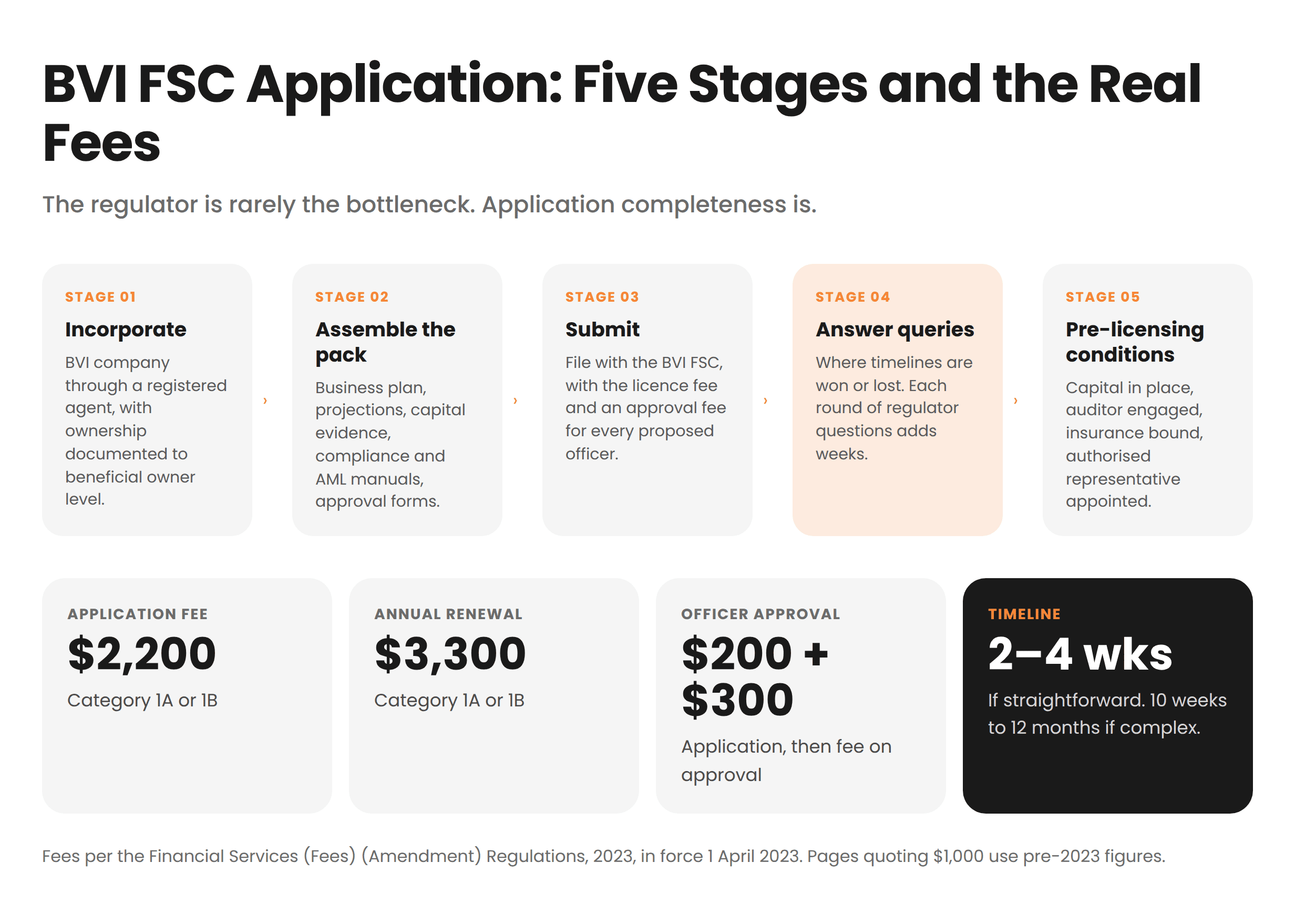
Item | Fee |
|---|---|
Category 1A or 1B, application | $2,200 |
Category 1A or 1B, annual renewal | $3,300 |
Director or senior officer, approval application | $200 |
Director or senior officer, fee on approval | $300 |
If you have read that a BVI Category 1 licence costs $1,000 to apply for, that figure comes from the base fee regulations and was superseded in 2023.
Fast fact: the regulator's fees are the smallest part of the BVI forex licence cost. Capital, legal drafting, audit and insurance dwarf the $2,200 application fee, which is why a founder who budgets from the fee schedule alone is out by an order of magnitude.
On timing, Harneys reports that a straightforward application can be determined in 2 to 4 weeks after submission, while complex or novel applications, or those generating multiple rounds of BVI FSC queries, take 10 weeks to 12 months. Licensing consultants working with start-up brokers typically observe 3 to 10 months end to end, which reflects how long founders take to assemble a filing-quality pack in the first place.
What this means: the regulator is not the bottleneck. Your documentation is. Every week spent tightening the business plan and the compliance manuals before submission saves more than a week later.
BVI vs Mauritius vs Seychelles: Choosing an Offshore Forex Licence
The three jurisdictions differ less on headline cost than on how they treat substance, capital and banking access. Founders who compare only the application fee usually pick wrong.
British Virgin Islands | Mauritius | Seychelles | |
|---|---|---|---|
Regulator | BVI FSC | Mauritius FSC | Seychelles FSA |
Licence | Investment Business, Category 1 | Investment Dealer | Securities Dealer |
Capital posture | Assessed against the business plan, no single published minimum | Published minimum by licence sub-type | Published minimum, comparatively low |
Substance | Annual economic substance assessment, authorised representative or real local management | Local presence and resident officers expected | Local office and resident director expected |
Standing with banks and LPs | Strong corporate standing, well-understood structure | Well regarded, treaty network | Widely used, more scrutiny at onboarding |
Best fit | Brokers wanting a credible offshore structure with a flexible capital assessment | Brokers wanting published thresholds and treaty access | Brokers optimising for speed and lower entry cost |
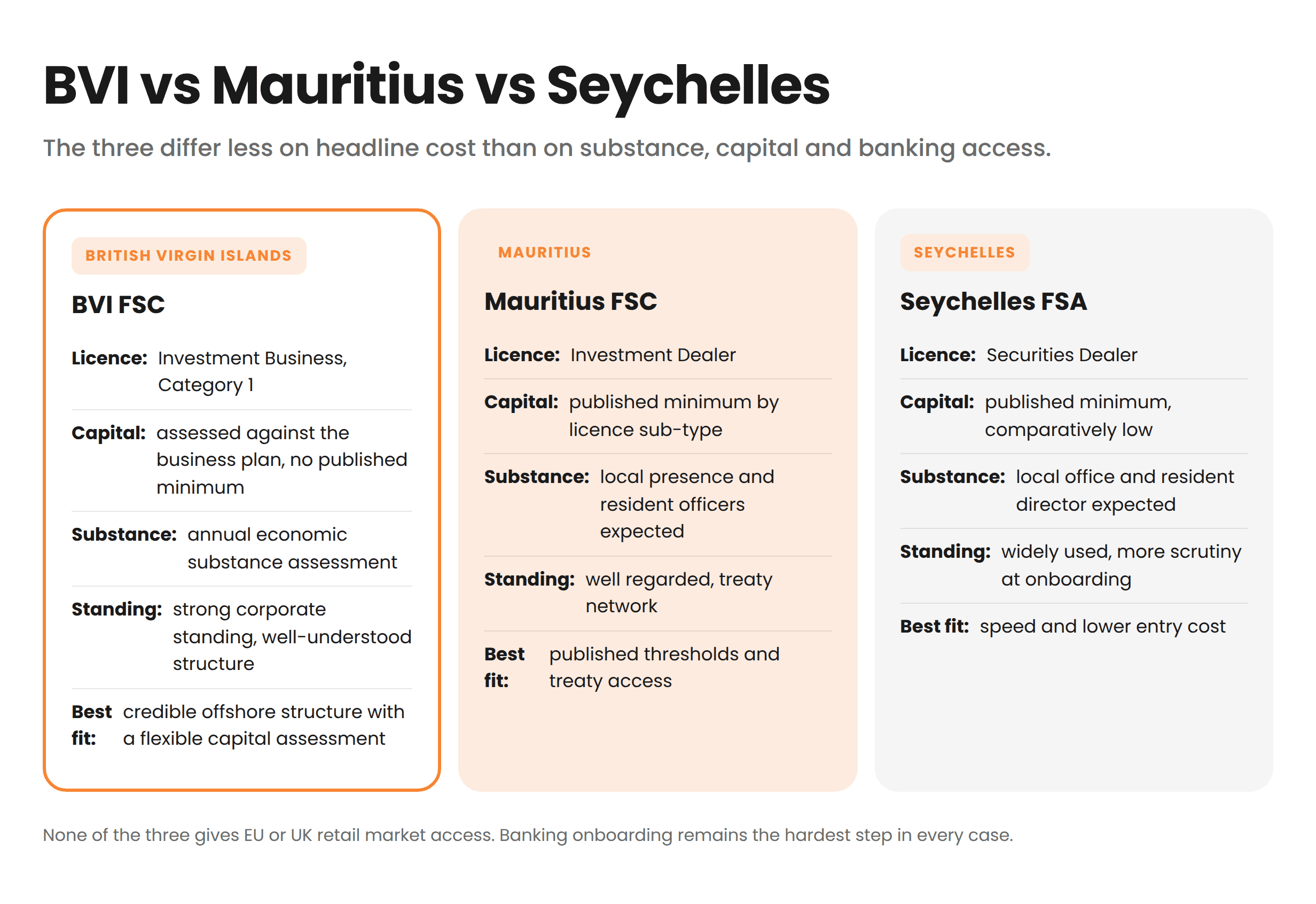
The BVI's advantage is credibility. It is a mainstream corporate jurisdiction with a mature regulator, and counterparties recognise the structure without needing it explained.
The honest limitation: a BVI licence does not give you EU or UK retail market access, and it does not make banking easy. Payment and banking onboarding remains the hardest step in launching any offshore brokerage, whichever of these three you choose.
If published capital thresholds matter more to you than flexibility, look at a Mauritius investment dealer licence. If entry cost and speed dominate, compare a Seychelles securities dealer licence. For the full jurisdiction-by-jurisdiction picture, the broader forex brokerage licence options guide covers the tier-one regulators too.
Run Your Licence and Website Tracks in Parallel
Waiting for approval before starting the site adds a month you do not need to spend.
What a BVI-Licensed Broker Must Publish on Its Website
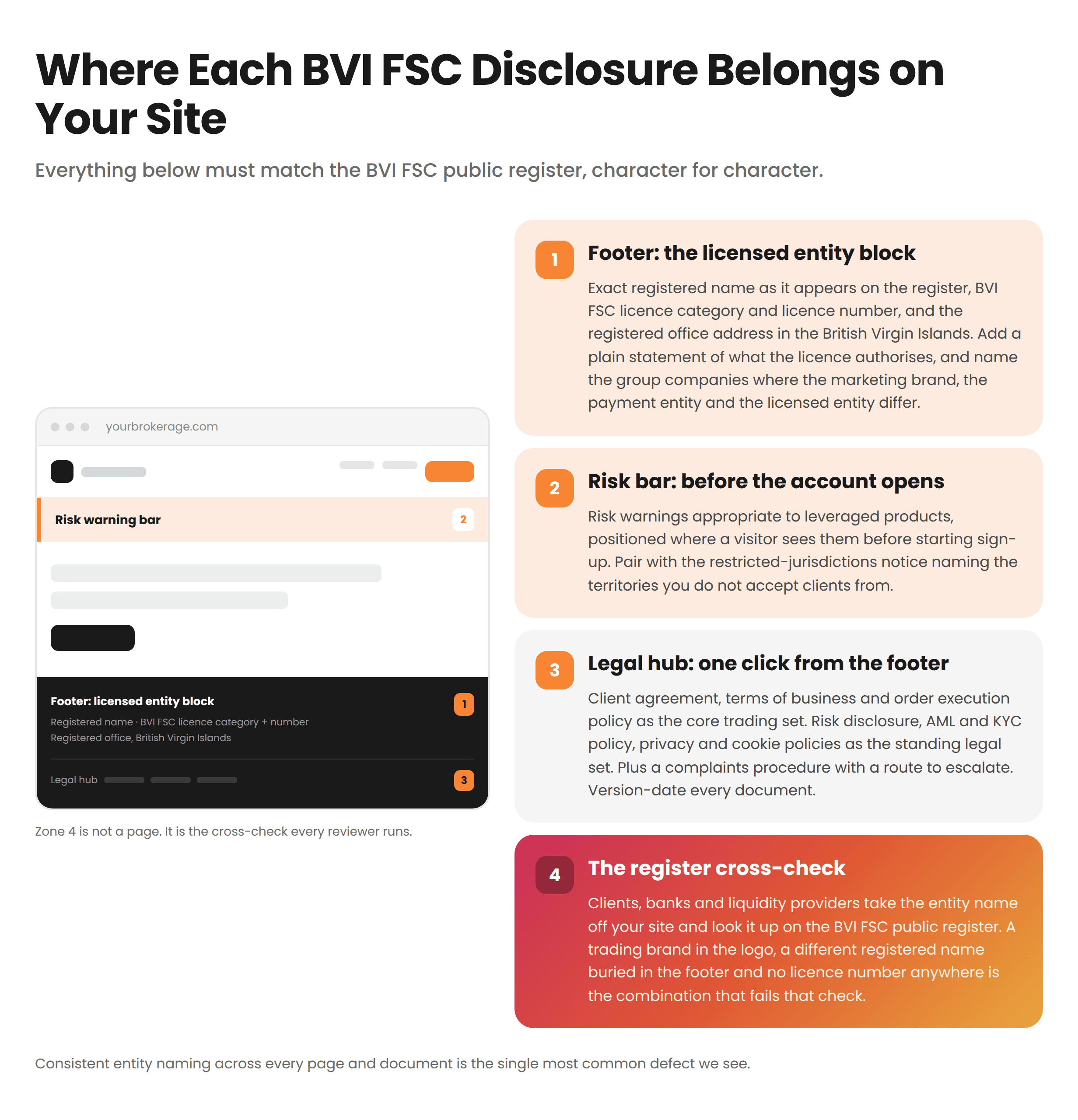
A BVI forex broker license changes what your website has to say. The site must identify the licensed entity by its exact registered name, state its BVI FSC licence category and number, show its registered office address, and carry risk warnings and restricted-jurisdiction notices. Everything on the site has to match what the BVI FSC public register says about you.
This is the half of the process almost no BVI licensing article covers, and the half that costs brokers real time.
Regulatory Disclosures and the BVI FSC Public Register
Clients, banks and liquidity providers verify brokers the same way: they take the entity name off your website and look it up on the BVI FSC public register. If the two do not match, the check fails.
The disclosures a licensed broker should publish:
Exact registered entity name, character for character as it appears on the register
BVI FSC licence category and licence number
Registered office address in the British Virgin Islands
A plain statement of what the entity is authorised to do, matching the licence category rather than overstating it
Group structure clarity where a marketing brand, a payment entity and the licensed entity are different companies
Risk warnings appropriate to leveraged products, placed where users see them before opening an account
Restricted jurisdictions notice, naming the territories you do not accept clients from
Complaints procedure and a route to escalate
The mismatch to avoid: a trading brand in the logo, a different registered name buried in the footer, and no licence number anywhere. That combination generates questions from every direction at once.
Legal Pages, Risk Warnings and Document Architecture
Publishing the documents is not the same as making them usable. Regulators, banks and clients each arrive looking for something different, and they all give up quickly.
Structure it so every compliance document is one click from the footer, grouped and dated:
Client agreement, terms of business, order execution policy as the core trading documents
Risk disclosure, AML and KYC policy, privacy and cookie policies as the standing legal set
A single legal or compliance hub rather than documents scattered across unrelated pages
Version dates on every document, so a reviewer can see what is current
Consistent entity naming across all of them, the single most common defect we see
The same architecture principles apply across regulators. The broker website compliance checklist sets out the pattern in detail, and the guide to legal pages every broker website needs covers the document set itself.
How WSA Builds Websites for BVI-Licensed Brokers
Two things decide whether a broker website survives a regulator's read-through: the licensed entity is unambiguous, and every compliance document is one click from the footer. Most sites fail on the first.
A BVI forex license project has two deliverables the founder rarely plans for: a site that can go live before approval, and a site that survives the day it arrives. WSA works only with fintech and brokerage brands, so the compliance layer is designed in from the start rather than retrofitted after a query letter arrives. In the licensing projects we support, the website is frequently requested as part of the application pack, and it is read again during banking and liquidity onboarding.
What that looks like in a build:
Entity and licence disclosure designed as a real part of the page, not a legal afterthought in six-point grey
A compliance document hub structured for three audiences at once: clients, banks and the regulator
Pre-licence and post-licence versions of the site, so you can launch a compliant pre-authorisation presence without making claims the entity cannot yet support
Restricted-jurisdiction handling built into the sign-up flow rather than bolted on afterwards
The tradeoff worth naming: none of this replaces legal advice on your licence. It makes sure the public face of the business does not contradict the file you submitted.
Conclusion
A BVI forex license is a Category 1 investment business licence from the BVI FSC, sized to your business plan rather than to a published capital table, and priced at $2,200 to apply and $3,300 a year. The approval timeline is decided by the quality of your application pack, and the obligations do not stop at the grant: economic substance, approved officers, audited accounts and public disclosure all continue.
The part easiest to underestimate is the website. It is read by the regulator during the application, by banks during onboarding, and by every client who checks you against the public register.
WSA builds brokerage websites for exactly that scrutiny. If you are preparing a BVI application or have just been approved, tell us where you are in the process and we will map what the site needs at each stage.
This article is informational and not legal advice. Requirements and fees change. Confirm current obligations with the BVI FSC or qualified BVI counsel before acting.
FAQ
Which BVI licence category covers forex dealing?
Forex dealing falls under Category 1, Dealing in Investments, of the BVI investment business licence regime. Sub-Category A covers dealing as agent, which suits A-book and STP brokers routing orders to a liquidity provider. Sub-Category B covers dealing as principal, which covers market making and B-book execution where the firm takes the other side of client trades. Many start-up brokers apply for both so they can run a hybrid book. Category 3 is investment management, not dealing, and Category 4 is advice only. Neither authorises brokerage.
What capital does a BVI investment business licence require?
There is no single published minimum capital figure that applies to every BVI investment business licensee. Under the Regulatory Code, the BVI FSC assesses whether your capital resources are adequate for the business described in your application, so the figure comes out of your own business plan and risk profile. In practice, published guidance ranges from around $100,000 for a modest agency operation to $1,000,000 or more for a substantial principal-dealing firm. Principal dealing under Sub-Category B attracts higher expectations than agency dealing under Sub-Category A. Budget separately for incorporation, legal, audit, insurance and local representation.
How long does BVI FSC approval take?
A straightforward, complete application can be determined in roughly 2 to 4 weeks after submission, according to law firm Harneys, while complex or novel applications and those generating multiple rounds of regulator queries take 10 weeks to 12 months. Licensing consultants working with start-up brokers commonly report 3 to 10 months end to end, which mostly reflects the time founders spend assembling a filing-quality application pack rather than the regulator's processing speed. The strongest lever on your timeline is submitting a complete business plan, compliance manuals and due diligence set the first time.
Does BVI require a local director or office?
The BVI requires a registered agent and registered office for every company, and a licensed investment business needs an authorised representative in the territory unless it maintains significant management presence there. Directors do not have to be BVI residents, but each one needs individual approval from the BVI FSC, and the practical expectation is at least two directors with around five years of relevant financial industry experience. Separately, if the company carries on a relevant activity under the Economic Substance Act, it has to demonstrate that it is directed and managed in the BVI, which is a higher bar than an address.
What must a BVI-licensed broker publish on its website?
A BVI-licensed broker should publish the exact registered name of the licensed entity, its BVI FSC licence category and licence number, its registered office address in the British Virgin Islands, and a statement of what the licence authorises that does not overstate it. Add risk warnings for leveraged products, a restricted-jurisdictions notice, a complaints procedure, and the core legal set: client agreement, terms of business, order execution policy, risk disclosure, AML and KYC policy, and privacy and cookie policies. Every detail must match the BVI FSC public register, because that is how clients, banks and liquidity providers verify you.
Launch Your Licensed Brokerage with Confidence
We support brokers and fintechs through licensing, launch planning, and everything a regulated brand needs to go live.