•
•

Forex License in Seychelles: FSA Requirements, Cost and Website
A forex license in Seychelles is formally a securities dealer licence, issued by the Financial Services Authority under the Securities Act 2007. The 2024 amendments, effective 1 January 2025, doubled minimum paid-up capital from USD 50,000 to USD 100,000 and introduced risk-based thresholds reaching USD 250,000 for higher-risk models. Most guides still quote the old figure.
This article is for informational purposes only and does not constitute legal or regulatory advice. Requirements and fees change. Confirm every figure and document requirement with the FSA or a qualified licensing adviser before you submit.
Your incorporation is done. Your consultant has the FSA forms open in one browser tab and your MT5 demo server in another. The AML manual is on draft three.
Then your payment provider asks for the website URL.
A Seychelles securities dealer licence application is a document exercise, and a large share of those documents end up on your public website. Risk disclosures, client agreements, complaints procedures, entity and licence details: the Financial Services Authority reviews them inside your pack, and your banks, payment service providers (PSPs) and liquidity providers look for the same material on your domain.
This is the practical version of the process. Which FSA forms you file, what sits in the pack behind them, what the regulator expects to see about your MetaTrader 5 setup, and exactly what your site should and should not claim while the application is still open.
Key Takeaways
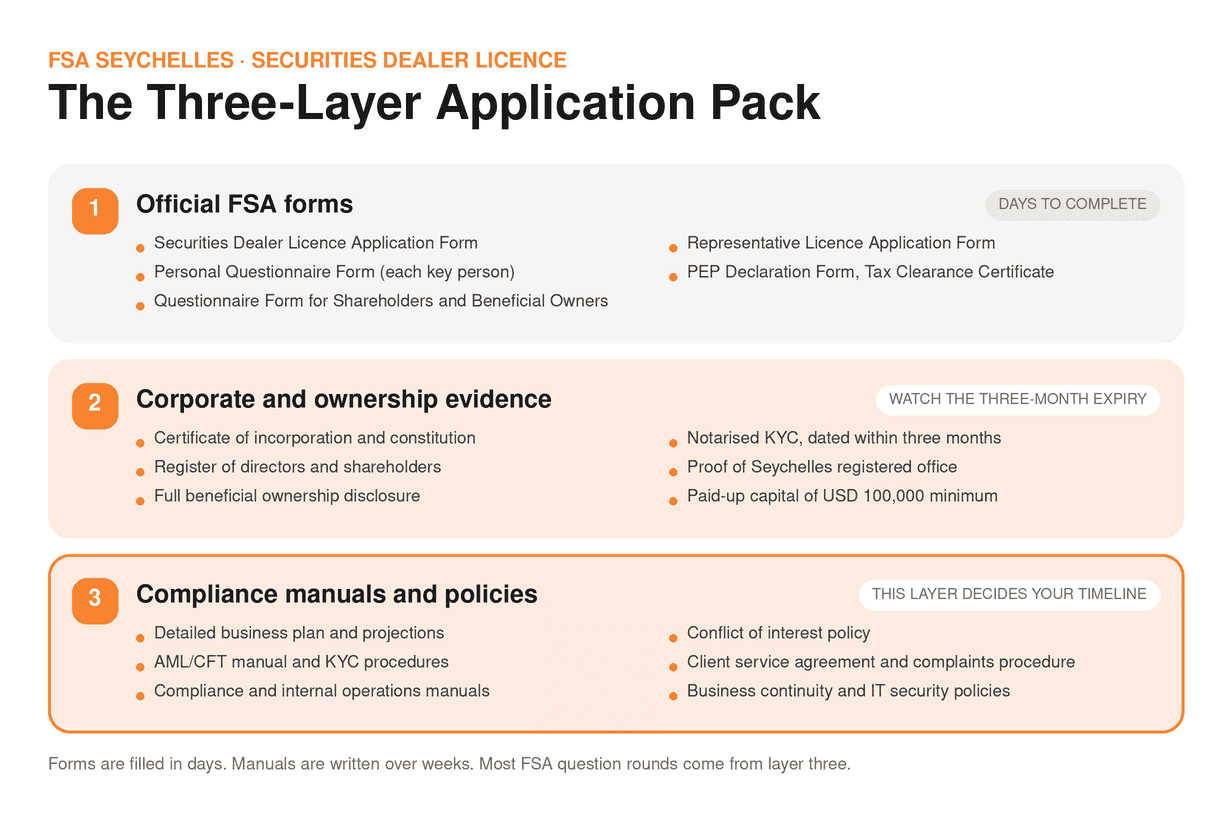
The Securities Dealer Licence documents fall into three layers: official FSA forms, corporate and ownership evidence, and compliance manuals. Applications stall in layer three, because forms get filled in days and manuals take weeks.
Minimum paid-up capital for new applicants is USD 100,000 following the 2024 Securities Act amendments. Guides still quoting USD 50,000 are out of date.
The FSA publishes an application fee of US$1,500 and an annual licence fee of US$3,000 for a securities dealer, well below the figures repeated on several consultancy sites.
Naming MT5 is not evidence of a platform arrangement. Your business plan, liquidity route, client-money flow and published fee schedule all have to say the same thing.
Seychelles broker website requirements are enforced in practice by three different audiences: the regulator, your banking and liquidity partners, and your clients. Each looks in a different place. Before assembling the application pack, settle whether the site must exist first. Once the licence is granted, the obligations shift to the live site: FSA compliance documents and where they belong.
Until the licence is issued, your site must not state or imply that you are FSA-regulated. Licence status is publicly checkable on the FSA register.
What the Seychelles Securities Dealer Licence Covers
A Seychelles securities dealer licence is the authorisation issued by the Financial Services Authority (FSA) under the Securities Act 2007, as amended in 2024, that permits a Seychelles company to deal in securities as principal or agent. One licence covers the full instrument range, which is the main reason brokers choose the jurisdiction.
Which Activities the Licence Permits
The licence authorises dealing in securities on your own account or on behalf of clients. In practice that covers:
Spot forex and currency pairs
Contracts for difference (CFDs) on indices, commodities and equities
Futures and other derivatives
Bonds and other debt instruments
Crypto-asset CFDs, subject to FSA conditions and suitability requirements for retail clients
You do not need a separate permit per product. What you do need is consistency: the instruments named in your business plan, your client agreement and your website's product pages should match, because a mismatch is the first thing a due-diligence reviewer notices.
Capital, Directors and Local Substance Requirements
New applicants must hold minimum issued and paid-up capital of USD 100,000, and the FSA may require USD 250,000 or more where the proposed model carries higher operational or market risk. Unlike guides published before the 2024 amendments, which still cite USD 50,000, this is the current baseline for new licences.
The substance requirements sit alongside the capital:
At least two natural persons appointed as directors
At least one employee licensed as a securities dealer representative
An FSA-approved Money Laundering Reporting Officer (MLRO) resident in Seychelles
A registered office in Seychelles
All directors, shareholders and key personnel passing the FSA fit and proper test, which assesses integrity, qualifications, financial standing and industry experience
Auditors appointed within 30 days of the licence being granted
Sources differ on whether the two directors must themselves be Seychelles-resident. Confirm this point with counsel rather than with a comparison table.
The FSA Document Checklist: What Goes in the Application Pack
The FSA securities dealer application pack has three layers: official FSA forms, corporate and ownership evidence, and compliance manuals. The forms are the easy part. The manuals are where timelines slip.
Official FSA Forms You Must Complete
The forms are published on the FSA's application forms page under the Securities tab. For a dealer application you will normally need:
Securities Dealer Licence Application Form
Cover letter signed by the applicant
Personal Questionnaire Form, completed by each director, representative, compliance officer and key individual
Questionnaire Form for Shareholders and Beneficial Owners, completed by each holder with no management role
Representative Licence Application Form for your securities dealer representative
PEP Declaration Form, covering politically exposed persons
Tax Clearance Certificate
Checklist for Licensees under the Securities Act, 2007
Watch the two questionnaires. The beneficial owner questionnaire and the Personal Questionnaire Form are different documents with different signatories. Sending the wrong one for a passive shareholder is a common and avoidable round trip.
Corporate and Ownership Documents
Corporate documents prove the applicant exists and show who controls it.
Certificate of incorporation and constitutional documents
Register of directors and officers
Shareholder register and full beneficial ownership disclosure
Notarised KYC documents for every shareholder, beneficial owner and director, dated within the last three months, in English or with a certified translation
Proof of registered office in Seychelles
Evidence of paid-up capital, usually bank statements or audited financials
Organisational chart showing reporting lines and ownership above the applicant
The three-month rule catches people out. Certified documents collected at the start of a six-month process expire mid-review, and the FSA will ask for fresh ones.
Compliance Manuals and Policies
This is layer three, and it is the layer that decides your timeline. The FSA expects working procedures, not templates with your logo dropped on the cover.
Detailed business plan covering the operating model, target markets, instruments, technology, financial projections and risk management
AML/CFT manual covering client due diligence, transaction monitoring, suspicious transaction reporting and record retention
KYC procedures, including enhanced due diligence triggers and PEP screening
Compliance manual and internal operations manual
Conflict of interest policy
Client service agreement and order execution arrangements
Complaints handling procedure
Business continuity plan
IT and data security policy
The consequence of thin manuals is not rejection. It is a question round. Each round adds weeks, and the FSA states plainly on its applying for a licence page that failure to disclose and submit all necessary information may lead to the application being rejected.
Fit and Proper Evidence for Directors and Key Persons
The fit and proper test is evidenced with documents, not assertions. For each director, shareholder and key individual, expect to supply a CV with a full employment history, educational and professional certificates, police clearance or certificate of good conduct, bank reference, professional references, and a sworn declaration of any regulatory or criminal history.
Ready to launch your regulated business?
We help you prepare for licensing with the right company structure, documents and website.
Trading Platform: What the FSA Wants to See About Your MT5 Setup
The FSA does not mandate a specific trading platform, but it does expect your application to describe the platform arrangement in concrete terms. Writing "the company will use MetaTrader 5" in a business plan is a statement of intent. What the regulator is assessing is whether the operating model you describe can actually function.
Your Seychelles MT5 broker setup should be documented across the pack with:
The licence model: your own MT5 server licence from MetaQuotes, or a white label arrangement through an existing licence holder
The technology provider or bridge vendor, named, with the contractual relationship described
Your liquidity provider arrangement and how orders are routed
Whether you operate A-book, B-book or a hybrid, and how conflicts are managed
Client fund segregation: which accounts hold client money and how they are separated from operating capital
Reporting and reconciliation between the platform, your back office and your accounts
Here is where most applicants create work for themselves. The platform contract is often signed after licence approval, for cash-flow reasons, which is normal and usually acceptable. What is not acceptable is a pack where the business plan describes an A-book STP model, the client agreement implies dealing on own account, and the website advertises spreads that neither arrangement could produce.
FSA membership of IOSCO is part of why MetaQuotes, liquidity providers and PSPs accept Seychelles entities at all. That acceptance depends on your documentation being coherent, which is a discipline problem rather than a technical one.
Your Website Is Part of the Application Pack
The FSA does not list a website as a standalone application document. In practice your site is still reviewed, because the material in your pack has a public twin: the client agreement you filed is the one traders accept, and the fee disclosure you described is the one that has to appear on your pricing page.
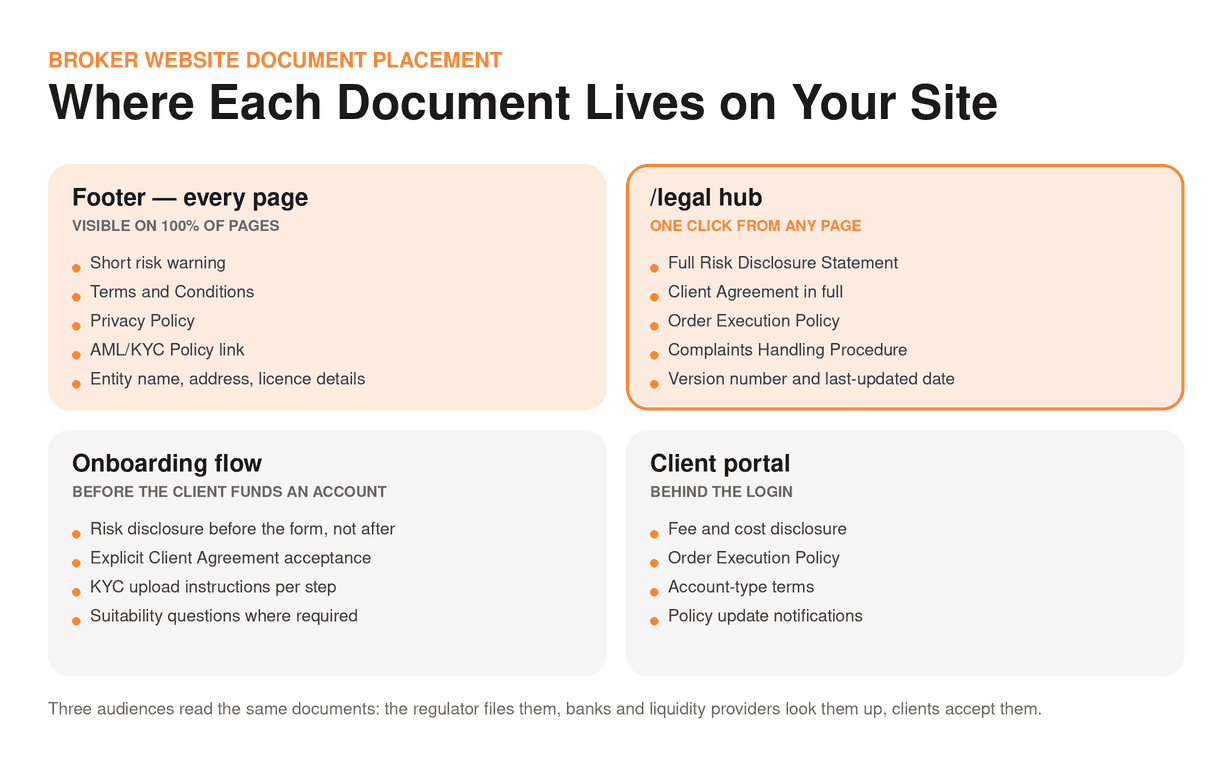
Three audiences read the same documents in three different ways. The regulator reads them as filed submissions. Your banks, PSPs and liquidity providers look them up on your public site during onboarding. Your clients accept them inside your registration flow.
Filing a document is not the same as publishing it. Seychelles broker website requirements are enforced by the second and third audience long before anyone audits you.
The Pages the FSA and Your Banking Partners Will Look For
Here is the placement map. If you have run the same exercise for an SCB Bahamas licence, the pattern will look familiar.
Document | Who prepares it | Where it lives on your site |
|---|---|---|
Risk Disclosure Statement | Compliance / counsel | Dedicated legal page, plus a short warning in the footer of every page |
Terms and Conditions (Client Agreement) | Counsel | Legal hub, and presented for explicit acceptance during registration |
Privacy Policy | Counsel | Legal hub and footer |
AML/KYC Policy (summary or full) | Compliance | Legal hub, linked from the footer |
Complaints Handling Procedure | Compliance | Legal hub, plus a link from your support and contact pages |
Fee and Cost Disclosure | Product and finance | Public pricing page and inside the client portal |
Order Execution Policy | Compliance | Legal hub and client dashboard |
Entity details and licence information | Corporate | Footer on every page and the About page |
A dedicated /legal hub that lists every document with a visible last-updated date is the structure that survives due diligence. A generic "Legal" page with placeholder text is the structure that stalls a banking relationship for six weeks. Our broker website compliance checklist covers the equivalent requirements for CySEC, FCA and ASIC entities.
Risk Warnings, Entity Details and Licence Status Placement
Risk warnings need placement rules, not good intentions. Put a concise warning in the footer of every page, a full risk disclosure before the registration form rather than after it, and a visible statement on any page that mentions spreads, leverage or potential returns.
The footer carries your regulatory identity: entity name, company number, registered address, licence type and licence number once issued.
Nielsen Norman Group's research on website footers found that users go to the footer specifically for company, policy and legal information. That is exactly the behaviour a compliance reviewer exhibits. Keep the footer persistent and visible, never behind a collapsible toggle.
The "Not Yet Licensed" Problem: What to Publish Before Approval
Until the licence is issued, your website must not state or imply that your company is FSA-regulated. Licence status is publicly verifiable on the FSA's capital markets register, so the claim is checkable in about thirty seconds and false until the day it is not.
Safe to publish while your application is open:
Company name, registered address and corporate identity
Your product and platform positioning, without live pricing you cannot yet honour
Full legal pages, marked as effective from launch
A clear statement that the company has applied for, or is in the process of obtaining, a Securities Dealer Licence, if you mention licensing at all
Team, technology and market content
A careers or contact page, which signals a real operating business to reviewers
Do not publish:
"FSA regulated", "licensed by the Financial Services Authority", or a licence number you do not hold
Regulatory badges or seals
Account opening forms that accept client funds
Promotional claims about protections that only apply once you are licensed
The consequence is asymmetric. A pre-approval regulated claim discovered by the FSA, a bank or a competitor costs you credibility at exactly the moment you have none to spare, and it is entirely avoidable.
Is Your Legal Architecture Ready for Due Diligence?
From footer structure to a versioned legal hub, WSA builds broker sites that pass partner and regulator review the first time.
Application Timeline, Fees and What the FSA Asks for After Submission
Seychelles Forex License Cost: What You Actually Pay
Regulatory fees are the smallest line in a Seychelles forex license cost. The FSA charges USD 1,500 to apply and USD 3,000 a year to hold the licence. Capital, incorporation, professional fees and the platform account for almost everything else.
Item | Amount |
|---|---|
Application fee, securities dealer | USD 3,000 |
Annual licence fee, securities dealer | USD 6,000 |
Application fee, dealer's representative | USD 500 |
Annual fee, dealer's representative | USD 750 |
Minimum paid-up capital | USD 100,000 |
Capital for higher-risk models, at FSA discretion | up to USD 250,000 |
Two caveats. The FSA's fee schedule is versioned 5 July 2022 and states plainly that it is indicative and does not override legislation. The 2024 amendments to the Securities Act are widely reported to have raised the application fee to USD 3,000 and the annual fee to USD 6,000, and several licensing consultancies quote those figures. The FSA has not published an updated schedule. Confirm the amount that will actually be invoiced with the FSA or your licensing adviser before budgeting — and budget for the higher figure.
The capital is not a fee. It is paid-up share capital that stays in the company, and since 2024 the requirement is risk-based, which means the FSA can ask for more than the floor depending on what your business plan describes.
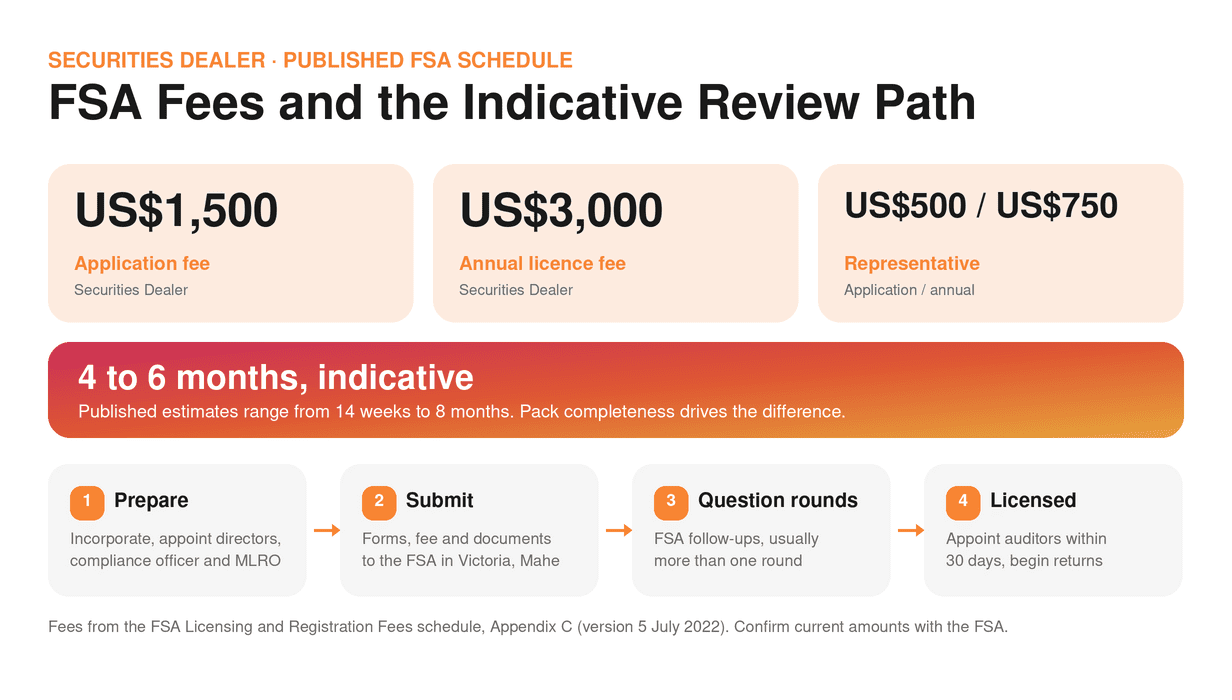
The FSA publishes an application fee of US$1,500 and an annual licence fee of US$3,000 for a securities dealer, with a securities dealer's representative at US$500 and US$750 respectively. These figures come from the FSA's own licensing and registration fees schedule, Appendix C.
Fee line | Amount (FSA schedule, v. 5 July 2022 |
|---|---|
Securities Dealer, application | US$1,500 |
Securities Dealer, annual licence | US$3,000 |
Securities Dealer's Representative, application | US$500 |
Securities Dealer's Representative, annual | US$750 |
Two caveats. That schedule is versioned 5 July 2022, so confirm current amounts with the FSA before budgeting. And several consultancy pages quote a US$6,000 annual fee, which does not match the regulator's published figure.
These are regulatory fees only. They sit alongside capital, incorporation, professional fees, platform costs and what a brokerage website costs.
A Seychelles forex licence application goes to the Chief Executive Officer of the FSA in Victoria, Mahé, by hand or by mail, accompanied by the forms, the fee and the supporting documents. There is no online portal for submission.
A step-by-step Seychelles securities dealer licence application for an MT5 broker typically runs:
Incorporate the Seychelles company and open the capital account
Appoint directors, the compliance officer and the Seychelles-resident MLRO
Draft the business plan and the full manual set
Assemble notarised KYC and fit and proper evidence
Submit forms, fee and documents to the FSA
Answer FSA follow-up questions, usually over more than one round
On approval, appoint auditors within 30 days and begin quarterly returns
Plan on an indicative four to six months from submission, and treat that as a range rather than a date. Published estimates run from fourteen weeks to eight months, and the variable is nearly always the completeness of your pack and how many question rounds it triggers. The follow-up stage is the real timeline risk, and it is the stage a coherent document set shortens.
How WSA Builds Regulator-Ready Broker Websites in Parallel With Licensing
Your website architecture does not depend on your licence number. Only your claims do. That single fact is why the four to six month review window is buildable time rather than dead time.
WSA Design builds websites for brokers, exchanges and fintech companies, which means the legal hub, footer structure and onboarding flow are scoped during discovery instead of patched in before launch. For a broker working through Seychelles forex broker licence requirements, that looks like:
Legal hub and footer in the initial sitemap, sized for the document set your counsel is drafting
Placement mapped to the jurisdiction, so each document sits where reviewers expect it
CMS structure that supports versioning, with Framer collections holding legal pages, version numbers and last-updated dates
Onboarding flow with compliance checkpoints for risk acknowledgement, client agreement acceptance and KYC upload
Claim layer built last, so licence references, badges and regulatory statements go live on approval day rather than being retrofitted
One honest limitation: WSA builds websites and does not provide licensing, legal or compliance advice. The content of your policies comes from your counsel and compliance team.
What we own is whether that content is structured, placed and maintainable, whether you are starting from nothing or you create a broker website to replace a template build. Compliance-aware structure and a forex broker website that converts are the same project, not competing ones.
Getting licensed shouldn’t feel like navigating it alone.
From company setup to a regulator-ready website, WSA helps you prepare every step of your licensing journey.
Conclusion
The Securities Dealer Licence documents you assemble for the FSA are also the raw material for your public site. Corporate filings stay in the regulator's files. Risk disclosures, client agreements, complaints procedures, fee schedules and entity details have to be findable by every trader, bank and liquidity provider who visits your domain.
Getting a Seychelles securities dealer licence application right is the first half of the work. Placing those documents correctly, and keeping your claims accurate until approval lands, is the half that decides whether you launch on schedule or spend another quarter explaining yourself to partners.
WSA Design builds broker websites with that structure in from the first wireframe. If your application is in progress and your site is still a placeholder, the next step is a conversation.
FAQ
What documents are required for a Seychelles Securities Dealer Licence?
The pack has three layers. First, official FSA forms: the Securities Dealer Licence Application Form, a signed cover letter, a Personal Questionnaire Form for each director, representative, compliance officer and key individual, a Questionnaire Form for Shareholders and Beneficial Owners, a Representative Licence Application Form, a PEP Declaration Form and a Tax Clearance Certificate.
Second, corporate and ownership evidence: certificate of incorporation, constitutional documents, register of directors, shareholder and beneficial ownership disclosure, notarised KYC for every shareholder, beneficial owner and director dated within three months and in English or certified translation, proof of a Seychelles registered office, and evidence of paid-up capital.
Third, compliance documentation: a detailed business plan, AML/CFT manual, KYC procedures, compliance and internal operations manuals, conflict of interest policy, client service agreement, complaints handling procedure, business continuity plan and IT security policy.
The exact list depends on your proposed model. Work from the current forms on the FSA website and confirm scope with a qualified licensing adviser.
Does the trading platform need to be contracted before applying?
Not usually, but the arrangement has to be described in concrete terms. Many applicants sign the MetaTrader 5 licence or white label agreement after approval for cash-flow reasons, and that sequence is generally accepted.
What the FSA is assessing is whether your described operating model is coherent and workable. Your business plan should name the platform, state whether you will hold your own server licence or operate as a white label, identify the technology provider and liquidity arrangement, explain order routing and your A-book or B-book approach, and describe how client funds are segregated from operating capital.
The risk is not an unsigned contract. The risk is a pack where the platform description, the execution model in your client agreement and the pricing on your website describe three different businesses. Reviewers read all three.
Is the website submitted with the Seychelles licence application?
The FSA does not list a website as a standalone application document, but your public site is reviewed in practice and should be treated as part of the package.
Your application describes client-facing arrangements, disclosures and marketing. Your website is where those arrangements become visible. Beyond the regulator, your banks, payment service providers and liquidity providers will review the site during their own onboarding, and they look for the risk disclosure, terms and conditions, privacy policy, complaints procedure, fee disclosure and clear entity identification.
One firm rule applies while the application is open: the site must not state or imply that you are FSA-regulated before the licence is issued. Licence status is publicly verifiable on the FSA register, so the claim is easy to check and damaging to get wrong.
What may the FSA Seychelles request after submission?
FSA Seychelles will usually come back with follow-up questions, often across more than one round. Common requests include clarification of the business plan, particularly revenue assumptions and target markets, revised AML/CFT procedures where monitoring thresholds or reporting steps are underspecified, and additional fit and proper evidence for directors, shareholders or key personnel.
The FSA may also ask for refreshed KYC where certified documents have passed the three-month window during review, more detail on platform, liquidity and client-money arrangements, confirmation of the MLRO appointment and Seychelles residency, and evidence that paid-up capital is in place.
The regulator states that failure to disclose and submit all necessary information may lead to rejection, so treat every request as substantive rather than procedural. Applications that answer follow-ups in one complete response tend to move faster than those that answer in instalments.
How long does a Seychelles Securities Dealer Licence application take?
Plan on an indicative four to six months from submission, with the caveat that published estimates range from roughly fourteen weeks to eight months.
The variable is rarely the regulator's speed. It is the completeness of the pack and how many question rounds it triggers. An application with a thin business plan and a templated AML manual can spend two months in follow-up correspondence that a well-prepared pack avoids entirely.
Add time before submission for incorporation, appointing your directors, compliance officer and resident MLRO, and drafting the manual set. Add time after approval for appointing auditors within 30 days, onboarding your platform, liquidity and payment providers, and going live. Anyone offering a guaranteed date is describing a hope, not a process.
Launch Your Licensed Brokerage with Confidence
We support brokers and fintechs through licensing, launch planning, and everything a regulated brand needs to go live.