•
•
Forex Brokerage License: Requirements, Costs and Jurisdictions (2026 Guide)
This article is for informational purposes only and does not constitute legal advice. Brokers should consult qualified legal and compliance professionals for jurisdiction-specific guidance.
You have liquidity conversations booked, a platform shortlisted, and investors asking when you go live. Then your lawyer asks the one question you have not answered: which activity are you applying for?
That single answer decides your capital floor. A forex brokerage license is not one product with one price tag. Apply to deal on your own account in the EU and the minimum capital is EUR 750,000. Apply as an agent in the Bahamas and it is USD 120,000. Same business idea, six times the cash locked up before you take a single client.
Most founders pick a country first and discover the capital number second. That order costs months. This guide runs it the other way round: what the licence permits, what every regulator asks for, what eight jurisdictions require in capital and time, and what year one really costs.
Key Takeaways
Your permission scope sets your capital floor before your choice of country does. Dealing on own account carries the highest minimum in every regime; agent-only carries the lowest.
Tier-1 capital minimums are roughly 7x higher than mid-tier: GBP 750,000 (UK) and EUR 750,000 (EU) for own-account dealing, against USD 100,000 in Seychelles and MUR 1,000,000 in Mauritius.
Indicative timelines run 4 to 6 months in Seychelles, 1 to 6 months in Mauritius, and 6 to 12 months for the FCA, CySEC, ASIC and the DFSA.
Response speed matters more than jurisdiction prestige. Miss the Mauritius FSC's 15-working-day reply window and you file a fresh application.
The licence fee is the smallest line in your year-one budget. Capital, legal drafting, compliance staffing, platform and audit dominate it.
An MT5 white label is a technology arrangement, not an authorisation. Someone else's licence is carrying you, and their compliance team sets your limits.
Regulators, banks and liquidity providers all check your public presence while your file is under review, so the website belongs on the application track.
What a Forex Brokerage License Actually Authorises
A forex brokerage license is an authorisation from a financial regulator permitting a company to deal in currency and CFD contracts with clients, within a defined scope of activity. The scope is the licence. Everything else follows from it: your capital, your reporting, your document pack, your permitted client types.
OTC foreign exchange turnover reached USD 9.6 trillion per day in April 2025, according to the BIS Triennial Central Bank Survey. Regulators treat access to a market that size as a permission to be earned, not a registration to be filed.
Three permission types cover almost every retail brokerage:
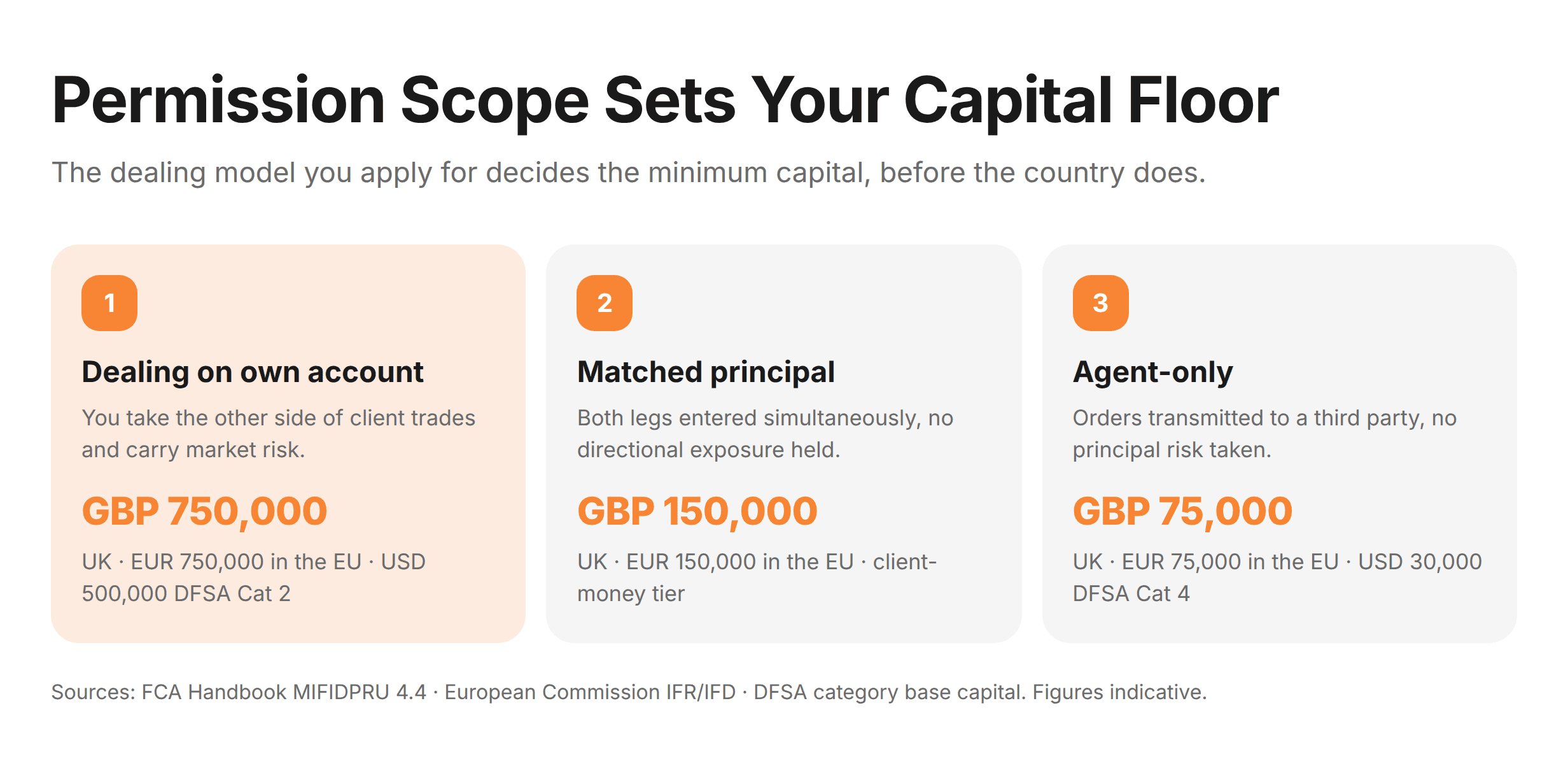
Dealing on own account: you take the other side of client trades and carry market risk.
Matched principal: you enter both legs simultaneously and hold no directional exposure.
Agent-only: you transmit orders to a third party and never take principal risk.
Dealing on Own Account, Matched Principal and Agent-Only
The difference between these three models is who takes the other side of the client's trade, and that answer sets your capital floor. Regulators price risk, not ambition. The more market exposure you hold, the more capital sits idle to absorb it.
Here is what that means in cash terms:
Dealing on own account: the top tier everywhere. GBP 750,000 in the UK, EUR 750,000 in the EU, USD 500,000 for a DFSA Category 2 firm.
Matched principal or client-money handling: the middle tier. GBP 150,000 in the UK, EUR 150,000 in the EU.
Agent-only or advisory: the entry tier. GBP 75,000 in the UK, EUR 75,000 in the EU, USD 30,000 for a DFSA Category 4 firm.
Here is where most founders lose three months. They write a business plan describing a B-book dealing model, submit it in a jurisdiction they chose for its low headline fee, and discover the capital requirement attached to that model is four times what they raised.
Decide the model first. Then shortlist jurisdictions that price it acceptably.
Where an MT5 White Label Sits (And Why It Is Not a Licence)
An MT5 white label is a technology arrangement, not an authorisation. You get a branded terminal and back office running on someone else's server infrastructure. You do not get permission to hold client money or execute client orders in your own name.
Unlike a licence, a white label leaves the regulatory risk with the licence holder above you. Their compliance team approves your marketing. Their risk desk sets your margin limits. Their relationship with the regulator is the one under review if something goes wrong. If you are weighing the two, an MT5 platform licence is not a brokerage licence.
That trade can be correct early on. It preserves runway while you test the product. What it does not do is make you a regulated broker, and confusing the two in front of a bank ends the conversation quickly.
Launching a Brokerage While Your Application Is Open
See how Website Studio Agency builds broker sites that hold up under regulatory review and convert traders from day one.
Forex Broker Licence Requirements Every Regulator Asks For
Forex broker licence requirements come down to five things, in every jurisdiction. The forms differ, the substance does not. This is what you need for a forex broker licence anywhere:
Paid-up capital, held and evidenced in a local bank account
Fit-and-proper directors, shareholders and beneficial owners
A compliance officer and MLRO the regulator will accept
Written AML/CFT, KYC, risk and operations manuals
A business plan with three-year financial forecasts
Miss one and you rarely get rejected. You get a follow-up round, and follow-up rounds are where timelines go to die.
Capital, Directors and Local Substance
Capital is the number founders quote. Substance is the requirement that actually stalls applications. Regulators want evidence the firm is run from their jurisdiction, not administered by email from somewhere else.
In practice that means most regimes expect:
At least two directors, commonly with one or two resident locally
A registered office and, in several jurisdictions, real physical premises
A resident compliance officer and MLRO, either employed or contracted
Enough operational staffing that the business plan is credible
What this means: your capital can be ready and your application still sits open because you have not hired a compliance officer the regulator recognises. Local substance is a hiring problem with a legal deadline attached, and it takes longer to solve than a bank transfer.
The Document Pack: Manuals, Business Plan and Fit-and-Proper Files
The document pack breaks into three layers, and regulators read them in order. Corporate proof establishes the entity exists. Fit-and-proper files establish the people are acceptable. Written policies establish the business can be run.
Corporate proof: certificate of incorporation, constitutional documents, director and shareholder registers, beneficial ownership disclosure, notarised KYC on every officer, proof of registered office, evidence of paid-up capital.
Fit-and-proper files: personal questionnaires, CVs, police clearances, bank references, source-of-funds evidence and PEP declarations for every director, shareholder and key person.
Written policies: business plan with three-year forecasts, AML/CFT manual, KYC procedures, compliance and operations manuals, conflicts policy, client agreement, complaints procedure, business continuity plan and IT security policy.
A forex licence application runs to several hundred pages, and reviewers read them for contradictions. If your business plan describes 12 staff and your forecasts fund four, that gap comes back as a question.
Brokerage Licence Jurisdictions Compared: Capital, Cost and Timeline
Brokerage licence jurisdictions split into three practical bands: tier-1, mid-tier and offshore. The gap between the top and bottom of that range is roughly 7x in capital and 3x in elapsed time. Figures below are indicative and current at the time of writing.
Jurisdiction | Regulator | Minimum capital | Indicative fees | Indicative timeline |
|---|---|---|---|---|
United Kingdom | FCA | GBP 750,000 own account; GBP 150,000 client money; GBP 75,000 execution and advice | Varies by complexity | 6–12 months |
Cyprus / EU | CySEC | EUR 750,000 own account; EUR 150,000; EUR 75,000 | Varies by category | 6–12 months |
Australia | ASIC | Greater of AUD 1,000,000 or 10% of average revenue | Varies by complexity | 6–12 months |
DIFC, Dubai | DFSA | USD 500,000 (Cat 2); USD 200,000 (Cat 3A); USD 30,000 (Cat 4) | USD 2,000–75,000 | 6–12 months |
Bahamas | SCB | USD 120,000 agent only; USD 300,000 agent and principal | Not published | Commonly several months |
Mauritius | FSC | MUR 1,000,000 (full service dealer excluding underwriting) | USD 750 processing; USD 2,500 annual | 1–6 months |
Seychelles | FSA | USD 100,000 paid-up | USD 1,500 application; USD 3,000 annual | 4–6 months |
South Africa | FSCA (ODP) | Proportionate to position risk; no fixed minimum | R50,000 application | Commonly several months |
Tier-1: FCA, CySEC and ASIC
Tier-1 authorisation buys distribution and banking access at the price of capital and time. A UK or EU licence opens tier-1 payment rails, better institutional liquidity terms, and ad channels that reject offshore entities outright.
The numbers behind each:
FCA (UK): a permanent minimum capital requirement of GBP 750,000 for dealing on own account, GBP 150,000 for holding client money, and GBP 75,000 for order execution, portfolio management or advice. Firms must meet the highest tier their permissions trigger.
CySEC (Cyprus) and the EU: since 26 June 2021 the IFR/IFD prudential regime sets permanent minimum capital at EUR 750,000, EUR 150,000 or EUR 75,000 depending on activity, plus a fixed overheads requirement and K-factor calculations. Guides still quoting EUR 730,000 are working from the pre-2021 rules.
ASIC (Australia): retail OTC derivative issuers must hold net tangible assets of the greater of AUD 1,000,000 or 10% of average revenue.
Cyprus adds a website-specific step: CySEC maintains a public register of approved domains for each licensed firm, and marketing from an unlisted domain triggers questions.
The honest counter-argument: a tier-1 licence is not automatically the right first move. Below roughly 5,000 active traders, the capital sitting idle plus a full compliance function can outrun what your funnel produces. Several brokers WSA works with started mid-tier, proved the funnel, then upgraded.
Mid-Tier and Offshore: Mauritius, Seychelles, Bahamas, DIFC, South Africa
Mid-tier and offshore regimes trade brand recognition for a lower capital floor and a shorter queue. They are properly regulated regimes with real supervision, not shortcuts, and each has its own quirks:
Mauritius FSC: MUR 1,000,000 for a full service dealer excluding underwriting, USD 750 processing and USD 2,500 annually, with decisions in one to six months. The catch is procedural: fail to answer the FSC's first query adequately within 15 working days and you start over with a fresh application.
Seychelles FSA: USD 100,000 paid-up capital since the 2024 update, USD 1,500 to apply and USD 3,000 annually, typically four to six months. Guides still quoting USD 50,000 are out of date.
Bahamas SCB: USD 120,000 for dealing as agent only, USD 300,000 for dealing as agent and principal, evidenced by bank statements or audited financials.
DFSA (DIFC): USD 500,000 for Category 2, USD 200,000 for Category 3A, USD 30,000 for Category 4. Straightforward DFSA files can clear in three to four months; retail-facing models run to the full 6 to 12.
FSCA (South Africa): an ODP authorisation sits alongside the FSP licence rather than replacing it. Capital is proportionate to the risk of the positions you hold, and the application fee is R50,000.
The tradeoff to be honest about: an offshore forex licence costs less and clears faster, but it narrows your banking options, limits which payment providers will onboard you, and closes off EU and UK retail marketing.
What a Forex Brokerage License Costs in Year One
Budget for five cost blocks, not one. The licence fee is usually the smallest line on the list, which is why year-one budgets built around it run out in month seven.
Regulatory capital. From USD 100,000 to over USD 900,000, and it is not working capital. It sits in a bank account satisfying a minimum.
Legal and application drafting. Typically USD 25,000 to USD 80,000 for the manuals, business plan, forecasts and fit-and-proper files, more in tier-1 regimes.
Compliance staffing. A resident compliance officer and MLRO, employed or outsourced. Commonly USD 30,000 to USD 120,000 a year depending on jurisdiction and whether the role is full time.
Platform, liquidity and payments. Platform licence or white label, liquidity bridge, PSP integrations and KYC vendors. A full MT5 licence commonly runs USD 60,000 to USD 150,000 all-in for year one.
Audit, filings and renewals. Annual audit, regulatory reporting, licence renewal, registered office and local directors.
What this means: the cheapest jurisdiction on paper rarely produces the cheapest first year of a forex brokerage license. A USD 100,000 capital requirement paired with USD 80,000 of drafting, staffing and platform spend beats a USD 300,000 requirement only if your funnel is already converting.
Budget the Website Before It Becomes the Bottleneck
Get a fixed scope and timeline for a broker site built to launch the day your approval lands.
The Forex Licence Application Process, Stage by Stage
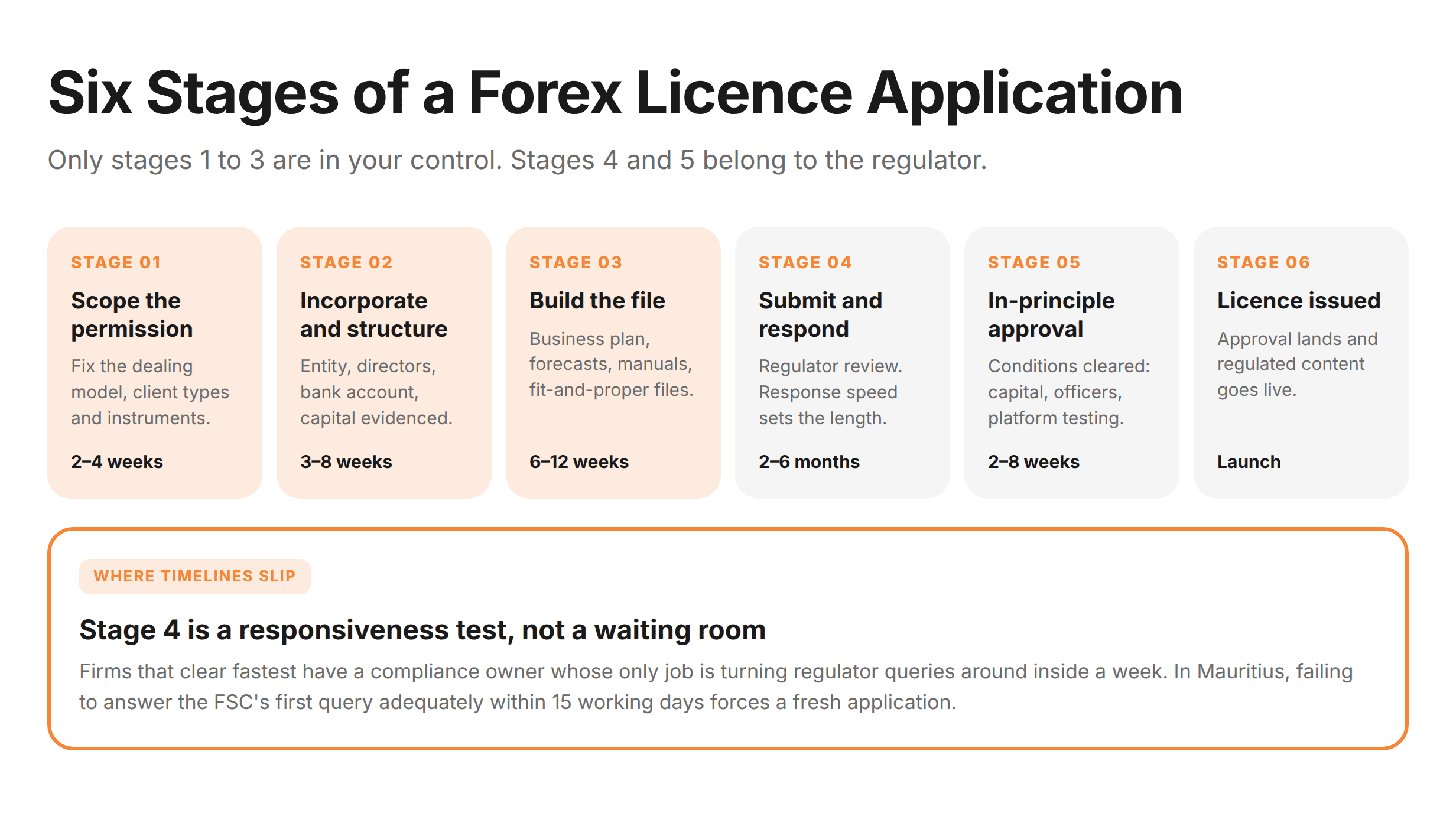
The forex licence application process runs in six stages, and only two of them are in your control. If you are wondering how to get a forex brokerage license without losing a year, the answer is compressing stages one to three, because stages four and five belong to the regulator.
Scope the permission (2–4 weeks). Decide your dealing model, client types and instruments. This fixes your capital requirement and your licence category.
Incorporate and structure (3–8 weeks). Register the entity, appoint directors, open the bank account, deposit and evidence capital.
Build the file (6–12 weeks). Draft the business plan, forecasts, manuals and policies. Compile fit-and-proper files for every officer. This stage runs in parallel with stage two.
Submit and respond (2–6 months). The regulator reviews and comes back with queries. Response quality and speed decide whether this stage takes eight weeks or eight months.
In-principle approval (2–8 weeks). Many regulators approve subject to conditions: fund the capital fully, appoint a named compliance officer, complete platform testing, finalise client-facing documents.
Licence issued and launch. Conditions cleared, licence granted, regulated content goes live.
Here is why the timeline matters. Stage four is where founders assume they are waiting. They are being tested on responsiveness, and the firms that clear fastest have a compliance owner whose only job is turning queries around inside a week.
What Regulators Check Outside Your Application File
Regulators, banks and liquidity providers all look you up while the file is under review. Your public presence is evidence, and it is the one piece you can fix this month rather than next quarter.
What gets checked:
Whether the entity name, registration number and address on your site match the application exactly
Whether you are promoting regulated services before authorisation
Whether your legal pages exist and read as drafted documents rather than templates
Whether your marketing claims are consistent with the business model you filed
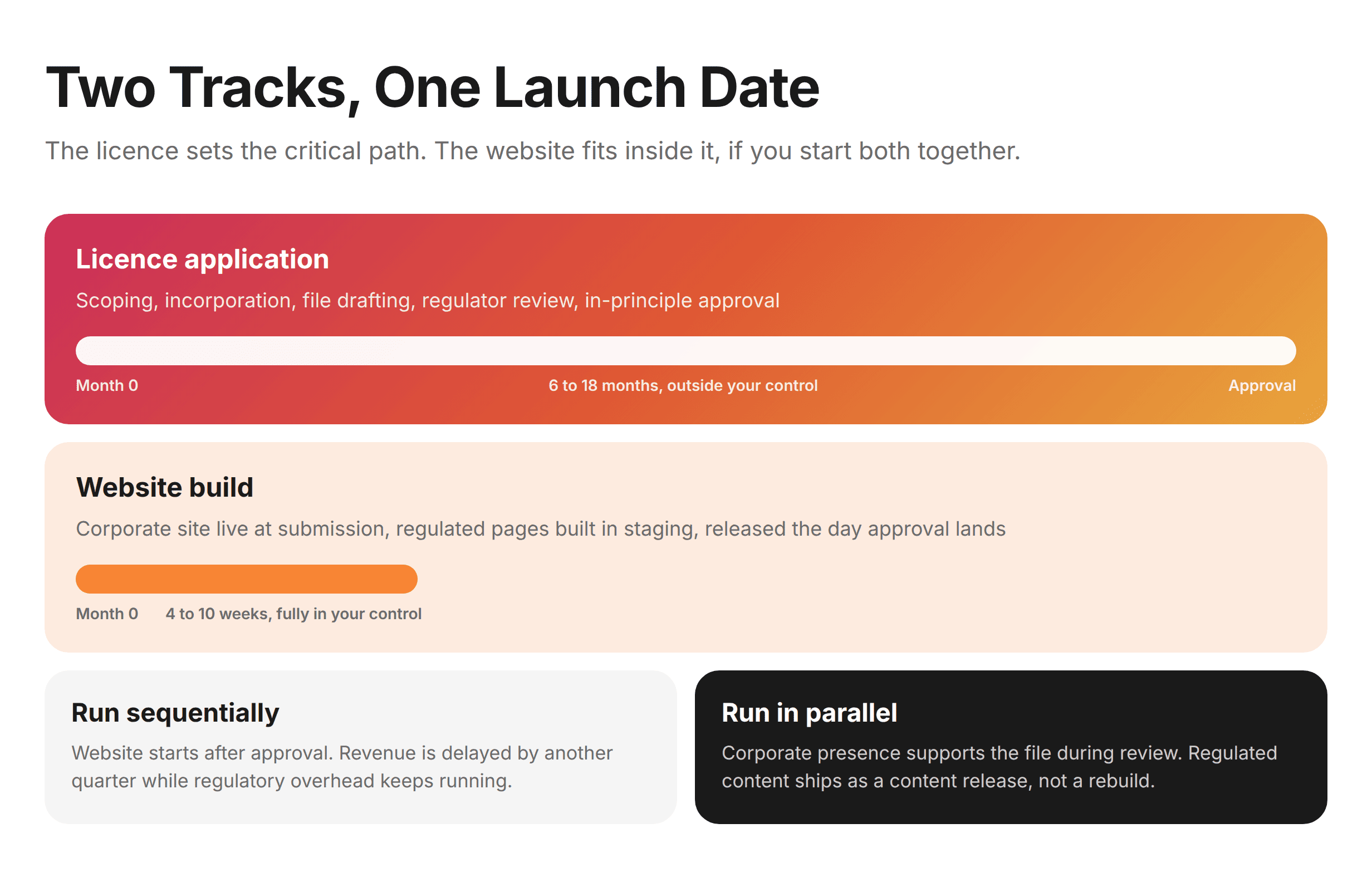
A regulated forex broker licence takes 6 to 18 months. A website takes 4 to 10 weeks. Waiting for one before starting the other adds dead time after approval, which is why it pays to run both tracks in parallel: corporate presence live at submission, regulated content held in staging until the licence lands.
The consequence of getting this backwards: a bank runs its check in week six of your application, finds a placeholder site claiming services you are not yet authorised to offer, and declines. You now have a banking problem on top of a licensing one. The page-by-page compliance checklist covers exactly which disclosures belong where.
How WSA Prepares Broker Websites for Licensing Review
WSA builds broker websites on Framer and Webflow for firms whose forex brokerage license applications are still open. That timing is the point: the site has to be credible to a regulator, a bank and a trader, and those three read the same pages differently.
To be clear about scope: WSA designs and builds websites. It does not advise on, arrange or obtain licences, and no agency can promise a regulatory outcome. What it can do is stop the public side of your business becoming the reason a reviewer asks another question.
The work covers three things:
Entity consistency. Every legal name, registration number, address and disclosure matches your filed documents across every page.
Staged release. Corporate presence ships at submission. Regulated content is built in staging and published the day approval lands, as a content release rather than a rebuild.
Conversion structure. Trust architecture, onboarding flow and landing pages designed for how regulated-market traders actually evaluate a broker.
Brokers WSA works with go from brief to launch-ready in four to ten weeks, inside the regulator's review window rather than past it.
Conclusion
A forex brokerage license is a scope of permitted activity, and everything expensive about it follows from the scope you choose. Decide the dealing model, then price the brokerage licence jurisdictions that suit it, then build the file and budget for the four cost blocks that dwarf the licence fee.
The regulator controls the review clock. You control everything either side of it: how completely you file, how fast you answer, and whether your public presence supports the application or raises questions about it.
Brokers who treat the website as part of the application track launch on the week their approval lands. Brokers who treat it as a post-approval task lose another quarter. WSA builds that side of it, on Framer and Webflow, in the window while your file is still open.
Ready to Launch the Day Your Licence Lands
WSA builds regulator-ready broker websites on Framer and Webflow in just a few days. Start your broker website.
FAQ
How long does a forex brokerage licence take to obtain?
Indicative timelines run from one to six months in Mauritius and four to six months in Seychelles, up to 6 to 12 months for the FCA, CySEC, ASIC and the DFSA. Straightforward DFSA files can clear in three to four months.
The variable is rarely the jurisdiction. It is how fast and how completely you answer the regulator's queries. Mauritius makes this explicit: if you do not respond adequately to the FSC's first query within 15 working days, you must submit a fresh application. Other regulators are less prescriptive but no more patient.
Add preparation time before submission. Scoping the permission, incorporating, funding capital and drafting the file realistically takes three to five months before anything reaches a reviewer. A founder targeting a live brokerage in nine months should be scoping the permission now.
Can I operate a forex brokerage without a licence?
No. Accepting client funds and executing currency or CFD trades without authorisation is a criminal offence in most jurisdictions, and regulators publish warning lists naming unauthorised firms.
The practical barrier arrives before the legal one. No tier-1 bank will open a client-money account for an unlicensed brokerage. Payment providers decline onboarding. Liquidity providers run regulatory checks before quoting. Google and Meta both require licence evidence to advertise financial services. An unlicensed brokerage cannot bank, cannot take deposits at scale, and cannot advertise.
Introducing brokers and affiliates operate under different rules and may not need their own dealing authorisation, but the moment you hold client money or execute orders in your own name, you need a licence.
What capital do I need for a forex broker licence?
Forex broker licence requirements start with the activity you apply for, not the country you pick first. Dealing on your own account carries the highest minimum in every regime, and agent-only carries the lowest.
Current indicative minimums: GBP 750,000 in the UK and EUR 750,000 in the EU for dealing on own account, dropping to GBP 150,000 or EUR 150,000 for holding client money and GBP 75,000 or EUR 75,000 for execution and advice. Australia requires net tangible assets of the greater of AUD 1,000,000 or 10% of average revenue.
The DFSA sets USD 500,000 for Category 2, USD 200,000 for Category 3A and USD 30,000 for Category 4. Offshore and mid-tier regimes are materially lower: USD 100,000 in Seychelles, MUR 1,000,000 in Mauritius, and USD 120,000 to USD 300,000 in the Bahamas depending on whether you deal as agent or as principal.
Treat these as floors, not budgets. Regulators also assess whether your capital is proportionate to your business plan, and a firm forecasting 20,000 clients on a bare minimum will be asked to explain the gap.
Do I need a local office and resident directors?
In most jurisdictions, yes to some degree, and this requirement stalls more applications than capital does. Regulators want evidence the firm is directed and managed from their jurisdiction rather than administered remotely.
Common expectations include at least two directors with one or more resident locally, a registered office, and a compliance officer and MLRO who are resident and acceptable to the regulator. Several regimes also expect physical premises rather than a service address, and will ask about staffing levels that match your business plan.
The requirement is satisfiable. It is not satisfiable quickly. Recruiting a compliance officer the regulator recognises can take longer than drafting the entire application file, so start that search in parallel with incorporation rather than after submission.
Does the regulator review my website during the application?
Yes, and so do your future bank and liquidity providers. Reviewers routinely search for applicants during due diligence, checking whether the public presence matches the filed documents and whether the firm is promoting regulated services it is not yet authorised to offer.
Three things get flagged most often: entity details that differ between the site and the application, marketing claims that overstate what the filed business model actually does, and any statement or implication of regulated status before the licence is issued. In Cyprus there is an extra layer, because CySEC publishes the approved domains associated with each licensed firm.
The workable approach is to publish a corporate presence at submission with team, contact and drafted legal pages, then build regulated content in staging and release it the day approval lands.
Launch Your Licensed Brokerage with Confidence
We support brokers and fintechs through licensing, launch planning, and everything a regulated brand needs to go live.