•
•

Legal Pages Every Forex Broker Website Needs
A forex broker website needs eight core legal pages: company and licence information, terms of business, risk disclosure, privacy policy, cookie policy, AML/KYC information, a complaints procedure, and a conflicts of interest policy. Requirements shift between the FCA, CySEC and offshore regulators.
This article is for informational purposes only and does not constitute legal advice. Brokers should consult qualified legal and compliance professionals for jurisdiction-specific guidance.
Your payment provider just paused your onboarding. The reason isn't your licence or your volumes. It's your website: no complaints page, a risk warning copied from another broker, and a privacy policy that names the wrong legal entity.
This happens to new brokerages more often than most founders expect. Forex broker legal pages are reviewed by everyone who decides whether to work with you: regulators, PSPs, banks, and increasingly the traders themselves. Missing or poorly written compliance pages are one of the most common reasons licence applications and payment onboarding get delayed.
This guide covers the complete set of legal pages your brokerage website needs, what belongs on each one, and how requirements shift between the FCA, CySEC, ASIC, and offshore jurisdictions. One note before we start: this is website-architecture guidance, not legal advice. Final wording always belongs to your compliance team.
Key Takeaways
A forex broker website needs eight core legal pages: licence and company information, terms of business or client agreement, risk disclosure, privacy policy, cookie policy, AML/KYC information, complaints procedure, and conflicts/execution/fees policies.
Legal pages are audited by more than regulators: PSPs, banks, and app stores review them during onboarding, and missing pages are a frequent rejection reason.
Copying another broker's legal pages is a regulatory and legal risk; documents must reflect your entity, instruments, leverage, and jurisdictions.
EU and UK brokers must show the standardised loss-percentage risk warning ("X% of retail investor accounts lose money...") and recalculate it quarterly.
Legal content should surface across the site (footer, product pages, signup flow, cookie layer), not sit in a single buried "Legal" page.
Publish legal pages before launch: regulators and payment partners check them during application review, not after go-live.
Key Takeaways
A forex broker website needs eight core legal pages: licence and company information, terms of business or client agreement, risk disclosure, privacy policy, cookie policy, AML/KYC information, complaints procedure, and conflicts/execution/fees policies.
Legal pages are audited by more than regulators: PSPs, banks, and app stores review them during onboarding, and missing pages are a frequent rejection reason.
Copying another broker's legal pages is a regulatory and legal risk; documents must reflect your entity, instruments, leverage, and jurisdictions.
EU and UK brokers must show the standardised loss-percentage risk warning ("X% of retail investor accounts lose money...") and recalculate it quarterly.
Legal content should surface across the site (footer, product pages, signup flow, cookie layer), not sit in a single buried "Legal" page.
Publish legal pages before launch: regulators and payment partners check them during application review, not after go-live.
What Legal Pages Does a Forex Broker Website Need?
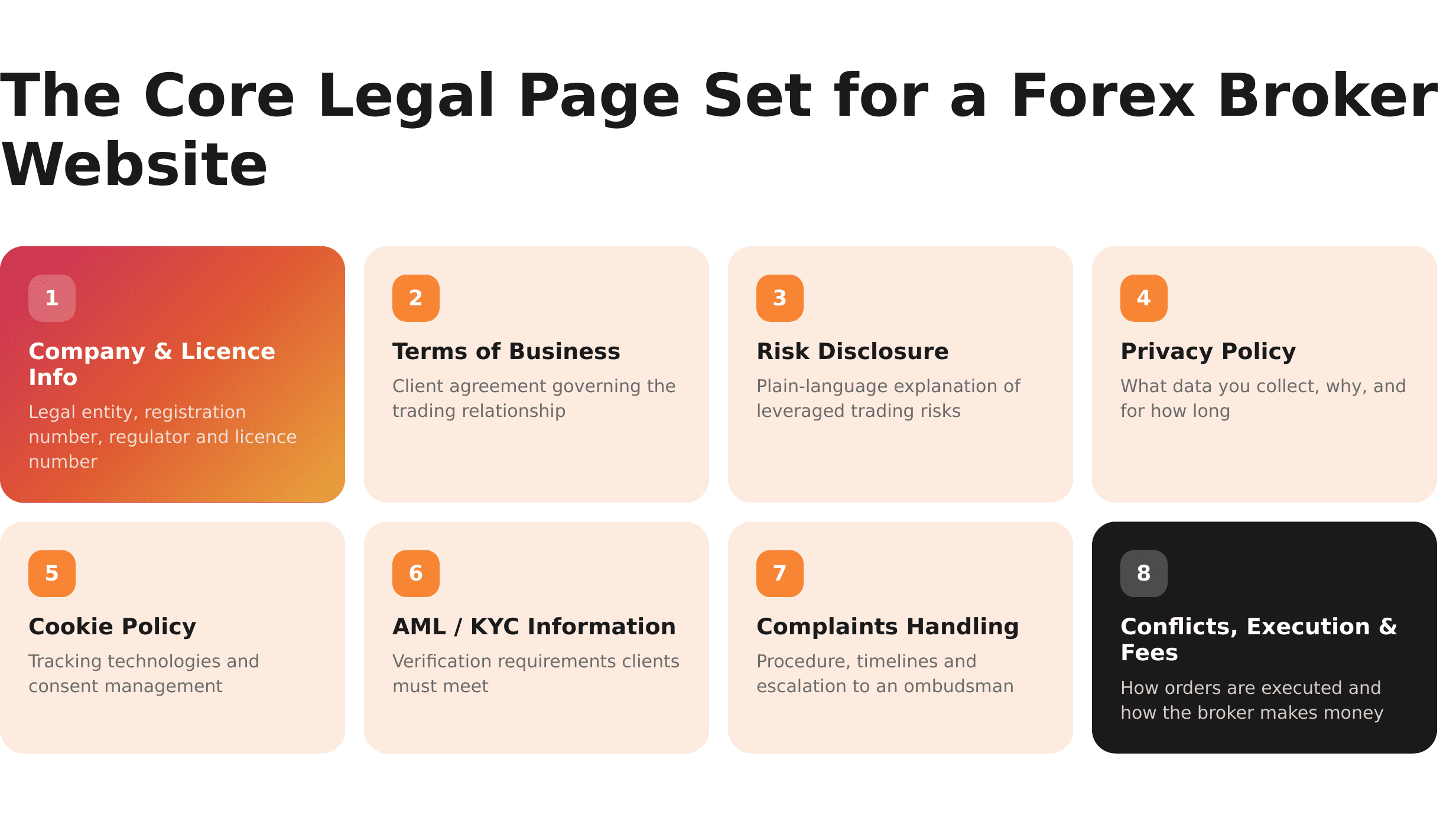
A forex broker website needs eight core legal pages: company and licence information, terms of business (client agreement), risk disclosure, privacy policy, cookie policy, AML/KYC information, a complaints procedure, and conflicts of interest, execution, and fees policies.
Here is the full set at a glance:
Company and licence information: legal entity, registration number, regulator, licence number
Terms of business / client agreement: the contract governing the trading relationship
Risk disclosure: plain-language explanation of leveraged trading risks
Privacy policy: what data you collect, why, and for how long
Cookie policy: tracking technologies and consent management
AML/KYC information: verification requirements clients must meet
Complaints handling: procedure, timelines, escalation path to an ombudsman
Conflicts, execution and fees: how orders are executed and how you make money
Regulated brokers typically need every page on this list. Offshore brokers need most of these forex broker legal pages anyway, because payment providers and banks apply the same checklist regardless of where you're licensed.
Here's where most teams get it wrong: they treat these pages as a launch-week formality. In practice, each page has specific content requirements, and several, such as broker website disclaimers and risk warnings, carry prescribed wording you cannot improvise.
Core Company and Licence Information
Every regulated broker must display its legal entity name, company registration number, regulator, and licence number on the website. This is the first thing a regulator, a PSP analyst, or an experienced trader looks for.
Legal Entity, Licence Number and Regulator Details
Your legal information block should state:
The full registered company name (not just the brand name)
Registration number and registered address
The regulator and licence/authorisation number
Which entity serves which client region, if you operate several
A brand name is not a legal identity. If "TradePro" is operated by TradePro Markets Ltd (CySEC-licensed) and TradePro Global LLC (offshore), your site must make clear which entity a visitor is contracting with. Regulators treat ambiguity here as a serious finding.
Where Licence Information Must Appear On the Site
Licence details belong in three places at minimum: the footer of every page, a dedicated legal or regulation section, and the account-opening flow. Verification matters too. Traders are taught to check your licence number against the regulator's register, so the number displayed must match it exactly.
In WSA's broker projects, the footer block is designed as a template component: one source of truth, rendered on every page, updated in one place when an entity or licence changes.
Launching a brokerage site that has to pass compliance review?
WSA designs broker websites where legal architecture is built in from day one, not patched in before an audit.
Terms of Business and Client Agreement
The client agreement (often published as terms of business or forex broker terms and conditions) is the contract that governs your entire trading relationship. It defines what you provide, what the client accepts, and what happens when something goes wrong.
A complete client agreement typically covers:
Account opening, eligibility, and acceptable jurisdictions
Order types, execution terms, and platform rules
Margin requirements, leverage, and close-out procedures
Deposits, withdrawals, and dormant account terms
Liability, indemnities, and dispute resolution
Amendment and termination terms
This document must be yours. A template downloaded from a competitor's site will reference the wrong entity, the wrong regulator, the wrong products, and often the wrong governing law. If you operate multiple entities, each needs its own terms, because each answers to a different regulator and legal system.
What this means in practice: the agreement your website serves must match the entity the client registers under. Serving CySEC terms to a client onboarded by your offshore entity is a compliance failure and a real litigation risk.
Risk Disclosure and CFD Warnings
A risk disclosure page explains, in plain language, the risks of trading leveraged products: losses can exceed expectations, leverage amplifies both directions, and past performance means nothing. Unlike a generic disclaimer, a risk disclosure must reflect the instruments and leverage you actually offer.
What a Risk Disclosure Page Must Cover
At minimum, your risk disclosure should address:
The nature of CFDs and margin trading
Leverage and how it magnifies losses
The realistic possibility of losing the full invested amount
Negative balance protection (required for retail clients in the EU and UK)
Market, liquidity, and technology risks
For EU and UK brokers, one element is prescribed word for word. Since ESMA's CFD intervention measures (now made permanent in national rules, including the FCA's COBS 22.5), retail-facing brokers must display the standardised warning: "X% of retail investor accounts lose money when trading CFDs with this provider." The percentage is your own client data, recalculated quarterly over the trailing 12 months. Across the industry, published figures typically fall between 65% and 82%.
Placement: Beyond the Legal Section
The risk warning does not live on one page. Regulators expect it on marketing pages, product pages, and account sign-up screens, anywhere a retail visitor is invited to trade. In the UK, the FCA's rules for high-risk investment promotions (in force since December 2022) tightened this further, with prominence requirements that apply to banners, landing pages, and even paid ads.
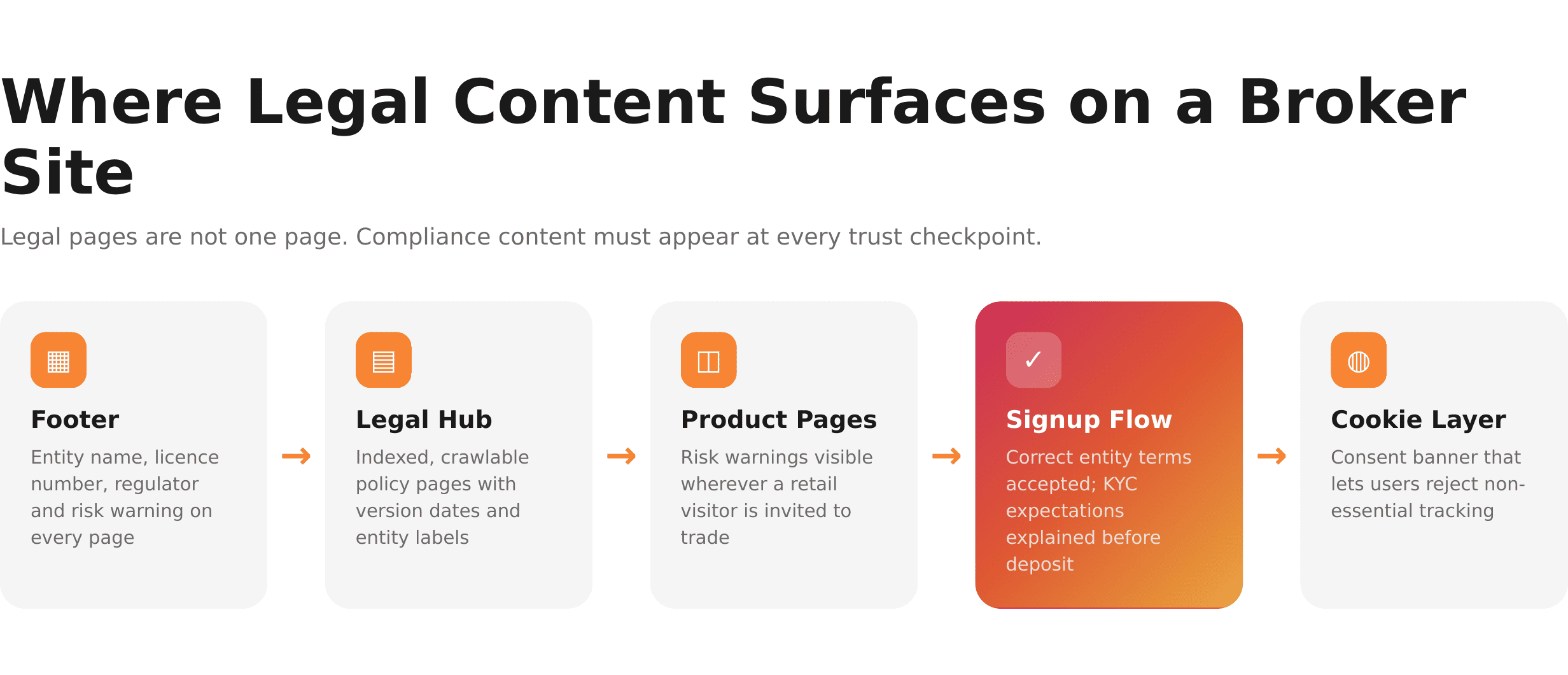
The design consequence: your risk warning is a persistent UI component, not a paragraph. It needs to survive responsive layouts, stay legible, and load on every templated page. That's an engineering and design task as much as a legal one.
Privacy, Cookies and Data Protection
Your broker privacy policy must state what personal data you collect, why you collect it, the legal basis, how long you keep it, who you share it with, and what rights users have. For any broker touching EU or UK residents, GDPR (and UK GDPR) set the transparency standard, and fines scale to 4% of global annual turnover.
Brokers process more sensitive data than most businesses:
Identity documents and proof of address (KYC)
Financial information and source-of-funds evidence
Trading behaviour and transaction history
Device, location, and usage data
A cookie policy and consent banner complete the set. Trading sites run heavy analytics and affiliate tracking, so your cookie layer must let users accept or reject non-essential tracking before it fires. A cookie banner that only offers "Accept" fails EU consent standards.
Keep the privacy policy per entity. Your Cyprus entity and your offshore entity almost certainly process data under different laws, and one merged policy usually satisfies neither.
AML/KYC Information
A public AML/KYC page tells clients what verification to expect before they can trade or withdraw. It's part disclosure, part expectation management.
The page should explain that you verify identity and address, screen against sanctions lists, may request source-of-funds evidence, and will refuse or exit relationships that fail checks. You don't publish your internal AML manual; you publish the client-facing summary of it.
There's a conversion benefit hiding here. Verification surprises are a leading cause of first-deposit abandonment. Brokers we work with report fewer support tickets and smoother onboarding when KYC requirements are explained on the website before registration, not discovered inside the client portal.
Not sure your legal pages would survive a regulator's website scan?
Get a structured review of your broker site's compliance architecture, page by page.
Complaints Handling
A broker complaints page must give clients a clear path: how to file a complaint, what information to include, how long you take to respond, and where to escalate if they disagree with the outcome.
A compliant complaints procedure typically follows four steps:
Client submits a complaint through a named channel (form, email, or portal)
The broker acknowledges it within a defined window (often 5 business days)
The broker investigates and issues a final response within a set period (often 8 weeks in the UK, 2 months under CySEC guidance)
If unresolved, the client may escalate to the relevant body: the Financial Ombudsman Service for FCA brokers, or the Financial Ombudsman of Cyprus for CySEC brokers
Regulated brokers are expected to publish this procedure, and PSPs check for it during onboarding. A missing complaints page reads as "this broker doesn't expect to answer complaints," and both regulators and payment partners treat it that way.
Conflicts of Interest, Execution and Fees
These three policies answer the question every informed client eventually asks: how does this broker actually make money, and is it at my expense?
Conflicts of interest policy: identifies situations where the broker's interests could diverge from clients' (B-book exposure, payment for order flow, affiliate incentives) and how you manage them
Order execution policy: how orders are handled and what best execution means in practice, a MiFID II requirement for EU/UK brokers
Fees and charges: spreads, commissions, swap rates, and inactivity fees, presented clearly enough to be found before account opening
Transparency here is a trust asset. Traders compare brokers on exactly these questions, and a clear execution and fees section shortens the decision. Hiding fees in a PDF is legal in some jurisdictions and costly in all of them.
Jurisdiction-Specific Legal Page Matrix (FCA, CySEC, ASIC, Offshore)
Requirements differ by regulator. The core set stays the same, but prescribed warnings, compensation scheme disclosures, and prominence rules vary. The matrix below summarises typical differences:
Requirement | FCA (UK) | CySEC (Cyprus/EU) | ASIC (Australia) | Offshore (e.g., FSA Seychelles) |
|---|---|---|---|---|
Standardised CFD loss-percentage warning | Required (COBS 22.5) | Required (ESMA-derived national rules) | Risk warning required; different prescribed content | Not prescribed, but expected by PSPs |
Negative balance protection disclosure | Required for retail | Required for retail | Required for retail CFDs | Varies by licence |
Compensation scheme mention | FSCS | ICF (up to €20,000) | None equivalent | Usually none |
Complaints escalation body | Financial Ombudsman Service | Financial Ombudsman of Cyprus | AFCA | Local regulator, if any |
Data protection regime | UK GDPR | GDPR | Privacy Act (APPs) | Local law; GDPR if serving EU clients |
Licence number display | FRN, verifiable on FS Register | CIF licence number | AFSL number | Licence number on regulator register |
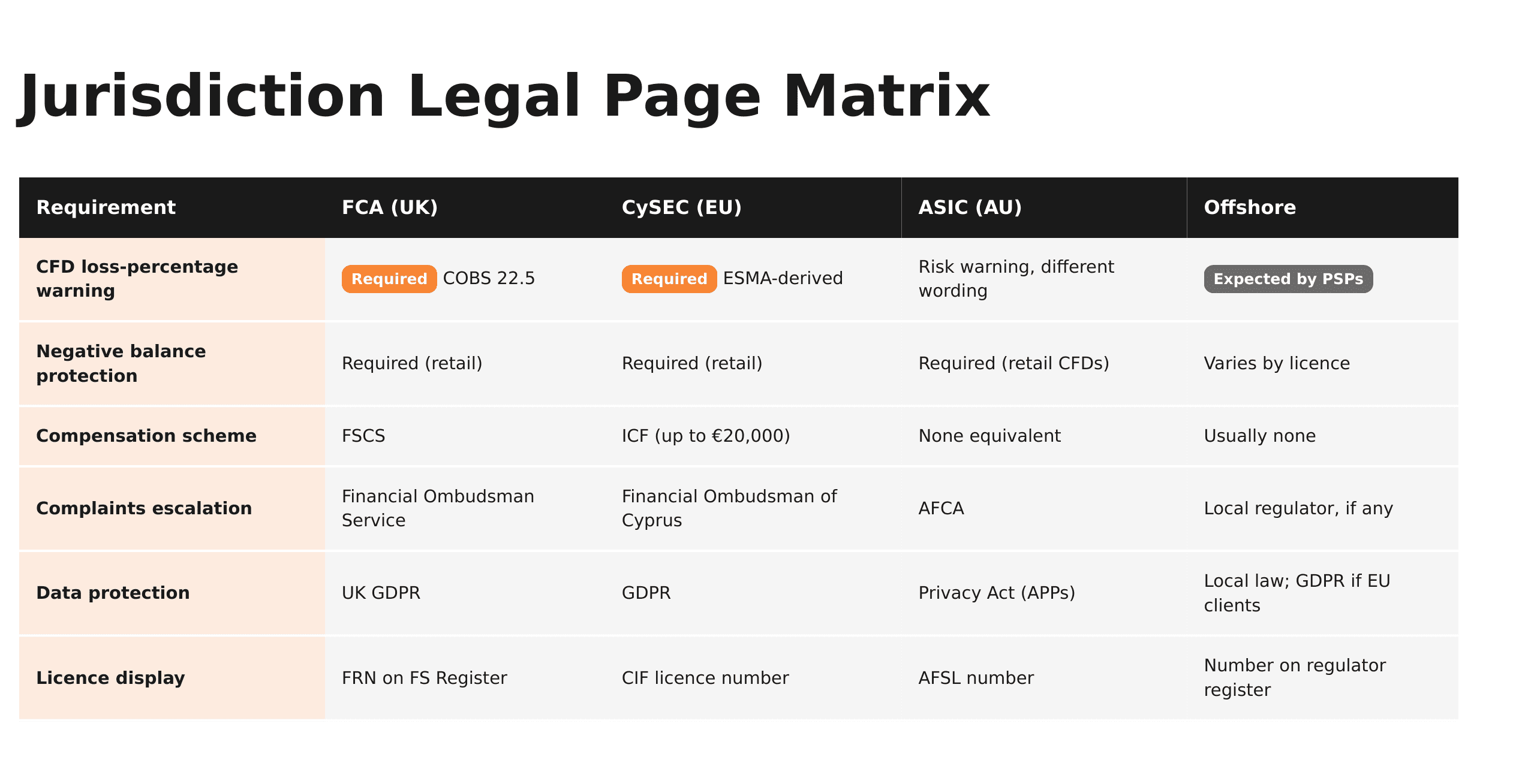
Two practical notes. First, regulators actively scan broker websites now; CySEC's Circular C703 (2025) reminded firms that web content is reviewed against fair, clear, and non-misleading standards. Second, if you operate several entities from one website, the matrix applies per entity, with geo-appropriate routing of visitors to the right terms and warnings.
For a deeper regulator-by-regulator breakdown, see WSA's broker website compliance checklist covering CySEC, FCA, and ASIC in detail.
How WSA Builds Legal Page Architecture for Brokers
WSA is a web design agency specialised in fintech and brokerage websites, and forex broker legal pages are a standard part of every broker build rather than an afterthought.
In practice, that means:
A structured legal hub: every policy as an indexed, crawlable page (not PDF-only), with version dates and entity labels
Persistent compliance components: footer legal block, risk warning bar, and cookie layer built as reusable Framer components, updated in one place
Entity-aware routing: visitors see the terms, warnings, and disclosures that match the entity serving their region
Conversion-safe placement: warnings meet prominence rules without wrecking page flow, so compliance and conversion stop fighting each other
Legal pages built this way pass reviews faster. They also update faster: when your loss percentage changes quarterly, editing one component beats editing forty pages.
Ready to get your forex broker licence?
WSA helps you on both fronts: licence application support and a website built to pass regulator and PSP review.
Conclusion
Forex broker legal pages do more than satisfy a checklist. They are inspected by regulators during authorisation, by PSPs and banks during onboarding, and by traders deciding whether your brokerage deserves a deposit. The core set is consistent: licence information, client agreement, risk disclosure page, privacy and cookies, AML/KYC, complaints, and execution policies, adapted to each jurisdiction you serve.
Treat these pages as designed infrastructure. Build them as structured, entity-aware components, and compliance reviews get faster while client trust gets stronger. If you're planning a broker website build or upgrading an existing one to pass regulatory and PSP review, WSA can help you get the architecture right from the first sprint. Start the conversation.
FAQ
What legal pages are required for a forex broker website?
Eight core pages: company and licence information, terms of business or the client agreement, a risk disclosure, a privacy policy, a cookie policy, AML and KYC information, a complaints procedure, and a conflicts of interest policy. Depending on the regulator you may also need client categorisation information, a fee schedule, an order execution policy and a client-money statement. The list varies between the FCA, CySEC and offshore authorities, but the structure does not: each document should be its own page with its own URL, reachable from a persistent footer. Bundling them into one page or a PDF makes them harder to update and harder for a reviewer to cite during due diligence.
Can a broker copy legal pages from another website?
No. Copied pages reference the wrong legal entity, the wrong regulator, the wrong products and the wrong governing law, which makes them factually false about your business rather than merely generic. That is a compliance problem, not a shortcut. A risk disclosure describing leverage levels you do not offer, or terms naming a jurisdiction you are not licensed in, fails the moment anyone reads it carefully, and the people who read carefully are regulators, banks and payment providers. There is also a copyright exposure in lifting another firm's drafted documents. Have counsel draft them against your actual permissions, products and client categories. The agency builds the structure; the lawyer writes the content.
Which legal pages must be publicly accessible?
Risk disclosure, licence and company information, privacy and cookie policies, the complaints procedure, and at least a summary of the terms of business. These have to be reachable without logging in, because clients, regulators, banks and payment providers all need to read them before any relationship exists. The full client agreement is often presented at account opening rather than published in full, which is acceptable, but a public summary should still exist. Two practical rules. Everything publicly required should sit within two clicks of the homepage, via a footer link on every page. And each document needs its own URL so a due diligence questionnaire can reference it directly rather than pointing at a bundle.
Does every broker entity need separate terms and conditions?
Yes. Each legal entity contracts with clients under its own regulator, jurisdiction and governing law, so each needs its own client agreement rather than a shared document with a list of entities at the top. Group structures with an EU entity and an offshore entity are the common case, and the two sets of terms differ substantially: client categorisation, leverage limits, compensation scheme coverage and dispute resolution are all entity-specific. Publishing one combined document creates ambiguity about which terms apply to which client, and that ambiguity is exactly what a regulator or an ombudsman will resolve against you. Make the entity selection explicit on the site, and route each client to the correct set.
When should legal pages be published on a broker website?
Before launch, and ideally before your licence or payment provider applications are reviewed. Regulators inspect websites as part of authorisation, and banks and payment processors review them during onboarding, so pages that appear after those reviews arrive too late to help. The practical sequence is to publish the documents during the application window, with content that matches what was filed, and then extend them as the product goes live. Placeholder pages are worse than absent ones. A page titled "Risk Disclosure" containing template text signals that the compliance framework is not real, and that impression shapes how everything else on the site is read.
Launch Your Licensed Brokerage with Confidence
We support brokers and fintechs through licensing, launch planning, and everything a regulated brand needs to go live.