•
•
EMI Website Design: What a Licensed Financial Brand Needs on Its Website
Your website is doing more work than you think. For an electronic money institution (EMI), it is not just a marketing surface. It is often the first place a prospective customer checks to assess credibility, the first place a potential partner looks to understand your public-facing proposition, and a visible part of how your firm presents its regulated status. In the UK, the FCA’s current approach materials include sample status-disclosure wording and say customers should be made aware of a firm’s authorisation status in relevant customer-facing materials. Across the EU/EEA, the EBA also maintains a central register of payment and electronic money institutions based on information from national authorities.
Generic fintech templates were not built for that reality. This guide is.
Whether you are preparing for launch, redesigning after authorisation or registration, or scaling into new markets, this article covers what a website for an EMI company actually needs: the right structure, visible compliance, clear product communication, and the trust signals that make a regulated financial brand feel credible rather than merely polished.
Key Takeaways
An EMI website must do more than look modern. It should make regulated status, product scope, and trust signals easy to understand.
Site structure is not just a design choice. It shapes how customers, partners, and compliance stakeholders read your business.
Compliance visibility is part of UX, not a legal afterthought buried in the footer.
Product pages should explain what your firm actually does in plain language, not aspirational fintech jargon.
Strong EMI website design balances conversion, transparency, and operational credibility throughout the user journey.
Why Is EMI Website Design Different From Generic Fintech Web Design?
Licensed financial brands operate in a different trust environment, and their websites need to reflect that.
A standard SaaS or startup website has one main job: convert a visitor into a user. An EMI website has several jobs at once. It must convert. It must reassure. It must explain what the firm is authorised or registered to do. And it must hold up under scrutiny from people who are not looking to sign up but to verify.
In the UK, the FCA is explicit that customers should be made aware of a provider’s authorisation status in relevant customer-facing materials, and its Approach Document includes sample status-disclosure statements. In the EU/EEA, the EBA’s central register makes it easy for counterparties and customers to check whether a payment or electronic money institution appears in the official records supplied by national authorities. Even where the formal disclosure requirement sits in contracts or correspondence rather than website copy itself, the site should not force visitors to hunt for this information.
Generic fintech templates are usually built around visual trends: gradients, floating cards, oversized claims, and broad product language. They are not built around the credibility architecture a regulated firm needs. Using one without significant customisation is one of the most common ways an EMI website ends up looking modern but feeling unconvincing.
What Pages Should Every Electronic Money Institution Website Include?
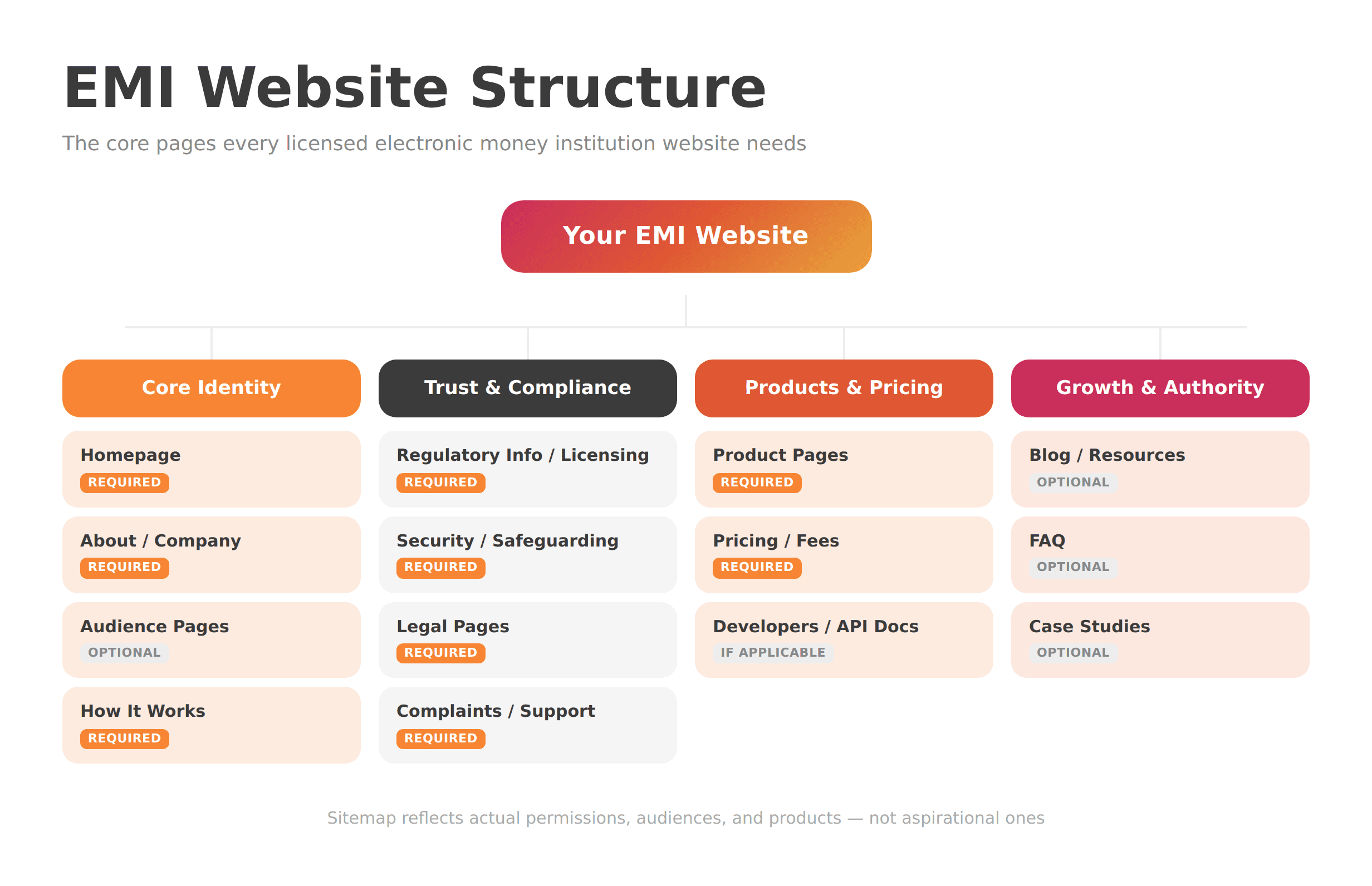
Your sitemap should reflect your real product scope and audience, not an aspirational version of either.
EMI website structure affects trust, search visibility, and user comprehension at the same time. A well-organised site tells visitors what you do, who you serve, and whether you are the right fit. A weak one forces them to hunt for answers they should be able to find immediately.
Here is the core page set most EMI websites should include:
Homepage — A clear explanation of what the company does, who it serves, and what products it offers.
Audience pages — Separate paths for personal users, businesses, enterprises, or partners if their needs differ.
Product pages — Accounts, wallets, cards, transfers, FX, payouts, collections, IBANs, SEPA access, API services, issuing, or acquiring capabilities, but only where those accurately reflect the business.
How It Works — A simple walkthrough of onboarding, key steps, and customer flow.
Pricing / Fees — Transparent fee information where relevant.
Security / Safeguarding — A plain-language explanation of how customer funds are safeguarded and what operational protections are in place.
Regulatory Information / Licensing — Legal entity name, regulator, register reference, and a clear statement of status.
Legal pages — Terms, privacy policy, cookie policy, and any AML/KYC-related documents relevant to your model.
Complaints / Support — A clear route for customers to raise issues and understand next steps.
About / Company — Background, leadership, offices, and ownership context that make the business feel real and accountable.
Developers / API docs — Essential if the firm offers infrastructure or embedded-finance capabilities.
Blog / Resources / FAQ — Educational content that builds authority and answers recurring questions.
Not every EMI needs every one of these pages. The principle is simpler: your sitemap should reflect your actual permissions, audiences, and products, not what you may offer later. If you are also at fundraising stage, it is worth noting that site structure carries weight with investors too — a point we cover in our guide to building a website for a fintech startup.
What Compliance and Regulatory Information Should Be Visible on an EMI Website?
Specific, easy to find, and clearly written — not buried, vague, or copied from a template.
This is where many EMI websites lose credibility fastest. Compliance information that is generic, hidden, or poorly written does not just create legal risk. It signals to informed readers that governance may have been treated as an afterthought.
The FCA’s Approach Document includes sample status-disclosure language and says customers should be made aware of a provider’s authorisation status in relevant customer-facing materials. It also notes that regulator details, including a reference or registration number, form part of required information in relevant contracts. The EBA, meanwhile, maintains a central register of payment and electronic money institutions, while national authorities maintain their own registers.
Key compliance content should include:
Full legal entity name — Not just the trading name.
Authorisation or registration status — Clearly stated, using the correct category.
Regulator name and register reference — With a link to the relevant public register where appropriate.
Jurisdictions served or restricted — Especially important for firms operating across multiple markets.
Safeguarding explanation — A plain-English summary of how safeguarding works under your model and jurisdiction.
Complaints process — How customers raise issues, expected timelines, and escalation routes.
Legal documentation — Terms, privacy, cookies, and other applicable policies, all easy to find.
Real contact details — A genuine address and working support channels.
One important wording note: in the UK, the FCA says funds held by payment and e-money firms are not directly protected by the Financial Services Compensation Scheme (FSCS). So if you explain safeguarding on the site, do it carefully. Explain what safeguarding does and does not mean rather than implying bank-style deposit protection. The FCA has also recently finalised changes to the safeguarding regime for payments and e-money firms, with implementation from May 2026.
Also avoid vague claims such as “fully licensed,” “globally compliant,” or “authorised across Europe” unless you can support them precisely.
How Should an EMI Explain Its Products and Use Cases Clearly?
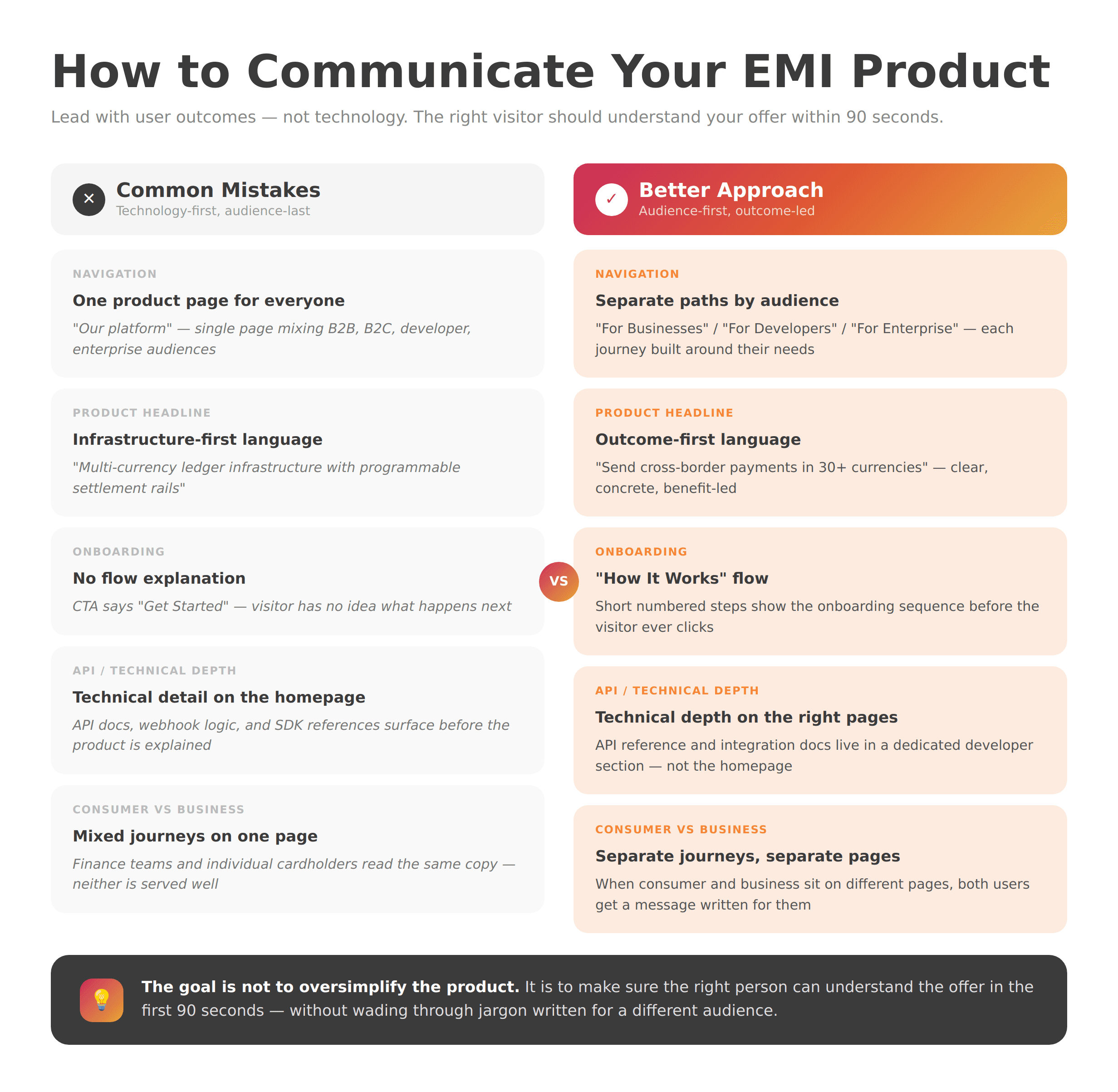
Start with who the product is for and what it helps them do, not with the technology underneath it.
Many EMI websites fail not because the product is weak, but because the website tries to say everything at once: cards, accounts, payouts, FX, open banking, KYC/KYB automation, embedded finance, business wallets, developer APIs. Without hierarchy, it all becomes noise.
A better approach is to organise product communication around user intent:
Build audience-first navigation. If a finance team and an individual cardholder need different information, do not force them through the same journey.
Write product pages around outcomes. “Send cross-border payments in 30+ currencies” is clearer than “multi-currency ledger infrastructure.”
Use “How It Works” flows. Diagrams, short sequences, and walkthroughs reduce anxiety around onboarding and complexity.
Reserve technical depth for the right audience. Keep API detail and deeper implementation notes for developer pages and later-stage decision-makers.
Separate consumer and business journeys. When both sit on one page, both usually suffer.
The goal is not to oversimplify the product. It is to make sure the right person can understand the offer in the first 90 seconds.
Which Trust Signals Matter Most on a Licensed Financial Brand’s Website?
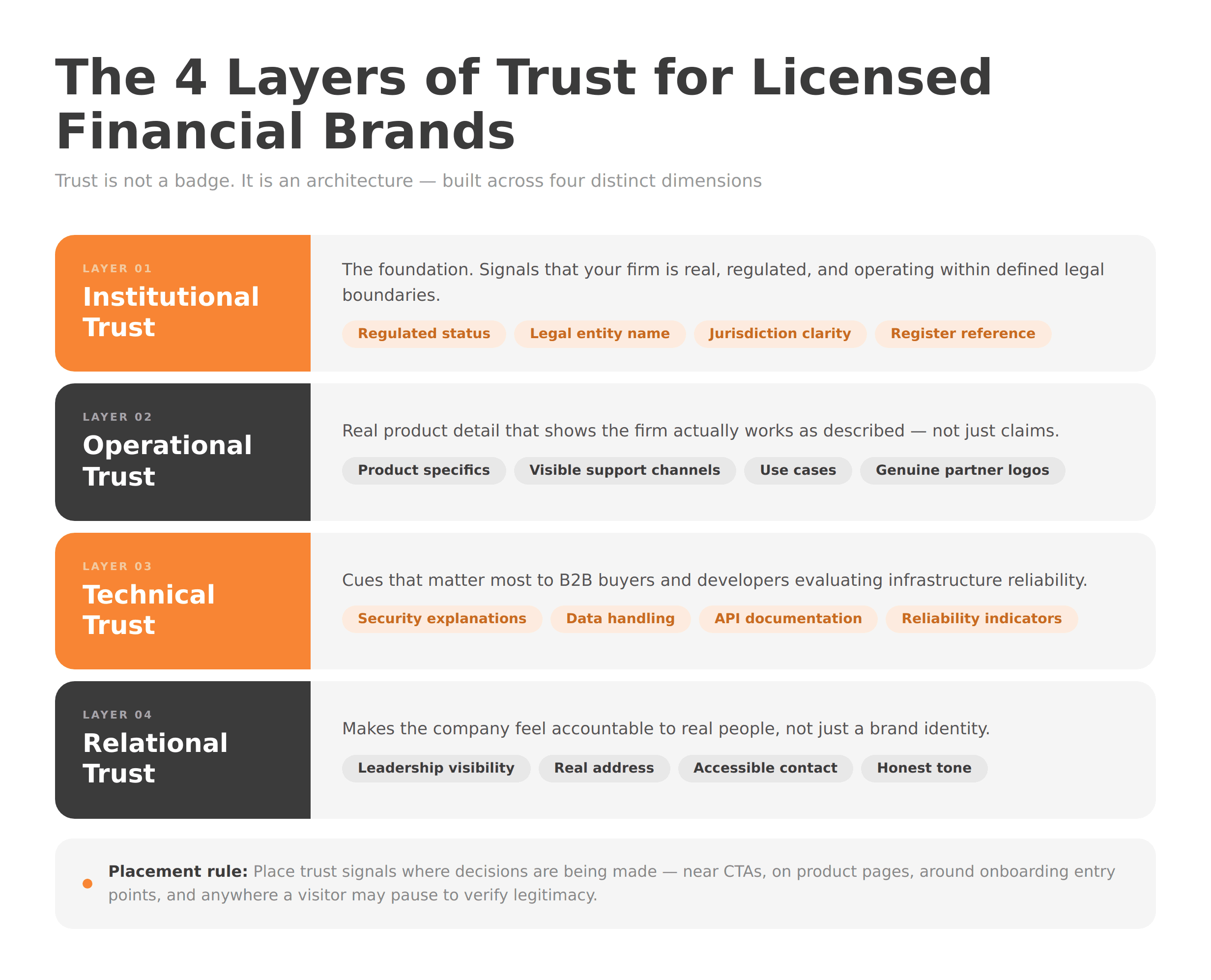
Trust is not a badge. It is an architecture.
For EMI brands, trust signals usually fall into four layers:
Institutional trust — Regulated status, legal entity details, jurisdiction clarity, company information. This is the foundation.
Operational trust — Real product detail, visible support channels, case studies or use cases where appropriate, and partner logos only where the relationship is real and usable in marketing.
Technical trust — Security explanations, responsible data-handling language, solid documentation, and reliability cues that matter to B2B buyers and developers.
Relational trust — Leadership visibility, accessible contact routes, and an honest tone. A named team and a real address make the company feel accountable.
Place trust signals where decisions are being made: near CTAs, on product pages, around onboarding entry points, and anywhere a visitor may pause and ask whether the business feels legitimate.
What UX, Mobile, and Performance Standards Should an EMI Website Meet?
Good EMI website UX is not about elegance. It is about removing uncertainty.
A user who cannot quickly understand what your product does, who it is for, or how to get help is a user who leaves. For a regulated financial brand, that exit can be permanent.
Standards worth building to:
Clear navigation and hierarchy — Visitors should be able to orient themselves quickly.
Mobile-first layouts — Disclosures, pricing, and support information should be as readable on mobile as on desktop.
Transparent CTA sequencing — Tell users what happens after “Get Started” before they click.
Accessible fee and product explanations — If pricing only makes sense after a sales call, many prospects will not bother.
Fast-loading pages — Performance supports both trust and usability.
Localised content where relevant — Language, currency conventions, and market context should reflect where you operate.
Google says page experience can affect how pages perform in Search and recommends achieving good Core Web Vitals as part of delivering a strong user experience. At the same time, relevance still matters most, so performance should be treated as part of a broader quality standard rather than as a ranking shortcut.
What Integrations, CMS, and Growth Infrastructure Should Support an EMI Website?
An EMI website is not a brochure. It is a working system.
Behind the front end, the right infrastructure determines whether the site scales with the business or turns into a bottleneck every time a product, jurisdiction, or policy changes.
Key components to plan for:
CRM-connected forms with lead routing and attribution
GA4 and GTM with meaningful event tracking from day one
Cookie consent and analytics governance aligned to applicable rules
Onboarding and KYC handoff points that connect cleanly to the compliance stack
Live chat or support tooling that actually supports the customer journey
Multilingual CMS if you operate across language markets
Blog and resources CMS that non-technical teams can update easily
Developer portal or API docs if infrastructure is part of the product
Clean SEO structure with readable URLs, metadata, internal linking, and structured content
One underrated criterion is update speed. If changing a regulatory page requires a developer sprint, those updates will drift — and that is where risk starts to build.
Common EMI Website Mistakes That Undermine Trust
These are the issues that make a site look less mature than the company behind it.
Hiding regulated status in the footer — Status information should be easy to find, not buried in tiny text.
Using vague compliance language — “Fully licensed” and “compliant by design” mean little without specifics.
Merging personal and business audiences into one journey — The result is usually a confused path for both.
Describing products with buzzwords instead of flows — Prospects need clarity, not slogans.
Publishing weak or templated legal pages — Generic legal copy signals weak governance.
Skipping a clear safeguarding or security explanation — Users should not have to guess how funds are handled or how to get help.
Launching without a clear complaints path — That is a customer-experience problem and, in some contexts, a governance problem.
Over-designing the hero and under-explaining the product — Attractive does not mean convincing.
Ignoring mobile performance — Important information must remain usable on smaller screens.
Making policy pages hard to update — Content operations matter just as much as design.
EMI Website Launch Checklist
Before going live, confirm the following:
The homepage clearly states who the company is, what it offers, and who it serves
All product pages reflect actual permissions and real scope, not aspirational features
The regulatory information page is live, accurate, and linked to the relevant public register where appropriate
Legal documents are published, current, and easy to find
Safeguarding information is explained carefully and in plain language
Complaints and support paths are clearly signposted
All forms, CTAs, and onboarding handoff points have been tested end to end
Mobile layouts have been reviewed across device types
Page speed and Core Web Vitals have been checked
Analytics, tracking, and consent management are configured correctly
Localised content has been reviewed for active markets
Internal owners are assigned to policy, product, and compliance updates
Next Steps: Why EMI Brands Benefit From Fintech-Specialised Website Partners
EMI website projects usually go wrong when generalist agencies treat them like standard startup builds.
The structural, regulatory, and trust requirements of a regulated financial brand demand a different approach from a generic SaaS or e-commerce site. The copy needs to be precise without sounding dense. The architecture needs to balance conversion with credibility. And the compliance layer needs to be considered from the beginning, not bolted on at the end. We break down exactly where those differences show up in practice in our comparison of fintech-specialist agencies versus generic web studios.
WSA describes itself as designing, building, and maintaining websites for financial and non-financial companies, and its portfolio highlights work for brokers, exchanges, and fintech companies. That kind of category familiarity matters when the website needs to do more than look good.
If you are preparing to launch, redesigning after authorisation or registration, or expanding into new markets, keep your existing homepage, portfolio, and discovery-call links here.
FAQ
How do you build an EMI website?
Start with your audience, product scope, and authorised or registered permissions, not a template. Map the sitemap before you design anything. Build product pages around outcomes and user intent. Make regulatory information easy to verify. Then move into UX, legal content, integrations, and performance testing before launch.
What pages should an EMI website have?
At minimum: a homepage, product pages, a regulatory-information page, legal documentation, a complaints and support path, and an about page. Add audience-specific pages, developer documentation, and resources based on your real business model.
Does an EMI website need to show its licence or register number?
As a practical matter, it should make status easy to verify. In the UK, the FCA’s guidance says customers should be made aware of regulated status in relevant customer-facing materials and points to regulator details and reference or registration numbers as part of required information in relevant contracts. Exact website wording should still be reviewed by legal or compliance, especially across jurisdictions.
What should an EMI website say about safeguarding?
Explain safeguarding in plain English: what it means, how your firm applies it to customer funds, and what it does and does not promise under your model and jurisdiction. In the UK, that explanation should not imply FSCS protection, because the FCA says funds held by payment and e-money firms are not directly protected by the FSCS. Final wording should be signed off by legal or compliance.
How is an electronic money institution website different from a bank website?
An EMI website should clearly explain what the firm is authorised or registered to do, what products it actually offers, and how users can verify its status. It should not borrow bank-style language that implies a broader regulatory status than the firm actually has. The FCA’s own guidance distinguishes between authorised EMIs and small electronic money institutions in the UK regime.
Can I use a template for an EMI website?
Templates can help validate layout ideas. But regulated financial brands usually need more precise structure, clearer trust architecture, better policy visibility, and more flexible content operations than a generic fintech template is designed to provide.
When should an EMI redesign its website?
After authorisation or registration. After a significant product change. When entering a new market. After a rebrand. When conversion is weak. When the site no longer presents regulated status, product scope, or compliance information clearly. Or when the business has outgrown the story the current site is telling.
Launch Your Licensed Brokerage with Confidence
We support brokers and fintechs through licensing, launch planning, and everything a regulated brand needs to go live.