•
•
How to Promote a Fintech Company: Marketing Strategies That Work in 2026
In 2026, it is more challenging than ever to promote your fintech company. The cost of acquiring customers is rising. The ad platforms are becoming more restrictive with financial ad policies. AI-powered search is revolutionizing the way customers find financial products. And, of course, regulators are paying close attention to the way fintech brands engage with customers.
It is no longer enough to just advertise. Nor is it enough to just write some blog posts and go to a conference.
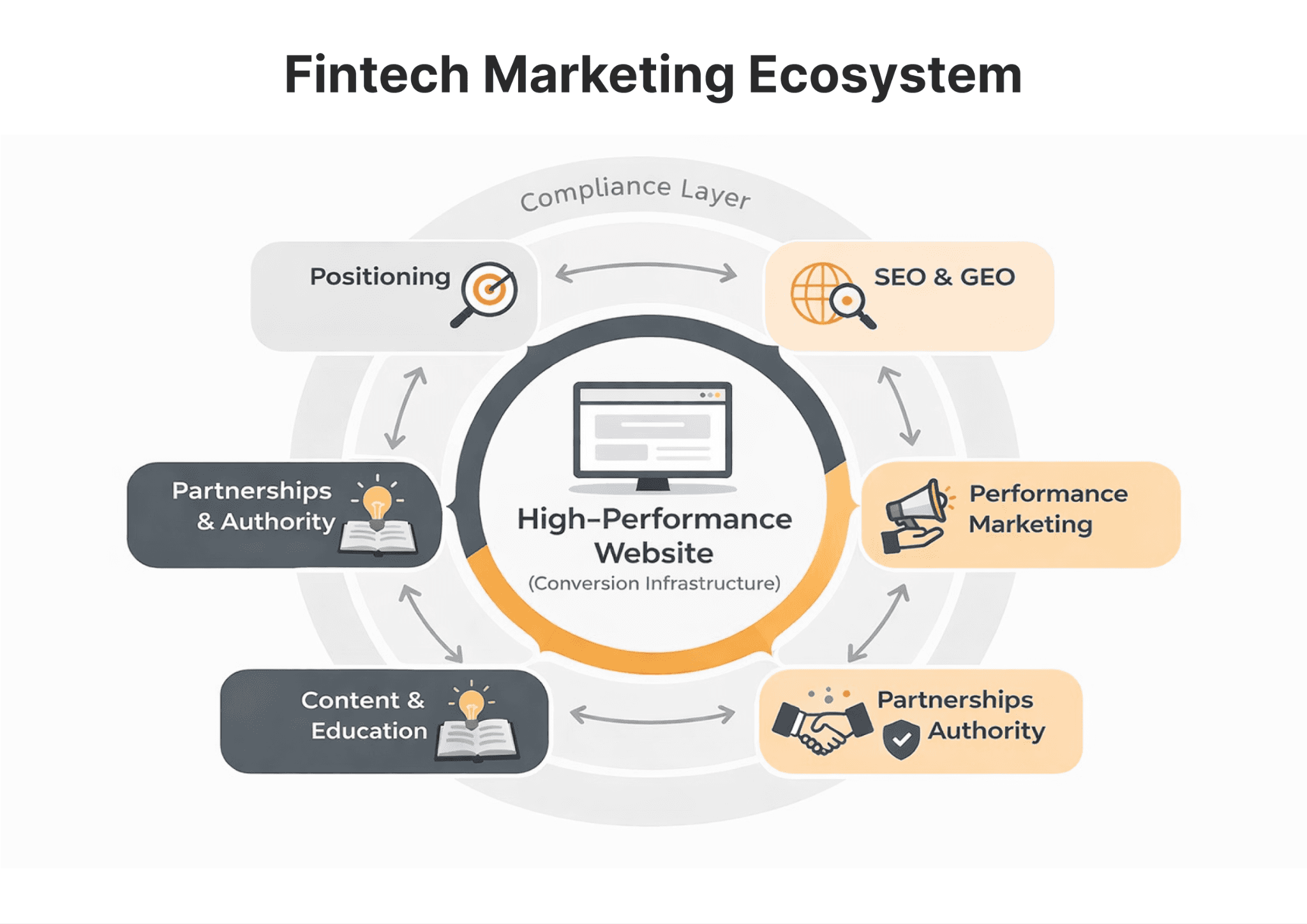
Fintech marketing is an ecosystem of trust, performance, compliance, and long-term visibility. All channels, assets, and messages must be aligned to deliver one outcome: acquiring customers at an acceptable cost.
This guide is for fintech founders, CMOs, and growth leaders looking for a framework, not another list of “marketing strategies.” You may be a fintech startup planning your launch, a neobank entering a new market, or a crypto platform growing beyond your initial customers. The principles in this guide will be relevant to your fintech brand.
Step 1: Define Your Positioning and Target Market
A successful fintech marketing strategy begins with positioning: who you're talking to, what you're solving for them, and why you're the guy or gal they should trust on this issue over all others. Without a strong positioning strategy, your marketing investment will only produce impressions, not customers.
B2B vs B2C Fintech Marketing: Key Differences
The channel mix, message, and timeline differ significantly depending on who you're selling to:
Dimension | B2B Fintech | B2C Fintech |
|---|---|---|
Decision cycle | Weeks to months | Days to weeks |
Key trust signals | Compliance, integrations, case studies | Security, UX simplicity, reviews |
Primary channels | LinkedIn, direct outreach, SEO | Paid social, app stores, influencers |
Content focus | Technical depth, ROI, regulatory fit | Clarity, onboarding ease, pricing |
Segment your ICP by business model, market, region, and regulatory context before allocating any budget.
Fintech branding is risk perception management — not a logo or color palette. Licensed and regulated status, audited financials, and security certifications all function as brand assets. They directly reduce perceived risk and shorten sales cycles.
Step 2: Build a High-Performance Website as Your Core Marketing Asset
Your website is the single most important marketing channel for a fintech company because every acquisition channel ultimately converts there.
Why Website Performance Directly Affects CAC
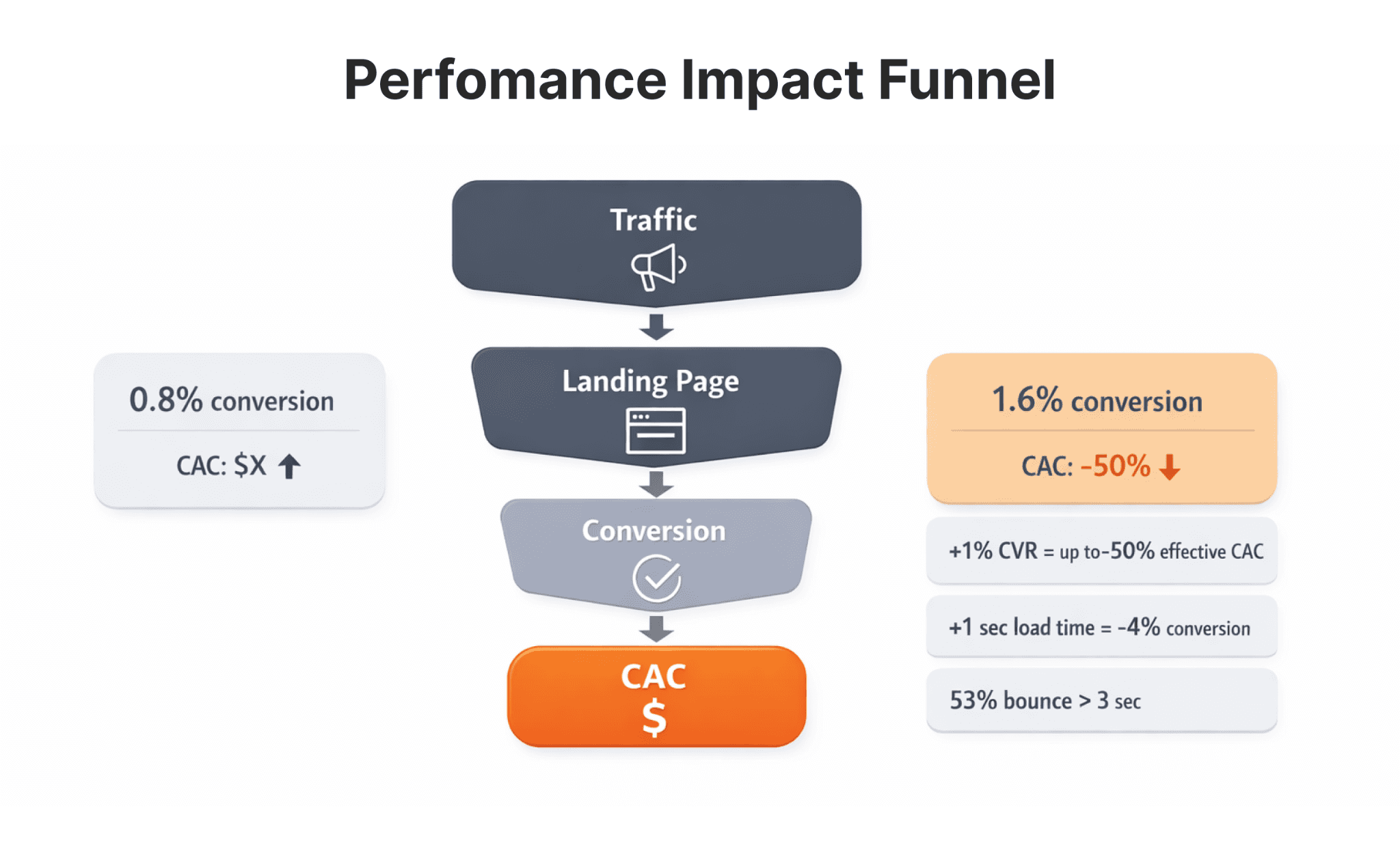
A 1% improvement in landing page conversion rate can halve effective CAC. Core Web Vitals improvements typically increase conversion rates by 10–25%. Google research shows that 53% of mobile users leave if a page takes over 3 seconds to load — and every additional second reduces conversion by approximately 4%.
[aa fast-fact]
Micro-scenario: A payments startup spending $40,000/month on Google Ads with a 0.8% landing page conversion rate will burn capital fast. Improve that rate to 1.6% — a realistic outcome from a well-structured fintech website design — and effective CAC drops by nearly half without increasing ad spend.
[/aa]
Fintech website design requirements go well beyond aesthetics:
Clear value proposition above the fold — users decide within 5 seconds
Compliance-ready structure — legal pages, risk disclosures, licensing information
Security signals — SSL, encryption messaging, regulatory badge placement near CTAs
Mobile-first UX — most fintech users first encounter products on mobile
SEO-ready architecture, CMS, CRM integration, and GA4 configured before launch
The website isn't a design deliverable. It's your primary growth infrastructure. See the full fintech website trust checklist for a pre-launch review framework.
Step 3: Implement SEO and AI-Driven Search Strategy
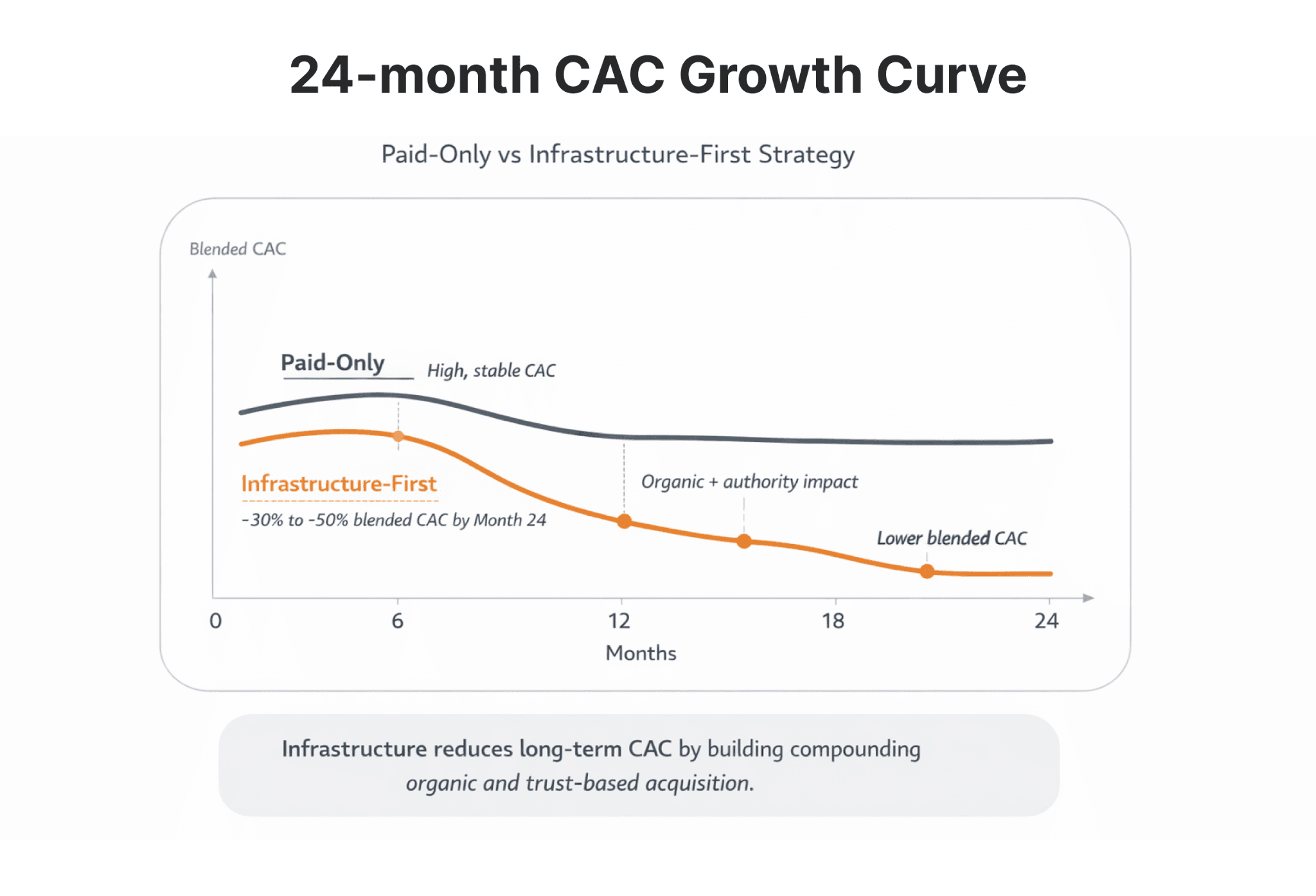
Fintech SEO compounds over time. Companies that build organic infrastructure in year one typically reduce paid acquisition dependence by 30–50% within 24 months. Given tightening ad restrictions in financial services, this matters more every year.
Traditional SEO Foundations
Technical SEO: Site speed, crawlability, core web vitals, etc. Fintech sites struggle in this area because of heavy JavaScript usage
E-E-A-T compliance: Provide source information, cite government sources, etc. Show domain expertise in the area of finance
Topic Clustering: Content about embedded finance, crypto, or trading infrastructure can cluster together to establish domain expertise
Keyword-to-intent mapping: "Best payment gateway for SaaS" and "payment gateway API docs" serve different users at different funnel stages
AI Search Visibility Checklist (GEO)
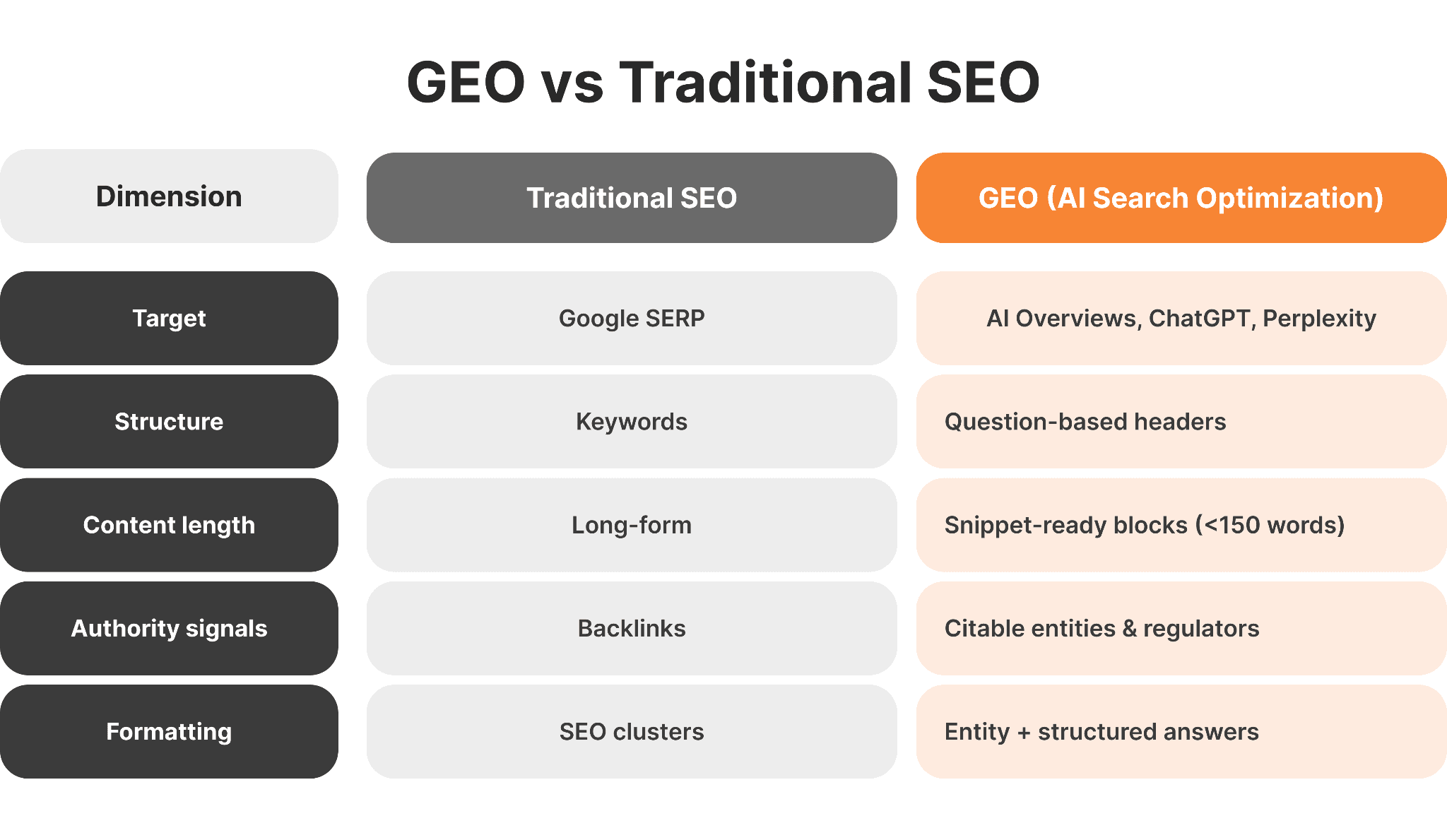
As Perplexity, ChatGPT Search, and Google AI Overviews increasingly surface financial products, content must be structured for AI citation:
H2/H3 headers phrased as direct questions
Each section is answerable as a standalone snippet (under 150 words)
Entity-rich content: reference FCA, SEC, MAS, PCI DSS, ISO 27001
Authoritative external links on every key claim
Original data or benchmarks (AI tools prefer citable statistics)
Short paragraphs — no blocks over 4 lines
Step 4: Use Performance Marketing — Strategically
Paid advertising still works in 2026 but requires strict compliance alignment in regulated industries.
Google Ads under financial advertising policies requires certification for investment, crypto, and financial service categories. Non-compliance leads to account suspension. LinkedIn Ads remain the most effective B2B fintech channel — decision-makers at banks, trading firms, and institutional clients are accessible there in ways they aren't elsewhere.
Retargeting improves conversion likelihood by up to 70% in long sales cycles. Given that fintech buyers typically research for weeks before deciding, retargeting is one of the highest-ROI tactics available.
[aa fast-fact]
Micro-scenario: A B2B lending platform running LinkedIn Ads without a conversion-optimized landing page typically sees 1–2% form completion. The same campaign directed to a compliance-ready, fast-loading page with clear social proof can reach 4–6% — tripling qualified pipeline without changing ad spend.
[/aa]
Key rules: Set up conversion tracking before ad spend, add the required disclaimer, test messaging strategies, and monitor CAC vs. LTV for each channel, not overall.
Step 5: Build Authority Through Partnerships and Ecosystem Credibility
In heavily regulated markets, partnerships with trustworthy brands can convey credibility much quicker than advertising. Technology integrations with established providers (Stripe, Fireblocks, Plaid, AWS) can convey a sense of standard quality to users, partners, and regulators.
Certifications such as FCA authorization, PCI DSS compliance, ISO 27001 — function as trust signals for enterprise buyers. Media mentions in Finextra, The Block, Bloomberg, and so on can accelerate sales cycles that would normally take weeks. Affiliate/IB marketing can be very powerful in markets such as trading and crypto, which already have a high degree of built-in referral structures.
Authority-driven growth can outperform aggressive advertising strategies in regulated markets.
Step 6: Leverage Content, Education, and Thought Leadership
Fintech customers are heavy researchers before making a buying decision. A crypto exchange launching a detailed MiCA compliance guide will win more institutional trust than a rival launching generic ads.
Educational content can enhance fintech SEO, increase AI search results, and reduce customer churn. Content formats to consider: educational guides, regulatory guides, platform comparisons, case studies, and data-driven reports. Case studies are among the most conversion-rich fintech content formats because they address the following questions: "Has this ever worked for a company like mine?"
Step 7: Align Compliance and Marketing From Day One
In the fintech space, marketing cannot exist in isolation from compliance. A false claim can lead to regulatory action, penalties, or even the forced removal of an ad campaign.
Financial Advertising Compliance by Region
Region | Key Body | Key Requirement |
|---|---|---|
United Kingdom | FCA | All financial promotions must be approved by an FCA-authorized person |
United States | SEC / FINRA | Investment ads require specific disclaimers; crypto ads face heightened scrutiny |
European Union | ESMA / National NCAs | MiCA regulations apply to crypto marketing; retail risk warnings mandatory |
Singapore | MAS | Financial promotions must not be misleading; digital token ads restricted |
Proactive compliance prevents campaign shutdowns and actually improves marketing quality. Precise, accurate messaging attracts better buyers than vague claims. Build a compliance review step into every campaign workflow from day one — not as a reactive gate, but as standard quality control.
Common Mistakes When Promoting a Fintech Company
Treating marketing as paid ads only — ads are one channel, not a strategy
Launching without a conversion-optimized website — the first step of acquisition fails before it begins
Ignoring SEO until year two — organic growth takes 6–18 months to compound; starting late means paying for acquisition longer
Overpromising in messaging — misleading claims damage trust and attract regulatory attention
No clear attribution model — without knowing which channels drive customers, optimization is impossible
Pre-Launch Marketing Checklist for Fintech Companies
✅ Clear positioning statement defined and documented
✅ Website conversion flow mapped and tested
✅ Compliance pages reviewed by legal (terms, disclosures, risk warnings)
✅ GA4 and GTM configured and verified
✅ SEO structure in place (URL structure, metadata, schema markup)
✅ Paid ad accounts verified under financial advertising policies
✅ Conversion tracking tested across all key actions
✅ Attribution model defined before first spend
Next Steps: Building a Scalable Fintech Marketing Engine
Successful fintech companies treat marketing as infrastructure — not campaigns. The difference between a startup struggling with high CAC and one scaling efficiently almost always comes down to whether marketing infrastructure was built first.
That infrastructure includes: a fintech website design built for conversion and compliance, SEO architecture from launch, content systems that build authority over time, and analytics that make every decision traceable.
As a specialized fintech digital agency, WSA delivers compliance-ready fintech website design, SEO-first website builds, performance-focused UX, and fast time-to-market — weeks, not months. Review brokerage website costs in 2026 to benchmark your infrastructure investment.
FAQs
What is the most effective way to promote a fintech company in 2026?
The most effective way is to leverage strong positioning, a high-performance website, SEO-driven content, and compliant performance marketing. Trust, authority, and conversion infrastructure are more important than individual approaches.
Companies that focus on building their marketing infrastructure prior to scaling paid channels achieve significantly lower CAC and sustainable growth.
Why is a website critical for fintech marketing?
A fintech website is the central conversion point for every marketing channel. Core Web Vitals improvements alone can increase conversion rates by 10–25%. Poor UX, slow performance, or missing compliance information increases acquisition costs significantly. See the full breakdown in the Fintech Website Trust Checklist.
Does SEO work for fintech companies?
Yes. Fintech SEO compounds over time, resulting in a 30-50% reduction in paid acquisition dependency over 24 months. Educational content, structural website architecture, and AI-optimized content formats all contribute to better visibility across traditional search as well as emerging generative AI technologies. It’s essential to start early, as the full effect of organic growth takes 12-18 months to materialize.
How much should a fintech company spend on marketing?
Fintech companies at the early stages should consider spending 10-20% of the company’s projected revenues on marketing. It’s essential to consider infrastructure investments like a website, SEO, and tracking systems before investing in paid acquisition channels. It’s recommended to review brokerage website costs in 2026 to gain insights into the cost of compliant infrastructure necessary for the business to operate.
What is the biggest mistake fintech startups make in marketing?
Focusing on short-term paid acquisition without building trust infrastructure — a compliant website, an SEO foundation, and clear positioning. Without these, every paid channel underperforms, CAC stays high, and growth remains fragile and campaign-dependent.
Launch Your Licensed Brokerage with Confidence
We support brokers and fintechs through licensing, launch planning, and everything a regulated brand needs to go live.