•
•

How to Get an MT4/MT5 Broker License: Step-by-Step Process, Costs and Requirements
You have the capital, a jurisdiction picked out, and a launch date in mind. Then you start asking vendors what an MT4/MT5 broker license costs, and every answer arrives as a range with a sales call attached. Nobody tells you what actually gets submitted, in what order, or what makes an application sit untouched for weeks.
Here is the part most founders discover late: MetaQuotes reviews your company before it reviews your trading plans. Your incorporation papers, your banking, your regulatory standing and your public website all get checked. Get the sequence wrong and you pay for a licence you cannot use yet, or you wait on an approval that was never going to arrive without a live website.
This article is for informational purposes only and does not constitute legal advice. Brokers should consult qualified legal and compliance professionals for jurisdiction-specific guidance.
This guide walks the MetaTrader broker licence process in the order it actually happens.
Key Takeaways
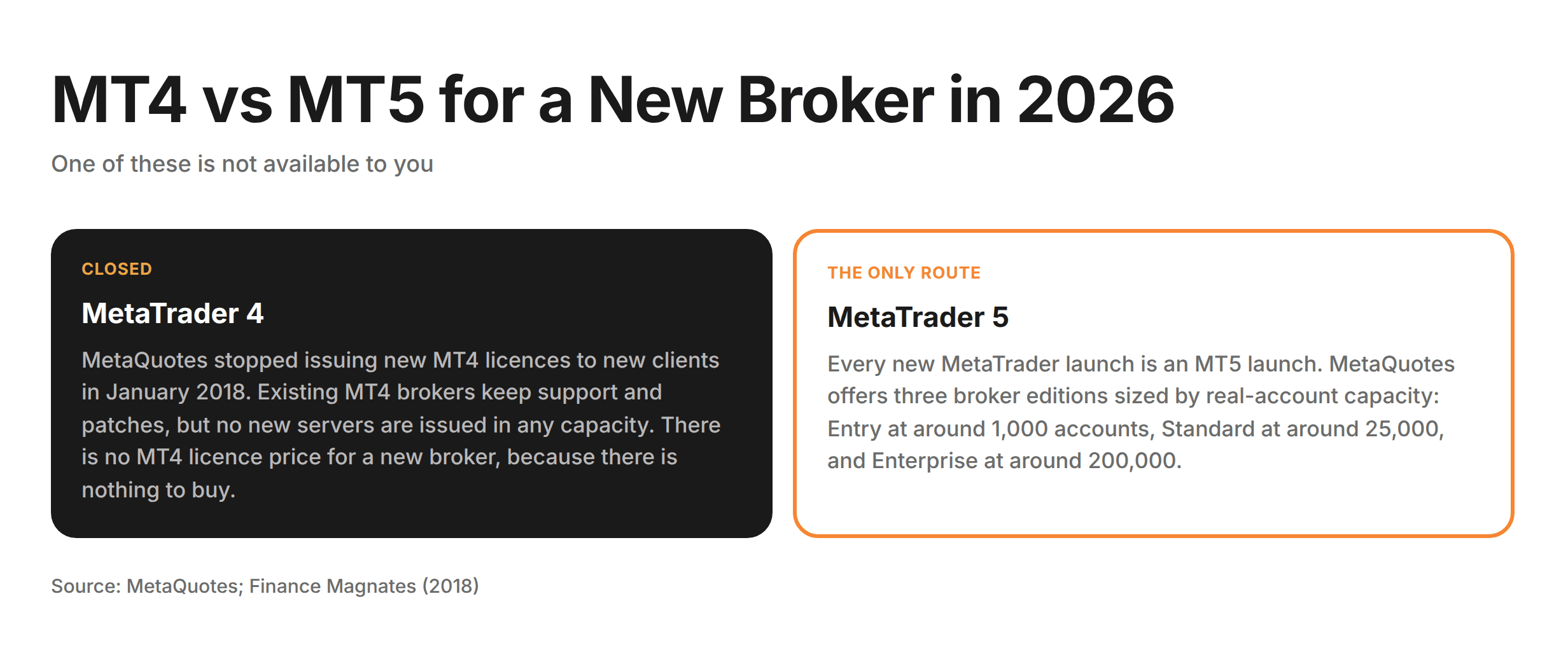
New brokers cannot buy MetaTrader 4. MetaQuotes stopped issuing MT4 licences to new clients in January 2018, and existing MT4 brokers receive no new servers. Every new launch in 2026 is an MT5 launch.
A MetaTrader licence is a software agreement, not permission to operate. Regulatory authorisation comes first, and the platform application is roughly step four of six.
MetaQuotes reviews four things: your legal entity, your regulatory standing, your corporate bank account, and your live company website on a domain registered in the entity's name.
MetaQuotes publishes no licence pricing. Fees are contract-specific and scale with your account-capacity tier, so treat every public figure as a market estimate rather than a price list.
Budget six to twelve months end to end. Regulatory authorisation, not the platform review, is what consumes most of that time.
The website is the cheapest item on the list and the one most often unfinished when the application goes in.
What an MT4/MT5 Broker License Actually Is
An MT4/MT5 broker license is a software agreement with MetaQuotes Software Corp. that lets your firm run its own MetaTrader server and offer the platform to your clients under your brand. It is not permission to operate as a broker, and it does not make you regulated.
That distinction decides your whole launch order. MetaQuotes is a software vendor protecting its brand from misuse. It is not a regulator, and it will not authorise you to hold client money. What it will do is check whether you already look like a real, licensed, banked company before it hands over a server.
Platform Agreement vs Regulatory Authorisation
The difference is who grants it and what it permits. A regulator grants authorisation to accept client funds and provide investment services. MetaQuotes grants a software contract that lets you run the terminal your clients will trade on.
You need both, and they are not substitutes. If you are still deciding which one to pursue first, the difference between a platform licence and a regulatory licence is worth reading before you spend anything.
What this means: paying for platform access early does not accelerate your launch. It just starts the monthly clock sooner.
Why MT4 Is No Longer an Option for New Brokers
MetaQuotes stopped issuing new MT4 licences to new clients in January 2018. Brokers already on the platform kept their servers, security patches and support, but the company confirmed that no new servers would be issued in any capacity. Finance Magnates, reported the decision at the time and the position has held since.
So there is no current MT4 licence cost for a new broker, because there is nothing to buy. Vendors still advertising "MT4 white label" packages are almost always reselling capacity on an existing licence holder's server, which is a very different arrangement from holding your own.
Fast fact: if a provider offers you a brand-new MT4 server in 2026, ask whose licence it sits on. The answer will not be yours.
MT5 Broker Licence Requirements: What MetaQuotes Asks For
MetaQuotes reviews four things: your legal entity, your regulatory standing, your corporate banking, and your public website. The MT5 broker licence requirements are less about trading volume than about proving the company on the application exists and operates as described.
What gets reviewed | Evidence expected | Common failure |
|---|---|---|
Legal entity | Certificate of incorporation, good standing, company address | Trading name does not match registered name |
Ownership and control | Director and shareholder ID, proof of address | Nominee structures with no explanation |
Regulatory standing | Licence or authorisation from your jurisdiction | Application still pending |
Corporate banking | Bank confirmation in the licensed entity's name | E-wallet or personal account submitted |
Public website | Live site on a domain registered to the entity | Placeholder page, mismatched domain, free email |
Corporate and Regulatory Documents
Your document pack starts with the certificate of incorporation and ends with proof that a regulator has authorised the entity named on it. Director and shareholder verification sits in between: passports, proof of address, and a clear ownership chain.
The pack itself is standard corporate diligence. What catches applicants out is consistency. A company registered in one name, trading under a second, and emailing from a third domain reads as three companies to a reviewer.
The company documents MetaQuotes asks for overlap heavily with what your regulator already requested, so assemble one canonical set and reuse it.
Corporate Bank Account in the Licensed Entity's Name
You need a corporate bank account held in the name of the registered and licensed entity. Payment processor balances and e-wallet accounts do not satisfy this, as Atomiq Consulting noted when MetaQuotes tightened its policy.
This is frequently the longest single item after regulatory authorisation. Banks underwrite CFD and forex firms slowly, and some decline the sector outright. Start banking conversations in parallel with your licence application, not after it.
Here's where most launches lose a month: the bank asks for a live website and a regulatory licence, the regulator asks for banking arrangements, and the founder waits for one to unblock the other instead of running both.
Company Website and Matching Domain
Your website has to be live, functional, and hosted on a domain registered in your company's full legal name. WHOIS privacy on that domain blocks approval, because a reviewer cannot confirm the registrant matches the applicant.
Reviewers check the ordinary things. Is the site real rather than a "coming soon" page? Does the company name match the registered entity? Are the phone number, email and office address genuine and consistent with your documents? Do staff use company-domain email rather than free mailboxes?
The takeaway: your website is an application artefact. It is evidence, and it is graded like evidence.
Not sure which option fits your business?
From startup brokerages to established platforms, WSA delivers websites that convert traders, satisfy regulators, and scale across markets.
The MT5 Broker Licence Application Process, Step by Step
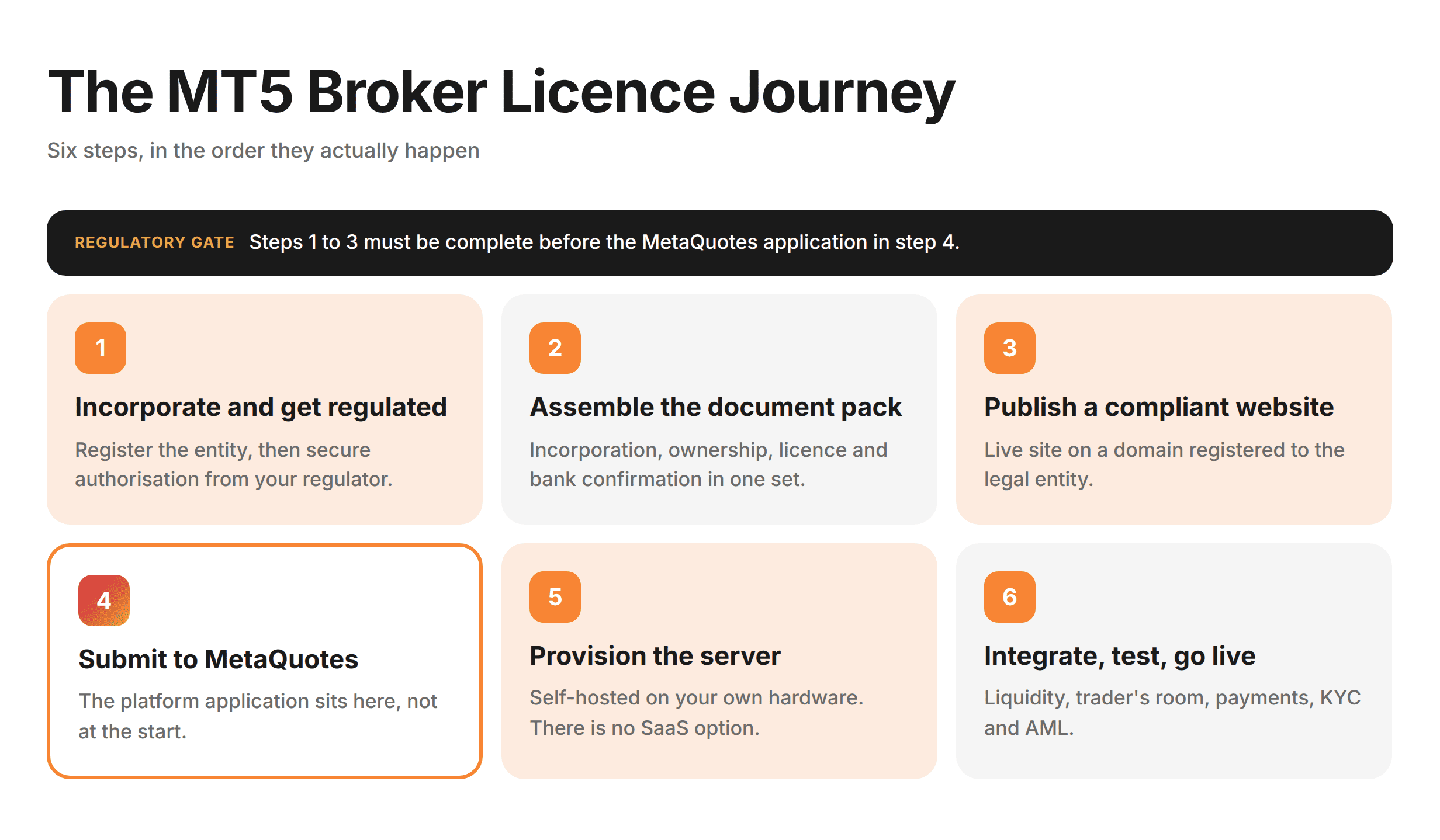
The MT5 broker licence application steps run in a fixed order, and the platform application is step four, not step one. Each earlier step produces something the next one needs. Skip ahead and you either pay early or wait longer.
Step 1: Incorporate and Secure Regulatory Standing
Register the operating entity in your chosen jurisdiction, then obtain authorisation from its regulator. Capital requirements set the tier: offshore regimes such as the FSA in Seychelles or the SCB in the Bahamas sit at the accessible end, CySEC in the middle, and the UK's FCA requires £750,000 of permanent minimum capital for a firm dealing on own account under MIFIDPRU 4.4.1R(2).
What stalls here: applying to MetaQuotes with authorisation still pending. Reviewers want a granted licence, not a receipt.
Step 2: Assemble the Document Pack
Collect incorporation certificate, good-standing evidence, director and shareholder verification, your regulatory licence, and corporate bank confirmation into one set. Check that the company name is identical on every page.
What stalls here: three slightly different versions of the company name across five documents.
Step 3: Publish a Compliance-Ready Website
Put a live site on a domain registered to the legal entity, with real contact details, risk warnings, terms, privacy policy and complaints information. Company-domain email addresses only. If you need a build sequence, our guide to how to build a broker website covers the page inventory.
What stalls here: a template placeholder, or a domain bought under a founder's personal name.
Step 4: Submit the MetaQuotes Application
Request broker access through MetaQuotes directly and submit the pack. Expect follow-up questions about ownership, target markets and your website. MetaQuotes broker approval is a review, not a purchase, and it publishes no service-level commitment on timing.
What stalls here: slow responses to clarification requests. Nominate one person to own the thread.
Step 5: Provision and Configure the Server
Once approved, you deploy. MetaQuotes states that brokers install its software on their own hardware and that MetaQuotes has no access to broker servers, so hosting, redundancy and latency are your responsibility. Choose your data centre based on where your clients trade.
What stalls here: treating the MetaTrader 5 server licence as a hosted service. There is no SaaS option.
Step 6: Integrate, Test and Go Live
Connect your liquidity provider, trader's room and CRM, payment gateways, and KYC and AML tooling, then test the full journey from registration to first trade and first withdrawal. Run it with real money at small size before you announce.
What stalls here: discovering during testing that the website and the trader's room feel like two unrelated products.
MT5 Broker Licence Cost: What to Budget
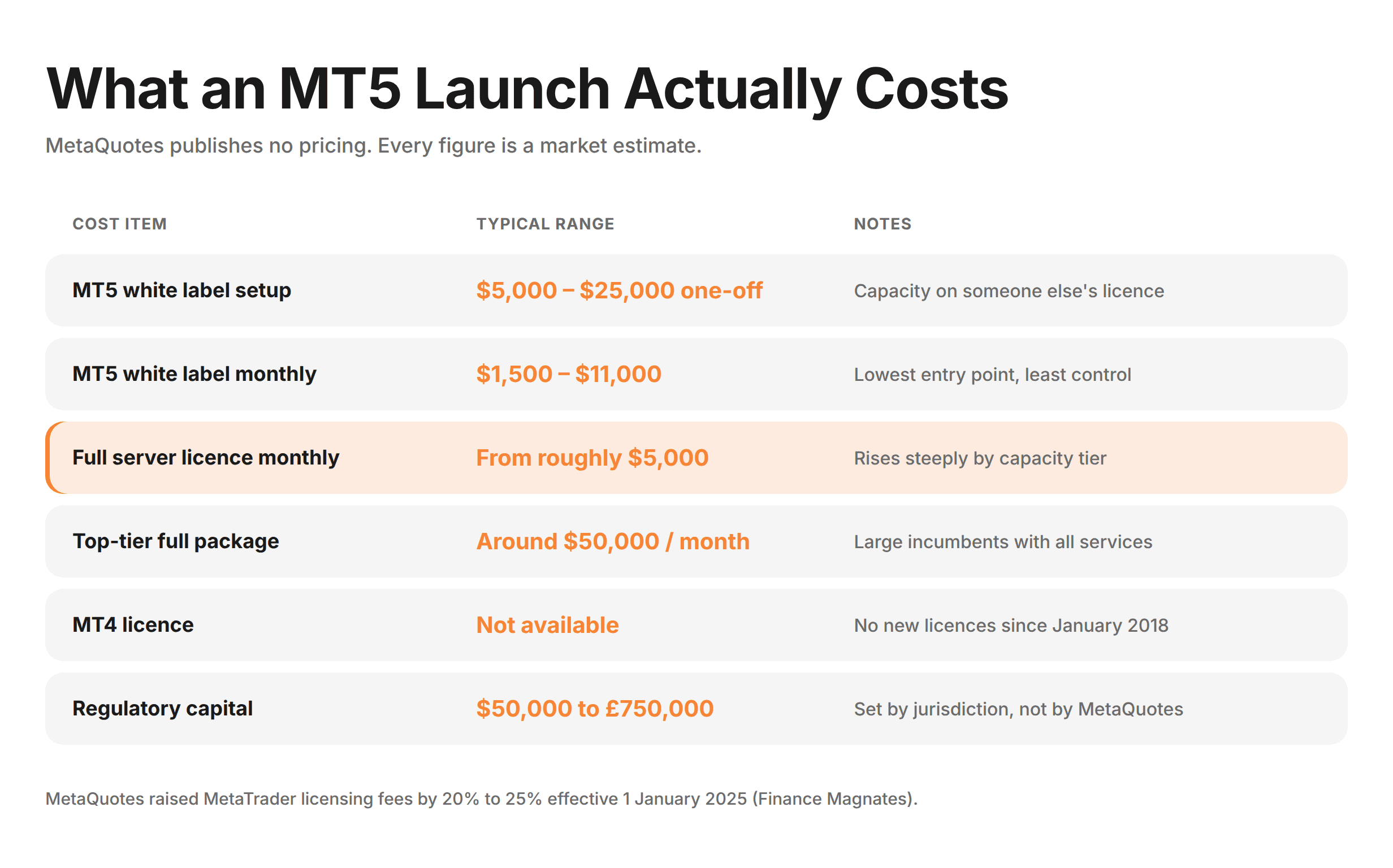
MetaQuotes does not publish licence pricing, so every figure below is a market estimate from named industry sources rather than a price list. Your actual number depends on the tier you negotiate and the services attached.
Tier is the part most cost guides skip. MetaQuotes offers MetaTrader 5 for brokers in three editions sized by real-account capacity: Entry at around 1,000 accounts, Standard at around 25,000, and Enterprise at around 200,000. A startup buying Entry capacity and a bank buying Enterprise capacity are not paying comparable amounts, which is why published ranges vary so wildly.
Cost item | Typical range | Notes |
|---|---|---|
MT5 white label setup | $5,000–$25,000 one-off | Capacity on someone else's licence |
MT5 white label monthly | $1,500–$11,000 | Lowest entry point, least control |
Full server licence monthly | From roughly $5,000, rising steeply by tier | Contract-specific, not published |
Top-tier full package | Reportedly around $50,000/month | Large incumbents with all services, per Finance Magnates |
MT4 licence | Not available to new brokers | No new licences since January 2018 |
Regulatory capital | $50,000 offshore to £750,000 FCA | Set by jurisdiction, not by MetaQuotes |
Website build | Low five figures | See what a brokerage website costs |
Fees also move. MetaQuotes raised MetaTrader licensing fees by 20% to 25% effective 1 January 2025, and Finance Magnates reported that some brokers' full packages landed near $50,000 a month afterwards. That headline number describes established multi-platform operators, not a first launch. Budget your own tier, then add 20% contingency for the next revision.
Honest tradeoff: a full server licence costs more every month than an MT5 white label and is not the right first move for every launch. If you are still weighing MT5 white label vs a full licence, decide on volume and plugin needs rather than prestige.
How Long the Process Takes End to End
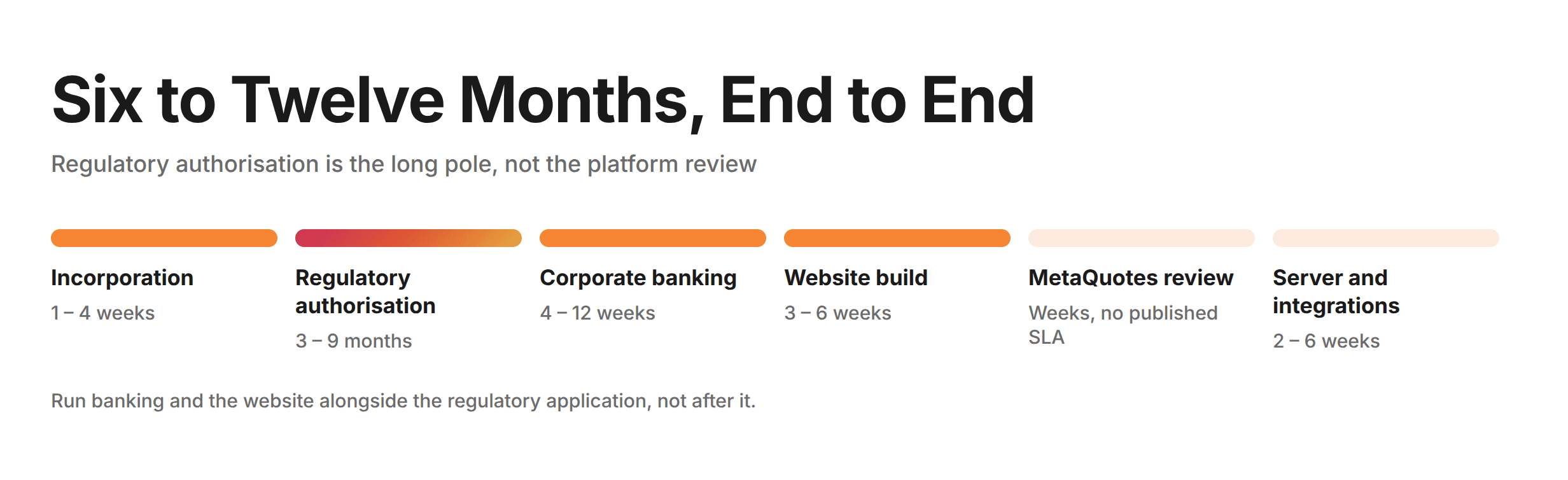
Most MetaTrader launches take six to twelve months from incorporation to first live trade, and regulatory authorisation accounts for most of that. The platform review is typically one of the shorter phases, which surprises founders who budgeted their entire timeline around it.
Phase | Typical duration | Runs in parallel with |
|---|---|---|
Incorporation | 1–4 weeks | Website discovery |
Regulatory authorisation | 3–9 months | Banking, website build |
Corporate banking | 4–12 weeks | Regulatory application |
Website build and launch | 3–6 weeks | Regulatory application |
MetaQuotes review | Weeks, no published SLA | Server procurement |
Server setup and integrations | 2–6 weeks | Testing |
Two things compress this materially. Run banking and the website alongside the regulatory application rather than after it. And prepare the document pack once, properly, so every subsequent request is a copy rather than a scramble.
Build the Website While Your Licence Is in Review
Most founders start the site after approval and add six weeks to their launch. Running it in parallel costs nothing extra.
Where Applications Stall and How to Avoid It
The most common cause of delay is not technical. It is a mismatch between what your documents say and what a reviewer can independently verify.
Domain not in the company name. Register it to the legal entity, and remove WHOIS privacy for the review period.
Placeholder website. A holding page reads as a shell company. Publish the real site before you apply.
Free email addresses. Move every contact address to your company domain first.
Pending regulatory status. Wait for the grant. Applying early does not reserve your place.
Personal or e-wallet banking. Only a corporate account in the licensed entity's name counts.
Inconsistent company naming. One legal name, used identically everywhere, including the website footer.
What this means in practice: five of those six are website and paperwork problems, and all five are solvable in weeks for a fraction of the platform fee. A compliant website will not rescue a weak regulatory file, but a missing one will hold up an otherwise strong application.
How WSA Prepares Broker Websites Before the Application Lands
WSA builds broker and fintech websites on Framer, and we build them to the standard a platform reviewer and a regulator will both apply. That means the legal page set, real contact information, risk disclosures, domain configured to the company entity, and a front end that matches the trader's room your clients will move into.
We are a fintech-specialist agency, not a licensing consultancy. We do not sell or arrange MetaTrader licences. What we do is remove the item that most often sits unfinished when everything else is ready.
In WSA's experience preparing broker sites before submission, the founders who launch on schedule are the ones who briefed the website during regulatory review rather than after it. A Framer build typically ships in three to six weeks, which fits inside the authorisation window at no cost to the critical path.
Conclusion
Getting an MT4/MT5 broker license is a sequencing problem more than a purchasing one. MetaTrader 4 is closed to new brokers, so the real question is which MT5 tier fits your volume, and whether your entity, banking, regulatory standing and website will all stand up to review at the same moment. Get those four aligned and the platform step is straightforward. Leave one unfinished and it sets your launch date, whatever else is ready.
A MetaTrader broker licence is the straightforward part once the other four line up. The website is the piece you control completely, and the one that most often slips. WSA builds broker sites that hold up to both regulatory and platform review, in the weeks you are already spending on authorisation.
Tell us your launch date and we will work backwards from it: get in touch
FAQ
Is MT4 still available to new brokers in 2026?
No. MetaQuotes stopped issuing new MT4 licences to new clients in January 2018, and no new MT4 servers are being issued in any capacity. Brokers who already held MT4 licences at that point continue to operate, receive support and get security patches, but they cannot add new servers either.
For anyone launching now, MetaTrader 5 is the only route to your own MetaTrader server. Offers advertising a "new MT4 white label" are reselling capacity on an existing licence holder's infrastructure rather than giving you a licence of your own. That can be a legitimate arrangement, but you are a tenant on someone else's server, with their compliance exposure sitting upstream of your business. Confirm whose licence it is before signing anything.
Do I need a regulatory licence before MetaQuotes will issue MT5?
Yes, in practice. MetaQuotes reviews applicants that already hold regulatory authorisation and a corporate bank account in the licensed entity's name, so the platform application follows your licence rather than preceding it.
The two are entirely separate instruments. A regulator authorises you to accept client funds and provide investment services. MetaQuotes signs a software agreement that lets you run its platform. Neither one substitutes for the other, and holding the software agreement gives you no regulatory standing whatsoever.
The practical consequence is sequencing. Incorporate, get authorised, open corporate banking, publish your website, then apply for the platform. Founders who reverse the order pay monthly platform fees during a regulatory review they cannot shorten.
Can I get MT5 as a white label instead of a full licence?
Yes. A white label gives you branded access to capacity on another firm's MetaTrader 5 server, with lower setup cost and no server administration, in exchange for less control over plugins, client data and configuration. It is the common starting point for a first launch.
The decision usually comes down to volume, plugin requirements and margin rather than prestige, and it is worth working through properly before committing to monthly fees either way.
What does MetaQuotes check on my website before approval?
MetaQuotes checks that the site is real, live, and demonstrably yours. Reviewers confirm the site is functional rather than a placeholder, that the company name on it matches your registered entity, and that the domain is registered in the company's full legal name without WHOIS privacy masking the registrant.
They also verify that contact details are genuine and consistent with your documents: a working phone number, a physical office address, and email addresses on your company domain rather than free mailboxes. The visible activity on the site should match the business you described in your application, so a generic corporate template with no trading content raises questions.
Expect the legal page set to be in place too: terms of business, privacy policy, risk warning, and complaints procedure. None of this is exotic, which is exactly why an unfinished site is such an avoidable reason to lose weeks.
How much does an MT5 broker licence cost per month?
There is no single published figure, because MetaQuotes does not publish licence pricing and negotiates per broker. Market estimates put white label arrangements at roughly $1,500 to $11,000 a month, and full server licences from around $5,000 a month upward depending on your account-capacity tier.
Tier is what drives the spread. MetaQuotes sizes its broker editions by real accounts, at roughly 1,000 for Entry, 25,000 for Standard and 200,000 for Enterprise, so a startup and a bank are buying quite different products. Finance Magnates reported that fees rose 20% to 25% from 1 January 2025 and that some large operators' full multi-platform packages reached around $50,000 a month afterwards. Treat that number as the ceiling for established incumbents rather than a launch budget, and add contingency for future revisions.
Launch Your Licensed Brokerage with Confidence
We support brokers and fintechs through licensing, launch planning, and everything a regulated brand needs to go live.