•
•
MT5 Broker Licence vs Brokerage Licence: Which One Do You Need?
This article is for informational purposes only and does not constitute legal advice. Brokers should consult qualified legal and compliance professionals for jurisdiction-specific guidance.
You have the funding, the business plan, and a shortlist of technology providers. Then someone asks which regulator you are authorised by, and the shortlist stops mattering.
An MT5 broker licence and a brokerage licence are not two names for the same thing, and they are not alternatives. The MT5 broker licence is a software licence from MetaQuotes that lets you run the MetaTrader 5 (MT5) platform for your clients.
A brokerage licence is authorisation from a financial regulator that lets you accept client money and provide investment services. You need both, and the order matters.
Global FX turnover reached $9.6 trillion a day in April 2025, up 28% on 2022, according to the Bank for International Settlements. A market that size is policed closely, and the licensing stack reflects that.
This guide separates the two licences, shows what each one costs and permits, and sets out the sequence that actually works.
Key Takeaways
An MT5 broker licence is software licensing from MetaQuotes. A brokerage licence is regulatory authorisation from a financial supervisor. You need both.
The regulatory licence comes first. Platform access is reported to go only to firms that already hold financial services authorisation.
MetaQuotes does not publish its onboarding criteria. Every requirement checklist circulating online comes from providers and consultants, not from the vendor.
Your jurisdiction choice sets capital, timeline, banking access, and what you are legally allowed to say on your own website.
A live corporate website on a company-registered domain is reported as an MT5 prerequisite and is separately reviewed by regulators.
What Is an MT5 Broker Licence?
An MT5 broker licence is a commercial software licence issued by MetaQuotes Software that permits a firm to operate the MetaTrader 5 platform for its clients. It is a technology agreement, nothing more.
MetaQuotes states on its own site that it "is a software development company and does not provide investment or brokerage services." That single line settles what the licence is and what it is not.
A software vendor cannot grant regulatory status, because a software vendor is not a regulator.
What the MetaTrader 5 platform licence actually gives you:
The right to run branded MT5 desktop, web, and mobile terminals for your clients
Back office control over client groups, margin requirements, contract specifications, swaps, and commissions
Server components deployed on your own infrastructure. The vendor provides no SaaS and holds no access to your servers, accounts, or trading data
APIs for connecting the platform to your CRM, website, and post-trade systems
What this means: a trading platform licence buys you technology and operational control. It buys you no legal permission to take a single client deposit.
Full Server Licence vs White Label
There are three ways to run MT5: a main label, a white label, or a grey label.
MT5 main label, also called a full server licence. You licence the MT5 server directly from MetaQuotes, with your own server, full administrator access, and control over symbols, trading groups, and leverage. Highest cost, highest operational responsibility.
MT5 white label. A sub-licensing arrangement under an existing main label holder. Your brand sits on the terminal; their infrastructure sits underneath it. Fastest route to market, least control.
Grey label. A partner arrangement on a main label holder's server with less branding independence than a white label. Usually the cheapest entry point.
For a new forex broker there is a catch. New MT5 white label licences stopped being issued in late 2022, as reported by TradeInformer and confirmed in B2BROKER's 2026 pricing breakdown. New MT4 licences stopped the same year.
A white label today means finding an existing main label holder willing to sub-licence to you.
On cost, B2BROKER's 2026 figures put white label setup at roughly $5,000 to $15,000 one-time, with $1,000 to $5,000 monthly for platform and hosting. That rises to $2,700 to $11,000 all-in once liquidity, CRM, and compliance support are added.
New full licences are quoted from approximately $10,000 per month under current terms, against historical setup costs above $100,000. Building proprietary infrastructure instead runs past $500,000 and takes 9 to 18 months.
Be careful with any single figure you read. Platform licence pricing is quoted inconsistently across the market, and some sources present monthly rates as one-time fees. Confirm current terms directly before you budget against them.
Here is where the decision usually lands. A white label gets you live in 4 to 8 weeks, but you do not own the server. A main label gives you control and costs more in cash and headcount.
The MT5 full licence versus white label question for a startup forex broker rarely turns on features. It turns on how much operational risk your team can carry in year one.
What MetaQuotes Checks Before Approval
MT5 licence requirements centre on one gate: platform access is reported to go to firms that already hold financial services authorisation.
One caveat before the list. MetaQuotes does not publish its onboarding criteria. Its broker page describes a flexible licensing policy in general terms, and its trial page is a request form with no stated conditions.
Every checklist you will find online, including this one, is assembled from licensing consultants and technology providers rather than from the vendor itself.
With that stated plainly, the prerequisites those sources report consistently are:
A valid financial services or brokerage licence from a recognised regulator
A certificate of company registration and documents confirming lawful activity in financial services
A corporate website on a domain registered to the applicant company
A corporate email address on that same domain for official correspondence
Server hosting arranged for the MT5 installation
Founders looking at how to get MT5 for a brokerage usually start with price. Price is not the gate. Standing is.
And founders regularly ask how to get a MetaTrader 5 licence before regulatory approval. On the reported evidence, that route is generally closed. The platform application assumes the licence already exists.
Get Your Broker Site Ready Before the Application Lands
Your MT5 application and your regulator both expect a finished website on a company-registered domain.
What Is a Brokerage Licence?
A brokerage licence is regulatory authorisation from a financial supervisory authority that permits a firm to accept client funds and provide investment services. Unlike an MT5 licence, it creates legal obligations rather than technical capability.
It defines which activities you may carry out, which clients you may solicit, how much capital you must hold, and how client money must be handled. The FCA, for example, requires firms to be authorised before they conduct regulated activity in the UK.
What this authorisation permits:
Accepting and holding client funds
Marketing to and soliciting clients in the markets your licence covers
Opening institutional banking and payment relationships as a regulated entity
Acting as the legal counterparty to your clients' trades
Tier-1, Mid-Tier and Offshore Jurisdictions
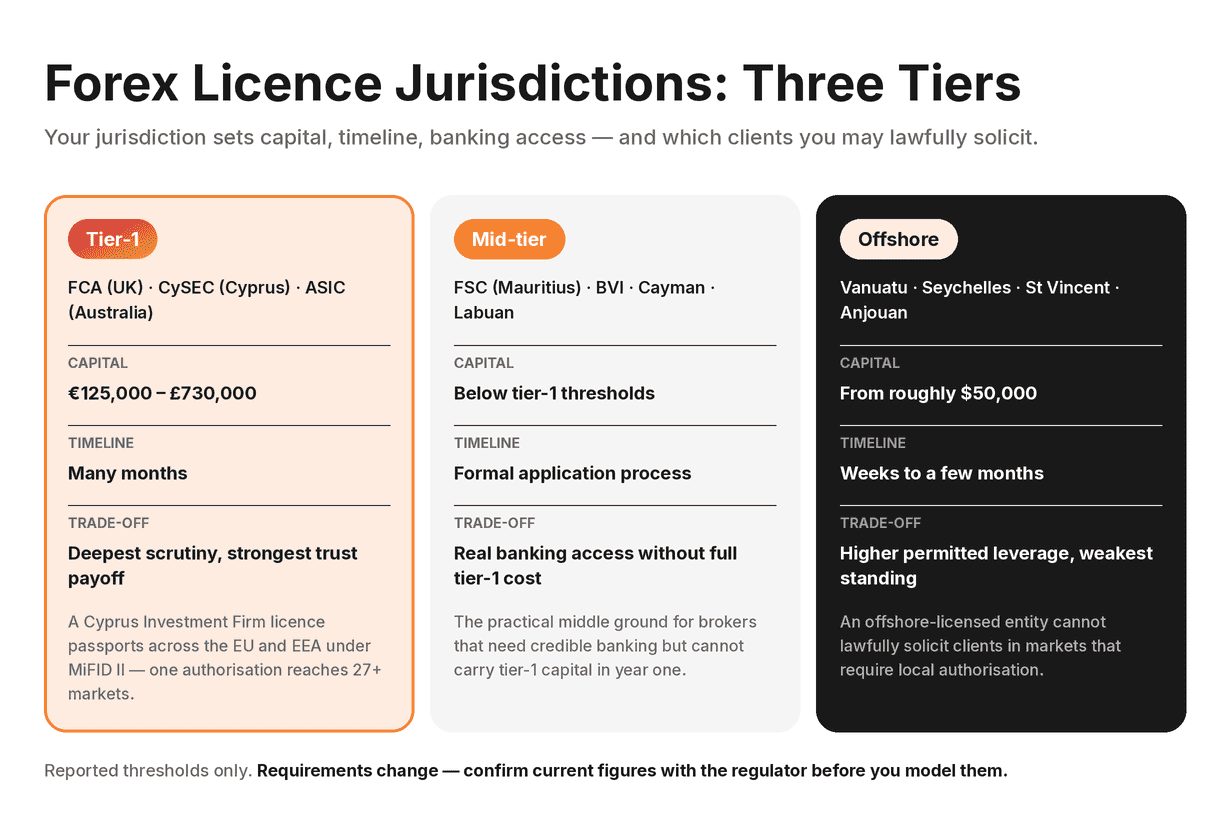
A forex broker licence falls into one of three practical tiers, and the tier you choose determines capital, timeline, and banking access.
Tier-1: the FCA in the UK, CySEC in Cyprus, ASIC in Australia. Longest timelines, highest capital, deepest scrutiny, strongest trust payoff. A Cyprus Investment Firm licence passports across the EU and EEA under MiFID II, so one authorisation reaches twenty-seven-plus markets.
Mid-tier: the FSC in Mauritius, plus BVI, Cayman, and Labuan. Real banking access and a formal application process, without full tier-1 cost.
Offshore: Vanuatu, Seychelles, St Vincent, Anjouan. Obtainable in weeks to a few months, modest capital, higher permitted leverage.
This is where the decision gets concrete. If your target clients sit in the EU or the UK, an offshore licence will not carry you. An offshore-licensed entity cannot lawfully solicit clients in markets that require local authorisation.
There is a reasonable counter-argument for starting offshore. You launch, prove the model, then apply for a tier-1 licence with revenue and a track record behind you. The cost is how banks, payment providers, and clients read you in the meantime, and that cost is real.
Capital and Compliance Requirements
Capital requirements scale with the licence class, not with the trading platform you choose.
Reported thresholds run from roughly $50,000 for offshore registrations, to €125,000 through €730,000 across the Cypriot investment firm classes, up to £730,000 for the heaviest UK permissions. Thresholds change. Confirm current figures with the regulator before you model them.
Obligations that no platform licence creates:
Client money segregation in accounts held separately from company funds
Minimum regulatory capital maintained on an ongoing basis
Local directors plus staffed compliance, risk, and internal audit functions
AML and KYC procedures with documented monitoring
Regular reporting, external audits, and supervisory inspections
What this means: the MT5 server does not care whether your capital is adequate. Your regulator does, and it is the regulator that can stop you trading.
MT5 Licence vs Brokerage Licence: Side-by-Side Comparison
The clearest way to settle the broker licence vs platform licence question is to put both in one table.
MT5 Broker Licence | Brokerage Licence | |
|---|---|---|
What it is | Commercial software licence for a trading platform | Regulatory authorisation to provide investment services |
Who issues it | MetaQuotes Software, a software company | A financial regulator such as the FCA, CySEC, ASIC or the FSC in Mauritius |
What it permits | Running branded MT5 terminals and server infrastructure for clients | Accepting client funds, soliciting clients, acting as counterparty |
Typical cost | White label from around $5,000 setup plus $1,000+ monthly; full licences quoted from about $10,000 monthly | Capital from roughly $50,000 offshore to £730,000 for heavy tier-1 permissions, plus application and ongoing compliance costs |
Typical timeline | Weeks once approved. White label launches commonly quoted at 4 to 8 weeks | Weeks to months offshore. Many months for tier-1 |
Prerequisite | Reported to require an existing financial services licence and a company-registered domain | Company formation, capital, staffed compliance functions, and a business plan |
Without it | You cannot lawfully operate MetaTrader 5 for clients | You cannot lawfully hold client money or solicit clients, whatever platform you run |
Read the last row twice. One licence is a technology blocker. The other is an existence blocker.
Not sure which option fits your business?
From startup brokerages to established platforms, WSA delivers websites that convert traders, satisfy regulators, and scale across markets.
Which Comes First? The Correct Launch Sequence
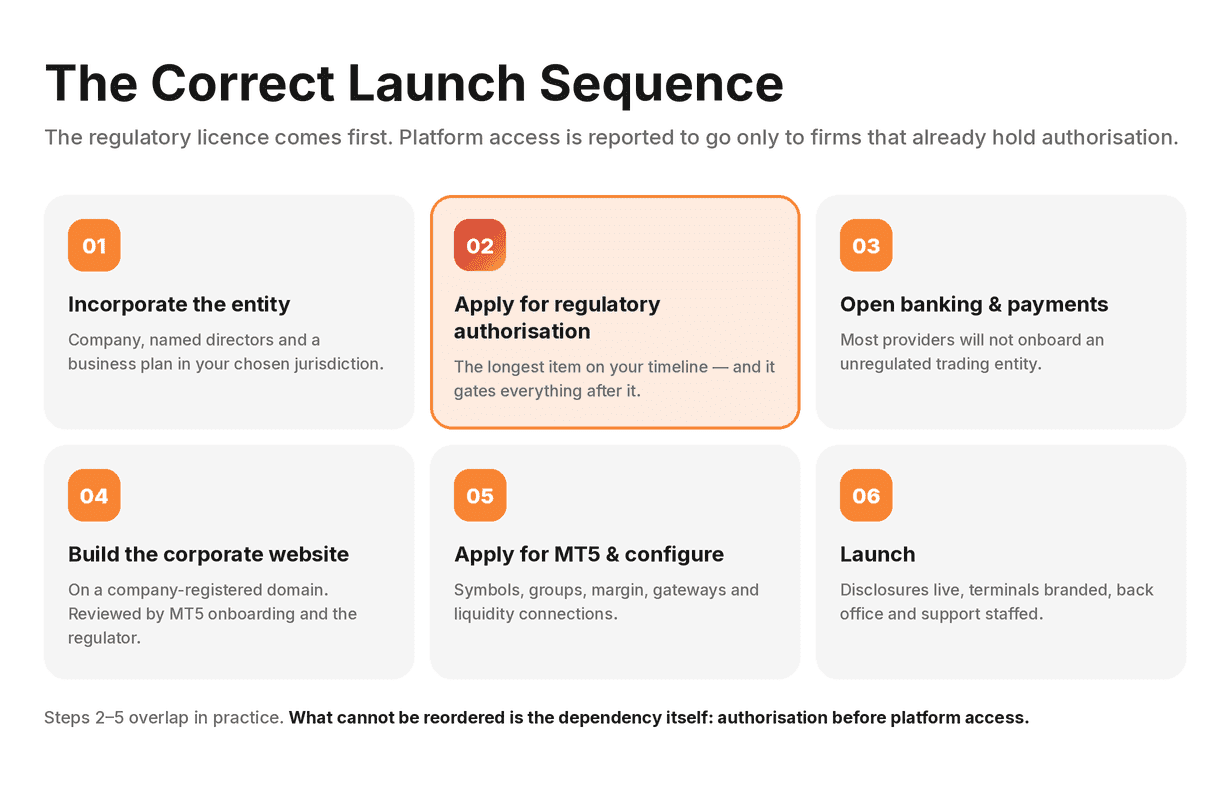
The brokerage licence comes first. Platform access is reported to be granted only to firms that already hold regulatory standing, so MT5 cannot lead the process.
Incorporate the operating entity in your chosen jurisdiction. The licence application needs a company, named directors, and a business plan.
Apply for regulatory authorisation. This is the longest item on your timeline and it gates everything after it.
Open banking and payment relationships. Most banks and payment providers will not onboard an unregulated trading entity.
Build the corporate website on a domain registered to the company. Reported MT5 prerequisites and regulator review both depend on it.
Apply for the MT5 broker licence and configure the platform: symbols, groups, margin, gateways, and liquidity connections.
Launch. Disclosures live, terminals branded, back office and support staffed.
Steps 2 through 5 overlap in practice. The licence application runs for months, and the website and platform configuration can be built alongside it.
What cannot be reordered is the dependency itself: authorisation before platform access. The same sequencing logic applies to launching a fintech company in any regulated vertical.
Where Founders Get the Order Wrong
The most common mistake is treating the platform as step one.
Budgeting the platform and forgetting the capital. Founders arrive with $40,000 earmarked for technology and no plan for the regulatory capital their chosen licence requires.
Choosing the jurisdiction to fit the platform. The jurisdiction should follow your target market, not your vendor's convenience.
Assuming the platform confers status. It does not, and the market knows it does not.
Can an unregulated company use MetaTrader 5? In practice, some operators do run MT5 under entities with no meaningful authorisation.
What it costs them is specific. Tier-1 banks and payment processors decline them. App store distribution becomes fragile. EU and UK clients are off limits. And the first serious client complaint has nowhere good to go.
Picture the version that happens most often. A broker launches on a rented white label under a shell entity. Deposits arrive through a high-risk processor at 6%, clients start asking who regulates the firm, and the answer is a page that does not exist.
The platform was never the problem. The absence of a licence was.
Why Your Website Is Part of the Licensing Process
A live corporate website is not a post-launch task. It appears inside the reported MT5 licence requirements and inside regulator application review.
Most launch plans treat licensing, platform, and website as three separate workstreams running in parallel. In practice the website sits underneath the other two.
The MT5 application is reported to expect a company-registered domain with a corporate email on it. The regulator reads your public pages to judge whether your client communications are fair, clear and not misleading.
In WSA's work with broker clients, the website is usually the workstream nobody resources until month three. The delay that causes is not a design delay. It is an approval delay, and it is the expensive kind.
The MetaQuotes Corporate Website Requirement
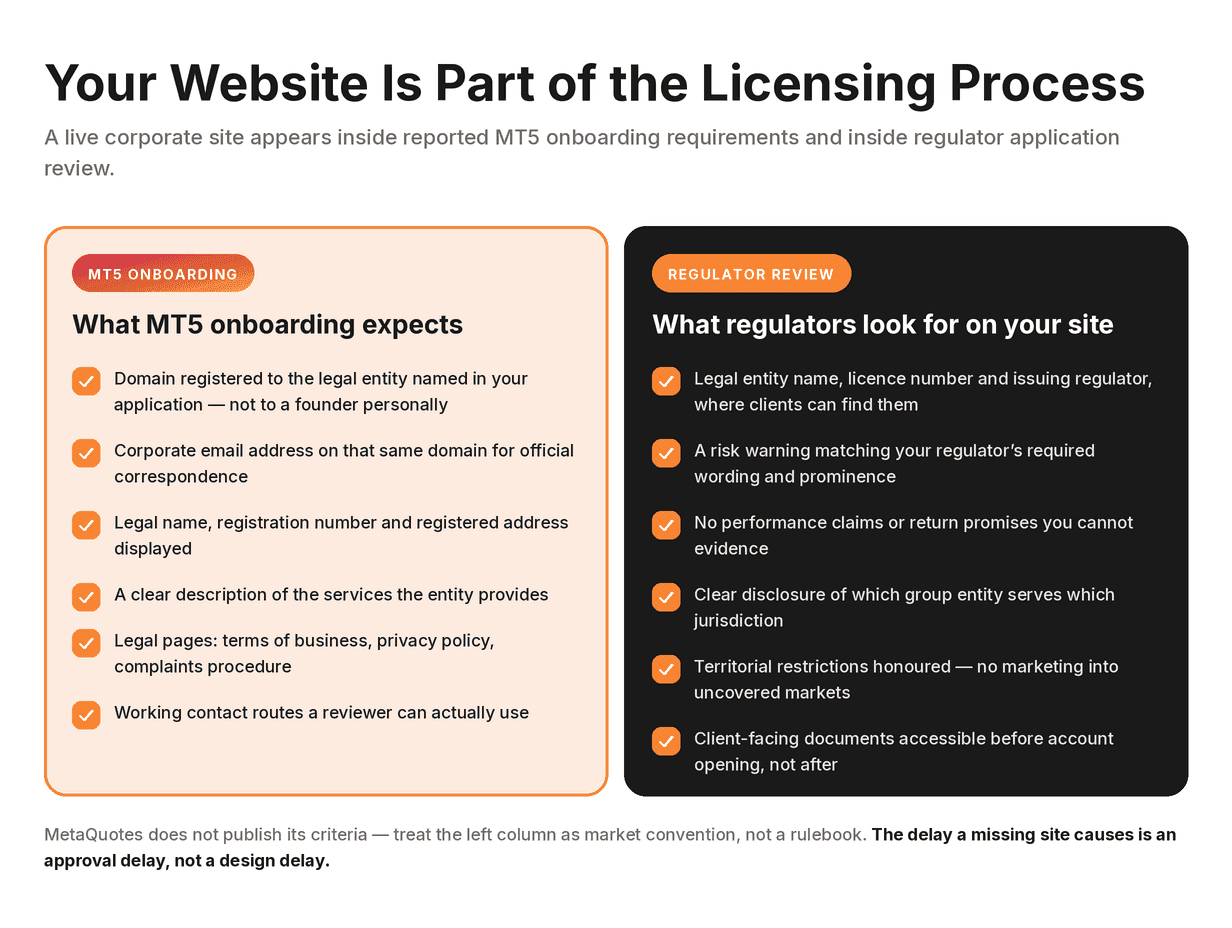
Providers and licensing consultants consistently report that MT5 onboarding expects a corporate website on a domain registered to the applicant company, plus a corporate email address on that domain.
What needs to be live before either review begins:
A domain registered to the legal entity named in your application, not to a founder personally
Corporate email on that domain for official correspondence
The company's legal name, registration number, and registered address
A clear description of the services the entity provides
Legal pages: terms of business, privacy policy, and a complaints procedure
Working contact routes that a reviewer can actually use
The vendor does not publish these criteria, so treat the list as a well-supported market convention rather than a rulebook. Confirm current requirements before you build to them.
The underlying point holds either way: a placeholder page does not read as a financial institution, and current fintech web design trends set a bar that a template will not clear.
What Regulators Expect to See on a Broker Site
Regulators review the public website as part of assessing whether a firm's client communications are fair, clear and not misleading. CySEC and the FCA both examine client-facing content, and both have acted against firms whose marketing overstated what they offered.
Legal entity name, licence number, and issuing regulator, displayed where clients can find them
A risk warning disclosure matching your regulator's required wording and prominence
No performance claims or return promises you cannot evidence
Clear disclosure of which group entity serves which jurisdiction, if you run more than one
Territorial restrictions honoured, with no marketing into markets your licence does not cover
Client-facing documents accessible before account opening, not after
The risk warning disclosure is where most first drafts fail. It gets treated as a footer element rather than a design requirement, and the wording differs by regulator. A broker website compliance checklist is worth working through line by line before submission.
How WSA Builds Launch-Ready Broker Websites
Licensing timelines and website timelines rarely match, and the website is usually the one that slips.
WSA is a web design agency built specifically for fintech and brokerage clients. We build on Framer, which means a full broker site ships in weeks rather than months. Your team can update disclosures and product pages afterwards without waiting in a developer queue.
Compliance-aware structure. Risk warnings, entity disclosures, and jurisdiction gating designed in from the first wireframe, not retrofitted after a reviewer flags them.
Launch-speed Framer builds sized to fit a licence application timeline rather than run past it.
Conversion-first architecture for regulated products, including high-converting landing pages built for each acquisition channel.
CMS and integrations so your team can publish legal updates without a release cycle.
One honest limit: we do not advise on licensing and we do not file applications. That is work for your law firm and your licensing consultant.
What we make sure of is that when a reviewer opens your domain, the site is finished, accurate, and does not undermine everything the application says about you.
Launch Your Licensed Brokerage with Confidence
We support brokers and fintechs through licensing, launch planning, and everything a regulated brand needs to go live.
Conclusion
You need both licences, and the regulatory one comes first. An MT5 broker licence is a technology agreement with a software company. A brokerage licence is permission from a financial authority to run a financial business.
Confusing the two costs founders months, because the platform is the part you can buy and the authorisation is the part you have to earn.
Plan the licence first, then the platform, and build the website alongside both. Nothing here is legal advice, and requirements differ by jurisdiction, so confirm your specifics with a licensing specialist before you commit capital.
FAQ
Do I need both an MT5 licence and a broker licence?
Yes. You need both, and they cover different things. The MT5 licence is a commercial software agreement with MetaQuotes that lets you operate the MetaTrader 5 platform for your clients. The brokerage licence is authorisation from a financial regulator that lets you accept client funds, solicit clients, and act as their counterparty. Neither substitutes for the other. Running MT5 without regulatory authorisation leaves you unable to bank, process payments, or lawfully market in most jurisdictions. Holding a regulatory licence without a platform licence leaves you authorised with nothing for clients to trade on.
Does an MT5 licence make a brokerage regulated?
No. An MT5 licence is a software licence and confers no regulatory status whatsoever. MetaQuotes states on its own website that it is a software development company and does not provide investment or brokerage services, which means it has no authority to regulate anyone. Displaying the MetaTrader logo is a familiarity signal for traders, not a compliance credential. Clients, banks, and payment providers assess your regulator, your licence number, and your jurisdiction. Those come from a financial supervisory authority such as the FCA, CySEC, ASIC, or the FSC in Mauritius.
Can an unregulated company use MetaTrader 5?
Generally no, at least not in any way that supports a real business. Reported MT5 onboarding requirements include proof of company registration in financial services and an existing financial services licence, so an unregulated entity is unlikely to be approved. Some operators do trade on sub-licensed platforms under entities with minimal authorisation. The practical consequences are consistent: tier-1 banking and payment processing are refused or priced punitively, app store distribution is unreliable, EU and UK retail clients cannot lawfully be solicited, and client disputes carry no regulatory backstop.
Which comes first, the licence or the trading platform?
The regulatory licence comes first. MT5 platform access is reported to require proof of regulatory standing, so the application sequence runs company formation, then regulatory authorisation, then banking, then the platform. In practice several of these overlap. You can configure infrastructure, build your website, and prepare disclosures while the licence application is in review, and most well-run launches do exactly that. What you cannot do is invert the dependency. Approaching the platform vendor before you hold authorisation generally means being told to come back once you do.
How much does it cost to launch an MT5 brokerage in 2026?
Budget in two separate columns, because platform and regulatory costs are unrelated. On the platform side, B2BROKER's 2026 breakdown puts white label setup at roughly $5,000 to $15,000 one-time and $1,000 to $5,000 monthly, rising to $2,700 to $11,000 all-in once liquidity, CRM, and compliance support are included. New full licences are quoted from approximately $10,000 monthly under current terms. On the regulatory side, capital alone runs from roughly $50,000 offshore to £730,000 for the heaviest tier-1 permissions, before application fees, local staffing, and audit. Treat every figure as a starting range. Market pricing is quoted inconsistently and regulatory thresholds change.
Launch Your Licensed Brokerage with Confidence
We support brokers and fintechs through licensing, launch planning, and everything a regulated brand needs to go live.