•
•

MT4 vs MT5 White Label: Cost, Requirements and Setup
You have a registered company, a liquidity provider on a call and two quotes on your desk. One is for an MT5 white label. The other is for MT4, and on paper it looks cheaper.
Before you sign either, you need to know what you are buying. MetaQuotes announced in January 2018 that it would stop issuing new MT4 licences. Industry reports say it stopped issuing new MT4 and MT5 white labels in 2022, so both options now run on capacity that a provider already holds.
This guide compares the two platforms, prices the package, lists what you need before you sign and shows how long setup takes. It also covers what the package leaves for you to build.
This article is for informational purposes only and does not constitute legal advice. Brokers should consult qualified legal and compliance professionals for jurisdiction-specific guidance.
Key Takeaways
MetaQuotes stopped issuing new MT4 licences after January 2018 and, according to industry reports, new MT4 and MT5 white labels in 2022. You buy access from an existing licence holder.
MT5 is the default for a 2026 launch: multi-asset, hedging and netting, 21 timeframes. MT4 fits a pure-forex brokerage whose traders depend on MQL4 Expert Advisors and whose provider confirms capacity in writing.
Providers publish roughly $5,000 to $15,000 for setup and $1,000 to $5,000 a month for the platform. Liquidity, CRM, payments and compliance are priced on top.
Platform delivery takes 1 to 4 weeks. Licence approval and your website usually take longer, so they set your launch date.
The package ends at the trading server. Your website, legal pages and client onboarding are still yours to build.
MT5 White Label vs MT4: What You Are Actually Choosing
A white label lets you run a brokerage under your own brand on a platform whose licence belongs to someone else. You get the trading server, branded terminals and admin access. Your provider keeps the MetaQuotes licence.
That makes the real choice one of access, not just software. You are picking a platform and a provider's capacity at the same time.
This is where quotes go wrong. Imagine a founder who compares an MT4 offer at a lower monthly fee with an MT5 offer and picks the cheaper one. Later the founder learns the MT4 server is shared capacity with no guarantee beyond the first contract term. The saving disappears the first time the provider renegotiates.
What a White Label Gives You (and What It Does Not)
Three models sit behind any MT5 white label solution, and providers use the words loosely. Ask each one to define its terms in the quote.
Main label: you hold the MetaQuotes licence yourself. You control the server, but it takes months and usually needs a financial licence first.
White label: your brand runs on a server operated by a main-label holder. Launch takes weeks.
Grey label: minimal branding on a provider's setup. It is the fastest and cheapest route, with the least room to differentiate.
A typical white label package covers server hosting, terminal branding, symbol setup, manager accounts and basic support. Liquidity, CRM, payments, compliance and your website are usually separate.
Why MetaQuotes Changed Who Can Offer MT4 and MT5
In January 2018, MetaQuotes said it would stop issuing new MT4 licences to new clients and positioned MT5 as the successor platform, as Finance Magnates reported. Existing MT4 users could keep operating.
In 2022, trade outlets reported that MetaQuotes had stopped issuing new MT4 and MT5 white labels. Atomiq Consulting wrote at the time that a full MT5 licence, backed by a financial licence and a corporate bank account, was the only direct route for a new broker.
What this means: providers sell you access through licences they already hold. Ask which licence your server runs under and how long the provider expects to keep that capacity.
Sources disagree on exact availability, because some providers still advertise MT5 white labels to new brokers. Get the licence arrangement in writing before you pay a setup fee.
MT4 vs MT5 White Label: Server, Bridge, Liquidity and Reporting Differences
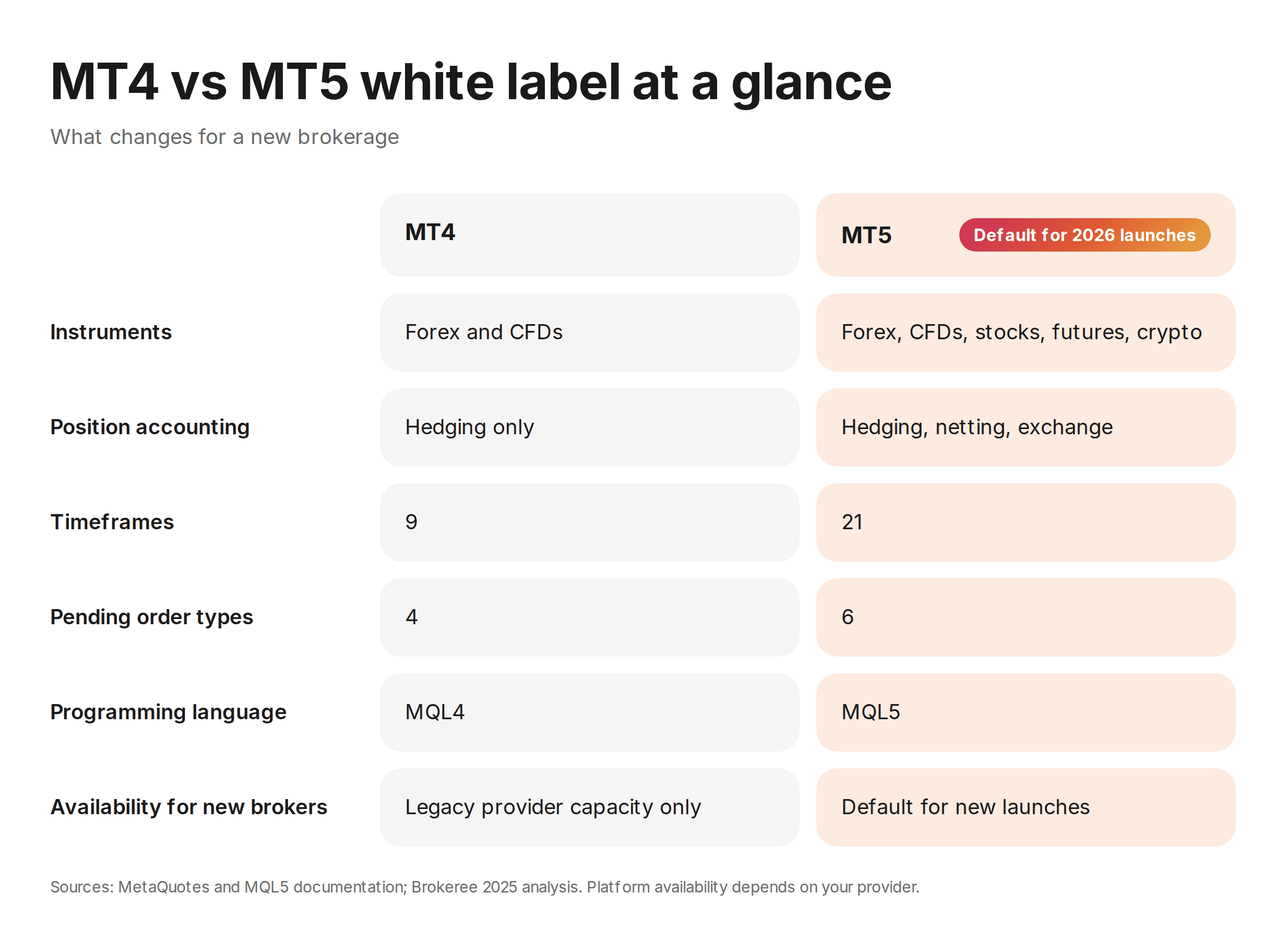
The main difference is architecture. MT4 is a forex and CFD platform with hedging only. MT5 is multi-asset and supports hedging, netting and exchange margin modes.
Every other difference follows from that. It changes what you can list, how positions are counted and how your liquidity connects.
Server and Trading Model
MT5 lets the broker set the account type on the server. The MQL5 documentation lists three margin modes: retail netting, exchange and retail hedging. MetaQuotes also lists four execution modes for MT5: instant, request, market and exchange, set by the broker for each instrument.
MT4 has no netting option. If you plan indices, stocks or futures alongside forex, MT4 pushes you into workarounds.
MT4 does have one strong argument: MQL4 Expert Advisors. Traders with years of EAs on MT4 will not switch easily, because EAs do not port to MQL5 without being rewritten. That is the main reason an MT4 white label still has buyers.
Feature | MT4 | MT5 |
|---|---|---|
Instruments | Forex and CFDs | Forex, CFDs, stocks, futures, crypto |
Position accounting | Hedging only | Hedging, netting, exchange |
Timeframes | 9 | 21 |
Pending order types | 4 | 6 |
Programming language | MQL4 | MQL5 |
Availability for new brokers | Legacy provider capacity only | Default for new launches |
Bridge and Liquidity Connection
Both platforms connect to liquidity providers over FIX API. On MT4 that link is usually a bridge. On MT5, providers often use a gateway that plugs into the platform more directly, according to Brokeree's 2025 analysis.
This trading platform integration is where quotes diverge most. One provider includes the liquidity connection, another charges for it monthly.
Reporting and Back Office
MT5 was designed with modern reporting and audit needs in mind. On MT4, compliance reporting often needs extra plugins for execution reports and negative balance protection.
Your CRM, KYC and client cabinet connect to the server through manager-side APIs. That MT4 integration or MT5 integration is a separate line item, and plugin availability differs by platform.
Partner and IB tracking deserves its own question. According to one 2026 platform comparison, the IB modules bundled with white label packages are usually basic, with flat per-lot rebates and limited multi-tier logic. If you plan an affiliate programme, ask what is native and what needs a plugin.
Your Broker Site Has to Match the Platform You Pick
The client cabinet, sign-up flow and legal pages all sit on top of the trading server. See how we build them for licensed brokers.
White Label Forex Broker Cost: MT4 and MT5 Compared
Expect a one-time setup fee and a monthly fee, with liquidity, CRM and compliance priced on top. Every figure below is an indicative range from providers' published price guides in 2026, not a quote. MT5 white label cost also moves with the servers and add-ons a provider bundles.
Setup Fees and Monthly Fees
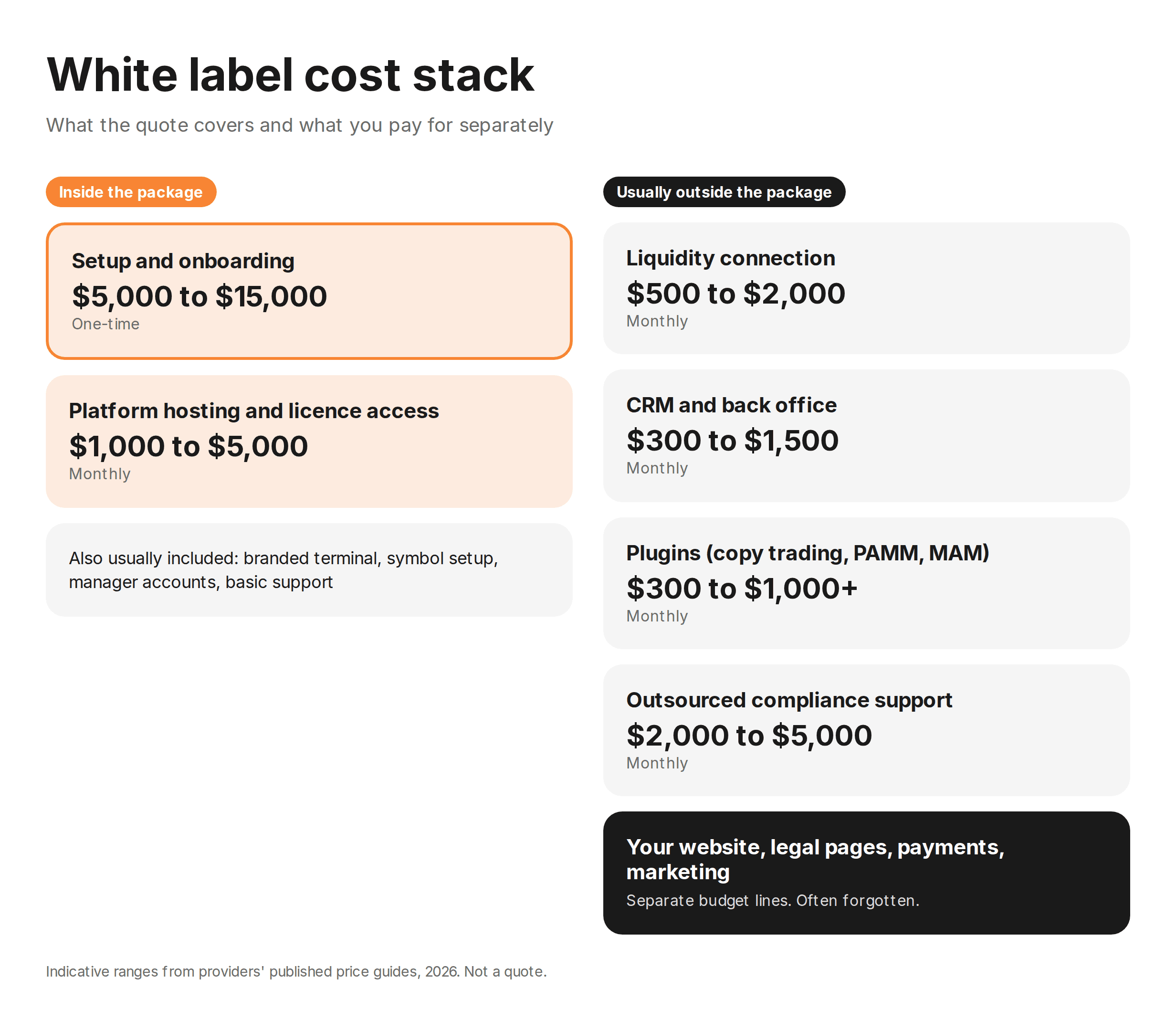
Cost item | Indicative range | Billing |
|---|---|---|
Setup and onboarding | $5,000 to $15,000 | One-time |
Platform hosting and licence access | $1,000 to $5,000 | Monthly |
Liquidity connection | $500 to $2,000 | Monthly |
CRM and back office | $300 to $1,500 | Monthly |
Copy trading, PAMM or MAM plugins | $300 to $1,000+ | Monthly |
Outsourced compliance support | $2,000 to $5,000 | Monthly |
The published ranges we reviewed do not split MT4 and MT5 pricing. The gap shows up in scope and availability instead. An MT4 white label is limited capacity, so providers tend to quote it case by case.
Here is why scope matters. Imagine Provider A quotes $8,000 setup and $2,500 a month with the liquidity gateway included. Provider B quotes $5,000 setup and $1,500 a month, then adds $1,200 for liquidity and $800 for CRM. Provider B looks $1,000 a month cheaper until you add the extras, and then it costs $3,500 a month against $2,500.
Add platform, liquidity and CRM and your run rate is roughly $1,800 to $8,500 a month. With setup, that puts year one at about $27,000 to $117,000 before compliance support, payments and marketing.
What this means: white label forex broker cost is only comparable once two quotes list the same scope. Ask each provider to itemise server, liquidity, CRM, reporting and support. Our full white label cost breakdown gives a checklist for comparing them.
Costs Outside the Package
The quote covers the platform. These items usually sit outside it:
Liquidity and market data
KYC, payments and client cabinet
Licensing, legal and compliance consulting
Your website, domain and legal pages
Marketing and affiliate tracking
Founders often budget the platform and liquidity and forget the website. Your broker website budget belongs in the same spreadsheet, because launch depends on it.
MT5 White Label Requirements Before You Sign
You need a company, a licence route, a corporate bank account and a live company website before a provider or MetaQuotes will proceed. The exact checklist varies by provider and jurisdiction.
A registered company with directors and shareholders who pass verification.
A corporate bank account in the company's name. E-wallets and payment-service accounts are typically not accepted.
A licence or a credible licence route for the jurisdiction you operate in. The MT5 licence and a brokerage licence are two different approvals, and the brokerage licence usually comes first.
A live company website on a domain that matches your company name, with legal and company pages.
A liquidity plan and a KYC process that your provider can connect to.
Here is where founders lose weeks: the paperwork is ready, but the site is a placeholder. Ask when the monthly fee starts: at signature, at delivery or at go-live. Our guide to MT5 white label requirements lists what a reviewer expects to see on it.
This is not legal advice. Confirm the checklist with your provider and a lawyer in your jurisdiction.
How Long Does White Label Setup Take?
Most providers quote 1 to 4 weeks to deliver the platform once your paperwork is complete. A full MT5 licence takes 2 to 6 months. Your licence approval and your website usually take longer than the platform, so they set your real launch date.
Step | Indicative time | Notes |
|---|---|---|
Choose provider and sign the quote | 1 to 2 weeks | Planning estimate |
Company documents, bank account, KYC | 2 to 6 weeks | Varies by jurisdiction |
Platform delivery: server, branding, symbols | 1 to 4 weeks | Provider-quoted range |
Liquidity connection and testing | 1 to 2 weeks | Planning estimate |
Website, legal pages, client cabinet | 3 to 5 weeks | WSA planning estimate; start in week 1 and run in parallel |
A main label takes longer because you deal with MetaQuotes directly, run your own servers and hire technical staff to manage them. A white label trades that control for speed.

Teams tend to skip one step: testing trading platform integration with the website. Sign-up, account creation and the client cabinet all have to work end to end before launch.
The consequence is simple. If the website starts after the platform is delivered, you pay monthly platform fees while nobody can open an account.
Start the Website Before the Platform Is Delivered
The site is the step most likely to delay your launch date. Map your broker website timeline against your provider's delivery date.
MT4 or MT5 for a New Brokerage: A Decision Framework
Choose MT5 unless two conditions hold: your traders depend on MQL4 Expert Advisors, and your provider confirms MT4 capacity in writing. Three questions settle it.
Which instruments will you offer? Forex only works on either platform. Indices, stocks, futures or crypto CFDs point to MT5.
Do your target traders run MT4 Expert Advisors? MQL4 EAs do not port to MQL5 without rewriting. If your audience relies on them, MT4 has a real pull.
Can the provider commit to capacity and support? Brokeree's 2025 analysis describes MT4 as in maintenance mode, with security updates but no new features. It also reports that 68% of brokers offer MT5 and 40% still offer MT4.
Imagine a founder targeting retail traders in a region where MT4 dominates. The pull toward MT4 is real. But if the provider cannot guarantee capacity beyond a year, the founder risks migrating clients and rewriting EAs later.
If you do go with an MT4 white label, ask three extra questions:
How long is the capacity guaranteed, and what happens at renewal?
What is the migration path to MT5 if MT4 support ends?
Which compliance and reporting plugins are included?
If your traders prefer cTrader, the same scope questions apply to cTrader integration, though it sits outside this comparison.

What a White Label Package Leaves You to Build
The package ends at the trading server. The website, legal pages and client onboarding are still yours, and they are the parts your clients see first.
In WSA broker projects, this layer is often the last item on the critical path. It is also the easiest to start early, because it does not depend on the platform.
Website and Legal Pages
You need a corporate website that states who you are, where you are licensed and what risks clients take. That means terms of business, risk disclosure, privacy and complaints pages, plus licence details in a consistent place.
The site is part of your application, not only your marketing. Our broker website guide covers the pages a regulator and a reviewer expect.
WSA builds these sites on Framer and Webflow, so your team can edit legal text without a developer.
The Client Journey Around the Platform
Your clients do not start in the terminal. They start on your site, register, pass KYC, fund an account and only then download the platform.
Each hand-off is a place to lose people. A slow sign-up form or a confusing funding step wastes the ad budget that brought the visitor.
What this means: treat the website, cabinet and platform as one journey. Design it once, then connect the platform to it.
Build the Broker Website Your Platform Deserves
Legal pages, sign-up flow and client journey designed for licensed brokers, on a timeline that matches your platform delivery.
Conclusion
Choosing between an MT5 white label and an MT4 white label is less about features than access. MetaQuotes closed new MT4 licences in 2018 and, according to industry reports, new white labels in 2022, so your provider's capacity matters as much as the platform.
Choose MT5 unless your traders depend on MQL4 Expert Advisors and your provider can guarantee MT4 in writing. Compare quotes on the same scope, and start your website in week 1, because it sets your launch date more often than the server does.
If you want the client-facing layer built in parallel with your platform, talk to WSA about your broker website.
FAQ
How much does an MT5 white label cost per month?
Providers typically publish about $1,000 to $5,000 per month for the platform alone, plus a one-time setup fee of roughly $5,000 to $15,000.
Liquidity connection (about $500 to $2,000), CRM and back office (about $300 to $1,500) and optional plugins are billed on top. Combined, a realistic monthly run rate for platform, liquidity and CRM is about $1,800 to $8,500. These are indicative 2026 ranges, so ask for an itemised quote.
What is included in an MT5 white label?
A typical package includes server hosting, a branded terminal, symbol configuration, manager accounts, software updates and basic technical support.
Some providers also include the liquidity gateway, back-office access or a web terminal. Packages differ, so compare scope line by line before you compare prices.
MT4 or MT5 for a new brokerage?
MT5 is the better default for a new brokerage in 2026.
It supports more instruments, hedging and netting, 21 timeframes and six pending order types. MT4 makes sense only if your target traders depend on MQL4 Expert Advisors and your provider confirms MT4 capacity in writing, since MetaQuotes stopped issuing new MT4 licences after 2018.
What does a white label not include?
A white label does not include your brokerage licence, liquidity, compliance consulting, payment processing or your website.
It also does not include legal pages, the client sign-up journey or marketing. Those are your responsibility, and several of them, such as the corporate website, are needed before the application is accepted.
How long does white label setup take?
Platform delivery typically takes 1 to 4 weeks once your documents are complete.
Company registration, bank account, licence approval and your website often take longer and decide your actual launch date. Start the website in week 1 and run it in parallel with the platform setup.
Launch Your Licensed Brokerage with Confidence
We support brokers and fintechs through licensing, launch planning, and everything a regulated brand needs to go live.