•
•
Where to Store and Present Your Compliance Documents as an FSA-Licensed Seychelles Broker
The FSA Seychelles register lists entity names and licence numbers but does not publish website domains, which makes your site the primary verification channel. Publish risk disclosure, terms and conditions, AML/KYC policy, privacy policy, fee schedule and complaints procedure in a dedicated /legal/ hub. Here's what that means in practice.
This article is for informational purposes only and does not constitute legal advice. Brokers should consult qualified legal and compliance professionals for jurisdiction-specific guidance.
You received your Securities Dealer License from the FSA Seychelles. The capital is deposited, the compliance officer is appointed, and the office in Victoria is set up. Now you need a website that proves all of it.
Unlike CySEC or the FCA, the Seychelles FSA does not publish broker website URLs in its public register. Clients, liquidity providers, and payment processors cannot verify your domain through the regulator. Your website is the only place where your compliance documents, licence number, and regulatory status are visible to the outside world.
This article covers which compliance documents belong on your FSA broker website, how to structure a /legal/ hub that withstands LP due diligence, and what partners actually check in the first 60 seconds of reviewing your site. If the licence is not yet granted, start with the securities dealer licence checklist, and on timing see whether the website has to exist before you apply.
Key Takeaways
The FSA Seychelles register lists entity names and licence numbers but does not publish website domains — your site is the primary verification channel for clients and partners
Compliance documents for an FSA broker website include risk disclosure, terms and conditions, AML/KYC policy, privacy policy, fee schedule, and complaints procedure
A dedicated /legal/ hub with clear navigation makes every document reachable within two clicks from the homepage
Liquidity providers and PSPs review broker websites during onboarding — missing or hard-to-find documents are a common reason for delays
Compliance pages should be part of site architecture from day one, not added after launch as an afterthought
Why Your Website Is the Primary Verification Channel for FSA Seychelles Brokers
The FSA Seychelles register lists licensed entities by name and licence number. It does not publish their website domains.
This creates a practical problem. When a potential client, introducing broker, or liquidity provider wants to confirm that your brokerage is licensed, they can check the FSA's Capital Markets register and find your entity name. But there is no link from that register to your website. The connection between your domain and your licence exists only on your own site.
The FSA Register Gap: Licence Numbers Without Domains
Compare this to CySEC. The Cyprus regulator publishes the regulated entity's website URL directly in its public register alongside the licence number. A client can click from the regulator's page to the broker's website in one step.
The FSA does not offer this. Its register under "Regulated Entities > Capital Markets" shows:
Entity name
Licence number (e.g., SD096, SD040)
Type of licence (Securities Dealer, Investment Advisor)
It does not show: website URL, contact email, physical office address, or the entity's trading name if different from the registered name.
The only time the FSA publicly connects a domain to a licence is in enforcement notices — when it warns the public that a specific website is not associated with a regulated entity. That is not the association you want.
What Clients, LPs, and PSPs Actually Look For
Nearly 200 firms hold FSA Seychelles Securities Dealer Licences. With no domain-level verification from the regulator, the broker's website becomes the differentiator. Clients and partners typically look for:
Licence number visible on the homepage — usually in the footer, sometimes in a header bar
Company registration details — registered name, IBC number, Seychelles registered address
A /legal/ section with clearly labelled compliance documents
Consistency — the entity name on the website matches the entity name in the FSA register
When these elements are present and well-structured, the website builds credibility. When they are missing or buried, it raises questions — regardless of whether the broker is genuinely licensed.
Compliance Documents Every FSA Seychelles Broker Should Publish
FSA Seychelles requires licensed brokers to maintain AML/CFT policies, risk management frameworks, and client-facing disclosures under the Securities Act 2007 and the AML/CFT Act 2020. The regulator does not prescribe an exact website disclosure checklist the way CySEC does (see the full compliance checklist for CySEC and FCA brokers). These recommendations reflect industry best practice and what LPs and PSPs expect to see.
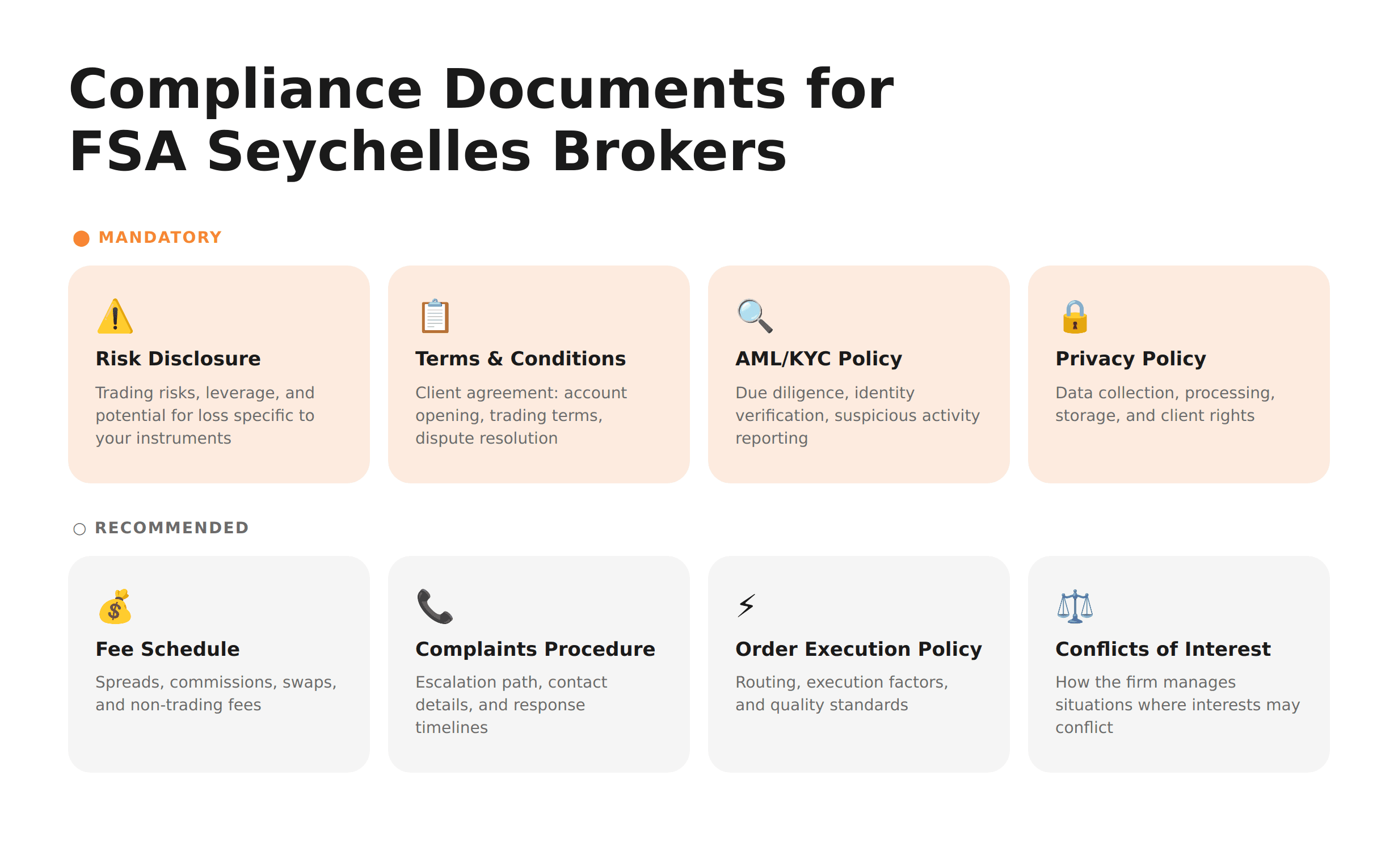
Mandatory: Risk Disclosure, Terms and Conditions, AML/KYC Policy, Privacy Policy
These four documents are non-negotiable for any FSA broker website:
Risk Disclosure — explains the risks of trading CFDs, forex, and other leveraged instruments. Should reflect the actual products and leverage offered, not generic boilerplate.
Terms and Conditions — the client agreement covering account opening, trading terms, dispute resolution, and limitation of liability.
AML/KYC Policy — outlines customer due diligence procedures, identity verification requirements, and suspicious activity reporting obligations in line with the AML/CFT Act 2020.
Privacy Policy — describes how client data is collected, processed, stored, and shared. Should reference applicable data protection standards.
Recommended: Fee Schedule, Complaints Procedure, Order Execution Policy, Conflicts of Interest
These documents are not always legally required to appear on the website, but their absence signals a gap to LP compliance teams:
Fee Schedule — transparent breakdown of spreads, commissions, swap rates, and any non-trading fees (withdrawal, inactivity)
Complaints Procedure — how clients can raise and escalate complaints, including contact details and expected response timelines
Order Execution Policy — how client orders are routed, executed, and the factors affecting execution quality
Conflicts of Interest Policy — how the broker identifies and manages situations where the firm's interests may conflict with client interests
How to Structure a /Legal/ Hub on Your Broker Website
A /legal/ hub is a dedicated section of your broker website that houses all compliance documents in one consistent, navigable location. Instead of scattering PDFs across different pages or burying links in the footer, a /legal/ hub gives every document a permanent, indexed address.
190+ Seychelles Brokers. Your Website Is How Clients Tell the Regulated Ones from the Rest
A compliance-first site structure is not optional — it is your licence made visible.
Page Hierarchy and Navigation Architecture
The structure should follow a simple parent-child model:
Homepage → /legal/ (landing page) → individual document pages
The /legal/ landing page acts as a directory. It lists every available document with a brief description and a direct link. Each document gets its own page — not a PDF download, but a full HTML page with the document content rendered in readable text.
Why HTML pages instead of PDFs? Three reasons:
Search engines index HTML content — PDFs are harder to crawl and rarely rank
Mobile readability — HTML adapts to screen size; PDFs require zoom and scroll
LP review speed — compliance reviewers can scan an HTML page in seconds; a PDF requires downloading and opening
The Two-Click Rule: Accessibility for Regulators and Partners
Any compliance document on your broker website should be reachable in two clicks from the homepage. If a compliance reviewer or LP analyst needs three or more clicks to find your risk disclosure, the structure has failed.
Click 1: Homepage → footer "Legal" link or navigation menu "Legal & Compliance" section
Click 2: /legal/ landing page → specific document (e.g., "Risk Disclosure")
This sounds simple. In practice, many broker websites bury legal documents inside accordion menus, nested dropdowns, or pages labelled with vague names like "Important Information."
Footer Links vs Dedicated Legal Section
Both approaches work — but they serve different purposes:
Footer links are the minimum. Every page on the site should include direct links to at least: Risk Disclosure, Terms & Conditions, Privacy Policy, and AML/KYC Policy.
A dedicated /legal/ section in the main navigation is the professional standard. It signals that compliance is a priority, not a checkbox. For FSA Seychelles brokers, where the website carries the full verification burden, this is the better choice.
The ideal setup uses both: a dedicated /legal/ hub accessible from the main navigation, plus footer links to the four core documents on every page.
What LPs and Payment Providers Check During Due Diligence
When a liquidity provider evaluates an FSA-licensed broker, the website review typically takes under 60 seconds. The analyst is not reading every document word by word. They are checking whether the right elements exist and are findable.
The Due Diligence Walkthrough: First 60 Seconds on Your Website
A typical LP or PSP compliance review follows this sequence:
Homepage scan (5 seconds) — licence number visible? Registered entity name present? FSA Seychelles mentioned?
Footer check (5 seconds) — links to Risk Disclosure, T&C, Privacy Policy present?
/legal/ section (15 seconds) — dedicated page exists? All core documents listed? Documents load and display correctly?
Cross-reference (15 seconds) — entity name on website matches entity name in FSA register? Licence number matches?
Risk disclosure review (20 seconds) — specific to actual instruments offered? Mentions leverage, margin, and loss potential?
If all five checks pass, the website portion of due diligence is complete. If any fail, the onboarding process stalls and the LP requests clarifications — often adding weeks to the timeline.
Red Flags That Block Onboarding
These are the most common website issues that delay or block LP and PSP onboarding for FSA Seychelles brokers:
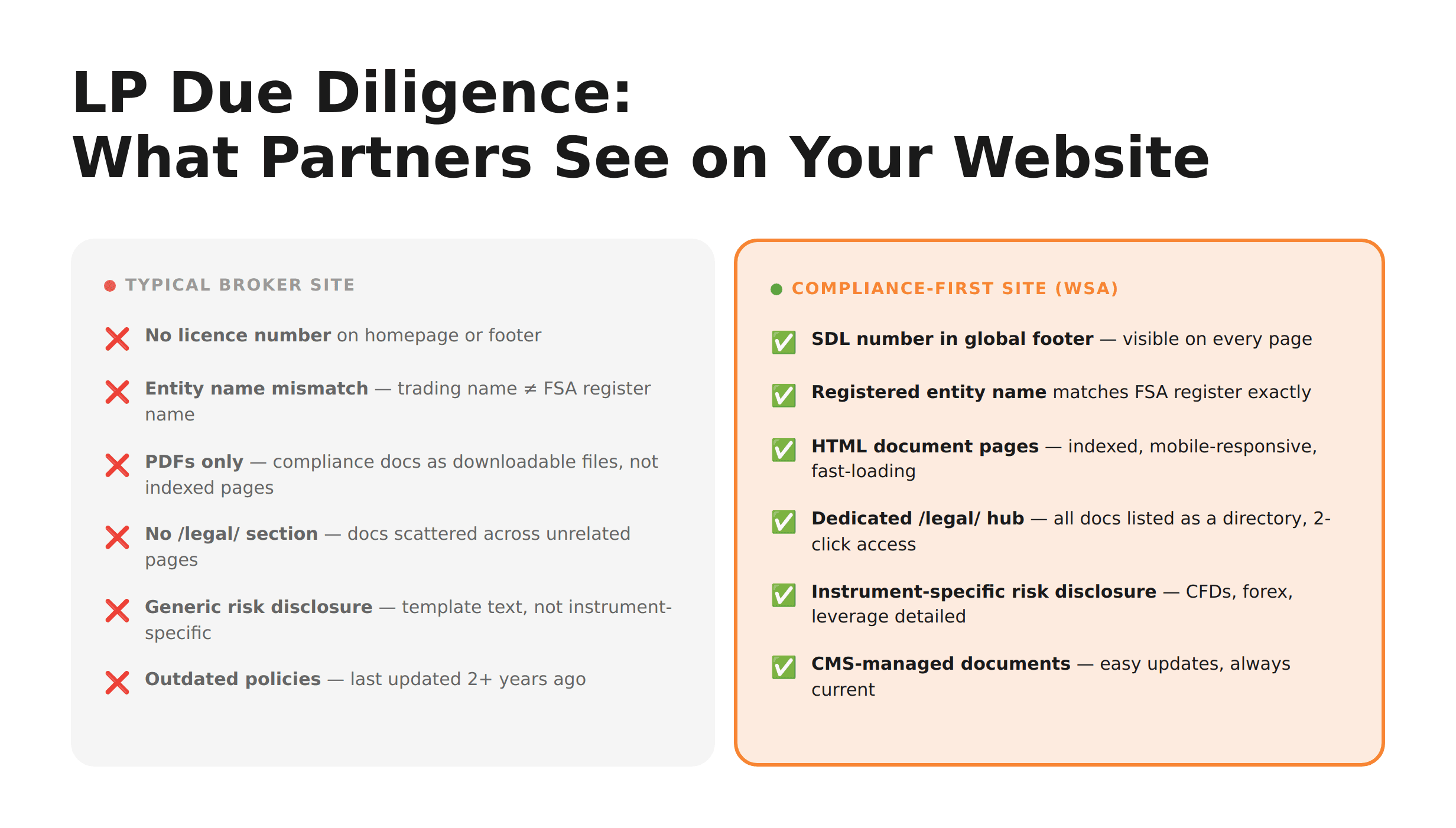
No licence number on the homepage — the simplest and most damaging omission
Entity name mismatch — trading name on website differs from registered name in FSA register, with no visible connection between them
Broken or missing document links — PDF links that return 404 errors, or pages that show empty content
Generic risk disclosure — copy-pasted from a template without adjusting for the broker's actual instruments and leverage
No /legal/ section — documents scattered across unrelated pages, or only accessible through deep navigation
Outdated documents — compliance policies that reference old legislation or show last-updated dates from two or more years ago
Building a Compliance-First Broker Website with WSA
WSA designs broker websites where the /legal/ hub is part of the information architecture from the first wireframe — not added after launch.
For Seychelles-licensed brokers, this means:
Licence and entity details in the global footer — visible on every page, matching the FSA register exactly
A /legal/ landing page with all documents listed, described, and linked
Individual HTML pages for each compliance document — indexed, mobile-responsive, and fast-loading
Risk disclosure integrated into the registration flow — not just on a standalone page, but surfaced at the point of account creation
CMS structure that makes document updates simple — when your compliance team revises the AML policy, publishing the update takes minutes, not a development ticket
This approach applies to broker websites built in Framer and Webflow (whether a new build or a broker website redesign) — both platforms support the page hierarchy, CMS integration, and footer architecture required for a compliance-first structure.
FAQ
What documents must an FSA Seychelles broker display on their website?
At minimum: a risk disclosure, terms and conditions, an AML and KYC policy, and a privacy policy. Add a fee schedule, a complaints procedure and clear jurisdictional restrictions, and display the licensed entity name, licence number and registered address on every page. The reason to publish more than the minimum is specific to Seychelles. The FSA register lists entity names and licence numbers but does not publish website domains, so there is no official way for a client, a bank or a liquidity provider to confirm that this site belongs to that licence. Your own website becomes the primary verification channel, which makes complete and consistent details more important here than in jurisdictions that publish an approved-domains register.
Does the Seychelles FSA require specific risk warning text on broker websites?
No. The FSA does not mandate a standardised risk warning format in the way CySEC and the FCA do, so there is no prescribed wording or minimum font size to copy. That freedom is a trap rather than a relief. Without a template, the disclosure has to be written to describe your actual products, leverage levels and client categories, and a generic paragraph copied from another broker will not match what you offer. Two audiences will judge it anyway: banks and liquidity providers apply their own standards during onboarding, and those standards are usually closer to the FCA's than to the FSA's. Write to the stricter benchmark, because the commercial partners are the ones who can refuse you.
Where should compliance documents appear in broker website navigation?
Within two clicks of the homepage, which in practice means a dedicated legal hub linked from the footer on every page. Put the hub at a predictable path such as /legal/ and list each document as its own page rather than as a bundled PDF, so each one has a URL that can be linked, indexed and cited in a due diligence questionnaire. Footer links alone are not enough on their own: a reviewer opening your site for the first time should be able to reach the risk disclosure without using search. The test is simple. Hand the site to someone unfamiliar with it and ask them to find your complaints procedure. If it takes more than two clicks, restructure it.
How do liquidity providers verify an FSA Seychelles broker's licence through the website?
They cross-reference the entity name and licence number shown on your website against the FSA's Capital Markets register, so both details have to appear on the site and match the register exactly. The complication is that the FSA register does not publish domains. There is no official record connecting a licence to a website, which means the reviewer is relying on your site to make that link credibly. A mismatch of any kind, including an outdated registered address or a trading name that does not appear on the register, stalls the review while it gets explained. Publish the full legal entity name, the licence number and the registered address in the footer, and keep them identical to the register.
Can I use a template site for an FSA-licensed broker, or does compliance require custom design?
When weighing a custom vs template broker website, the answer depends on compliance architecture. A template can work if it supports the required page hierarchy — a global footer with licence details, a dedicated /legal/ section, individual pages for each document, and CMS-managed content for easy updates. The problem with most templates is that they lack the information architecture for compliance pages. They are designed for marketing-first websites, not regulated broker websites. A custom or customised build, where the /legal/ hub is part of the site structure from day one, reduces the risk of compliance gaps that surface during LP onboarding.
Conclusion
Your FSA Seychelles licence proves you met the regulator's standards. Your website proves it to everyone else.
With the FSA register showing licence numbers but not domains, the burden of verification falls on the broker's own site. A well-structured /legal/ hub, consistent entity details, and accessible compliance documents are what separate a credible FSA broker website from one that raises questions during LP onboarding.
The documents are finite. The real challenge is presenting them in a way that builds trust in seconds — not minutes.
WSA builds broker websites for Seychelles-licensed firms where compliance architecture is part of the design from the first wireframe. If your site needs to pass LP due diligence before your first onboarding, that is where it starts.
Launch Your Licensed Brokerage with Confidence
We support brokers and fintechs through licensing, launch planning, and everything a regulated brand needs to go live.