•
•

Startup Launch: High-Conversion Website in Days (not Months)
Most fintech founders underestimate what a website actually is. It is not a brochure. It is not a placeholder while the product gets built. For a forex broker, a crypto exchange, or a prop trading firm, the website is the first regulated touchpoint — the asset that determines whether a liquidity provider takes the call, whether a payment processor approves the account, and whether a trader decides to register or close the tab.
The pressure is high from day one. And yet, most early-stage financial platforms either launch with a template that undermines trust before a single word has been read, or they wait months to launch with a scope and vendor list that has grown exponentially. Neither of these options works when launch times directly impact licensing and revenue.
There is a better path. A high-conversion fintech website — built on the right platform, structured around compliance from the start, and designed with fintech UX principles — can go live in 14 days. Not as a compromise. As a deliberate, professional execution. The following framework shows exactly how.
Key Takeaways
A high-conversion website can be realistically launched in several days if scope is locked in early, compliance is integrated from day one, and cutting-edge tools like Webflow or Framer are used.
The website performs four business-critical roles: trust engine, lead acquisition funnel, compliance asset, and growth platform.
Fintech website design differs fundamentally from standard web design — regulatory scrutiny, conversion architecture, and onboarding UX demand specialist knowledge.
Common launch delays stem from scope creep, late-stage compliance additions, and platform mismatches — not from complexity alone.
Analytics, CRM integrations, and Core Web Vitals benchmarks must be configured before launch, not after.
Can a High-Conversion Fintech Website Really Launch in 14 Days?
Yes — if scope is defined, compliance is integrated early, and modern no-code platforms are used.
The 14-day timeline is not a headline. It is an execution reality for teams that make decisions early and avoid the traps that drag most regulated financial website launches past the 8-week mark.
Rapid launches fail for predictable reasons: undefined scope that expands mid-build, revision cycles without a feedback deadline, compliance requirements discovered at final review, and platform choices that require custom engineering before a single page goes live.
The framework is realistic for an 8–15 page site with defined branding, clear content ownership, and decisive stakeholder feedback. It is not a timeline for a full institutional portal with proprietary back-office integrations — that requires 4–8 weeks. Knowing that distinction at the start saves significant time and budget.
For forex brokers, crypto exchanges, and fintech platforms preparing for launch, every week of delay carries a measurable cost — in licensing timelines, partnership negotiations, and early customer acquisition.
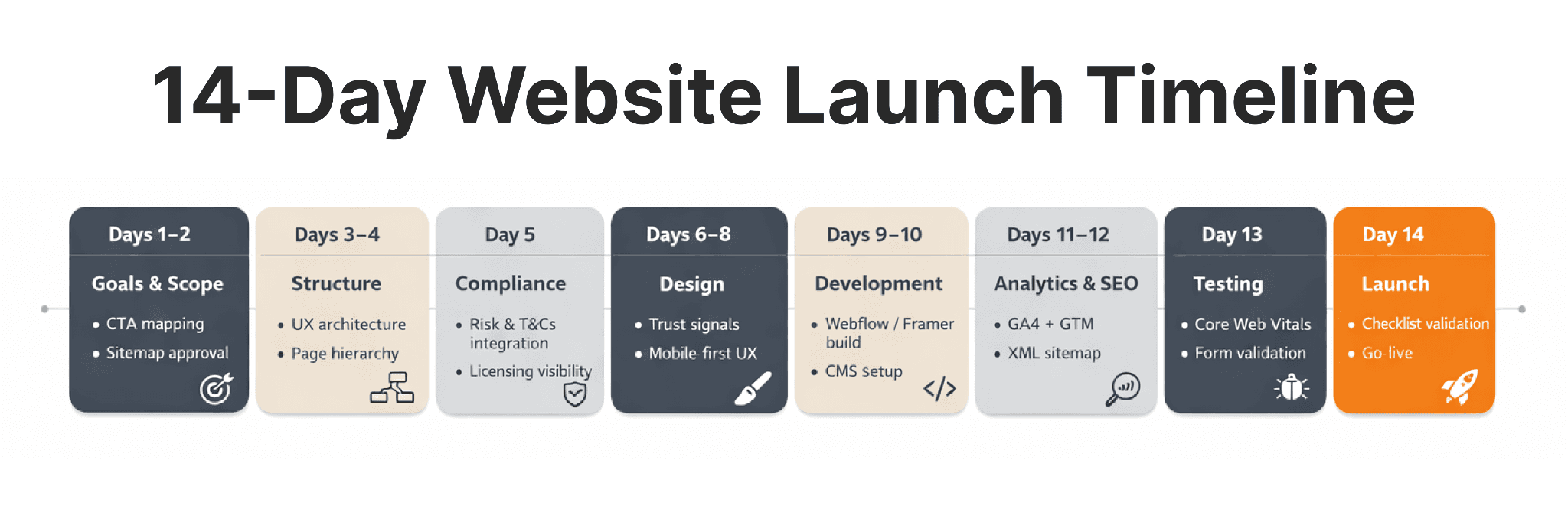
Day 1–2: Define Conversion Goals and Scope
A high-conversion fintech website must be built around measurable business goals — not aesthetics.
Before any wireframe opens, the team needs a conversion map. That means identifying the primary CTA — account registration, demo request, or partnership inquiry — alongside secondary CTAs and the core user journeys that move a visitor from landing page to qualified lead.
For a forex broker, the priority conversion is typically a live or demo account registration. For a prop trading firm, it is an evaluation purchase or challenge signup. For a crypto exchange, it is KYC-verified account creation. Each path requires a different fintech web architecture and a different information hierarchy.
By end of Day 2, three deliverables must be locked: an approved sitemap, a conversion map, and a feature scope freeze. Any scope change after this point should trigger a formal decision — with timeline and cost implications stated clearly.
Day 3–4: Build the Right Website Structure from the Start
Clear structure improves fintech UX, SEO, and regulatory review simultaneously.
Financial services website design must support both the marketing team and the compliance reviewer. Each page should have a specific goal, and the navigation structure should make the regulatory section as accessible as the product pages.
The basic pages for a broker or a trading platform: Homepage, Products and Markets, Trading Platforms (MT4, MT5, cTrader, or Web-based), Account Types, Fees and Conditions, About and Licensing, Compliance pages, Education or Blog, Contact/Onboarding pages.
Internal linking strategy belongs here — not as a retrofit. Account Types linking to Fees and Conditions, Platform pages linking to the Onboarding flow — these connections reduce bounce rates and improve crawlability from day one.
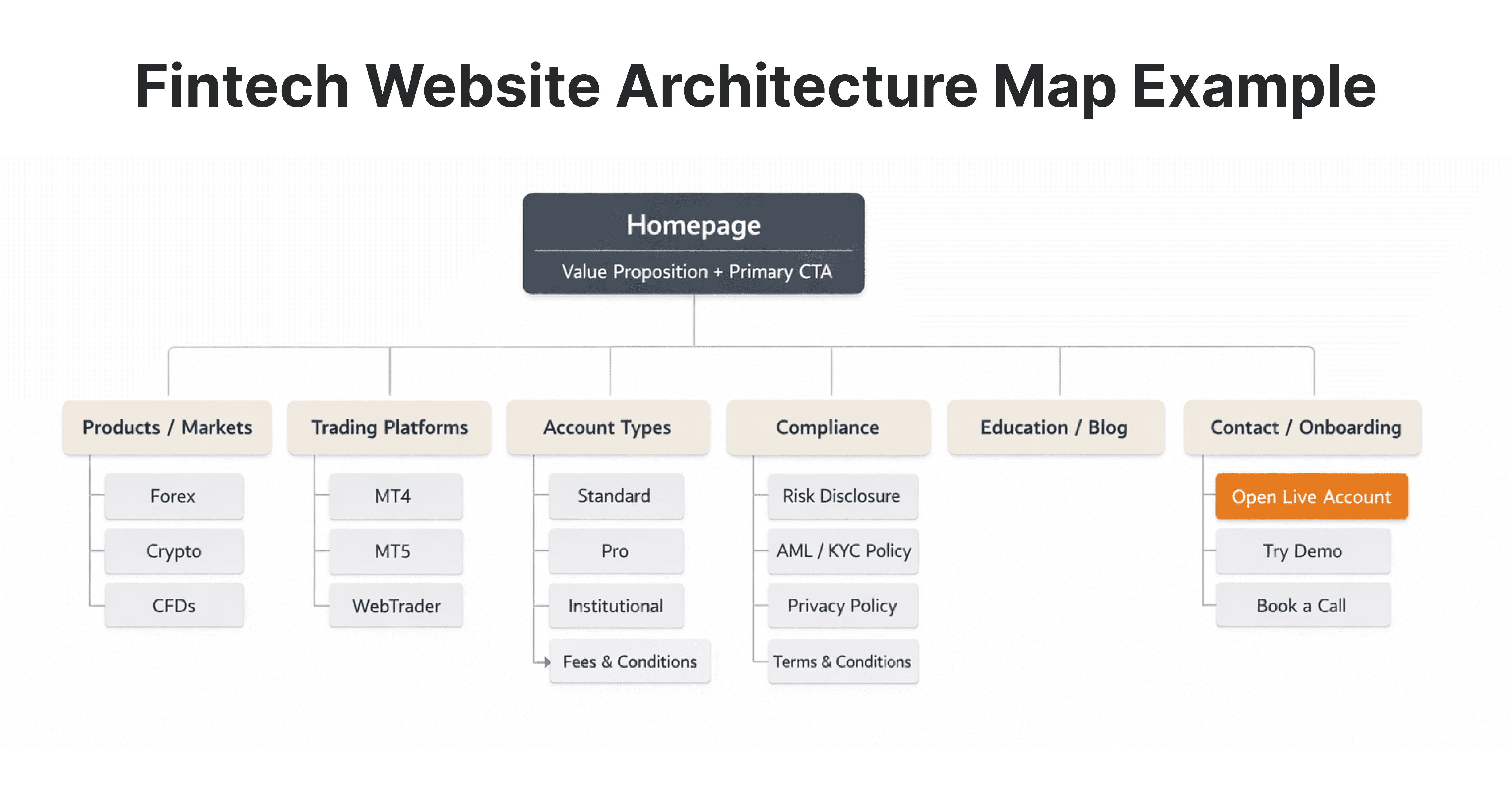
Day 5: Integrate Compliance Before Design Is Finalized
Compliance content must be embedded in the structure early — not inserted as a footer checkbox two days before launch.
Regulators, liquidity providers, and payment processors all conduct due diligence on the brokerage marketing site before approving partnerships or processing accounts. A site missing clearly visible Risk Disclosure, Terms and Conditions, Privacy Policy, AML/KYC statement, or license number will face delays — sometimes critical ones.
For firms operating under FCA, CySEC, or ASIC frameworks, compliance page structure often follows specific structural requirements beyond general best practice. Building these pages into the architecture on Day 5 eliminates one of the most common and most expensive pre-launch bottlenecks.
A compliance-ready regulated financial website is also a competitive signal. It tells institutional partners, payment providers, and serious traders that the operation is professionally run before a single conversation takes place.
Day 6–8: Design for Trust and Conversion
Fintech UX directly affects credibility perception and registration rates.
This is not decorative work. Website design demands a specific visual logic: clarity in value proposition messaging, a clean professional hierarchy, mobile-first execution, and fast-loading page architecture. What separates a high-converting broker website from a cookie-cutter template is the intentional inclusion of trust indicators such as the placement of regulatory badges, SSL indicators, security certifications, client fund segregation statements, and partner logos of well-known brands.
Core Web Vitals targets are hard requirements:
Largest Contentful Paint < 2.5 seconds,
Cumulative Layout Shift < 0.1,
Interaction to Next Paint < 200ms.
Conversion-focused CTAs must be present on every scroll depth, with varying language depending on visitor intent. "Open Live Account," "Try Demo," and "Talk to Our Team" CTAs cater to different audiences and decision-making processes. A well-structured trading platform website deploys all three — strategically, not randomly.
Day 9–10: Develop on Webflow or Framer
Modern no-code fintech website platforms enable professional execution in days — not months.
Webflow website development and Framer website development represent the current performance standard for fintech brands. Both outperform traditional WordPress installation in terms of speed, SEO control, and visual flexibility – without requiring a development team to make content updates.
Webflow is best suited to teams requiring a solid CMS architecture, SEO control, and page scaling. Framer is best suited to design-centric brands requiring interactivity and a premium aesthetic. Both solutions are production-ready for a regulated financial website build.
The integration stack required at launch will typically include: HubSpot or Salesforce for CRM/lead pipeline; GA4 for behavior tracking; GTM for event configuration; live chat; email automation; and direct deep links to MT4/MT5 client terminals or web trading environments.
Low-code does not mean limited. It means faster iteration, lower maintenance overhead, and cleaner performance from day one.
Not sure if your current site structure is built to convert?
A pre-launch audit identifies compliance gaps, UX friction, and missed conversion opportunities before they cost you.
Day 11–12: Set Up Analytics, SEO, and Growth Infrastructure
A high-conversion fintech website must be measurable from the moment it goes live.
GA4 configuration, GTM event tracking, and funnel tracking — from first visit through registration to verified account — must be deployed and tested before launch. As a result, there are gaps in the analytics after the launch. This means the first weeks of live traffic data, which are the most valuable performance data set available, are lost forever.
The SEO infrastructure involves structured data markup, SEO-friendly URL structure, XML sitemap generation, canonical tag implementation, and full metadata implementation across all indexed pages. In addition, if the brokerage marketing website has multilingual goals, then hreflang implementation should be tested at this stage.
Fintech technical SEO in the early stages in the financial services industry is highly competitive. Well-built foundations at the early stages avoid the costly problem of inheriting a technically broken website at a later stage.
Day 13: Testing, Optimization, and Performance Benchmarking
In a highly regulated industry, it is not optional to test before a launch. A flawed onboarding process communicates a lack of operational reliability to every potential customer it touches.
A structured pre-launch phase should include:
cross-device UX tests across desktop, tablet, and mobile;
page speed benchmarking targeting < 2-second load times;
Core Web Vitals verification;
SSL certificate verification;
form submission tests across all lead capture forms;
internal link validation.
Registration flow testing deserves the most attention. A broken step in the journey from homepage to completed account application does not just lose a lead — it tells a prospect evaluating where to place funds that the operation cannot be trusted with details.
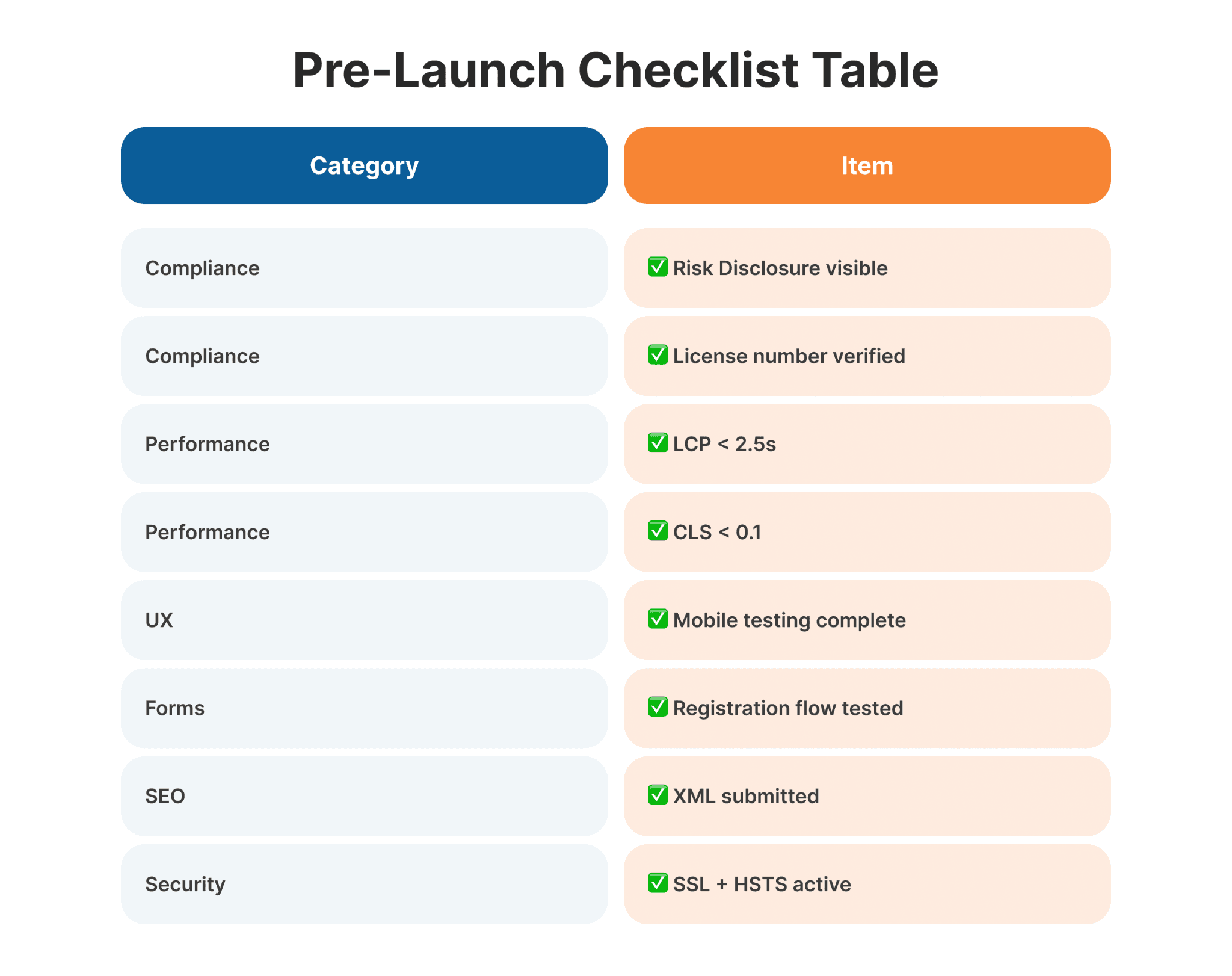
Day 14: Launch with a Structured Website Launch Checklist
The final day is a validation process, not a celebration. Structure it accordingly.
Final steps before going live:
Compliance content reviewed and legally cleared
All CTAs functioning and routing to correct destinations
GA4 and GTM live with confirmed event firing
Backup and restore point configured
Security headers verified — HSTS, CSP, X-Frame-Options
SEO meta tags complete across all indexed pages
Multilingual testing completed where applicable
Trading platform links verified end-to-end
Mobile rendering confirmed on iOS and Android
The website launch checklist is the final quality gate protecting the brand's first impression with every subsequent visitor — including liquidity providers, payment processors, regulators, and serious traders.
DIY vs. Specialist: What Actually Determines Launch Success?
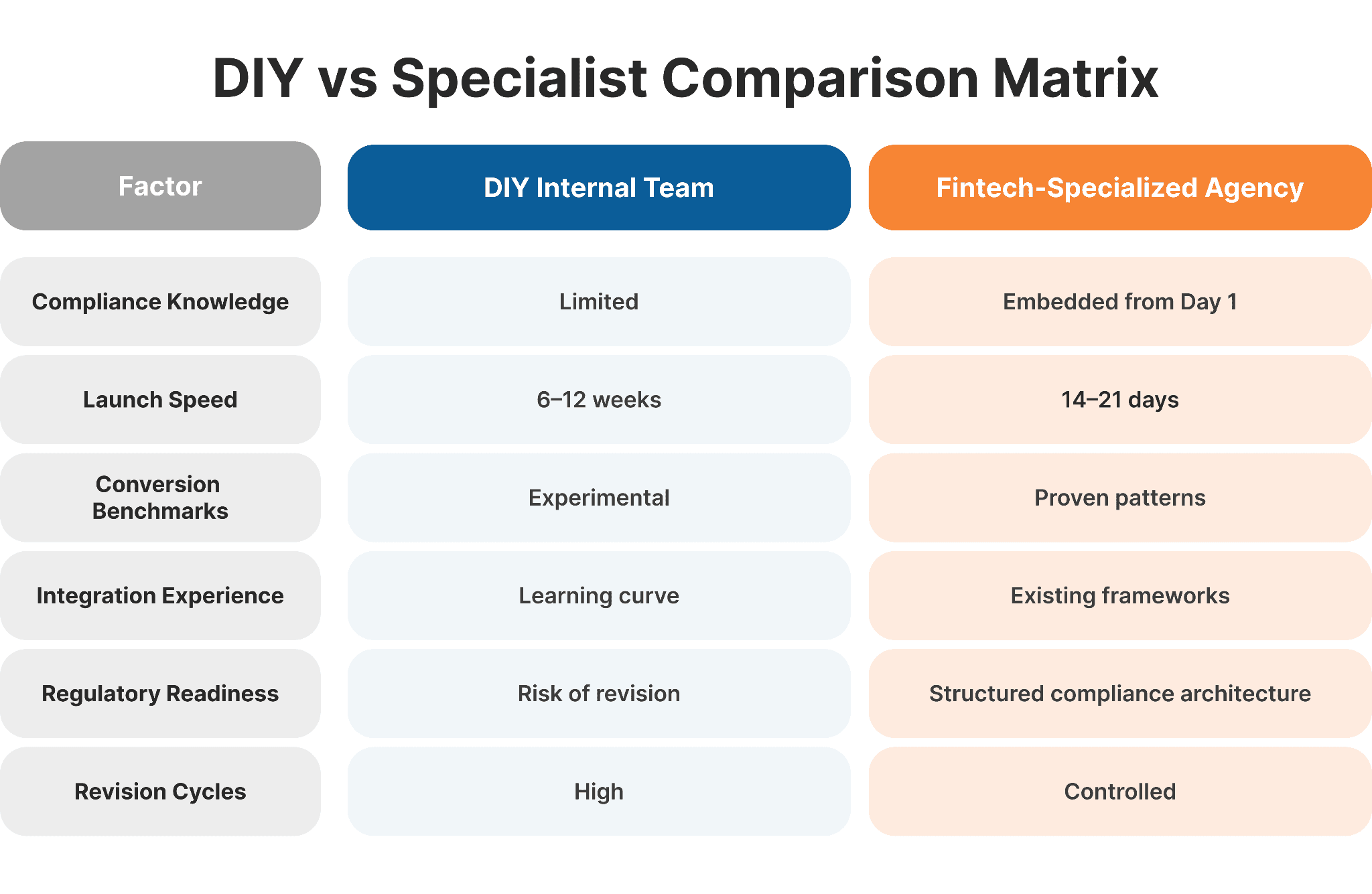
The choice between developing internally and using a specialist fintech web development agency ultimately comes down to what the launch stakes are.
A DIY approach works when compliance requirements are minimal, internal design and development capability exists, and the goal is an experimental MVP with limited external scrutiny.
A specialist partner is critical when regulatory review is likely, speed is tied to licensing milestones or funding timelines, conversion rates drive material revenue from week one, or CRM and trading platform integrations are required at launch.
Generic agencies without fintech vertical experience consistently miss the nuances of broker website design: the correct placement and legal phrasing of regulatory disclosures, the conversion patterns specific to trading platforms, and the integration requirements of financial data infrastructure. The result is a site that looks acceptable but fails commercially.
Common Mistakes That Delay Fintech Website Launches
Most delays are avoidable. The same patterns repeat regardless of firm size:
Scope expansion mid-project — the single most reliable way to push a 14-day launch to 6 weeks
Over-customizing before validating — bespoke design investment before core conversion flows are tested wastes time and budget
Ignoring mobile UX — over 60% of financial research begins on mobile; desktop-first design is a structural conversion problem
Treating compliance as secondary — retroactive regulatory content requires restructuring pages built without it
Launching without analytics — the first weeks of traffic are irreplaceable baseline data
Choosing the wrong CMS for growth — a platform that cannot scale content operations becomes a rebuild project within 18 months
Why Fintech-Specialized Agencies Deliver Faster Results
A fintech-specialized agency brings domain knowledge that shortens every phase of the process. Compliance requirements are understood before the brief is written. Conversion benchmarks for broker registration flows already exist in the agency's reference data. Platform decisions — Webflow versus Framer, CMS configuration, integration architecture — reflect real fintech use cases, not theoretical frameworks.
Fewer revision cycles. No mid-project compliance surprises. A launch timeline that holds.
Website development for startups in regulated financial services is a different discipline from standard web production. The agencies that do it well have built the frameworks, checklists, and pattern libraries through direct experience — and those assets benefit every subsequent engagement.
WSA's project portfolio reflects work across forex brokers, trading platforms, and fintech startups where speed to market and conversion performance were the primary requirements.
Ready to Launch a Fintech Website That Converts from Day One?
WSA specializes in high-conversion fintech website design for brokers, trading platforms, prop firms, and crypto exchanges — with a proven launch process built around regulatory clarity, fintech UX, and measurable results.
FAQs
How fast can a high-conversion fintech website realistically launch?
With Webflow or Framer, a structured 8–15 page regulated financial website can launch in 14 days when scope, branding, and content ownership are finalized at the start. Larger portals with proprietary integrations or multilingual requirements typically require 4–8 weeks.
What platform is best for a fintech startup website?
Webflow and Framer are the strongest options for no-code fintech website builds. Webflow suits CMS-heavy, SEO-critical projects; Framer suits design-forward, interactive brand experiences. WordPress is generally less suitable for performance-critical, compliance-sensitive brokerage marketing sites.
What makes a fintech website genuinely high-conversion?
A clear value proposition, visible trust signals, strong fintech UX, sub-2-second load times, transparent regulatory information, structured onboarding flows, and strategically placed CTAs matched to visitor intent at each scroll depth.
Should compliance content be built in from the start or added before launch?
Compliance content must be integrated into the fintech web architecture from Days 3–5, not inserted before launch. Retroactive compliance consistently requires restructuring pages that were built without it — adding days or weeks to the timeline.
Should a fintech startup use a template or a custom website?
Templates can support MVP testing but rarely meet the standards required for professional broker website design or scalable financial services website design. Firms facing regulatory review, institutional due diligence, or meaningful conversion targets need custom structure from the outset.
Launch Your Licensed Brokerage with Confidence
We support brokers and fintechs through licensing, launch planning, and everything a regulated brand needs to go live.