•
•

Bahamas DARE Application Checklist for Crypto Exchanges
A Bahamas DARE licence application is a registration filing to the Securities Commission of The Bahamas under the Digital Assets and Registered Exchanges Act, 2024. Most crypto exchanges file Form 1 Part A, which lists ten required attachments. A digital asset exchange pays USD 6,250 to apply and USD 18,750 on registration.
This article is general information based on materials published by the Securities Commission of The Bahamas as at July 2026. It is not legal advice. Confirm current forms, fees and requirements with the SCB before filing.
Your Bahamas company is incorporated. Your counsel has the policy manuals drafted. Then someone opens the regulator's application pack and asks which of the four versions of Form 1 you are actually supposed to file, and whether the marketing site can go live before you submit.
That is where a Bahamas DARE licence application usually loses two or three weeks. Not on the legal analysis. On assembling the package: ten separate attachments, a personal questionnaire for every beneficial owner, a schedule of proposed fees, and a business plan that has to agree with everything else you have published.
This checklist covers what the Securities Commission of The Bahamas (SCB) asks for, what each stage costs, how long approval typically takes, and one item no other guide covers: how your public website intersects with a filing that two of your senior officers certify as true, correct and not misleading.
Key Takeaways
The Digital Assets and Registered Exchanges Act, 2024 (the DARE Act 2024) came into force on 29 July 2024 and replaced the 2020 Act. Anyone carrying on digital asset business in or from The Bahamas must be registered with the SCB.
Most crypto exchanges file Form 1 Part A. Part B is for firms already regulated by the SCB adding digital asset services, Part C covers a digital token exchange, Part D covers a token offering.
Form 1 Part A lists ten required attachments. The form itself takes an afternoon; the attachments take months.
A digital asset exchange pays $6,250 to apply, $18,750 on registration and $18,750 each year to renew, plus $575 per registered officer.
There is no published statutory minimum capital figure. The SCB expects your board to have reviewed and documented a capital commitment proportionate to the size, nature and complexity of the business.
Your website is referenced in the application. If the live site describes products, fees or activities that differ from your filed business plan, you have created your own inconsistency. Non-crypto brokerage applications follow a different document set, listed in the SCB licence guide.
What the Bahamas DARE Licence Application Actually Covers
A Bahamas DARE licence application is a registration filing to the Securities Commission of The Bahamas under the Digital Assets and Registered Exchanges Act, 2024, which came into force on 29 July 2024 and repealed the 2020 Act. It is not a single form. It is a package: the application form, a personal questionnaire per key person, and roughly a dozen attachments.
The regulator is assessing three things. Whether the people behind the business are fit and proper, whether the business can actually operate what it describes, and whether it has the money and controls to keep operating.
DARE 2024 vs DARE 2020: What Changed
Unlike DARE 2020, the DARE Act 2024 sets stricter prudential and conduct expectations across a wider set of activities. The SCB describes the reforms as increasing investor and consumer protection through more demanding systems and controls requirements.
In practical terms, four things changed for applicants:
Expanded registration categories, with explicit treatment of custody, staking and stablecoin activity
Enhanced client asset protection and segregation expectations
Fit-and-proper testing extended across beneficial owners and senior officers
AML/CFT and counter-proliferation provisions aligned with FATF recommendations
Here is where founders get caught. The DARE application forms currently published on the SCB's DARE page are still headed under the 2020 Act and marked version 6.0, while the 2024 Act is the law in force. Confirm the current version of every form with the SCB Supervision Department before you file rather than assuming the download is up to date.
Who Has to Register
Any person carrying on digital asset business in or from The Bahamas must be registered with the SCB. Physical location is not the test; conducting the activity from the jurisdiction is.
The activity list on Form 1 Part A covers:
A payment service provider using digital assets
An exchange between digital assets and fiat currencies
An exchange between one or more forms of digital assets
The transfer of digital assets
Financial services related to an issuer's offer or sale of a digital asset
A spot exchange with fiat on-ramps normally ticks at least two of those boxes. Each additional activity carries its own fee, so the categories you select on page two determine your total cost.
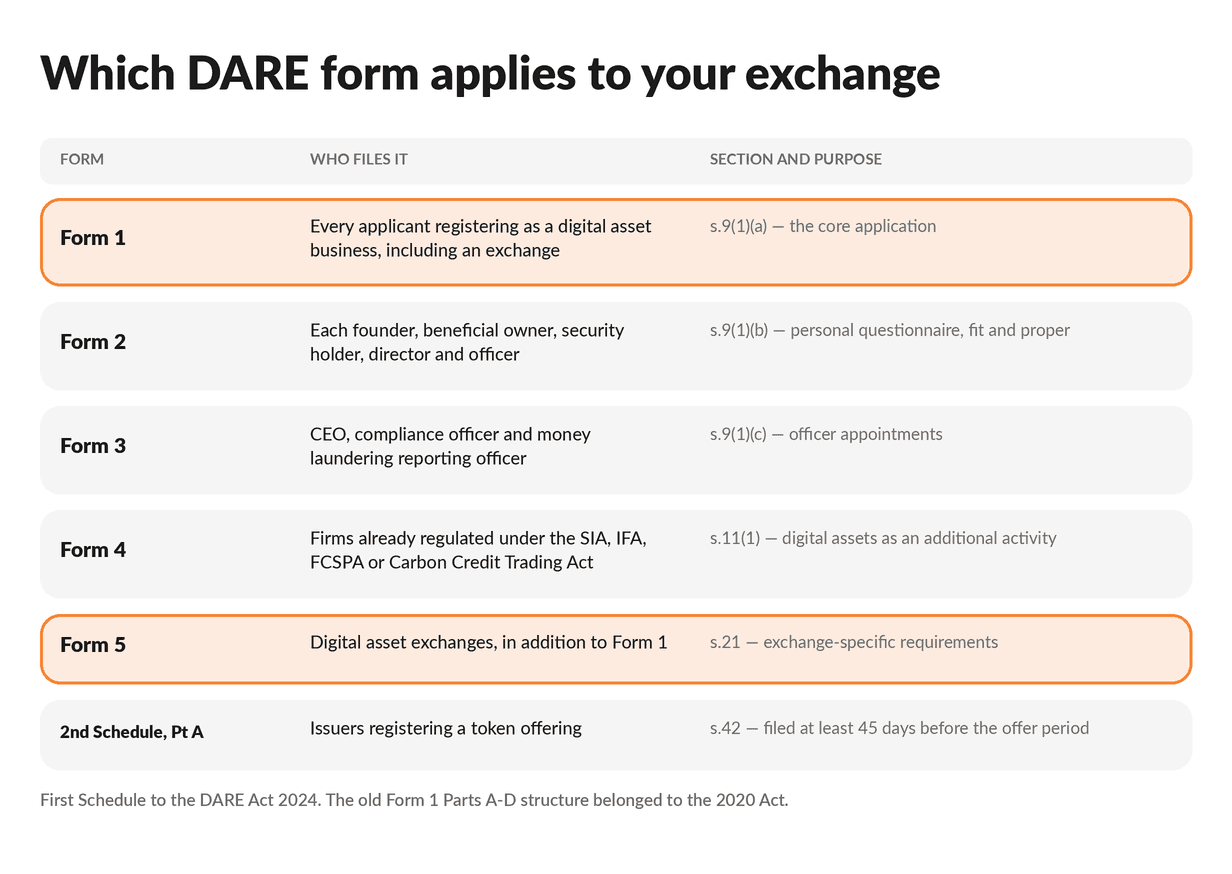
Which DARE Form Applies to a Crypto Exchange
Most crypto exchanges file Form 1 Part A. The SCB publishes four DARE application forms under Form 1, each for a different type of applicant, and filing the wrong part restarts your clock.
Form | Who files it | Statutory reference | Notable extras |
|---|---|---|---|
Form 1 Part A | A new applicant seeking registration as a digital asset business, including a spot exchange | Section 8 | Ten required attachments, two-officer certification |
Form 1 Part B | An entity already registered or licensed by the SCB (securities firm, investment fund licensee, financial and corporate service provider) adding digital asset services | Section 9 | Evidence of additional regulatory capital, named Information Security Officer |
Form 1 Part C | A digital token exchange | Section 15 | Full exchange rulebook plus market surveillance systems |
Form 1 Part D | An initial token offering | Part IV | Offering memorandum filing, $6,000 filing fee |
What this means: if you are building a venue where third-party tokens are listed and traded, read Form 1 Part C alongside Part A. Part C asks for something Part A does not: a complete rulebook covering membership, listing, business conduct, and clearing and settlement, plus a description of your trading, clearing, security and market surveillance systems.
Forms 2 and 3: Personal and Key-Person Filings
Form 2 is a personal questionnaire required for every founder, beneficial owner, significant interest holder, director and officer. Form 3 registers the chief executive officer and the compliance officer.
Two practical notes. Corporate significant interest holders must also submit audited financial statements, an auditor's report and recent interim statements, which is often the longest lead item in the whole package. And each registered officer carries a fee, so a slim senior team is cheaper than a decorative one.
Building the exchange behind the licence?
Regulators read your site the same way your first institutional client does. See how WSA structures crypto exchange platforms before they go public.
The Complete Document Checklist for a DARE Application
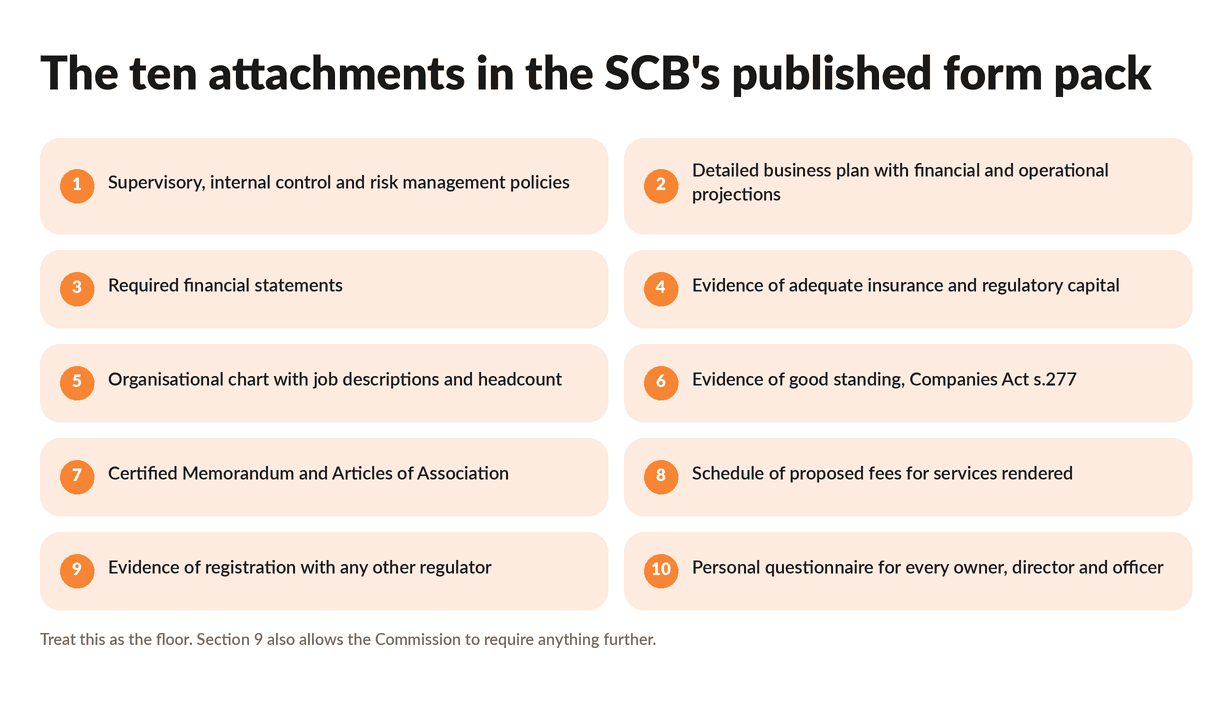
Form 1 Part A lists ten required attachments. Every one of them is a document you have to write, commission or obtain, and this is the part of a Bahamas crypto exchange licence project that takes months rather than days.
Written supervisory, internal controls and risk management policies and procedures
Detailed business plan with financial and operational projections
Required financial statements
Evidence of adequate insurance and regulatory capital
Organisational chart with job descriptions and total headcount
Evidence of good standing under section 277 of the Companies Act
Certified Memorandum and Articles of Association
Schedule of proposed fees for services rendered
Evidence of registration with any other regulatory authority, if applicable
Completed Form 2 for each founder, beneficial owner, significant interest holder, director and officer
Corporate and Incorporation Documents
Your applicant must be a company incorporated in The Bahamas, with a registered office and local presence including resident senior personnel. The certified constitutive documents and the good standing evidence are administrative, but they expire, so order them close to submission rather than at the start of the project.
The organisational chart is where a Bahamas digital asset business licence application often looks thin. A box diagram is not enough. The SCB asks for job descriptions per position and total employee numbers, which means your staffing plan has to be real before you file.
Financial Statements, Capital and Insurance Evidence
What you submit depends on how old the company is. If the applicant was established within six months of the application and has not started trading, you provide a CEO statement confirming that, statements of financial position from establishment to date, and financial projections covering no more than three years.
Everything else requires audited statements for the two prior financial years, the auditor's report, and interim statements for the prior two quarters certified by the CEO.
On capital, ignore the numbers you have read elsewhere. In its published approach to regulating digital asset businesses, the SCB stated that it does not currently prescribe regulatory capital for digital asset businesses, though it intends to. Instead, the applicant should satisfy the Commission that its board has reviewed and discussed an appropriate capital commitment given the size, nature and complexity of the business.
The figures circulating on offshore licensing sites, typically $100,000 to $500,000, are market expectations rather than statutory minimums. Documenting a defensible board decision matters more than hitting an imagined threshold.
Policies, Controls and Cybersecurity Documentation
Form 1 Part A asks for a summary of your supervisory, internal control and risk management policies, then a complete copy of them. The named areas include digital token management, cybersecurity operations, operational controls, AML/CFT policies and controls, reporting policies and a code of conduct.
Item 7 goes further and asks you to describe your operational capabilities in detail: physical premises, cybersecurity protocols, data management and data protection systems, risk management systems, banking, digital clearing and digital custody arrangements, and communication capabilities. You also name your principal bankers, digital custodians and technical providers.
Part B adds a role many applicants overlook: an Information Security Officer responsible for overseeing the cybersecurity and data protection programme, with experience, qualifications and rank stated, or full details of the outsourced provider.
The takeaway: a policy library written to a template will not survive item 7. The description has to match the vendors, wallets and infrastructure you have actually contracted.
DARE Application Fees and Registration Timeline
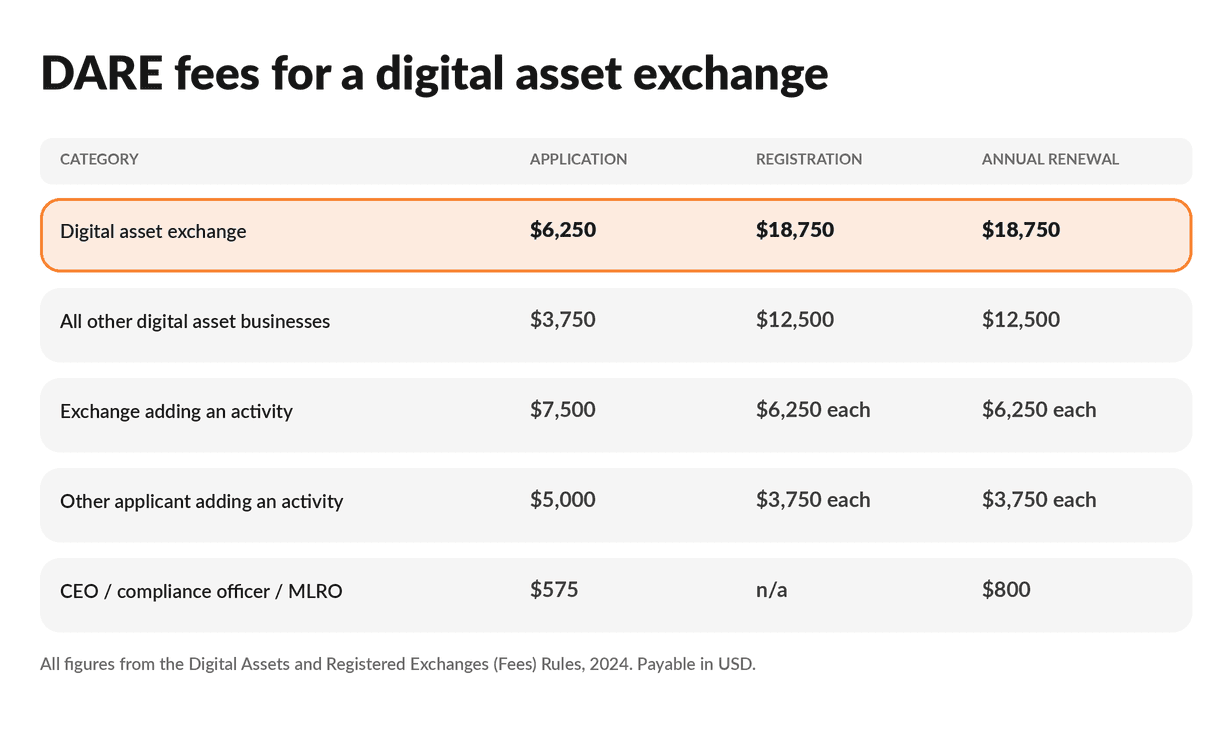
A digital asset exchange pays $6,250 to apply and $18,750 on registration, with an $18,750 annual renewal. Every figure for SCB Bahamas digital asset registration is published, so a Bahamas DARE licence application can be budgeted precisely before you commit. All amounts below come from the Digital Assets and Registered Exchanges (Fees) Rules, 2024.
Category | Application | Registration | Annual renewal |
|---|---|---|---|
Digital asset exchange | $6,250 | $18,750 | $18,750 |
All other digital asset businesses | $3,750 | $12,500 | $12,500 |
Exchange adding an activity | $7,500 | $6,250 per activity | $6,250 per activity |
Other applicant adding an activity | $5,000 | $3,750 per activity | $3,750 per activity |
Chief executive officer | $575 | n/a | $800 |
Compliance officer | $575 | n/a | $800 |
Money laundering reporting officer | $575 | n/a | $800 |
Administrative filings carry their own charges, including $620 for a change in directors, $625 for approval of an issue or transfer of digital assets, and $500 for a name change. Fees are payable in USD and conversion charges apply on wire transfers. Check the current DARE (Fees) Rules, 2024 before you budget, because rules get amended.
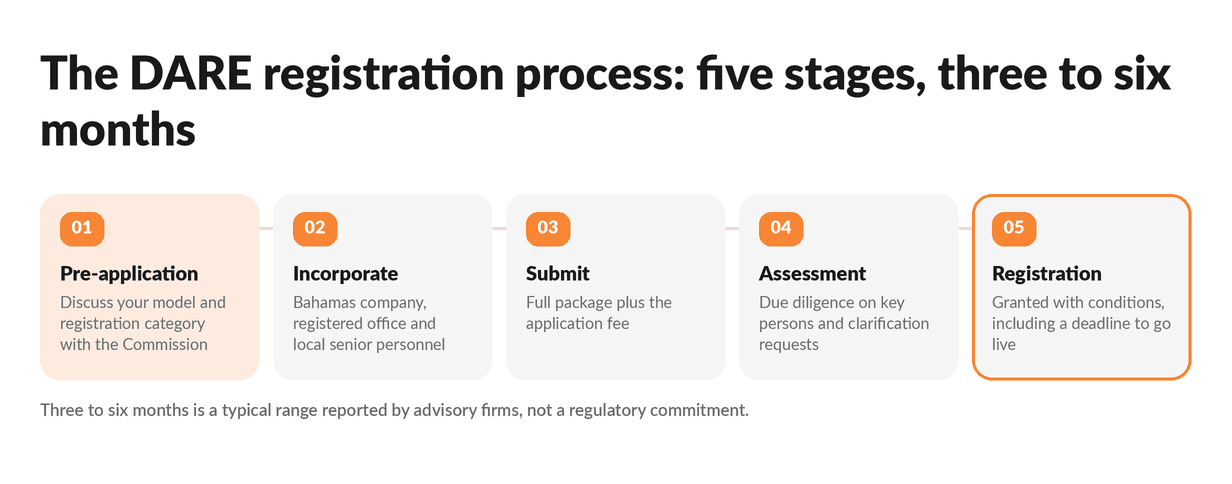
Registration typically takes three to six months from submission, according to advisory firms active in the jurisdiction. That is an observed range, not a regulatory commitment, and completeness of the package is the main variable you control.
The process runs in five stages:
Pre-application discussion with the Commission about your model and category
Incorporation in The Bahamas and establishment of local presence
Preparation and submission of the full package with the application fee
Assessment, due diligence on key persons, and clarification requests
Grant of registration, followed by post-registration conditions including operational go-live within a set window
Here's why the timeline matters. Stage 5 usually comes with a deadline to be operational. Teams that treat the website and platform as post-approval work discover they have weeks, not months, to launch something a regulator has already read about. Plan the build alongside the Bahamas DARE licence application, not after it.
Custody, Token Activities and Additional Activity Registrations
Adding a digital asset activity to an existing DARE registration is a separate application with its own fee. For an exchange, that is $7,500 to apply and $6,250 per additional activity on registration and each renewal, which makes activity scope a pricing decision rather than a paperwork detail.
Custody deserves specific attention. The SCB has noted that wallet services and custody of digital assets require a licence under the Financial and Corporate Service Providers Act, unless provided as an ancillary service to a digital token exchange registered under DARE. Whether you hold client keys, and under what structure, changes which authorisations you need.
Token activity sits in Part IV of the DARE Act 2024. Filing an offering memorandum costs $6,000, and interim financial statements filed within the prescribed period carry no fee.
What this means in practice: map every revenue line to a registration category before you file. Retrofitting a staking product or a custody offering after approval costs a new application, a new fee and a new assessment cycle, so scope the Bahamas DARE licence application around the roadmap rather than the launch product.
Does Your Exchange Website Need to Be Ready Before You Apply?
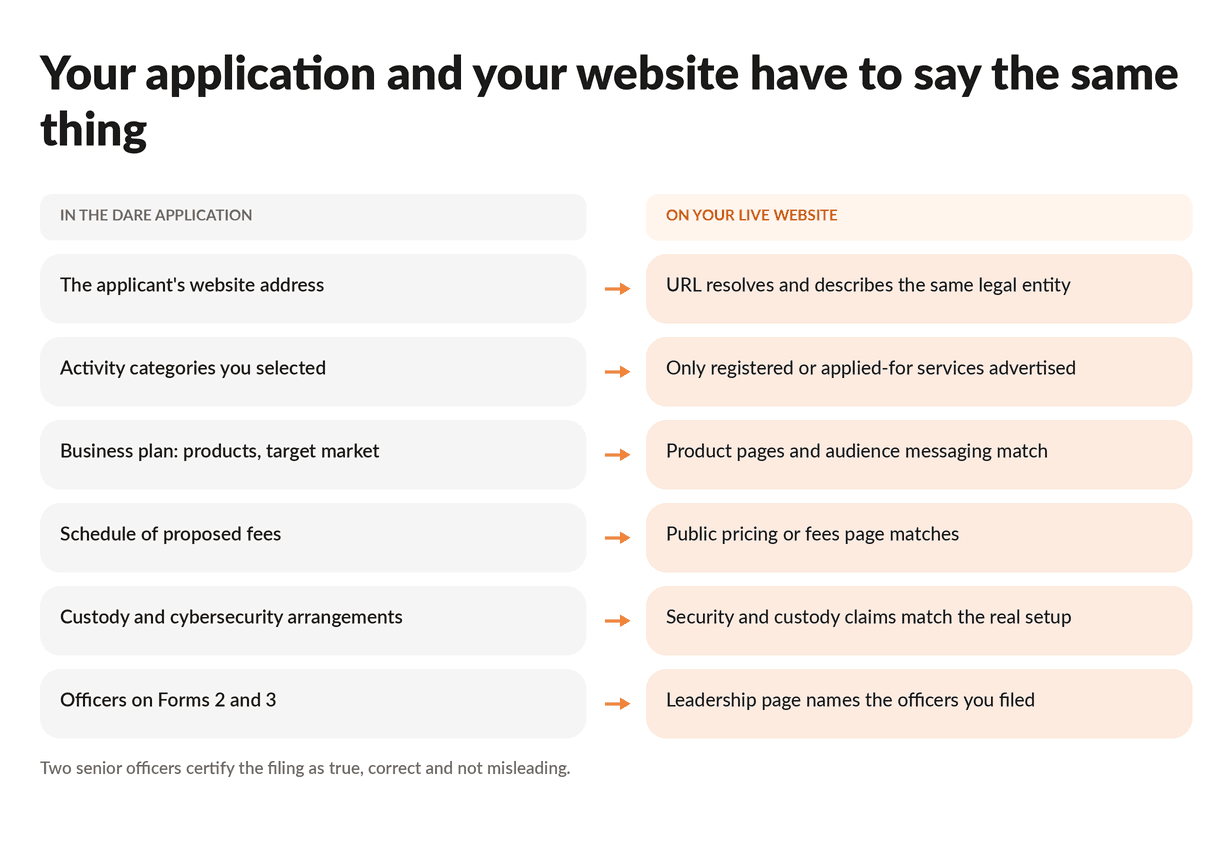
There is no rule requiring a finished website before you file. But Form 1 Part A asks for the applicant's website, and the business plan, product description, target market and schedule of proposed fees you attach have to match whatever is live at that URL.
Two senior officers sign the form certifying that its contents and attachments are true, correct and not misleading. A live site that advertises services outside your filed categories, or a pricing page that contradicts your submitted fee schedule, is an inconsistency you introduced yourself. Nothing in a Bahamas DARE licence application asks the regulator to ignore your public claims.
What the Regulator Sees When It Opens Your Site
Assume someone at the Commission will visit the URL you wrote on the form during the assessment stage. What they find should read like the same business described in the attachments.
The failure mode is familiar. A pre-launch site built for investors and a licensing package built for a regulator are drafted by different people at different times, and nobody reconciles them.
Website Elements That Must Match Your Application
Application item | Corresponding website element |
|---|---|
Item 3: applicant's website | URL resolves, describes the same legal entity |
Item 2: categories applied for | Only registered or applied-for services advertised |
Attachment 2: business plan, products, target market | Product pages and audience messaging |
Attachment 8: schedule of proposed fees | Public pricing or fees page |
Item 7: custody and cybersecurity arrangements | Security and custody claims match the actual setup |
Forms 2 and 3: key persons | Leadership page names the officers you filed |
Two rules follow from this table. Do not describe yourself as regulated or registered before the SCB has granted registration. And keep risk disclosures and terms consistent with the client onboarding procedures you submitted, the same discipline that applies to any website compliance checklist for regulated brokers.
Preparing a DARE application for your crypto exchange?
WSA helps you turn complex requirements into a clear, well-prepared licensing journey.
How WSA Builds DARE-Ready Exchange Websites
WSA designs and builds websites for regulated fintech companies: brokers, crypto exchanges and payment firms. That specialisation is the reason compliance consistency is part of the brief rather than a late review, and it is what a Bahamas crypto exchange licence project needs from a web partner.
For a digital asset exchange preparing an SCB filing, the work usually breaks into three tracks.
Content architecture that mirrors the application. Product pages map to registered activities. Fees live on one page that matches the filed schedule. Disclosures are structured, not buried.
Trust and performance. Fast, accessible pages with clear security and custody information, because institutional visitors and regulators both look for the same signals early.
Speed to launch. Framer builds let a compliant site ship in weeks, which matters when registration comes with a go-live deadline.
If you are earlier in the process, our guides on launching a regulated fintech company and the current trust signals and performance expectations cover the structural decisions, and our breakdown of landing page structure that converts covers the registration funnel once you are live.
One honest caveat: a Bahamas registration is not a shortcut. Over five years, the ongoing obligations cost more than the application ever will: audits, financial reporting, market surveillance, client asset protection and annual information updates.
Conclusion
A Bahamas DARE licence application rewards preparation over speed. The form is short, the ten attachments are not, and the SCB is assessing whether the business you describe can actually run. Get the category selection right, document the board's capital decision, and make sure the policies you file describe the infrastructure you have contracted.
Then close the last gap. The DARE registration requirements reach further than most founders expect, into the public site that carries your product claims, your fees and your disclosures. Build that site to match the filing, not the pitch deck.
WSA builds websites for regulated crypto and fintech companies that have to hold up to both. Start a conversation with our team.
FAQ
What documents are required to register a crypto exchange under DARE?
Form 1 Part A requires ten attachments plus the completed form. The attachments are: your written supervisory, internal controls and risk management policies and procedures; a detailed business plan with financial and operational projections, staffing and technology requirements; the required financial statements; evidence of adequate insurance and regulatory capital; an organisational chart with job descriptions and total headcount; evidence of good standing under section 277 of the Companies Act; a certified copy of your Memorandum and Articles of Association; a schedule of proposed fees for your services; evidence of registration with any other regulatory authority if applicable; and a completed Form 2 for each founder, beneficial owner, significant interest holder, director and officer.
You also complete Form 3 for the chief executive officer and compliance officer. If you are registering a digital token exchange, Form 1 Part C adds a full rulebook covering membership, listing, business conduct, and clearing and settlement.
Financial statement requirements depend on company age. A company established within six months that has not traded provides a CEO statement, statements of financial position from establishment, and projections covering up to three years. Older applicants provide two years of audited statements, the auditor's report, and the prior two quarters of certified interim statements.
Is a Bahamas company required for DARE registration?
Yes. The applicant must be a company incorporated under the Companies Act of The Bahamas, and the registration is granted to that entity rather than to a foreign parent.
Incorporation alone is not sufficient. Applicants are expected to maintain genuine local presence: a registered office and physical premises in The Bahamas, resident senior personnel including compliance capability, and local AML/CFT reporting arrangements. Form 1 Part A asks you to describe your physical premises as part of operational capabilities, and to disclose every Bahamian address you operate from.
This is stricter than standard Bahamian company formation, where no resident director is required. A DARE registrant is a regulated financial institution, and the substance requirements reflect that. Foreign groups typically incorporate a Bahamian subsidiary, staff it locally, and file the group's audited statements as a significant interest holder.
Which DARE form applies to a crypto exchange?
Most crypto exchanges file Form 1 Part A, the application for registration as a digital asset business under section 8. On page two you select the activities you are applying for, such as exchange between digital assets and fiat currencies, exchange between forms of digital assets, and transfer of digital assets.
Three alternatives exist. Form 1 Part B, under section 9, is for entities already registered or licensed by the SCB, such as securities firms, investment fund licensees or financial and corporate service providers, that want to add digital asset services. Form 1 Part C, under section 15, registers a digital token exchange and requires an exchange rulebook plus market surveillance systems. Form 1 Part D covers registration of an initial token offering.
If you are unsure, raise it in pre-application discussion with the Commission. The forms published on the SCB DARE page are still headed under the 2020 Act, so confirm you have the current version before filing.
How much does a Bahamas DARE licence cost?
Under the Digital Assets and Registered Exchanges (Fees) Rules, 2024, a digital asset exchange pays a $6,250 application fee, $18,750 on registration and $18,750 for each annual renewal. All other digital asset businesses pay $3,750, $12,500 and $12,500 respectively.
Additional activities are charged separately. An exchange adding a digital asset business activity pays $7,500 to apply, then $6,250 for each additional activity on registration and at renewal. Other applicants pay $5,000 and $3,750 per activity.
Individual registrations cost $575 to apply and $800 annually for each of the chief executive officer, compliance officer and money laundering reporting officer. Filing an offering memorandum under Part IV costs $6,000.
Administrative charges apply on top, including $620 for appointing or changing directors, $625 for approval of an issue or transfer of digital assets, $500 for audit confirmation letters and $500 for a name change. Fees are payable in USD, and wire conversion charges apply. Professional fees for counsel, audit, compliance staffing and registered office services are separate and usually exceed the regulatory fees in year one.
How long does DARE registration take?
Advisory firms active in the jurisdiction report a typical range of three to six months from submission to grant, depending on the complexity of the business model and how completely the DARE registration requirements have been met in the filing.
The variable you control is completeness. Applications slow down on incomplete Form 2 packages for beneficial owners, missing audited statements for corporate shareholders, organisational charts without job descriptions, and policy manuals that do not match the operational capabilities described in item 7.
Two things extend the calendar beyond the assessment window. Incorporation and local presence have to be in place before or during preparation, and registration is typically granted with post-registration conditions including a deadline to become operational. Plan the platform and website build to finish inside that window rather than after it. A sandbox route is available for genuinely novel models, which requires additional Commission approval but allows more flexibility during early operations.
Launch Your Licensed Brokerage with Confidence
We support brokers and fintechs through licensing, launch planning, and everything a regulated brand needs to go live.