•
•
Best Jurisdictions for a Broker Licence: FSA, FSC, DFSA, FSCA, SCB and CySEC Compared
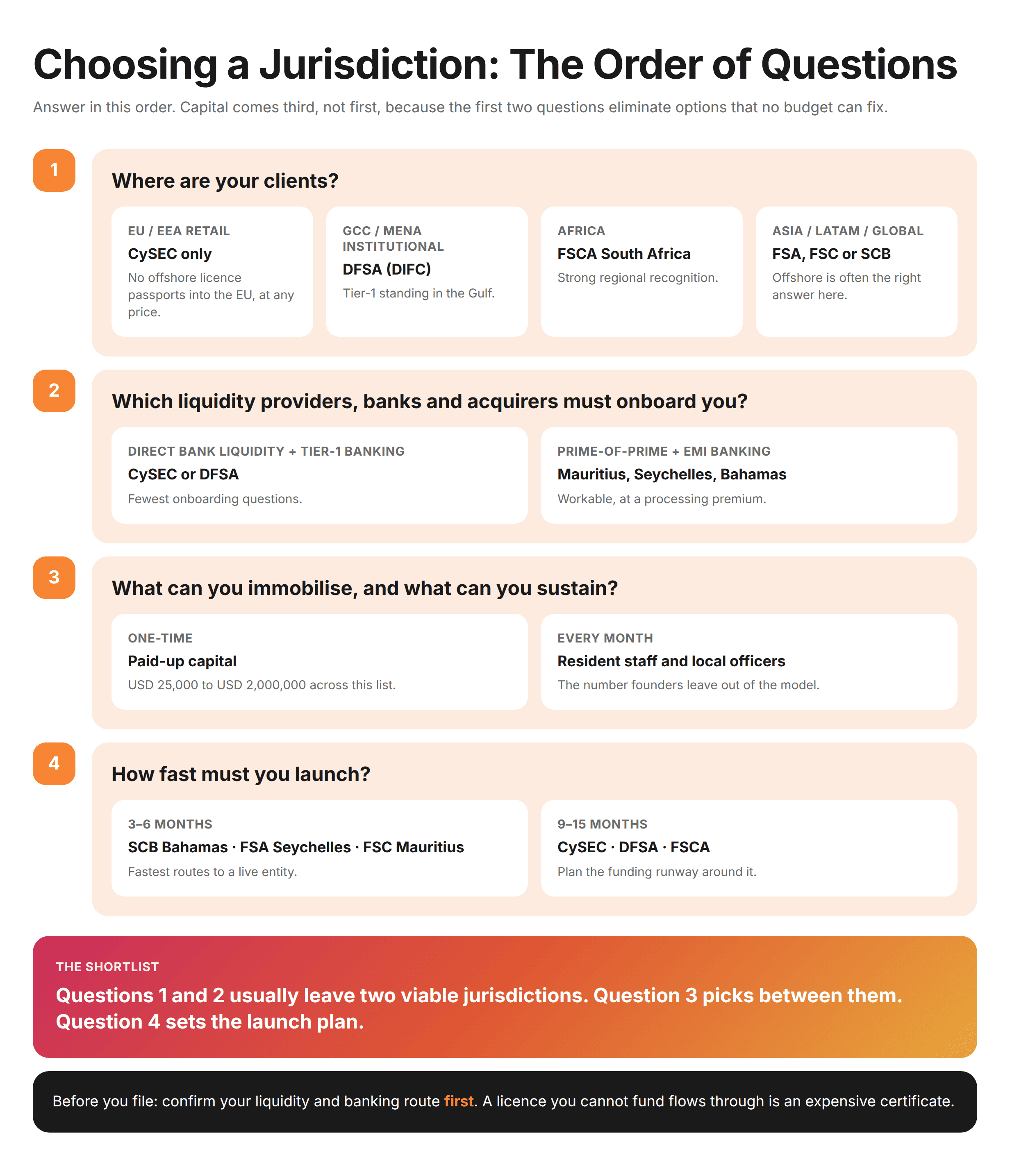
There is no single best jurisdiction for a broker licence. The right one is set by four things: where your clients are, how much capital you can lock up, which liquidity providers and banks you need to onboard with, and how fast you have to launch. Get those four straight and the shortlist usually writes itself.
Most comparisons of forex broker licence jurisdictions stop at the capital figure. That is the number founders remember and the one that misleads them most.
A Seychelles Securities Dealer licence asks for USD 100,000 in paid-up capital, but also two full-time Seychelles-resident staff. A Cyprus Investment Firm licence asks for EUR 150,000 in a mid-tier class, plus a Cyprus office and a four-person board.
The capital is a one-time lock. The rest is payroll, every month, for as long as you hold the licence.
This page compares six regulators side by side: the FSA in Seychelles, the FSC in Mauritius, the DFSA in Dubai, the FSCA in South Africa, the SCB in the Bahamas and CySEC in Cyprus.
This article is for informational purposes only and does not constitute legal advice. Brokers should consult qualified legal and compliance professionals for jurisdiction-specific guidance.
All figures are current as of 2026 and each is attributed. Where a dedicated WSA checklist exists for a jurisdiction, this page links to it rather than repeating it.
Key Takeaways
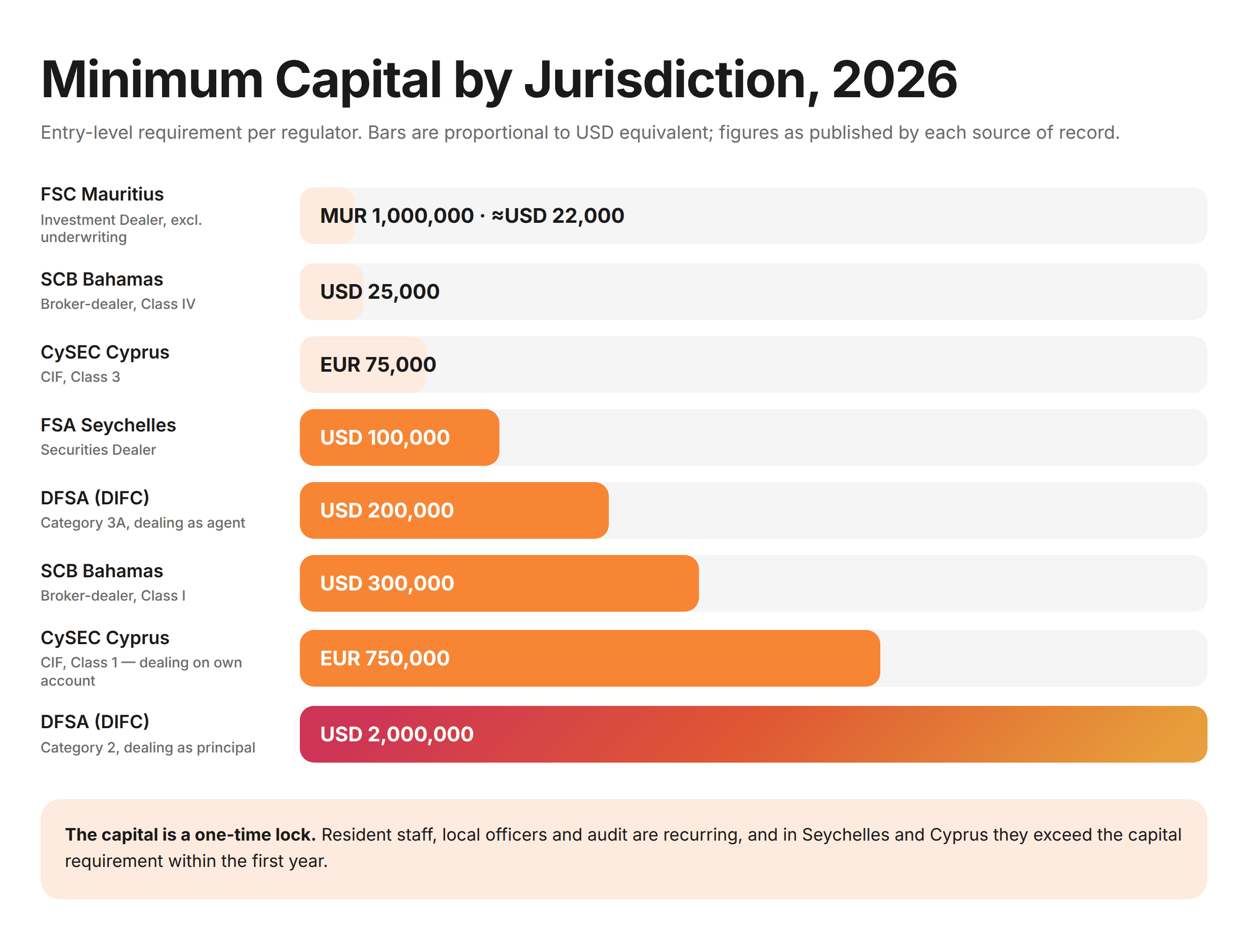
Capital ranges from USD 25,000 (SCB Bahamas Class IV broker-dealer) to EUR 750,000 (CySEC Class 1) and USD 2,000,000 (DFSA Category 2 dealing as principal). Timeline ranges from 3 months to 15 months.
Local presence is the hidden cost. Seychelles requires two resident full-time personnel since the 2024 amendments; Cyprus requires a local office and at least four directors, two of them independent.
Only CySEC gives you MiFID passporting into the EU. No offshore licence replicates it, at any price.
An FSCA Category I FSP licence covers intermediation in derivatives. Issuing them as principal needs separate ODP authorisation. Brokers regularly assume the wrong scope here.
A large share of competitor pages still quote CySEC initial capital as EUR 125,000 or EUR 730,000. Those are pre-IFR/IFD figures. The current classes are EUR 75,000, EUR 150,000 and EUR 750,000.
Every regulator on this list expects specific documents to be publicly reachable on your website. The site is part of the licence file, not something you finish afterwards.
How to Compare Forex Broker Licence Jurisdictions
Five variables decide which forex broker licence jurisdictions are realistic for a given firm:
Target market. Which countries you can legally solicit clients in, and which you cannot.
Capital you can immobilise. Paid-up capital sits in a regulated account and stops being working capital.
Local substance you can sustain. Resident directors, a physical office, licensed local staff, each with a salary attached.
Counterparty acceptance. Which liquidity providers, banks and payment processors will onboard a firm holding that licence.
Time to launch. Three months versus fifteen months changes your entire funding plan.
Rank the six on cost alone and you get one answer. Rank them on what the licence actually unlocks and you often get a different one.
The Five Variables That Actually Decide It
Here is where most teams get it wrong. They optimise variable 2, capital, because it is the easiest to model in a spreadsheet. Then they discover variable 4 twelve weeks before launch, when the prime-of-prime they had penciled in declines the application.
What this means in practice: confirm your liquidity and banking route before you file the licence application, not after. A licence you cannot fund flows through is an expensive certificate.
Offshore vs Onshore: What You Trade Away
Unlike a CySEC or DFSA licence, an offshore broker licence does not passport into the EU or the Gulf, and it narrows which banks and payment providers will onboard you. That is the trade. You gain speed and a lower capital lock; you give up market access and counterparty options.
The trade is often the right one. A broker targeting Southeast Asia, Latin America or Africa may never need EU passporting, and paying 5× the capital for a permission you will not use is not prudence.
The trade goes wrong when the business plan quietly assumes European retail clients. If your growth model needs EU traffic, an offshore licence is not a cheaper route to the same place. It is a different place.
Broker Licence Jurisdictions Compared at a Glance
The table below sets the six forex broker licence jurisdictions against each other on capital, timeline, local presence and market access, all as of 2026.
Regulator | Licence | Min capital (2026) | Typical timeline | Local presence | Market access |
|---|---|---|---|---|---|
FSA Seychelles | Securities Dealer | USD 100,000 paid-up | ~3 months on a complete file; 4–6 months realistic | 2 resident full-time personnel | Global ex-EU/US; broad securities definition incl. CFDs, crypto |
FSC Mauritius | Investment Dealer (Full Service excl. underwriting) | MUR 1,000,000 (≈USD 22,000); MUR 10,000,000 with underwriting | 4–6 months | Economic substance; local directors and officers | Global ex-EU/US; stronger treaty network and bank acceptance than Seychelles |
DFSA (DIFC) | Cat 3A dealing as agent / Cat 2 as principal | USD 200,000 (3A); USD 2,000,000 (2), or USD 500,000 matched principal | 8–12 months institutional; 12–15 months retail-facing | DIFC office; UAE-resident SEO, plus Finance, Compliance, MLRO and often Risk officers | GCC and MENA institutional; tier-1 credibility |
FSCA South Africa | Category I FSP, plus ODP where acting as principal | No single published minimum; ODP capital set case by case | 6–12 months | South African entity, key individuals, local compliance officer | South Africa and much of Africa; well-regarded regionally |
SCB Bahamas | Broker-dealer Class I–IV | USD 300,000 / 120,000 / 60,000 / 25,000 by class | 3–4 months | Bahamian entity and local officers | Global ex-EU/US; DARE Act available for digital assets |
CySEC Cyprus | Cyprus Investment Firm (CIF), Class 1–3 | EUR 750,000 / 150,000 / 75,000 by class | 9–14 months end to end | Cyprus office; ≥4 directors (≥2 executive, ≥2 independent); full local governance team | EU/EEA via MiFID passporting |
The takeaway: the cheapest capital requirement on this table (SCB Class IV, USD 25,000) and the widest market access (CySEC) sit at opposite ends. There is no option that gives you both.
Not Sure Which Licence Your Site Has to Match?
Your website has to satisfy whichever regulator you pick, and the requirements differ more than founders expect.
FSA Seychelles: The Fast, Low-Capital Entry Point
The Financial Services Authority (FSA) of Seychelles issues the Securities Dealer licence, which requires USD 100,000 in issued and paid-up capital and takes around three months on a complete, well-prepared file. Four to six months is more realistic once regulator queries are counted.
Its definition of securities is unusually broad, covering CFDs, commodities, currencies and cryptocurrency, which is why so many multi-asset brokers start here.
The change people miss: since the 2024 amendments, applicants must maintain two full-time personnel resident in Seychelles. That is a permanent operating cost, not a filing requirement.
For the document-by-document view, see WSA's full Seychelles securities dealer licence checklist.
Mauritius FSC: The Credibility Step Up from Seychelles
The Financial Services Commission (FSC) of Mauritius issues the Investment Dealer licence in four flavours. Full Service excluding underwriting sits at MUR 1,000,000 in stated unimpaired capital, roughly USD 22,000; adding underwriting raises it to MUR 10,000,000. Broker and Discount Broker categories sit at MUR 700,000 and MUR 600,000.
On paper Mauritius is cheaper than Seychelles. In practice it asks for more: professional indemnity insurance, demonstrable experience among key staff, and economic substance for the underlying company.
What you buy is standing. Mauritius has a deep treaty network and is treated more favourably by banks and liquidity providers than most pure offshore options. See the Mauritius investment dealer licence application checklist for the filing detail.
DFSA (DIFC): Tier-1 Access to the Gulf
The Dubai Financial Services Authority (DFSA) regulates firms inside the Dubai International Financial Centre (DIFC), a separate legal and regulatory zone within the UAE.
A brokerage dealing as agent falls in Category 3A with USD 200,000 base capital; dealing as principal is Category 2 at USD 2,000,000, or USD 500,000 on a matched-principal basis. Arranging and advising only sits in Category 4 at USD 30,000.
Expect 8 to 12 months for an institutional-only application and 12 to 15 months for anything retail-facing, because of the additional conduct and client-money review.
The DFSA also requires named authorised individuals: a UAE-resident Senior Executive Officer, a Finance Officer, a Compliance Officer and an MLRO, with a Risk Officer at scale. That is a real hiring plan, not a form. WSA's DFSA authorisation checklist covers what the file needs.
FSCA South Africa: The ODP Route and Why It Is Different
The Financial Sector Conduct Authority (FSCA) authorises Financial Services Providers, and the distinction that catches brokers out is scope rather than capital. A Category I FSP licence lets you advise on and intermediate in derivative instruments. It does not let you issue them as principal.
Issuing derivatives as principal, which is what a market-making CFD broker does, requires separate authorisation as an Over-the-Counter Derivative Provider under the Financial Markets Act. Two licences, two processes.
Why this matters: a firm that markets itself as "FSCA regulated" on the strength of an FSP licence alone may be describing permissions it does not hold. Counterparties check. The FSCA ODP application checklist sets out the ODP-side requirements.
Not sure which option fits your business?
From startup brokerages to established platforms, WSA delivers websites that convert traders, satisfy regulators, and scale across markets.
SCB Bahamas: Class-Tiered Capital and the DARE Overlay
The Securities Commission of The Bahamas (SCB) registers broker-dealers in four classes under the Securities Industry Act 2024, with regulatory capital of USD 300,000 for Class I, USD 120,000 for Class II, USD 60,000 for Class III and USD 25,000 for Class IV. A Securities Investment Advisor registration also sits at USD 25,000.
Registration typically runs three to four months where the application and business plan are complete.
The class structure is the appeal: you buy only the permissions your model needs, and Class IV is the lowest entry point of the six jurisdictions here.
Brokers adding digital assets need the DARE Act regime alongside the securities registration, not instead of it. WSA has documented which SCB documents have to live on your website.
CySEC Cyprus: EU Passporting and the Highest Bar
The Cyprus Securities and Exchange Commission (CySEC) authorises Cyprus Investment Firms in three classes. Under IFR/IFD, initial capital is EUR 75,000 for Class 3 (reception, transmission and advice), EUR 150,000 for Class 2 (adding execution, portfolio management and safeguarding) and EUR 750,000 for Class 1 (dealing on own account, market making, underwriting).
Note the figures. Many competitor pages still publish EUR 125,000 and EUR 730,000, which are the older pre-IFR/IFD numbers.
Governance is the real bar: a Cyprus office with local executive management, a board of at least four directors including two independent, and named heads of compliance, risk, internal audit and dealing. Budget 9 to 14 months end to end and EUR 5,000 to 10,000 in application fees. The CySEC CIF requirements and timeline are covered in detail separately.
Which Licence Do Liquidity Providers and Banks Actually Accept?
Liquidity providers, banks and payment processors run their own due diligence, and it does not map neatly onto regulator tiers. This is the variable that decides whether a licence turns into a working brokerage, and almost no broker licence comparison covers it.
Patterns worth planning around:
Tier-1 liquidity and prime-of-prime: CySEC and DFSA entities onboard with the fewest questions. Mauritius is usually workable. Seychelles and Bahamas entities are often routed to prime-of-prime rather than direct bank liquidity.
Corporate banking: EU and UAE banks are markedly more comfortable with a locally regulated entity. A broker holding an offshore broker licence commonly ends up with EMIs and specialist providers rather than a tier-1 bank.
Card acquiring and PSPs: acquirers price on licence jurisdiction as well as chargeback history. The same volume can cost noticeably more to process under an offshore licence.
B2B partners and IB networks: introducing brokers in regulated markets increasingly filter partners by licence before they will discuss commercials.
Honest caveat: onboarding policy is set per counterparty and changes without notice. Treat the above as the pattern to plan against, and confirm with the specific LP, bank and acquirer you intend to use before you commit to a jurisdiction.
What Every Regulator Expects From Your Website
In every jurisdiction on this list, part of the licence file lives on your website. Regulators, banks and auditors all check the public site, and they check whether the documents are reachable without a login.
Regulator | Must be publicly accessible | Domain notified | Risk warning | Entity disclosure |
|---|---|---|---|---|
FSA Seychelles | T&Cs, risk disclosure, AML policy summary, complaints procedure | Yes, in the application | Prominent, on product and homepage | Full legal name, licence number, registered address |
FSC Mauritius | Client agreement, risk disclosure, complaints handling, privacy | Yes | Prominent on trading pages | Legal name, FSC licence number, Mauritius address |
DFSA (DIFC) | Client agreement, key information, complaints, conflicts policy | Yes | Retail warnings per DFSA conduct rules | DIFC entity name, DFSA reference, DIFC address |
FSCA | FAIS disclosures, conflict of interest policy, complaints, fee schedule | Yes | Required on derivative product pages | FSP number, and ODP status where applicable |
SCB Bahamas | T&Cs, risk disclosure, AML/KYC summary, complaints, fee schedule | Yes | Prominent, versioned | Legal name, SCB registration, Bahamas address |
CySEC | Full legal hub: client agreement, risk warnings, order execution policy, ICF, complaints, KIDs | Yes, approved domains only | Standardised CFD risk warning with loss percentage | CIF name, licence number, Cyprus address, on every page |
Documents That Must Be Publicly Accessible
Roughly half of what you file ends up needing a public home. The failure mode is predictable: the documents exist, but they sit behind the client portal, or in a PDF with no version history, or on a page that was replaced in the last redesign and now 404s.
Auditors flag that. So do banks during onboarding. WSA builds the compliance-facing side of broker sites in Framer with the legal hub, footer disclosure block and document versioning designed in from the wireframe stage, because retrofitting them after a licence is granted is slower and more expensive than building them once.
Domain Approval, Language and Risk Warnings
CySEC works from approved domains, so every trading domain and white-label sub-brand has to be declared. Add one later and you have a filing to make, not just a DNS record.
Risk warnings differ in placement and wording by regulator, and CySEC prescribes a standardised CFD warning including a loss percentage. That percentage changes, which means the warning has to be a maintainable component in your site, not text baked into a design file.
What this means: if you expect to hold two licences within two years, design the site multi-entity from the start. Per-region risk warnings, geo-aware product pages and a versioned legal hub are cheap to build in and costly to bolt on.
Conclusion
Comparing forex broker licence jurisdictions well means comparing what each licence lets you do, not what it costs to obtain. Capital is the easiest number to model and the least predictive one. Market access, counterparty acceptance and the local headcount you have to sustain decide whether the licence becomes a business.
Whichever regulator you choose, your website carries part of the obligation. Build it to hold the documents, the disclosures and, ideally, the second licence you will probably apply for within two years.
WSA designs and builds broker and fintech websites for firms regulated under all six of these regimes, with compliance architecture designed in rather than added later. If you are choosing a jurisdiction now, talk to us before the site brief is written.
This comparison is for information only and is not legal, regulatory or licensing advice. Capital requirements, fees and timelines change; verify current figures with the relevant regulator or a licensed adviser before filing.
Building a Broker Site That Two Regulators Will Accept
WSA designs and builds broker websites in Framer with the legal hub, versioning and multi-entity disclosure structured in from day one.
FAQ
Which jurisdiction is best for a forex brokerage license?
There is no single best jurisdiction, but the shortlist narrows fast once you fix your target market and capital. For EU retail clients, CySEC is the only option here that passports. For GCC institutional business, the DFSA. For speed and lowest capital, SCB Bahamas Class IV at USD 25,000 or FSA Seychelles at USD 100,000. Mauritius sits in the middle, offering better bank and liquidity acceptance than pure offshore options without Cyprus-level governance costs. Choose based on where your clients are and which counterparties you need, not on the application fee.
What is the cheapest forex broker licence jurisdiction?
Of the six compared here, SCB Bahamas is cheapest on capital: a Class IV broker-dealer registration requires USD 25,000 in regulatory capital, with Class III at USD 60,000. FSA Seychelles requires USD 100,000, and Mauritius Full Service excluding underwriting sits near USD 22,000 equivalent but carries insurance and substance obligations. Cheapest capital is not cheapest total cost. Resident staff, local officers, audit, annual fees and the payment processing premium that offshore licences attract can exceed the capital requirement within the first year.
Can I upgrade from an offshore to a tier-1 licence later?
Yes, and it is a common path, but it is an additional authorisation rather than an upgrade. You apply to the new regulator as a new applicant, usually with a new local entity, and most brokers keep the original licence running for clients the new one cannot serve. Plan for it structurally: a group holding company, clean separation of client funds by entity, and a website architected for multi-entity disclosure. Brokers who built single-entity sites typically rebuild them, because footer disclosure, risk warnings and product availability all become region-dependent.
Which jurisdictions require a resident director or local office?
Seychelles requires two full-time personnel resident in the jurisdiction, added by the 2024 amendments to the securities dealer regime. Cyprus requires a physical office with local executive management and a board of at least four directors, two of them independent. The DFSA requires a DIFC office and a UAE-resident Senior Executive Officer plus named Finance, Compliance and MLRO functions. Mauritius and the Bahamas require a local entity with local officers and economic substance, though the resident-headcount bar is lower. South Africa requires a local entity with approved key individuals and a compliance officer.
How do website requirements differ by regulator?
The core set is similar and the strictness is not. Every regulator here expects terms, risk disclosure, complaints procedure and full entity identification to be publicly reachable without a login. CySEC goes furthest: approved domains only, a standardised CFD risk warning carrying a loss percentage, and a complete legal hub including order execution policy and investor compensation fund information. The DFSA prescribes retail conduct disclosures. Offshore regulators specify the documents but say less about placement, which in practice means banks and auditors set the bar instead.
Launch Your Licensed Brokerage with Confidence
We support brokers and fintechs through licensing, launch planning, and everything a regulated brand needs to go live.