•
•

DFSA Authorisation Checklist for Brokerage Firms
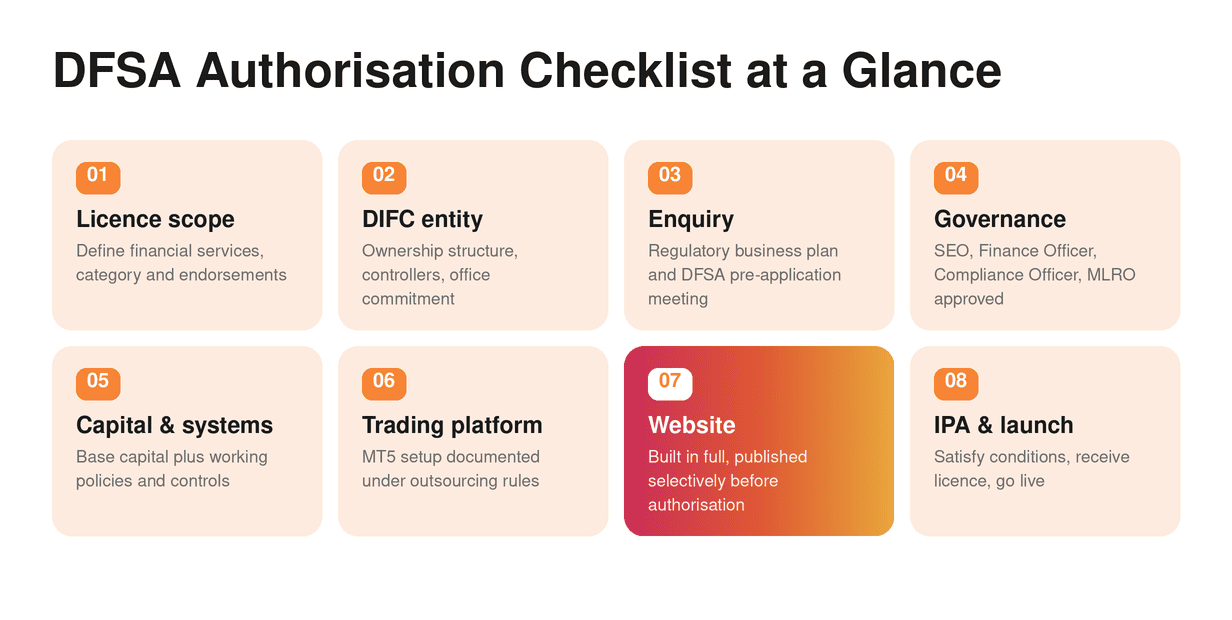
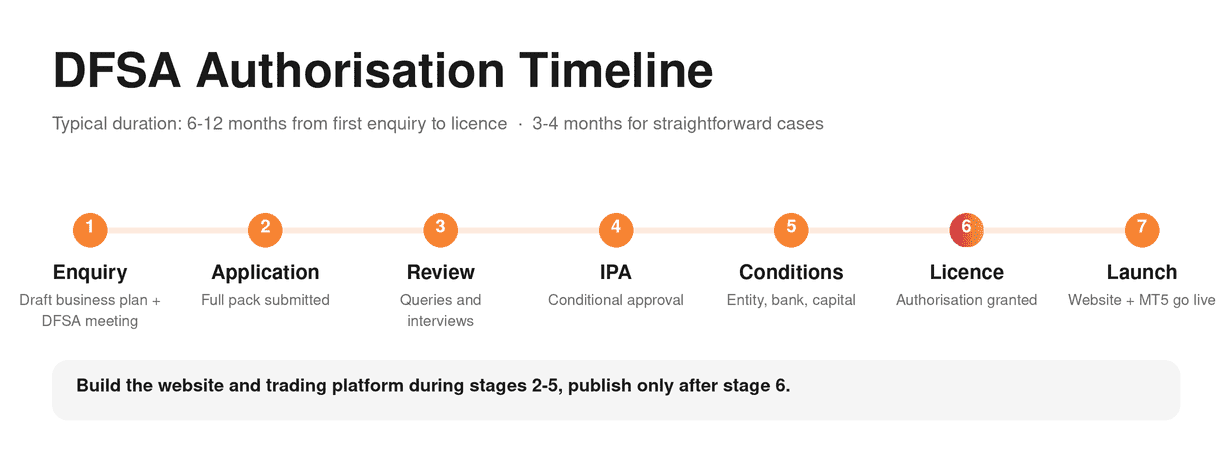
A DFSA licence application requires six elements: a defined financial services scope, a DIFC entity, a regulatory business plan, approved authorised individuals, base capital and compliant systems. The process runs authorisation enquiry, formal application, in-principle approval, condition satisfaction, then final licence. Typical duration is 6 to 12 months. Let's take a closer look.
This article is for informational purposes only and does not constitute legal advice. Brokers should consult qualified legal and compliance professionals for jurisdiction-specific guidance.
Your brokerage has picked Dubai. The entity plan is drafted, the MT5 white label is scoped, and investors want a launch date. What stands between you and your first client is a DFSA licence application: a staged authorisation process run by the Dubai Financial Services Authority (DFSA), the independent regulator of the Dubai International Financial Centre (DIFC). To apply, you need a defined financial services scope, a DIFC entity, a regulatory business plan, approved individuals in mandatory roles, base capital, and compliant systems. Most applications take 6 to 12 months from first enquiry to licence.
That timeline is not dead time. The brokers that launch fastest use the application window to build the two assets clients actually see: the trading platform and the website. This DFSA authorisation checklist covers the regulatory workstream step by step, plus the part most guides skip: which elements of your launch must stay inactive or carefully worded until the licence is issued.
Key Takeaways
A DFSA licence application requires six core elements: a defined financial services scope, a DIFC entity, a regulatory business plan, approved authorised individuals, base capital, and compliant systems and controls.
The process is staged: authorisation enquiry, formal application, in-principle approval (IPA), condition satisfaction, then final licence. Typical duration is 6 to 12 months.
Licence scope drives everything else. Category, base capital (from USD 30,000 for advisory up to USD 500,000+ for dealing), staffing, and systems all follow from the services you apply for.
MT5 brokers can operate from the DIFC, but platform hosting and white-label arrangements fall under DFSA outsourcing rules and must be documented in the application.
Your website is a regulated asset before launch. Under the DIFC financial promotions prohibition, only Authorised Persons may promote financial services in or from the DIFC. DIFC expectations are one instance of a broader pattern, covered in the compliance checklist that applies across jurisdictions.
An IPA is conditional, not a licence. Build the website and platform during the IPA window so you can go live the day final authorisation is granted.
What to publish once final authorisation lands is covered in DFSA broker website compliance documents.
Define the Financial Services and Licence Scope
Every DFSA licence application starts with defining which Financial Services the firm will carry on, because scope determines which of the DFSA licence categories applies, along with base capital, staffing, and systems obligations. Get this wrong and you either overpay for permissions you never use or return to the regulator mid-application to extend scope, adding months.
For a brokerage, the usual building blocks are dealing in investments (as agent or as matched principal), arranging deals in investments, and holding client assets. Each permission you add raises the bar for capital and controls. A firm that only arranges and advises faces far lighter requirements than one that holds client money and executes trades.
Licence Categories and Base Capital Requirements
Base capital follows category. The figures below reflect the DFSA's 2025 prudential reforms (Consultation Paper 161), which took effect in phases from 1 July 2025:
Category | Typical brokerage activity | Base capital requirement |
|---|---|---|
Category 2 | Dealing in investments as matched principal | USD 500,000 (reclassified from 3A in 2025) |
Category 3A | Dealing in investments as agent | USD 200,000 (reduced from USD 500,000) |
Category 4 | Arranging and advising only | USD 30,000 |
The 2025 reduction of the Category 3A base capital requirement to USD 200,000 changed the economics of a DIFC broker licence for smaller firms. Confirm current figures with the DFSA before you commit a financial model; they are set in the PIB module of the Rulebook and do change.
Retail vs Professional Client Endorsements
Decide early whether you will serve retail clients. A retail endorsement brings materially higher scrutiny: stronger disclosure, complaints handling, product governance, and typically more back-and-forth during review. Many brokers launch professional-only, then add the retail endorsement once operations are proven. If retail is your core market, plan for a longer review and build your website copy to retail disclosure standards from day one.
DIFC Entity and Ownership Structure
A DIFC broker licence is issued to a DIFC-incorporated entity, most commonly a private company limited by shares registered with the DIFC Registrar of Companies. You do not need the entity fully incorporated to start the application, but you do need the structure designed: shareholders, ultimate beneficial owners, and any holding companies.
The DFSA reviews controllers closely. Every person holding 10% or more must be disclosed and assessed as fit and proper, with source-of-wealth evidence to match. Complex offshore layers are not prohibited, but each layer adds review time and questions.
Here's where most applicants lose weeks: mismatched documents. The business plan says one shareholding split, the structure chart says another, and the application stalls while the regulator reconciles them. Lock the ownership structure before submission and keep every document consistent.
You will also need a physical presence commitment. DIFC offers options from flexi-desks to full offices, and the lease is usually finalised as an IPA condition rather than upfront.
Authorisation Enquiry and Regulator Meeting
The DFSA expects an authorisation enquiry before a formal application is submitted. This pre-application stage is not a formality; it is where the regulator decides whether your model is viable in the DIFC, and it shapes the rest of the DFSA authorisation process.
The sequence in practice:
Prepare a draft regulatory business plan: your services, target clients, revenue model, org chart, and three-year financial projections.
Meet the DIFC Business Development team and the DFSA Authorisation Enquiries team to walk through the model.
Incorporate the regulator's feedback. The DFSA either signals go-ahead for submission or asks for a rework of the draft.
Submit the formal application pack: business plan, financial model, policies and manuals, and fit-and-proper documentation for shareholders, directors, and senior management.
Straightforward applications can complete in 3 to 4 months; complex or retail-facing models typically run 6 to 12 months. Application fees vary by category, roughly USD 2,000 to USD 75,000.
What this means: the enquiry meeting is your one cheap iteration. Every change after formal submission costs weeks. Arrive with a business plan that already answers the obvious questions.
Applying for a DFSA Licence? We'll Help You Get There
We help brokers get through the authorisation journey, from application to launch day.
Governance and Authorised Individuals
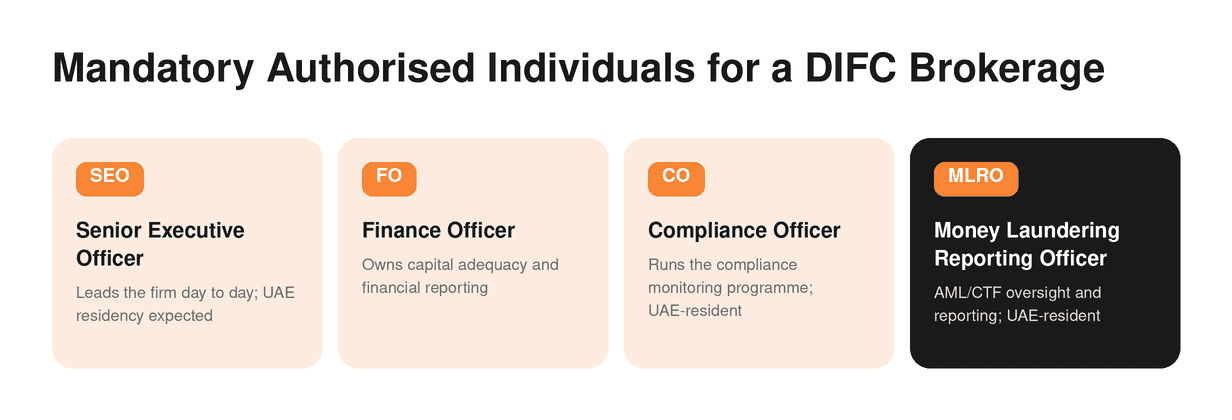
The DFSA requires named, approved individuals in mandatory functions before authorisation is granted. For a brokerage, that means a Senior Executive Officer, a Finance Officer, a Compliance Officer, and a Money Laundering Reporting Officer (MLRO), each assessed individually as fit and proper under the DFSA's approval process.
Expectations that catch applicants out:
The Senior Executive Officer, Compliance Officer, and MLRO are expected to be UAE-resident. Remote governance from another jurisdiction rarely passes.
One person can hold Compliance Officer and MLRO roles in smaller firms, but the combined workload must be justified.
Non-executive directors and controllers are also assessed, not just day-to-day management.
Recruit these people early. CVs, regulatory references, and interviews happen during review, and a late change of Senior Executive Officer effectively restarts the assessment of your governance. Clients preparing DFSA applications typically sign key hires on conditional contracts tied to authorisation.
Capital, Systems and Controls
Base capital requirements depend on licence category, but capital is only the entry ticket. The DFSA also assesses whether your systems and controls match the scale and risk of the business described in your plan.
The DFSA application requirements go further than capital: the pack must include working policies, not templates: compliance monitoring, AML/CTF aligned to the DFSA's AML module, risk management, conflicts of interest, business continuity, and remuneration. Reviewers read these against your business plan. A 20-page generic compliance manual attached to a matched-principal brokerage model is an immediate credibility gap.
Financial projections need to show capital adequacy under stress, not just at launch: typically three years, with the expenditure-based requirement often exceeding base capital once staff and platform costs are real. Budget for capital to sit untouched in the DIFC bank account, because deploying it into operating costs below the requirement is a breach.
The takeaway: write the policies for the firm you described, size the capital for the firm you will actually run.
Trading Platform and Outsourcing
Yes, an MT5 broker can operate from the DIFC, and MetaTrader 5 is a common platform choice for multi-asset brokers there. What the DFSA cares about is how the platform is delivered. A DFSA MT5 broker setup almost always involves outsourcing arrangements: hosting, bridge and liquidity connectivity, sometimes a white-label agreement with an established provider.
DFSA MT5 Broker Setup Under Outsourcing Rules
Under the DFSA's outsourcing requirements in the GEN module, you remain fully responsible for outsourced functions. Your application should document:
Who hosts and operates the MT5 server infrastructure, and where.
The written agreement covering service levels, data access, audit rights, and exit.
How you supervise the provider: uptime monitoring, incident reporting, and business continuity.
How client data and trade records remain accessible to you and the regulator.
In practice, the platform workstream runs in parallel with the application. Licence agreements with MetaQuotes or a white-label provider, server setup, and liquidity arrangements all take weeks to months. Signing them conditional on authorisation keeps the timeline moving without breaching the perimeter, because the platform can be built and tested privately before launch. What cannot happen is onboarding live clients before the licence is issued.
Platform Ready, Website Ready, Launch on Day One
WSA builds brokerage websites in weeks, integrated with your platform stack and structured for regulated markets.
Website and Financial Promotions Before Authorisation
Under Article 41A of the DIFC Regulatory Law 2004, only Authorised Persons may make financial promotions in or from the DIFC. The financial promotions prohibition, detailed in chapter 3 of the DFSA's GEN Rulebook, covers any communication that invites or induces someone to engage in financial services, and your website is exactly that kind of communication.
This is the workstream most licensing guides ignore, and it is where a brokerage can accidentally create a regulatory problem before it even holds a licence.
What Must Stay Inactive or Carefully Worded
The practical rule: build everything, publish selectively. Design, development, and content production can run at full speed during the application; what goes live must be limited until authorisation.
Your pre-authorisation website CAN | Your pre-authorisation website CANNOT |
|---|---|
Show a branded holding page with company identity | Invite visitors to open a trading account |
Describe the company factually ("applying for DFSA authorisation") | Claim to be licensed or regulated before the licence is issued |
Collect contact details for launch updates (with consent) | Promote spreads, bonuses, or trading conditions |
Publish neutral educational content | Display sign-up forms, deposit flows, or platform downloads |
Announce leadership and careers | Target UAE or DIFC clients with product offers |
Regulators check applicants' websites during review. A live sign-up form or a premature "regulated broker" claim invites exactly the wrong kind of attention, and misleading regulatory status claims can jeopardise the application itself.
WSA's experience building broker sites reflects this sequencing: the full site, including the account funnel and platform pages, is designed and staged during the application window, while only a compliant holding version is public. On authorisation day, the switch is a deployment, not a rebuild. A conversion-focused forex broker website structure can be fully tested behind the curtain before a single client sees it, and planning the brokerage website cost alongside the licence budget keeps the launch plan realistic.
Don't Let Your Website Delay Your DFSA Licence
One wrong claim on a public page can raise questions during review. We'll make sure yours stays clean until authorisation day.
In-Principle Approval Conditions and Launch
In-principle approval is a conditional green light, not a licence. The IPA letter states that the DFSA intends to grant authorisation once specified conditions are met, and it typically gives you a window of around three months to complete them.
Standard IPA conditions for a brokerage:
Incorporate the entity with the DIFC Registrar of Companies.
Finalise the office lease.
Open the corporate bank account and deposit the base capital.
Confirm authorised individuals in post and any remaining documentation.
Only when the DFSA verifies these conditions does it issue the licence, and only then may you conduct financial services and market them. Launching anything client-facing during the IPA window, including a live website funnel, is still premature.
Sequence the final month deliberately: platform in final testing, website staged and reviewed against a broker website checklist, compliance sign-off on every public page, bank account funded. Firms that treat the IPA window as a countdown checklist go live within days of the licence; firms that start building at IPA add months after approval.
Conclusion
A DFSA licence application rewards firms that treat it as a programme, not a form: scope defined first, ownership locked, governance recruited early, capital sized honestly, and the platform and website built in parallel under the constraints that apply before authorisation. The brokers that reach revenue fastest are the ones whose website and MT5 stack are staged, tested, and compliance-checked while the regulator completes its review.
This checklist is practical guidance, not legal advice; confirm specifics with the DFSA or a licensing adviser. And when you are ready to make the website workstream launch-proof, WSA designs brokerage sites that satisfy the wording constraints today and convert traders tomorrow.
FAQ
Does the DFSA require an enquiry before application?
Yes. The DFSA expects prospective applicants to go through an authorisation enquiry before submitting a formal application. The enquiry is a structured pre-application conversation covering your proposed business model, ownership structure, financial services scope and the individuals intended for authorised functions. Treating it as a formality is a mistake. The enquiry is where the DFSA signals whether the model is viable in the DIFC and which licence category fits, and applicants who skip the substance of it often discover a structural problem months later, after the formal application is filed. Prepare a regulatory business plan, a clean ownership chart and named candidates for the authorised individual roles before the first meeting rather than after it.
Can an MT5 broker operate from DIFC?
Yes. MetaTrader 5 brokers operate from the DIFC under DFSA licences, typically with dealing permissions in Category 2 or Category 3A depending on whether the firm deals as principal or as agent. What determines the category is the execution model, not the software. The DFSA assesses whether the firm is the counterparty to client trades, how orders are routed, and where market risk sits. An MT5 installation with a B-book component is a different application from a pure straight-through setup, even though both use the same platform. Document the execution chain, the pricing methodology and the liquidity arrangements in the application, because the platform brand tells the regulator very little on its own.
Can the website launch before authorisation?
A limited version can; a functioning broker website cannot. Under the DIFC financial promotions prohibition, an unauthorised firm may not make a financial promotion, which means the site cannot advertise regulated services, account types, leverage or spreads, and cannot invite clients to register or deposit. What is permitted is a corporate presence: who the company is, what it intends to do, and factual contact information. The phrase "Regulated by the DFSA" cannot appear until authorisation is granted. The practical approach is to build during the in-principle approval window with corporate content and legal pages live, then switch on the regulated service content and the DFSA statement once the final licence is issued.
What happens after in-principle approval?
You satisfy the in-principle approval conditions, then the licence is issued. An IPA means the DFSA intends to authorise you once specific steps are complete: incorporating the DIFC entity, depositing the required base capital, finalising office premises, confirming the authorised individuals in post, and putting the systems and compliance framework into operation. It is conditional, not a licence, and the firm cannot conduct regulated activity or describe itself as DFSA-regulated during this period. The window is where the website should be built, because the conditions typically take weeks to months and the site is needed on day one of authorisation. Confirm the deadline attached to your IPA, since conditions carry a time limit.
How long does a DFSA licence application take?
Typically six to twelve months from first enquiry to licence. Straightforward models serving professional clients with clean ownership structures move faster; retail-facing models, complex group structures or unusual products take longer. The stages are the authorisation enquiry, the formal application, in-principle approval, satisfying the IPA conditions, and final authorisation. What extends the timeline is rarely the DFSA's processing speed. It is incomplete submissions, ownership structures that need explaining, and authorised individual candidates who have to be reassessed. Plan the website against the IPA window rather than against the final licence date, because that is the period when the site has to be ready and the content still cannot claim authorisation.
Launch Your Licensed Brokerage with Confidence
We support brokers and fintechs through licensing, launch planning, and everything a regulated brand needs to go live.