•
•

FSCA ODP Application Checklist: Documents, Platform Setup and Website Readiness
You need FSCA ODP authorisation if your firm issues, sells or makes a market in over-the-counter derivatives as principal. It is a separate approval from an FSP licence, granted under the Financial Markets Act, 2012. An MT5 broker acting as counterparty to client trades falls squarely into ODP territory.
This article is for informational purposes only and does not constitute legal advice. Brokers should consult qualified legal and compliance professionals for jurisdiction-specific guidance.
Your company is registered, the MT5 white label is on order, and the launch date is pencilled in. Then the lawyers ask a question that stalls everything: is your FSCA ODP licence application actually ready to file? For most new CFD brokers targeting South Africa, the honest answer is no. The documents exist in six different inboxes, the execution model has never been written down, and nobody has decided what the website can say before approval.
This checklist walks through what the Financial Sector Conduct Authority (FSCA) expects from an over-the-counter derivative provider (ODP) applicant: the corporate documents, the key-person evidence, the platform and pricing files, and the website work you can complete while the application is under review. It is practical readiness guidance, not legal advice, so treat it as your preparation map rather than a substitute for a South African compliance adviser. Before mapping the application, it is worth knowing what regulators expect on a broker website once authorisation is granted.
Key Takeaways
An FSP licence and ODP authorisation are separate FSCA approvals. A broker that issues or makes a market in CFDs as principal needs this authorisation under the Financial Markets Act, 2012.
Your execution architecture, not your platform brand, determines the obligation. An MT5 broker acting as counterparty to client trades falls squarely into ODP territory.
Non-bank applicants file the prescribed Form FM6 with a R50,000 application fee and complete the FSCA's Application Index 2, including a capital adequacy form.
Conduct Standard 1 of 2018 sets the authorisation criteria: governance, fit-and-proper key persons, capital adequacy, risk management, and reporting to a trade repository.
Website readiness runs in parallel: risk warnings, legal documents, and disclosure pages should be drafted alongside the application, and full client onboarding should wait for approval. Once the licence is issued, the disclosures move to the live site: see FSCA broker compliance documents.
When a Forex/CFD Business May Need ODP Authorisation
A forex or CFD business needs FSCA ODP authorisation when it issues, sells, or makes a market in over-the-counter derivatives as principal. The obligation comes from the Financial Markets Act, 2012, and the authorisation criteria are set out in the FSCA's Conduct Standard 1 of 2018. No firm may act or advertise itself as an OTC derivative provider without the FSCA's approval. If your brokerage is the counterparty to client trades, the FSCA ODP requirements apply to you regardless of where your technology or liquidity comes from.
Here's where most teams get caught out: they assume an existing FSP licence covers derivatives. It doesn't.
FSP Licence vs ODP Authorisation: Two Different Approvals
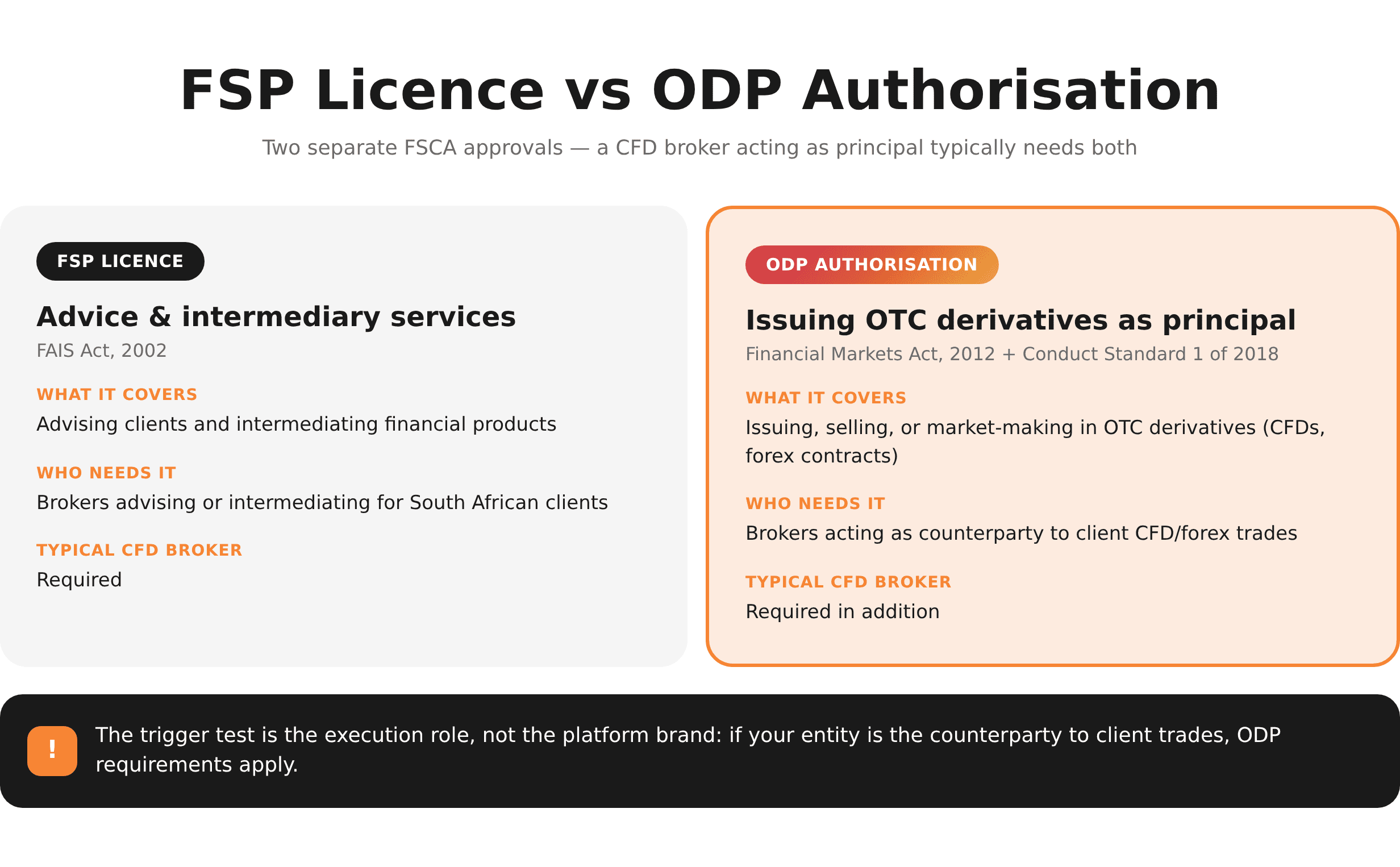
An FSP licence under FAIS authorises you to provide advice and intermediary services. ODP authorisation permits you to originate the product itself. A CFD broker acting as principal typically needs both.
FSP licence (FAIS) | ODP authorisation (FMA) | |
|---|---|---|
What it covers | Advice and intermediary services | Issuing or market-making in OTC derivatives as principal |
Governing framework | FAIS Act, 2002 | Financial Markets Act, 2012 + Conduct Standard 1 of 2018 |
Who needs it | Brokers advising or intermediating for SA clients | Brokers acting as counterparty to client CFD/forex trades |
Typical CFD broker | Required | Required in addition |
The takeaway: "FSCA forex broker licence" is a shorthand that hides two distinct approvals. Budget time and documents for both.
How the FSCA Views MT5 Execution Models
The FSCA looks at what happens to a client order, not at the logo on the terminal. On a typical MT5 setup, the client trades against your dealing entity, and you hedge some or all of that exposure with a liquidity provider. That structure makes you the issuer of the CFD, and issuers need the ODP licence.
This holds for market makers, hybrid books, and most STP arrangements where the broker remains the legal counterparty. If two platforms sit in your execution chain, one facing clients and one facing liquidity, expect the FSCA to treat the activity as ODP business.
Planning a South Africa launch?
Licensing takes months. A compliance-ready broker site can be designed, built, and waiting long before approval lands.
Company and Governance Documents
A South Africa ODP application starts with the corporate record. Non-bank applicants apply on the prescribed Form FM6, pay the R50,000 application fee, and complete the FSCA's Application Index 2, which lists every supporting document the regulator expects to assess.
Prepare the following before you think about filing:
Certificate of incorporation and company registration documents
Group and ownership structure, including beneficial owners
Organisational chart showing reporting lines for the derivatives business
Board and governance framework: charters, committee mandates, delegation of authority
Business plan covering products, target market, projected financials, and growth assumptions
Compliance framework and the identity of the compliance officer
Outsourcing agreements, including platform, liquidity, and back-office arrangements
In practice, the business plan does the heavy lifting. It must describe the CFD and forex products you will issue, the client segments you will serve, and how the operation stays solvent under stress. Thin, template-style plans are a common reason applications loop back with questions.
Fit-and-Proper and Key-Person Requirements
The FSCA assesses the honesty, integrity, and competence of every key person behind the ODP: directors, senior managers, the compliance head, and anyone controlling the dealing function. Fit-and-proper requirements are evidence-based, so each key person should have a file containing:
Certified identity documents and detailed CV
Qualifications and relevant derivatives experience
Criminal record and regulatory background checks
Personal financial soundness declarations
Disclosure of directorships and potential conflicts of interest
One weak file slows the whole application. If your head of dealing has deep MT5 experience but no documented derivatives qualification, address that gap before filing, not after the FSCA raises it.
Risk Management and Operational Controls
Conduct Standard 1 of 2018 requires an ODP to demonstrate working systems, not intentions. Your application needs a documented risk management framework covering market, credit, liquidity, and operational risk for the derivatives book, plus the governance controls that keep it honest.
Capital Adequacy and Prudential Requirements
Non-bank applicants complete a capital adequacy form as part of Application Index 2. You must show sufficient capital and liquid reserves, proportionate to the risk of the positions you hold, and a process for monitoring capital on an ongoing basis. Decide early whether you run a market-making book or hedge back-to-back, because the capital story differs materially between the two.
Reporting and Record-Keeping Obligations
Authorised ODPs report their OTC derivative transactions to a licensed trade repository. Your application should show how trade data flows from MT5 into reporting, how records are retained, and who owns the process. Regulators read this section as a proxy for operational maturity.
What this means: the FSCA is testing whether your operation can behave like a regulated derivatives issuer from day one, not whether you can write policy documents.
Trading Platform, Pricing and Execution Model
The FSCA expects an ODP applicant to document exactly how client orders are priced, executed, and hedged. For an FSCA MT5 broker setup, that means turning your platform architecture into an evidence pack:
Platform description: MT5 server topology, white label or full licence, hosting and business-continuity arrangements
Execution model: market maker, STP, or hybrid, and which entity is counterparty at each step
Pricing methodology: price sources, spread construction, markups, and swap calculations
Liquidity and hedging: provider agreements and the rules for routing exposure
Margin and leverage policy: client margin requirements, margin-close-out rules, and negative balance handling
Conflict-of-interest controls around the dealing desk
Brokers we work with report that this is the section where technology and compliance teams first meet in the same room. The earlier that meeting happens, the fewer contradictions the FSCA finds between your platform configuration and your written policies.
Website and Client Communication
A broker website is part of the FSCA's conduct picture. Client-facing communication must be fair, clear, and not misleading, and your site is the most visible piece of evidence of how you communicate. Treating the website as a post-approval afterthought is the most common sequencing mistake in a South Africa ODP application.
What the FSCA Expects From a Broker Website
Plan the site so that, at approval, you can switch on a presence that already carries:
Accurate legal entity details and, once granted, licence references
Prominent risk warnings appropriate for CFDs and leveraged products
Legal documents: terms of business, client agreement, complaints and conflicts policies, privacy notice
Clear product and pricing disclosure, including spreads, swaps, and fees
Honest marketing claims with no guaranteed-profit language
In WSA's broker projects, the legal-document and disclosure pages are wireframed while the licence application is still in drafting. That way compliance reviews real pages, not promises.
Pre-Approval Marketing Restrictions
You cannot conduct or promote unauthorised ODP business to South African clients while the application is pending. What you can do is build: brand, site architecture, educational content, and the full onboarding flow behind a staging wall. The distinction is between preparing a website and operating a business through it. If you already run a live site and are regularising your licence position, work through a broker website redesign checklist so the compliance rework doesn't cost you rankings.
Launch in South Africa without losing a year
Structured support for FSP and ODP workstreams, run in parallel with one launch date.
Running FSP and ODP Workstreams in Parallel
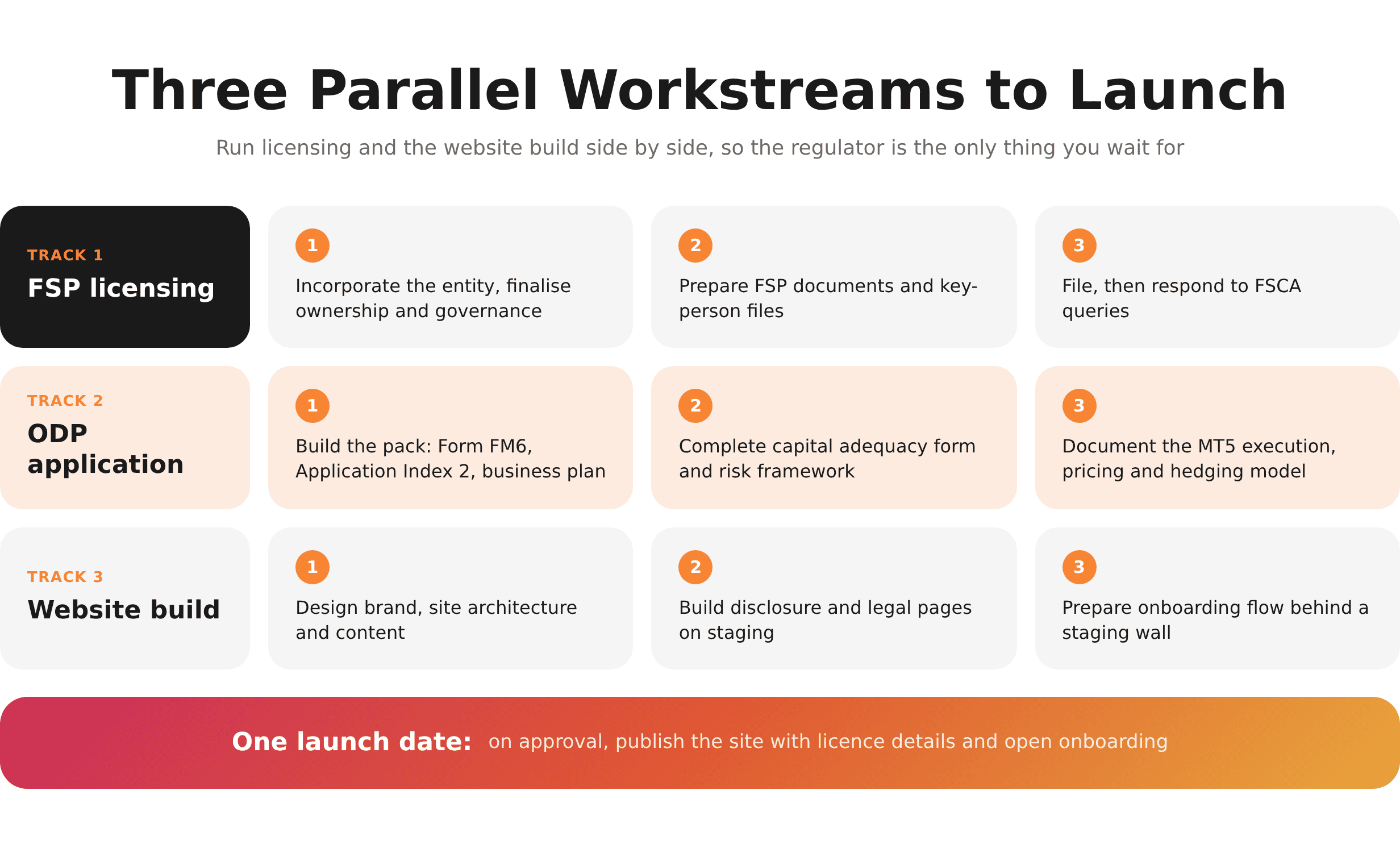
Most new South African brokers run two approval workstreams at once, with the website build as a third track alongside them. A workable sequence looks like this:
Incorporate the entity and finalise ownership and governance structures
Prepare FSP licensing documents and key-person files
Build the ODP pack: Form FM6, Application Index 2, business plan, capital adequacy form
Document the MT5 execution model, pricing, and hedging arrangements
Design and build the website, including all disclosure and legal pages, on staging
File applications, respond to FSCA queries, and keep evidence current
On approval, publish the site with licence details and open onboarding
Timelines vary case by case, and ODP assessments commonly run for months, so the parallel approach exists to make sure the slowest workstream is the regulator, never your own preparation.
FSCA ODP Application Readiness Checklist
Use this checklist to confirm your FSCA ODP licence application is ready to file. It follows the same structure as our licence document checklist for brokers applying under SCB Bahamas. Documents required for an FSCA ODP application fall into six groups:
Company: incorporation documents, ownership structure, organisational chart, business plan
Key persons: fit-and-proper evidence for directors, senior managers, and compliance officers
Capital: completed capital adequacy form and proof of financial resources
Risk and controls: risk management framework, compliance policies, outsourcing agreements
Platform and execution: MT5 architecture, pricing methodology, hedging and liquidity agreements, margin policy
Website and communication: risk warnings, legal documents, disclosure pages, marketing claims review
If any group is incomplete, fix it before filing. Applications with gaps invite questions, and every question cycle adds weeks.
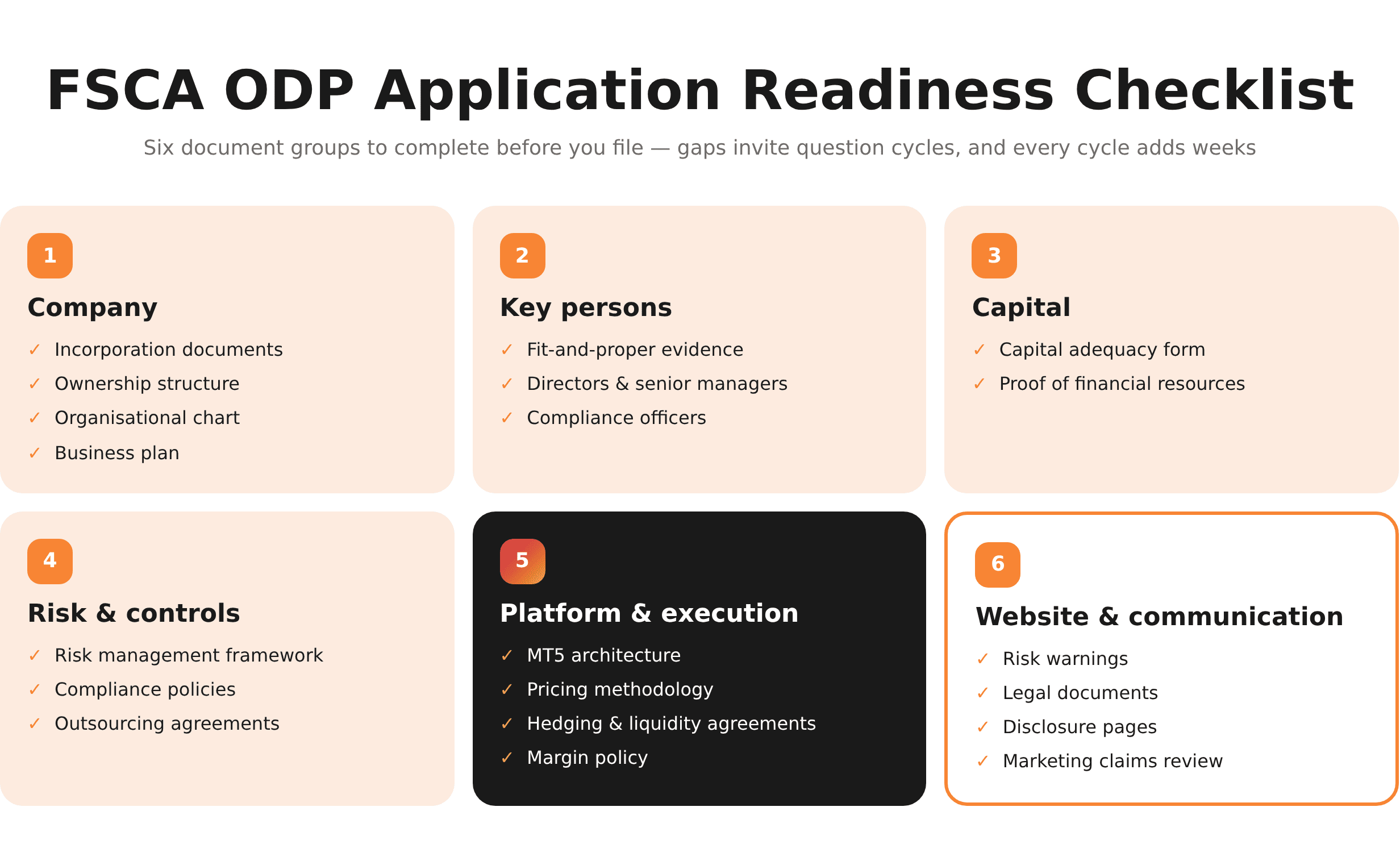
[Visual: ODP Application Readiness Checklist — six-group checklist card covering company, key persons, capital, risk, platform, and website documents]
Not sure which option fits your business?
From startup brokerages to established platforms, WSA delivers websites that convert traders, satisfy regulators, and scale across markets.
Conclusion
An FSCA ODP licence application succeeds on preparation: complete company records, credible key-person files, a defensible capital and risk story, a documented MT5 execution model, and client communication that already meets FSCA ODP requirements. Brokers that treat the website as part of the application evidence, rather than a launch-week afterthought, reach approval day with something to show for the wait.
WSA designs and builds websites for brokers and fintech companies, including the disclosure and legal-page architecture that regulated launches depend on. If South Africa is on your roadmap, start the website workstream now, so the day the FSCA says yes is the day you go live. Talk to the team.
FAQ
What documents are required for an FSCA ODP application?
A non-bank applicant files the prescribed Form FM6 with the application fee and the documents listed in the FSCA's Application Index 2. In practice that means company registration and ownership records, a detailed business plan, governance and compliance frameworks, fit-and-proper evidence for key persons, a completed capital adequacy form, a risk management framework, outsourcing and liquidity agreements, and documentation of the trading platform, pricing, and execution model. Client-facing legal documents and website disclosures support the conduct side of the assessment.
Is an FSP licence enough for a CFD broker?
No, not if the broker issues CFDs as principal. An FSP licence under FAIS covers advice and intermediary services. A firm that acts as counterparty to client trades in OTC derivatives also needs ODP authorisation under the Financial Markets Act, 2012. In practice, a CFD broker licence in South Africa means holding both approvals, run as parallel workstreams.
Does an MT5 broker need ODP authorisation?
Yes, if the broker is the counterparty to client trades on the platform. The FSCA assesses the execution chain rather than the software brand: an MT5 broker running a market-making or hybrid book, or an STP model where it remains the legal counterparty, is issuing OTC derivatives and needs ODP authorisation. A firm that only introduces clients to an authorised ODP without issuing products may fall outside the requirement.
What platform documents are required for an ODP application?
The application should document the platform architecture, the execution model, and the pricing methodology. For an MT5 setup this typically includes the server and hosting arrangement, whether the platform is a white label or full licence, price sources and spread construction, liquidity and hedging agreements, margin and leverage policy, and business-continuity plans. The goal is to show the FSCA precisely what happens to a client order from placement to hedge.
Can the broker website launch before FSCA approval?
A brand or educational website can go live, but the broker cannot onboard South African clients or promote unauthorised ODP services before approval. The practical approach is to build everything, including onboarding flows, legal pages, and disclosure architecture, on a staging environment during the application, then publish fully once the authorisation is granted and licence details can be displayed.
Launch Your Licensed Brokerage with Confidence
We support brokers and fintechs through licensing, launch planning, and everything a regulated brand needs to go live.