•
•
Brokerage Website Development in 2026: What Financial Brands Must Get Right
In 2026, brokerage website development is no longer just a design project.
For regulated forex brokers, CFD brokers, and multi-asset trading firms, a website functions simultaneously as:
Regulatory infrastructure
Client acquisition engine
Due diligence surface
Operational integration layer
It shapes:
How regulators evaluate your governance
How traders assess your legitimacy
How efficiently traffic converts into funded accounts
How cleanly CRM, KYC, and trading systems operate together
Brokers who treat their website as a marketing brochure often rebuild within 12–18 months. Brokers who treat it as infrastructure tend to scale without structural disruption.
In competitive trading markets, structure signals seriousness.
This guide outlines what regulated brokerage websites must address in 2026 across compliance, UX, performance, integration, multilingual architecture, and AI-driven search visibility.
Key Takeaways
Brokerage website development in 2026 is operational infrastructure—not decoration
Compliance hierarchy must be embedded structurally from day one
Trust-driven UX directly impacts registration quality and funded account growth
Performance influences SEO rankings, paid media efficiency, and CPA
MT4, MT5, and cTrader integration must be engineered before launch
Multilingual and multi-jurisdiction architecture is baseline for regulated brokers
Strategic planning prevents costly rebuilds within 12–24 months
AI-driven search increasingly rewards structured, extractable content
What Is Brokerage Website Architecture?
Brokerage website architecture refers to the structural framework that governs how compliance, content, onboarding, and trading platform integrations operate together within a regulated financial environment.
Unlike generic corporate web design, broker website development must balance:
Regulatory disclosure obligations (FCA, CySEC, ASIC, FSCA, ESMA)
Cross-border communication requirements under MiFID II
Conversion-optimized UX for trader acquisition
MT4, MT5, or cTrader integration
CRM, KYC/AML, and payment gateway connectivity
Multilingual and multi-entity segmentation
A regulated broker website is not merely a marketing channel. It is a controlled financial communication system.
In forex and CFD markets, architecture becomes strategy.
1. Regulatory Architecture Is Structural — Not Cosmetic
Compliance cannot live in a footer.
Regulators increasingly review broker websites during licensing, renewals, and audits. They assess not only whether risk disclosures exist, but how clearly and structurally they are presented.
Typical evaluation criteria include:
Visibility of risk warnings
Clarity of leverage and margin communication
Transparency of spreads and commissions
Separation between licensed entities
Accuracy of marketing claims
Accessibility of legal documentation
Under MiFID II and ESMA-aligned frameworks, jurisdictional communication must precisely reflect authorization boundaries. Even technically compliant disclosures can raise concerns if buried deep within navigation.
Banks and liquidity providers also review websites during due diligence. Structural opacity can trigger operational red flags.
A properly engineered broker website typically includes:
Clear compliance hierarchy
Contextual, prominent risk disclosures
Jurisdiction-specific content segmentation
Accessible legal hubs
Explicit entity differentiation
Compliance failures rarely occur because information is missing. They occur because structure reduces clarity.
2. Trust-Driven UX Determines Funded Account Growth
In trading environments, perceived legitimacy directly influences conversion.
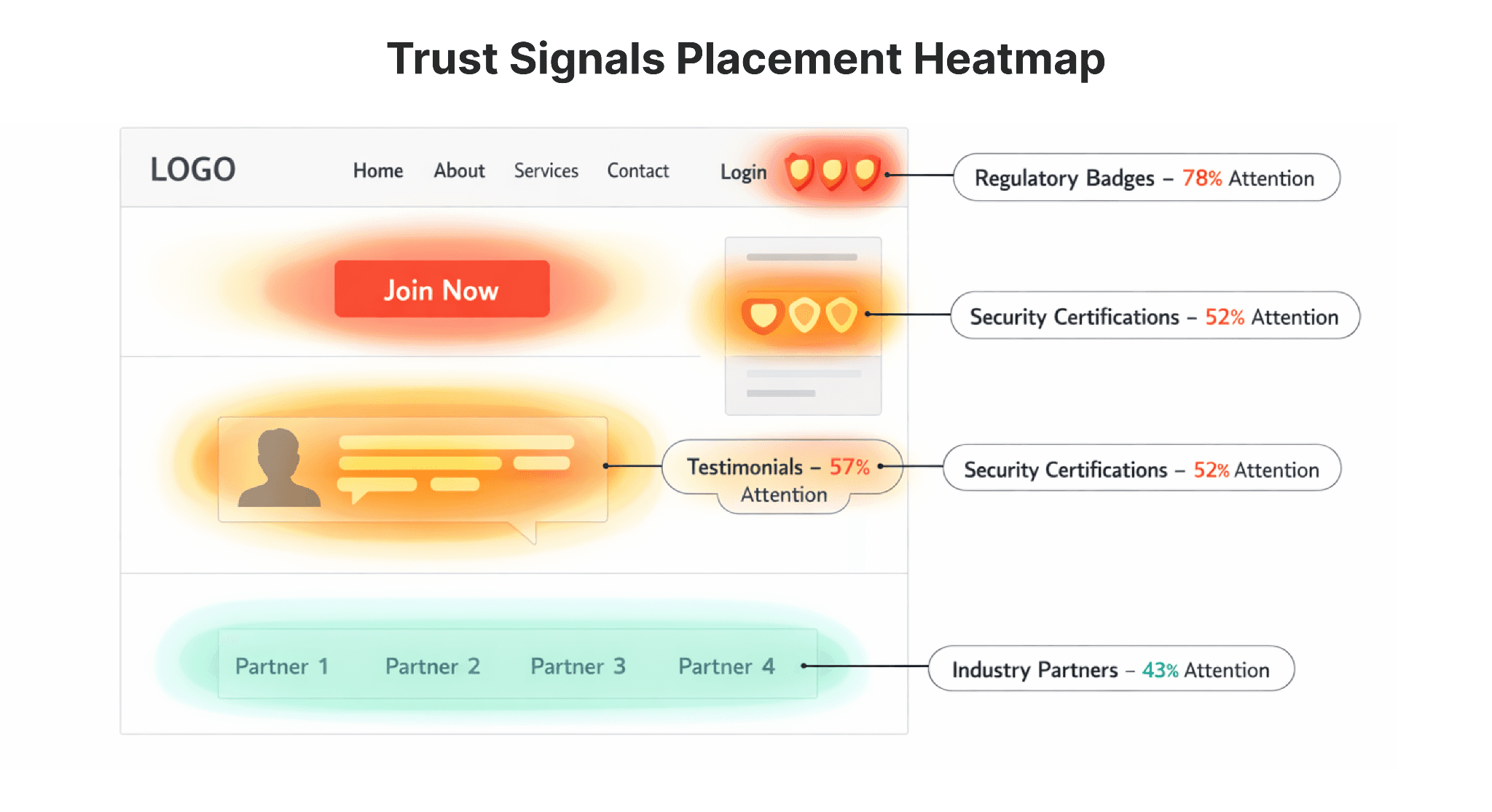
Users form credibility judgments in milliseconds, according to research from the Nielsen Norman Group. If uncertainty outweighs clarity, onboarding stalls.
Common friction points on broker websites include:
Overloaded hero sections
Hidden or vague spread information
Confusing account comparison tables
Inconsistent regulatory positioning
Weak mobile optimization
Slow performance under peak traffic
Traders rarely abandon because a layout feels outdated. They abandon when risk perception rises.
High-performing brokerage websites prioritize:
Clear value proposition above the fold
Transparent spreads, leverage, and fee communication
Logical account comparison structures
Guided onboarding flows
Mobile-first responsiveness
Sub-2-second load times
Conversion architecture is less about visual polish and more about cognitive risk reduction.
3. Performance Directly Impacts SEO, Paid Media, and CPA
Performance is not just technical—it is financial.
Google's Core Web Vitals influence rankings, but speed also affects:
Bounce rate
Onboarding completion
Paid media Quality Score
Cost-per-acquisition
When funded accounts cost $400–$1,200 to acquire, a one-second delay becomes measurable revenue loss.
Modern brokerage websites should include:
Global CDN configuration
Optimized image formats (WebP, AVIF)
Clean front-end architecture
Deferred script loading
Stable layout rendering
Plugin-heavy systems often introduce volatility—particularly when integrating MT4/MT5 dashboards. Modern platforms like Webflow consistently deliver superior performance benchmarks.
In competitive markets, speed communicates reliability.
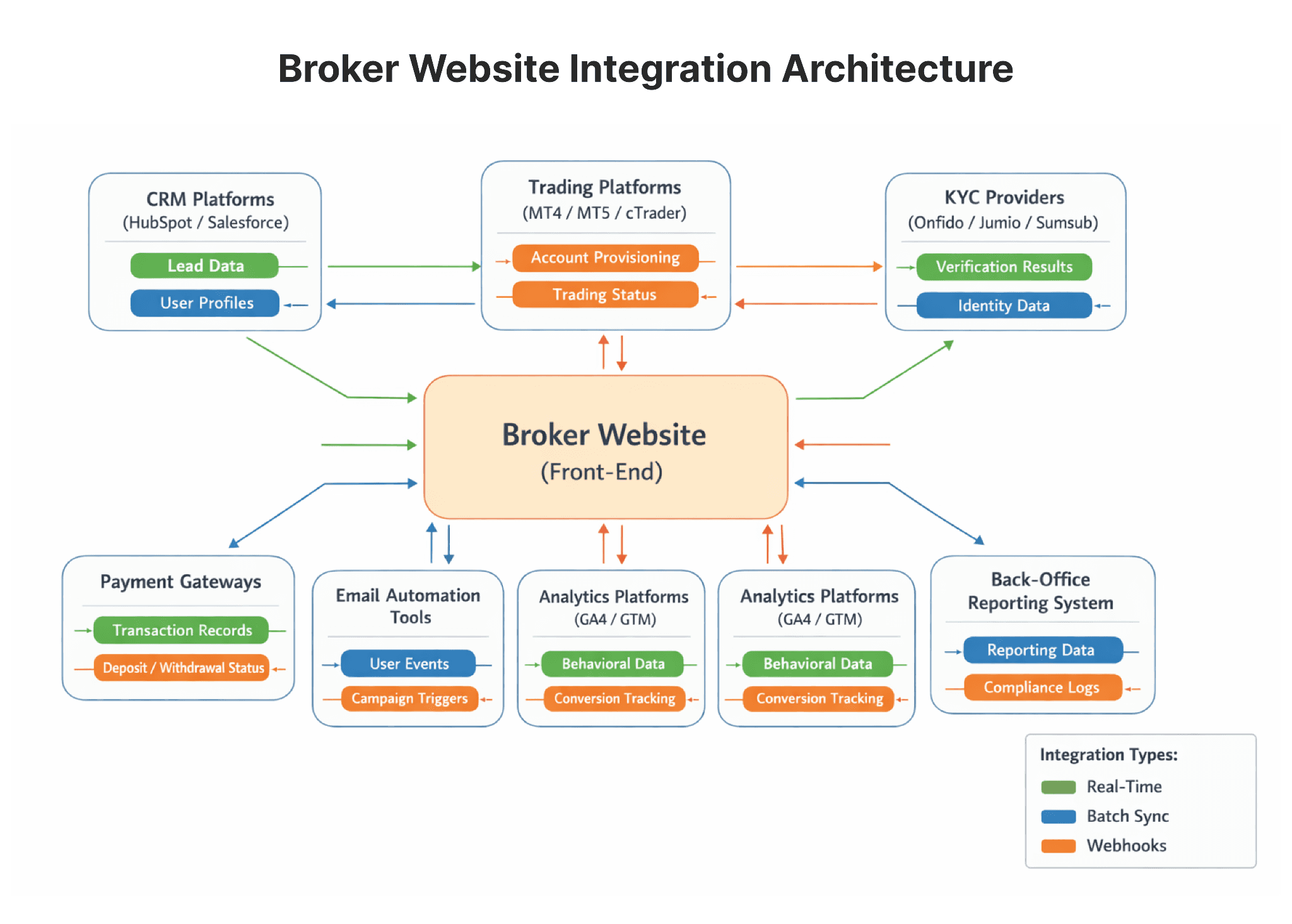
4. Trading Platform Integration Defines Operational Stability
A website disconnected from trading infrastructure creates friction that compounds over time.
Broker websites often integrate with:
MetaTrader 4 (MT4)
MetaTrader 5 (MT5)
cTrader
Proprietary dashboards
These integrations must align with:
CRM synchronization (HubSpot, Salesforce, or proprietary systems)
KYC/AML workflows
Payment automation
Client authentication systems
Reporting and audit trails
When visual design is prioritized before integration logic, brokers frequently spend months reconciling CRM data and restructuring onboarding flows. Learn more about proper integration planning for broker websites.
Website structure should follow operational logic - not visual preference.
5. Platform Selection Shapes Long-Term Risk
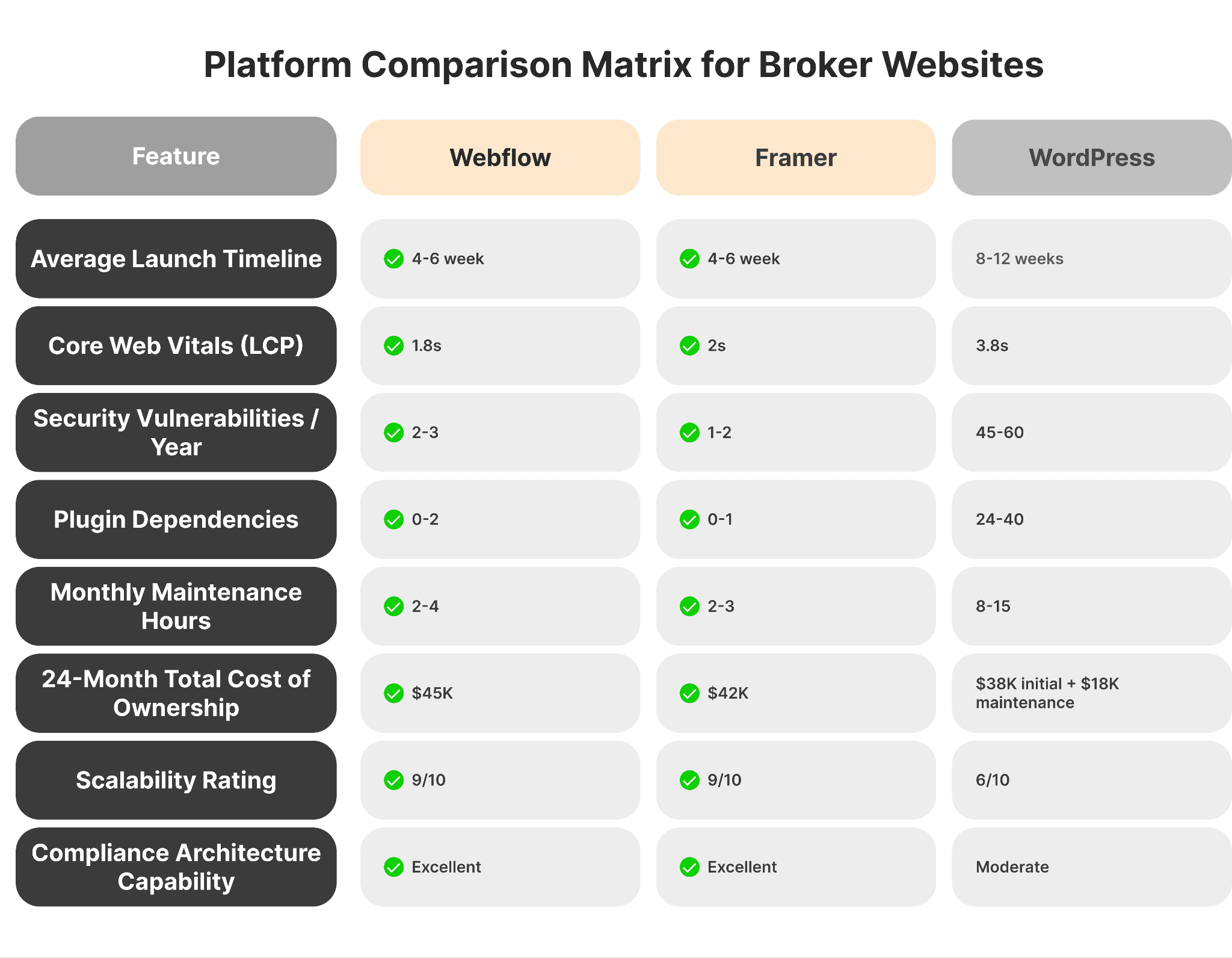
The CMS or framework chosen defines scalability, security exposure, and performance stability.
Modern platforms such as Webflow and Framer provide:
Structured CMS control
Strong SEO capabilities
Faster deployment timelines (4–8 weeks typical)
Reduced plugin dependency
Built-in performance optimization
Automatic security updates
WordPress remains common but often introduces:
Ongoing security management
Plugin vulnerabilities and security overhead — 96% of WordPress security vulnerabilities originate in plugins, not core (Patchstack + Sucuri, 2025)
Performance variability
Templates optimize for launch speed. Strategic brokerage website development optimizes for longevity and regulatory stability. Those are fundamentally different objectives. For detailed cost considerations, see our analysis of brokerage website development costs in 2026.
6. Multilingual and Multi-Jurisdiction Architecture Is Baseline
Most regulated brokers operate across multiple regions.
Modern brokerage websites must support:
Structured multilingual CMS architecture
Accurate hreflang implementation
Jurisdiction-specific disclosures
Entity-based segmentation
Region-aligned marketing restrictions
Improper structuring can cause:
SEO cannibalization
Duplicate content
Cross-border compliance issues
Marketing violations
Localization is not optional expansion. It is baseline infrastructure.
Retrofitting multilingual logic after launch often costs 30–50% of the original build.
7. SEO and Generative Engine Optimization (GEO)
Search behavior is evolving.
AI systems increasingly extract structured answers directly from broker websites. Visibility now depends on clarity and extractability—not keyword density alone.
Broker websites should include:
Clear FAQ sections
Structured heading hierarchies
Schema markup (Organization, FAQPage, BreadcrumbList)
Contextual internal linking
Well-organized educational content
As AI-driven search tools from OpenAI, Google, and Anthropic summarize broker information, structured clarity outperforms verbosity.
Generative Engine Optimization (GEO) is becoming foundational.
8. Templates vs Strategic Brokerage Development
Template-based websites can reduce upfront cost and speed launch.
They may suit:
Early-stage brokers
Offshore-only entities
Short-term campaign projects
However, regulated brokers typically require:
Custom compliance hierarchy
Deep trading platform integration
Multi-jurisdiction scalability
Conversion-engineered UX
Short-term savings often translate into rebuilds within 12–24 months.
A realistic cost comparison frequently shows that strategic builds—while higher upfront—reduce long-term technical debt and operational disruption.
Common Strategic Mistakes
Treating compliance as a checklist instead of architectural logic
Overinvesting in visuals while neglecting UX structure
Selecting platforms based on familiarity rather than scalability
Ignoring mobile-first realities (60–70% of traffic is mobile)
Launching without structured analytics and conversion tracking
Separating website launch from CRM and trading integrations
Underestimating multilingual and jurisdiction complexity
In regulated trading environments, your website is measurable acquisition infrastructure.
2026 Brokerage Website Development Checklist
Before launch, verify:
Regulatory
Compliance hierarchy structured
Jurisdiction disclaimers validated
Risk disclosures prominently integrated
Performance
Core Web Vitals optimized
Mobile performance tested
CDN implemented
Integrations
CRM synchronization active
MT4/MT5 or cTrader integration connected
KYC workflow tested
Payment automation validated
SEO & GEO
Structured data implemented
Internal linking defined
XML sitemaps configured
Hreflang validated
Operations
Backup systems in place
Staging environment established
Team CMS training completed
Analytics tracking functional
If your current website does not meet several of these criteria, a structured audit may reveal hidden performance or compliance risks.
Planning Your Brokerage Website for 2026
Brokerage website development now intersects:
Compliance engineering
Behavioral UX
Performance optimization
Multilingual SEO
Trading platform integration
For regulated brokers, the website is no longer a marketing layer. It is operational infrastructure.
Firms that architect strategically build once—and scale. Firms that prioritize speed over structure often rebuild repeatedly.
When evaluating your 2026 roadmap, consider:
Can your current structure support an additional regulatory entity?
Does your onboarding logic align with CRM attribution?
Are your compliance disclosures clearly extractable by AI systems?
Would a licensing audit view your site as structured—or improvised?
These questions often surface architectural gaps that are not visible during daily operations.
If You're Evaluating a 2026 Brokerage Website Strategy
Specialized fintech agencies bring experience navigating:
Regulatory reviews
Trader conversion optimization
MT4/MT5 integrations
Multilingual compliance frameworks
For firms operating in regulated environments, structural clarity reduces regulatory friction, improves acquisition efficiency, and prevents costly rebuild cycles. Understanding the difference between fintech web design agencies and generic web studios clarifies what specialized expertise delivers.
If you're assessing whether your current website can support your next phase of growth, a structured discovery conversation can clarify where risks or opportunities exist.
Final Perspective
In 2026, brokerage websites are not pages.
They are regulated systems that influence licensing outcomes, trader trust, acquisition efficiency, and operational stability.
The firms that treat them as infrastructure build once and scale. The firms that treat them as marketing collateral tend to rebuild under pressure.
If growth, compliance stability, and acquisition efficiency matter to your brokerage, website architecture deserves strategic planning—not cosmetic updates.
FAQs
How long does brokerage website development take in 2026?
Most modern builds take 4–8 weeks from discovery to launch, including UX design, compliance review, development, and integration testing. Integration-heavy environments may require 3–6 months depending on complexity, particularly when connecting proprietary CRM systems, multiple KYC providers, and trading platform APIs. For a detailed timeline breakdown, see our step-by-step guide to creating a broker website.
What platform is best for broker websites?
Webflow and Framer offer strong performance and structured CMS control, with sub-2-second load times and reduced maintenance overhead. WordPress remains viable but requires active security and optimization management due to plugin dependencies and vulnerability exposure. Platform choice should align with integration depth and growth plans rather than familiarity. Strategic platform selection considers 24-month growth projections, multilingual requirements, and internal team capabilities.
Do regulators review broker websites?
Yes. FCA, CySEC, ASIC, and others evaluate disclosure clarity, marketing claims, and jurisdiction alignment during licensing and audits. They assess risk disclosure prominence, fee transparency, leverage communication, and entity separation. Missing or unclear compliance content can delay licensing by months and damage banking relationships. Regulatory review is why compliance architecture must be embedded structurally from day one.
How much does broker website development cost?
Strategic builds typically range from $30,000–$60,000 depending on scope, including core integrations, CMS setup, and compliance architecture. Complex multi-jurisdiction builds with extensive custom functionality may exceed this range, reaching $80,000-$150,000. Template approaches may appear cheaper initially ($5,000-$15,000) but often require complete rebuilds within 12–24 months, bringing total costs to $25,000-$55,000. For detailed cost breakdowns, see our analysis of what you should actually budget for broker website development.
Is AI website building suitable for brokers?
AI tools assist with prototyping, but regulated environments require structured compliance and integration logic beyond template automation. While AI tools can help with initial website creation, they cannot handle jurisdiction-specific compliance requirements, custom trading platform integrations, or the regulatory nuances that licensed brokers face. For mission-critical brokerage infrastructure where compliance errors have serious consequences, human expertise remains essential.
Launch Your Licensed Brokerage with Confidence
We support brokers and fintechs through licensing, launch planning, and everything a regulated brand needs to go live.