•
•
Framer Fintech Website: Is It Ready for Financial Brands?
Most financial brands do not need a fully custom-coded marketing website from day one. They do need a platform that earns trust at first glance, presents legal information clearly, loads quickly, supports multiple markets, and connects cleanly to their analytics and CRM stack.
The question is whether Framer — now one of the most talked-about no-code tools — can actually deliver that for fintech and financial services, or whether its reputation still rests mainly on beautiful landing pages and startup launch sites.
The short answer is yes: Framer is ready for many financial marketing websites. It now supports localization, SEO controls, analytics and tag management, webhooks, custom headers and CSP, reverse-proxy hosting, staging environments, and enterprise-grade security documentation. But it is not the right fit for every financial web requirement — and understanding where that line sits is exactly what this article is designed to help you do.
This article is written for fintech startups, payment platforms, brokers, exchanges, wealthtech teams, financial SaaS companies, and established financial brands evaluating a rebrand or platform change. It focuses on the website layer — not on replacing your core application, trading infrastructure, or onboarding systems.
Key Takeaways
Framer is a serious option for many financial marketing websites, not just startup landing pages.
It is strongest when speed, visual polish, interaction design, and lean team workflows are the priority.
It is weaker when self-hosting, deep CMS governance, or product-grade backend logic are mandatory.
Compliance still depends on your content, your legal team, and your approval workflows — not on the website builder.
For most financial brands, the real decision is Framer vs. Webflow vs. hybrid/custom — not “Framer or nothing.”
What Does a Financial Brand Actually Need From a Website Platform?
Financial brands evaluate website platforms differently from generic startups. The benchmark is not “Can it look credible?” The bar is much higher.
A financial services website needs to deliver clear trust signals from the first screen. It needs to surface legal disclosures and risk warnings prominently, without burying or visually diminishing them. For regulated firms, the website itself can form part of the financial promotion surface — which means design decisions carry regulatory consequences, not just aesthetic ones.
Beyond compliance, financial brands need:
Strong Core Web Vitals and dependable performance under load (a slow site erodes credibility fast — see how speed impacts trust)
Multilingual and regional readiness for cross-border growth
Analytics, lead attribution, and CRM/integration support
Sufficient governance and publishing control for teams with compliance oversight
A security posture that stands up to basic due diligence
The platform, the information architecture, and the design execution all need to work together. Choose the wrong foundation, and all three become harder to get right. If you are still mapping out what your fintech website structure should achieve, this piece on website structure for fundraising is a useful companion read.
What Does Framer Already Handle Well for Fintech Websites?
Framer is no longer just a prototyping tool or a fast landing-page builder. Its current infrastructure covers most of what a marketing-focused financial brand needs from a website platform.
Localization is now robust: Framer supports additional locales, localized page paths, automatic lang and hreflang handling, automatic locale routing, and RTL support. For financial brands targeting multiple geographies, that is a meaningful capability — not a minor extra.
SEO controls are solid: metadata management, redirects, robots.txt, XML sitemaps, Google Search Console setup, and JSON-LD structured data are all supported, giving fintech teams the tools they need for technical SEO without relying on a developer for every change.
Analytics and tagging work cleanly: Framer supports GA4, GTM, custom event tracking, UTM and GCLID capture, and hidden form fields for campaign attribution. That means your growth stack can be connected from day one.
Forms, webhooks, and integrations are strong enough for standard marketing use cases: HubSpot form embeds, webhook-based lead routing, and standard CRM integrations are all viable. For basic lead capture, the native form system works well.
Hosting and security are solid: SSL on custom domains, DDoS protection, staging and production workflows, version history, custom headers, CSP configuration, and reverse-proxy hosting are all built in. Enterprise tiers add SSO, role-based permissions, SOC 2 Type II and ISO 27001 documentation, and Trust Center access.
Custom code is supported, which matters for financial brands with specific tracking requirements, third-party scripts, or consent tooling.
In short: Framer now offers enough real website infrastructure to support serious fintech marketing operations.
Not sure which option fits your business?
From startup brokerages to established platforms, WSA delivers websites that convert traders, satisfy regulators, and scale across markets.
Where Is Framer a Strong Fit for Financial Brands?
Framer is strongest when the website is primarily a brand, acquisition, education, or product-marketing asset — not an authenticated product environment.
The strongest use cases include:
Early-stage fintechs that need a high-trust launch site without a lengthy custom development cycle
Payment platforms, wealthtech companies, brokers, and financial SaaS brands running brand sites alongside product-marketing pages
Campaign microsites and subdomains where speed and visual quality matter more than deep content operations
Rebrands where motion design, interaction design, and a modern visual identity sit at the heart of the brief
Multilingual marketing websites managed by lean teams without dedicated developer resources
Investor-facing and fundraising-focused websites for startups that need credibility without a lengthy development sprint
If you are deciding between a no-code fintech website and a fully custom build, it is worth reading our breakdown of custom vs. template approaches to understand where each approach earns its cost.
Where Does Framer Fall Short for Some Financial Teams?
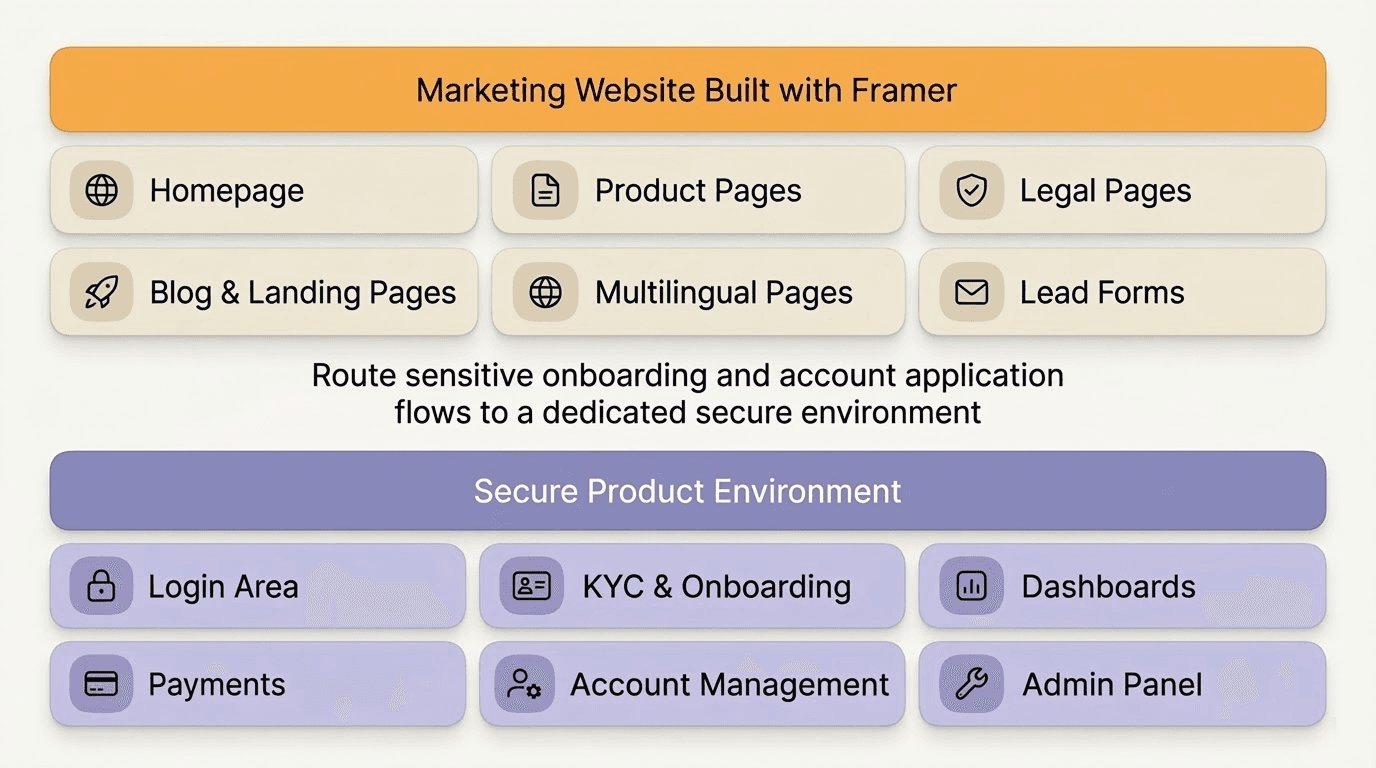
This is the more important half of the assessment.
No HTML export for self-hosting. Framer does not let you export clean HTML for hosting on your own infrastructure. Reverse-proxy hosting is available, but Framer remains the origin. If your organization has a hard requirement for a self-hosted web layer, this is a real constraint — not a footnote.
Not suitable for product-layer requirements. Logged-in dashboards, complex KYC journeys, transaction flows, and account-management areas should not be built on a visual marketing builder. These belong in your product infrastructure.
Content governance at scale needs careful evaluation. If multiple stakeholders — including compliance officers, legal reviewers, and regional marketing teams — need structured publishing workflows and approval gates, Framer’s CMS should be assessed against that operational reality.
Sensitive data and client-side logic. Framer’s own documentation warns against putting sensitive data in client-side JavaScript. Native forms are fine for lead capture, but they are not a substitute for secure onboarding architecture or regulated data-collection flows.
Native spam protection does not include reCAPTCHA. For financial brands with high-value forms or regulated contact flows, that is worth factoring into your integration plan.
The core message is simple: Framer can publish compliant marketing content. It should not be mistaken for product infrastructure or secure onboarding architecture. The website development partner you choose should understand both layers and treat them separately.
How Does Framer Compare with Webflow for Financial Brands?
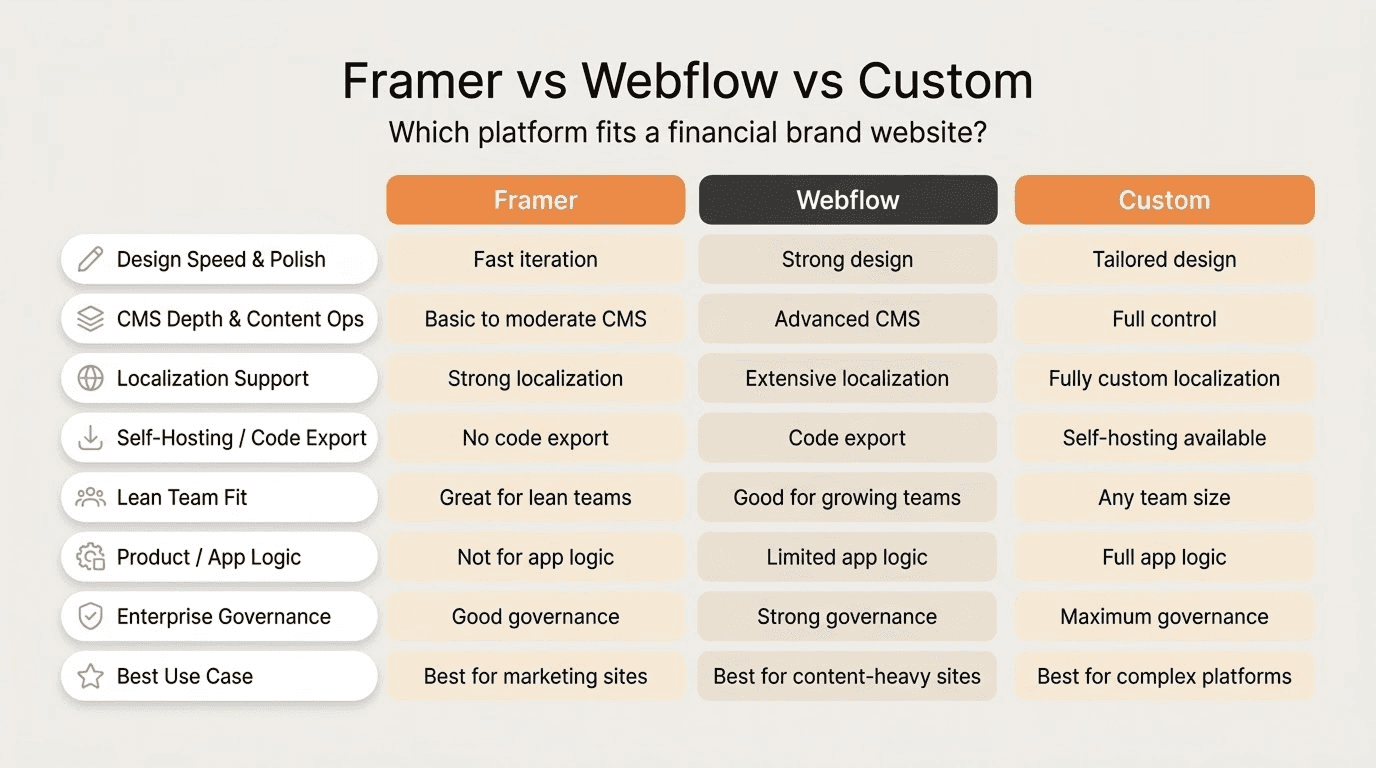
Visual: Comparison matrix — Framer vs. Webflow vs. Custom
Criteria | Framer | Webflow | Custom / Hybrid |
|---|---|---|---|
Design speed & visual polish | ⭐⭐⭐⭐⭐ | ⭐⭐⭐⭐ | ⭐⭐⭐ |
CMS depth & content operations | ⭐⭐⭐ | ⭐⭐⭐⭐⭐ | ⭐⭐⭐⭐⭐ |
Localization support | ⭐⭐⭐⭐ | ⭐⭐⭐⭐⭐ | ⭐⭐⭐⭐⭐ |
Code export / self-hosting | ✗ | ✓ | ✓ |
Lean team operations | ⭐⭐⭐⭐⭐ | ⭐⭐⭐⭐ | ⭐⭐ |
Application/product logic | ✗ | ✗ | ✓ |
Enterprise governance | ⭐⭐⭐⭐ | ⭐⭐⭐⭐ | ⭐⭐⭐⭐⭐ |
Framer vs. Webflow for fintech is not a tribal argument — it is a practical trade-off. Framer wins on design iteration speed, interactive presentation quality, and ease of use for lean teams. Webflow wins on CMS depth, more complex content operations over time, localization API flexibility, and code export availability.
Neither is a replacement for a code-first application build when the requirement is truly product-level. For a deeper look at CMS options for financial brands specifically, see the best CMS for fintech websites guide.
Can a Framer Site Support Regulated Financial Marketing Content?
Yes — but Framer does not make that content compliant. That distinction matters.
A Framer site can absolutely publish legal pages, disclosure blocks, risk statements, cookie and privacy pages, product explanation pages, pricing and fee disclosures, and region-specific content variants. The platform supports all of that.
What the platform does not determine:
What wording is legally required in your jurisdiction
How risk warnings must be visually prioritized under FCA, ESMA, or other regulatory frameworks
Whether a claim is misleading or constitutes a financial promotion
What internal approval chain is required before content goes live
FCA guidance is clear that financial promotions must not disguise, diminish, or obscure important information. A beautifully designed page can still fail that test. Responsibility sits with the firm, not the website builder.
Framer’s own GDPR guidance confirms that site owners remain responsible for cookie compliance. Its built-in analytics is cookie-free, but most financial brands running GA4 or GTM will still need a properly configured consent layer.
If your brand is building a trust-first website experience, your compliance content strategy needs to be planned before design begins — not retrofitted after launch.
What Stack Should Support a Framer Fintech Website at Launch?
A practical fintech marketing stack built around Framer might look like this:
Framer — site build, publishing, and design system
GTM + GA4 — event tracking and analytics
Google Search Console — SEO monitoring and indexing
HubSpot, Marketo, or Typeform — lead capture, lead routing, and CRM integration via webhooks or native embeds
UTM + GCLID capture — campaign attribution
Cookie consent layer — required if tracking cookies are in use (e.g., Cookiebot, Osano)
JSON-LD structured data — for core commercial pages
Custom headers and CSP — for security hardening
Reverse proxy or subdomain architecture — if the broader infrastructure requires it
One important nuance: for basic lead capture, Framer’s form system works well. For regulated data flows or sensitive onboarding steps, route users into a dedicated, secure product environment rather than handling them at the website layer. For more on fintech conversion architecture, see the CRO framework for financial brands.
Should You Choose Framer, Webflow, or Custom Development?
Visual: Decision flowchart — Framer / Webflow / Custom
Choose Framer when:
Launch speed is a genuine business priority
The site is primarily a marketing, content, or education asset
The team is lean and does not have dedicated web development resources
Visual design quality and interaction design are central to the brand brief
Self-hosting and code export are not hard requirements
Choose Webflow when:
The site is content-heavy and requires a more complex CMS structure
You expect more demanding content operations across teams over time
Code export or platform portability matters more than design speed
Localization APIs or deeper CMS integrations are required
Choose custom or hybrid development when:
The requirement is truly product-level: authenticated portals, KYC flows, or account management
Infrastructure or security controls exceed what a visual builder should own
The site must integrate deeply with internal platform architecture
Long-term maintainability at scale matters more than launch speed
Common Mistakes Financial Brands Make with Framer
Treating a Framer template as a brand strategy
Assuming a “secure-looking” design means the site is compliance-ready
Routing sensitive onboarding or regulated data flows through the website layer
Overusing motion and animation on trust-critical pages, where clarity matters more than visual flair
Hiding fee disclosures, risk warnings, or legal information in low-prominence areas
Launching without GTM, GA4, or event tracking configured
Ignoring localization structure until it becomes a painful migration
Assuming a platform decision solves weak messaging or poor information architecture
Final Verdict: Is Framer Ready for Financial Brands?
Yes — Framer is ready for many financial brand websites. The platform has matured well beyond its reputation as a designer’s prototyping tool. For marketing-led fintech websites, launch sites, campaign microsites, and moderately scaled content hubs, it is a legitimate — and often excellent — choice.
But the qualifier matters: Framer is best suited to marketing-led financial websites, not every financial web requirement. If your needs extend to self-hosting, deep CMS governance, complex publishing workflows, or product-grade authenticated experiences, a different architecture — or a hybrid approach — will serve you better.
The most expensive mistake is not necessarily choosing the wrong platform. It is choosing one before clearly defining whether the requirement is a marketing-website requirement or a product-infrastructure requirement. Get that distinction right first.
If you need help deciding whether Framer, Webflow, or a custom build is the right foundation for your financial brand website, book a discovery call with WSA. We work with fintech teams to make that decision before a line of code is written or a single component is built.
FAQ
Is Framer good for fintech websites?
Yes — especially for marketing websites, launch sites, and content-led brand experiences. Framer supports localization, SEO controls, analytics, webhooks, and enterprise security features, which makes it a serious option for many financial brands. The caveat is that “good for fintech” does not mean “good for every fintech use case.” Logged-in product areas, KYC flows, and complex onboarding should sit within dedicated product infrastructure, not a visual website builder.
Can regulated financial brands use Framer?
Yes. Regulated brands can use Framer to publish marketing websites, legal pages, disclosure content, and regional language variants. However, FCA and other regulatory frameworks place compliance responsibility on the firm — not on the platform. Legal review, content approvals, and jurisdiction-specific obligations sit with your business and your legal team, regardless of which website builder you use.
Is Framer secure enough for financial services websites?
For marketing-site use cases, yes. Framer provides SSL on custom domains, DDoS protection, custom headers and CSP configuration, reverse-proxy hosting options, and enterprise security documentation, including SOC 2 Type II and ISO 27001. “Secure enough for a marketing website” is different from “appropriate for handling sensitive application data or regulated onboarding flows” — those require separate, purpose-built infrastructure.
Does Framer support multilingual SEO?
Yes. Framer supports multiple locales, localized page paths, automatic lang attribute and hreflang handling, automatic locale routing, and RTL layout support. That covers the core requirements for a multilingual financial marketing website targeting multiple regions.
Can Framer integrate with HubSpot, GA4, GTM, and webhooks?
Yes. Framer supports HubSpot form embeds, GTM and GA4 implementation, custom event tracking, webhook-based lead routing, hidden form fields, and UTM/GCLID capture for campaign attribution. The integration layer is solid for a standard fintech marketing stack.
When should a financial brand choose Webflow instead?
When the site is more content-heavy, needs a deeper or more structured CMS, involves complex publishing operations across teams, or when code export and platform portability matter more than Framer’s design speed and interaction quality. Webflow’s CMS depth and code export give it an edge for more operationally complex financial websites.
Does Framer support self-hosting?
Not via HTML export. Framer does not offer a code export path for traditional self-hosting. Reverse-proxy hosting is available, but Framer remains the origin server. If your organization has a hard infrastructure or security requirement for a fully self-hosted web layer, this is a real limitation and should be treated as a decision factor — not a minor footnote.
When do you need custom development instead of Framer?
When the requirement is truly product-level: authenticated user portals, complex onboarding and KYC journeys, bespoke backend logic, transaction flows, or tighter infrastructure and security control than a visual website builder should own. A fintech marketing website and a fintech product are different things — and that distinction should drive your platform decision from the start.
I can also do a sharper “editorial polish” pass next — less proofreading, more making it sound premium and opinionated.
Launch Your Licensed Brokerage with Confidence
We support brokers and fintechs through licensing, launch planning, and everything a regulated brand needs to go live.