•
•
How to Build a Liquidity Provider Website for B2B Fintech Lead Generation
When you create a liquidity provider website, you are not building a product brochure. You are building an institutional trust layer and a qualified lead-generation system — one that must earn the attention of sophisticated B2B buyers before a single sales call is booked.
BIS reported average daily FX turnover of $9.6 trillion in April 2025. The market is vast, but the buyer pool for any given LP is narrow and selective. Prospects — brokers, exchanges, prop firms, and fintech platforms — typically review three to five competing websites before reaching out. That means your website is doing meaningful commercial work long before sales gets involved.
This guide explains how to build a liquidity provider website that performs in that environment: what pages to include, how to structure messaging for different institutional buyer types, which proof points actually move the needle, and how to connect the site to a measurable lead-generation process. It is written for prime-of-prime firms, multi-asset liquidity providers, market-access companies, brokers launching an LP arm, crypto liquidity businesses, and fintech infrastructure brands selling into brokers or exchanges.
Step 1. Define the Commercial Goal of Your Liquidity Provider Website
The first decision is not what the site should look like — it is what the site should achieve commercially.
For most liquidity providers, the primary goals fall into a short list: demo bookings, request-a-quote or request-liquidity submissions, broker and exchange partnership inquiries, and support for outbound sales by giving prospects a credible destination to review before a call. Secondary goals include strengthening institutional credibility during counterparty onboarding and due diligence.
What makes LP lead generation different from most B2B categories is volume and intent. Traffic to a liquidity provider website is typically low in volume but high in commercial intent. A firm that generates 20 qualified demo requests per month from serious brokers or exchanges is outperforming one that generates 500 generic contact-form submissions. The goal of your fintech lead-generation website is not to maximize raw leads — it is to maximize qualified conversations that progress to onboarding.
Defining this before design begins determines page structure, CTA hierarchy, form logic, and CRM routing. Without that clarity, teams default to aesthetics, and the commercial architecture gets bolted on late — if at all.
Step 2. Map Your ICP and the Institutional Buying Journey
Many LP websites fail because they use one generic message for every audience — and institutional buyers notice immediately.
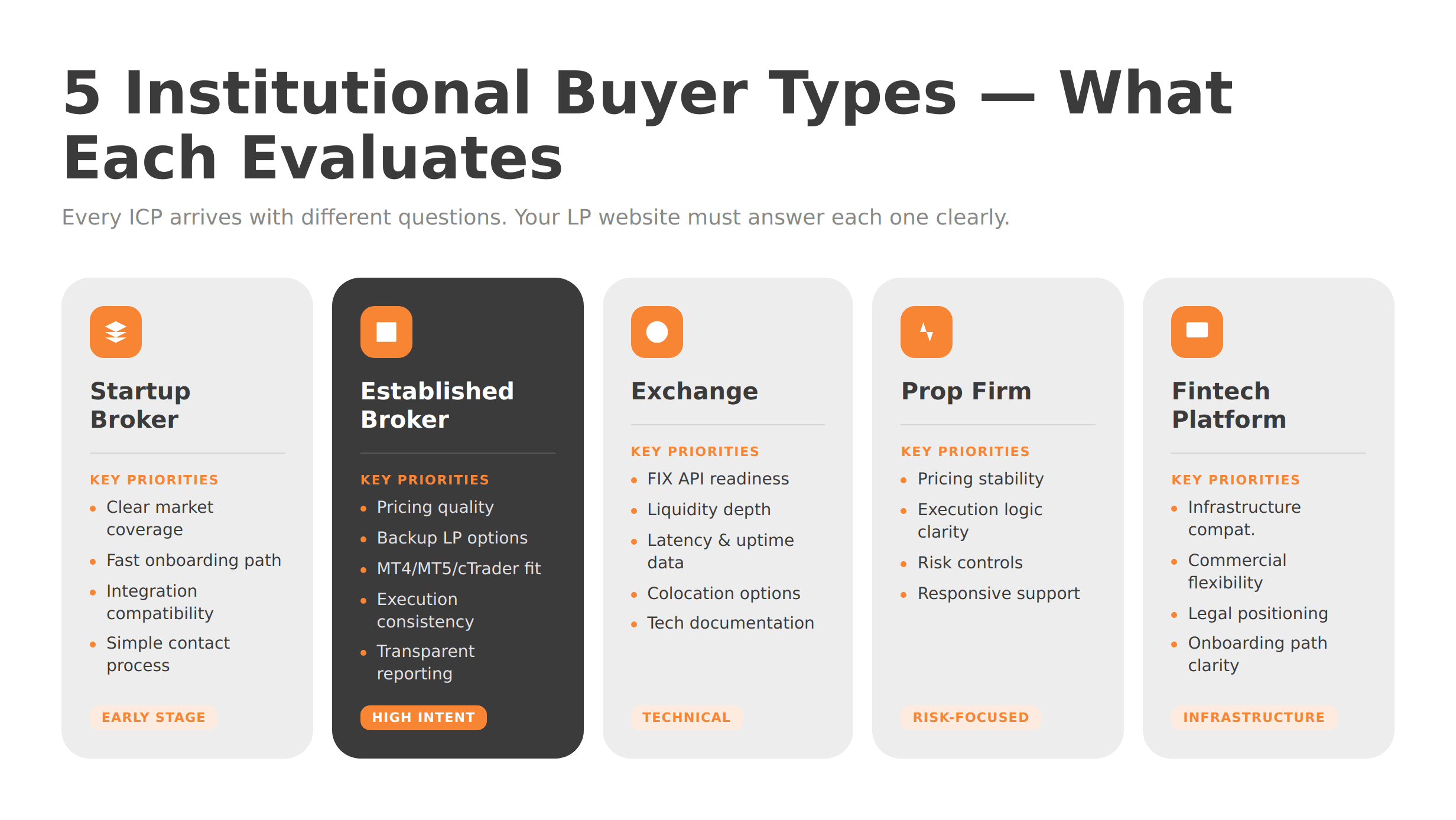
A website for a liquidity provider must serve several distinct buyer types, each with different priorities, technical questions, and risk thresholds. The core ICPs — and what each expects to see — include:
Startup brokers — clear market coverage, a fast onboarding path, basic integration compatibility, and a straightforward contact process
Established brokers — pricing quality, backup LP options, bridge and aggregation compatibility (MT4, MT5, cTrader, oneZero, PrimeXM, Centroid), transparent reporting, and execution consistency
Exchanges — FIX API readiness, liquidity depth and breadth, asset coverage, latency and uptime data, colocation options, and technical documentation
Prop firms — pricing stability, transparent execution logic, risk controls, and responsive support during periods of market stress
Fintech platforms and embedded finance products — infrastructure compatibility, commercial flexibility, legal positioning, and a clear path to counterparty onboarding
An institutional fintech website that treats all of these buyers as a single audience produces copy that resonates with none of them. Page hierarchy, solution pages, and CTA copy should reflect the specific questions each buyer type arrives with.
Step 3. Plan Your Liquidity Provider Website Structure
A clear liquidity provider website structure helps both institutional buyers and search engines understand what the business does and who it serves.
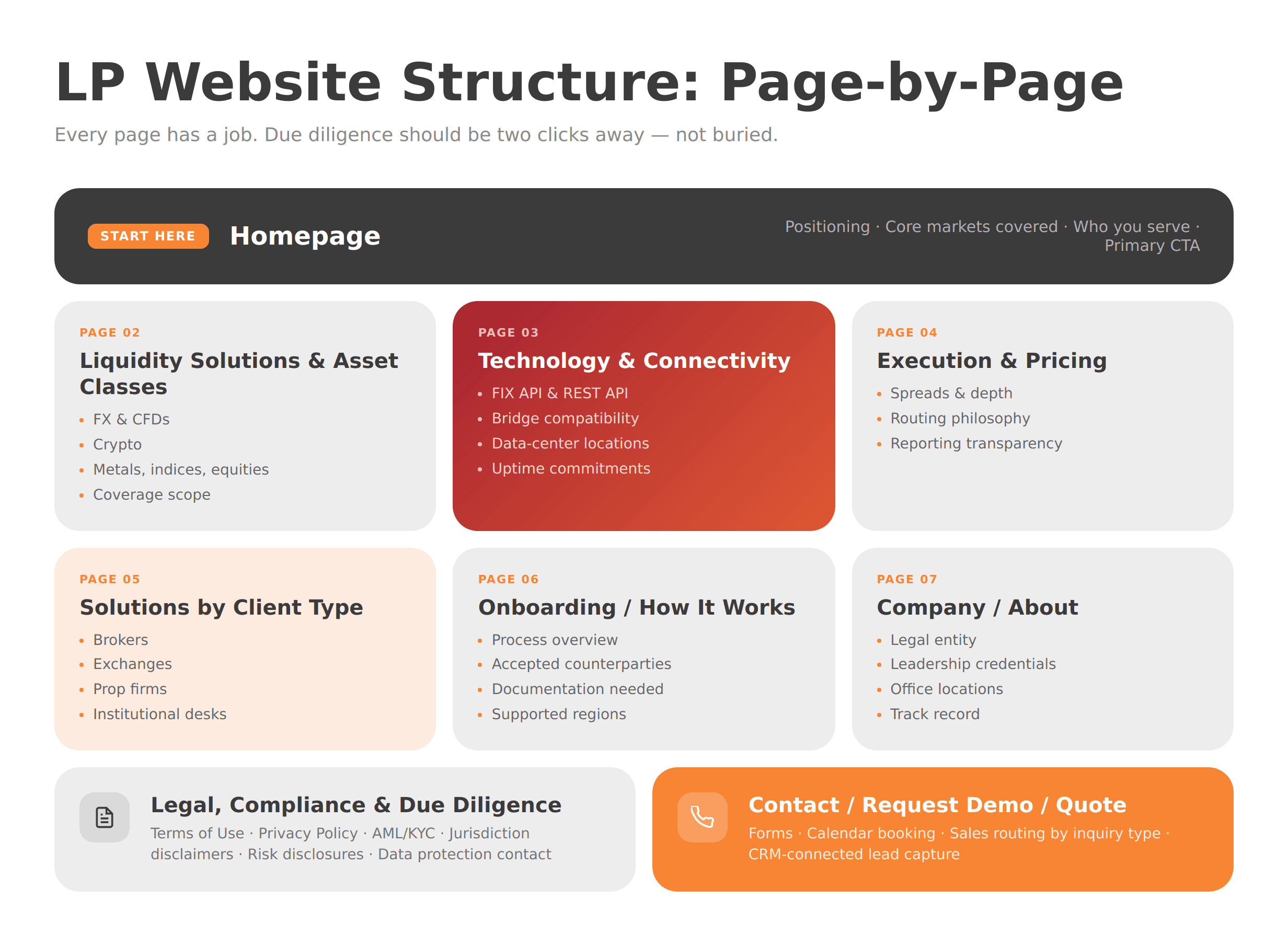
An LP website should not require visitors to work hard to find critical information. Due diligence should be easy. A page-by-page framework that supports this includes:
Homepage — positioning, core markets covered, who you serve, and a primary CTA
Liquidity Solutions / Asset Classes — FX, CFDs, crypto, metals, indices, equities, and any additional asset classes
Technology & Connectivity — FIX API, REST API, bridge compatibility, aggregation and routing logic, data-center locations, and uptime commitments
Execution & Pricing — spreads, liquidity depth, routing philosophy, and reporting transparency
Solutions by Client Type — dedicated pages or sections for brokers, exchanges, prop firms, and institutional desks
Onboarding / How It Works — process overview, accepted counterparties, documentation requirements, and supported regions
Company / About — legal entity, leadership credentials, office locations, and track record
Legal / Privacy / Terms / Disclaimers — detailed in the next section
Resources / Insights / Blog — SEO and GEO content, educational material, and authority-building content
Contact / Request a Demo / Request a Quote — forms, calendar booking, and sales routing by inquiry type
The navigation should reduce friction in the due-diligence process, not add to it. If a prospect cannot find information about FIX API compatibility, KYC/AML requirements, or counterparty onboarding within two clicks, the site is working against the sales process.
Step 4. Design for Institutional Trust: Show Proof, Not Just Claims
Institutional buyers do not respond to bold claims or retail-style graphics — they respond to evidence, clarity, and low-friction access to specific answers.
Liquidity provider website design must earn trust through structure and proof, not visual energy. The UX elements that matter most in a B2B fintech website design context include:
Immediate positioning clarity — who you serve and what you provide, visible above the fold
Visible proof points — platform integrations, connected venues, asset coverage, uptime data, trading-volume figures, partner logos, and named case studies
Plain-language explanations — technical concepts such as latency, aggregation, bridge compatibility, and risk controls explained without assuming expert knowledge
Strong CTA hierarchy — Request Liquidity, Book a Demo, and Talk to Sales should each lead to the right destination, not a generic contact form
Clean, technical layouts — layouts that communicate competence rather than retail-style energy
Downloadable assets — one-pagers, product summaries, or onboarding guides that support the due-diligence process offline
Performance as a trust signal — fast load times and stable performance across mobile and desktop indicate operational maturity
A fintech website designed to generate demo requests should make that action feel like the obvious next step for a qualified buyer — not bury it in the footer. WSA's published content consistently frames fintech websites as conversion- and trust-driven infrastructure rather than visual decoration, and that framing is directly applicable here: how to attract clients in 2026.
Step 5. Build Compliance, Legal, and Due-Diligence Pages from Day One
Compliance and legal pages are not an afterthought — they are part of the institutional evaluation process.
Even when a website for a liquidity provider targets institutions rather than retail traders, legal clarity still matters. Prospects evaluating an LP during onboarding will review these pages. Missing or thin legal content sends the wrong credibility signal. Pages to build from the start include:
Terms of Use
Privacy Policy
Cookie Policy
AML/KYC and counterparty onboarding policy
Jurisdiction restrictions and service-eligibility disclaimers
Legal-entity and corporate information
Risk disclosures and product disclaimers where relevant, especially under MiFID II and similar frameworks
Data-protection and security contact details
Support and complaints contact information
Claims about spreads, execution quality, asset access, or connectivity should be accurate and supportable. "Best execution," "deepest liquidity," and similar superlatives without evidence are both unconvincing and potentially problematic in regulated contexts. Readers should obtain jurisdiction-specific legal advice; this guide does not constitute legal guidance.
WSA's broker website compliance content covers website review standards across CySEC, FCA, and ASIC jurisdictions and is a useful reference for LP teams working on this layer: broker website compliance checklist.
Step 6. Choose the Right Platform and Integration Stack
Platform choice affects time to market, maintainability, and whether the site can grow with the business.
For most LP marketing websites, the decision falls into two categories:
Modern CMS and no-code platforms (Framer, Webflow) work well for fast-launch marketing sites with strong design control, easy content updates, and clean performance. As platforms for a liquidity provider website, both support the level of design quality and page customization institutional audiences expect, without requiring a full development team for day-to-day maintenance.
Hybrid builds are appropriate when the public-facing marketing site is simple, but the business also needs custom forms, gated documentation, partner portals, CRM logic, or technical resource hubs layered on top.
LP website integrations to plan from day one:
CRM (HubSpot, Salesforce, Pipedrive) for lead routing and attribution
Calendar booking (Cal.com or equivalent) for demos and discovery calls
GA4 and GTM for measurement and conversion tracking
Chat or direct sales-contact tools
Email nurture workflows and lead-routing logic
UTM capture and form-level attribution
Downloadable-asset tracking
Status pages or technical documentation hubs, if relevant to the offer
Most LP marketing websites do not need to be fully custom-built. They do, however, require careful integration planning before the design brief is written — not after the site goes live.
Step 7. Set Up SEO, GEO, and Conversion Infrastructure
Building SEO and conversion measurement into the project from the start delivers far better returns than retrofitting either after launch.
Liquidity provider lead generation depends on institutional buyers finding the site through search and AI platforms, as well as through direct referral and outbound activity. The infrastructure that supports this includes:
Clean URL structure and site architecture that reflect the buyer-type and solution-page hierarchy
Internal linking between solution pages, buyer-type pages, technology pages, and resources
Structured-data markup where appropriate
A content strategy covering liquidity models, API documentation overviews, asset-coverage explainers, onboarding processes, and pricing concepts
Multilingual or multi-region structure, if the LP sells across language markets — a multilingual fintech website can materially expand reach for firms serving Asia-Pacific, MENA, or Latin American brokers
Source tracking, event tracking, CRM routing, form QA, and lead attribution to identify which channels and pages drive pipeline
Success for a fintech lead-generation website is measured in sales-qualified pipeline, not raw traffic. An LP site that generates two qualified broker inquiries per week is performing better than one that generates 50 unqualified form submissions.
DIY Templates vs. Professional B2B Fintech Website Design
The right choice depends on how complex the offer is and how much institutional credibility the business needs to establish.
DIY templates can work if:
The requirement is a very simple brochure site
Strong in-house copy and design resources are available
ICP segmentation is minimal
Compliance and CRM needs are basic
Iteration time is not a constraint
A specialist partner makes more sense when:
The offer is technically complex and needs clear explanation
Multiple audience types require tailored messaging and distinct CTA flows
Differentiation from similar LPs matters commercially
Trust architecture, proof structure, SEO, GEO, analytics, and CRM must be planned together
Time to market has commercial consequences, and rework would be expensive
A practical point worth noting: most generic templates are built for SaaS products or retail brands. They tend to resemble retail brokers or entry-level fintech companies, not institutional market-infrastructure providers. That visual mismatch creates a credibility cost many LP businesses absorb without realizing it.
For context on what specialist LP and broker website work looks like in practice, WSA's breakdown of the broker website build process covers related structure and positioning decisions: how to create a broker website.
Common Mistakes When Creating an LP Website
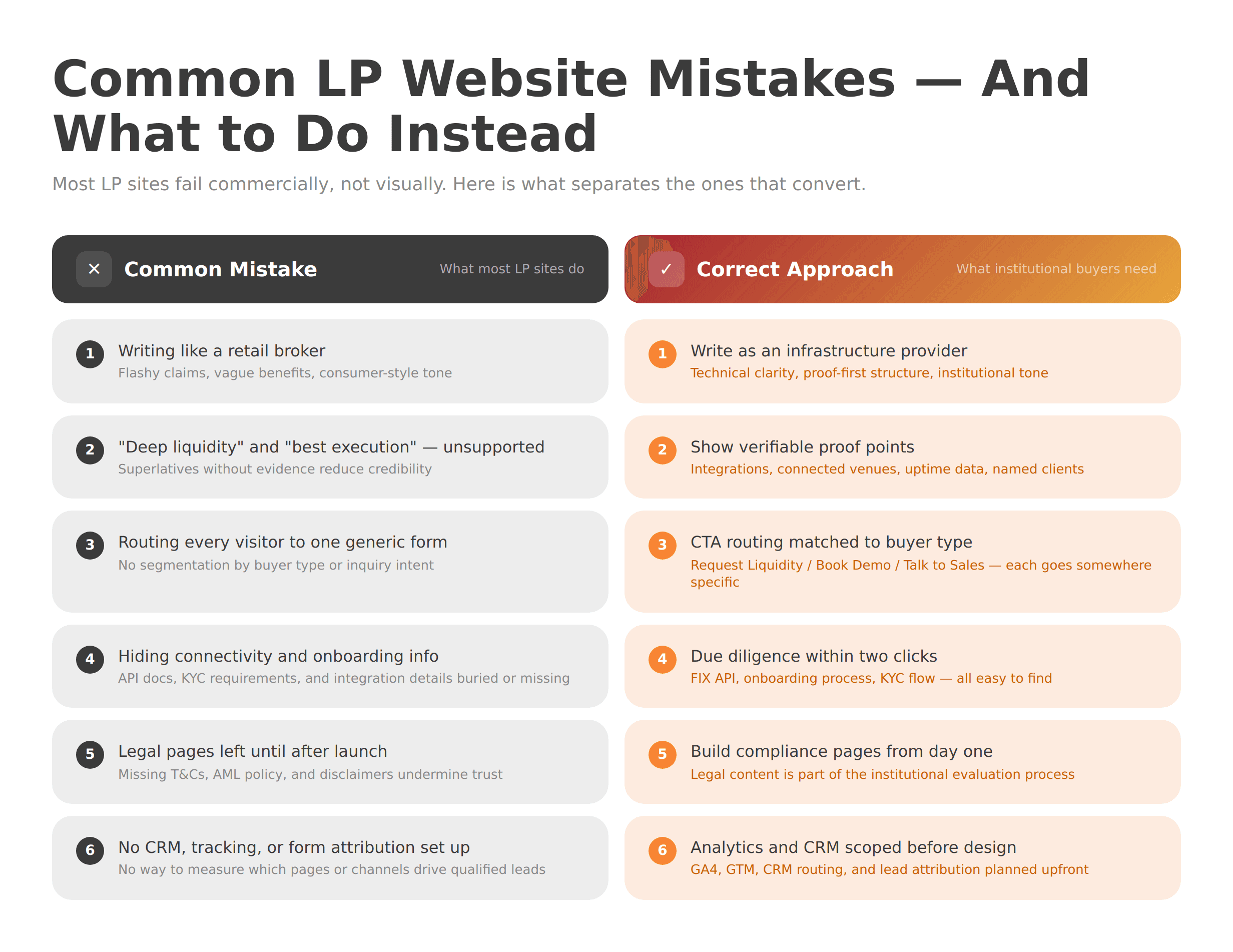
Writing like a retail broker instead of an infrastructure provider
Using claims such as "deep liquidity" or "best execution" without supporting proof
Routing every visitor to the same generic contact form, regardless of inquiry type
Hiding or omitting connectivity, integration, and onboarding information
Deprioritizing legal and due-diligence content until late in the build
Overloading pages with technical jargon while under-explaining the actual offer
Launching without CRM attribution, form tracking, or conversion-event setup
Treating the website as a static brochure rather than an active sales and due-diligence asset
Pre-Launch Checklist: What to Verify Before Going Live
Messaging reviewed by the sales and business development team
All proof points, statistics, and integrations fact-checked
Legal and policy pages reviewed by qualified counsel
Forms, CRM routing, and calendar booking links tested end to end
GA4, GTM, and conversion events verified and firing correctly
CTA hierarchy consistent and tested across all key pages
Performance, speed, and mobile QA completed
Metadata, sitemap, robots.txt, and core SEO elements in place
Internal links checked and pointing to the correct destinations
Handoff and maintenance ownership confirmed before launch
Next Steps: Why Fintech-Specialized Partners Deliver Better Results
Most LP websites underperform not because the design is wrong, but because the team building them does not understand how institutional fintech buyers evaluate infrastructure, risk, and credibility.
A specialist B2B fintech website design partner understands what a COO at a regulated broker wants to see when reviewing an LP's site, what questions a technical team at an exchange will ask before recommending an integration, and how to structure proof assets and legal content so they accelerate — rather than delay — the due-diligence process.
WSA works with brokers, exchanges, and fintech companies on conversion-ready institutional websites. The agency publishes related content on modern fintech web design trends, and its case studies include a project where organic clicks grew by 28.5% following a focused redesign.
Before committing to a build, work through this short list:
Define your core ICPs and what each one needs to see
List the proof assets you can publish: integrations, venues, coverage, stats, and client types
Choose one primary CTA and build the site around it
Audit three to five competitor LP websites for gaps and positioning opportunities
Choose a platform based on 12- to 24-month growth and maintenance needs
When you are ready to scope the project, book a free discovery call with WSA.
Launch Your Licensed Brokerage with Confidence
We support brokers and fintechs through licensing, launch planning, and everything a regulated brand needs to go live.