
Case Studies
A product-led website redesign case study: how rebuilding Coinsbuy's web presence around its actual capabilities reversed months of declining search traffic — and grew organic clicks by +11.4%.
Our platform had grown significantly, but the website still looked like a startup tool. We needed something that reflected where Coinsbuy actually was as a product.
Chief Product Officer
COINSBUY
+11.4%
Organic clicks growth
~4.1% → ~7.5%
avg. CTR recovered
Overview
Coinsbuy is a multi-chain crypto processing platform serving brokers, exchanges, merchants, and enterprise clients. By early 2025, the product had matured significantly. The website had not kept pace.
This is a fintech SEO case study — not about running campaigns or building links, but about what happens when a website finally represents the product it's selling. The kind of redesign that generates organic traffic ROI without paid media. From February 2025 to June 2025, organic CTR dropped from over 4% to under 3%. Impressions were rising. Clicks were collapsing. The site was gaining search visibility, then failing to convert it — every single time.
The problem wasn't keyword rankings. It was the website itself: a product that had grown into a serious infrastructure platform, still being presented like a simple payment plugin.
WSA.design was brought in to rebuild it. The redesigned site launched June 25, 2025. By Q4 2025, organic clicks had grown by +11.4%, CTR had recovered from ~4.1% to ~7.5%, and average search position improved from 56 to 36.6. A growing share of branded search queries also contributed, as brand awareness built steadily after launch.
The Challenge
Impressions up. Clicks down.
Between February 2025 and June 2025, daily impressions more than doubled. CTR dropped by more than half — from roughly 4% to under 2% — while the site simultaneously fell to position 68 in Google Search Console.
More people were finding the site. Fewer were choosing to click on it. That's one of the clearest signs a website has a product clarity problem — not a traffic problem.
A product the website no longer represented
The deeper issue was structural. Coinsbuy had evolved into a serious multi-chain infrastructure platform — but the website was still built around a much simpler story. This is a common gap for fintech companies that scale faster than their web presence. The platform's actual capabilities included:
Token collection and multi-wallet consolidation
On-chain and off-chain transaction handling
Gas fee optimisation and TRX staking
Flexible settlement options by coin type and stablecoin
Dedicated merchant and enterprise processing environments
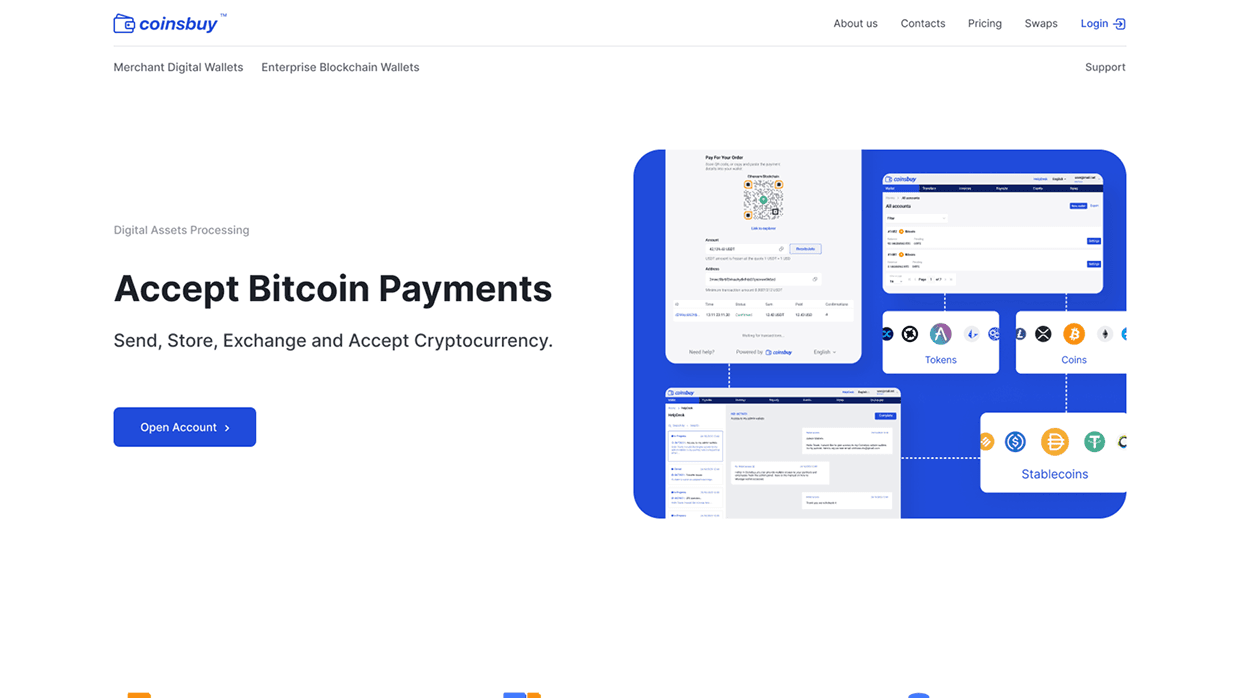
None of this was visible on the website. The homepage led with "Accept Bitcoin Payments" and offered two navigation items. Product pages were thin — a few paragraphs and a screenshot each. No fee transparency. No developer section. No proof of scale.
B2B buyers evaluate infrastructure before they evaluate pricing. If they can't understand what the platform does from the website, they move on. The old Coinsbuy site consistently failed that test.
The Strategy
WSA.design approached this as a buyer journey problem, not a design problem. The question wasn't "how do we rank better?" — it was "why would a serious buyer click, read, and trust this site?" Three decisions shaped the redesign.
1. Match the headline to the actual product
The site was speaking to the wrong buyer. "Accept Bitcoin Payments" targets a small merchant. Coinsbuy's real customers — exchanges, brokers, enterprise clients — needed to see themselves in the first screen. Shifting the product category, not just the copy, is the core of good fintech product design — and the first thing to get right before anything else can follow.
2. Organise around buyer decisions, not product names
The old navigation put product names at the top level — which only works if visitors already know which product they want. The new structure was built around the questions buyers actually have: What does this platform do? How do I integrate it? What does it cost?
3. Build for the audiences the old site ignored
Developers and enterprise buyers were completely absent from the old site — no API documentation, no enterprise framing, no competitive context. For a B2B infrastructure product, these are often the people who make or block the final buying decision. Adding content for them wasn't a content strategy move. It was filling a gap that was actively costing deals.
What Changed
The homepage: first screen, first impression
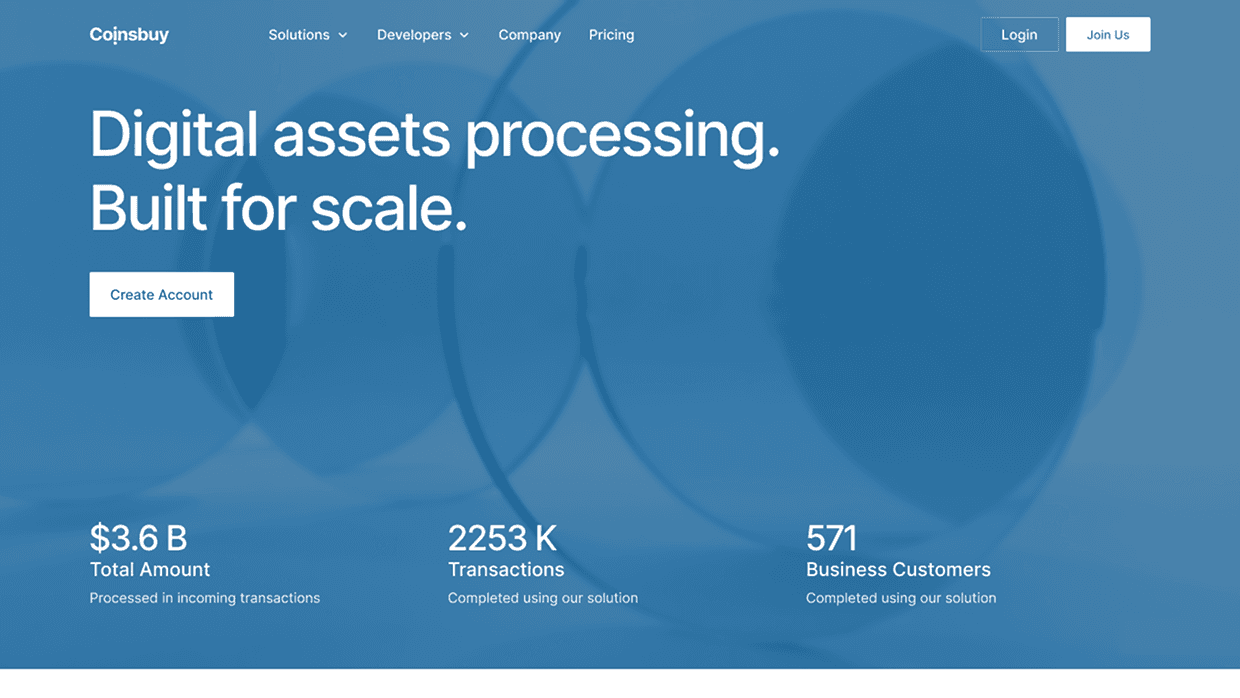
The headline changed from "Accept Bitcoin Payments" to "Digital assets processing. Built for scale." One sentence. Completely different buyer. Immediately below: $3.6B processed, 2.2M+ transactions, 571 business clients — moved above the fold. The opening screen now answers the B2B buyer's first question before it's asked: can this company handle my volume?
Getting the hero section right — the combination of category headline, trust signals, and visual clarity — is the single highest-impact change in most fintech redesigns. This one was no exception.
Product pages: from thin overviews to full documentation
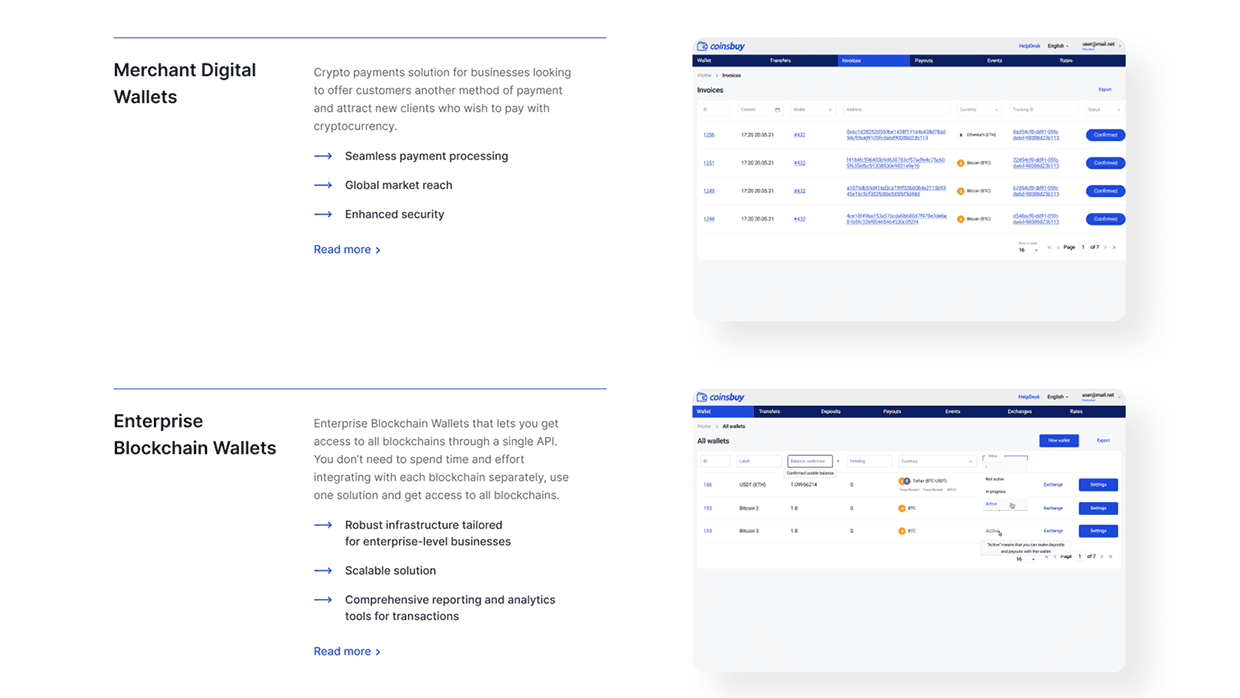
The old Merchant Digital Wallets and Enterprise Blockchain Wallets pages were summaries — a few paragraphs, a screenshot. They told buyers a product existed, not what it actually did.
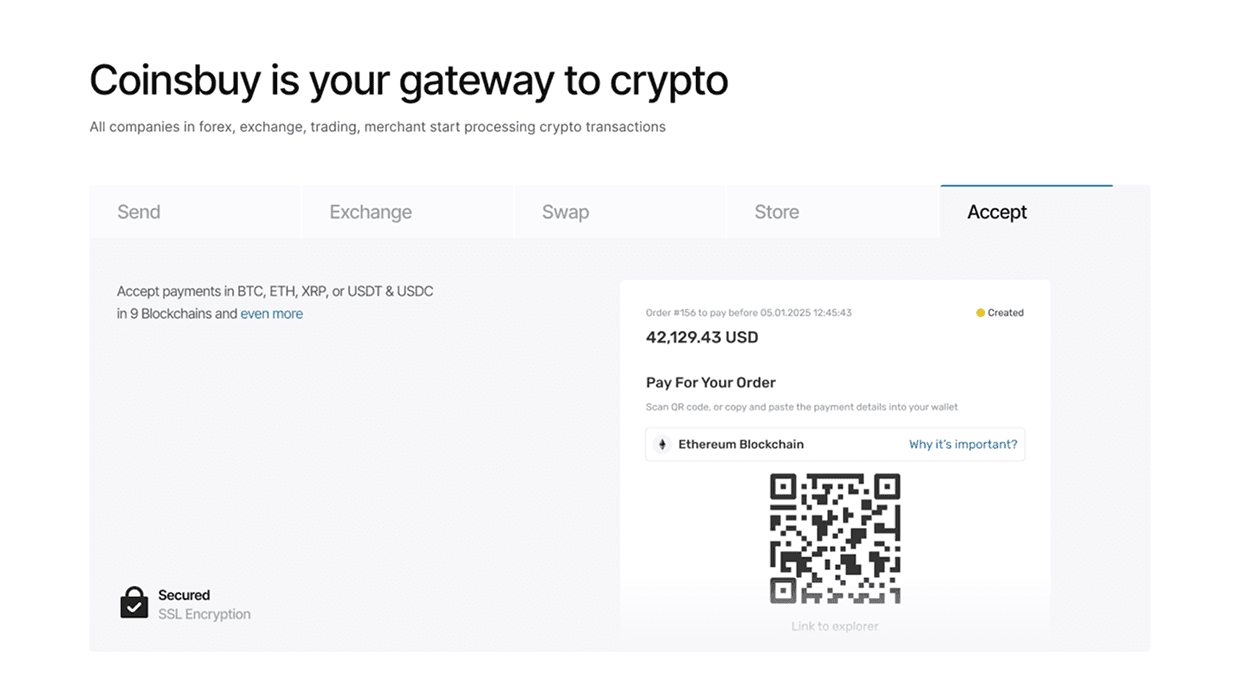
The new Crypto Payment Processing and Wallet as a Service pages were rebuilt as structured capability documentation. Every major feature has its own section with supporting UI:
Liquidity management and automatic conversion
Settlements by coin type and stablecoin
Deposit limits and payment currency selection
Off-chain transaction flows and token collection
Gas fee savings and TRX staking
Flexible confirmation thresholds
A competitive comparison section was also added, directly contrasting Coinsbuy against standard crypto wallet platforms. Enterprise buyers use exactly this kind of comparison to build internal business cases.
Navigation: built around the buyer journey
The old menu used product names. The new four-item structure — Solutions, Developers, Company, Pricing — maps to stages of a real evaluation. Industry segmentation tags (E-commerce, Forex and CFD Brokers, Gambling, Merchants, Crypto Brokers, Exchanges) let each visitor type immediately see that the product is built for their context.
Fee transparency and developer coverage
The "Know Your Fees" section was added: exact rate tiers for both products, side by side. For enterprise buyers, pricing opacity is a common reason to stop evaluating. It was entirely missing from the old site.
A dedicated developer section — API documentation, integration patterns, financial operations — was built from scratch. This kind of technical content directly supports fintech conversion rate optimisation by removing friction at a critical stage of the buyer journey.
Results
Comparison runs from pre-launch average (February–June 2025) to full post-launch period — approximately 4–6 months after the new site fully indexed.
+11.4%
Organic Clicks Growth
Avg daily clicks: Feb–Jun 2025 vs full post-launch period
~4.1% → ~7.5%
CTR Recovered
Avg CTR: Feb–Jun 2025 (pre-launch) vs full post-launch period
pos. 56 → pos. 36.6
Google Position
Avg position: Feb–Jun 2025 (pre-launch) vs full post-launch period
The CTR recovery reflects two things: the redesign's impact on page structure, title relevance, and search intent alignment — and a growing share of branded queries as awareness built post-launch.
The position improvement is the most structural signal. The site went from average position 56 pre-launch to an average of 36.6 post-launch, with a best-reached position of 12.9 on January 29, 2026. The settled Q4 2025 average was ~36 — a sustained, compounding improvement, not a spike.
Why results took ~8 weeks to appear
The redesign launched June 25, 2025. July and August showed no significant change in clicks or positions — and that's completely normal.
Google needs 6–10 weeks to re-crawl, re-index, and re-evaluate a substantially changed site before new relevance signals appear in rankings. The improvement started in early September and kept building through Q4 2025 and into 2026. This is a well-documented pattern in fintech SEO following major site overhauls.
A delayed but sustained improvement is a stronger signal than an immediate spike. It reflects a genuine structural re-evaluation by Google — not a temporary fluctuation.
Conclusion
The Coinsbuy redesign worked because it started with the right question: not "how do we rank higher?" — but "why would a serious buyer trust this site enough to get in touch?"
The old site had a product clarity problem. The platform had evolved into a serious multi-chain infrastructure layer. The website was still presenting it like a Bitcoin payment widget. The redesign fixed that gap — rebuilt product pages that actually document what the platform does, fee transparency that removes a common enterprise sales blocker, developer coverage for an audience that was completely absent from the old site.
The organic traffic gains were a consequence of that clarity — not the goal. For crypto and fintech companies facing the same pattern — a product that's outgrown its website — this case study shows that a website redesign ROI doesn't require an SEO campaign. It requires clarity. A website that properly represents its product earns more clicks, holds attention longer, and converts the visitors it already has.
If your site is showing the same pattern — rising impressions, falling CTR, or a product that's grown beyond what the website communicates — see how WSA.design approaches fintech redesigns or explore our portfolio.
Is your website holding your product back?
If your search impressions are growing but clicks aren't, the issue is often structural — not technical. We build high-performance websites for fintech companies, brokers, and exchanges that convert the traffic you already have.
FAQ
How do you increase organic clicks on a fintech website?
The most reliable way is to improve how clearly the website communicates what the product actually does. CTR in search results reflects whether your page title and content match what a buyer is looking for. In Coinsbuy's case, rebuilding the product pages, updating the homepage headline, and adding transparent pricing drove a +11.4% increase in organic clicks — without any link-building or paid campaigns.
Why do impressions increase but clicks drop?
This usually means Google is surfacing your pages in more searches — but the titles, meta descriptions, or content don't match what searchers expect. For Coinsbuy, impressions more than doubled between February and June 2025, while CTR dropped from ~4% to under 3%. The redesign fixed the underlying mismatch between what the site showed and what buyers were actually looking for.
How long did the website redesign take to show results?
Measurable improvement in positions and CTR began approximately 8–10 weeks post-launch. Google needs time to re-crawl and re-evaluate a substantially changed site. A delayed but sustained improvement like this is a stronger signal than an immediate spike.
What website changes improve organic CTR?
Three changes had the greatest impact: (1) rebuilding product pages to document actual platform capabilities, (2) shifting the homepage headline to match the product's real category, and (3) adding fee transparency and a developer section that addressed buyer audiences the old site had completely ignored.
Can a website redesign increase organic traffic without link building?
Yes. The Coinsbuy case study is a direct example. Organic clicks grew by 28.5% after the redesign with no link-building campaign and no paid traffic. The gain came entirely from better search intent alignment, clearer product pages, and improved CTR signals. For fintech and crypto platforms, fixing what the site communicates is often more impactful than any off-page tactic.
Get Your Professional Website Today
Whether you’re launching something new or improving an existing platform, we’re ready to discuss your goals and explore the best way forward.