•
•

Crypto Exchange License: Where and How to Get Licensed in 2026
You have the product roadmap, a liquidity provider lined up and two developers building the matching engine. Then your prospective payment partner asks one question: which regulator authorises you, and can you show the licence number?
That question stops more exchange launches than any technical problem. A crypto exchange license is not a form you file at the end of the build. It determines who you may legally onboard, which banks will talk to you, how your sign-up flow has to work, and what your website is allowed to say.
This article is for informational purposes only and does not constitute legal advice. Brokers should consult qualified legal and compliance professionals for jurisdiction-specific guidance.
Most founders start by asking which licence is cheapest. The better question is which market you want access to, because the answer changes everything downstream. This guide covers the main routes available in 2026, what each one realistically costs and takes, and the part almost nobody plans for: what your regulator expects to see on your public site.
Key Takeaways
There is no single global crypto exchange license. Permissions are granted per jurisdiction and per activity: trading, custody, fiat on-ramp and staking are often separate permissions.
Jurisdiction choice is a market-access decision. MiCA authorisation opens the EEA. VARA opens Dubai. A lighter-touch offshore route is faster and cheaper, but narrows who you can legally serve and which banks will onboard you.
Credible routes typically take 6 to 12 months from entity formation to authorisation. Budget for that, not for six weeks.
Indicative first-year cost ranges from roughly USD 50,000 for a light offshore setup to EUR 150,000 to 500,000 or more for a fully staffed EU CASP, once capital, legal, compliance hires and audit are counted.
Regulators and correspondent banks review your public website during due diligence. Entity details, licence disclosure, risk warnings and jurisdiction exclusions are all inspected.
The website belongs inside the application window, not after approval. Building it late is the most common avoidable delay we see.
What Is a Crypto Exchange License?
A crypto exchange license is a regulatory permission that allows a company to operate a platform where users buy, sell, hold or convert crypto assets. No single licence covers the world. Each regulator authorises a specific legal entity for a specific list of activities inside a specific territory.
That last point matters more than founders expect. Authorisation is granted activity by activity, and the activities you request shape capital, staffing and audit obligations.
Typical permission types include:
Operating a trading platform, meaning matching client orders on your own venue
Exchanging crypto for fiat or for other crypto assets, including brokerage against your own book
Custody and administration of client assets, which almost always carries the highest requirements
Transfer, payment and settlement services, often regulated separately under payments law
What this means: if your product plan includes a fiat on-ramp and self-custody wallets, you are not applying for one licence. You are applying for a bundle of permissions, and the weakest link sets your timeline.
Which Activities Actually Need Authorisation
Custody, order matching and fiat conversion are the three activities that trigger licensing in nearly every major market. A purely non-custodial interface that never touches client funds sometimes sits outside a licensing regime, but that position narrows every year.
Here is where teams get caught out. Features added "later" often carry their own permissions: staking as a service, lending, derivatives and portfolio management are each treated as distinct regulated activities in the EU, the UAE and Singapore. Adding staking after approval can mean a variation application and another review cycle.
VASP, CASP and DAB: One Idea, Three Names
The same business is called different things depending on who regulates it. A VASP licence (virtual asset service provider) is the international term drawn from FATF standards. In the European Union the equivalent is CASP authorisation, granted to a crypto-asset service provider under MiCA. The Bahamas uses digital asset business, or DAB, under its DARE Act. The United States has no single label at all: you register federally and then licence state by state.
Different names, one underlying test: are you handling other people's money or other people's crypto? If yes, you need permission.
Do You Legally Need a Licence to Run a Crypto Exchange?
In almost every major market, yes. If you hold client assets, match orders or convert crypto to fiat, you are performing a regulated financial activity, and operating without authorisation exposes founders and directors personally, not just the company.
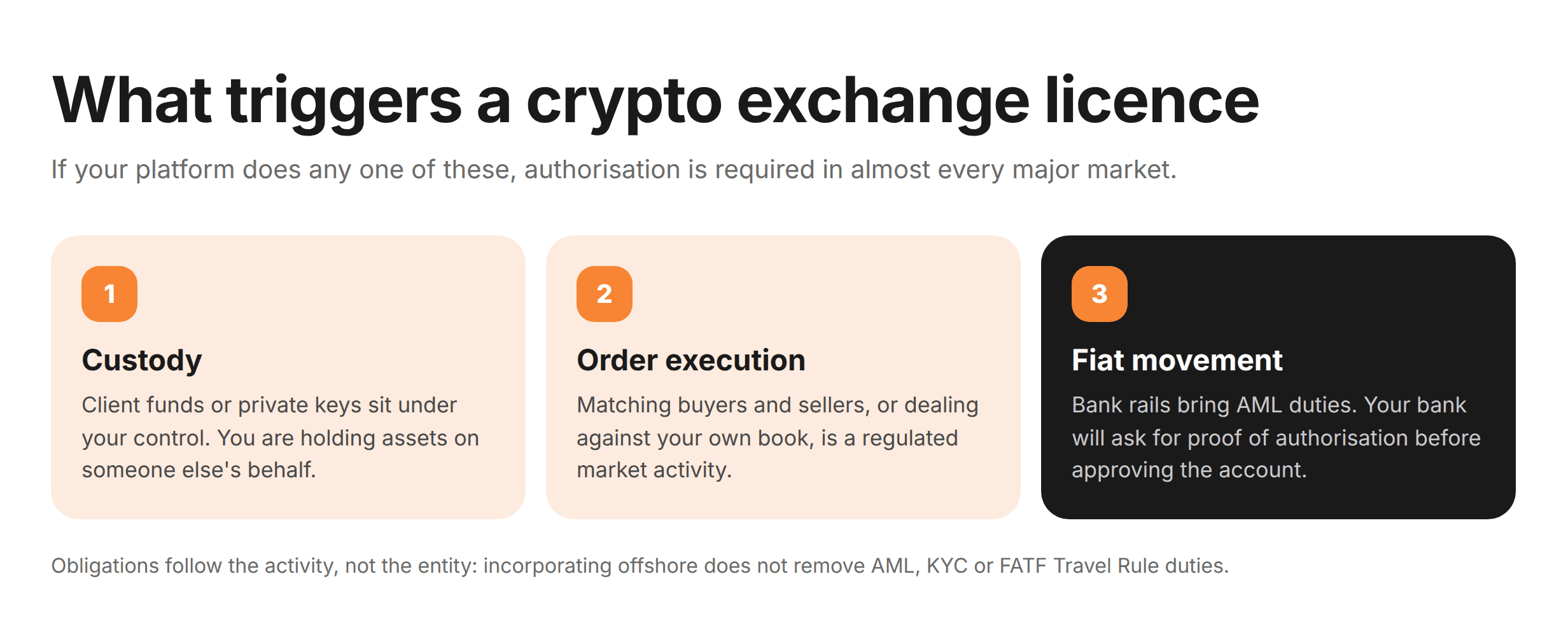
Three things reliably trigger a licensing obligation:
Custody. The moment client funds or keys sit under your control, you are holding assets on someone else's behalf.
Order execution. Matching buyers and sellers, or dealing against your own book, is a market activity.
Fiat movement. Bank rails bring anti-money-laundering duties, and your bank will require proof of authorisation before approving the account.
Alongside the licence come AML and KYC obligations, sanctions screening and the FATF Travel Rule, which requires originator and beneficiary information to travel with qualifying transfers. These obligations follow the activity, not the entity, so incorporating offshore does not remove them.
The consequence of getting this wrong is not a fine first. It is usually a frozen bank account, a payment provider that terminates without notice, and a user base that cannot deposit. Recovery from that point is slow.
Planning Your Exchange Launch Around a Licence Application?
The site, brand and onboarding flow can be built while your application is under review, so approval day is a launch and not the start of a rebuild.
Where to Get Licensed in 2026: Jurisdiction Comparison
Unlike a company registration, a licence buys market access rather than mere legality. The right jurisdiction is the one whose passport reaches the users you actually want, at a cost and timeline your funding supports.
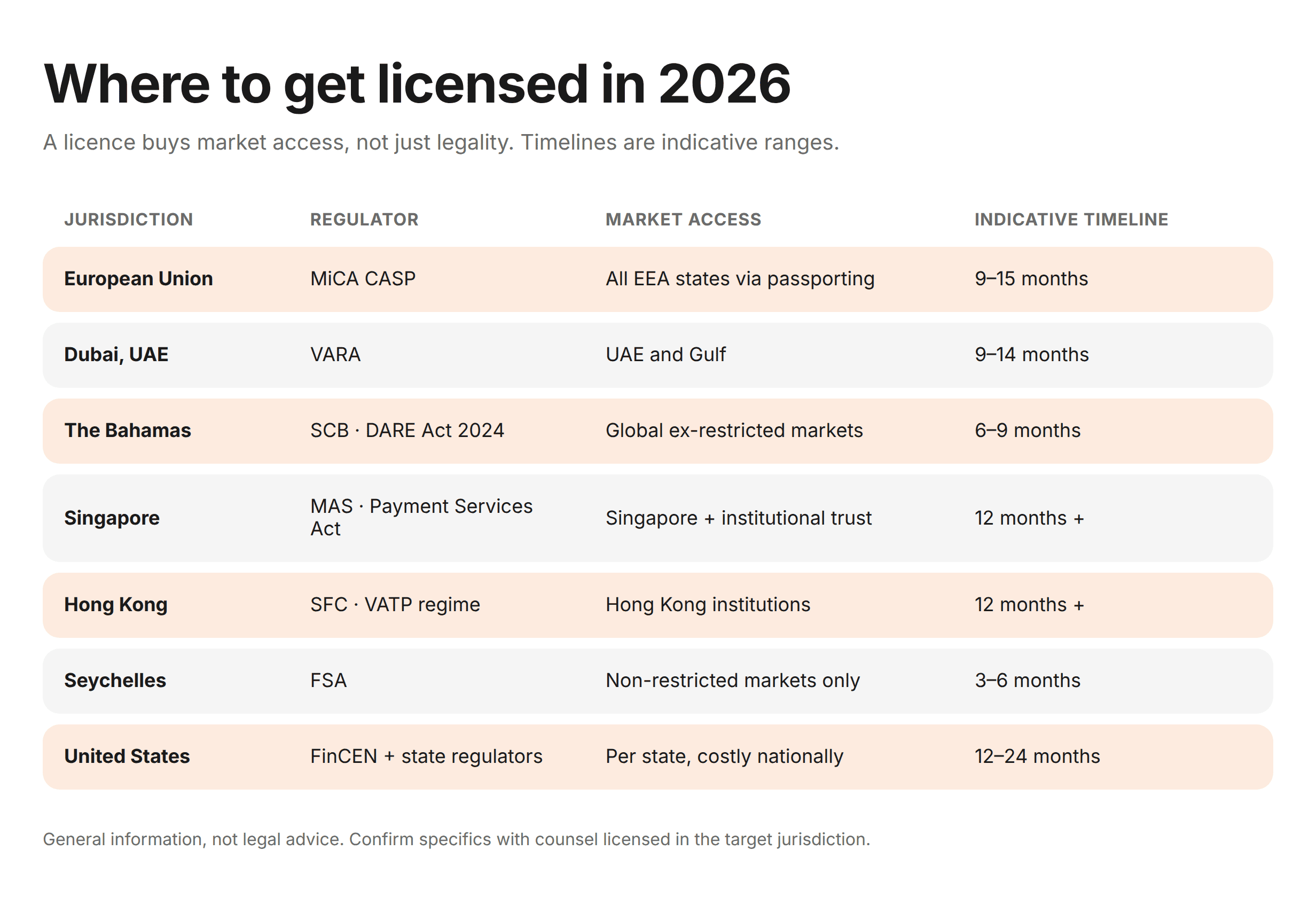
Jurisdiction | Regulator / framework | Market access | Indicative timeline | Practical profile |
|---|---|---|---|---|
European Union | MiCA CASP authorisation | All EEA states via passporting | 9 to 15 months | Highest credibility in Europe, heaviest documentation |
Dubai, UAE | VARA | UAE and Gulf, strong global standing | 9 to 14 months | Activity-based categories, substantial fees |
The Bahamas | SCB, DARE Act 2024 | Global ex-restricted markets | 6 to 9 months | Purpose-built digital asset regime, real local presence expected |
Singapore | MAS, Payment Services Act | Singapore plus institutional trust | 12 months or more | Very selective, strong banking access if granted |
Hong Kong | SFC, VATP regime | Hong Kong, mainland-adjacent institutions | 12 months or more | Strict custody and insurance conditions |
Seychelles | FSA | Non-restricted markets only | 3 to 6 months | Fastest and cheapest, hardest banking |
United States | FinCEN plus state regulators | Per state, national coverage is expensive | 12 to 24 months for multi-state | Federal registration plus 50 separate licensing regimes |
Timelines above are indicative ranges based on publicly reported application experience and vary with the quality of your submission. Treat this as general information rather than legal advice, and confirm specifics with counsel licensed in the target jurisdiction.
European Union: MiCA CASP Authorisation
Best for: exchanges whose target users are in Europe. MiCA, the EU regulation on markets in crypto-assets, replaced a patchwork of national regimes with one authorisation that passports across the European Economic Area. One approval, roughly 30 markets.
The trade-off is depth of scrutiny. Own-funds requirements are tiered by the services you request, commonly cited in the range of EUR 50,000 to EUR 150,000, with the top tier applying to operating a trading platform. Expect governance documentation, a named compliance function, ICT and resilience policies, and a white paper regime for any tokens you admit. Lithuania, Poland, the Czech Republic and Malta remain the most active entry points for a crypto license in Europe.
Dubai: VARA Virtual Asset Licence
Best for: teams building a Gulf presence with real staff on the ground. Dubai's Virtual Assets Regulatory Authority licenses by activity, with separate categories covering exchange, broker-dealer, custody, lending and borrowing, management and investment, transfer and settlement, and advisory.
You apply for the categories your product needs, and each adds fees and capital. VARA expects a physical Dubai office, local senior management and a named money laundering reporting officer. Application and annual supervision fees for exchange activity run into the hundreds of thousands of dirhams, so this is not the budget route.
The Bahamas: DARE Act Registration
Best for: global platforms that want a purpose-built digital asset regime without EU-level overhead. The Securities Commission of The Bahamas regulates digital asset businesses under the DARE Act 2024, covering exchange operation, custody, staking services and token issuance as separate registrations.
The regime is written for crypto rather than retrofitted from securities law, which shortens some arguments during review. Expect genuine local substance: a Bahamian entity, resident directors and locally accessible records. WSA has published a DARE application checklist and a breakdown of the documents the SCB asks for, both drawn from work with exchange clients going through this route.
Singapore and Hong Kong: High Bar, High Trust
Best for: institutional-facing platforms where counterparty confidence outweighs speed. Singapore's Monetary Authority licenses digital payment token services under the Payment Services Act, and separately regulates Singapore-based firms that serve only overseas customers. Approval rates are low and reviews are long.
Hong Kong's Securities and Futures Commission runs a licensing regime for virtual asset trading platforms with strict custody, insurance and listing-review conditions. Both are worth pursuing if institutional flow is your business model. Neither is a good first licence for a bootstrapped team.
Seychelles and Other Lighter-Touch Routes
Best for: getting to market quickly with a clear geo-restriction strategy. Seychelles licenses virtual asset service providers through its Financial Services Authority, and Panama and El Salvador attract similar traffic from founders comparing cost. These routes are faster and materially cheaper.
Here is the honest tradeoff. A lighter-touch licence does not let you market to EU or US retail users, tier-one banking is difficult, and institutional partners increasingly decline offshore-only counterparties. Some teams start here deliberately, prove volume, then apply for MiCA or VARA with revenue behind them. That is a strategy. Assuming the cheap licence is equivalent is not.
United States: FinCEN Registration and State-Level Licensing
Best for: teams with US capital and patience. There is no federal crypto exchange license. You register as a money services business with FinCEN, then obtain money transmitter licences state by state, and New York's regime under the Department of Financial Services (the BitLicense) sets the highest bar in the country.
National coverage means dozens of applications, surety bonds and separate examinations. Most non-US founders treat the US as a phase-two market for this reason.
How to Get a Crypto Exchange Licence: The Application Process
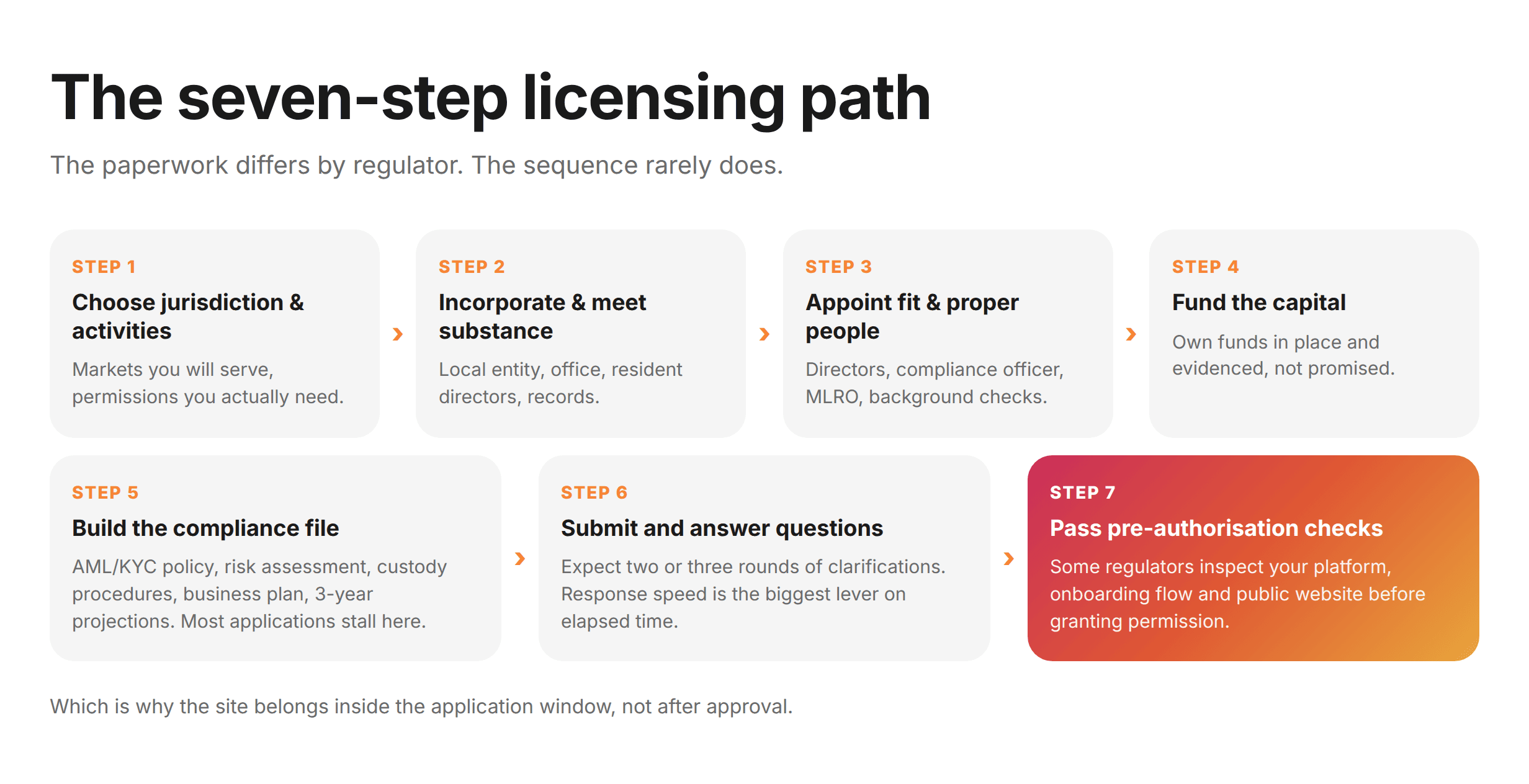
The application process follows the same seven steps in most jurisdictions, even when the paperwork differs. Regulators are assessing one thing: whether your team can run a financial business without losing client money.
Choose the jurisdiction and activity set. Decide which markets you will serve and which permissions your product actually needs.
Incorporate the local entity and meet substance rules. Office, resident directors and local records where required.
Appoint fit and proper people. Directors, a compliance officer and a money laundering reporting officer, each subject to background checks.
Fund the capital requirement. Own funds must be in place and evidenced, not promised.
Build the compliance file. AML and KYC policy, risk assessment, custody and key-management procedures, business plan and three-year financial projections.
Submit and answer questions. Expect two or three rounds of clarifications; response speed is the single biggest lever on total elapsed time.
Pass pre-authorisation checks and launch. Some regulators inspect your platform, onboarding flow and public website before granting permission.
What this means in practice: step 5 is where applications stall, and step 7 is where unprepared teams lose another two months. Your website and sign-up journey are part of the assessment, so they need to exist in reviewable form well before approval.
What a Crypto Exchange Licence Costs
Crypto exchange licence cost is best read as a first-year total rather than an application fee, because the fee is rarely the largest line. Indicative all-in first-year budgets range from roughly USD 50,000 to 150,000 for a light offshore setup, to EUR 150,000 to 500,000 or more for a fully staffed EU CASP.
The components that actually move the number:
Application and annual supervision fees. Modest in Seychelles, into six figures for VARA exchange activity.
Regulatory capital. Locked into the entity, tiered by activity: commonly cited at EUR 50,000 to 150,000 under MiCA depending on services requested.
Legal and advisory work. Frequently USD 30,000 to 100,000 for drafting and managing the submission.
Compliance staffing. A qualified local compliance officer and MLRO are recurring salary lines, not one-off costs.
Audit, technology and insurance. External audit, penetration testing, key-management infrastructure and, in some regimes, professional indemnity cover.
Renewal and ongoing reporting. Crypto license renewal in Europe and elsewhere brings annual fees, filings and periodic inspections. VASP licence cost estimates that omit year two are misleading.
The takeaway: the cheapest licence is not the cheapest business. An offshore route that blocks EU users and tier-one banking can cost far more in lost revenue than the licence saved.
Turn Approval Day Into Launch Day
Your brand, site and onboarding journey can be designed and shipped inside the application window instead of after it.
What Regulators Expect to See on Your Website
Regulators and correspondent banks review your public website as part of due diligence. Reviewers open the site, read the footer, test the sign-up flow and check whether your marketing claims match your permissions. This is the part of licensing almost no legal guide covers, and it is where a crypto exchange license becomes visible to customers.
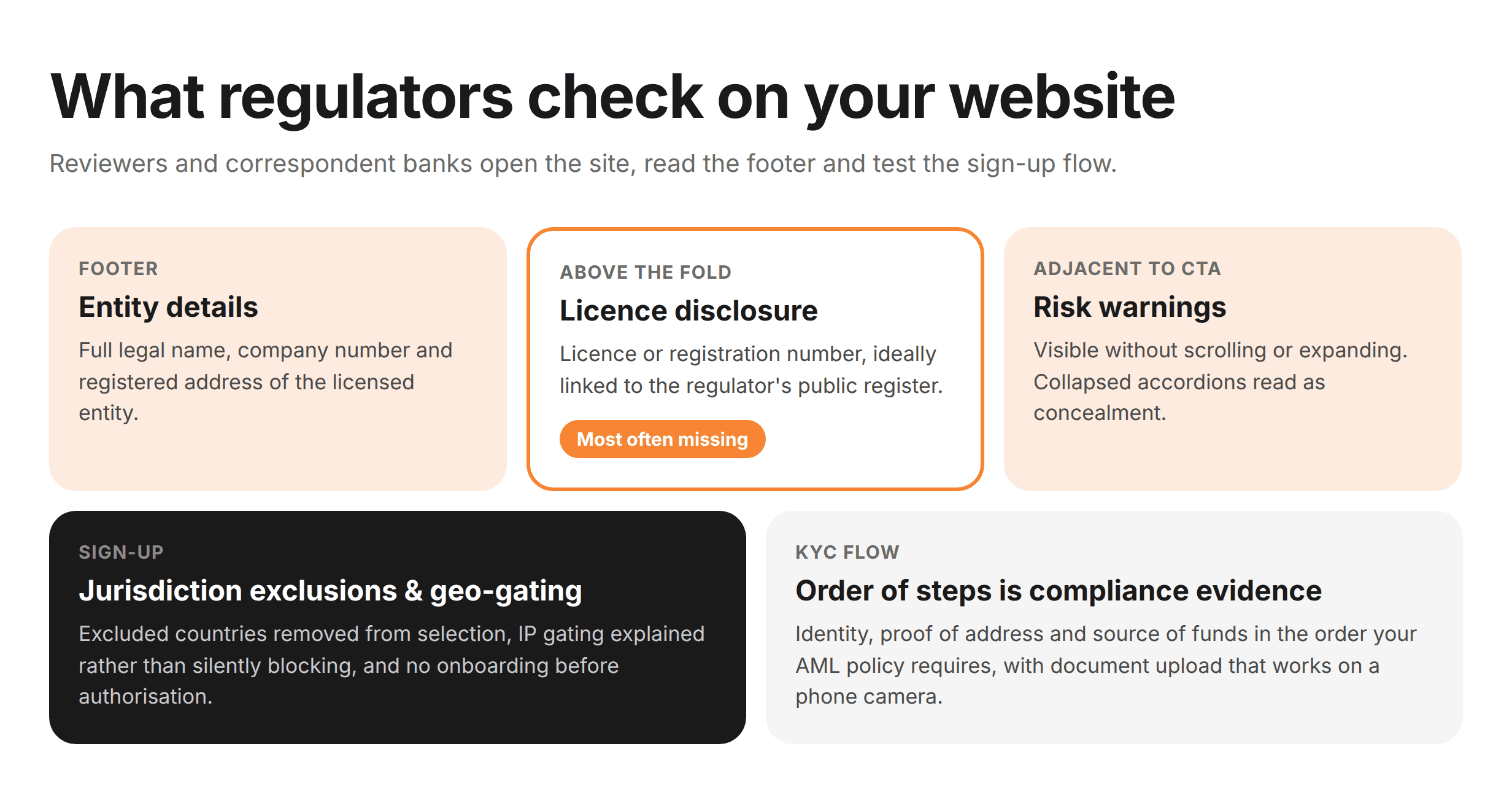
Four things get checked first:
The regulated entity's full legal name, registration number and registered address
The licence or registration number, ideally with a link to the regulator's public register
Risk warnings that are visible without scrolling or expanding anything
A clear statement of which countries and user types you do not serve
Entity Details, Disclosures and Risk Warnings
The footer is a compliance surface, not a design afterthought. It should carry the licensed entity name, company number, registered address and licence reference, plus terms, privacy policy, AML statement and complaints procedure.
Risk warnings need to sit where the eye lands. A disclosure hidden behind a collapsed accordion or set in low-contrast grey text reads as concealment during review. If your product line includes margin products, the warning belongs adjacent to the call to action, not three screens below it.
Marketing copy is scrutinised too. Return promises, "risk-free" phrasing and unqualified performance claims cause problems in every serious regime.
KYC, Onboarding and Geo-Restriction Flows
Your sign-up flow is compliance evidence. It has to collect identity, proof of address and source-of-funds information in an order that satisfies your AML policy while keeping abandonment survivable, and it has to block users from jurisdictions your licence excludes before they deposit rather than afterwards.
Practical mechanics that get reviewed: IP-based gating with a clear explanation instead of a silent block, country selection that removes excluded jurisdictions rather than failing at submission, document upload that works on a phone camera, and honest status messaging while verification is pending.
What this means: step order in KYC is a design decision with two audiences. Get it wrong and you either fail review or lose users who were ready to fund an account. A well-structured sign-up and KYC flow protects both.
How WSA Builds Licence-Ready Crypto Exchange Websites
WSA designs and builds websites for fintech, forex and crypto companies, which means compliance constraints are the starting brief rather than a late surprise. We work in Framer, so a site can go live in weeks and be updated the day a permission changes.
On exchange projects, that usually means three things. We build two site states from the start: a pre-authorisation version that informs without onboarding, and a post-authorisation version that opens trading, so approval day flips a switch instead of triggering a rebuild. We design the disclosure architecture with your compliance officer, so entity details, licence references and risk warnings sit where reviewers expect them. And we structure the onboarding journey around your AML policy, then optimise the steps that cost you sign-ups.
The pattern we see repeatedly: teams that start the site during the application window launch on approval. Teams that wait lose another two to three months at the worst possible moment. If you want the structural detail, our guide on how to build a crypto exchange website covers information architecture, integrations and UX in depth.
Conclusion
A crypto exchange license is a market-access decision disguised as a compliance task. Pick the jurisdiction that reaches your users, budget for a first-year total rather than an application fee, and plan for 6 to 12 months on any credible route.
Then use that window. The brand, website, disclosure architecture and KYC flow all have to exist before a regulator signs off, and building them during the review turns approval into a launch. A VASP licence nobody can verify on your site does not build trust, and a compliant site that nobody wants to sign up to does not build a business.
WSA builds both sides of that equation for crypto and fintech companies. If you are mid-application and the website is still a placeholder, let's talk.
FAQ
Do I legally need a licence to run a crypto exchange?
Yes, in almost every market where you intend to serve users. Holding client assets, matching orders or converting crypto to fiat are regulated financial activities, and doing them without authorisation exposes directors personally as well as the company. A small number of strictly non-custodial models sit outside licensing regimes today, but that space is narrowing, and banks and payment providers will still ask which regulator authorises you before approving accounts. Confirm your specific position with counsel in each target market.
Which is the cheapest crypto exchange licence?
Lighter-touch offshore regimes such as Seychelles are usually the cheapest and fastest, with indicative first-year budgets starting around USD 50,000 including advisory costs. The saving comes with real restrictions: you cannot market to EU or US retail users, tier-one banking relationships are difficult, and institutional counterparties increasingly decline offshore-only partners. Founders comparing a crypto license in Panama or El Salvador face the same tradeoff. If most of your users are in Europe, a cheap licence that blocks those users is the more expensive option once lost revenue is counted.
Is MiCA authorisation mandatory to serve EU clients?
To actively offer crypto services to clients in the European Economic Area, yes. MiCA CASP authorisation is the route to serving EU users legally, and once granted it passports across the EEA, so one approval covers roughly 30 markets. National transitional arrangements for firms already operating under previous local regimes differ by member state and have been closing through 2025 and 2026. If EU retail users are core to your plan, treat MiCA as a requirement rather than an upgrade, and check the current position in your chosen member state before committing.
Can I launch the exchange before the licence is approved?
You can build and publish an informational website, but you cannot onboard clients or take deposits for regulated activities before authorisation. Many regulators check your public site and sign-up flow during the review, and a live trading product without permission can end the application outright. The workable approach is a pre-authorisation site that explains the product, states clearly that authorisation is pending, and collects waitlist interest without opening accounts. Then a post-authorisation state switches onboarding on.
Do I need separate licences for custody and trading?
Usually separate permissions rather than separate licences. Most modern regimes, including MiCA in the EU and VARA in Dubai, authorise one entity for a defined list of activities, so custody and operating a trading platform are requested together but assessed separately, each with its own capital and control requirements. Custody almost always carries the strictest conditions on key management, segregation of client assets and insurance. Adding an activity later typically means a variation application and a further review cycle, so map your 24-month product plan before submitting.
Launch Your Licensed Brokerage with Confidence
We support brokers and fintechs through licensing, launch planning, and everything a regulated brand needs to go live.