•
•

EMI Licence Explained: Requirements, Cost and Timeline
You have a working product, a founding team and a bank that keeps asking one question: which licence covers this? Three months later you are still comparing options, and your launch date has moved twice.
This is the usual starting point for payments founders. An EMI licence lets you issue e-money and hold customer balances, so it is the right fit when users keep funds inside your product. It also brings heavier capital, safeguarding and disclosure duties than most teams budget for.
This guide covers what an electronic money institution needs in place, what an EMI license typically costs, how long authorisation takes in the UK and EU, and what an authorised EMI must publish on its website. It is general information, not legal advice.
This article is for informational purposes only and does not constitute legal advice. Brokers should consult qualified legal and compliance professionals for jurisdiction-specific guidance.
Key Takeaways
An EMI can issue e-money and hold customer balances; a payment institution can only move money. Choose by product, not by price.
The EU baseline is EUR 350,000 in initial capital plus ongoing own funds of 2% of average outstanding e-money. The UK rules follow the same baseline.
Customer funds must be fully safeguarded. In the UK, the stricter CASS 15 regime applies from 7 May 2026.
The application fee is the smallest cost. For a small, well-prepared firm, total costs can stay below GBP 1 million; ambitious firms often spend several million.
A complete UK application is decided within three months, but the full journey typically runs 9 to 12 months. Lithuania and Ireland sit at either end of the EU range.
Your website is part of the regulated surface: status wording, register number, safeguarding and complaints information must be easy to find.
What Is an EMI Licence?
An EMI licence is a regulatory authorisation that allows a company to issue electronic money (e-money): monetary value stored electronically and redeemable at face value. In the UK the FCA grants it under the Electronic Money Regulations 2011. In the EU it follows the second Electronic Money Directive (EMD2).
Think of a founder building a multi-currency account for cross-border business customers. Users load funds, hold balances and send payments from them. That product needs an e-money licence, because the company is issuing e-money, not just passing payments along.
EQWIRE, an FCA-authorised EMI that offers multi-currency accounts, is a real example of this model.
What an Authorised EMI Can and Cannot Do
An authorised EMI can issue e-money, hold customer balances and provide payment services, but it cannot take deposits or pay interest like a bank.
What an EMI can do:
Issue e-money and hold customer balances in wallets or accounts
Execute payment transactions, such as transfers and card payments
Offer multi-currency accounts and IBANs
Distribute e-money through agents and partners, subject to regulator rules
What an EMI cannot do:
Take deposits or pay interest on balances
Lend out customer funds
Mix customer money with its own operating funds
That last point is called safeguarding: keeping customer funds separate and protected so they can be returned if the firm fails. It shapes almost everything else in the licence.
What this means: if your users will hold a balance in your product, you are in EMI territory from day one.
EMI Licence vs Payment Institution Licence: Which Do You Need?
The key difference is that an EMI can issue e-money and hold customer balances, while a payment institution only executes payments and holds funds briefly in transit. People often search for this as a PSP licence, but regulators use the term payment institution licence.
Feature | Payment institution | EMI |
|---|---|---|
Issues e-money | No | Yes |
Holds client balances | In transit only | Yes, as e-money |
Minimum capital (EU) | Up to EUR 125,000 | EUR 350,000 |
Typical timeline | 6 to 9 months | 6 to 12 months |
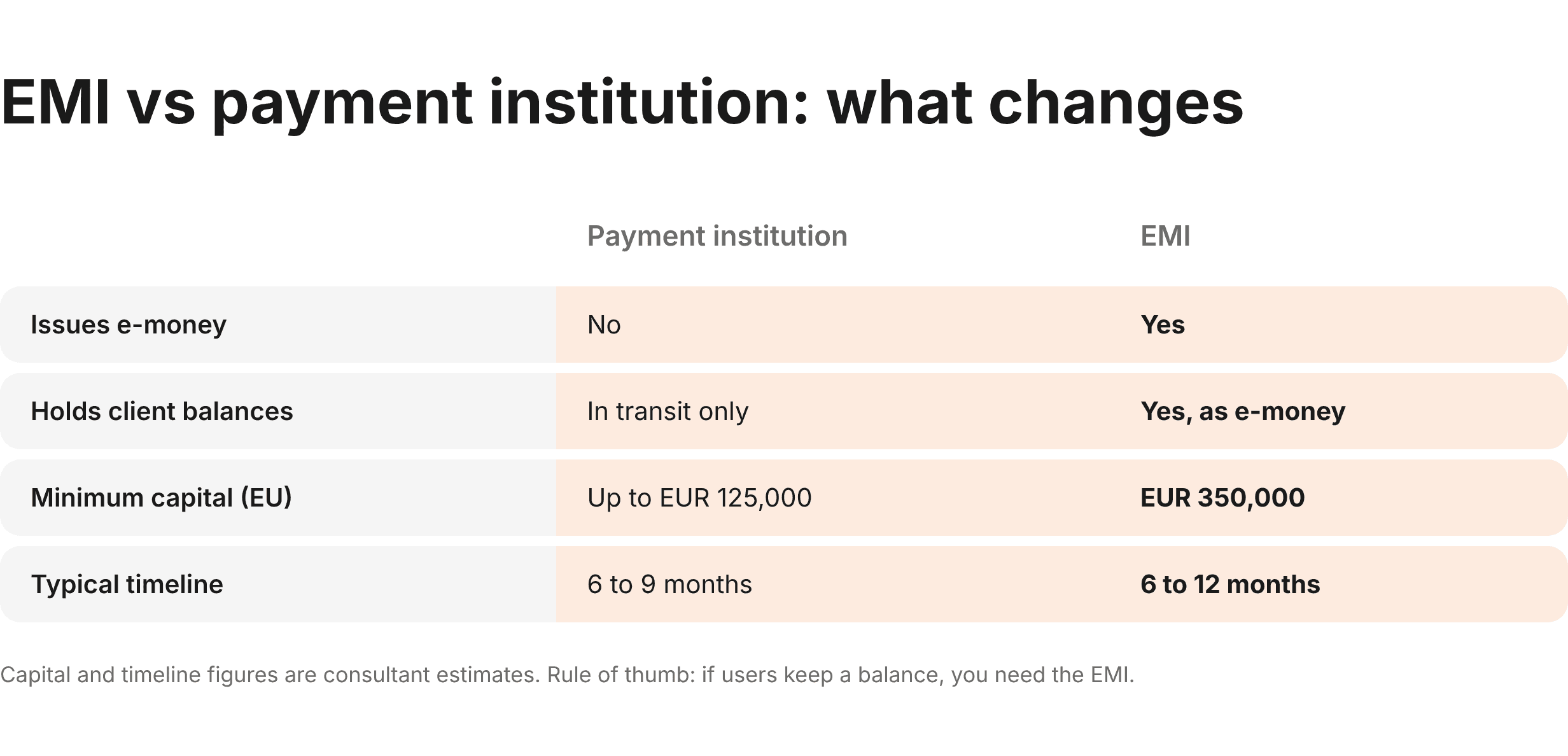
The capital and timeline figures above are consultant estimates, and a payment institution's capital depends on the services it provides. Narrower services, such as money remittance, can carry lower thresholds.
Here is where most teams lose time. A founder applies for a PSP license because it looks cheaper, then adds wallets six months later. That product change needs a different authorisation, and the review clock starts again.
A simple rule of thumb: if you only move money between third parties, a payment institution licence is enough. If users keep a balance, get cards or hold IBANs, you need the EMI.
One change is coming. The EU's PSD3 package was provisionally agreed in November 2025 and merges the e-money regime into a single payment institution framework. It still needed formal adoption at the time of writing, and application is expected roughly 21 months after publication, so plan under today's rules and check the current status before you file.
EMI Licence Requirements: Capital, Safeguarding and Governance
To obtain an EMI licence, a firm needs initial capital of EUR 350,000, full safeguarding of customer funds and a fit and proper management team. Regulators then expect written policies and working systems behind every claim in the application.
Initial Capital and Ongoing Own Funds
EMI licence capital and safeguarding requirements by jurisdiction are largely aligned, because UK rules were built on the same EMD2 baseline. The initial capital floor is EUR 350,000.
On top of that, your own funds must cover at least 2% of average outstanding e-money. If customers hold an average of EUR 50 million in e-money, you need at least EUR 1 million in own funds.
Regulators typically expect a buffer of 120 to 150% of the minimum, which pushes real working capital to EUR 1 to 3 million in total, according to Crassula's estimates.
What this means: EUR 350,000 is the entry ticket, not the budget.
Safeguarding Customer Funds
You must protect 100% of customer funds. The usual methods are holding them in a segregated account at a bank, investing them in low-risk liquid assets, or covering them with insurance or a comparable guarantee. Most EMIs combine the first two and reconcile daily.
UK rules tightened on 7 May 2026 with the CASS 15 regime. Firms now need:
A statutory trust over safeguarded funds
Daily reconciliations of relevant funds
Monthly safeguarding returns to the FCA
A resolution pack that shows how funds would be returned in an insolvency
An annual safeguarding audit, with an exemption for firms holding under GBP 100,000 in relevant funds
If you plan to launch in the UK, build these controls into your operating model before you apply, not after.
People, Policies and Systems
The application is judged on whether your firm can actually run safely. Expect to prepare:
A business plan with financial projections and a wind-down plan
Fit and proper directors, plus a named compliance lead and money laundering reporting officer
AML, sanctions and transaction monitoring policies
Governance, risk management and complaints procedures
IT security and outsourcing arrangements
Crassula estimates 6 to 12 weeks of preparation before filing, including entity set-up, capital injection and a policy pack of 200 pages or more.
See How Fintech Brands Present Regulated Products
Your licence file and your public website should tell the same story. Browse fintech projects built for regulated brands.
How Much Does an EMI Licence Cost?
The government application fee is the smallest line in the budget; capital, people and compliance build drive the real cost. A founder who budgets for the fee and the EUR 350,000 floor usually finds the gap at the next step: hiring, advisers, banking and the buffer regulators expect.
Cost area | What it covers | Guidance |
|---|---|---|
Application fee | Regulator fee for the application | FCA: GBP 5,580 (authorised EMI), GBP 1,120 (small EMI) |
Initial capital | Minimum capital held by the firm | EUR 350,000, held rather than spent |
Capital buffer | Headroom over the minimum | 120 to 150% of the minimum expected |
Pre-application build | Entity set-up, policies, compliance hire | 6 to 12 weeks of work |
Total programme | Everything to reach authorisation | Below GBP 1 million for a small, well-prepared firm; several million for ambitious ones |

Notice what the table says about the fee. At GBP 5,580, it is a rounding error next to a programme budget that can reach seven figures.
A small EMI route exists in the UK for firms with limited e-money volumes. It carries a lower fee and lighter requirements, but it also limits how far you can grow before you must upgrade.
If you expect large balances within two years, the authorised route is usually the better starting point. Treat all figures as estimates and confirm current fees with the regulator.
How Long Does EMI Authorisation Take?
A complete UK application is decided within three months, but the full journey from set-up to authorisation typically takes 9 to 12 months. An incomplete application can take up to 12 months for the regulator to decide, which is why preparation matters more than speed.
The path looks like this for most firms:
Set up the legal entity and inject initial capital
Hire or appoint compliance, AML and management roles
Write the policy pack and financial plan
Submit a complete application
Respond to regulator questions
Receive the decision and begin operating

Typical Timelines by Jurisdiction
EMI authorisation speed varies by regulator. These are consultant estimates, not regulator promises:
Jurisdiction | Typical timeline |
|---|---|
Lithuania | 6 to 9 months |
Estonia | 8 to 12 months |
UK (FCA) | 9 to 12 months |
Malta | 9 to 12 months |
Ireland | 12 to 18 months |
An EMI authorised in one EU or EEA country can usually serve customers in other member states through passporting. A UK authorisation does not give you that right in the EU, so decide your target market before you choose a regulator.
If your launch depends on a funding round or a partner deadline, plan around the upper end of each range. A three-month slip is far cheaper to absorb in the plan than in the pitch.
Plan Your Website Alongside Your Application
A regulated brand needs a site that is ready on authorisation day. Get a clear estimate before your timeline tightens.
What an EMI Has to Publish on Its Website
Website and disclosure obligations for an authorised EMI start with one idea: customers must be able to see who regulates you and what protects their money. In practice, an authorised EMI should publish its regulated status, register number, safeguarding approach, complaints route and legal terms.
Requirements differ by regulator, so confirm exact wording with your compliance lead or adviser. A typical checklist looks like this:
Regulated status: the exact authorisation wording your regulator expects, with the legal entity name
Register number: the firm reference number, ideally linked to the public register
Safeguarding statement: how customer funds are protected and that e-money is not a bank deposit
Complaints route: your procedure and the external dispute body customers can use
Legal pages: terms, privacy policy, fees and cookie information
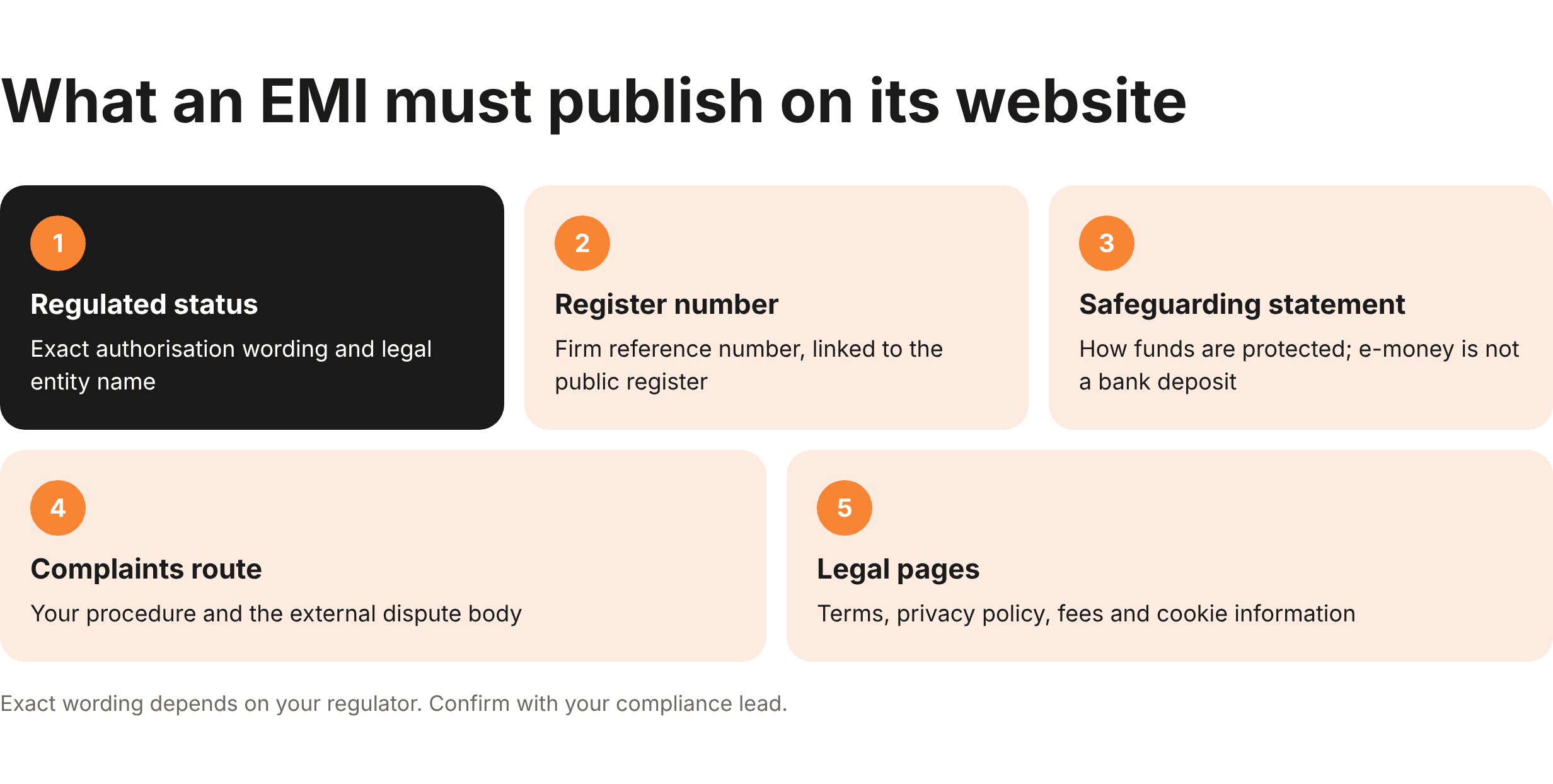
Here is where this connects to design. A status line buried in the footer or a safeguarding claim that contradicts your terms is not just a UX problem. It can undermine the file you submitted.
WSA's view is that preparing licence documents and the website in parallel shortens launch time. The same wording should appear in your application, your terms and your pages.
For page-by-page detail, see WSA's guide to EMI website design. If you also need the full set of legal pages, a broker website compliance checklist is a useful template for structure, even though the regulator and wording differ.
How WSA Works With Authorised EMIs
WSA is a fintech-specialist web design agency that builds regulated-brand websites in Framer and Webflow. It does not advise on licensing; it builds the public-facing site that the licence requires you to maintain.
EQWIRE is a verified example. When WSA started work, the FCA-authorised EMI had a single landing page. WSA rebuilt it as a segmented site, added a blog for the questions a landing page cannot answer, and gave legal documents a dedicated home.
According to the EQWIRE case study, organic clicks rose 399% and search impressions grew twentyfold. Those results are specific to that project and market, but the structure behind them applies to any EMI that wants to be found and trusted.
Conclusion
An EMI licence is the right route when customers hold balances in your product. It asks for EUR 350,000 in capital, full safeguarding, a credible management team and a timeline of 9 to 12 months in most cases. Choose the licence by what your product does, then budget for the programme, not just the fee.
The decision does not end at authorisation. Your website has to carry the same status wording, safeguarding statement and complaints route you put in the file. Plan the site alongside the application and you launch with one story instead of two. If you want that site built by a team that has worked with an FCA-authorised EMI, start the conversation with WSA.
Start Your Fintech Website Project
Tell us about your licence timeline and we will map the site to it.
FAQ
What is an EMI licence?
An EMI licence is a regulatory authorisation that allows a company to issue electronic money and hold customer balances. It lets an electronic money institution provide wallets, accounts and payment services, but not take deposits or pay interest. In the UK the FCA authorises EMIs under the Electronic Money Regulations 2011. In the EU the framework comes from the second Electronic Money Directive.
EMI licence vs payment institution licence: which do you need?
You need an EMI licence if customers will hold balances, receive cards or IBANs, or if you issue e-money. A payment institution licence is enough if you only execute payments between third parties and never hold funds beyond transit. The EMI route carries higher capital (EUR 350,000 in the EU) and stricter safeguarding. If you start with a payment institution licence and later add wallets, you will need a new authorisation.
How much does an EMI licence cost?
The regulator fee is small, but the total programme usually costs far more. FCA application fees are quoted at GBP 5,580 for an authorised EMI and GBP 1,120 for a small EMI. A small, well-prepared firm may keep total costs below GBP 1 million, while more ambitious firms can spend several million. You also need at least EUR 350,000 in initial capital, plus the buffer regulators typically expect.
How long does EMI authorisation take?
A complete UK application is decided within three months, but the whole process typically takes 9 to 12 months. An incomplete application can take up to 12 months. Consultant estimates put Lithuania at 6 to 9 months and Ireland at 12 to 18 months. Add 6 to 12 weeks of preparation before you file.
What must an EMI-licensed firm publish on its website?
An EMI-licensed firm should publish its regulated status, register number, safeguarding approach, complaints procedure and legal terms. Exact wording depends on the regulator, so confirm it with your compliance lead. Place the status information where customers can see it before they sign up, and keep it consistent with your application and terms.
Launch Your Licensed Brokerage with Confidence
We support brokers and fintechs through licensing, launch planning, and everything a regulated brand needs to go live.