•
•

Forex and Crypto Licence Costs in 2026: Full Fee Breakdown by Jurisdiction
You have a business plan, a liquidity provider in mind, and one question you cannot get a straight answer to: what does the licence actually cost?
Ask three consultants and you get three numbers an order of magnitude apart. One quotes US$25,000. Another quotes US$400,000. Both are describing the same licence.
The reason is that "forex broker licence cost" is not one number. It is five separate lines, and most published figures quietly mix them together. This article separates them and puts a figure against each one, so the forex broker licence cost you budget for is the one you actually pay, across nine forex and CFD jurisdictions and two crypto regimes.
This article is for informational purposes only and does not constitute legal advice. Brokers should consult qualified legal and compliance professionals for jurisdiction-specific guidance.
Every figure below carries a named source and a date. All figures were verified in September 2026. Regulator fee schedules change annually and currency conversions move, so treat this page as a snapshot and check the linked source before you commit capital.
Key Takeaways
A forex broker licence cost splits into five lines: application fee, registration fee, minimum capital, annual fee, and professional fees. Conflating them is why quotes differ by 10x.
Government fees are the smallest line. Vanuatu's Class A application and certificate fees total roughly US$2,640; Belize charges BZ$3,000 to apply and BZ$30,000 to register.
Minimum capital is not a fee. It stays on the balance sheet: US$100,000 in Seychelles, €125,000 to €730,000 in Cyprus, A$1,000,000-plus in net tangible assets in Australia.
Year two reorders the table. Vanuatu charges no annual renewal after the initial certificate fees, Belize charges BZ$30,000 every year, and ASIC billed retail CFD issuers A$128,388 in levy alone for 2025-26.
Under MiCA, crypto own-funds tiers are fixed in law at €50,000, €125,000 or €150,000, but the professional-fee stack around them runs €150,000 to €250,000 a year.
The costs providers leave out of the quote (audit, MLRO, local directors, professional indemnity insurance, website and legal pages) routinely add US$30,000 to US$80,000 in year one.
What a Forex Broker Licence Cost Actually Includes
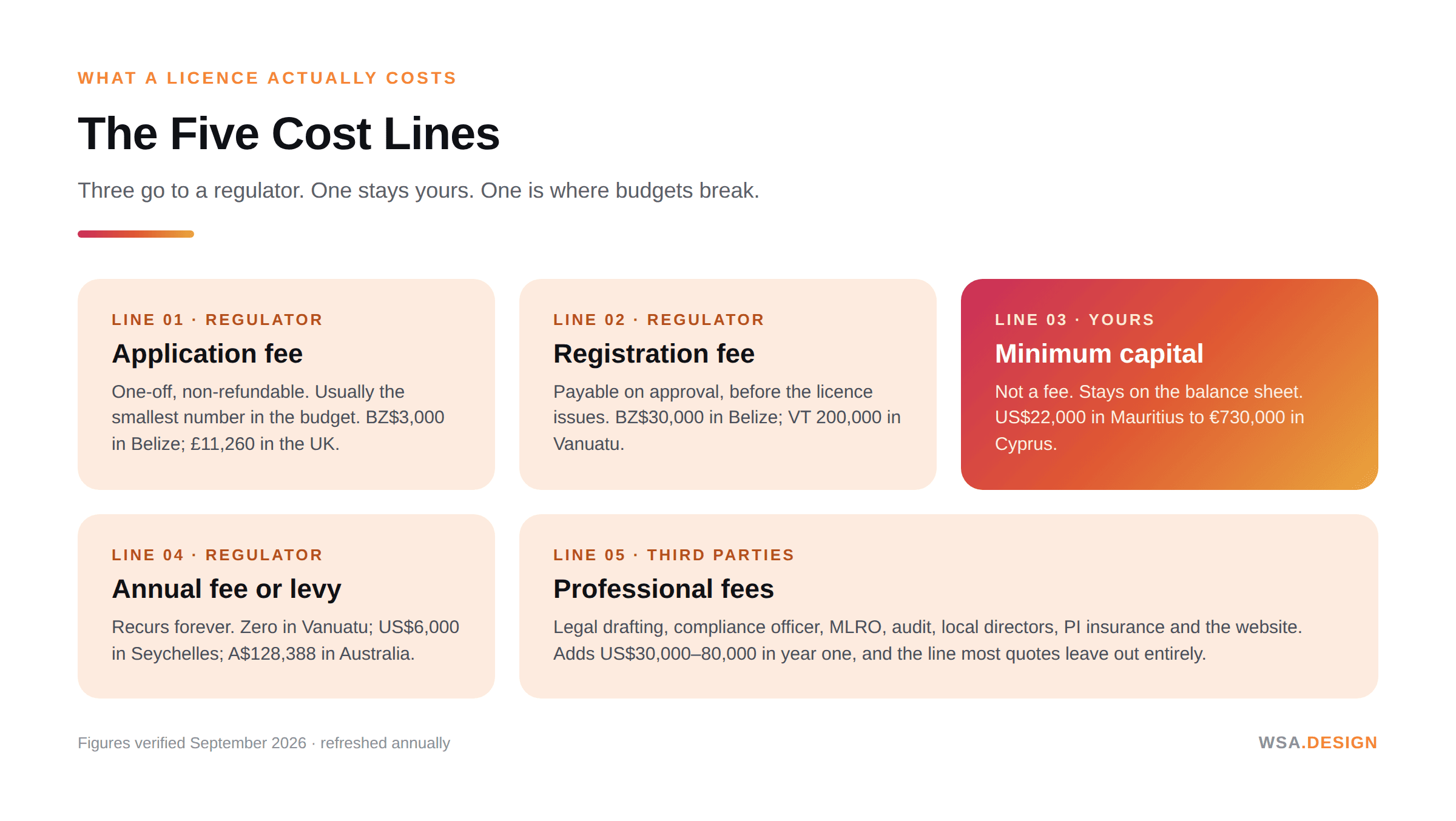
A forex broker licence cost is made up of five separate lines. Read any quote against this list and the differences stop looking mysterious.
The Five Cost Lines Every Budget Needs
Application fee: a one-off charge to have the regulator assess your file. Non-refundable if you are rejected. Usually the smallest number in the whole budget.
Registration or certificate fee: payable on approval, before the licence is issued. Belize and Vanuatu both charge this separately from the application; Cyprus and the UK do not.
Minimum capital: money that must sit in the company and stay there. Called paid-up capital, own funds, or net tangible assets depending on the regime. This is not a payment to anyone.
Annual fee or levy: what you pay every year to keep the licence. Fixed in some jurisdictions, calculated on turnover or sector cost recovery in others.
Professional fees: legal drafting, compliance officer, MLRO, audit, local directors, insurance, and the website. Third-party costs, not regulator costs, and the line most often left out.
What this means: only lines 1, 2 and 4 of a forex broker licence cost are money paid to a regulator. Line 3 is capital you still own. Line 4 recurs forever. Line 5 is where budgets break.
Why "Licence Cost" Quotes Differ by 10x
The spread in any published licensing quote comes from which lines it includes. A US$25,000 quote for Vanuatu is lines 1, 2 and part of 5. A US$400,000 quote for Cyprus is line 3 doing almost all the work.
Here is where most founders lose money: they compare a figure that includes locked capital against one that excludes it, pick the lower number, and then discover the capital requirement six weeks into the application.
Approval time is a cost too. Cyprus and the UK typically run 9 to 18 months, and you are paying salaries, rent and legal fees throughout. Vanuatu can close in one to three months. Twelve extra months of a €200,000 annual burn is a real number that appears in no fee schedule.
Forex and CFD Licence Costs by Jurisdiction in 2026
The table below sets out 2026 government fees, minimum capital and annual fees for nine forex and CFD jurisdictions, with the source and date behind each row. Figures in local currency carry an approximate USD equivalent; conversions move, the underlying figures do not.
Jurisdiction | Regulator | Application / registration fee | Minimum capital | Annual fee | Source (date) |
|---|---|---|---|---|---|
Cyprus | CySEC | ~€5,000 + 19% VAT, scope-dependent | €125,000 (STP/agency) to €730,000 (own-account dealing) | Scope-based under Directive DI87-03, plus ICF contribution up to 0.5% of assets | CySEC fees pages; Zitadelle AG (Apr 2026) |
United Kingdom | FCA | £11,260 (Category 6) | From £75,000 base own funds under IFPR | Periodic fee by fee-block, set annually | FCA application fees (updated 13 Jul 2026) |
Australia | ASIC | A$7,537 lodgement (responsible entity / market maker) | A$1,000,000+ net tangible assets | A$128,388 retail OTC derivatives levy, 2025-26 | ASIC industry funding; sector levy reported Jul 2026 |
South Africa | FSCA (ODP) | Scope-dependent, published by FSCA | Six months' projected operating expenses, typically ZAR 5–15m (~US$275,000–825,000) | Annual FSCA levy | Zitadelle AG (Feb 2026) |
Mauritius | FSC | Scope-dependent | MUR 1,000,000 (~US$22,000), Full Service excl. underwriting | MUR 60,000–290,000 (~US$1,500–7,000) | Zitadelle AG (Jul 2026) |
Seychelles | FSA | Application per FSA schedule | US$100,000 paid-up, raised from US$50,000 | US$6,000 licence fee, plus US$750 per representative | Securities (Amendment) Act 2024; Zitadelle AG (10 Jun 2026) |
Vanuatu | VFSC | VT 100,000 application + VT 200,000 certificate (Class A, ~US$2,640) | No statutory minimum for Classes A–C; US$500,000 for Class D digital assets | None after initial certificate fees | Zitadelle AG (Jul 2026) |
Labuan, Malaysia | Labuan FSA | Scope-dependent | MYR 1,000,000 (~US$225,000) plus MYR 200,000 reserve | US$5,000, revised January 2026 | Zitadelle AG (Jul 2026) |
Belize | FSC Belize | BZ$3,000 application + BZ$30,000 registration | Paid-up capital per FSC requirement | BZ$30,000 renewal | FSC Belize, Securities Industry Regulations 2023, Schedule II |
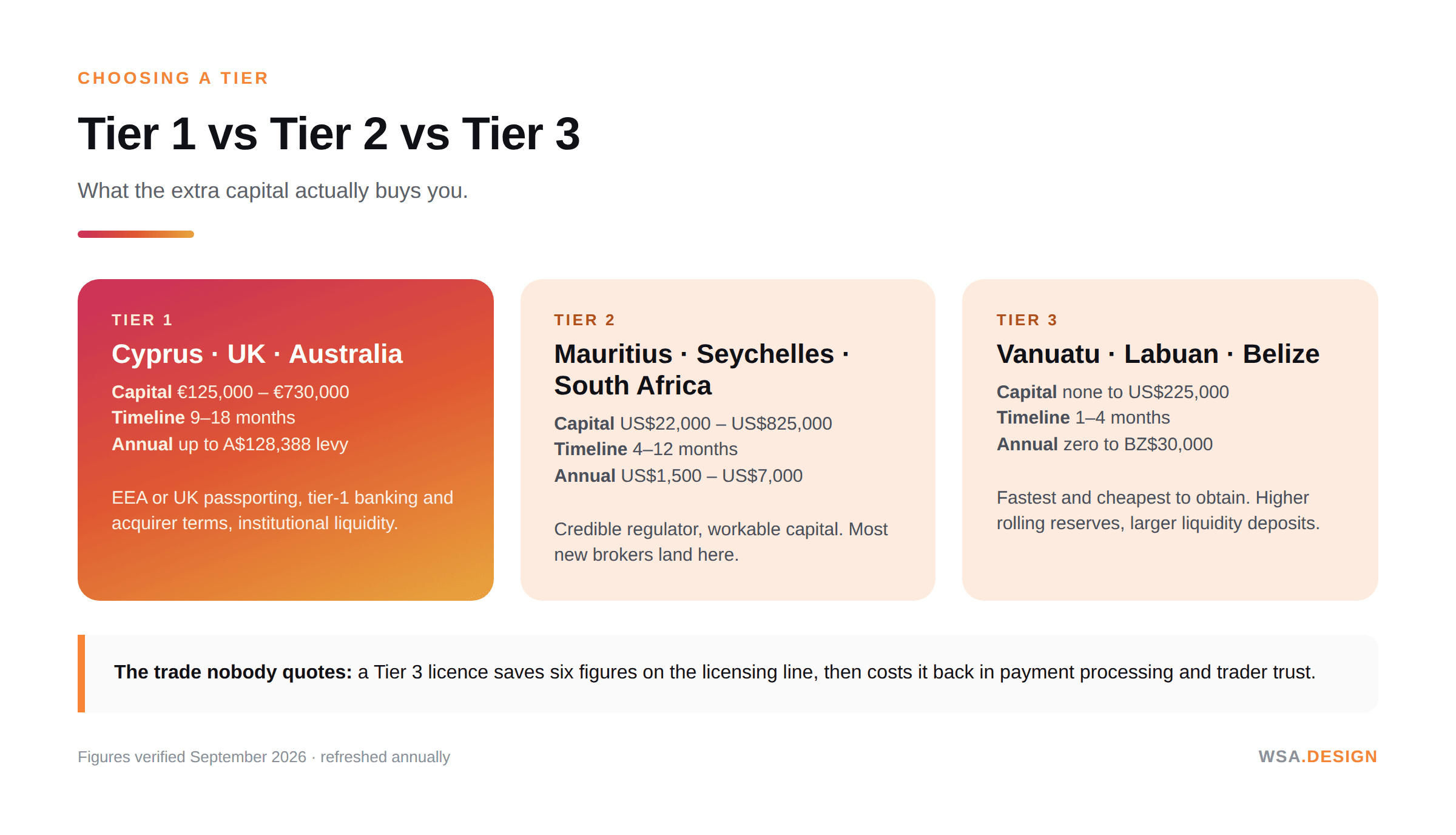
Tier 1: Cyprus, UK, Australia
Tier 1 carries the highest forex broker licence cost and buys the most trust. A CySEC licence passports across the EEA, and that access is what the CySEC licence cost really buys.
The CySEC licence cost starts modestly on paper, which is exactly how founders get caught. The application fee is roughly €5,000 plus 19% VAT, with the exact figure calculated from the services you apply for (Zitadelle AG, April 2026). Then capital lands: €125,000 for a straight-through or agency model, €730,000 if you deal on own account as a market maker.
Cyprus also expects real substance. Staffing and operational costs of €150,000 to €400,000 a year are typical for a minimum-viable CIF with local key function holders (Zitadelle AG, April 2026). Retail-facing firms contribute to the Investor Compensation Fund, up to 0.5% of assets annually.
The UK is the cleanest fee to quote and the hardest to win. Most MiFID investment firms fall into Category 6, a £11,260 application fee (FCA, page updated 13 July 2026), with base own funds from £75,000 under the Investment Firms Prudential Regime.
Australia is the year-two outlier. The lodgement fee is A$7,537 for the responsible entity and market maker category, and consultants typically charge A$10,000 to A$60,000 to prepare the file (AFSL House, June 2026). The recurring number is the one to plan around: ASIC's industry funding levy for the subsector covering most retail CFD and forex brokers was A$128,388 per firm for 2025-26, down 23% from A$166,679 the year before.
The takeaway: in Tier 1, the application fee is noise. Capital and annual regulatory fees decide the budget.
Launching a regulated broker in 2026?
Your licence tier dictates your disclosure text, your legal page set, and which markets you can geo-target. Those decisions belong in the design phase, not after launch.
Tier 2: Mauritius, Seychelles, South Africa
Tier 2 is where most new brokers actually land: credible regulators, mid-six-figure total budgets, and approval in months rather than years.
Mauritius is the capital-efficient option. An Investment Dealer (Full Service, excluding underwriting) licence requires MUR 1,000,000 in capital, around US$22,000, with FSC renewal fees of MUR 60,000 to MUR 290,000 depending on category (Zitadelle AG, July 2026). First-year budgets typically land at US$40,000 to US$75,000 once a management company, audit and insurance are included.
Seychelles doubled its entry price. The Securities (Amendment) Act 2024 raised minimum paid-up capital for a securities dealer licence from US$50,000 to US$100,000, and the FSA may require US$250,000 or more for complex models or large client books (Zitadelle AG, 10 June 2026). The annual licence fee is US$6,000, due by 31 January, plus US$750 per licensed representative and US$1,000 a year for each additional trade name.
South Africa prices capital as a function of your own burn rate. An Over-the-Counter Derivative Provider licence requires six months of projected operating expenses held at all times, typically ZAR 5–15 million or roughly US$275,000 to US$825,000, with a 12 to 24 month approval path (Zitadelle AG, February 2026).
What this means in practice: Mauritius is the cheapest credible capital requirement in this tier. Seychelles is the cheapest to run annually. South Africa is neither, and firms choose it for market access, not price.
Tier 3: Vanuatu, Labuan, Belize
Tier 3 has the lowest forex broker licence cost on paper and the sharpest hidden costs. This is the tier where the headline number misleads most.
Vanuatu has the lowest cash-out of any jurisdiction in this article. A Class A Financial Dealer Licence costs VT 100,000 in application and representative fees plus a VT 200,000 certificate fee, about US$2,640 in total, and there has been no annual renewal fee since the 2021 legislative change (Zitadelle AG, July 2026).
Then the bond appears. The VFSC holds a security deposit of VT 5,000,000, roughly US$44,000. Not a fee, but cash you cannot trade with. A realistic first-year budget for Classes A, B and C combined runs US$70,000 to US$90,000 once the bond, incorporation, insurance and a resident director are counted.
Labuan looks mid-tier until you read the capital line. A money broking licence requires MYR 1,000,000 in paid-up capital, around US$225,000, plus an MYR 200,000 reserve, with an annual licence fee of US$5,000 as revised in January 2026 (Zitadelle AG, July 2026). Substance rules require two full-time Labuan employees.
Belize is the clearest published schedule of the three. Trading as Principal or Trading as Agent each cost BZ$3,000 to apply, BZ$30,000 to register, and BZ$30,000 every year to renew, set out in Schedule II of the Securities Industry Regulations 2023. The Belize dollar is pegged at two to the US dollar, so that is roughly US$1,500 and US$15,000.
The consequence nobody quotes: a Tier 3 licence saves six figures on the licensing line, then costs it back in payment processing. Card acquirers price offshore brokers at higher rolling reserves, liquidity providers ask for larger deposits, and traders comparing two brokers read the footer.
Crypto Exchange Licence Cost in 2026
A crypto exchange licence cost splits along the same five lines, with one difference: in the EU the capital tiers are fixed in law, so there is nothing to negotiate.
Under the Markets in Crypto-Assets Regulation, own-funds requirements for a crypto-asset service provider are set at €50,000, €125,000 or €150,000 depending on which class of services you provide. Exchange and execution services sit in the €125,000 band; custody sits at €150,000.
Regime | Regulator | Application fee | Minimum capital / own funds | Annual fee | Source (date) |
|---|---|---|---|---|---|
EU, MiCA CASP, Class 1 (advice, order transmission) | National competent authority | Set per member state | €50,000 own funds | Supervisory fee per NCA | MiCA Article 67 and Annex IV |
EU, MiCA CASP, Class 2 (exchange, execution) | National competent authority | Set per member state | €125,000 own funds | Supervisory fee per NCA; BaFin €50,000–100,000 | MiCA Art. 67; ItisPay (5 Sep 2026) |
EU, MiCA CASP, Class 3 (custody) | National competent authority | Set per member state | €150,000 own funds | Supervisory fee per NCA | MiCA Article 67 and Annex IV |
Dubai, Exchange Services | VARA | AED 100,000 (~US$27,200) | Risk-based, set per licensee | AED 200,000 (~US$54,500) supervision | VARA Rulebook, Schedule 2 |
Dubai, Broker-Dealer Services | VARA | AED 100,000 (~US$27,200) | Risk-based, set per licensee | AED 200,000 (~US$54,500) supervision | VARA Rulebook, Schedule 2 |
Dubai, Advisory Services | VARA | AED 40,000 (~US$10,900) | Risk-based, set per licensee | AED 80,000 (~US$21,800) supervision | VARA Rulebook, Schedule 2 |
EU: MiCA CASP Own-Funds Tiers and Regulator Fees
MiCA fixes the capital and leaves the fees to member states, which is why the same authorisation costs different amounts in Vilnius and Frankfurt.
The professional stack is the real spend. Legal advisory for the application runs €40,000 to €100,000, a chief compliance officer €80,000 to €120,000, an MLRO €70,000 to €110,000, ICT and DORA work €30,000 to €80,000, and external audit €20,000 to €50,000 (ItisPay, 5 September 2026). Germany sits at the top: BaFin applications typically carry €80,000 to €200,000 in advisory costs and €50,000 to €100,000 in annual supervisory fees.
The takeaway: €125,000 of own funds is the smallest part of a MiCA budget. Year-two run-rate lands at €150,000 to €250,000 before any capital is locked.
Dubai: VARA Schedule 2 Fees
Dubai publishes the clearest crypto exchange licence cost schedule in the world, and it is not cheap.
Exchange Services, Broker-Dealer Services, Custody Services and Lending and Borrowing each cost AED 100,000 to apply and AED 200,000 a year in supervision. Advisory Services and Virtual Asset Transfer and Settlement Services cost AED 40,000 and AED 80,000 respectively. Applying for more than one activity triggers an extension fee per additional licence, and VARA can impose additional fees based on your risk profile.
At roughly 3.67 dirhams to the dollar, an exchange pays about US$27,200 to apply and US$54,500 every year thereafter, before capital, staff or premises.
Comparing jurisdictions and need the site to match?
A MiCA-authorised exchange and an offshore CFD broker need different trust architecture, different disclosures and different page sets.
Minimum Capital: What Must Stay in the Company
Minimum capital is not a fee. The capital requirements a forex licence imposes are money that must sit in the licensed entity and stay there, and drawing it down without regulator consent is a breach.
Regimes use three different terms and they are not interchangeable:
Paid-up capital: share capital actually paid in, used in Seychelles, Labuan and Mauritius. Must usually be deposited in a local bank before the licence is granted.
Own funds: a prudential measure under EU rules, used by CySEC and under MiCA. Can be eroded by losses, and must be topped up when it is.
Net tangible assets: the Australian measure, which excludes intangibles and requires ongoing liquidity and cash-flow projections.
Bond or security deposit: Vanuatu's VT 5,000,000, roughly US$44,000. Held by the regulator, not on your balance sheet, and separate from any capital requirement.
The 2026 spread runs from no statutory minimum for Vanuatu Classes A to C, through US$22,000 in Mauritius and US$100,000 in Seychelles, to €730,000 for a Cyprus market maker and A$1,000,000-plus in Australia.
What this means: treat capital as working capital you cannot use, and model the opportunity cost. Six months of a €730,000 balance sitting idle is a financing decision, not a licensing one.
Annual Fees and Year-Two Running Costs
Year two is where the cheapest jurisdiction often stops being cheapest. Application fees are set once; annual regulatory fees compound.
Compare the recurring regulator line only:
Vanuatu: nothing. Licence fees have been permanent since the 2021 change (Zitadelle AG, July 2026).
Labuan: US$5,000 a year, revised January 2026.
Seychelles: US$6,000 a year, plus US$750 per representative.
Mauritius: MUR 60,000 to 290,000, roughly US$1,500 to US$7,000.
Belize: BZ$30,000, about US$15,000, every year (Securities Industry Regulations 2023, Schedule II).
Australia: A$128,388 for 2025-26 in sector levy alone, on top of the corporate fees.
Over five years, Belize's renewal alone costs about US$75,000 more than Vanuatu's. Australia's levy over the same period exceeds US$400,000 at current rates.
Then add the parts that recur regardless of jurisdiction: audit, compliance staff, insurance, platform licences, and the website. Labuan's substance rules require two full-time local employees and MYR 100,000 of local annual operating spend; Cyprus expects at least three local staff.
The practical implication: build a three-year model of forex broker licence cost, not a first-year one. Once annual regulatory fees are included, the ranking changes.
The Costs Providers Leave Out of the Quote
Five lines get left out of almost every forex broker licence cost quote: external audit, compliance and MLRO staffing, local resident directors, professional indemnity insurance, and the website with its legal page set.
Hidden cost | Typical annual range | Notes |
|---|---|---|
External audit | US$2,000–8,000 | Mauritius and Seychelles bands; higher in Tier 1 (Zitadelle AG, Jun–Jul 2026) |
Management company / outsourced compliance | US$6,000–66,000 | Mauritius range, scales with activity (Zitadelle AG, Jul 2026) |
Professional indemnity insurance | US$2,000–10,000 | Mandatory in most regimes for retail-facing firms |
Local directors and substance staffing | US$20,000–40,000 | Labuan two-employee requirement; Cyprus expects three-plus |
Website, content and legal pages | US$5,000–25,000 first year | Build plus 15–20 pages of content and compliance rewrites |
Audit, MLRO, Local Directors and PI Insurance
These are not optional extras. They are licence conditions, and a regulator will not issue without them.
Seychelles requires two resident directors and at least one licensed Securities Dealer Representative physically present, plus a compliance officer and an MLRO. Cyprus expects key function holders on the ground. Labuan requires two full-time local employees to keep its tax treatment.
Website, Legal Pages and Localisation
The website is a licence condition, not marketing spend. Your regulator dictates what appears on it, and the page set changes with the jurisdiction.
Real 2026 figures, from our own brokerage website cost in 2026 breakdown: a template build runs US$3,000 to US$7,000, a custom Framer or Webflow build US$8,000 to US$20,000, and an advanced custom platform US$20,000 to US$50,000 or more. Content production for 15 to 20 pages adds US$2,000 to US$5,000, compliance rewrites US$500 to US$2,000 per cycle, and each additional language US$2,000 to US$5,000.
Here is where most brokers get caught. Switching jurisdiction mid-application does not mean editing a footer. It means a new entity name and registration number in every disclosure, a rewritten risk warning, a different client agreement, a different complaints procedure, and often a different set of countries you can legally target. Our Bahamas walkthrough shows exactly which licence documents your website has to carry.
How WSA Budgets the Website Side of a Licence Launch
Budget US$10,000 to US$30,000 for a first-year broker website that satisfies a regulator and converts traffic. That covers the build, the legal page set, and the content, not ongoing paid media.
WSA works exclusively with fintech, brokerage and crypto clients, and the licensing stage is where we usually come in. If you are starting from zero, our step-by-step guide covers how to build the broker website itself. Our broker builds run on Framer, which means a five-week launch window rather than five months, and a CMS the compliance team can edit without a developer.
What the website line covers in practice:
Compliance-ready page architecture: entity details, registration number, risk warning placement and jurisdiction disclosures built into the template, not bolted on
The legal page set: client agreement, risk disclosure, privacy policy, complaints procedure, AML statement, structured for the regulator you are applying to
Trust architecture above the fold: the licence badge, entity name and regulator reference where traders actually look
Multi-language support: priced per market, so you add languages as you add licences
Conversion structure: account-opening flows designed for converting regulated traffic into funded accounts, not generic SaaS signup patterns
One tradeoff to be honest about: if your jurisdiction is still undecided, build the site in a jurisdiction-agnostic structure first and populate the disclosure fields last. It costs a little more in planning and saves a full rewrite later.
Not sure what your licence tier means for your site?
We map the regulator's disclosure requirements onto a page structure before design starts, so nothing gets rewritten after approval.
Conclusion
A forex broker licence cost in 2026 ranges from about US$2,640 in government fees in Vanuatu to more than €730,000 in locked capital in Cyprus — and the gap between those numbers is mostly capital, not fees. Separate the five lines, model three years of annual regulatory fees rather than one, and the right jurisdiction usually becomes obvious.
The crypto exchange licence cost follows the same logic with less room to manoeuvre: MiCA fixes own funds at €50,000, €125,000 or €150,000, and Dubai's VARA publishes AED 100,000 to apply and AED 200,000 a year to stay licensed.
All figures here were verified in September 2026 and are refreshed annually. Whichever jurisdiction you choose, the licence eventually has to show up on your website: in the disclosures, the legal pages and the trust signals traders check before they fund an account. That is the part WSA builds. Let's talk.
FAQ
How much does a forex brokerage license cost in total?
A forex broker licence cost runs US$30,000 to US$90,000 all-in for an offshore licence in year one, US$40,000 to US$150,000 in a mid-tier jurisdiction, and US$300,000 to US$700,000 or more in Cyprus, the UK or Australia once locked capital is counted.
The split matters more than the total. Government fees are small: Vanuatu's Class A application and certificate fees total roughly US$2,640, and Belize charges BZ$3,000 plus BZ$30,000 to register under Schedule II of its Securities Industry Regulations 2023.
Minimum capital is what moves the total. Mauritius requires MUR 1,000,000, around US$22,000. Seychelles requires US$100,000 following the Securities (Amendment) Act 2024. Cyprus requires €125,000 for an agency model or €730,000 to deal on own account. Australia requires A$1,000,000-plus in net tangible assets.
Professional fees add US$30,000 to US$80,000 in year one for audit, compliance staffing, local directors, insurance and the website. Figures verified September 2026.
Which forex licence is cheapest all-in, including year two?
Vanuatu carries the lowest forex broker licence cost across two years, mainly because it charges no annual renewal fee after the initial certificate fees, a position unchanged since the 2021 legislative amendment.
Year-one cash is roughly US$2,640 in government fees plus a VT 5,000,000 security deposit of about US$44,000, which you get back rather than spend. A realistic first-year total including incorporation, insurance and a resident director is US$70,000 to US$90,000. Year two adds no regulator fee at all.
Mauritius is the closest competitor on a three-year view: about US$22,000 in capital and MUR 60,000 to 290,000 a year in renewal fees. Seychelles costs US$6,000 a year plus US$750 per representative, with a US$100,000 capital lock.
Belize looks similar at the application stage and then charges BZ$30,000 every year, which over five years is roughly US$75,000 more than Vanuatu.
The caveat is real: cheapest on fees is rarely cheapest on operations. Offshore brokers face higher acquirer rolling reserves and larger liquidity deposits, and those costs do not appear in any fee schedule.
How much does a crypto exchange licence cost in the EU under MiCA?
A MiCA authorisation for exchange and execution services requires €125,000 in own funds, with €50,000 for advice and order transmission and €150,000 for custody, fixed by Article 67 of the regulation.
Application fees are set by each national competent authority rather than by MiCA, so the same authorisation costs different amounts in different member states. Germany is the expensive end: BaFin applications typically carry €80,000 to €200,000 in advisory costs and €50,000 to €100,000 in annual supervisory fees. Lithuania sits at the low end, with supervisory fees in the low thousands per year.
The professional stack dominates the budget. Legal advisory for the application runs €40,000 to €100,000, a chief compliance officer €80,000 to €120,000, an MLRO €70,000 to €110,000, ICT and DORA work €30,000 to €80,000, and external audit €20,000 to €50,000. Year-two run-rate lands at €150,000 to €250,000, excluding the opportunity cost of locked capital. Timelines typically run 12 to 24 months (ItisPay, 5 September 2026).
What minimum capital must stay in the company?
All of it, permanently, unless the regulator agrees otherwise. Minimum capital is a continuing condition of the licence, not a one-time deposit you can draw down after approval, and in most jurisdictions it is the largest single element of a forex broker licence cost.
The 2026 capital requirements for a forex licence, by jurisdiction: no statutory minimum for Vanuatu Classes A to C; MUR 1,000,000, around US$22,000, in Mauritius; US$100,000 in Seychelles, with the FSA able to require US$250,000 or more for complex models; MYR 1,000,000, around US$225,000, plus an MYR 200,000 reserve in Labuan; €125,000 to €730,000 in Cyprus; from £75,000 in base own funds in the UK under the Investment Firms Prudential Regime; and A$1,000,000-plus in net tangible assets in Australia.
For crypto, MiCA sets own funds at €50,000, €125,000 or €150,000 by service class.
Two things people miss. Capital is usually verified before the licence is granted, often requiring a deposit in a local bank plus a source-of-funds review. And Vanuatu's VT 5,000,000 bond, about US$44,000, is held by the regulator rather than sitting on your balance sheet, so it is neither capital nor a fee.
How much should I budget for the broker website and legal pages?
Budget US$10,000 to US$30,000 in year one for a regulated broker website including the legal page set and content, with US$900 to US$3,500 a month ongoing for hosting, maintenance, SEO and conversion work. Published tiers are on WSA pricing.
Build cost depends on approach. A template runs US$3,000 to US$7,000 and rarely satisfies a compliance review without rework. A custom Framer or Webflow build runs US$8,000 to US$20,000. An advanced custom platform with portal integrations runs US$20,000 to US$50,000 or more.
Content and compliance are separate lines. Producing 15 to 20 pages costs US$2,000 to US$5,000. Compliance rewrites cost US$500 to US$2,000 per cycle, and you should expect at least one cycle per licence application. Each additional language adds US$2,000 to US$5,000.
Do not treat the website as post-approval work. Your entity name, registration number, risk warning wording and complaints procedure all come from the licence, and building the page structure around them from the start avoids a full rewrite when the licence is granted.
Launch Your Licensed Brokerage with Confidence
We support brokers and fintechs through licensing, launch planning, and everything a regulated brand needs to go live.