•
•

Labuan Forex License: LFSA Requirements, Cost and Website Rules
A Labuan forex license is a money broking licence issued by Labuan FSA. Since the guidelines dated 9 September 2024, minimum paid-up capital is RM1,000,000, or RM1,500,000 with digital asset activity. Direct fees are USD 350 to apply and USD 5,000 a year to hold, and the licence pushes a set of disclosure obligations onto the broker's public website.
Your jurisdiction shortlist is down to three. Capital is earmarked, the liquidity provider conversation has started, and a consultant has told you Labuan needs RM500,000 and about two months.
That capital figure has been wrong since September 2024.
A Labuan forex license today means a money broking licence issued by the Labuan Financial Services Authority (Labuan FSA), granted under guidelines that doubled the minimum paid-up capital, tightened the rules on who your counterparties can be, and pushed a list of disclosure obligations onto your public website. Half the pages ranking for this term still quote the old number. Some of them are selling the application.
This article is for informational purposes only and does not constitute legal advice. Brokers should consult qualified legal and compliance professionals for jurisdiction-specific guidance.
This guide sets out what the licence actually permits, what it costs to get and keep, how long approval takes, and what your site has to carry once you hold it. Figures come from Labuan FSA's own guidelines and fee schedule, with the guideline date attached so you can check them yourself.
Key Takeaways
A retail FX broker in Labuan holds a money broking licence, not a securities dealer licence. The distinction decides what you can offer.
Minimum paid-up capital is RM1,000,000, or RM1,500,000 if you also want digital asset activity. The RM500,000 figure still published on many pages was superseded by the 9 September 2024 guidelines.
Direct fees are small: USD 350 to process the application, USD 5,000 a year to hold the licence. Capital, office and staff are the real budget.
Labuan is mid-shore, not offshore. You need an operational office on the island, two full-time employees and RM100,000 in annual operating expenditure to keep the 3% tax treatment.
Product scope is capped: 100:1 maximum leverage, foreign currency only, intermediary role only. No principal dealing, no market making, no index or share CFDs.
Labuan FSA requires licensed brokers to publish their authorised introducing broker list, execution and order-routing arrangements, spreads and all fees, and risk disclosures on a publicly accessible medium. In practice, that is your website.
What Is a Labuan Forex License?
A Labuan forex license is a money broking licence issued by Labuan FSA that lets a Labuan company act as an intermediary in foreign currency transactions, matching buyers and sellers and earning brokerage or commission. It is granted to companies incorporated in Labuan IBFC, Malaysia's mid-shore financial centre, and regulated separately from mainland Malaysia.
The licence covers a specific set of activities:
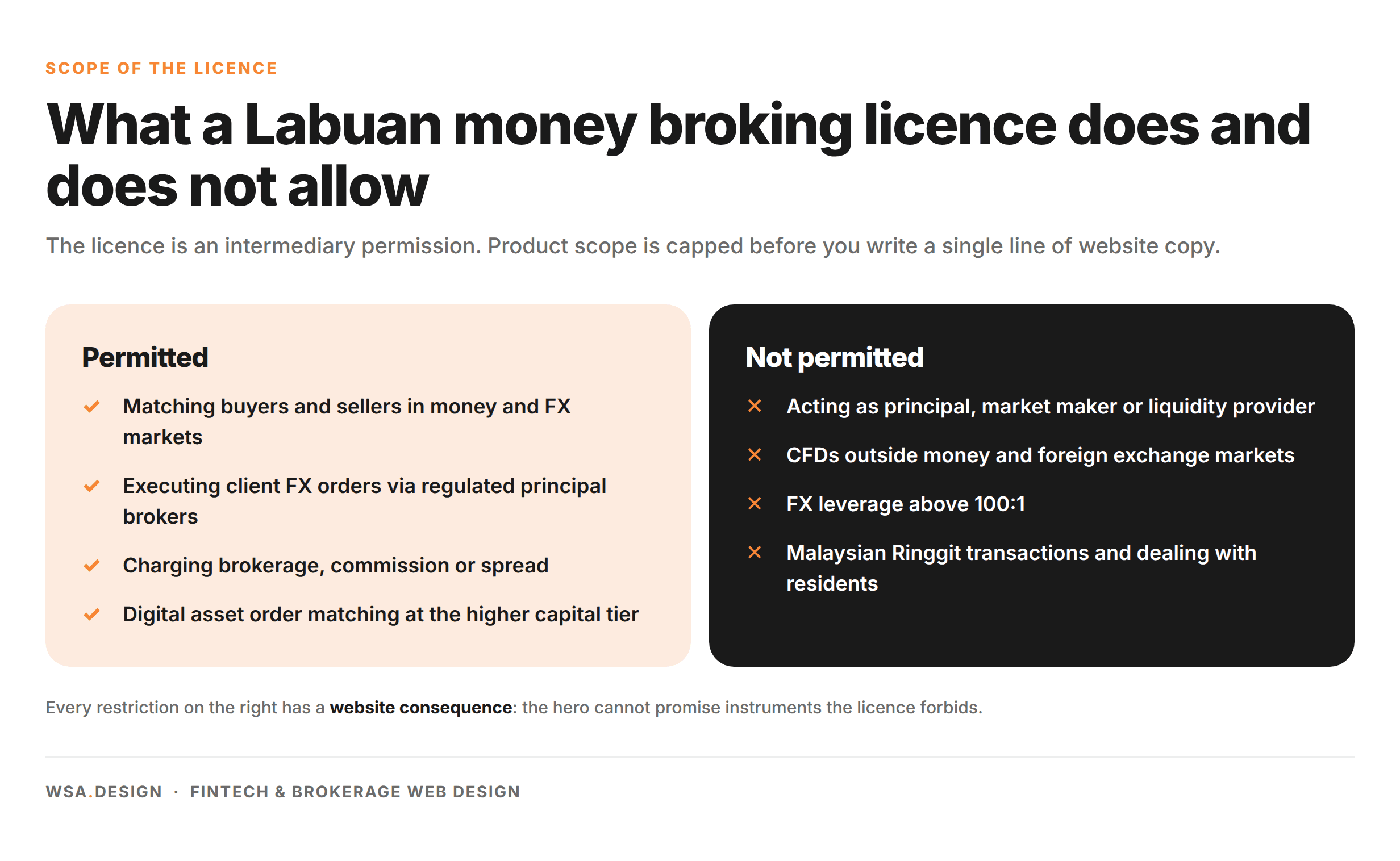
Bringing together counterparties in the money and foreign exchange markets
Executing client FX orders through regulated principal brokers and liquidity providers
Charging brokerage, commission or spread for that intermediation
Facilitating digital asset trading and order matching, if you hold the higher capital tier
What it is not is a permission to run a dealing desk. That single point reshapes more business plans than the capital requirement does.
Money Broking vs Securities Licensing Under LFSA
The difference between money broking and securities licensing under LFSA is what sits on the other side of your client's trade. A money broker matches orders and passes them to a regulated counterparty. A securities licensee, under Labuan's separate capital markets regime, deals in a broader instrument set with its own capital and conduct rules.
For a retail FX and crypto broker, money broking is the right instrument. If your product roadmap includes index CFDs, single-stock CFDs or commodity CFDs, the money broking route will not carry it, and applying for a Labuan forex broker license on that assumption wastes a quarter.
What this means: confirm your instrument list before you file. The licence class you apply for locks your product page for the next two years.
What the Licence Does Not Let You Do
A Labuan money broking licence does not permit:
Acting as principal, market maker or liquidity provider to your own clients
Offering CFDs on anything outside money and foreign exchange markets
Offering FX leverage above 100:1, which means a minimum 1% margin deposit
Transacting in Malaysian Ringgit, other than for administrative and statutory costs
Dealing with Malaysian residents, except authorised dealers under the Exchange Control Act 1953
Every one of those restrictions has a website consequence. A broker who promises "trade 500+ instruments at 1:500" on the hero section and then holds an LFSA licence has a compliance problem printed on the homepage.
LFSA Requirements for a Labuan Money Broking Licence
To hold a Labuan money broking licence, an applicant must show minimum paid-up capital of RM1,000,000, or RM1,500,000 where the business also carries on digital asset activity, under Labuan FSA's Guidelines on the Establishment of Money Broking Business in Labuan IBFC dated 9 September 2024. Those guidelines replaced the November 2017 version and doubled the previous RM500,000 threshold.
Labuan FSA can also require more capital than the minimum where the business is complex or the risk profile warrants it. Applicants now have to produce certified evidence that the capital has actually been deposited with a regulated bank, so a paper subscription no longer clears the bar.
Requirement | Standard | Source |
|---|---|---|
Minimum paid-up capital | RM1,000,000 | 2024 guidelines |
With digital asset activity | RM1,500,000 | 2024 guidelines |
Prior experience | 3 years in money broking | 2024 guidelines |
Office | Operational premises in Labuan | 2024 guidelines |
Full-time employees | 2 | 2021 substance regulations |
Annual operating expenditure | RM100,000 | 2021 substance regulations |
Maximum FX leverage | 100:1 | Labuan FSA / Labuan IBFC |
Tax on trading activity | 3% of audited net profits | Labuan FSA |
This is not legal advice, and guidelines move. Confirm the current version with Labuan FSA or your licensing counsel before you commit capital.

Capital, Fit-and-Proper and Counterparty Rules
Capital gets you through the door. Three other tests decide whether you stay.
Directors, controllers and the principal officer have to satisfy Labuan FSA's fit-and-proper standards, and staff handling client transactions need demonstrable competence in the products they sell. Applicants regulated elsewhere need a letter of awareness from their home authority.
The counterparty rule is the one that catches new brokers. Your principal broker, liquidity provider, client asset custodian, payment provider and e-wallet provider all have to be regulated by a recognised supervisory authority. A cheap unregulated PSP is not an option you can quietly keep.
Client money sits in accounts separate from the company's own, marked per client, reconciled monthly, and protected from the broker's debts. Withdrawal requests have to be completed within three working days.
Office, Staffing and Substance Requirements
Labuan requires real presence: an operational office on the island, two full-time employees, and at least RM100,000 in annual operating expenditure. The employee and expenditure thresholds come from the Labuan Business Activity Tax (Requirements for Labuan Business Activity) Regulations 2021, and they are the price of the 3% tax rate on Labuan trading activity.
Miss the economic substance requirements and the entity falls out of the preferential regime and into Malaysia's standard corporate rate. The office also has to be furnished and used for business, with enough staff to handle finance, accounting, statistical submissions and record-keeping, plus a named Labuan contact person.
You will also need a Labuan trust company for the registered office, resident secretary and statutory filings.
The takeaway: budget for a running operation, not a mailbox. Two salaries, rent and trust company fees put the true annual cost well above the USD 5,000 licence fee.
Launching a Labuan-Licensed Brokerage This Quarter?
WSA builds broker websites that carry the disclosures your licence requires, without looking like a legal document.
Labuan Forex License Cost: Fees, Capital and Running Costs
A Labuan forex license cost breaks into two very different halves. The regulator's fees are modest: USD 350 to process the application and USD 5,000 a year to hold the licence, with a further USD 3,500 if you operate a marketing office. Capital, substance and professional fees are what actually shape the budget.
Item | Amount | One-off or recurring |
|---|---|---|
Minimum paid-up capital | RM1,000,000 (RM1,500,000 with digital assets) | One-off, committed |
Application processing fee | USD 350 | One-off |
Annual licence fee | USD 5,000 | Recurring, due by 15 January |
Marketing office fee | USD 3,500 | Recurring, if applicable |
Labuan office and two employees | Varies by setup | Recurring |
Minimum annual operating expenditure | RM100,000 | Recurring |
Tax on Labuan trading activity | 3% of audited net profits | Recurring |
Trust company, audit, legal and licensing advisory | Varies | Mixed |
Note what is missing from that table: technology, liquidity, payments and the website. A broker who budgets only for the licence arrives at conditional approval with no platform integration and no site, and then discovers that building the broker site itself is a project of its own.
In practice: brokers who plan the licence and the client-facing build in parallel launch weeks after approval. Brokers who treat the website as a post-licence task lose that time, and pay for it in delayed first deposits.
How Long LFSA Approval Takes
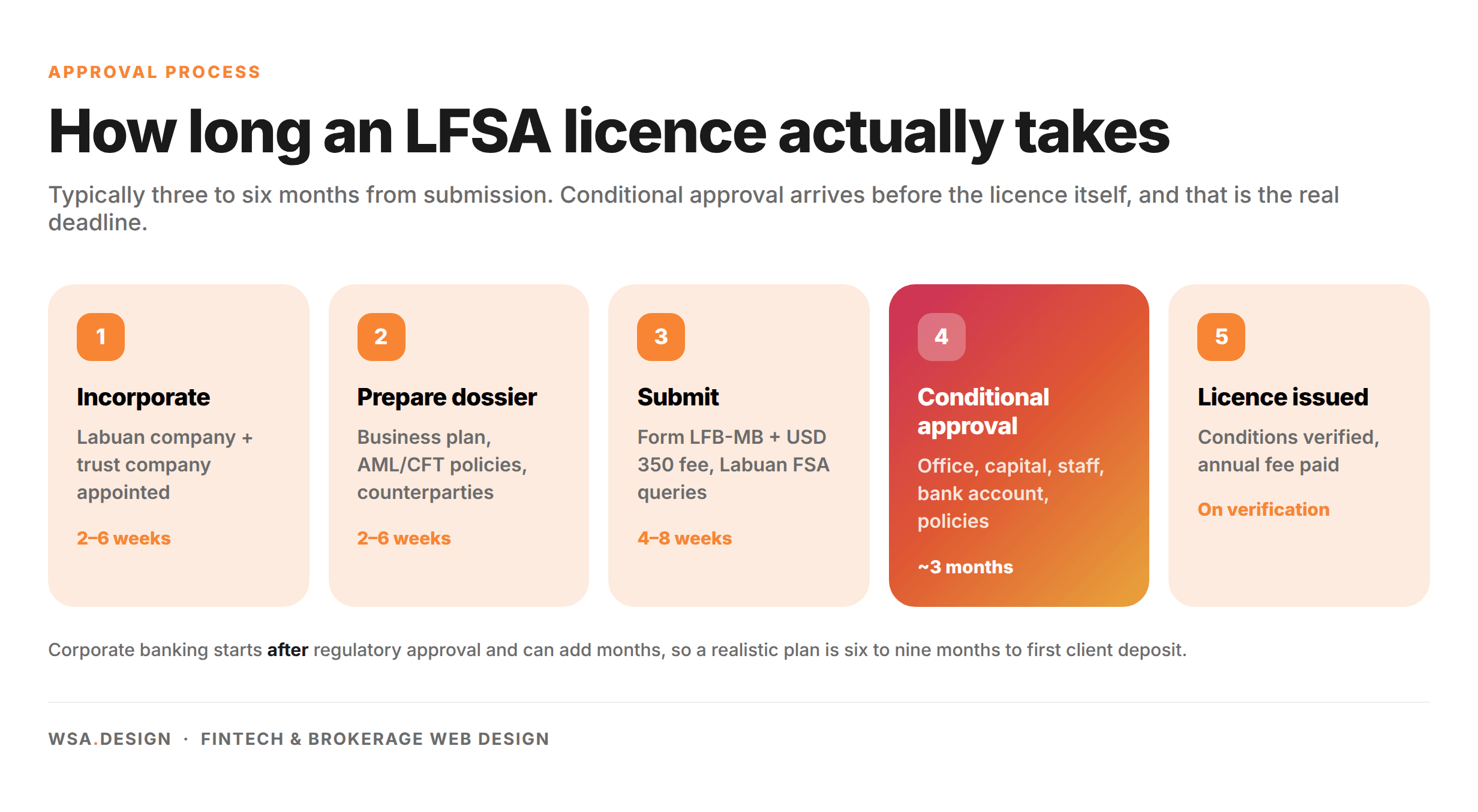
LFSA approval typically takes three to six months from submission, and the licence arrives in two stages rather than one. Timelines quoted by service providers usually start at submission and exclude the weeks of document preparation that come first.
Incorporate the Labuan company and appoint a trust company. Two to six weeks, depending on how fast shareholder and director documents arrive.
Prepare the dossier. Business plan, financial projections, director and shareholder profiles, AML and CFT policies, counterparty details. Two to six weeks, and the main source of delay.
Submit with Form LFB-MB and the USD 350 processing fee. Labuan FSA reviews and comes back with queries. Four to eight weeks is normal.
Receive conditional approval. You get a limited window, often around three months, to meet operational conditions: office, capital deposit, staff, bank account, policies.
Licence issued once the conditions are verified and the annual fee is paid.
Banking is the step that slips. Corporate account opening starts after regulatory approval and can add months on its own, which is why experienced applicants start bank conversations during the review stage rather than after it.
Website Requirements for a Labuan-Licensed Broker
Labuan FSA's disclosure rules require a licensed money broker to publish specific information on a publicly accessible medium, which in practice means the website. This is the part of the licence that most applicants discover late, because no licensing consultant treats it as their scope.
Mandatory Disclosures Your Site Must Carry
Under the 2024 guidelines, a licensed broker has to make the following available to clients and prospective clients:
The list of authorised introducing brokers acting on the broker's behalf
Order execution and routing arrangements, including how fairness in routing is maintained
Third-party arrangements, covering principal brokers, custodians and payment providers
Spreads, fees and all charges applied to client accounts
Risk disclosures appropriate to the products offered
Add the licence identity itself: entity name as registered in Labuan, licence type, registration number and registered address. Traders check this, and so do payment providers during onboarding. Brokers holding a second licence in a stricter regime have to satisfy both sets of rules at once, which is what our website compliance checklist for CySEC, FCA and ASIC covers.
Legal Pages, Risk Warnings and Introducing Broker Lists
Three of those requirements are design problems, not copy problems.
The introducing broker list changes. Partners are added, others are terminated, and a hard-coded page goes stale within a quarter. It belongs in a CMS collection with a named owner and a review date, so compliance can update it without a developer.
Fee and spread disclosure has to be findable in two clicks from any product page, and it has to match what the trading platform actually charges. Where those two disagree, the website is the version a regulator will read back to you.
Risk warnings need placement rules, not a single page, and they sit alongside the legal pages every broker site needs. Any page that shows leverage, returns or product performance carries the warning near the claim, not buried in a footer.
Here is where most broker sites fail: not on design quality, but on disclosure completeness and maintainability. The information exists somewhere in a PDF, and nothing on the site links to it.

Your Licence Has Website Obligations. Most Sites Miss Them.
A disclosure review takes an hour and shows exactly which LFSA-required elements your site is missing.
Labuan vs Vanuatu vs Seychelles for a Forex Broker
Labuan trades product flexibility for banking credibility. It costs more to enter than Vanuatu or Seychelles and restricts what you can offer, and in exchange a Malaysian regulator, an audited entity and a real office make payment and banking conversations noticeably easier.
Labuan (Labuan FSA) | Vanuatu (VFSC) | Seychelles (FSA) | |
|---|---|---|---|
Licence type | Money broking | Financial Dealers Licence | Securities Dealer |
Minimum capital | RM1,000,000 (about USD 210,000) | No fixed statutory minimum; VT 5,000,000 security deposit (about USD 44,000) | Around USD 50,000 |
Max FX leverage | 100:1 | Set by licensee policy | Set by licensee policy |
Non-FX CFDs | Not permitted | Permitted by class | Permitted |
Local presence | Office plus 2 employees | Office plus resident director since 2022 | Local director and office |
Typical approval | 3 to 6 months | 3 to 6 months | 3 to 6 months |
Tax on profits | 3% where substance is met | Nil corporate tax | 1.5% on worldwide taxable income |
Figures are approximate and change. Verify current requirements with each regulator before shortlisting.
Choose Labuan if you run an STP FX and crypto book, want Asian market credibility and can carry the capital. Choose Seychelles or Vanuatu if multi-asset CFDs are central to the offer or capital is the binding constraint. Plenty of groups hold more than one, using Labuan as the credibility entity and a lighter licence for broader products.
How WSA Builds Websites for Labuan-Licensed Brokers
Brokers usually reach WSA at conditional approval, with a three-month window and a site that does not exist yet. That is a design and build problem with a fixed deadline and a regulator reading the output.
WSA works only with fintech and brokerage clients, which means the disclosure architecture is designed in rather than retrofitted. On a Labuan project that looks like:
A licence and disclosure layer mapped before the first screen is designed, so risk warnings, fee tables and the introducing broker list have defined homes
CMS collections for anything that changes: introducing brokers, instrument specifications, fee schedules, legal documents with version dates
Product messaging checked against licence scope, so the hero does not promise instruments the licence forbids
A Framer build that a compliance officer can update without a developer
The result is a site that a trader trusts, a payment provider accepts, and a compliance team can maintain after launch. It also has to convert traders, not just inform them.
See How WSA Builds Brokerage Sites
Fintech-only design practice, Framer builds, disclosure architecture handled from the first screen.
Conclusion
A Labuan forex license is a serious instrument with a narrow scope. RM1,000,000 in paid-up capital, a real office with two employees, a 100:1 leverage ceiling and FX-only products rule it out for some business models and make it the obvious choice for others. What almost nobody plans for is the disclosure work that lands on the website: introducing broker lists, execution policies, fee tables and risk warnings that Labuan FSA expects to be public, accurate and current.
Design that in from the first screen and the site is ready when the licence is. Retrofit it and you spend the conditional approval window rewriting pages instead of acquiring clients. If you are building or rebuilding a brokerage site around a licence application, WSA can help you get the structure right the first time.
FAQ
What capital does an LFSA money broking licence require?
An LFSA money broking licence requires minimum paid-up capital of RM1,000,000, rising to RM1,500,000 if the business also carries on digital asset activity. Both figures come from Labuan FSA's Guidelines on the Establishment of Money Broking Business in Labuan IBFC dated 9 September 2024, which replaced the 2017 guidelines and doubled the previous RM500,000 requirement. Many licensing pages and even some official promotional material still show RM500,000, so check the guideline date on any figure you are quoted. Applicants must also provide certified evidence that the capital has been deposited with a regulated bank. Labuan FSA can require more than the minimum where the business model is complex or the risk profile is higher, and the board is expected to keep assessing capital adequacy against the risks the business actually runs, rather than treating the minimum as a permanent answer.
Does Labuan require a local office?
Yes. A licensed money broker must maintain an operational office in Labuan, used for business purposes and properly furnished, with enough staff to handle finance and accounting, statistical submissions and record-keeping, plus a named contact person based in Labuan. Separately, the Labuan Business Activity Tax (Requirements for Labuan Business Activity) Regulations 2021 set economic substance requirements of two full-time employees and at least RM100,000 in annual operating expenditure for a Labuan money broker. Meeting them is what preserves the 3% tax rate on Labuan trading activity; failing them moves the entity to Malaysia's standard corporate rate. A registered address from a trust company satisfies the incorporation requirement but not the substance test, so budget for a functioning office from the start.
How long does LFSA approval take?
LFSA approval typically takes three to six months from submission, with document preparation adding two to six weeks before that. Labuan FSA reviews the application, raises queries, then issues conditional approval with a limited window, often about three months, to meet operational conditions such as depositing capital, securing the office, hiring staff and opening a bank account. The licence itself is issued once those conditions are verified and the annual fee is paid. Corporate banking is the most common cause of overrun, because account opening starts only after regulatory approval and can take months on its own. Timelines quoted by service providers usually measure from submission and exclude both the preparation phase and the banking phase, so a realistic end-to-end plan is six to nine months from decision to first client deposit.
How does Labuan compare with Vanuatu and Seychelles?
Labuan is the more expensive and more restrictive of the three, and the strongest on credibility. Minimum capital of RM1,000,000 is several times what a Seychelles securities dealer licence or a Vanuatu Financial Dealers Licence requires, FX leverage is capped at 100:1, and CFDs outside money and foreign exchange markets are not permitted. In return, brokers get a Malaysian regulator, an audited local entity and materially easier conversations with banks and payment providers, particularly across Asia. Seychelles and Vanuatu allow broader product ranges and higher leverage set by the licensee, at lower capital and with lighter local presence obligations. Choose Labuan when an STP FX and crypto offer, Asian market positioning and banking access matter more than instrument breadth. Choose the alternatives when multi-asset CFDs are central to the proposition or capital is the binding constraint. Confirm current requirements directly with each regulator, since all three regimes have changed within the last three years.
What must a Labuan broker publish on its website?
A Labuan-licensed money broker must publish its list of authorised introducing brokers, its order execution and routing arrangements including how routing fairness is maintained, its third-party arrangements covering principal brokers and payment providers, its spreads and all fees and charges, and risk disclosures appropriate to the products offered. Labuan FSA's guidelines require this information on a publicly accessible medium, and for a retail brokerage that means the website. Beyond the guidelines, expect to publish the licensed entity name as registered in Labuan, the licence type and number, and the registered address. Traders verify these, and payment providers ask for them during onboarding. Two practical points: the introducing broker list changes often enough to need a CMS collection rather than a static page, and fee disclosures on the site must match what the trading platform charges, because the published version is the one a regulator will hold you to.
Launch Your Licensed Brokerage with Confidence
We support brokers and fintechs through licensing, launch planning, and everything a regulated brand needs to go live.