•
•
Turnkey Forex Broker Setup: What's Actually Included and What's Missing
Three months after signing, the platform works. Charts load, spreads are live, the demo account opens in two clicks. Then someone on the team clicks the company logo and lands on a template homepage with stock photography and placeholder copy, because the website was never in scope. This is the most common outcome of a turnkey forex broker setup, and it is not a vendor failing. It is a scope gap that nobody read carefully enough at signature. The word "turnkey" describes how you buy the components, not which components exist. Two proposals both labelled turnkey can differ by half the stack and by six figures. This article audits the whole commercial bundle, names what is genuinely delivered, and lists what you will be filling in yourself.
Key Takeaways
"Turnkey" is a purchasing model, not a fixed scope. Ask for a line-item inclusion list before comparing prices between vendors.
No vendor grants a licence. Regulators do. What you buy is application preparation and submission support, and the regulator controls the timeline.
The platform, liquidity feed, CRM and hosting are almost always in. The website, brand, payment approval, compliance documents, support staffing and marketing are almost always out.
The platform fee is usually the smallest line in a realistic launch budget. Licensing, capital and the client-facing layer dominate the real total.
Payment processing approval is granted by an acquirer to your legal entity based on your risk profile. It cannot be transferred from a vendor and it is the single most common launch delay.
Get ownership in writing before you sign: domain, design files, CMS access, client data export and CRM records determine whether you can ever change provider.
What a Turnkey Forex Broker Setup Actually Is
A turnkey forex broker setup is a bundled commercial arrangement in which a single provider supplies most of the technology and administrative support a new brokerage needs, so you contract once instead of assembling six vendors yourself. The industry also sells this as a "brokerage in a box", and the phrase is accurate about convenience and misleading about completeness.
What you are buying is coordination. The provider has existing relationships with a platform vendor, one or more liquidity sources, a hosting environment and a corporate services firm, and packages them under one invoice and one account manager. That is genuinely valuable. Assembling the same broker technology stack independently means running four procurement processes in parallel while you are also trying to raise money and hire.
What you are not buying is a finished business. The bundle covers the machinery that executes trades and records clients. It rarely covers anything a client actually sees or touches before they fund an account.
The forex market is large enough to make the pitch compelling. Global over-the-counter FX turnover reached roughly $9.6 trillion per day in April 2025 according to the BIS Triennial Central Bank Survey, and every retail broker competing for a slice of that flow is buying from a small pool of the same technology providers. Which means your platform will look very much like your competitor's platform. The differentiation has to come from somewhere else.
Turnkey vs White Label: The Difference That Matters
The difference between a turnkey forex broker setup and a white label forex broker arrangement is scope, not quality. A white label is a platform-layer deal: you get branded access to a trading platform running on someone else's server infrastructure, usually MetaTrader 5, and you pay a setup fee plus a monthly licence. A turnkey package wraps that white label inside a wider bundle that also touches liquidity, CRM, hosting and licensing support.
Unlike a white label, which answers only the question "what will clients trade on", a turnkey deal is supposed to answer "how do I operate". In practice the two overlap heavily, and some providers use the words interchangeably in their own marketing.
The third option is a full server licence, where you license the platform from MetaQuotes directly and run your own server environment. It costs substantially more up front and in monthly infrastructure, and it gives you control over configuration, symbol groups and data. Most first-time brokers start on a white label or turnkey forex solution and migrate later, once volumes justify the overhead.

Why "Everything You Need to Launch" Is a Scope Statement, Not a Promise
"Everything you need to launch" is a claim about the vendor's product catalogue, not about your business. Every provider defines the phrase against their own inventory, so it is internally honest and externally useless for comparison.
This is why two turnkey broker package quotes can look wildly different for no apparent reason. One includes a year of hosting, a CRM with a client portal and a compliance document review. The other includes platform access and an introduction to a corporate services firm. Both call themselves turnkey. The price gap is not a discount, it is a scope gap.
The only defence is a line-item list. Ask the vendor to itemise every deliverable, name who performs it, and mark each one as either "we deliver this" or "we help you obtain this". The second category is where forex broker startup package budgets quietly double.
What's Included in a Standard Turnkey Package
Most turnkey brokerage solutions include five layers:
Trading platform access: branded MT4 or MT5, usually as a white label on the provider's server.
Liquidity connection: a feed from one or more liquidity providers, routed through a bridge.
CRM, client portal and back office: account registration, document upload, deposits and withdrawals, IB structures, reporting.
Hosting and infrastructure: servers, latency management, backups, uptime monitoring.
Licensing and company formation support: jurisdiction advice, document preparation, application submission through a partner firm.
That list is real and it is worth paying for. The caveat is that four of the five are infrastructure your clients never see, and the fifth is facilitation rather than delivery.
The Trading Stack: Platform, Server, Bridge
The trading stack is the part of a turnkey brokerage solution that is genuinely turnkey. You get a branded platform, a server environment sized to your expected volumes, and a bridge that routes orders from the platform to your liquidity source over a FIX API connection.
Worth knowing: the platform itself is licensed from MetaQuotes, not from your provider. Your provider resells access. That matters for two reasons. Your configuration flexibility is bounded by what the provider's server allows, and if you later want your own server licence, you are starting a new commercial relationship rather than upgrading an existing one.
Ask specifically about symbol group configuration, leverage settings, plugin permissions and whether you can export historical trade data if you leave.
Liquidity, CRM and Back Office
Liquidity and CRM are included, but the terms vary more than the technology does. Liquidity arrives through a prime of prime or aggregated feed, and the commercial question is not "is it included" but "what are the mark-up rules, minimum volume commitments and settlement terms".
The CRM and client portal (sometimes called the client cabinet) is where clients register, complete KYC and AML checks, upload documents, fund accounts and request withdrawals. It is included in most packages as a configurable product, which means you get the provider's screens with your logo on them.
Two questions decide how much that limitation costs you. Can you customise the onboarding flow, or only the colours? And can you export the full client database, including documents and audit trail, on demand?
Licensing and Company Formation Support
Licensing support in a turnkey deal means application preparation, not a licence. Providers work with corporate services partners who incorporate your entity, draft the business plan and compliance manual, assemble director and shareholder documentation, and file with the regulator.
The regulator decides. The Seychelles Financial Services Authority, the Vanuatu Financial Services Commission and every other authority run their own assessment, request their own clarifications and set their own processing times. Even in a mature regime like the FCA's, authorisation is a multi-month statutory process with defined determination periods, and no commercial partner can compress it.
Read the contract wording carefully. "Licence assistance" and "licence included" are used almost interchangeably in sales material, and only the first is ever true.
Not sure which option fits your business?
From startup brokerages to established platforms, WSA delivers websites that convert traders, satisfy regulators, and scale across markets.
What's Missing: The Gaps Nobody Itemises
Four things are excluded from almost every turnkey forex broker setup: the client-facing website and brand, payment processing approval, jurisdiction-specific compliance documentation, and the people and budget to acquire clients. None of them are optional. All of them are yours.
Stack component | Typically included | Typically excluded |
|---|---|---|
Trading platform (MT4/MT5) | Branded white label access on provider server | Own server licence, deep configuration control, data export rights |
Liquidity | Feed via bridge or aggregator | Negotiated pricing tiers, secondary provider for redundancy |
CRM and client portal | Provider's product, your logo | Custom onboarding flow, bespoke UX, design ownership |
Hosting and infrastructure | Servers, monitoring, backups | Own infrastructure, independent disaster recovery |
Regulatory licence | Application preparation and submission | The licence itself, government fees, paid-up capital, ongoing reporting |
Payment processing | Introductions to PSPs | Acquirer approval, merchant account, per-region payment methods |
Website and brand | Nothing, or a generic template | Design, copy, brand identity, CMS, SEO foundation, ongoing content |
Compliance documents | Boilerplate templates | Jurisdiction-specific policies, risk disclosures, legal review |
Support and marketing | Nothing | Support staffing, training, acquisition budget, IB programme |
The Website and Brand — Almost Never in Scope
The website is the most consistently excluded item in a turnkey deal, and the one your clients judge you on first. Some providers include a template site as a courtesy. It looks like the template the provider's other twenty clients received, because it is.
This creates a specific and expensive sequencing problem. The platform is ready, the licence is progressing, the PSP conversation has started, and the front end is a placeholder. So the broker launches behind a generic page and starts spending on acquisition traffic that lands on a site with no positioning, no proof and no working onboarding path.
Read the small print on what "website included" means. Ask whether it covers design, copy, a CMS you can edit, structured data, page speed and a real onboarding flow, or whether it means a theme with your logo dropped in. Before accepting a template, check what a broker website actually costs to build so you can price the alternative.
Payment Processing Approval
Payment processing is the gate most launches underestimate, because approval is not something a vendor can hand over. A payment service provider or acquirer approves your legal entity, on your licence, against your projected volumes, chargeback exposure and target markets. Your turnkey provider can make introductions. It cannot transfer its own approval to you.
Expect to apply to several PSPs, to be asked for the same documentation repeatedly, and to need different providers for different regions. Expect the acquirer to review your website as part of underwriting, which is another reason a placeholder front end delays more than it embarrasses.
Also budget for the ongoing cost, not just the approval. Rolling reserves, per-transaction fees and chargeback handling are operating costs that sit outside every turnkey quote.
Compliance Documents, Support and Marketing
Compliance documentation, client support and client acquisition are the three post-signature costs that surprise founders most. Providers supply templates. Templates are a starting point, not a compliance position, and the specific risk disclosures, client agreements, complaints procedure and AML policy your regulator expects are jurisdiction-specific and need legal review in that jurisdiction. The same applies to the licence documentation your website has to reflect, which is a publishing task as much as a legal one.
Support is a headcount question. Traders expect responses during their market hours, in their language, and a funded client waiting eleven hours for a withdrawal answer becomes a public review.
Marketing is not in any package. Acquisition budget, content, an IB or affiliate programme and the analytics to measure any of it are all yours to build.
How Much a Turnkey Forex Broker Package Really Costs
A realistic first-year launch budget stacks up across five layers, and the platform fee is the smallest of them. Vendor-neutral licensing references put entry-level offshore jurisdictions in the tens of thousands of dollars all-in for application, government and professional fees, with paid-up capital required on top. Platform white label arrangements are commonly quoted in the low thousands of dollars per month with a separate one-off setup fee. A full server licence costs materially more.
Then come the items nobody quoted you: the client-facing website and brand, compliance legal review, PSP setup and reserves, support salaries, and acquisition spend. In most launches these together exceed the technology line by a wide margin.
The practical exercise is to build the stack yourself before comparing vendors. List every layer, mark who pays for it, and mark whether the cost is one-off or recurring. Our breakdown of brokerage website development covers the front-end line in detail. A turnkey forex broker setup with licence and website support looks cheap next to in-house assembly only until the excluded lines are added back.
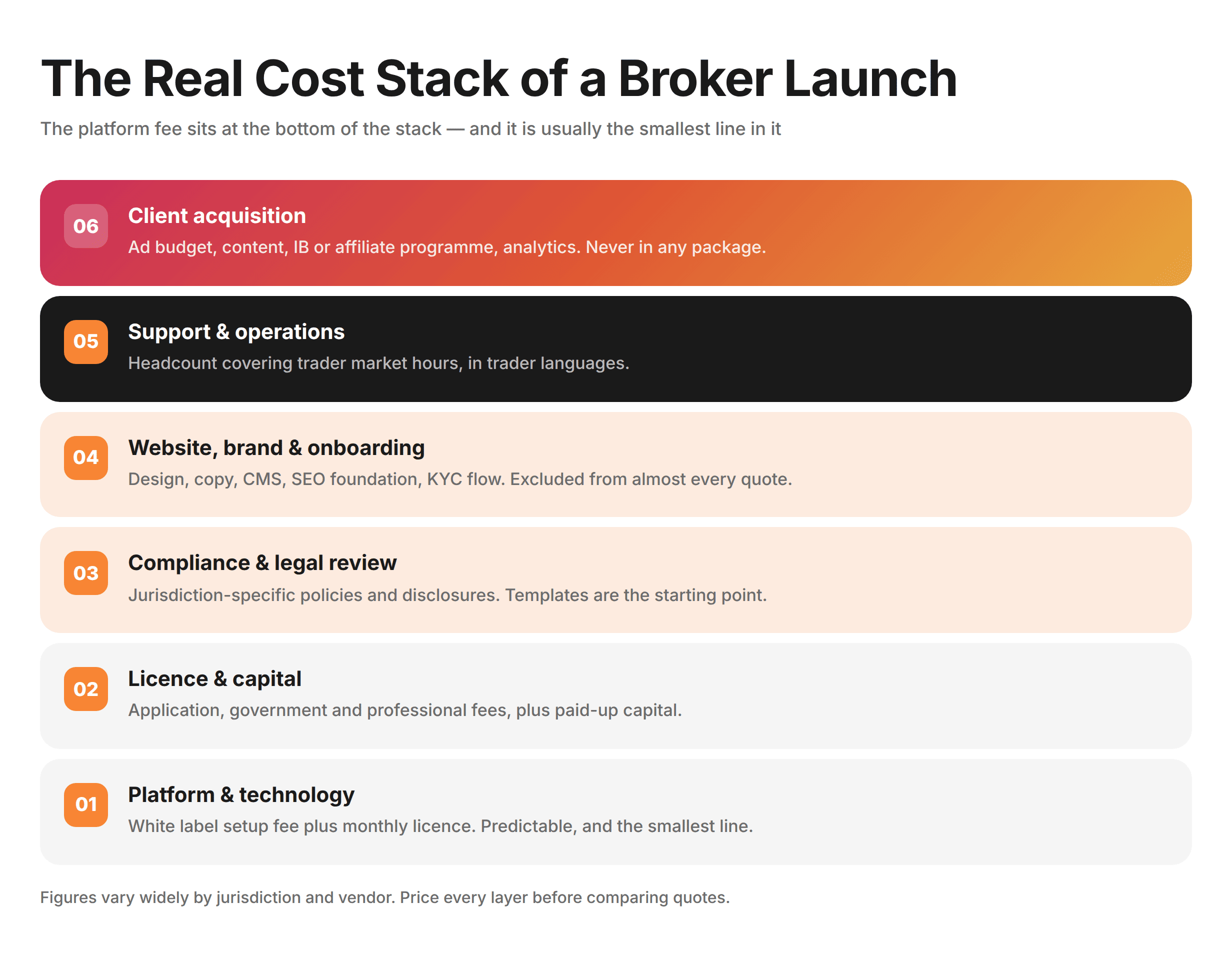
Budget the Front End Before You Sign
The website is the line item most turnkey quotes leave out and the one your acquisition spend depends on.
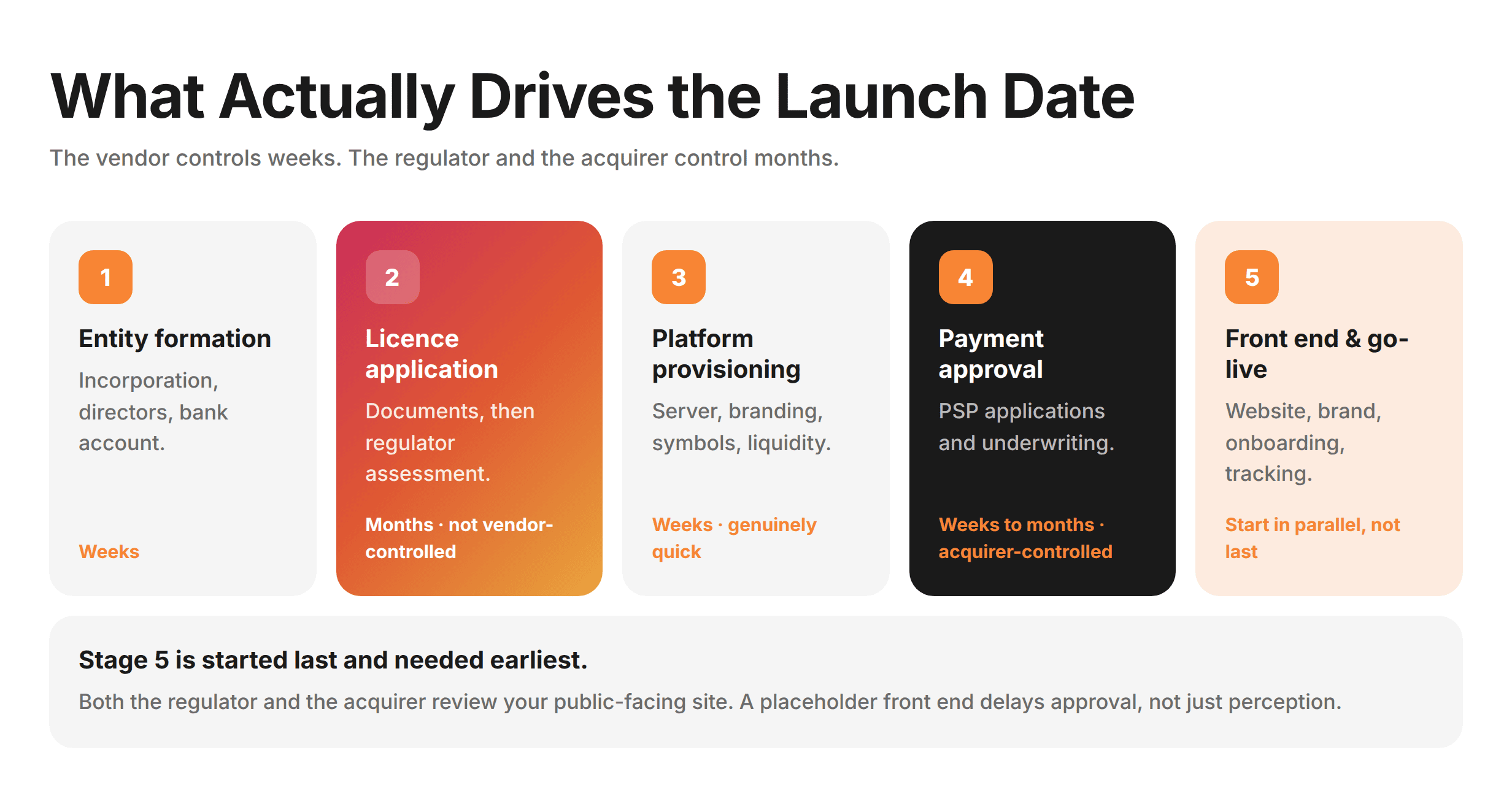
Turnkey Setup Timeline: What Actually Drives the Date
The vendor controls weeks; the regulator controls months. Technology provisioning is fast and predictable. Everything involving a third-party approval is neither, and that is where launch dates slip.
A typical forex brokerage launch runs in five stages:
Entity formation: incorporation, directors, bank account opening. Weeks, and the bank account is often the first surprise.
Licence application: document preparation then regulator assessment. Months, driven entirely by the authority's queue and clarification requests.
Platform provisioning: server setup, branding, symbol configuration, liquidity connection. Weeks, and genuinely quick.
Payment approval: PSP applications and underwriting, often running in parallel with licensing. Weeks to months, and dependent on your licence being in place.
Front end and go-live: website, brand, onboarding flow, content, tracking, then launch.
Stage five is the one most often started last and needed earliest, because stages two and four both involve someone reviewing your public-facing site. Running the front end in parallel with licensing, rather than after it, removes the most avoidable delay in the sequence.
Who Owns What: Website, Client Data and Exit Risk
Ownership questions are cheap to ask before signing and expensive to raise afterwards. Five of them decide whether you can ever change provider:
Domain and DNS: is the domain registered to your company, in an account you control?
Design files and code: do you own the design source and the site build, or licence it for the term of the contract?
CMS access: can your team publish and edit without a support ticket?
Client data: can you export the full client database, including KYC documents and audit trails, on demand and in a usable format?
CRM and trade history: is historical trading data exportable, and in what format?
A white label forex broker arrangement where the provider owns the domain, the site and the client records is not a partnership, it is a dependency. Providers rarely refuse these terms when asked at contract stage. They rarely offer them unprompted either.
The practical safeguard is to keep the client-facing layer independent of the technology contract. A site you own, on a platform your team can edit, with the CMS in your account, means changing platform provider is a technical migration rather than a rebuild.
How WSA Fills the Front-End Gap
WSA builds the layer turnkey providers leave out. We are a fintech-specialist design agency, and a recurring pattern in our work is being called in after the platform is live: execution works, the licence is progressing, and the website is still the vendor's template.
What that work covers is a broker website that converts traders: brand and positioning that separates you from every other broker on the same liquidity feed, a site built on a Framer CMS your team owns and can edit, an onboarding path designed so KYC friction does not cost you funded accounts, and the technical foundation (structured data, page speed, working analytics) that acquisition spend depends on.
The onboarding point is worth dwelling on. Long, unexplained forms cost conversions in every industry that measures it; e-commerce research on checkout abandonment has documented that for years. A broker KYC flow is a longer, more intrusive form than any checkout, aimed at someone about to transfer money to a company they found last week. Designing that flow is not decoration.
Conclusion
A turnkey forex broker setup solves a real problem. It compresses procurement, gives you one contract instead of six, and gets a working trading environment live faster than you could assemble one yourself. What it does not do is deliver a business, and the gap between the two is predictable enough to plan for.
Treat the vendor's proposal as an inventory list rather than a promise. Separate what is delivered from what is facilitated. Price the excluded layers before you compare quotes, and start the client-facing work in parallel with licensing rather than after it. The brokers who launch well are the ones who knew what a turnkey brokerage solution was never going to cover.
If the platform is on its way and the website is still a placeholder, that is the gap we build.
Launch With a Front End That Earns Deposits
WSA designs and builds broker websites, brands and onboarding flows for regulated financial businesses.
FAQ
Does a turnkey forex broker package include the regulatory licence?
No. A turnkey package includes licensing support, which means jurisdiction advice, document preparation and application submission through a partner firm. The licence itself is granted by a regulator, and government fees, paid-up capital and ongoing reporting obligations are separate costs paid by your company. Contract wording matters here: "licence assistance" is accurate, "licence included" is not. Licensing requirements are jurisdiction-specific and this is not legal advice.
How much does a turnkey forex broker package cost?
There is no single figure, because "turnkey" covers different scopes at different vendors. Platform white label arrangements are commonly quoted in the low thousands of dollars per month plus a one-off setup fee. Entry-level offshore licensing is commonly quoted in the tens of thousands all-in, with paid-up capital on top. Website, compliance review, payment setup, support staffing and marketing usually exceed the technology cost combined. Build the stack line by line before comparing quotes.
Is turnkey faster than building a brokerage in-house?
Yes, for the technology layer. A provider with existing platform, liquidity and hosting relationships can provision in weeks where independent assembly takes months of parallel procurement. It is not faster for anything gated by a third party. Licence approval and payment processing approval run on the regulator's and the acquirer's timelines regardless of how you bought your stack.
What is usually excluded from turnkey broker packages?
Six things, consistently: the client-facing website and brand, payment processing approval and merchant accounts, jurisdiction-specific compliance documentation and legal review, client support staffing, marketing and acquisition budget, and the regulatory licence itself along with its fees and capital requirements. Template documents and template websites are sometimes provided, but a template is a starting point rather than a deliverable.
Do I own the website and client data in a turnkey deal?
Not automatically. Ownership depends entirely on contract terms, and defaults often favour the provider. Confirm in writing who holds the domain registration, who owns design files and site code, whether your team has direct CMS access, and whether you can export the full client database including KYC documents and trade history on demand. Keeping the front end on a platform you control makes a future provider change a migration rather than a rebuild.
Launch Your Licensed Brokerage with Confidence
We support brokers and fintechs through licensing, launch planning, and everything a regulated brand needs to go live.