•
•

Vanuatu Forex License: VFSC Requirements, Cost and Website
You have costed a Vanuatu forex license at around USD 45,000 and pencilled in three months. Then the real checklist arrives: a dedicated office in Port Vila, a director living there half the year, an indemnity policy, a resident compliance officer. The deposit turns out to be a bond the regulator holds, not capital you can spend. And nobody has mentioned the website your bank will read before it opens an account.
That gap between the quoted figure and the real one is where most applications stall. This guide covers what the Vanuatu Financial Services Commission requires for a financial dealers licence (FDL), also sold as a Vanuatu securities dealer licence or simply a VFSC license, all the same instrument. What it costs, how long it takes, and what your site has to say at each stage.
This article is for informational purposes only and does not constitute legal advice. Brokers should consult qualified legal and compliance professionals for jurisdiction-specific guidance.
Key Takeaways
A Vanuatu forex license, a financial dealers licence (FDL) and a Vanuatu securities dealer licence are three names for one instrument issued under the Financial Dealers Licensing Act [CAP. 70].
The VT 5,000,000 security deposit (roughly USD 42,000–50,000) is a bond lodged with the regulator. It is not working capital and cannot fund your platform, office or website.
Since October 2022 Vanuatu requires real substance: a dedicated office, a resident director or VFSC-approved resident manager, a resident AML/CFT compliance officer and local staff. Licensees who missed the deadline lost their FDL.
Class choice is driven by instruments, not by tier. Spot FX sits in Class A. A multi-asset CFD book usually needs A, B and C together, and Class D covers digital assets but cannot be held on its own.
Plan 3 to 5 months for the application and longer from a standing start. That window is exactly long enough to build the brokerage site in parallel, which is the only way to launch on approval day.
Vanuatu's weakest point is banking and payment acceptance. Your disclosure quality on site does more work here than it would under a tier-one regulator.
What Is a Vanuatu Forex License?
A Vanuatu forex license is a Financial Dealers Licence issued by the Vanuatu Financial Services Commission under the Financial Dealers Licensing Act [CAP. 70]. It authorises a Vanuatu-registered company to deal in securities and foreign exchange as a business, for its own account or on behalf of clients.
What the licence covers depends on the class you hold. What it always requires is a local company, a lodged deposit and officers the regulator has cleared. The class definitions themselves sit in the consolidated text of the Act, which is the document worth reading before you accept an agent's summary of what you can offer.
Financial Dealers Licence, Securities Dealer Licence or VFSC Licence — Same Thing
These three names describe one instrument. The confusion costs founders real time when they think they are comparing options.
Financial dealers licence (FDL) is the statutory name used in the Act and on VFSC forms. This is what appears on your certificate.
Vanuatu securities dealer licence is industry shorthand, borrowed from how Seychelles and Mauritius label their equivalents.
VFSC license is regulator shorthand, used the way people say "CySEC licence" or "FSA licence".
What this means: if one provider offers you a "securities dealer licence" and another quotes an "FDL", they are quoting the same product. Compare the scope of work, not the label.
What the Licence Lets You Do (and What It Does Not)
An FDL lets you take retail clients globally, set your own leverage, and run bonus structures that tier-one regulators restrict. There is no statutory leverage cap and no deposit-bonus ban.
What it does not do is open doors. It carries no passporting rights into the EU or UK, no client compensation scheme, and no automatic banking access. Vanuatu also does not authorise you to solicit clients in countries that require local licensing, which is why your restricted-jurisdictions list matters from day one.
VFSC Licence Classes: A, B, C and D Explained
The VFSC issues four licence classes, and which one you need depends on the instruments you intend to offer. Classes are not tiers of quality. They are permission sets, and you stack the ones your product range requires.
Class | What it permits | Relevance to a forex broker |
|---|---|---|
Class A | Debenture stocks, loan stock, bonds, certificates of deposit and the proceeds of foreign exchange | Core class for spot FX. Required by almost every broker. |
Class B | Shares in the capital of a corporation, proceeds of precious metals and commodities, warrants, depositary receipts | Needed for equity, metals and commodity CFDs |
Class C | Futures contracts, their derivatives and options | Needed for a derivatives or options book |
Class D | Virtual currencies and digital assets | Add-on only. Cannot be held without A, B or C, and carries a materially higher capital expectation. |
Which Class a Forex Broker Actually Needs
A spot FX broker needs Class A at minimum. That single class covers the proceeds of foreign exchange, which is the instrument most retail brokerages are built around.
If you offer only spot FX and no other asset, Class A is the answer. If your product page lists indices, gold, oil and single-stock CFDs, you are dealing in commodities, metals and shares, which is Class B territory. A derivatives or options book pulls in Class C. Multi-asset brokers commonly apply for A, B and C together in one submission.
Sources disagree on current VFSC practice here, with some reporting that brokers who once held Class C alone must now add A and B. Confirm your class stack with the regulator or your licensing agent before you file, because it changes both your fee total and your application documents.
Class D and Digital Assets
Class D covers virtual currencies and cannot be held as a standalone licence. You need an existing Class A, B or C before the VFSC will consider adding it.
The practical implication: if crypto CFDs are on your roadmap, say so in the original application. Adding Class D later means a second process, second fees and a second round of compliance documentation.
VFSC Requirements for a Vanuatu Forex License
To hold a Vanuatu forex license, a company must lodge a security deposit with the regulator, carry professional indemnity insurance, appoint officers the VFSC clears as fit and proper, and maintain genuine operations inside Vanuatu. In summary:
Security deposit: VT 5,000,000 (about USD 42,000–50,000), lodged and locked
Professional indemnity insurance: VT 5,000,000 per claim, VT 50,000,000 annual aggregate
Executive director: minimum five years of relevant securities or investment experience
Physical office: dedicated, not shared with another business
Resident presence: a director or manager in Vanuatu at least six months a year, or a VFSC-approved resident manager
Resident AML/CFT compliance officer: based in Vanuatu, with an alternate permitted overseas
Security Deposit, Insurance and Fit-and-Proper Rules
The VT 5,000,000 security deposit is lodged with the VFSC or the Registrar of the Supreme Court and stays there for the life of the licence. It is a bond, not a bank balance. You cannot draw on it, and recovering it after a licence is surrendered takes a process of its own.
Why this matters more than it looks: most founders model that VT 5,000,000 as their opening capital, then discover the platform licence, office lease, salaries, audit and website all sit on top of it. Budget the deposit as a sunk cost for the licence term, not as launch funding.
Professional indemnity insurance is mandatory, not advisory. The policy has to cover VT 5,000,000 per claim with a VT 50,000,000 annual aggregate, the deductible cannot exceed VT 500,000, and cover must extend to directors, employees and consultants. Premiums commonly land in five figures annually depending on the size of the book.
Fast fact: the deposit plus a year of indemnity cover and a modest Port Vila office puts you past USD 60,000 before you have written a line of website copy or licensed a trading platform.
On top of that, expect:
Audited annual financial statements prepared to International Accounting Standards
Quarterly and annual compliance reporting to the VFSC
A documented AML/CFT programme, with registration with the Vanuatu Financial Intelligence Unit
Fit-and-proper clearance and personal questionnaires for every director and beneficial owner
Local Presence After the 2022 Tightening: Office, Resident Staff, Records
Since October 2022, the VFSC requires genuine substance in Vanuatu. The Financial Markets Association of Vanuatu is direct about the consequence: licensees who had not complied by the deadline had their FDL withdrawn. This is the biggest change to the jurisdiction in a decade and the reason older cost estimates are wrong.
What substance means in practice:
A rented office in Vanuatu, dedicated to your business and not shared
A domestic business licence for that entity
Registration as a foreign investor and as an employer
At least one management-level person living and working in Vanuatu, or a VFSC-approved resident manager overseeing operations
Local staff on payroll
Corporate records and compliance functions housed at the registered office, not at a mail drop
Brokers who treated this as a box-tick sent one person. Those that cleared review comfortably placed real functions locally: compliance, risk operations, client support.
The takeaway: Vanuatu is no longer a paper jurisdiction, and pricing it like one is how a launch plan slips two quarters. Industry coverage now frames the tightening as a deliberate move upmarket, with Finance Magnates reporting that Vanuatu wants to be taken seriously alongside established regimes.
Launching a VFSC-Licensed Brokerage This Quarter?
Your application window is also your build window. WSA designs brokerage sites that are ready the day your licence lands.
Vanuatu Forex License Cost: Deposit, Fees and Running Costs
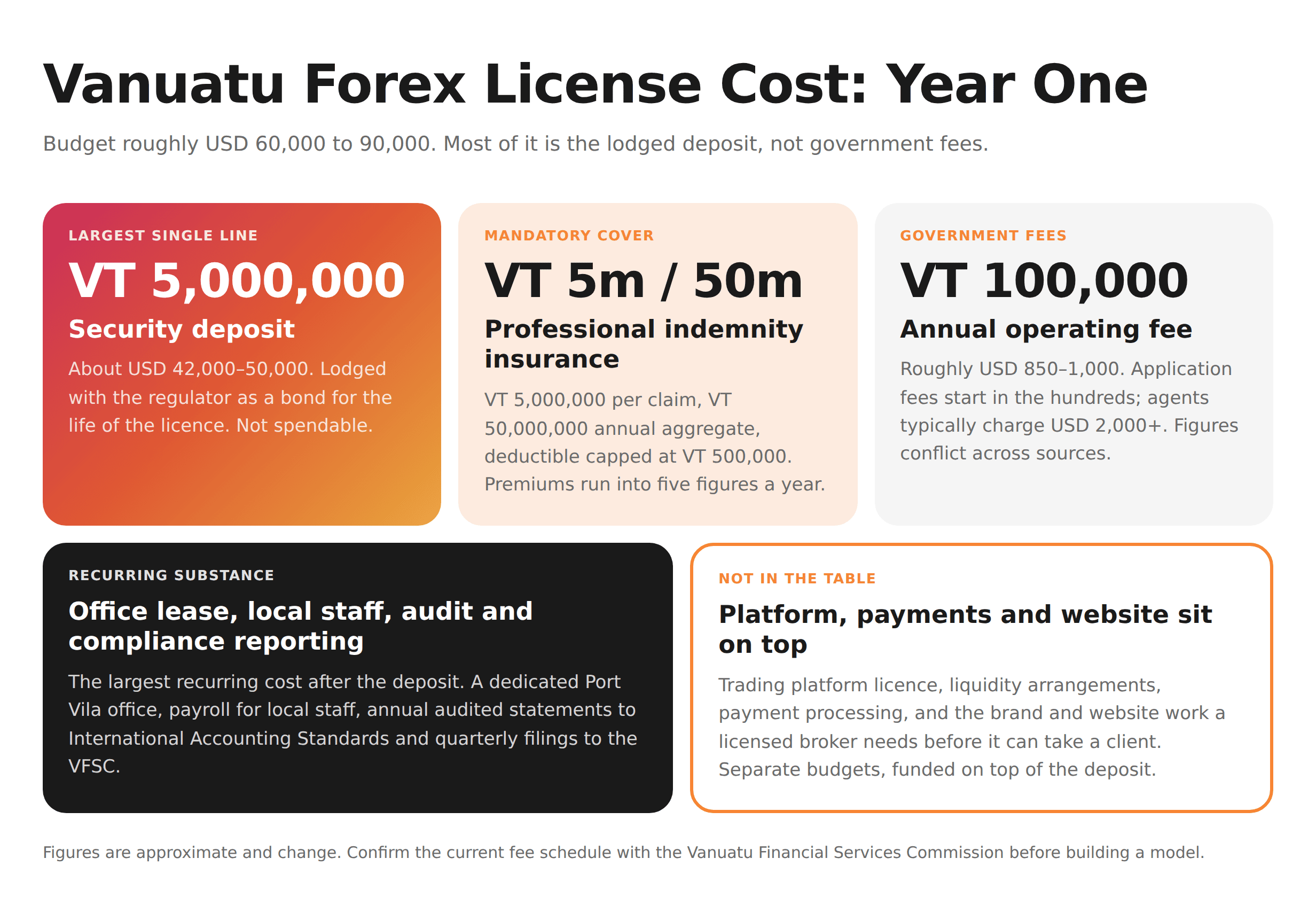
Budget roughly USD 60,000 to 90,000 for year one, and expect most of it to be the lodged deposit rather than government fees. The fees themselves are modest. Substance is what costs money.
Item | Amount | Notes |
|---|---|---|
Security deposit | VT 5,000,000 (~USD 42,000–50,000) | Lodged with the regulator, not spendable |
Application fee | From a few hundred USD; agents typically charge USD 2,000+ | Non-refundable; per class |
Annual operating fee | Around VT 100,000 (~USD 850–1,000) | Figures conflict across sources, see below |
Professional indemnity insurance | Five figures annually | Scales with the size of your book |
Office lease and local staff | Varies | The largest recurring line after the deposit |
Audit and compliance reporting | Varies | Annual audited statements plus quarterly filings |
Company formation and agent fees | Varies by provider | Compare scope, not headline price |
A word on the annual fee. Sources do not agree. Some quote VT 100,000, others a USD 5,000 renewal, and the Financial Markets Association of Vanuatu states the current FDL is permanent with no annual renewal while it remains in lawful use. TradeInformer's breakdown puts annual operating costs at roughly VT 100,000 and notes that providers routinely mark up the regulator's own application fee several times over. Confirm the current schedule with the VFSC before you build a model on any of these numbers.
What the table does not include: your trading platform licence, liquidity arrangements, payment processing, and the website and brand work a licensed broker needs before it can take a client. Those are separate budgets, and they sit on top of the deposit.
How Long VFSC Approval Takes
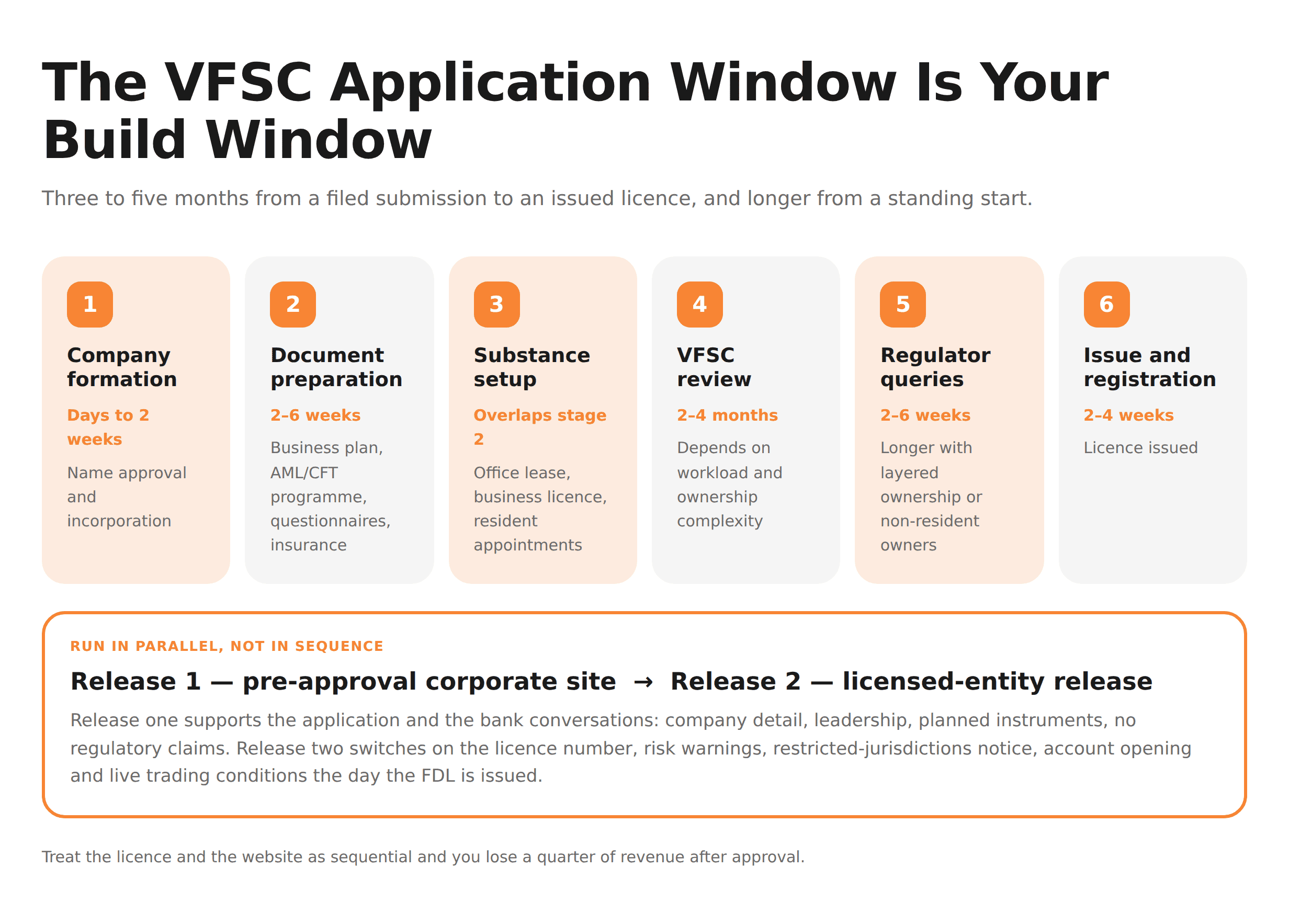
Most applications run three to five months from a filed submission to an issued licence. From a standing start, with company formation, office setup and document preparation in front of it, the full sequence typically takes longer, and practitioners put the realistic end-to-end figure closer to eight months.
The stages, in order:
Company formation and name approval: a few days to two weeks
Document preparation: 2 to 6 weeks for the business plan, AML/CFT programme, personal questionnaires, insurance and office arrangements
Substance setup: office lease, domestic business licence, foreign investor and employer registration, resident appointments, often overlapping stage 2
VFSC review: 2 to 4 months, depending on workload and ownership complexity
Regulator queries: 2 to 6 weeks, longer if your structure has multiple layers or non-resident beneficial owners
Issue and registration: 2 to 4 weeks
Two things move the needle. A clean, single-layer ownership structure shortens stage 5 substantially. An incomplete AML/CFT programme is the most common reason for a second round of queries.
Here's why the timeline matters: a forex license in vanuatu takes about as long to obtain as a full brokerage website takes to design, build, populate and test. Treat those as sequential and you lose a quarter of revenue after approval. Treat them as parallel and you launch the week your certificate arrives.
Your Website During a VFSC Application
Your website is part of what the regulator and your banking partners look at, so it has to exist before approval and say the right things at each stage. Brokers who wait for the certificate arrive at approval day with an empty domain and no way to onboard a client.
The fix is to build the licence and the website in parallel, in two releases. Release one is a corporate site that supports the application and the bank conversations. Release two switches on the licensed-entity disclosures the day the FDL is issued.
What You Can and Cannot Publish Before Approval
Before your licence is issued you cannot describe your company as regulated, licensed or authorised. Claiming regulatory status you do not hold is the fastest way to create a problem with the regulator you are currently applying to.
Safe to publish pre-approval:
Company name, registered address and corporate structure
Leadership team, experience and advisory board
Planned instruments and platform, described as an intended offering
Educational and market content
Contact details and a general enquiry form
Hold until the certificate is in hand:
The words regulated, licensed, authorised or supervised
Your licence number and the VFSC name or logo
Live account-opening and deposit flows
Trading conditions presented as available
Any claim of client fund protection
Post-Approval Disclosures Your Site Must Carry
Once the FDL is issued, the licensed entity's details have to appear where a client or a payment provider can find them without asking. That means the footer and a dedicated regulatory page, not a PDF buried three clicks deep.
Full legal entity name exactly as registered in Vanuatu
Licence number, cross-checkable against the VFSC list of licensed financial dealers
Registered Vanuatu office address
Risk warning on every page that mentions trading, leverage or returns
Restricted-jurisdictions notice naming the countries you do not accept
Complaints procedure with a named contact and response timeframe
Versioned legal pages covering the client agreement, privacy policy, AML policy and order execution policy, each with a visible last-updated date
This is a conversion asset, not just a compliance chore. Nielsen Norman Group's research on communicating trustworthiness found that users look for specific, verifiable company detail rather than reassuring language.
A licence number and a registered address are exactly that. The full list lives in our broker website compliance checklist.
What this means in practice: a hardcoded footer becomes a compliance defect the moment your entity details change. Every disclosure above belongs in a CMS field with a version date, so a compliance officer can update it without a developer.
Your Licence Has Website Obligations. Most Sites Miss Them.
Licence number, risk warnings, restricted jurisdictions and versioned legal pages need designed homes, not a footer retrofit.
Vanuatu vs Seychelles vs Labuan for a Forex Broker
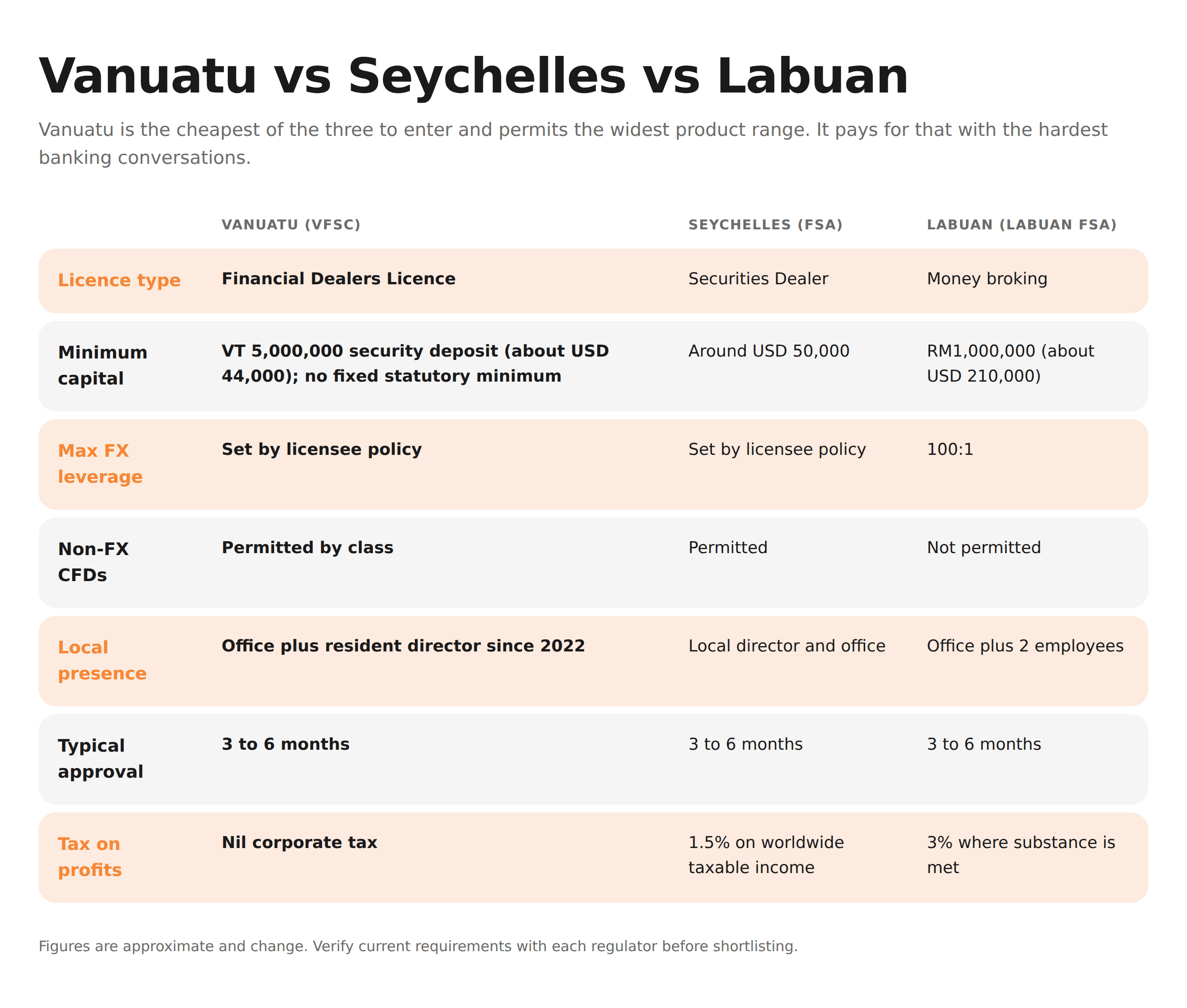
Vanuatu sits between Seychelles and Labuan on cost and between both on substance. It is the cheaper offshore forex licence to enter, it permits the widest product range of the three, and it pays for that with the hardest banking conversations.
Vanuatu (VFSC) | Seychelles (FSA) | Labuan (Labuan FSA) | |
|---|---|---|---|
Licence type | Financial Dealers Licence | Securities Dealer | Money broking |
Minimum capital | No fixed statutory minimum; VT 5,000,000 security deposit (about USD 44,000) | Around USD 50,000 | RM1,000,000 (about USD 210,000) |
Max FX leverage | Set by licensee policy | Set by licensee policy | 100:1 |
Non-FX CFDs | Permitted by class | Permitted | Not permitted |
Local presence | Office plus resident director since 2022 | Local director and office | Office plus 2 employees |
Typical approval | 3 to 6 months | 3 to 6 months | 3 to 6 months |
Tax on profits | Nil corporate tax | 1.5% on worldwide taxable income | 3% where substance is met |
Figures are approximate and change. Verify current requirements with each regulator before shortlisting.
Choose Vanuatu if multi-asset CFDs are central to the offer, you want no statutory leverage cap, and capital is the binding constraint.
Choose the Seychelles securities dealer licence for a similar profile with a slightly better-known regulator. Choose the Labuan money broking licence if Asian market credibility and easier banking are worth USD 160,000 more in capital and a narrower product set.
The honest limitation: banking is Vanuatu's weak point, and practitioners name it as the jurisdiction's single biggest pain point. Payment providers apply more scrutiny to a VFSC entity than to a Labuan or Mauritius one. Your site's disclosure quality, entity transparency and legal documentation carry more weight in those conversations than they would elsewhere, which is a design problem as much as a compliance one.
How WSA Builds Websites for VFSC-Licensed Brokers
WSA builds brokerage sites in two releases timed to the licence, because that is the only sequence that works when a regulator and a bank are both reading your output before you have a certificate.
WSA works only with fintech and brokerage clients, which means broker website compliance is designed in rather than retrofitted. On a Vanuatu project that looks like:
A disclosure layer mapped before the first screen is designed. Licence number, entity name, registered Vanuatu address, risk warnings and the restricted-jurisdictions list each get a defined home and a CMS field, so switching them on at approval is a content change, not a rebuild.
A two-release plan matched to the application window. A pre-approval corporate site that supports bank and regulator conversations, then a licensed-entity release with account opening, MetaTrader 5 integration and live trading conditions.
CMS collections for everything that changes. Instrument specifications, fee schedules, introducing brokers, legal documents with version dates, all editable by a compliance officer without a developer.
Built in Framer, the pre-approval release typically goes live in weeks rather than months, which is what makes the parallel track realistic inside a three to five month licence window.
Conclusion
A Vanuatu forex license is still one of the more accessible routes to a licensed brokerage, but it is no longer a cheap one. The VT 5,000,000 deposit is locked capital, the October 2022 substance rules mean a real office and real people in Port Vila, and banking will test you harder than the regulator does.
The founders who launch cleanly treat the application window as a build window. They arrive at approval with a site that already carries the disclosure architecture, and they switch the licensed-entity release on the same week the certificate lands.
If you are applying for a forex license in vanuatu and your site does not exist yet, that is a design and build problem with a fixed deadline. Talk to WSA about a two-release plan that fits your application timeline.
FAQ
How much is the VFSC security deposit?
The VFSC security deposit is VT 5,000,000, roughly USD 42,000 to 50,000 depending on the exchange rate. It is lodged with the Vanuatu Financial Services Commission or the Registrar of the Supreme Court and held for the life of the licence.
Treat it as a bond rather than capital. You cannot draw on it to fund operations, and it is released only when the licence is cancelled and all obligations are settled. Your platform, office, staff and website budgets sit on top of it.
Which VFSC licence class fits a forex broker?
Class A fits a spot FX broker, because it covers the proceeds of foreign exchange alongside debt instruments. Most retail brokerages need it.
If your product range extends to shares, indices, metals or commodity CFDs you also need Class B, and a futures or options book brings in Class C. Multi-asset brokers commonly file for A, B and C together. Class D covers digital assets and cannot be held without one of the other classes. Sources differ on current VFSC practice, so confirm your class stack with the regulator before filing.
Does Vanuatu require a physical office?
Yes. Since October 2022 the VFSC requires a dedicated physical office in Vanuatu that is not shared with another business, along with a domestic business licence for the entity.
The office requirement comes with the rest of the substance package: registration as a foreign investor and as an employer, at least one management-level person living and working in Vanuatu or a VFSC-approved resident manager, local staff on payroll, and corporate records held at the registered office. Licensees who had not complied by the October 2022 deadline had their financial dealers licence withdrawn.
How long does VFSC approval take?
Most VFSC applications take three to five months from filing to an issued licence. The regulator's own review typically runs two to four months, with document preparation in front of it and two to six weeks of queries after.
From a standing start the whole sequence takes longer, because company formation, the office lease, the business licence and the resident appointments all have to be in place first. Practitioners put the realistic end-to-end figure closer to eight months. A single-layer ownership structure and a complete AML/CFT programme are the two things that shorten it most.
Is professional indemnity insurance mandatory in Vanuatu?
Yes, professional indemnity insurance is mandatory for a Vanuatu financial dealers licence, not optional.
The policy must provide cover of VT 5,000,000 per claim with a VT 50,000,000 annual aggregate, and the deductible cannot exceed VT 500,000. Cover has to extend to directors, employees and consultants. Premiums commonly run into five figures annually and scale with the size of your book, so get a quote before you finalise your cost model rather than after.
What must a VFSC-licensed broker show on its website?
A VFSC-licensed broker must publish its full legal entity name as registered in Vanuatu, its licence number, and its registered Vanuatu office address where clients can find them without asking.
Alongside those: a risk warning on every page that mentions trading, leverage or returns; a restricted-jurisdictions notice naming the countries you do not accept; a complaints procedure with a named contact and a response timeframe; and versioned legal documents including the client agreement, privacy policy, AML policy and order execution policy, each carrying a visible last-updated date.
The licence number should be cross-checkable against the VFSC list of licensed financial dealers. Before approval, none of this may describe the company as regulated, licensed or authorised.
Launch Your Licensed Brokerage with Confidence
We support brokers and fintechs through licensing, launch planning, and everything a regulated brand needs to go live.