•
•

Webflow vs WordPress for Web3 Companies in 2026: Which Platform Should You Choose?
You're building a Web3 project — a token launch, a DAO landing page, a DeFi protocol marketing site — and you need a website that looks credible, loads fast, and doesn't require a full dev team to maintain. Two platforms come up in almost every conversation: Webflow and WordPress.
Both can build the site. The question is which one is the right fit for what Web3 companies actually need in 2026: speed to market, clean design, minimal maintenance overhead, and a foundation that won't collapse the moment you need to embed a wallet connector or update your tokenomics page at 11pm before a launch.
This guide breaks down the Webflow vs WordPress decision across 10 criteria that matter specifically to Web3 founders and their teams — not generic website builders comparing pricing tiers. If you are still deciding whether Webflow fits at all, start with the complete guide to Webflow development.
Key Takeaways
Webflow delivers faster launch timelines for Web3 marketing sites — no plugin stack to configure, no hosting to set up separately
WordPress has a larger Web3 plugin ecosystem, but 91% of WordPress security vulnerabilities originate in plugins — a real risk for crypto projects that attract bad actors
Webflow's managed hosting achieves a 58% Core Web Vitals pass rate; WordPress reaches 51% when optimised, but requires significant configuration to get there
For token launch sites, DAO pages, and DeFi marketing sites, Webflow is the stronger choice — better design flexibility, lower maintenance burden, faster deployment
WordPress wins for content-heavy crypto communities, forum-driven ecosystems, and projects that need deep custom plugin infrastructure
The decision isn't about which platform is "better" — it's about which one fits your project type, your team's capabilities, and your go-live timeline
Why the Webflow vs WordPress Decision Matters for Web3 in 2026
The stakes are higher for Web3 websites than for most other industries — as covered in WSA's guide to fintech web design trends in 2026.
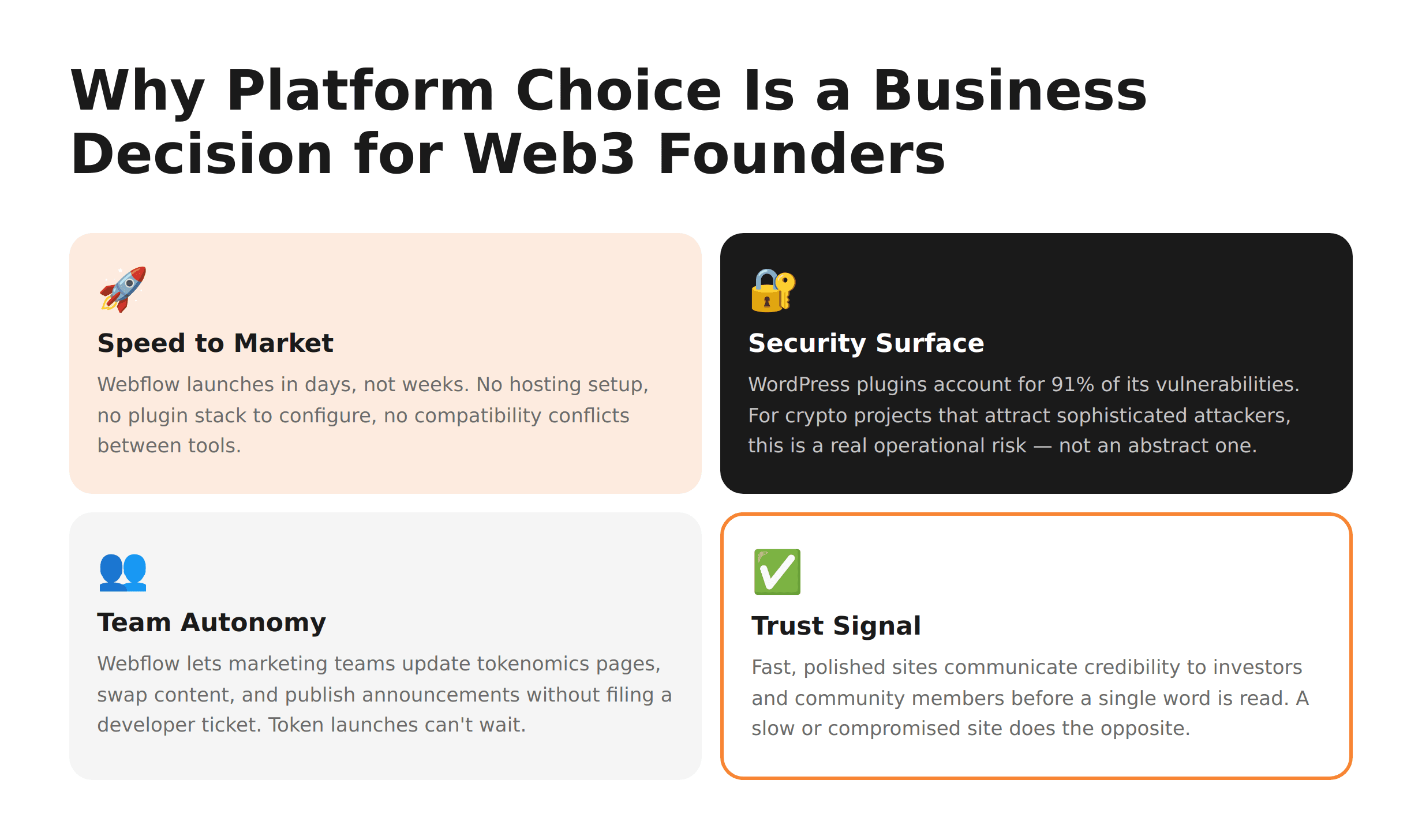
A crypto founder's website is a trust document before it's a marketing tool. Investors, community members, and potential users form their first impression of your project within seconds of landing on the page. A slow site, a hacked site, or a site that looks like it was built on a template from 2019 doesn't just underperform — it signals credibility risk.
Security matters more in crypto than almost anywhere else. Web3 projects attract sophisticated attackers. A compromised WordPress site running outdated plugins is a real attack surface — not an abstract risk. In 2025, the Patchstack State of WordPress Security research identified 11,334 new vulnerabilities in the WordPress ecosystem, with 91% originating from plugins rather than WordPress core. That figure is relevant for any Web3 team running a plugin-heavy setup.
Launch timing is also a real constraint. Token launches, IDO campaigns, and DAO governance announcements don't wait for a developer to be available. Your marketing team needs to be able to update pages, swap content, and publish new sections without filing a ticket.
This is the context in which the Webflow vs WordPress comparison plays out for Web3 companies in 2026 — and it changes the calculus compared to a general-purpose agency blog.
Webflow vs WordPress: Full Platform Comparison for Web3
The table below compares both platforms across 10 criteria that directly affect Web3 marketing sites, token projects, and DeFi protocol pages.
Criterion | Webflow | WordPress |
|---|---|---|
Speed & Core Web Vitals | 58% pass rate out of the box — managed hosting on AWS CloudFront with 275+ edge locations | 51% pass rate when optimised — requires caching plugins (WP Rocket, Cloudflare), managed hosting (WP Engine, Kinsta), and performance tuning |
Security & Maintenance | Automatic updates, managed SSL, no plugin vulnerabilities — zero-maintenance security model | 11,334 new vulnerabilities in 2025 (91% from plugins) — security depends entirely on your update discipline |
SEO & AI Discoverability | Native SEO controls, clean semantic code, Webflow AI Optimize for meta automation (launched Jan 2026); schema requires custom code | Plugin-dependent (Yoast, RankMath) — more granular control over complex schema; better for content-heavy structured data |
CMS Flexibility | Visual CMS, scales to 1 million items per project (Jan 2026 update); excellent for marketing pages and landing page variations | Highly flexible with custom post types, taxonomies, and editorial workflows — better for high-volume editorial content |
Developer Dependency | Marketers and designers can build and update without developers; custom code available when needed | Requires developer for theme customisation, plugin integration, and backend work; Gutenberg helps but has limits |
Web3 Plugin Ecosystem | No native Web3 plugins — wallet connectors (MetaMask, WalletConnect), price feeds, and minting flows require custom JavaScript or third-party embeds | Larger plugin library for Web3 functionality; plugins available for wallet connect, NFT display, token gating |
NFT / Token-Gating Support | Possible via custom code and third-party services (e.g., Unlock Protocol, Mintgate) — requires a developer; not a native feature | Multiple plugins available (e.g., MemberPress + token-gating layers); more options but more plugin complexity |
Webflow Designer vs Gutenberg | Full visual design freedom, pixel-level control, animations and interactions built in — designed for design-led teams | Gutenberg block editor works well for content; design control is limited without a premium page builder (Elementor, Divi) which adds performance overhead |
Pricing & Total Cost of Ownership | Predictable all-in pricing — hosting, SSL, CDN, updates included; no hidden plugin spend | Free licence but real operating cost includes hosting, premium plugins, security tools, and developer time — adds up quickly |
Hosting & Infrastructure Control | Managed SaaS — no server access; Webflow controls the infrastructure | Full control over hosting environment — self-host on any server, migrate freely; useful for projects needing data sovereignty |
Not sure which platform fits your Web3 project?
WSA helps crypto, DeFi, and Web3 teams build on the right platform from day one — without the guesswork.
Speed & Core Web Vitals
Page speed is not optional for Web3 sites. A slow token launch page costs conversions at the exact moment when community trust is being built.
Webflow runs on AWS CloudFront with 275+ global edge locations. Every site gets managed CDN, automatic SSL, and clean code output by default — no configuration required. Independent benchmarks in 2026 show Webflow sites achieving a 58% Core Web Vitals pass rate without any additional optimisation.
WordPress can reach comparable performance — but only with the right stack: managed hosting (WP Engine, Kinsta, or equivalent), a caching layer (WP Rocket), and careful plugin management to avoid JavaScript bloat from page builders. Optimised WordPress now achieves a 51% Core Web Vitals pass rate, up from 42% in 2025 following the WordPress 6.9 release which reduced CSS payloads by approximately 45%.
The Key Difference
Webflow's performance is a baseline. WordPress's performance is a ceiling you have to build toward.
Security & Maintenance
This is where the decision becomes particularly important for Web3 projects.
Web3 companies operate in a high-value, high-attention environment. Crypto sites are actively targeted by attackers looking to compromise user-facing pages, inject malicious scripts, or conduct phishing operations. A vulnerable website is a real business risk — not a hypothetical one.
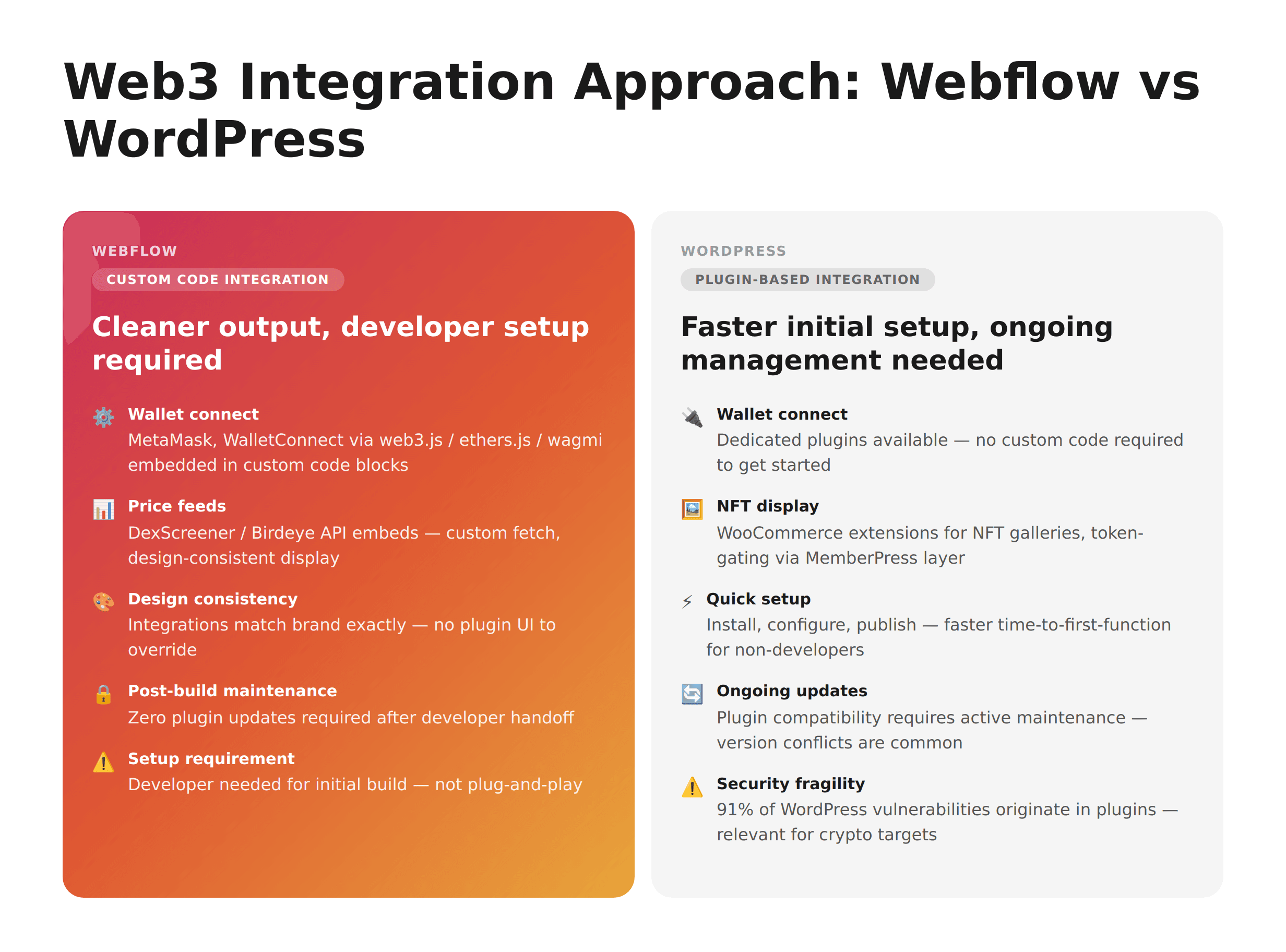
Webflow's security model is managed and automatic. The platform handles SSL, updates, and infrastructure — there is no plugin surface for attackers to use.
WordPress's security model is conditional. The platform itself is well-maintained: WordPress core had only 6 vulnerabilities in 2025. The risk comes from plugins. With 11,334 new vulnerabilities identified in the WordPress ecosystem in 2025 — a 68% increase from the year prior — any WordPress site running multiple plugins requires ongoing maintenance discipline: regular updates, security scanning, and hosting-level protection.
For a Web3 team that doesn't have a dedicated DevOps resource, that maintenance burden is a genuine risk.
SEO & AI Discoverability
Both platforms can rank. The difference is in how much configuration is required and what trade-offs you accept.
Webflow has native SEO controls on every page: meta titles, descriptions, canonical URLs, Open Graph tags, sitemaps. The January 2026 AI Optimize tool adds automated meta generation and hreflang support. Clean semantic HTML output gives it a strong technical baseline. The remaining gap: complex schema markup (Article, FAQ, HowTo structured data) requires custom JSON-LD code or App Marketplace integrations — it's not a native point-and-click workflow.
WordPress remains the benchmark for content-heavy SEO. Plugins like Yoast and RankMath give full schema control, deep on-page analysis, and automated structured data without custom code. For Web3 projects that plan to run an editorial blog alongside their marketing site — research content, protocol updates, community posts — WordPress's SEO depth is a genuine advantage.
WSA's Take
For a standard Web3 marketing site, Webflow's SEO baseline is sufficient. For a content-heavy operation publishing 20+ pieces a month, WordPress's SEO tooling justifies the trade-offs.
Web3 Plugin Ecosystem & Integration
This is the criterion where WordPress holds its clearest advantage — and where Web3 founders sometimes overestimate what they actually need.
WordPress has a larger native plugin library for Web3 functionality. Wallet connection, NFT display grids, token-gating plugins, and DeFi data embeds are available without custom code. Teams comfortable with plugin management can assemble a functional Web3 marketing site from existing tools.
Webflow requires custom JavaScript for most Web3 functionality. Wallet connectors (MetaMask, WalletConnect), live token price feeds from DexScreener or Birdeye, and minting flows all need to be built with libraries like web3.js or ethers.js and embedded via Webflow's custom code blocks. This requires a developer — but once built, these integrations are typically cleaner, faster, and more design-consistent than plugin-based alternatives.
The Honest Framing
Most Web3 marketing sites don't actually need deep on-chain functionality in the CMS. They need a fast, polished informational site — tokenomics, roadmap, team, whitepaper link, social links, and a wallet-connect button at most. Webflow handles that use case extremely well. The need for a heavy plugin ecosystem typically signals a more complex application layer — which is usually handled by a separate dApp, not the marketing site itself.
When Webflow Wins for Web3 Projects
Webflow is the stronger choice for the majority of Web3 marketing sites. Here is why, and for which specific project types.
Token Launch Sites & Whitepaper Pages
A token launch site has one job: build credibility and drive community sign-ups before and during the launch window. Speed, visual quality, and update frequency are all critical.
Webflow allows a design-first approach — the site can match the visual language of the token brand precisely, with no template constraints. Animations, scroll interactions, and landing page variants can be built and tested without developer involvement at the update stage. When tokenomics change or a new exchange listing needs to be announced at midnight, a marketing team member can update the page in minutes.
DAO Landing Pages
DAO governance sites typically need to communicate complex structures simply: voting mechanisms, treasury data, proposal history, community links. The emphasis is on clarity and trust — not plugin functionality.
Webflow's CMS handles repeatable content structures well. Proposal pages, team bios, and governance updates can be managed entirely by non-technical team members. The performance baseline also matters: community members checking governance updates on mobile need fast load times, not a plugin-bloated WordPress install.
DeFi Protocol Marketing Sites
DeFi protocol sites face a particular credibility challenge. They're asking users to trust a smart contract with real money — the website has to communicate technical competence and security from the first impression.
Clean, fast, professionally designed Webflow sites achieve this better than most WordPress builds in practice. The absence of a plugin layer also reduces the attack surface — relevant for protocols where front-end compromises are a known attack vector.
Building a DeFi or Web3 marketing site on Webflow?
WSA specialises in design and development for fintech and Web3 brands — fast builds, credibility-first design.
When WordPress Wins for Web3 Projects
WordPress is the better choice in specific scenarios where its depth justifies the additional maintenance investment.
Content-Heavy Crypto Communities & News Sites
For crypto media, research publications, and community blogs publishing at high volume — 10 to 50+ posts per week — WordPress's editorial infrastructure is significantly stronger. Multi-author workflows, editorial calendars, content categories, author profiles, and content scheduling are all native WordPress capabilities.
Webflow's CMS is excellent for marketing pages and structured content, but it wasn't built for newsroom-scale publishing operations.
Forum-Driven Ecosystems & Community Platforms
If the Web3 project's website needs to host an active community forum, a membership portal, or user-generated content, WordPress is the practical choice. bbPress, BuddyPress, and MemberPress have years of development behind them. Webflow has no equivalent native community infrastructure.
Projects Needing Extensive Custom Backend Functionality
If the website needs to function as more than a marketing site — user dashboards, portfolio tracking, staking calculators pulling live data, custom registration flows — WordPress's plugin ecosystem and support for custom PHP development gives it more flexibility.
That said, for most of these cases the better architecture separates the marketing site (Webflow or another managed platform) from the application layer (a purpose-built dApp or portal). Building complex application functionality into WordPress increases technical debt without necessarily producing a better user experience.
WSA's Recommendation for Web3 Founders
WSA builds on Webflow for the majority of Web3 and fintech marketing sites — and the decision is deliberate, not a platform preference.
The projects that come through WSA's workflow share common characteristics: tight launch timelines, founders who want to own their marketing updates without a developer ticket queue, and a design brief that requires credibility and precision rather than template customisation.
Webflow delivers all three. A well-built Webflow site for a Web3 project can be designed, developed, and live in three to five weeks. The client team can update pages, swap tokenomics data, publish announcements, and manage CMS-driven sections without any developer involvement after handoff. The site won't be compromised because someone forgot to update a plugin.
Where WSA recommends WordPress instead: When a client has an existing high-volume editorial operation, needs a community portal, or is building something closer to a content platform than a marketing site, WordPress is the more appropriate tool. The key is scoping the site's actual function before choosing the platform — not defaulting to either option because it's familiar.
The Bottom Line for Web3 Founders
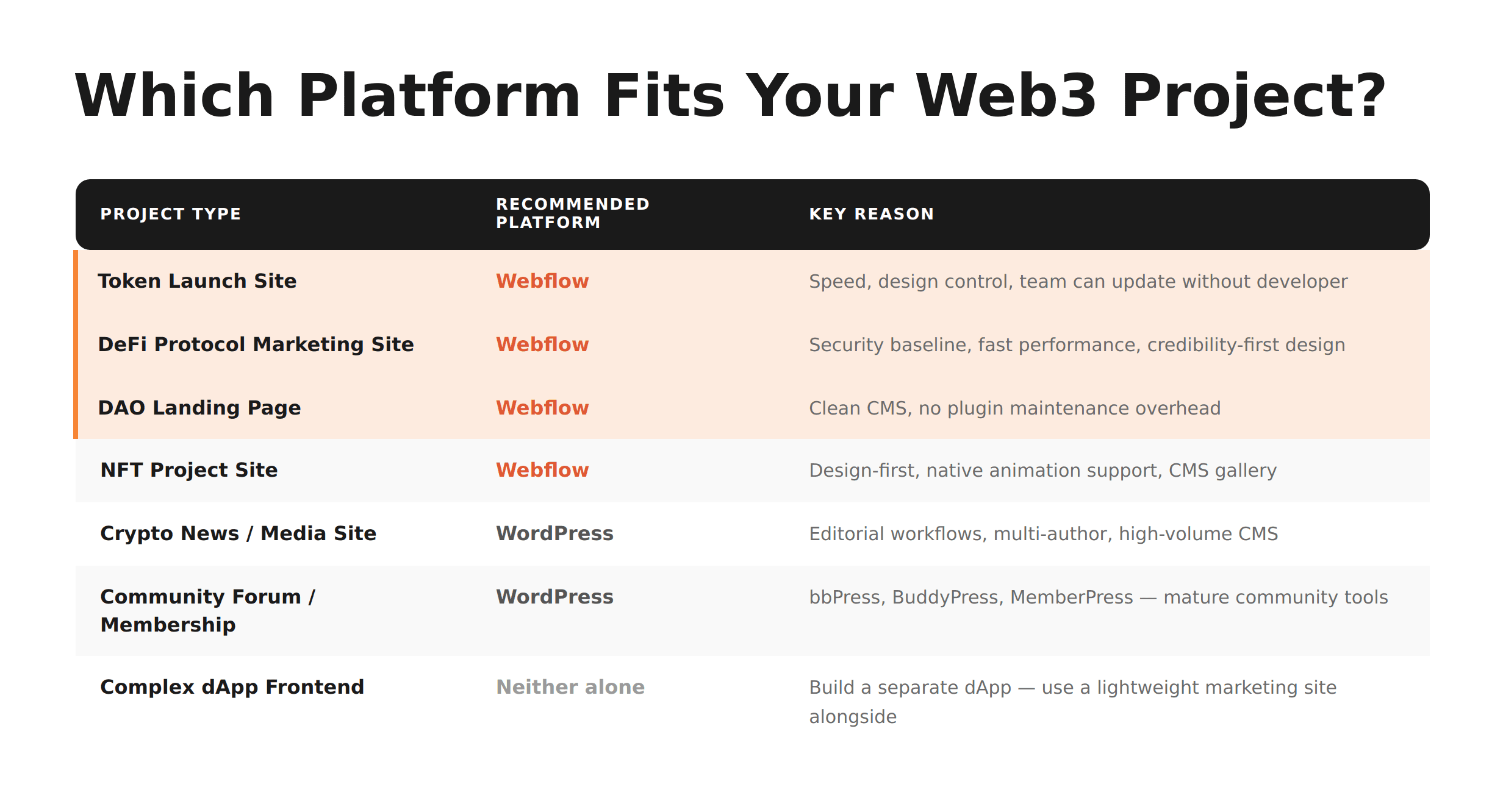
If you're building a token launch site, a DeFi protocol page, or a DAO landing page — and your team needs to move fast and maintain the site without developer dependency — Webflow is the right platform. If you're building a content community, a crypto media operation, or a forum-driven ecosystem, WordPress gives you the infrastructure you actually need.
Not sure which category your project falls into? That's a five-minute conversation — and getting it right before you start saves weeks of rework after.
Not sure which platform fits your Web3 project?
WSA helps Web3 teams choose and build the right website — fast, credible, and built to convert.
Conclusion
The Webflow vs WordPress decision for Web3 companies in 2026 comes down to one question: what kind of site are you actually building?
For the majority of Web3 projects — token launches, DeFi protocol pages, DAO landing pages, NFT project sites — Webflow is the stronger platform. It's faster to launch, easier for non-technical teams to maintain, more secure by default, and better suited to the design-first credibility requirements of the space.
WordPress wins where content volume, community infrastructure, and custom backend functionality are genuine requirements — not as a default.
The platform you choose at the start of a project shapes the team's ability to move fast for months afterward. Getting that decision right before you start building — rather than migrating after launch — is one of the highest-use calls a Web3 founder makes.
If you're weighing the decision for your project, WSA can help you scope it in a single conversation. We build on Webflow for most Web3 and fintech projects — and we'll tell you directly if WordPress or another platform is a better fit for what you're trying to do.
FAQ
Can Webflow connect to a crypto wallet like MetaMask?
Yes, but not natively. Webflow does not have built-in wallet connect functionality. You can integrate MetaMask, WalletConnect, and similar wallet providers by embedding custom JavaScript using libraries like web3.js, ethers.js, or wagmi in Webflow's custom code blocks. This requires a developer to build the initial integration, but once set up it functions cleanly within the Webflow site. Third-party services like Unlock Protocol can also handle token-gated content on Webflow without requiring fully custom code.
Is WordPress secure enough for a crypto website?
WordPress core is well-maintained and relatively secure. The security risk in WordPress comes from plugins — 91% of WordPress vulnerabilities in 2025 originated in plugins, not WordPress core. For a crypto website, which attracts more sophisticated attackers than most industries, a plugin-heavy WordPress setup with inconsistent update habits represents a genuine risk. A lean WordPress install on managed hosting with minimal plugins and a strict update policy can be reasonably secure. Webflow's fully managed security model removes this maintenance requirement entirely.
Does Webflow support NFT display and minting?
Webflow can display NFT galleries using CMS-driven image grids or custom code embeds pulling from NFT APIs (OpenSea, Alchemy). Native minting functionality — connecting to a smart contract and executing a mint transaction — requires custom JavaScript. This is a developer task, but it can be built into a Webflow site cleanly. For simpler use cases like showcasing a collection or linking to an external minting platform, no custom code is required.
Which platform is better for SEO on a DeFi or token project site?
For a standard DeFi marketing site — homepage, product pages, team, tokenomics, whitepaper — Webflow's native SEO controls are sufficient and require no additional configuration. For a project running a high-volume editorial blog alongside the marketing site, WordPress's SEO plugin ecosystem (Yoast, RankMath) offers deeper control over schema markup and structured data. The correct answer depends on the volume and complexity of your content operation, not the platform's theoretical SEO ceiling.
How long does it take to build a Web3 marketing site on Webflow vs WordPress?
A typical Web3 marketing site built on Webflow takes three to five weeks with a specialist agency: one week for strategy and design direction, two to three weeks for build and CMS setup, one week for QA and content population. An equivalent WordPress build typically takes four to eight weeks due to the additional steps of hosting setup, theme selection, plugin configuration, and the compatibility testing those layers require. For token launches and IDO campaigns with fixed go-live dates, Webflow's faster timeline is often a deciding factor.
Launch Your Licensed Brokerage with Confidence
We support brokers and fintechs through licensing, launch planning, and everything a regulated brand needs to go live.