•
•

Buying a Ready-Made Forex Licence: What You Actually Get
A founder finds a listing: Seychelles securities dealer, licensed since 2019, "ready to trade", price agreed in a week. Four months later the deal still hasn't closed. The regulator wants source-of-funds evidence for every new shareholder, the bank account is frozen pending KYC on the new directors, and the domain on the regulator's register expired last year.
This is what a forex broker license for sale looks like after the listing. You are not buying a certificate. You are buying a company, its history, its obligations and its approval conditions, and the regulator decides whether you may own it.
A ready-made licence can shorten your route to market. It can also cost more than a fresh application and bring problems you never created. This guide covers what the asset really is, how transfer of ownership works, what it costs, and the due diligence to run before you sign anything. It is a buyer's map, not legal advice: confirm the rules for your target jurisdiction with a licensed adviser.
This article is for informational purposes only and does not constitute legal advice. Brokers should consult qualified legal and compliance professionals for jurisdiction-specific guidance.
Key Takeaways
You never buy a licence on its own. You buy shares in the company that holds it, and the permission stays with that entity.
The regulator must approve you as the new controller before closing. Under MiFID II that assessment runs up to 60 working days after a complete filing, plus possible interruptions.
Buying is not automatically faster. For the new owner, approval scrutiny often mirrors a fresh application.
You inherit liabilities: complaints, unpaid fees, licence conditions, bank relationships and past marketing.
The entity's website, domains and promotion history are part of the asset. Check them as carefully as the accounts.
After closing, disclosures, legal pages and the website must be rebuilt around the new owners and business model.
What a Forex Broker License for Sale Actually Is
A licensed forex entity offered for sale is a company that already holds a regulatory authorisation, sold through a share purchase. The licence itself cannot be sold, assigned or moved to another company. It belongs to the legal entity that the regulator approved.
That changes how you should read every listing.
You Buy the Company, Not the Licence
Can you buy an existing forex licence? Yes, but only by buying the company that holds it. The regulator must then approve you as the new controller before the shares change hands. If you skip that approval, the licence can be suspended or withdrawn, and in some jurisdictions the buyer commits an offence.
What you actually acquire:
The legal entity, its registration and its licence conditions
Its directors, compliance officer and any local staff (or the obligation to replace them)
Its bank, PSP and liquidity provider contracts, if any survive the change
Its records, filings, audits, complaints and regulatory correspondence
Its brand, domains, website and marketing archive
Unlike an MT5 white label, which only gives you platform access under someone else's technology, an acquired entity gives you your own authorisation. It also gives you your own liability.
Dormant Shell vs Operating Broker
Most ready-made listings fall into two groups, and they need very different diligence.
Type | What you get | Main risk |
|---|---|---|
Dormant shell | Licence, entity, minimal history, no clients | Licence conditions, missed filings, capital gaps |
Operating broker | Licence plus clients, platform, staff, revenue | Client complaints, disputes, legacy marketing |
A dormant shell is cheaper and simpler to audit. An operating broker brings revenue, but also every promise the old owner made to clients and to the regulator.
How Transfer of Ownership Works in a Licensed Forex Entity
Transfer of ownership in a licensed forex entity happens in two stages: the regulator approves the buyer, then the shares change hands. The share purchase agreement is usually signed first, with regulator approval set as a condition precedent to closing.
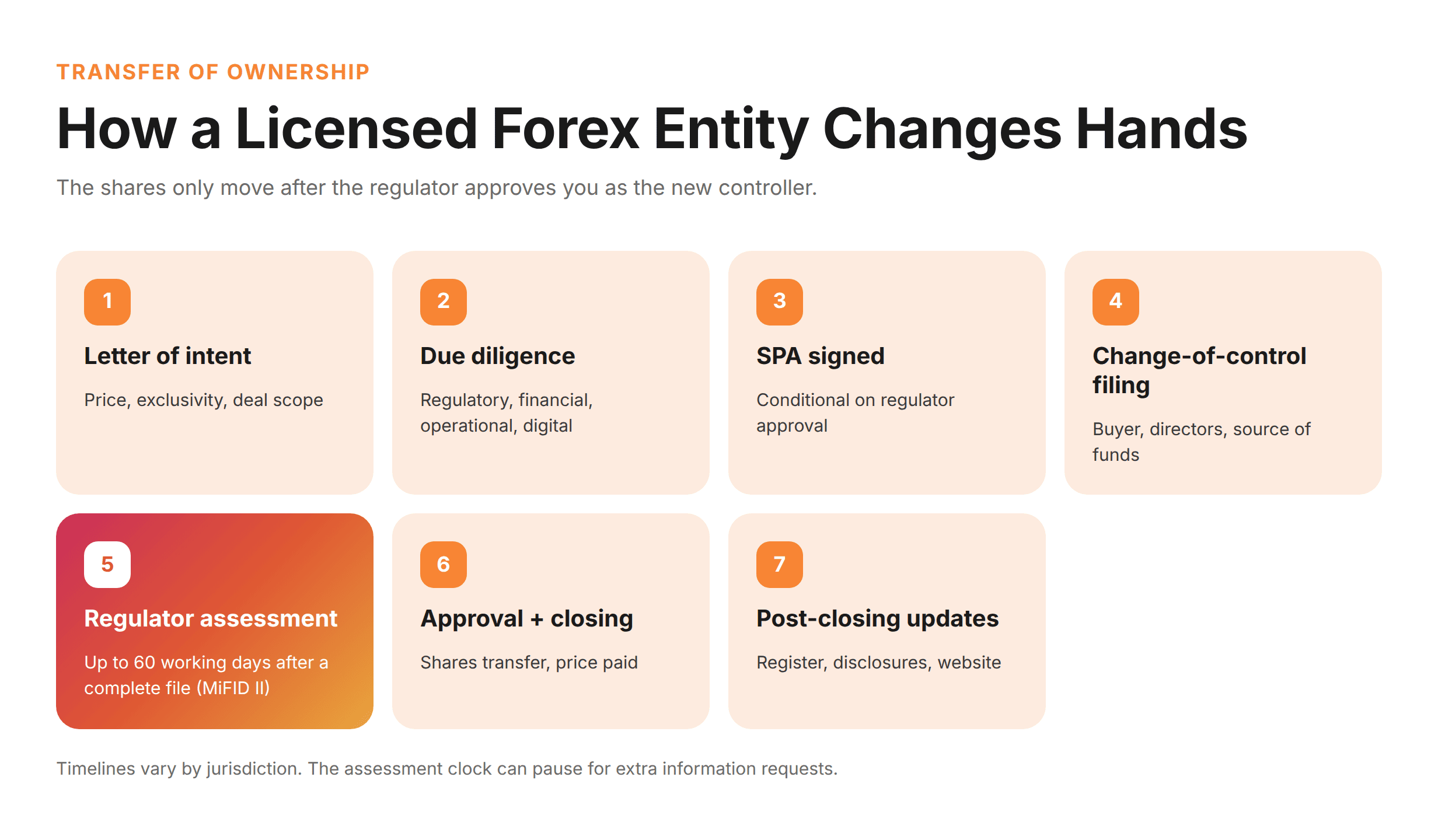
A typical sequence looks like this:
Letter of intent and exclusivity
Buyer due diligence (regulatory, financial, operational, digital)
Share purchase agreement signed, conditional on approval
Change-of-control filing with the regulator
Regulator assessment and questions
Approval, then closing and payment
Post-closing notifications and public disclosure updates
Regulator Approval Comes Before Closing
In the EU, anyone acquiring a qualifying holding (generally 10% or more of capital or voting rights) must notify the regulator first. MiFID II gives the authority up to 60 working days from acknowledgement to assess, and it can pause that clock for up to 20 working days to request information, or 30 working days for acquirers outside the EU.
The UK is stricter on consequences. The FCA states that you must obtain approval before the change in control takes place, and that acquiring control without it is a criminal offence.
Here's where most timelines break. The 60 days only start once the file is complete. Missing source-of-wealth documents or unclear ownership charts push the start date back by weeks.
What the Regulator Assesses in a New Owner
MiFID II Article 13 sets five criteria that EU regulators apply to a proposed acquirer:
Your reputation as the acquirer
The reputation and experience of the people who will run the firm
Your financial soundness
Whether the firm can keep meeting prudential requirements under your ownership
Whether the deal raises money laundering or terrorist financing risk
Offshore regulators such as the FSA Seychelles and FSC Mauritius apply similar fit-and-proper logic, often with less formal timelines.
What this means in practice: you are applying to be the owner, even if you are not applying for the licence.
Know What a Licence-Ready Broker Website Must Include
From startup brokerages to established platforms, WSA delivers websites that convert traders, satisfy regulators, and scale across markets.
Buying vs Applying: Cost, Timeline and Control Compared
The key difference between buying and applying is where you spend your time: on building a new application file, or on proving you are a fit owner of someone else's company. Neither route skips scrutiny.
Reported acquisition prices vary widely. In a 2023 industry review, Finance Magnates cited ready-made CySEC entities at roughly €400,000–€600,000, Mauritius at €250,000–€350,000 and South Africa at $120,000–$200,000, often two to three times the cost of applying. Treat these as indicative ranges, not quotes.
Factor | Buy a licensed entity | Apply for a new licence |
|---|---|---|
Upfront cost | Purchase price plus legal and diligence fees | Application fees, capital, setup costs |
Timeline | Change-of-control review, often 2–6 months | Full application, often 6–12+ months |
Business model fit | Fixed by existing licence scope | Designed around your model |
History | Inherited | Clean |
Main risk | Hidden liabilities | Rejection or long delay |
Decision trigger: if the existing licence matches your model exactly and diligence comes back clean, buying can save months. If you need a different licence scope, you will likely file a variation anyway, and the time advantage shrinks.
If you are still comparing routes, the full process of applying for a forex brokerage licence is covered separately. You can also compare jurisdictions by capital and timeline before choosing a forex license for sale in a specific country.
Risks of Buying a Licensed Entity
The main risk of buying a licensed entity is that you inherit its history. The regulator does not reset the file because the owner changed.
Hidden Liabilities You Inherit
Unresolved client complaints, chargebacks or litigation
Unpaid regulatory fees, fines or late filings
Tax exposures and intercompany debts
Capital shortfalls the regulator has not yet flagged
Legacy marketing that breaches current promotion rules
Situation → mistake → consequence: a buyer skips the marketing archive, relaunches ads on the old brand, and the regulator links historic misleading promotions to the "new" firm. The first supervisory letter arrives in month two.
Licence Scope That Does Not Match Your Business Model
A licence authorises specific activities. An agency-only (STP) permission does not allow you to run a market-making book. Retail restrictions, product limits or approved-country lists may block your target markets.
Changing scope usually means a variation application, which brings back part of the timeline you tried to avoid.
Red Flags in Ready-Made Listings
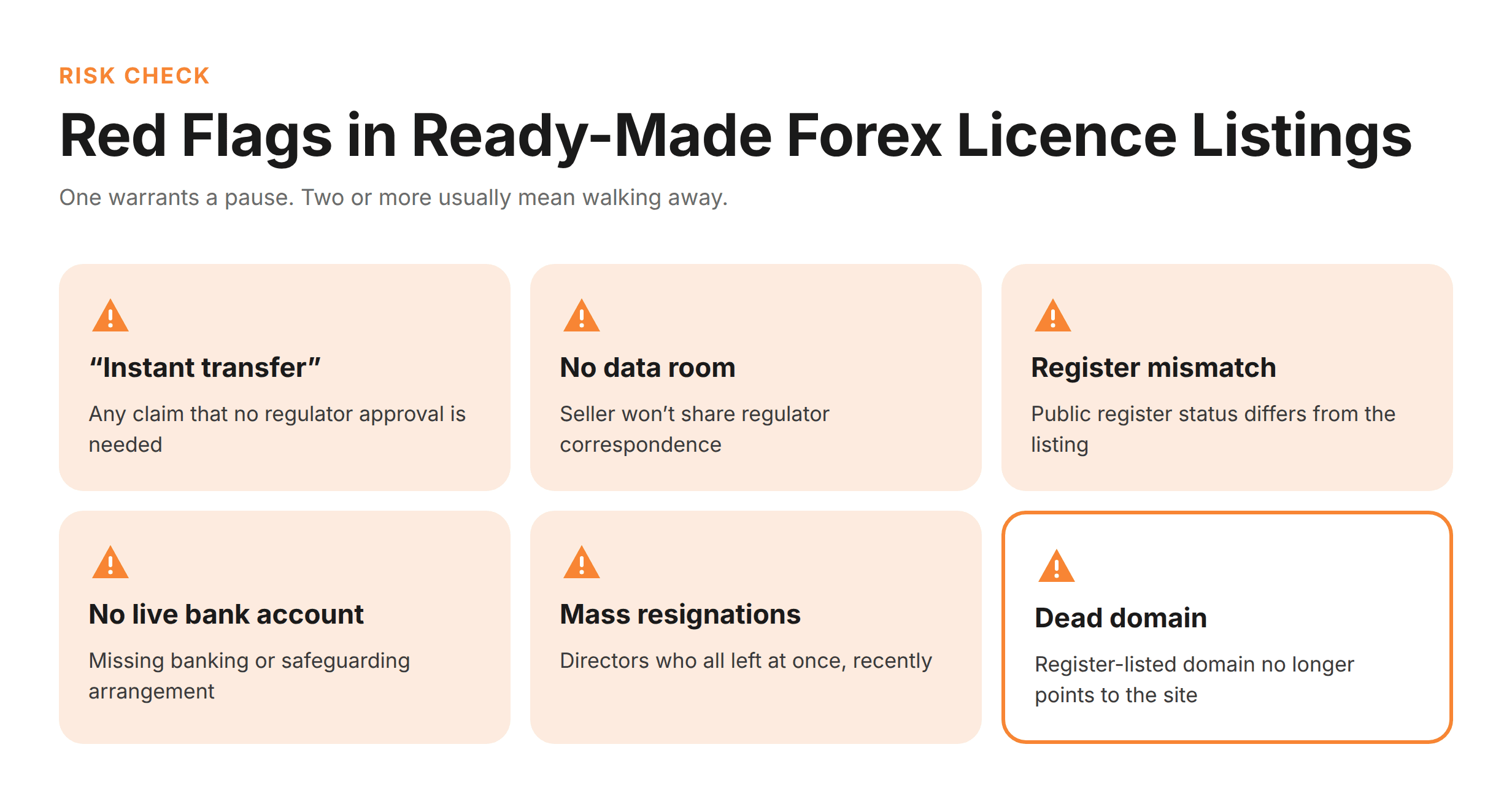
"Instant transfer" or "no regulator approval needed"
Seller refuses a data room or regulator correspondence
Licence status on the public register differs from the listing
No active bank account or safeguarding arrangement
Directors who resigned recently, all at once
Domain on the register no longer points to the company's website
Any one of these warrants a pause. Two or more usually mean walking away.
Due Diligence a Buyer Should Run Before Signing
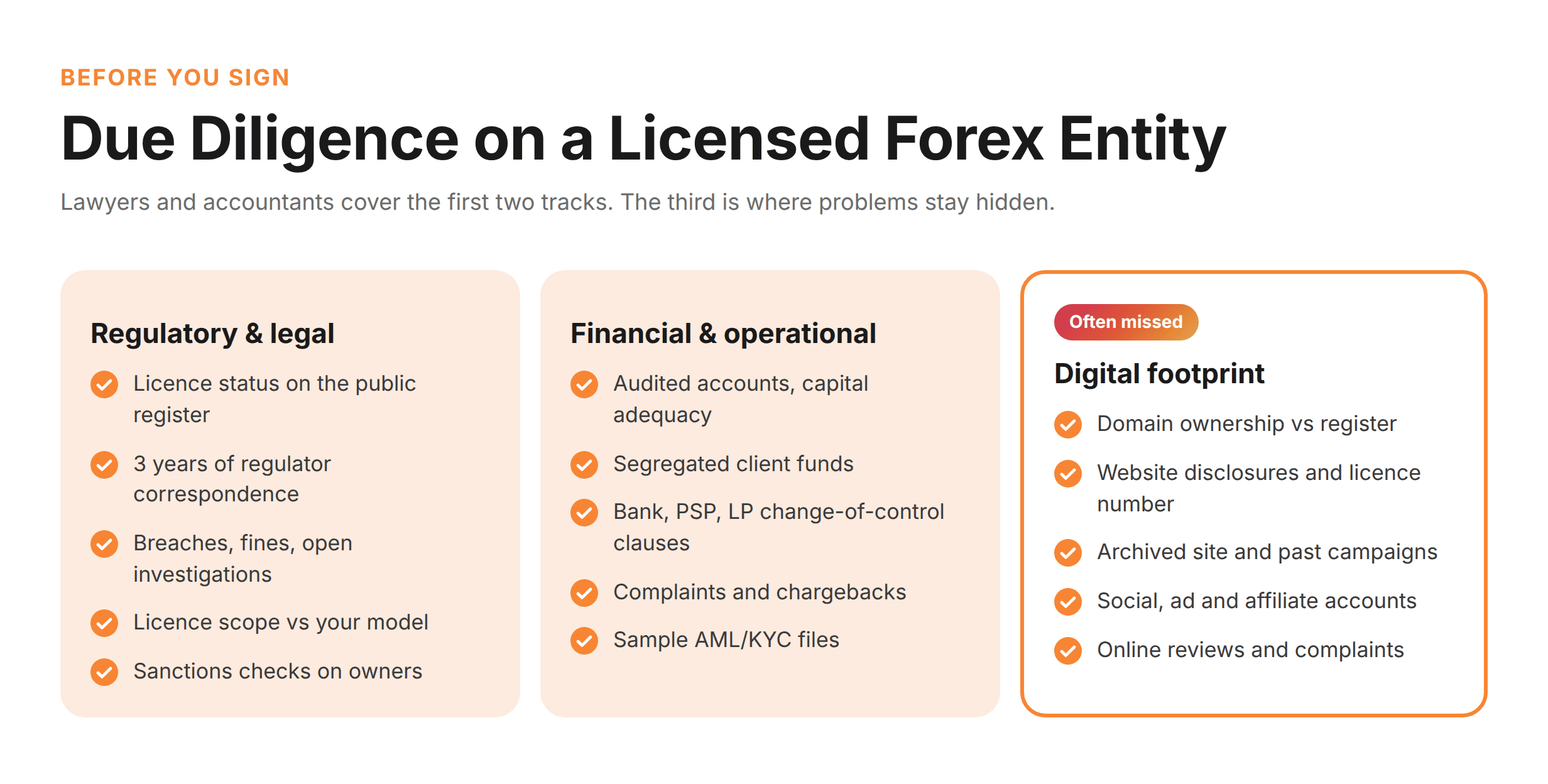
Due diligence on a licensed forex entity covers four areas: regulatory standing, finances, operations and the digital footprint. Most buyers cover the first three with lawyers and accountants. The fourth is where problems stay hidden.
Regulatory and Legal Checks
Verify licence status and conditions on the regulator's public register
Request all regulator correspondence for the last three years
Review breaches, warnings, fines and open investigations
Confirm licence scope matches your planned activities
Check shareholder and director history against sanctions lists
Financial, Banking and Operational Checks
Audited accounts and current capital adequacy
Segregated client funds and safeguarding reconciliations
Bank, PSP and liquidity provider contracts, including change-of-control clauses
Complaint logs, disputes and chargeback ratios
AML/KYC files for a sample of clients
Many banking and PSP contracts terminate on a change of control. Ask each counterparty in writing whether they will continue before you close.
Digital Footprint: Domains, Website and Marketing History
This is the area generalist advisers miss. Regulators often list the approved website on the public register, and your future promotions are judged against the firm's past ones.
Check:
Who legally owns the domains, and whether the registered domain matches the register
Website disclosures: entity name, licence number, address, risk warnings
Archived versions of the site and past campaigns (via web archives)
Social accounts, ad accounts and affiliate agreements tied to the brand
Online reviews and complaints that will follow the brand name
In WSA's broker projects, domain ownership is a frequent surprise: the domain sits in a former director's personal registrar account. Get it transferred into the company before closing, not after.
Rebuild Your Broker Website for the New Ownership
Updated disclosures, compliant legal pages and a rebrand that keeps your search rankings.
After Closing: What Has to Change in the First 90 Days
After closing, your public disclosures must reflect the new owners and business model quickly. Regulators typically expect notification of director changes and updates to published information within set deadlines, and clients see the website before they read any notice.
A practical 90-day list:
Days 1–14: notify counterparties, update directors on the register, secure domains and admin access
Days 15–45: review legal pages, risk warnings and client agreements with your compliance officer
Days 46–90: relaunch the website and brand, retire non-compliant content, restart marketing
Rebuilding the Website Under New Ownership
The site you inherit was built for the previous owner's model. When WSA audits an acquired broker's site, the usual gaps are outdated entity details, risk warnings from an older rule set, and landing pages promoting products the new licence scope does not cover.
Use a broker website compliance checklist to rebuild disclosures, and plan redirects so you redesign without losing rankings. If you bought an entity as part of turnkey broker packages, check which website elements the provider actually delivers.
Conclusion
A forex broker license for sale is a company with a past, not a shortcut around regulation. You still need regulator approval, you still carry the compliance burden, and you inherit whatever the previous owner left behind.
The buyers who close cleanly treat the deal as three problems: transfer of ownership, regulator approval and hidden liabilities. They check the digital footprint as carefully as the balance sheet, and they plan the website rebuild before the approval letter arrives.
WSA builds and rebuilds broker websites for licensed firms, including post-acquisition relaunches with updated disclosures and preserved SEO. If you are evaluating a licensed entity, talk to WSA about the website side before you sign.
FAQ
Can you buy an existing forex licence?
Yes, but only by buying the company that holds it, not the licence itself. A forex licence is issued to a specific legal entity and cannot be transferred to another company. When you buy shares in that entity, the regulator must approve you as the new controller before the deal completes. Expect to submit identity, source-of-funds and fit-and-proper documents for every new shareholder and director. In the EU and UK, closing without approval can lead to enforcement action, and in the UK it is a criminal offence.
What are the risks of buying a licensed entity?
The biggest risk is inheriting liabilities you did not create. These include client complaints, litigation, unpaid regulatory fees, capital shortfalls, tax issues and non-compliant past marketing. A second risk is licence scope: the existing permission may not cover your business model, which means filing a variation. A third is counterparty loss, because many bank, PSP and liquidity contracts end on a change of control. Thorough due diligence and warranties in the share purchase agreement reduce, but do not remove, these risks.
What due diligence should a buyer run?
A buyer should run due diligence across four tracks: regulatory, financial, operational and digital. Regulatory checks cover licence status, scope, breaches and correspondence. Financial checks cover audited accounts, capital adequacy and segregated client funds. Operational checks cover bank, PSP and liquidity contracts, complaints and AML files. Digital checks cover domain ownership, website disclosures, archived promotions, social and ad accounts, and online reputation. Use a data room, request documents in writing, and make key findings conditions of closing.
How long does regulator approval take when buying a forex company?
In the EU, regulators have up to 60 working days to assess a change of control once the notification is complete, with possible pauses of 20 to 30 working days for extra information. The UK FCA also has up to 60 working days from a complete notification. Offshore regulators often move faster, but timelines vary by case. In practice, preparing a complete file takes several weeks, so plan for two to six months from signing to closing.
Is buying a forex licence cheaper than applying for a new one?
Usually not. Industry reporting from 2023 put ready-made entity prices at roughly two to three times the cost of a fresh application, for example about €400,000–€600,000 for a CySEC entity. Buying can still make financial sense if it saves several months of launch time and the entity matches your model. Add diligence, legal fees, capital top-ups and website rebuild costs before comparing the two routes.
Launch Your Licensed Brokerage with Confidence
We support brokers and fintechs through licensing, launch planning, and everything a regulated brand needs to go live.