•
•

Forex License Comparison: Cost, Capital and Timeline by Jurisdiction (2026)
You have a liquidity provider shortlisted, a trading platform in a demo environment, and investors asking for a launch date. Then a licensing adviser gives you three different budgets for the same business model.
That confusion usually comes from mixing four separate numbers: regulatory capital, government fees, professional fees and the cost of maintaining local substance. A forex license is not a product with one price tag. The permission scope, target clients and counterparties determine the real budget.
This comparison uses a 2026 snapshot to rank eight practical jurisdictions for a typical forex or CFD brokerage. It covers capital, direct fees, realistic timing, local presence and the likely level of payment-service-provider (PSP) and liquidity-provider (LP) scrutiny. Treat it as a planning guide, not legal advice. Confirm the current rules with the regulator or a licensed adviser before filing.
This article is for informational purposes only and does not constitute legal advice. Brokers should consult qualified legal and compliance professionals for jurisdiction-specific guidance.
Key Takeaways
Mauritius can have the lowest published capital floor in this shortlist, but local substance, insurance, audit and operating costs still decide whether it is the cheapest launch.
Cyprus, the UK and Australia buy stronger onshore credibility at a higher price. Cyprus is the only route in this table with EU/EEA passporting through the MiFID framework.
Capital is not a fee. It remains in the licensed entity, while application fees, annual charges, compliance staff, audit, technology and professional work sit on top.
PSP and LP acceptance is never guaranteed by a license. Counterparties assess your client markets, ownership, AML controls, website, transaction flow and source of funds.
A complete file can move in months; an incomplete one can run past a year. Permission scope, local hires, platform evidence and response speed create the difference.
The website belongs on the licensing workstream. It may not need to be live at submission, but it will be checked before client onboarding by regulators, banks, PSPs and liquidity partners.
Forex License Cost: What You Are Actually Paying For
The first budget mistake is treating a minimum-capital figure as the cost of obtaining a license. It is only one part of the balance-sheet requirement. Your year-one plan needs a separate line for money locked in the entity, money paid to the regulator and money spent building an operating business.
Capital Is Not a Fee
Regulators use different terms for the money that must remain available. The UK uses permanent minimum capital under MIFIDPRU. Cyprus applies initial-capital classes under its investment-firm prudential law. Australia uses net tangible assets and liquidity tests for retail OTC derivatives. Paid-up capital, own funds and net tangible assets are not interchangeable.
The activity you request usually determines the floor:
Agent or execution-only model: you transmit or execute orders without taking the other side of client trades.
Matched-principal model: you enter offsetting trades and aim to avoid directional market exposure.
Own-account or market-making model: you take principal risk and may hold client positions on your book.
For example, the FCA sets permanent minimum capital at £75,000 for several execution, portfolio-management and advice permissions, £150,000 where a firm holds client money or assets in MiFID business, and £750,000 for dealing on own account. The FCA's MIFIDPRU capital table shows why a business plan must describe the dealing model before it names a jurisdiction.
What this means: a consultant who quotes a low capital number without asking whether you will act as agent, matched principal or market maker is not comparing like with like.
Why Year-One Cost Changes the Ranking
Direct regulator fees are often the smallest line. Legal drafting, compliance appointments, audit, local directors, office space, platform contracts, liquidity connectivity, KYC tooling and website work can exceed the application fee by a wide margin.
Build the budget in five blocks:
Regulatory capital or own funds.
Application, registration and annual fees.
Legal, compliance and fit-and-proper preparation.
Local people, office, insurance and audit.
Platform, liquidity, PSP, KYC and website implementation.
This is why a US$100,000 capital requirement in Seychelles can cost more to operate than a higher-capital route with better counterparties. It is also why "ready-made license" offers often look cheap: the seller may be quoting a company transfer or a certificate, not a tested compliance operation with bank and PSP approval.
Turn a licensing budget into a launch-ready site
Your website, legal hub and onboarding flow should match the entity and permission scope in your application.
Forex License Comparison by Jurisdiction
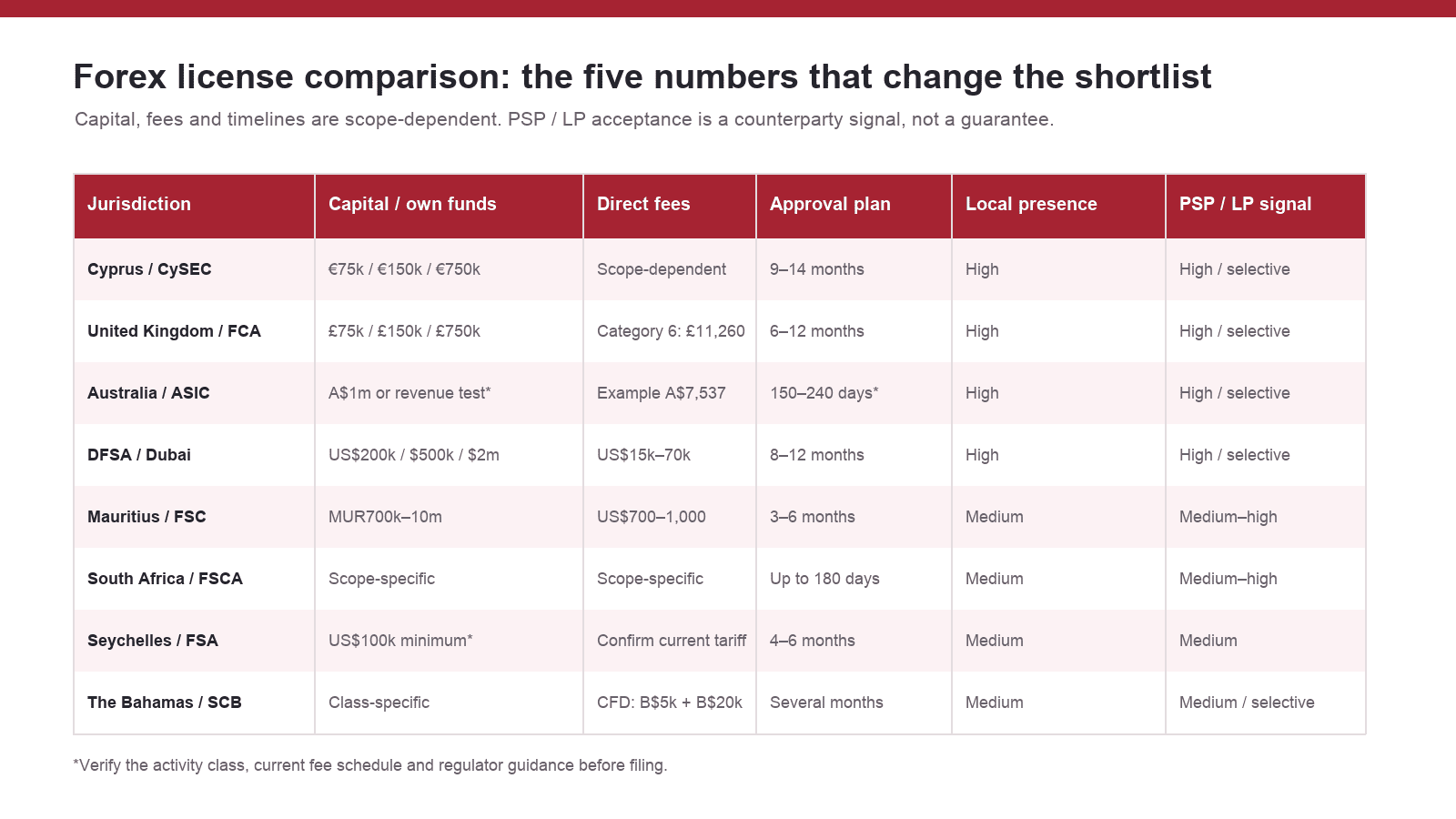
The table below is a practical shortlist, not a universal league table. The rank assumes a broker wants a real regulated operating entity, credible counterparties and a defined market-entry plan. A different target market can reverse the order.
Rank | Jurisdiction and regulator | Regulatory capital or own funds | Direct regulatory fees | Realistic approval timeline | Local presence | PSP / LP acceptance signal* |
|---|---|---|---|---|---|---|
1 | Cyprus, CySEC CIF | €75,000 / €150,000 / €750,000 by activity class | Scope-dependent application charge; annual flat fee and turnover-based elements | 9–14 months end to end | Cyprus office, local management and board; governance functions | High for EU/EEA use, still selective |
2 | United Kingdom, FCA | £75,000 / £150,000 / £750,000 by permission scope | Most CFD firms fall in Category 6: £11,260 application fee; periodic fees vary | 6 months for a complete application; up to 12 months if incomplete | UK entity, approved senior managers and operating substance | High for UK use, selective for cross-border retail |
3 | Australia, ASIC | Retail OTC issuer: greater of A$1m or 10% of average revenue; other FX models can trigger different tests | Body-corporate AFS application fee is complexity-based; online high-complexity example is A$7,537 | ASIC targets 70% within 150 days and 90% within 240 days of a complete file | Australian entity, responsible managers and local controls | High for Australia, selective for global retail |
4 | DFSA, Dubai DIFC | US$200,000 Cat 3A agent; US$500,000 matched principal; US$2m Cat 2 principal | Application fees range from US$15,000 to US$70,000 | 8–12 months is a realistic broker planning range | DIFC office, UAE-resident SEO and named control functions | High for GCC and institutional business; selective for retail |
5 | Mauritius FSC | Common forex routes around MUR 700,000–1,000,000; MUR 10m for full service with underwriting | About US$700–1,000 application and US$2,700–3,400 annual for common dealer categories | 3–6 months, excluding preparation and banking | Economic substance, local officers, insurance and audit | Medium to high for Africa and Asia; case-by-case |
6 | South Africa, FSCA | No single public minimum for an ODP; capital is proportionate to position risk | Fee schedule and activity scope apply; confirm current FSCA tariff | Up to 180 working days for an ODP file under the FSCA service-level table | South African entity, key individuals and local compliance | Medium to high for South Africa and Africa; principal models are closely checked |
7 | Seychelles FSA | US$100,000 paid-up minimum; higher capital may be required for higher-risk models | Current guideline figures should be confirmed with FSA before filing | 30 working-day service standard for a complete file; 4–6 months is a safer end-to-end plan | Local office, resident personnel, licensed representative and compliance coverage | Medium, with stronger scrutiny for some markets and PSPs |
8 | The Bahamas, SCB | Class and business model specific; broker-dealer bands historically include US$120,000–300,000 | CFD firms: B$5,000 application, B$20,000 registration and B$45,000 annual renewal under the current fee schedule | Several months; build in time for scope and substance questions | Bahamian entity, officers and physical-presence requirements | Medium and selective; depends heavily on target market and flow |
* PSP / LP acceptance is an editorial planning signal, not a promise from a regulator or counterparty. The same license can be accepted by one PSP and declined by another.
Tier 1: Cyprus, United Kingdom and Australia
Tier 1 routes are expensive because they connect the license to a mature supervisory framework, stronger market access and more demanding operational evidence. They are not automatically better for every broker.
Cyprus is the standout when EU/EEA distribution is the actual goal. CySEC's current framework uses €75,000, €150,000 and €750,000 initial-capital classes. The CySEC license application guide explains how permissions, local governance and activation requirements fit together. Annual charges are scope-dependent; CySEC's current fee material also includes flat and turnover-linked components. Check the current fee material with the application calculator before budgeting.
The UK is more useful when your plan is genuinely UK-led. The FCA's current fee schedule shows the application categories, but the fee is not the hard part. The hard part is proving that governance, prudential resources, client-money handling, systems and management experience match the permissions. A UK authorization does not recreate EU passporting.
Australia is a serious route for an Australia-focused broker, but its financial test is easy to misstate. ASIC's RG 166 financial requirements sets the broader framework, while retail OTC derivative issuers must meet a net-tangible-asset test and keep part of the requirement liquid. If you are entering FX as principal, your model may trigger an alternative capital test. Get the product and client scope reviewed before assuming A$1m is the complete answer.
Tier 2: DFSA Dubai, Mauritius and Seychelles
Tier 2 is not a synonym for "light touch." It means the trade-off is different. You may get a lower capital floor or a more regional market fit, but the operating model, website and counterparties still need evidence.
The DFSA is a strong fit when the business is built around the DIFC and professional or institutional GCC clients. Category 3A agent activity is not the same as Category 2 principal activity. The capital difference is material, and the control-function hiring plan is material too. The DFSA authorisation checklist is useful for mapping the people, systems and documents before you speak to a provider. DFSA application fees alone range from US$15,000 to US$70,000, before local setup and professional costs, according to its official fee page.
Mauritius often wins a first-pass budget comparison because its published capital and government fees are comparatively low. The right category matters: the FSC publishes separate requirements for brokers, derivatives, full-service dealers and underwriting. Its current licensing codified list shows the category-specific processing and annual fees. WSA's Mauritius investment-dealer checklist maps those categories to the operating documents a broker needs. The FSC can also stop progressing a file if the applicant does not answer a query within the stated window. That turns document management into a timeline issue.
Seychelles is attractive when speed and capital are binding constraints. The FSA's securities dealer guidelines require more than a certificate: directors, a licensed representative, local premises, insurance, compliance capability and financial resources all matter. A file can meet the headline capital number and still fail the operating test. Use the Seychelles forex license guide for the website and document implications.
South Africa and The Bahamas: Scope-Sensitive Alternatives
South Africa needs a scope warning. An FSCA financial-services-provider authorization for intermediation is not automatically an authorization to issue OTC derivatives as principal. The ODP layer is where capital, technology, controls and risk management become more demanding. WSA's platform requirements guide explains why the trading method and third-party systems belong in the application conversation.
The Bahamas is also not one simple "Class IV" answer. The SCB's current public fee table separates capital-markets activities from CFD registration and applies different fees to each. The Bahamas broker licence checklist is the practical companion for the documents and public disclosures. Ask the SCB or counsel to confirm the exact capital and activity class before relying on a low headline quote.
How to Rank Jurisdictions for PSP and Liquidity-Provider Acceptance
There is no regulator-issued PSP acceptance score. A payment provider, bank or liquidity provider makes its own risk decision after reviewing your entity, shareholders, markets, products and transaction flow.
What Banks, PSPs and LPs Actually Check
Counterparties usually want to answer five questions before onboarding:
Who is the legal customer? Entity name, ownership chain, directors, registration and license status must align.
Where are the customers? An offshore entity targeting restricted retail markets creates a different risk profile from an Africa-focused or professional-only broker.
What actually happens to money? The PSP will review deposits, withdrawals, refunds, chargebacks, segregated accounts and settlement flows.
Can the business evidence its controls? AML/KYC, complaints, sanctions, transaction monitoring, source of funds and responsible officers need owners and records.
Does the public site match the file? Product pages, risk warnings, license claims, domains and legal documents should describe the same business.
This is why a familiar regulator can help without guaranteeing acceptance. A bank may like the jurisdiction but reject the ownership profile. An LP may approve the entity but restrict trading limits, instruments or client countries. A PSP may onboard the legal entity and still hold reserves until it sees live volume.
Why Offshore Does Not Mean Unregulated
Offshore should describe location, not the absence of rules. Seychelles, Mauritius and The Bahamas have real regulators, application processes, reporting duties and enforcement powers. The limitation is usually market access: an offshore license does not create EU or UK passporting and may narrow the pool of banks and PSPs willing to take the relationship.
The right question is not "Which jurisdiction is most reputable?" It is "Which regulator, permission scope and operating model can my counterparties support for the countries I plan to serve?" Get written onboarding feedback from your likely PSP and LP before committing capital.
Forex License Approval Timelines: What Determines 3 Months or 12
Approval time is the sum of preparation, regulator review, query rounds, conditions and final activation. The regulator controls only part of that clock. Your team controls whether the file is complete, consistent and answered quickly.
Preparation Time vs Regulator Review Time
A realistic launch plan has parallel tracks:
Scope and target-market decision: choose agency, matched principal or own account; define instruments and client types.
Entity and people: incorporate, appoint directors and responsible managers, confirm local substance and evidence capital.
Application pack: write the business plan, financial projections, AML/KYC manual, compliance policies, outsourcing plan, platform description and client documents.
Submission and queries: lodge a complete file, log every question, assign an owner and answer with version-controlled evidence.
Conditions and activation: fund the entity, appoint final roles, complete testing, confirm domains and release approved public content.
The FCA gives a useful benchmark: statutory determination is six months for a complete application and up to twelve months for an incomplete one. ASIC aims to decide 70% of complete AFS applications within 150 days and 90% within 240 days. Seychelles publishes a shorter service standard for complete files, but the end-to-end project still includes incorporation, staffing, responses and banking.
![orex license approval timeline: scope, preparation, submission, queries and activation]](https://framerusercontent.com/images/SdfDl16m0NLvZcX3Usf4iW6vCg.png)
The Documents That Usually Trigger Queries
Most delays are not caused by a missing comma. They come from contradictions that reveal the business is not ready:
The business plan says agency execution, but the website advertises a market-making model.
The forecast assumes 15 employees, while the budget funds four.
The platform agreement, liquidity model and order-execution policy describe different flows.
A director's CV does not support the controlled function being proposed.
The domain, legal entity, registered address or license claim changes between documents.
Client-money and PSP flows are described in marketing language instead of process language.
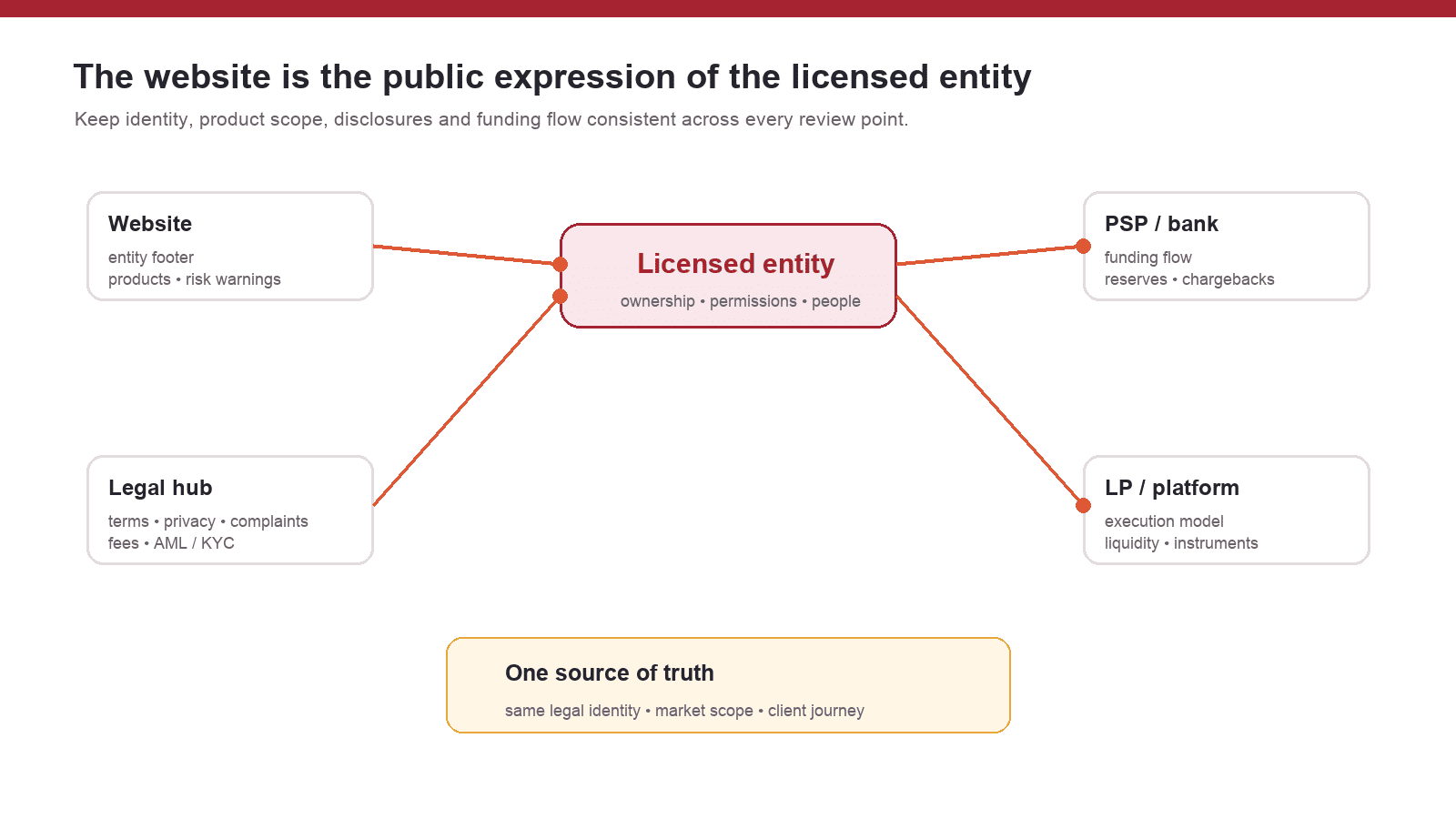
Create a single source of truth for names, permissions, instruments, target markets, warnings and disclosure text. That same source can drive the website, client agreement and application pack.
Do You Need a Website for a Forex License?
Usually, no regulator requires a generic live marketing website as a condition for simply submitting an application. But a credible public presence becomes operationally important before approval, banking and PSP onboarding. The answer is about timing and scope, not a yes-or-no checkbox.
What Needs to Exist at Submission
At submission, you need the information that proves the business exists and can operate:
A clear description of the entity, ownership and management.
A domain and brand plan that do not imply authorization before it exists.
Draft legal documents, product descriptions and risk disclosures.
The intended platform, liquidity model, client journey and funding flow.
A plan for publishing approved disclosures when the license is granted.
For a pre-license site, use accurate language such as "application in progress" where appropriate. Never display a regulator logo, license number or "regulated" claim before the status is true. The website timing guide for CySEC covers the distinction between an application-stage holding site and a live regulated broker website.
What Must Be Live Before Onboarding
Before taking clients, your public site should make it easy to find the legal identity, license details, terms, risk disclosure, privacy and cookie policy, AML/KYC information, complaints route, conflicts information and fee schedule that apply to that entity.
The content must be entity-aware. If one group uses a Cyprus entity for EU clients and a Seychelles entity elsewhere, the site should not serve the same footer, risk warning or product availability to everyone. WSA's broker legal-pages guide explains why the legal hub is an information architecture problem as much as a copy task.
Build the site while the regulator reviews the file
Stage the full experience privately, then publish the approved entity, disclosures and funding flow when the license lands.
How to Choose the Right Forex License for Your Business Model
The best jurisdiction is the one that your capital, target market, permissions and counterparties can support at the same time. Use a decision sequence instead of starting with the cheapest quote.
Choose by Market Access
Start with the countries you intend to serve in year one. If EU/EEA retail access is core, Cyprus has a structural advantage because of MiFID passporting. If you need the UK, use the UK regime. If Australia is the market, ASIC's rules and local capability are the relevant test. If the business is GCC institutional, DFSA may fit better than an offshore entity.
Do not ask an offshore license to solve a market-access problem it was never designed to solve.
Choose by Permission Scope and Capital
Write down exactly what the entity will do:
Advise only or transmit orders?
Execute for clients or deal as matched principal?
Take the other side of trades?
Hold client money or assets?
Offer CFDs, crypto CFDs, commodities or only currency products?
Then compare the capital class, fixed-overhead requirement, client-money rules and local staffing for that scope. A smaller license with the wrong permission is not a saving. It creates a variation application and another review.
Choose by Launch Sequence
Plan the application, platform, liquidity, PSP and website as one launch system. The website can be staged while the regulator reviews the file. The platform and liquidity agreements may need to be named earlier than the founder expects. The bank and PSP may need to see the same documents before they approve the account.
If your plan depends on a live business within six months, a 12-month authorization is not a small delay. It changes payroll, funding runway, launch messaging and investor reporting. Put the jurisdiction decision inside the financial model, not only inside the legal workstream.
Conclusion
The right forex license is not the one with the smallest headline number. It is the one whose permission scope, capital, local substance, target-market access and counterparties fit the business you will actually run.
Use the comparison to build a shortlist, then confirm the category and current fees with the regulator or licensed adviser. Get written feedback from your intended PSP and liquidity provider before you lock capital. Run the website, platform and compliance-document workstreams alongside the application so approval does not create a second launch delay.
WSA designs broker and fintech websites around the entity, jurisdiction and customer journey you need to disclose. Discuss your broker website and launch sequence with WSA.
This article is for informational purposes only and is not legal, regulatory or licensing advice. Capital requirements, fees, timelines and counterparty policies change. Verify current rules before filing.
Frequently Asked Questions
Which forex license is cheapest to obtain?
Among the jurisdictions compared here, Mauritius can have the lowest published capital and direct-fee combination for a suitable broker or currency-derivatives category, while Seychelles is often the simpler lower-capital offshore shortlist. The cheapest total launch is not determined by the application fee. Add local people, office, insurance, audit, compliance, technology, capital lock-up and PSP onboarding costs before deciding.
How long does each jurisdiction take to approve a forex license?
Plan for roughly 3–6 months in Mauritius or Seychelles after preparation, 6–12 months for the UK and Australia, 8–12 months for a realistic DFSA broker file, and 9–14 months for Cyprus. South Africa and The Bahamas are scope-sensitive and can take several months. These are planning ranges, not promises. A complete file, named control functions and fast answers to queries matter as much as the regulator's published service target.
Which forex licenses do banks and payment providers accept?
Banks and PSPs accept entities after their own risk review, not because a regulator guarantees acceptance. Onshore licenses such as FCA, CySEC, ASIC and DFSA often create a stronger starting point for the markets they supervise. Mauritius and Seychelles can work for international models, but counterparties may apply tighter country, volume, reserve or transaction-flow conditions. Ask your intended PSP and LP for a written pre-screen before filing.
Do I need a website for a forex license?
You may not need a fully live trading site to submit every application, but you do need consistent website, domain and disclosure information before banking, PSP onboarding and client launch. The site must not claim a license before the regulator grants it. Before go-live, publish the correct entity details, risk warnings, terms, complaints process, privacy information, product scope and funding disclosures.
Can I buy a ready-made forex license?
You can buy or transfer a company, but you cannot buy another firm's regulatory history or make its approval automatically yours. A change in ownership, directors, business model, products, controllers or target markets can trigger regulator review and fresh fit-and-proper work. Treat any "ready-made" offer as a corporate transaction that still requires legal, regulatory, banking and PSP due diligence.
Launch Your Licensed Brokerage with Confidence
We support brokers and fintechs through licensing, launch planning, and everything a regulated brand needs to go live.