•
•
How to Start a Forex Brokerage in 2026: The Full Launch Sequence
Six months in, the licence lands. The founder has a regulator's approval letter, a company in Seychelles, and nothing else. No platform contract. No liquidity agreement. No payment provider. No website. Onboarding all of that takes another four months, and the regulatory capital sits idle the whole time.
This happens because almost every guide on how to start a forex brokerage presents the job as a numbered list. Do step one, then step two. In reality a launch is nine workstreams running at different speeds, with a handful of hard dependencies between them.
This article is for informational purposes only and does not constitute legal advice. Brokers should consult qualified legal and compliance professionals for jurisdiction-specific guidance.
Global FX turnover reached USD 9.6 trillion per day in April 2025 according to the Bank for International Settlements, so demand is not the constraint. Sequencing is. This guide maps the whole business: what each phase costs, what blocks what, and what you can run in parallel to save months.
Key Takeaways
Only two workstreams sit on the critical path: entity formation and licensing. Platform, payments, CRM, website and marketing can all run alongside them.
Forex brokerage startup costs in year one run roughly USD 50,000 to USD 150,000 for a lean offshore setup, USD 350,000 to USD 800,000 for a mid-tier CySEC launch, and USD 1 million or more for a fully regulated firm.
Regulatory capital is money you hold and maintain, not money you spend. Budget it separately from operating costs.
Your website is an input to licensing and payment approval, not the final task before launch. Regulators and payment providers both review the live site.
Payment processing, not licensing, is where most launches actually stall. Expect an effective cost of 3 to 8 percent once rolling reserves and currency conversion are counted.
Time to first funded client is realistically three to six months offshore with a white label, and nine to eighteen months for a CySEC or FCA-class authorisation.
How to Start a Forex Brokerage: The Nine Workstreams and the Order They Run In
To start a forex brokerage you run nine workstreams, in this dependency order:
Corporate structure: holding and operating entities, directors, shareholders
Capital: regulatory capital, liquidity margin, operating runway
Licence: jurisdiction selection and the authorisation application
Trading platform: MetaTrader 5, cTrader, DXtrade or a proprietary build
Liquidity: provider selection, bridge, execution model
Payments: card acquiring, bank transfer, local methods, crypto rails
CRM and back office: trader's room, KYC workflow, IB and affiliate tracking
Website and brand: positioning, compliance pages, conversion structure
Marketing and acquisition: SEO, paid media, IB network, partnerships
Most guides on how to start a forex brokerage step by step stop at describing these. The useful question is which ones block the others.
Your forex broker business plan should treat these as nine tracks on a chart, not nine boxes to tick in order. The plan that gets funded shows overlap. The plan that slips shows a straight line.
The Critical Path vs What Runs in Parallel
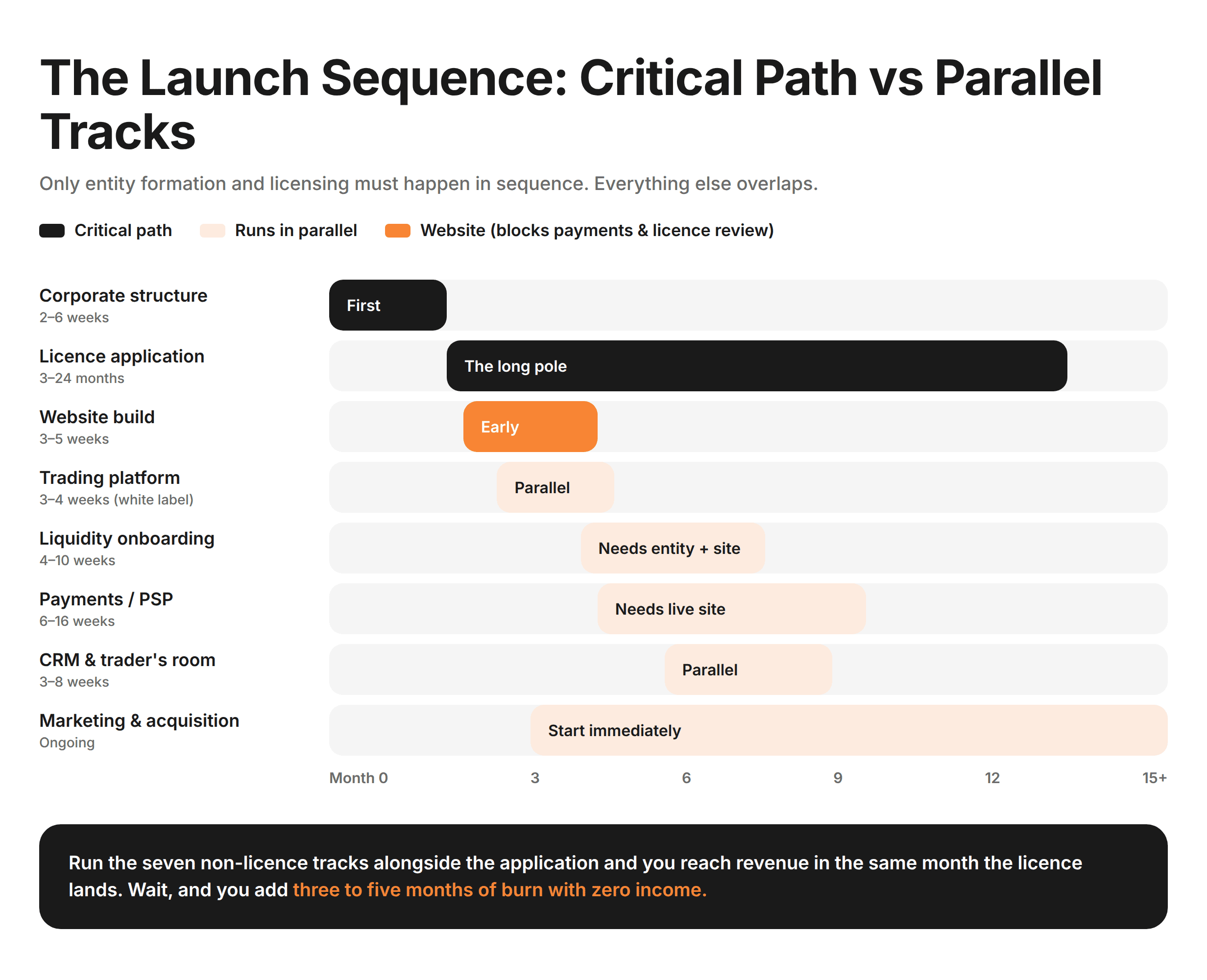
Only two workstreams sit on the critical path: entity formation and licensing. Everything else can start before the licence is granted, and four tracks can run entirely in parallel: platform selection, payment provider applications, CRM configuration, and the website build.
Here is where the months are won or lost.
Workstream | Duration | Can start before licence? | Blocks |
|---|---|---|---|
Corporate structure | 2-6 weeks | Yes (it comes first) | Everything |
Licence application | 3-24 months | No | Live client onboarding |
Trading platform | 3-4 weeks (white label) | Yes | Liquidity integration |
Liquidity onboarding | 4-10 weeks | Yes, with entity in place | Pricing and execution |
Payments (PSP) | 6-16 weeks | Yes, needs live website | Deposits |
CRM and trader's room | 3-8 weeks | Yes | Client onboarding |
Website | 3-5 weeks | Yes (needed early) | PSP and licence review |
Marketing | Ongoing | Yes | Nothing |
What this means: a founder who runs the seven non-licence tracks alongside the application reaches revenue in the same month the licence lands. A founder who waits adds three to five months of burn with zero income.
The forex broker launch timeline is not set by how long the regulator takes. It is set by how much you did while waiting.
Why the Website Is Not the Last Step
Unlike most launch checklists suggest, the website is a mid-sequence dependency, not a final task. Two separate parties review your live site before you can take a single deposit: the regulator assessing your application, and the payment service provider assessing your merchant account.
Regulators check that public-facing material matches what your application claims. Risk warnings, the legal entity behind the brand, which countries you accept clients from, and how client money is handled all have to be visible and consistent. The CySEC website requirements for forex brokers are specific enough that a generic template will fail review.
Payment providers go further. Their underwriting teams open the site, look for the disclosure set, and check whether the funding flow is clear before they approve a high-risk merchant account.
In practice: the brokers who launch fastest brief their website in month one, alongside the licence application, not in month eight. The staging question that follows, what can go live during the application and what has to wait for approval, is covered in our guide on whether to put the licence first or the website first.
Build Your Broker Website Before It Blocks You
WSA builds licence-aware broker sites on Framer with the compliance pages, risk disclosures and funding structure regulators and payment providers expect to see.
Entity, Ownership and Capital: The Foundation Layer
A brokerage launch starts with a corporate structure, because the entity is what applies for the licence, signs the liquidity agreement, and holds the merchant account. Get the structure wrong and every downstream contract needs redoing.
Before you start a forex brokerage firm, four decisions have to be settled: where the licensed entity sits, who owns it, who sits on the board, and how much substance you maintain locally.
Structuring the Holding and Operating Entities
Most brokerages use two entities: a holding company that owns the IP and receives profits, and a licensed operating company that faces clients. The separation protects the group and keeps the regulated entity's balance sheet clean.
Every regulator will assess your people, not just your paperwork. Expect to supply:
Fit-and-proper files for directors and beneficial owners, including CVs, references, clean criminal records and proof of relevant experience
Local substance: in most mid-tier jurisdictions, at least two resident directors, a local office and a local compliance officer
A compliance and AML manual matched to your actual business, not a template with the jurisdiction name swapped
A business plan with three-year financial projections the regulator can stress-test
Here's where most teams lose time: the document pack, not the application form. Founders who hire a start forex brokerage license consultant early usually clear this stage two to three months faster than those who assemble it themselves.
How Much Total Capital a Realistic Launch Needs
How much does it cost to start a forex brokerage depends almost entirely on jurisdiction tier: roughly USD 50,000 to USD 150,000 all-in for a lean offshore setup, USD 350,000 to USD 800,000 for a mid-tier CySEC launch, and USD 1 million or more for a fully regulated firm, according to Track360's 2026 cost breakdown.
One distinction founders miss more than any other: regulatory capital is money you hold, not money you spend. Under the EU prudential regime, an investment firm carries a permanent minimum capital requirement of EUR 75,000, EUR 150,000 or EUR 750,000 depending on the activities it is authorised for, and that capital has to stay on the balance sheet. It is not a fee, and it cannot fund your marketing.
So a mid-tier launch needs the capital requirement plus the setup costs plus runway. Budget them as three separate lines.
The Licence: One Chapter of the Launch, Not the Whole Project
A forex broker license authorises a defined activity, not a business. It tells you what you may do, in which markets, with which clients, and how much capital you must hold while doing it. It does not give you a platform, prices, payment rails or clients.
Approval timelines vary widely by jurisdiction, from around three months at the fast end to two years at the slowest:
Vanuatu (VFSC): 3-6 months
Seychelles (FSA): 4-8 months
Cyprus (CySEC): 9-15 months
UK (FCA): 12-18 months
Mauritius, the Bahamas, South Africa and the DIFC sit between those poles. The full side-by-side of capital, fees and timeline is in our comparison of the best broker licence jurisdictions.
One correction worth carrying, because competing articles still get it wrong: St. Vincent and the Grenadines has not issued standalone forex licences since January 2023. An SVG company alone does not amount to a forex broker license, and no payment provider will treat it as one.
The requirements themselves, capital floors, document packs and the application process stage by stage, sit in our guide to forex brokerage licence requirements. The point to carry into your sequencing is simpler: the licence sets your ceiling, and everything else in this list determines whether you reach it.
The honest tradeoff: an offshore licence is faster and cheaper, but it narrows your payment provider options, restricts which paid channels will accept your ads, and limits the countries you can legally accept clients from. If your target market is Western Europe or the UK, the FCA's position on retail CFD distribution makes a light-touch licence a dead end, and the slower authorisation is the cheaper route overall.
Platform and Liquidity: Building the Trading Engine
The trading engine has two parts: the platform traders see, and the liquidity behind the prices they trade. They are separate purchases, they onboard on different timelines, and both can start before your licence is granted.
Platform expectations in 2026 still centre on MetaTrader 5, with cTrader, DXtrade and Match-Trader taking share among brokers who want more control over the front end. Your execution model is the other half of the decision: A-book routes client orders to the market, B-book keeps them internally, and most brokers run a hybrid that routes by client profile and risk.
White Label vs Own Server vs Proprietary Platform
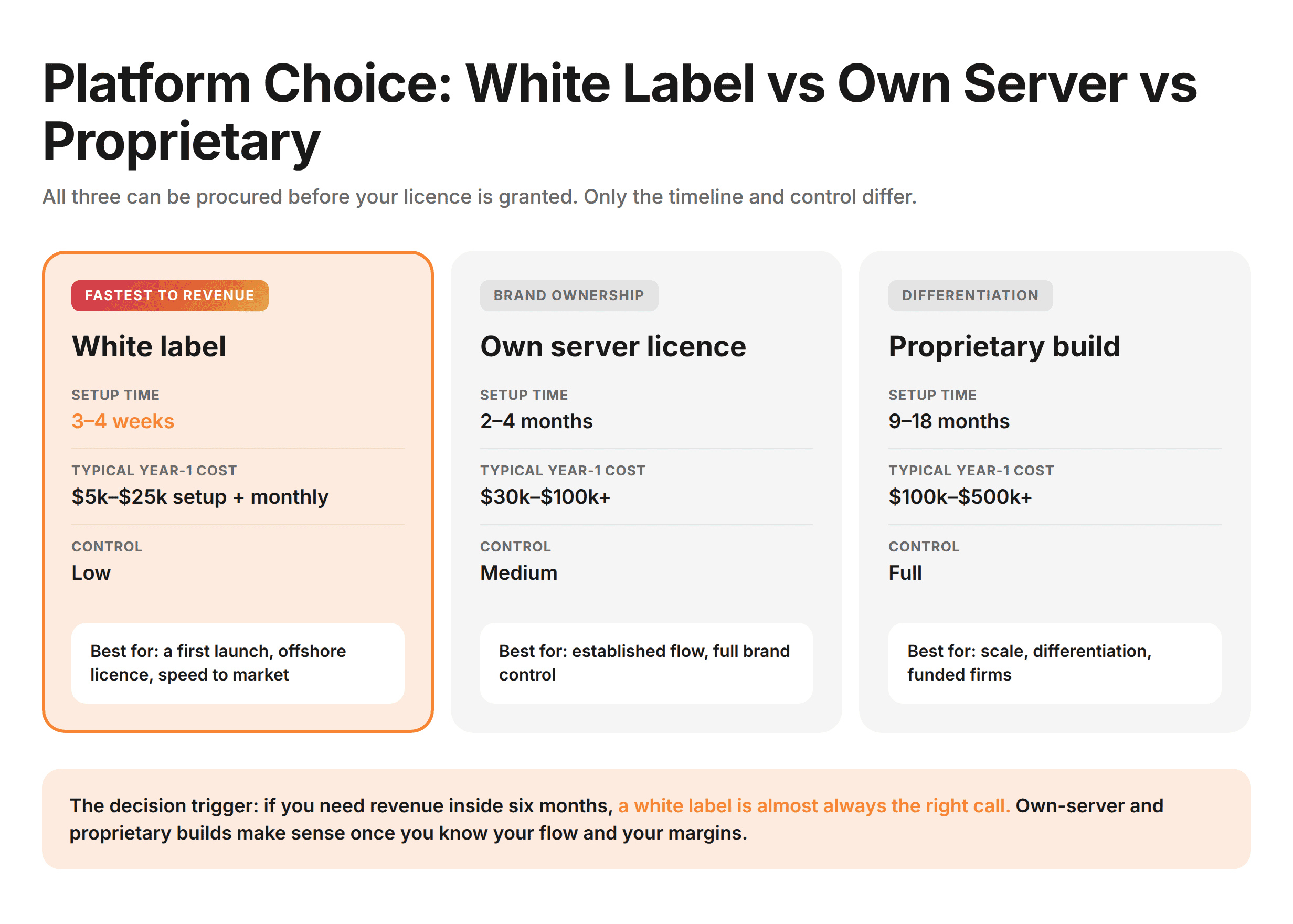
A white label forex brokerage rents platform infrastructure from a provider; an own-server licence gives you the platform under your own brand and control; a proprietary build means you own the code.
Model | Setup time | Typical year-1 cost | Control | Best for |
|---|---|---|---|---|
White label | 3-4 weeks | USD 5k-25k setup + monthly | Low | First launch, offshore, speed to market |
Own server licence | 2-4 months | USD 30k-100k+ | Medium | Established flow, brand ownership |
Proprietary build | 9-18 months | USD 100k-500k+ | Full | Scale, differentiation, funded firms |
The decision trigger: if you are launching your first brokerage and need revenue inside six months, a white label or turnkey forex broker package is almost always the right call. Own-server and proprietary builds make sense once you know your flow and your margins, and it is worth checking what those packages leave out before you sign one.
What Liquidity Providers Ask For Before They Quote
A forex liquidity provider will ask for four things before quoting you pricing: a licensed or licensing-in-progress entity, a funded margin account, a defined risk and execution model, and a live website they can review.
Liquidity provider onboarding typically runs four to ten weeks and involves:
Commercial discussion: instruments, expected volume, spreads and commission structure
Due diligence: corporate documents, licence status, beneficial owner checks, AML policy
Margin funding: commonly USD 50,000 to USD 100,000 minimum, plus a setup fee around USD 5,000
Technical integration: FIX API bridge into your platform, then latency and fill testing
Test trading: a live period on small size before full flow is switched on
If you need deeper pricing than a single provider gives, you are looking at a prime of prime: a broker that aggregates several bank and non-bank liquidity sources and resells the combined book to smaller firms.
What this means in practice: the margin account is dead capital sitting in a provider's account while you finish everything else. Fund it late in the sequence, not early.
Payments and CRM: The Money and Client Layer
Payment approval, not licensing, is where most brokerage launches stall. You can hold a licence, a platform and liquidity, and still take zero revenue because no provider will process your deposits.
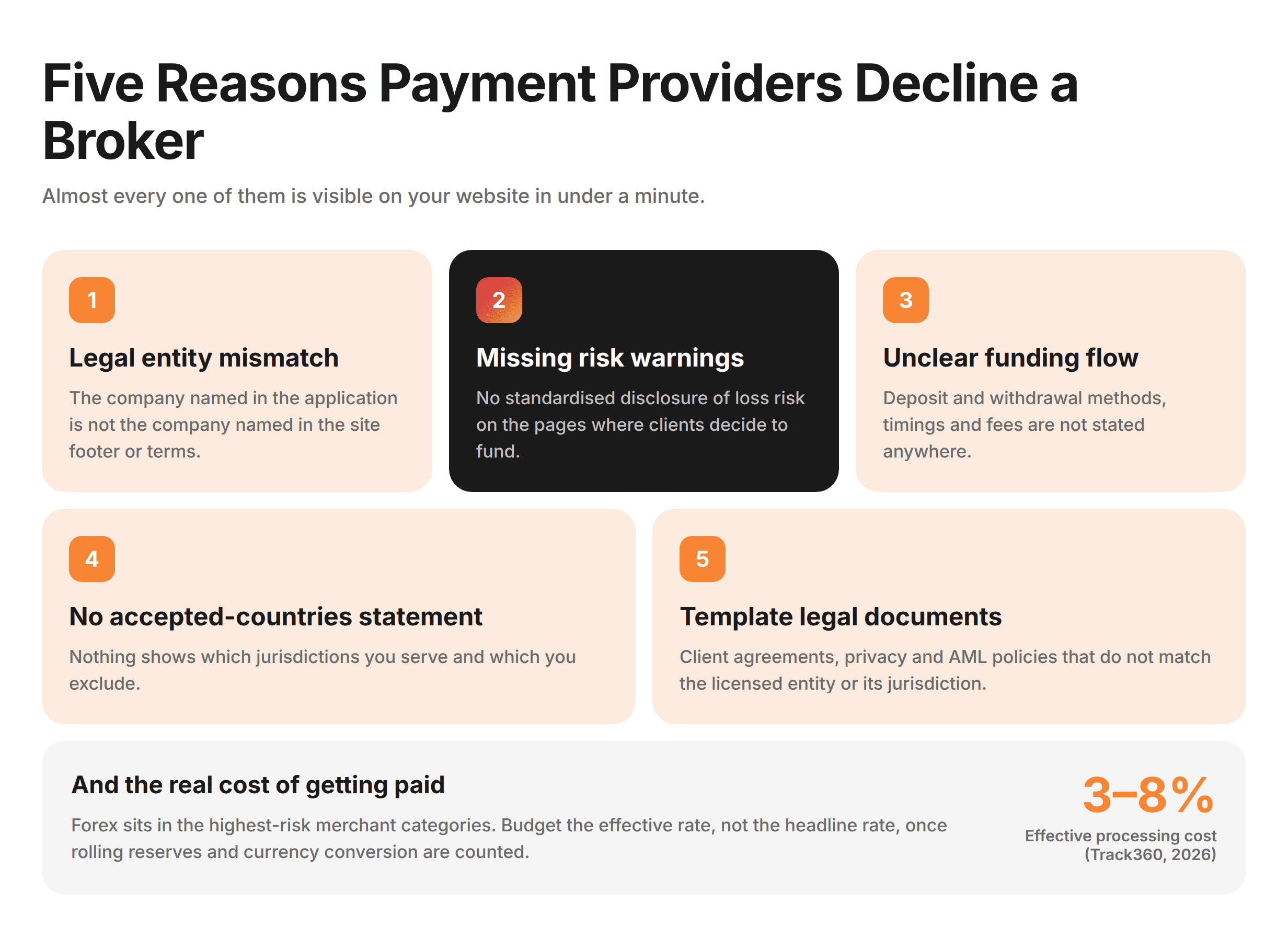
Forex sits in the highest-risk merchant categories. Expect an effective processing cost of 3 to 8 percent once rolling reserves and currency conversion are counted, not the 2 percent headline rate. A rolling reserve means the provider withholds a percentage of your settlements for a fixed period, typically 5 to 10 percent held for six months, as protection against chargebacks.
PSP Onboarding and Why It Gets Declined
Underwriting teams decline broker applications for a short list of reasons, and most of them are visible on your website in under a minute:
Legal entity mismatch: the company named in the application is not the company named in the site footer or terms
Missing risk warnings: no standardised disclosure of loss risk on the pages where clients decide to fund
Unclear funding flow: deposit and withdrawal methods, timings and fees are not stated anywhere
No accepted-countries statement: nothing showing which jurisdictions you serve and which you exclude
Template legal documents: client agreements, privacy and AML policies that do not match the licensed entity or its jurisdiction
In WSA's work on broker launches, the decline almost never comes back as a statement that the business is too risky. It comes back as a question about something the site does not say. Fixing that is a week of work if the site is built for it, and a rebuild if it is not.
Plan for redundancy. One provider is a single point of failure; two or three, with different acquiring banks and a local method for each target market, is the working standard.
CRM, Trader's Room and Back Office
Your CRM and trader's room are the operational spine of the brokerage. The trader's room is the client-facing portal where traders register, complete KYC, deposit, withdraw and open trading accounts. The CRM behind it handles sales pipelines, IB and affiliate tracking, and compliance records.
Configuration takes three to eight weeks and can run entirely in parallel with licensing. Do not leave it until the licence lands. The KYC workflow inside it is exactly what the regulator will ask you to demonstrate.
Get Your Broker Site Through Payment Underwriting
The disclosure set, entity clarity and funding-flow structure that payment providers look for, built into the site from the first draft.
Website and Marketing: Turning Permission Into Funded Clients
The website is where the licence, the platform and the payment rails become a business. It is the only part of your brokerage that regulators, payment providers, introducing brokers and traders all evaluate, which is why it earns a place in the middle of the sequence rather than the end.
What a Licence-Aware Broker Website Must Contain
A compliant broker site carries a defined disclosure layer, not just marketing pages. Under ESMA's product intervention measures, firms selling CFDs to retail clients in the EU face maximum retail exposure of 30:1 on major currency pairs, falling to 2:1 on crypto, mandatory negative balance protection, and a standardised risk warning that has to appear on communications, including the website.
Beyond the disclosure set, the pages that decide whether a visitor funds an account are:
Entity and regulation page: who you are, licence number, registered address
Legal document set: client agreement, risk disclosure, privacy, AML, complaints procedure
Funding page: methods, currencies, minimums, processing times, fees
Instruments and spreads: what you offer and on what terms
Account types: a clear ladder, not five near-identical tiers
Our broker website compliance checklist covers the full page inventory. If you are starting from nothing, the practical build order is in our guide on how to create a broker website.
The First 90 Days of Acquisition
Your first funded clients will come from three channels, and only one of them is fast. Paid media is fastest but gated: Google and Meta both require licence verification for financial services advertising, and an offshore-only licence limits which countries you can target.
Introducing brokers and affiliates are the fastest route for most new brokerages, because IBs bring existing client relationships. They also evaluate you the same way a trader does, by looking at your site. Organic search compounds but takes six to twelve months, which is another argument for building the website early rather than last.
Situation, action, result: a new broker launches with a template site, spends USD 30,000 on paid traffic, and converts at 0.8 percent because visitors cannot find the entity behind the brand or the withdrawal terms. Restructuring the funding path and trust layer moves that toward the 2 percent-plus range typical of a broker website that converts traders. Same budget, roughly double the funded accounts.
Launching in Weeks, Not Quarters
A broker site designed for licence review, payment underwriting and trader conversion, live in three to five weeks. See website build pricing.
Forex Brokerage Startup Costs and Timeline by Phase
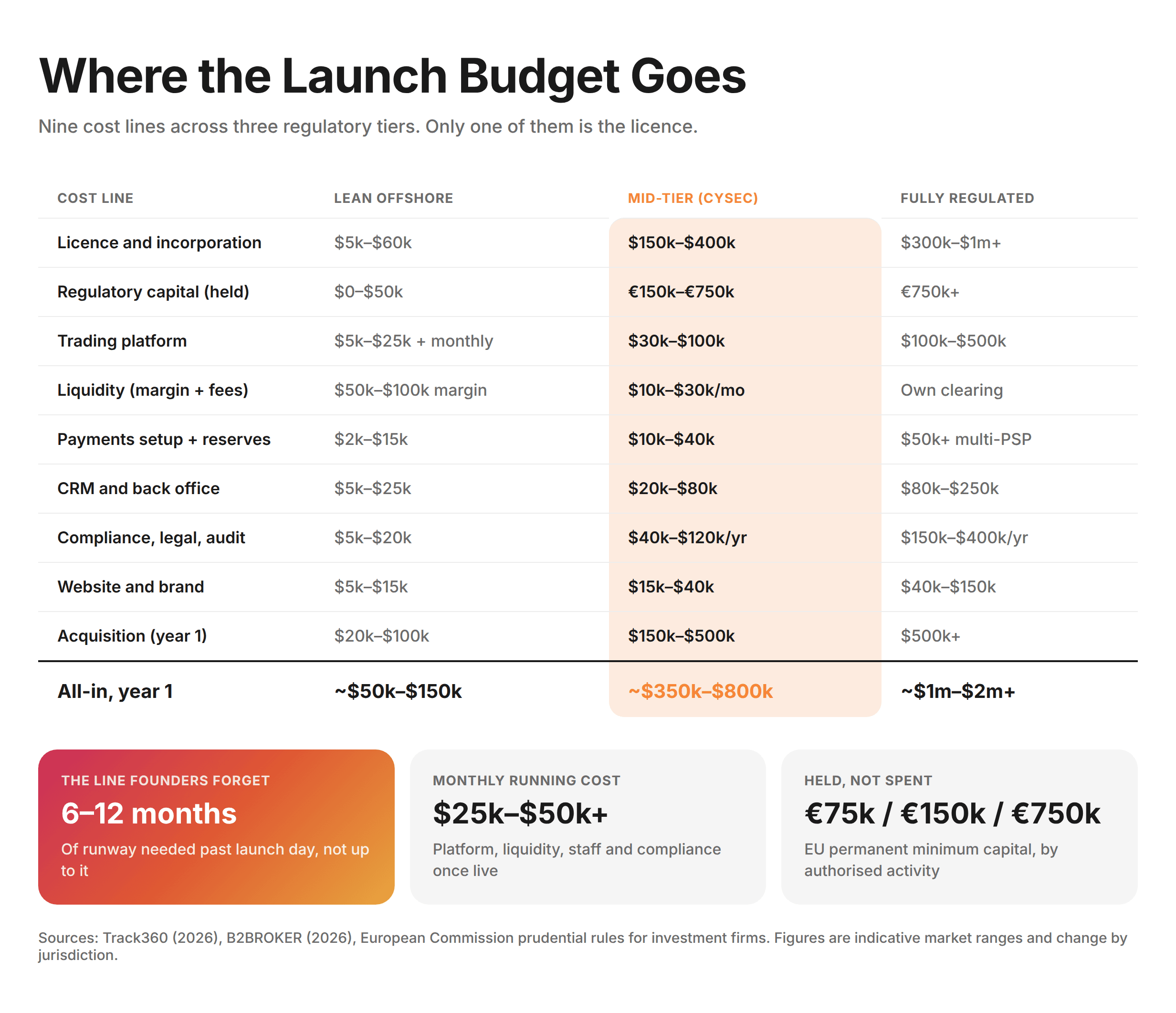
Forex brokerage startup costs fall into nine lines, only one of which is the licence. Year-one totals land near USD 50,000 to USD 150,000 for a lean offshore launch, USD 350,000 to USD 800,000 for a mid-tier CySEC firm, and USD 1 million or more for full Tier-1 regulation.
Cost line | Lean offshore | Mid-tier (CySEC) | Fully regulated |
|---|---|---|---|
Licence and incorporation | USD 5k-60k | USD 150k-400k | USD 300k-1m+ |
Regulatory capital (held) | USD 0-50k | EUR 150k-750k | EUR 750k+ |
Trading platform | USD 5k-25k + monthly | USD 30k-100k | USD 100k-500k |
Liquidity (margin + fees) | USD 50k-100k margin | USD 10k-30k/mo + bridge | Own clearing |
Payments setup + reserves | USD 2k-15k + reserves | USD 10k-40k + reserves | USD 50k+ multi-PSP |
CRM and back office | USD 5k-25k | USD 20k-80k | USD 80k-250k |
Compliance, legal, audit | USD 5k-20k | USD 40k-120k/yr | USD 150k-400k/yr |
Website and brand | USD 5k-15k | USD 15k-40k | USD 40k-150k |
Acquisition (year 1) | USD 20k-100k | USD 150k-500k | USD 500k+ |
All-in, year 1 | ~USD 50k-150k | ~USD 350k-800k | ~USD 1m-2m+ |
The website line is the one most founders under-budget, and it is broken down build type by build type in our guide to brokerage website cost in 2026.
Then the running cost starts. A live brokerage typically absorbs USD 25,000 to USD 50,000 or more per month in platform fees, liquidity, staff and compliance, so a realistic forex broker launch timeline includes six to twelve months of runway past launch day, not up to it.
The takeaway: the licence is rarely the largest line, and never the only one. Founders who budget for the licence and the platform, then discover payments, reserves, margin and runway, are the ones who run out of money in month nine.
How WSA Fits Into the Launch Sequence
WSA builds the website workstream. WSA designs and develops sites for forex brokers, crypto exchanges and fintech firms on Framer, with the compliance page set, entity disclosure and funding structure that licence review and payment underwriting both check for.
That is a deliberately narrow scope. WSA is not a licence consultant, a platform vendor or a liquidity provider, and a launch needs all three. What it does is make sure the one asset every other party inspects is ready when they inspect it, in three to five weeks rather than three to five months. Because WSA works almost exclusively with regulated financial brands, compliance requirements are designed in from the first draft rather than retrofitted after a regulator or an underwriter sends the application back.
Note: nothing in this article is legal or licensing advice. Capital requirements, timelines and permitted activities change, and vary by jurisdiction and by the specific permissions you apply for. Confirm current requirements with the relevant regulator or a licensed adviser before committing capital.
Conclusion
Knowing how to start a forex brokerage is less about the list of tasks than the order you run them in. Entity and licence set the pace; platform, liquidity, payments, CRM, website and marketing determine whether you are earning on approval day or still building. Forex brokerage startup costs follow the same logic: budget the capital you hold separately from the money you spend, and add runway past launch rather than up to it.
The website is the one asset every other party inspects, and the one most founders schedule last.
If you are mapping a launch and want the site ready for licence review and payment underwriting rather than added at the end, talk to WSA.
FAQ
What is the correct order: entity, licence, platform or website?
Entity first, then licence and everything else in parallel. The corporate structure has to exist before you can apply for a licence, sign a liquidity agreement or open a merchant account, so it is genuinely sequential. After that, only the licence application sits on the critical path. Platform selection, payment provider applications, CRM configuration and the website build can all proceed while the regulator reviews your file. The website in particular should start early, because both the regulator and your payment provider will review the live site before approving anything. Founders who treat those tracks as sequential typically add three to five months of burn with no revenue.
How much does it cost to start a forex brokerage?
Year-one costs run roughly USD 50,000 to USD 150,000 for a lean offshore setup, USD 350,000 to USD 800,000 for a mid-tier CySEC launch, and USD 1 million or more for full Tier-1 regulation. Those totals cover licence and incorporation, regulatory capital, platform, liquidity margin, payment setup and reserves, CRM, compliance, website and first-year acquisition spend. Two lines catch founders out. Regulatory capital is money you must hold and maintain on the balance sheet, not money you spend, so it cannot fund operations. And a live brokerage costs USD 25,000 to USD 50,000 or more per month to run, which means you need six to twelve months of runway past launch day on top of the setup budget.
How long does it take from zero to first funded client?
Three to six months for a light-touch jurisdiction with a white label platform, and nine to eighteen months for a CySEC or FCA-class authorisation. The licence is the long pole: Vanuatu and Belize typically take three to six months, Seychelles and Mauritius four to eight, Cyprus nine to fifteen, and the UK FCA twelve to eighteen. Everything else is faster. A white label platform can be live in three to four weeks, a website in three to five, a CRM in three to eight, and payment onboarding in six to sixteen. Run those alongside the application and your first funded client arrives within weeks of approval instead of months after it.
Can I start in a light-touch jurisdiction and migrate later?
Yes, and many brokers do, but plan for the cost of the move rather than treating an upgraded forex broker license as a free one. Starting offshore gets you to revenue faster and cheaper, which funds the eventual mid-tier or Tier-1 application. The constraints are real, though: an offshore licence narrows which payment providers will underwrite you, restricts paid advertising because Google and Meta verify financial services licences by region, and limits the countries you can legally accept clients from. Migration also means a new entity, a new application, new local substance, new capital and, usually, client re-onboarding. If your target market is the UK or EU, applying for the appropriate authorisation from the start is often cheaper than launching offshore and migrating within two years.
Which steps can run in parallel to save months?
Four tracks run fully in parallel with the licence application: trading platform setup, payment provider applications, CRM and trader's room configuration, and the website build. Marketing groundwork such as SEO, content and IB outreach can also start immediately. Only entity formation must complete before the licence application, and liquidity onboarding needs the entity in place before a provider will run due diligence. Sequencing these correctly compresses a typical launch by three to five months. The one dependency to respect: your payment provider applications and, in most cases, your liquidity due diligence both require a live website, so the site needs to exist before those tracks can finish.
Launch Your Licensed Brokerage with Confidence
We support brokers and fintechs through licensing, launch planning, and everything a regulated brand needs to go live.