•
•
Website for Prop Trading Firm: How to Build a Trust-First, High-Converting Site (Step-by-Step)
Your prop firm website isn’t a brochure. It’s the public “source of truth” for your rules, payout model, onboarding flow, and brand credibility—all at once. Traders decide whether to trust you in seconds, and if your rules are buried, inconsistent, or vague, that decision goes against you before a single challenge is purchased.
This guide is for prop firm founders, COOs, marketing leads, and fintech operators who are either launching a funded trader website for the first time—or rebuilding an existing one to improve conversion, reduce support load, and increase trust. Whether you run a single-brand evaluation program or operate multiple white-label prop firm websites, the principles below apply.
Step 1: Define What Your Prop Firm Website Must Actually Do
Before you design a single page, map the funnel your website is responsible for.
A prop firm website typically needs to do several things at once:
Convert qualified traders into challenge purchases or applications
Capture leads for email/SMS nurture (for traders who aren’t ready to buy yet)
Recruit affiliates and partners by communicating your program’s legitimacy and economics
Drive onboarding completion: account creation → payment → portal access → trading credentials
Deflect repetitive support tickets by answering common questions before they become tickets
For most funded trader websites, the funnel looks like this:
Landing Page → Challenge Selection → Rules Confidence → Purchase → Account Creation → Trader Portal + Platform Credentials → KYC (for payout eligibility)
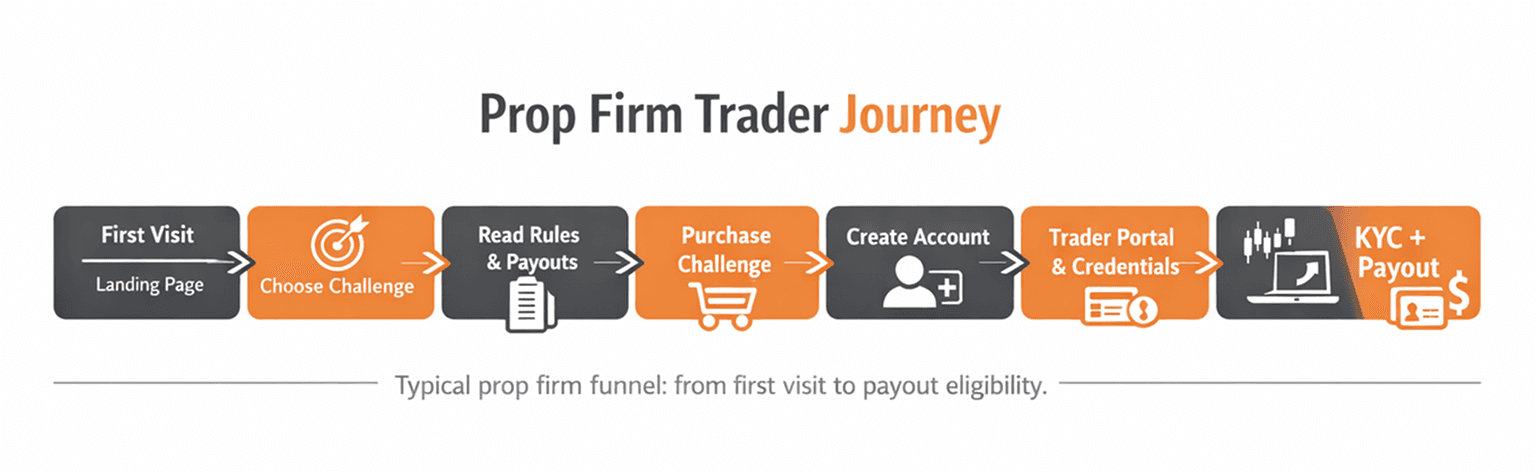
Every page on your site should map to at least one stage of that journey. If a page doesn’t move the user forward or reduce friction, it needs a clearer purpose—or it shouldn’t exist.
Step 2: Plan Your Site Structure — Pages Every Prop Firm Website Needs
A clear site structure increases challenge purchase conversion and reduces misunderstandings around rules, drawdowns, and payouts.
Prop firm website development starts with information architecture. Here’s the page framework we recommend for most evaluation challenge websites:
Page | Primary purpose |
|---|---|
Homepage | Value proposition, trust signals, primary CTA (“Choose Your Challenge”) |
Challenges / Pricing | Tiers, fees, objectives, key rules summary |
Challenge Comparison | Table or selector for quick decision-making |
Rules (Master Rules Page) | Single canonical source for all program rules—linkable by section |
Payout Policy | Schedule, profit split, KYC requirements, accepted methods |
How It Works | Step-by-step walkthrough from purchase to funded status |
Platforms | Supported platforms (MT4/MT5, cTrader, TradeLocker), instruments, hours |
FAQ | Objections + edge cases: news trading, EAs, copy trading, martingale |
Reviews / Social Proof | Trust signals—handled carefully and accurately |
Affiliate / Partner Program | Terms, commission structure, tracking, signup flow |
About / Company | Who’s behind the firm, support channels, business identity |
Legal / Disclosures | Risk disclosure, program terms, privacy policy, cookie policy, refunds |
Support / Help Center | Knowledge base, ticketing, live chat entry points |
Blog / Education | SEO content + program explainers + trader education |
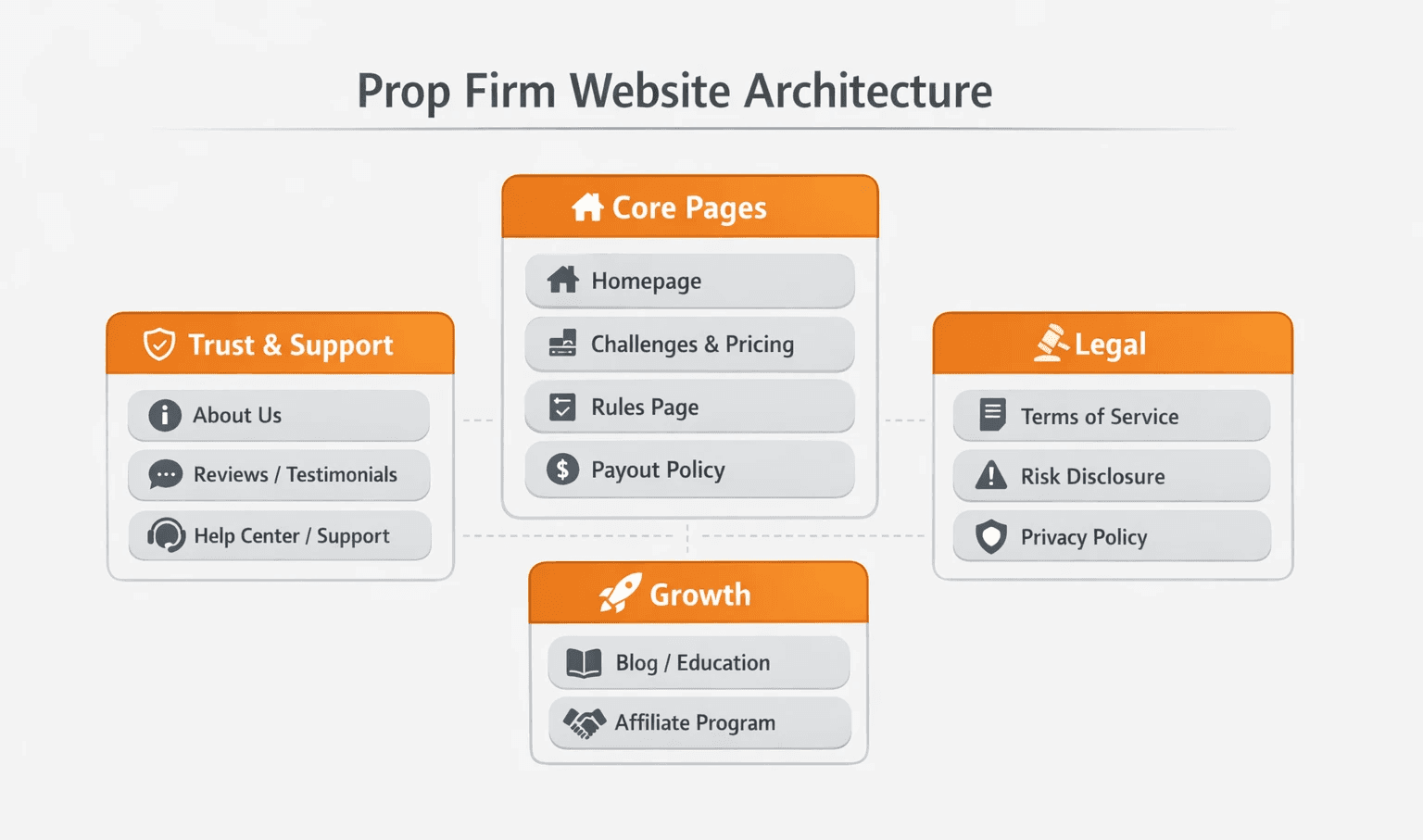
The most overlooked pages are the Master Rules Page and the Payout Policy page. These aren’t “supporting content”—they’re core product pages. If a prop firm challenge page links to vague or incomplete rules, you’re creating a conversion problem and a dispute risk.
Step 3: Write Your Rules, Disclosures, and Program Terms From Day One
Your rules pages are your product specification. If they’re unclear, everything downstream breaks—conversion, support, payouts, and trust.
A prop firm rules page should remove ambiguity on:
Drawdown type: daily vs. overall; trailing vs. static (with calculation examples)
Max loss: how it’s calculated, when it resets (if ever), what triggers a breach
Profit target: what’s required and over what timeframe
Strategy allowances: news trading, EAs, copy trading, martingale, grid strategies—allowed or prohibited (and under what conditions)
Consistency rules: if applicable, show worked examples
Inactivity rules: minimum trading days, consequences of inactivity
Payout conditions: minimum trading days, profit split, payout windows
KYC timing: when verification is required + acceptable documents
Refund policy: whether challenge fees are refundable and under what conditions
Disclosures: clarity is a trust multiplier
Many prop firms run evaluation programs in simulated environments—meaning traders aren’t placing orders in live markets during the challenge/performance phase. That distinction matters operationally and legally.
Apex Trader Funding’s risk disclosure, for example, states explicitly that accounts are simulated and that the firm does not act as a broker or accept deposits into trading accounts. This kind of language shouldn’t be buried in a footer—it should be easy to find anywhere a trader is about to pay.
Your disclosures should clearly communicate:
Evaluation accounts operate in a simulated environment (if applicable)
Your firm is not a broker, dealer, or investment manager (as applicable)
Challenge fees are program fees—not deposits into trading capital
The nature of any funded allocation offered (simulated or live)
This is not legal advice—consult qualified counsel for your jurisdiction. From a website clarity standpoint, transparent, prominent disclosures build credibility. Hiding material information in fine print creates the exact post-purchase confusion that leads to chargebacks and reputational damage.
Consistency check: Before launch, run a cross-page audit. Your Rules page, FAQ, checkout copy, confirmation emails, and Terms of Service should never contradict each other—even slightly.
For a practical framework on credibility cues and messaging consistency, see WSA’s fintech website trust checklist.
Step 4: Design for Trust — UX That Converts and Reduces Support Tickets
Prop firm UX must remove doubt before purchase—especially around rules, payouts, and the legitimacy of the program itself.
In this market, generic design erodes trust. Prop firm website design must do more than “look premium”—it should answer objections before a trader feels the need to ask.
If you want a deeper breakdown of how trust is formed quickly through interface decisions, read Fintech website design: how UI/UX builds trust in seconds.
Trust-first UX patterns for prop firms
Above-the-fold clarity: Your hero section should clearly communicate what is being purchased—access to an evaluation program—not a promise of profit. Vague claims like “Trade with our capital” without explaining the challenge structure create confusion and attract the wrong audience.
Rules summary cards on challenge pages: Each challenge tier should include a condensed summary (drawdown, target, time limit, key restrictions) with a prominent link to the full Master Rules page. Don’t make traders hunt for fundamentals.
Challenge selector or wizard: A simple selector (account size → risk tolerance → budget) reduces decision paralysis and helps traders self-qualify. This is high-leverage UX for funded trader websites with multiple tiers.
Transparent trust signals: Show your company identity, real support channels, and response expectations. Third-party reviews should be accurate and current—not cherry-picked screenshots. Real support availability (chat, ticketing, email + response time) signals legitimacy more than hype copy.
Mobile-first checkout: A large share of challenge purchases happen on mobile. Your checkout—from plan selection to payment confirmation—must be tested end-to-end on multiple devices. A friction-heavy mobile flow is a direct conversion leak.
Support-deflection UX: Build a searchable FAQ, a “top 10 misunderstandings” section, and a glossary (trailing drawdown, consistency rule, simulated account). If your goal is to reduce support tickets, the website is your first line of defense.
A clean, specific UX consistently outperforms hype. Traders have seen bold claims. What they respond to is clarity, specificity, and evidence you’ve thought through their experience.
Step 5: Choose the Right Platform and Architecture
The right technical setup separates your marketing site from your trader portal while keeping branding, tracking, and UX consistent.
Building a prop firm website usually involves two layers:
Layer 1: Marketing website (CMS + conversion)
This is your public-facing site: homepage, challenges, rules, FAQ, blog, and legal pages. For modern prop firm website design, Webflow and Framer are both strong options:
Webflow is typically better for heavier CMS needs, multilingual structures, and teams that want strong editorial control.
Framer is ideal for design-led teams that move fast and care about interaction and animation quality.
Both platforms make it easier to update rules, pricing, and content without a developer—important in an industry where program terms evolve.
If you’re considering AI-assisted site generation for speed, treat it as a tool—not a strategy. Here’s a practical decision framework: How to create a website with AI in 2026 (and when it’s a bad idea).
Layer 2: Trader portal / back office
This is your operational layer: dashboards, progress tracking, credentials, payout requests, and KYC. It’s usually handled by a prop-tech platform or a custom app. Your marketing site should connect cleanly via SSO-style links, consistent UI language, and event tracking that shows where traders drop off between purchase and activation.
A note on platform risk: The prop trading industry has seen periods of operational instability with platform access and provider continuity. Finance Magnates has documented examples of firms needing to communicate platform changes quickly. Structure your website so platform-specific pages can be updated fast—without a redesign.
Step 6: Integrations to Plan Before Design Starts
Integrations define the real trader journey—from first click through purchase, onboarding, and payout. Plan them at the start, not after launch.
Here’s the integration checklist we recommend for prop firm website development:
Payments
Stripe or alternative processors (based on geography and merchant category)
Checkout tracking (plan selected, checkout started, payment success/fail)
CRM + email automation
HubSpot, Klaviyo, or Mailchimp for lead capture and onboarding sequences
Welcome email → portal access guide → first trading day checklist → payout eligibility reminders
Analytics
GA4 + Google Tag Manager (GTM)
Custom events: challenge selected, rules viewed, checkout started, purchase completed, account created
Without clean tracking, you can’t optimize what you can’t see
If you want a fintech-specific CRO lens (especially around onboarding and KYC drop-off), see Fintech conversion optimization: CRO framework for financial brands.
Support
Intercom or Crisp for live chat
Zendesk or Freshdesk for ticketing + help center
A knowledge base that mirrors your rules and payout structure
KYC (for payouts)
Sumsub, Veriff, or equivalent
KYC should be explained on the payout policy page before traders reach payout (surprises here create disputes)
Affiliate tracking
FirstPromoter, TUNE, or your platform’s native affiliate module
Document commission structure, cookie duration, and payout terms on the affiliate page
Infrastructure
CDN, backups, role-based admin access control
Basic security hardening and monitoring
Step 7: SEO and Content Strategy for Prop Firms
SEO for a prop firm website isn’t “just blog posts.” It starts with how you structure challenges, rules, FAQs, and how-it-works content.
Technical + structural SEO essentials
Clean URL slugs:
/challenges,/rules,/payout-policy,/how-it-worksFAQ schema markup where appropriate
Strong internal linking between challenge pages, rules, and payout policy
Fast load times (especially on checkout and pricing pages)
Website speed is also a trust factor. If you’re building for performance, this is worth reading: Core Web Vitals for fintech: how speed impacts trust & conversions.
Content that attracts qualified traders
High-intent content tends to explain concepts traders search before buying:
“How do prop firm challenges work?”
“What is trailing drawdown?” (with numerical examples)
“Common rule violations and how to avoid them”
“How payouts work (step-by-step)”
These pages do double duty: they bring organic traffic and reduce support tickets by answering questions pre-purchase.
GEO / AI search tip
Open key sections with a short, direct definition before going deeper. AI-powered search tools often surface those “first two sentences” as direct answers—especially for terms like trailing drawdown, max daily loss, and payout rules.
DIY Templates vs. Professional Prop Firm Website Design
Templates can get you live fast, but prop firms compete on trust. Generic design can quietly drain conversion and credibility.
When DIY makes sense
You have a simple, stable challenge offer with limited tiers
You have strong in-house copy + information architecture skills
You have time (and discipline) to test and iterate
When a specialist build makes sense
You need a brand that doesn’t look cloned (differentiation is a conversion factor)
Your rules/payout model needs careful information design to prevent misunderstandings
You want conversion optimization built in—not bolted on later
You need analytics + integrations architected properly from day one
Speed-to-market matters and you can’t afford a messy handover
For a broader fintech perspective on this tradeoff, see Custom fintech website vs template solution.
Common Mistakes Prop Firms Make With Their Websites
These are the issues we see most often—and the ones that become expensive after launch:
Rules scattered across multiple pages with no single authoritative source
Payout conditions and KYC requirements buried until after purchase
Overhyped marketing language instead of clear mechanics and expectations
Weak mobile checkout UX (a direct conversion leak)
No event tracking (you’re flying blind)
Treating the website as static in a business where terms evolve
Buried disclosures about simulated environments and program structure
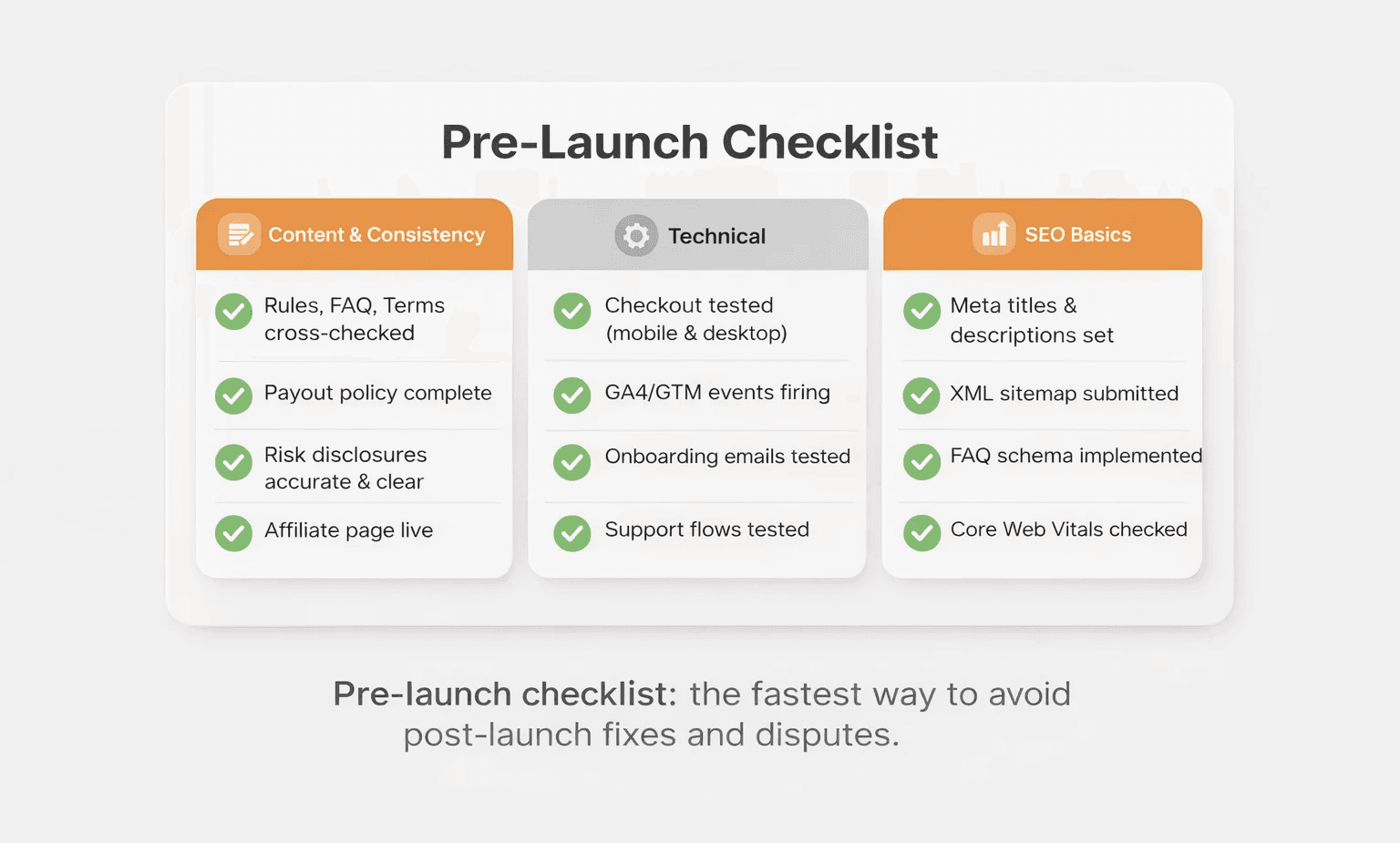
Pre-Launch Checklist: What to Verify Before Going Live
Run this before you publish:
Content + consistency
Rules, FAQ, Terms, and checkout copy cross-referenced for contradictions
Payout policy complete (schedule, split, KYC requirements, accepted methods)
Risk disclosures prominent and accurate
Affiliate page live with clear terms and tracking instructions
Technical
Checkout tested on mobile + desktop (multiple devices/browsers)
GA4/GTM events firing (challenge select, rules click, checkout start, purchase, account created)
Email onboarding sequences tested end-to-end
Support flows tested (chat + ticketing + help center)
SSL active, CDN configured, backups scheduled, admin access restricted
SEO basics
Titles + meta descriptions set for core pages
XML sitemap submitted in Google Search Console
FAQ schema implemented (where relevant)
Internal linking between challenges → rules → payouts verified
Core Web Vitals checked
If you’re aiming to launch quickly without sacrificing conversion fundamentals, this is a useful benchmark: Startup launch: high-conversion website in days (not months).
Next Steps: Build a Prop Firm Website That Looks Legit — Because It Is
A well-built website for a prop trading firm is not a marketing expense—it’s operational infrastructure. It’s where traders decide if your program is worth the fee, where confused users either find answers or file chargebacks, and where your reputation is built (or eroded) one visit at a time.
WSA works with prop firms, funded trader programs, and fintech operators to build websites that are structurally sound, conversion-ready, and built to evolve with your program. That means scoping the funnel first, designing for trust-first UX, building on a maintainable platform, and wiring analytics and integrations correctly before launch.
FAQ
How long does it take to build a website for a prop trading firm?
It depends on scope. A focused landing page or single-challenge site can often launch in 2–3 weeks. A full multi-page prop firm website—challenges, rules architecture, payout policy, FAQ, affiliate page, blog, and integrations—typically takes 4–8 weeks on modern platforms like Webflow or Framer. Complex integrations (KYC, affiliate tooling, custom tracking) can extend timelines.
What pages should a prop firm website include?
At minimum: Challenges/Pricing, Master Rules, Payout Policy, How It Works, FAQ, Legal/Disclosures, Support/Help Center entry point, About/Company, and Contact. As you scale, add a Challenge Comparison tool, Affiliate Program page, and a Blog/Education hub.
What should a prop firm risk disclosure include?
Your disclosure should clearly state whether evaluation accounts operate in a simulated environment, clarify that your firm is not acting as a broker/dealer (as applicable), explain that challenge fees are program fees (not deposits into trading capital), and outline key risks. For specific legal language, consult qualified counsel in your jurisdiction. The website principle is simple: make it prominent, not hidden.
What platform is best for a prop firm website — Webflow or Framer?
Both work well. Webflow is typically better for robust CMS needs, multilingual builds, and teams that want strong content governance. Framer is often better for design-led teams that prioritize fast iteration and interactions. Either choice can support a modern, SEO-ready prop firm website—provided your rules and funnel are structured properly.
Should the trader portal be part of the website or separate?
Almost always separate systems—but they should feel seamless. The marketing site handles public content and challenge sales; the portal handles dashboards, progress, credentials, and payouts. The handoff should be clean (SSO-style links, consistent branding, and tracked events so you can see where drop-off happens).
How much does a professional prop firm website cost?
Costs vary by scope. A focused landing page with a single offer may start in the low thousands. A full multi-page prop firm website with rules architecture, blog, affiliate program, and integration setup commonly ranges from $8,000 to $25,000+, depending on content volume and complexity. If you want a scoped estimate, WSA’s discovery call is the fastest way to map requirements.
How can a prop firm website reduce support tickets?
Start with rules clarity. A single canonical rules page with linkable sections, rules summary cards on challenge pages, an FAQ that covers edge cases (news trading, EAs, consistency, drawdown calculations), and a payout policy page that explains KYC before payout are the highest-leverage changes. Second: keep language consistent across rules, checkout, confirmation emails, and terms—contradictions are a major driver of support volume.
Launch Your Licensed Brokerage with Confidence
We support brokers and fintechs through licensing, launch planning, and everything a regulated brand needs to go live.